
Physics 102 Lecture 05 Circuits and Ohms Law
- Slides: 22
Physics 102: Lecture 05 Circuits and Ohm’s Law Physics 102: Lecture 5, Slide 1
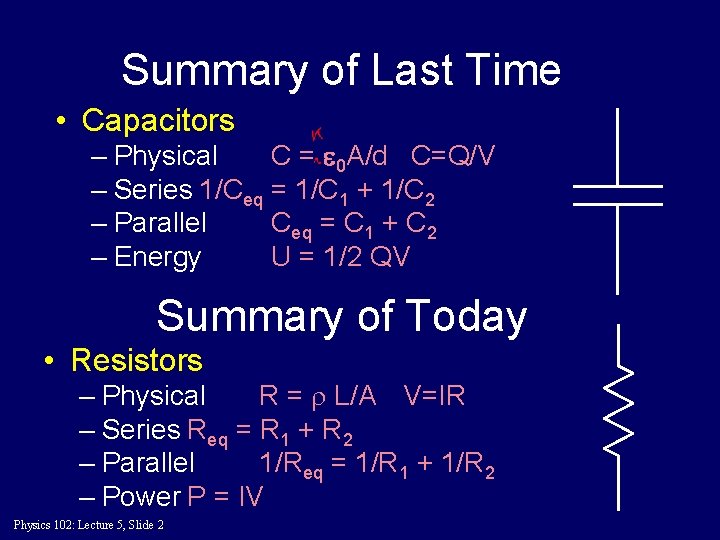
Summary of Last Time • Capacitors – Physical C = e 0 A/d C=Q/V – Series 1/Ceq = 1/C 1 + 1/C 2 – Parallel Ceq = C 1 + C 2 – Energy U = 1/2 QV Summary of Today • Resistors – Physical R = r L/A V=IR – Series Req = R 1 + R 2 – Parallel 1/Req = 1/R 1 + 1/R 2 – Power P = IV Physics 102: Lecture 5, Slide 2
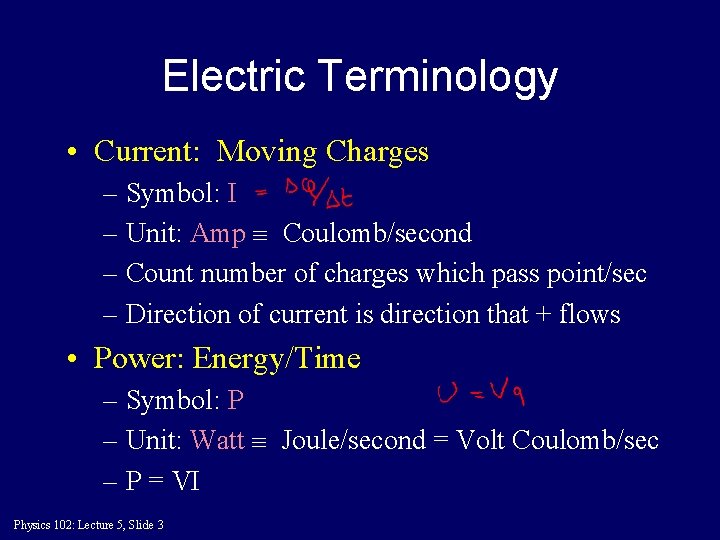
Electric Terminology • Current: Moving Charges – Symbol: I – Unit: Amp Coulomb/second – Count number of charges which pass point/sec – Direction of current is direction that + flows • Power: Energy/Time – Symbol: P – Unit: Watt Joule/second = Volt Coulomb/sec – P = VI Physics 102: Lecture 5, Slide 3
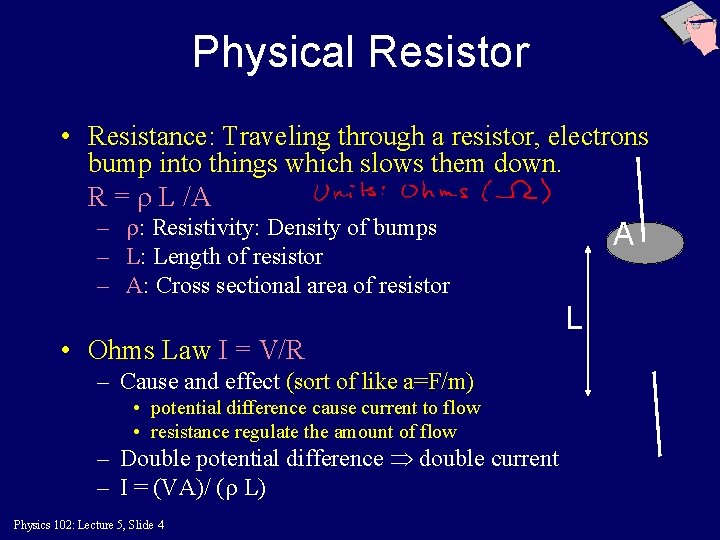
Physical Resistor • Resistance: Traveling through a resistor, electrons bump into things which slows them down. R = r L /A – r: Resistivity: Density of bumps – L: Length of resistor – A: Cross sectional area of resistor • Ohms Law I = V/R – Cause and effect (sort of like a=F/m) • potential difference cause current to flow • resistance regulate the amount of flow – Double potential difference double current – I = (VA)/ (r L) Physics 102: Lecture 5, Slide 4 A L
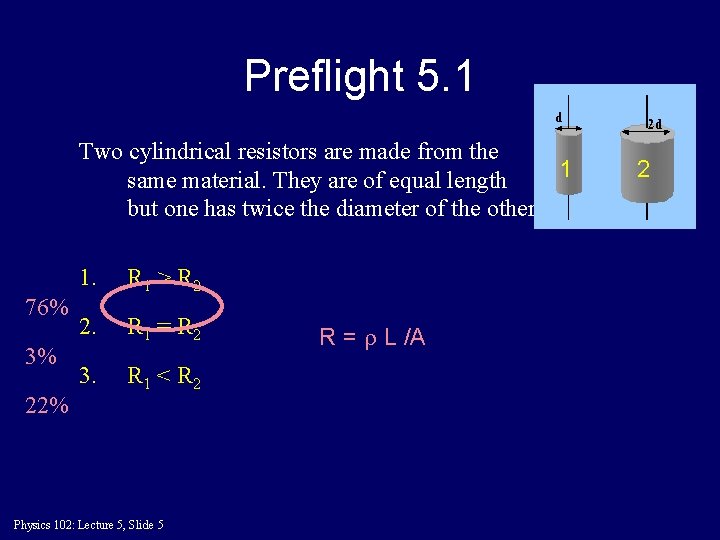
Preflight 5. 1 Two cylindrical resistors are made from the 1 same material. They are of equal length but one has twice the diameter of the other. 76% 3% 22% 1. R 1 > R 2 2. R 1 = R 2 3. R 1 < R 2 Physics 102: Lecture 5, Slide 5 R = r L /A 2
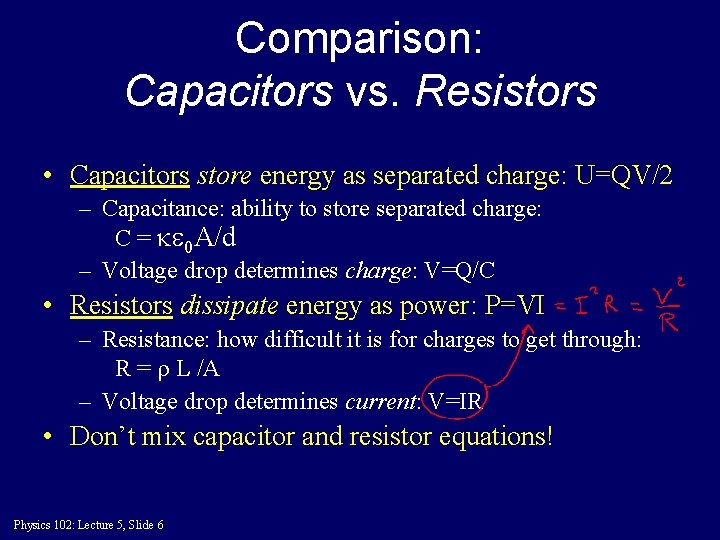
Comparison: Capacitors vs. Resistors • Capacitors store energy as separated charge: U=QV/2 – Capacitance: ability to store separated charge: C = ke 0 A/d – Voltage drop determines charge: V=Q/C • Resistors dissipate energy as power: P=VI – Resistance: how difficult it is for charges to get through: R = r L /A – Voltage drop determines current: V=IR • Don’t mix capacitor and resistor equations! Physics 102: Lecture 5, Slide 6
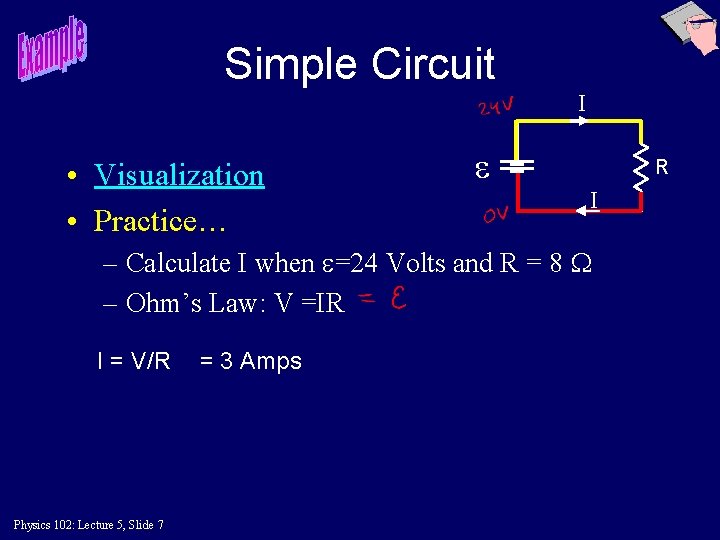
Simple Circuit I • Visualization • Practice… e R I – Calculate I when e=24 Volts and R = 8 W – Ohm’s Law: V =IR I = V/R Physics 102: Lecture 5, Slide 7 = 3 Amps
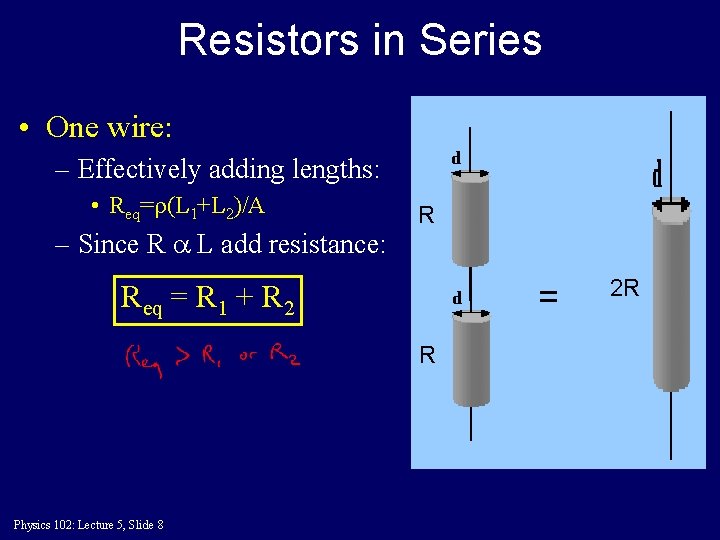
Resistors in Series • One wire: – Effectively adding lengths: • Req=r(L 1+L 2)/A – Since R a L add resistance: R = Req = R 1 + R 2 R Physics 102: Lecture 5, Slide 8 2 R
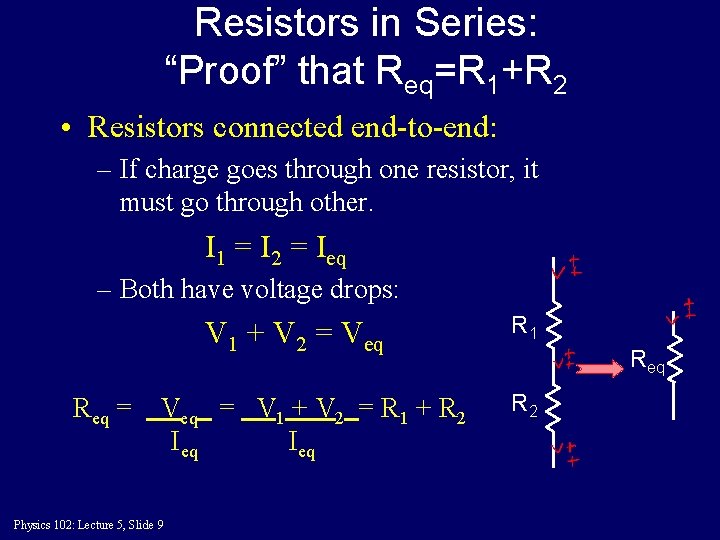
Resistors in Series: “Proof” that Req=R 1+R 2 • Resistors connected end-to-end: – If charge goes through one resistor, it must go through other. I 1 = I 2 = Ieq – Both have voltage drops: V 1 + V 2 = Veq Req = V 1 + V 2 = R 1 + R 2 Ieq Physics 102: Lecture 5, Slide 9 R 1 Req R 2
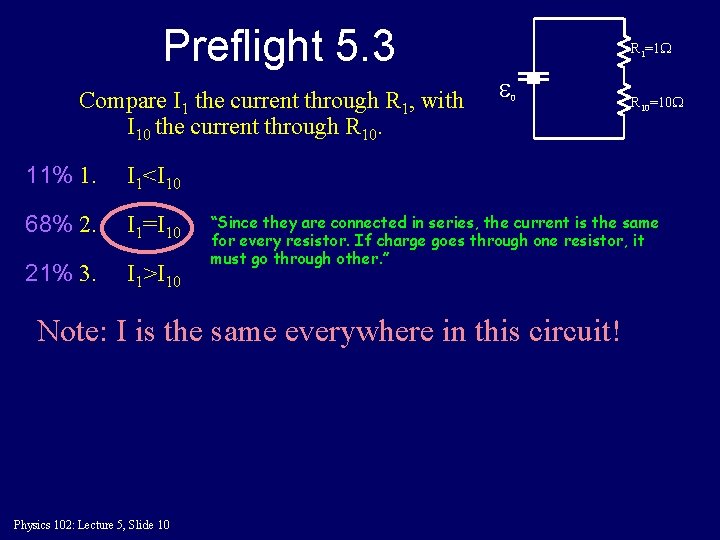
Preflight 5. 3 Compare I 1 the current through R 1, with I 10 the current through R 10. 11% 1. I 1<I 10 68% 2. I 1=I 10 21% 3. I 1>I 10 R 1=1 W e 0 “Since they are connected in series, the current is the same for every resistor. If charge goes through one resistor, it must go through other. ” Note: I is the same everywhere in this circuit! Physics 102: Lecture 5, Slide 10 R 10=10 W
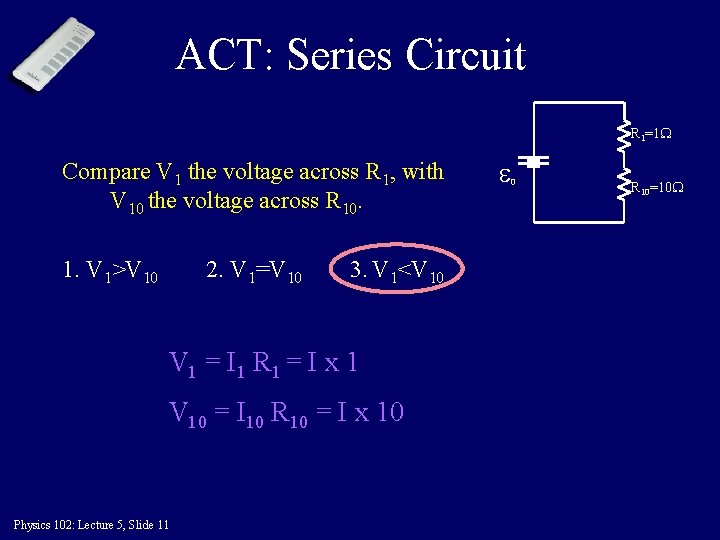
ACT: Series Circuit R 1=1 W Compare V 1 the voltage across R 1, with V 10 the voltage across R 10. 1. V 1>V 10 2. V 1=V 10 3. V 1<V 10 V 1 = I 1 R 1 = I x 1 V 10 = I 10 R 10 = I x 10 Physics 102: Lecture 5, Slide 11 e 0 R 10=10 W
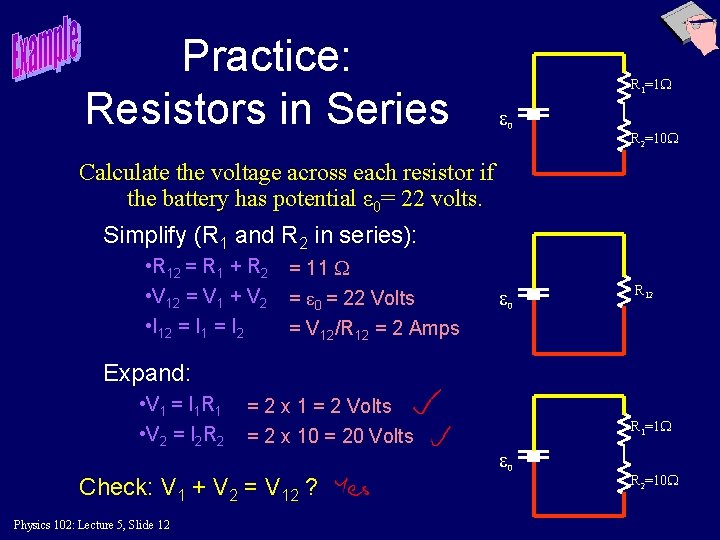
Practice: Resistors in Series R 1=1 W e 0 R 2=10 W Calculate the voltage across each resistor if the battery has potential ε 0= 22 volts. Simplify (R 1 and R 2 in series): • R 12 = R 1 + R 2 = 11 W • V 12 = V 1 + V 2 = ε 0 = 22 Volts • I 12 = I 1 = I 2 = V 12/R 12 = 2 Amps e 0 R 12 Expand: • V 1 = I 1 R 1 • V 2 = I 2 R 2 = 2 x 1 = 2 Volts = 2 x 10 = 20 Volts Check: V 1 + V 2 = V 12 ? Physics 102: Lecture 5, Slide 12 R 1=1 W e 0 R 2=10 W
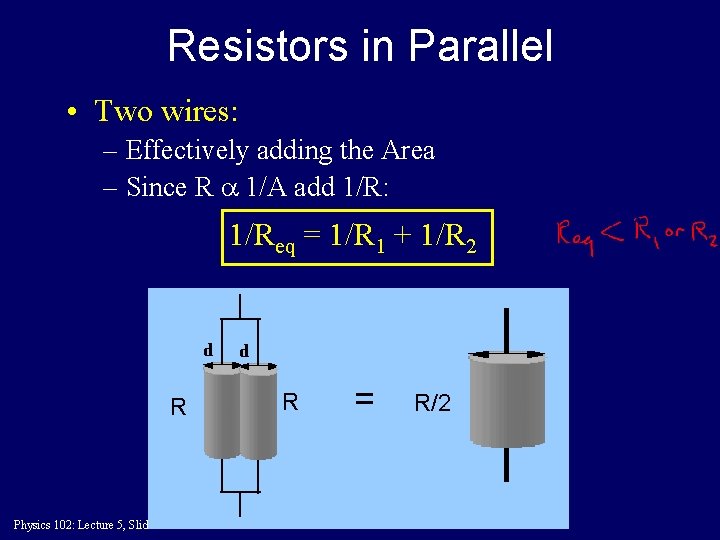
Resistors in Parallel • Two wires: – Effectively adding the Area – Since R a 1/A add 1/R: 1/Req = 1/R 1 + 1/R 2 R Physics 102: Lecture 5, Slide 13 R = R/2
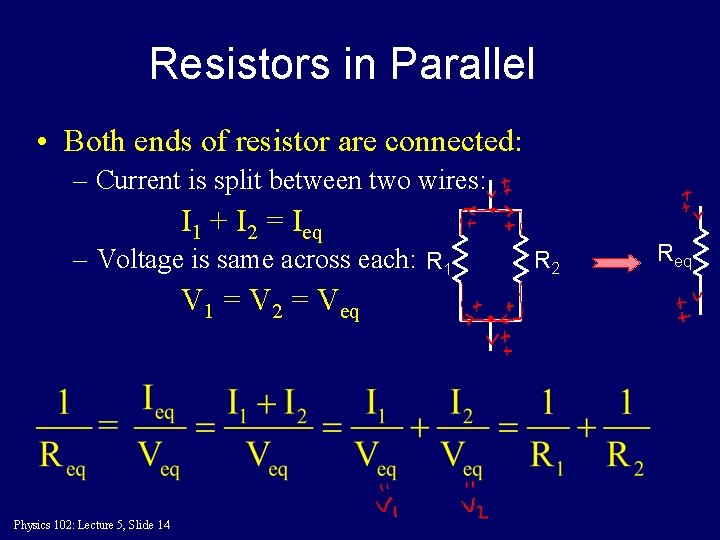
Resistors in Parallel • Both ends of resistor are connected: – Current is split between two wires: I 1 + I 2 = Ieq – Voltage is same across each: R 1 V 1 = V 2 = Veq Physics 102: Lecture 5, Slide 14 R 2 Req
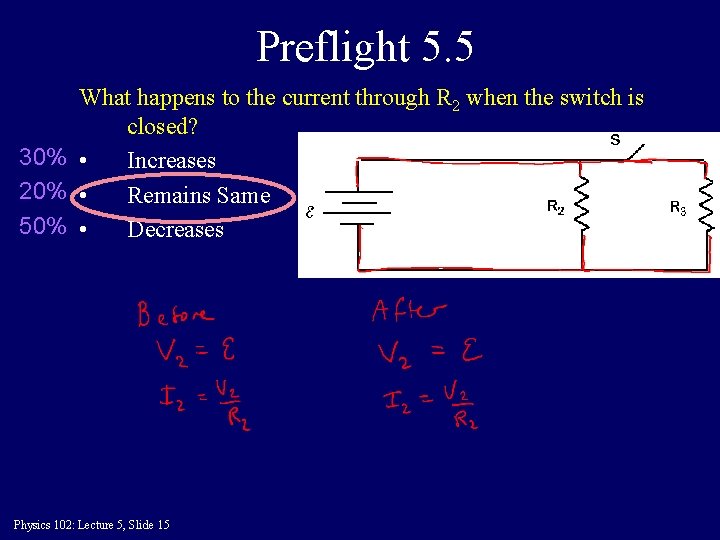
Preflight 5. 5 What happens to the current through R 2 when the switch is closed? 30% • Increases 20% • Remains Same 50% • Decreases Physics 102: Lecture 5, Slide 15
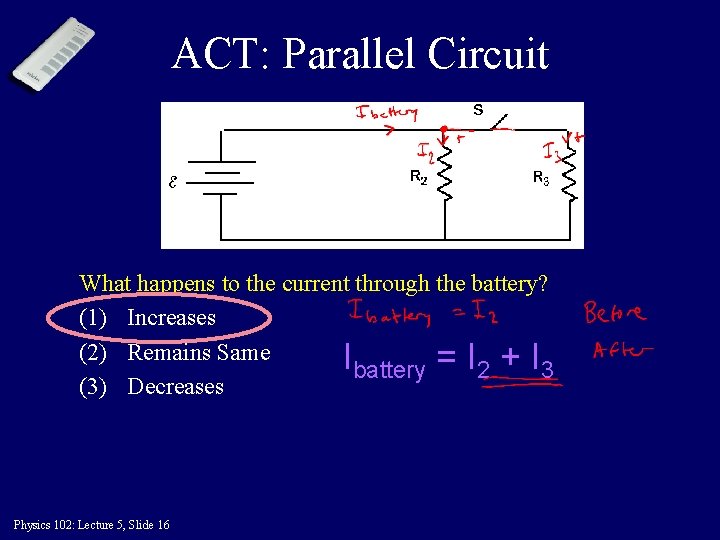
ACT: Parallel Circuit What happens to the current through the battery? (1) Increases (2) Remains Same Ibattery = I 2 + I 3 (3) Decreases Physics 102: Lecture 5, Slide 16
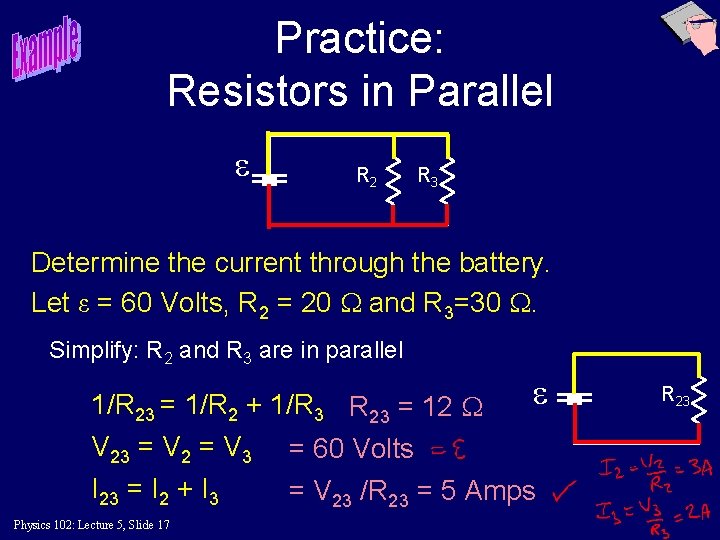
Practice: Resistors in Parallel e R 2 R 3 Determine the current through the battery. Let ε = 60 Volts, R 2 = 20 W and R 3=30 W. Simplify: R 2 and R 3 are in parallel e 1/R 23 = 1/R 2 + 1/R 3 R 23 = 12 W V 23 = V 2 = V 3 = 60 Volts I 23 = I 2 + I 3 = V 23 /R 23 = 5 Amps Physics 102: Lecture 5, Slide 17 R 23
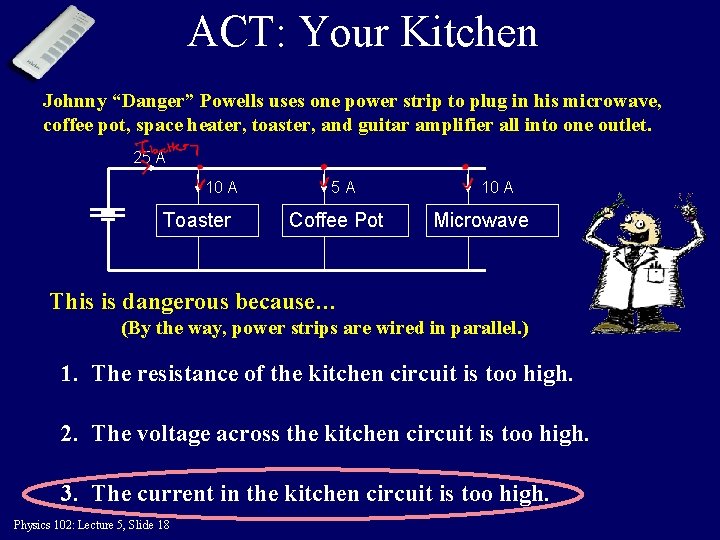
ACT: Your Kitchen Johnny “Danger” Powells uses one power strip to plug in his microwave, coffee pot, space heater, toaster, and guitar amplifier all into one outlet. 25 A 10 A Toaster 5 A Coffee Pot 10 A Microwave This is dangerous because… (By the way, power strips are wired in parallel. ) 1. The resistance of the kitchen circuit is too high. 2. The voltage across the kitchen circuit is too high. 3. The current in the kitchen circuit is too high. Physics 102: Lecture 5, Slide 18
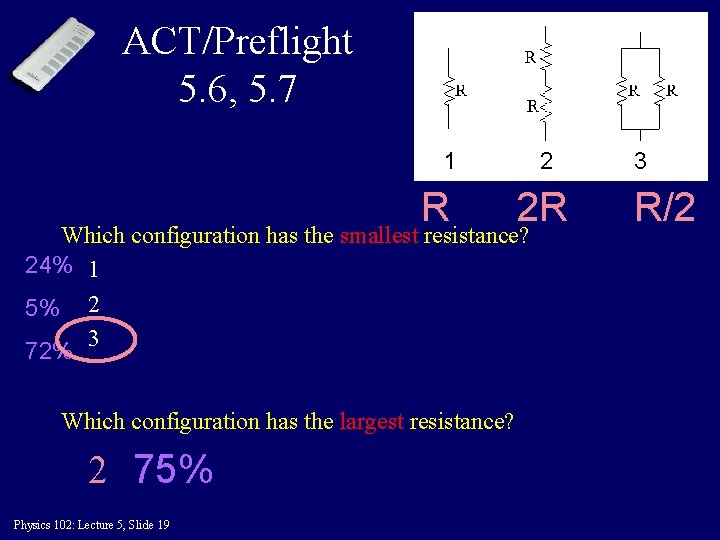
ACT/Preflight 5. 6, 5. 7 1 R 2 2 R Which configuration has the smallest resistance? 24% 1 5% 2 3 72% Which configuration has the largest resistance? 2 75% Physics 102: Lecture 5, Slide 19 3 R/2
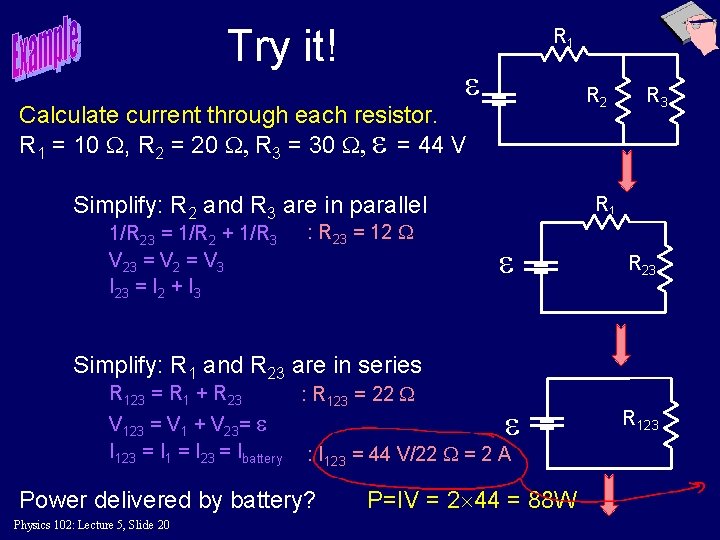
Try it! R 1 e R 2 Calculate current through each resistor. R 1 = 10 W, R 2 = 20 W, R 3 = 30 W, e = 44 V Simplify: R 2 and R 3 are in parallel 1/R 23 = 1/R 2 + 1/R 3 V 23 = V 2 = V 3 I 23 = I 2 + I 3 : R 23 = 12 W R 3 R 1 e R 23 e R 123 Simplify: R 1 and R 23 are in series R 123 = R 1 + R 23 V 123 = V 1 + V 23= e I 123 = I 1 = I 23 = Ibattery : R 123 = 22 W : I 123 = 44 V/22 W = 2 A Power delivered by battery? Physics 102: Lecture 5, Slide 20 P=IV = 2 44 = 88 W
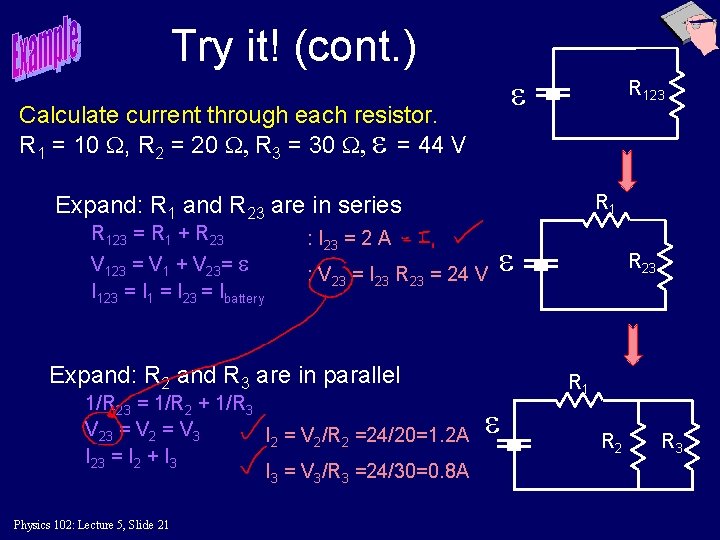
Try it! (cont. ) e Calculate current through each resistor. R 1 = 10 W, R 2 = 20 W, R 3 = 30 W, e = 44 V R 123 R 1 Expand: R 1 and R 23 are in series R 123 = R 1 + R 23 V 123 = V 1 + V 23= e I 123 = I 1 = I 23 = Ibattery : I 23 = 2 A : V 23 = I 23 R 23 = 24 V e Expand: R 2 and R 3 are in parallel 1/R 23 = 1/R 2 + 1/R 3 V 23 = V 2 = V 3 I 2 = V 2/R 2 =24/20=1. 2 A I 23 = I 2 + I 3 = V 3/R 3 =24/30=0. 8 A Physics 102: Lecture 5, Slide 21 e R 23 R 1 R 2 R 3
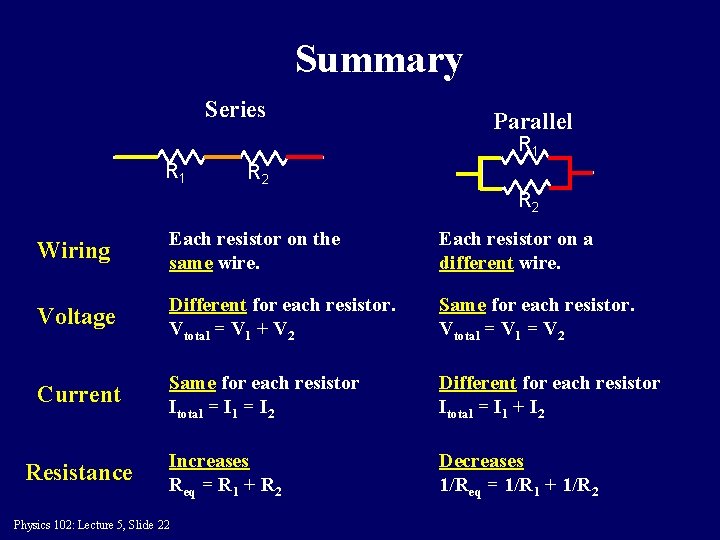
Summary Series Parallel R 1 R 2 Wiring Each resistor on the same wire. Each resistor on a different wire. Voltage Different for each resistor. Vtotal = V 1 + V 2 Same for each resistor. Vtotal = V 1 = V 2 Current Same for each resistor Itotal = I 1 = I 2 Different for each resistor Itotal = I 1 + I 2 Increases Req = R 1 + R 2 Decreases 1/Req = 1/R 1 + 1/R 2 Resistance Physics 102: Lecture 5, Slide 22