
Physics 101 Lecture 19 Elasticity and Oscillations Physics



![Simple Harmonic Motion: x(t) = [A]cos( t) v(t) = -[A ]sin( t) a(t) =](https://slidetodoc.com/presentation_image/26363d902caf35d5606da7c8f971aea6/image-16.jpg "Simple Harmonic Motion: x(t) = [A]cos( t) v(t) = -[A ]sin( t) a(t) =")

- Slides: 21
Physics 101: Lecture 19 Elasticity and Oscillations Physics 101: Lecture 19, Pg 1
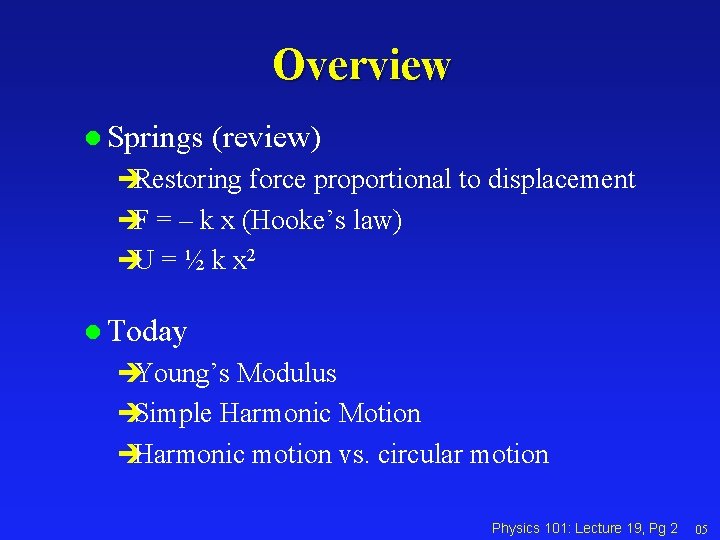
Overview l Springs (review) èRestoring force proportional to displacement èF = – k x (Hooke’s law) èU = ½ k x 2 l Today èYoung’s Modulus èSimple Harmonic Motion èHarmonic motion vs. circular motion Physics 101: Lecture 19, Pg 2 05
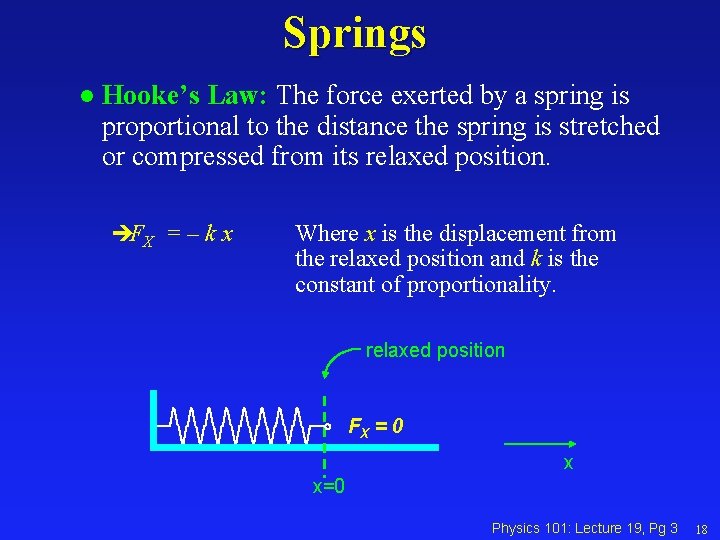
Springs l Hooke’s Law: The force exerted by a spring is proportional to the distance the spring is stretched or compressed from its relaxed position. èFX = – k x Where x is the displacement from the relaxed position and k is the constant of proportionality. relaxed position FX = 0 x x=0 Physics 101: Lecture 19, Pg 3 18
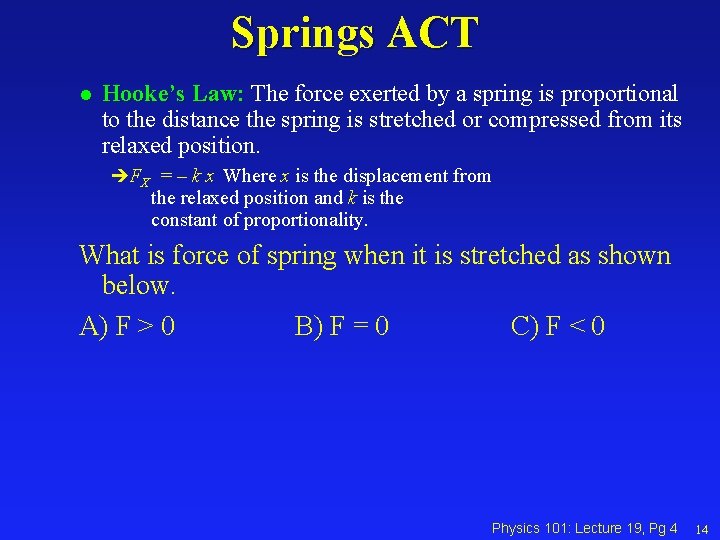
Springs ACT l Hooke’s Law: The force exerted by a spring is proportional to the distance the spring is stretched or compressed from its relaxed position. èFX = – k x Where x is the displacement from the relaxed position and k is the constant of proportionality. What is force of spring when it is stretched as shown below. A) F > 0 B) F = 0 C) F < 0 Physics 101: Lecture 19, Pg 4 14
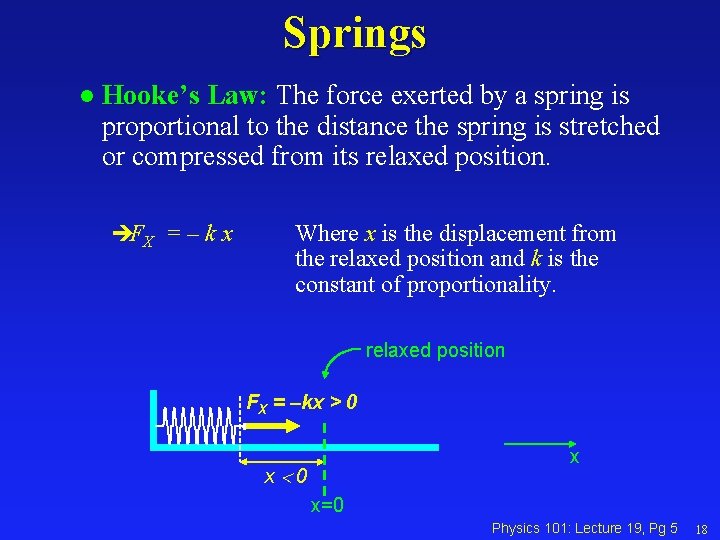
Springs l Hooke’s Law: The force exerted by a spring is proportional to the distance the spring is stretched or compressed from its relaxed position. èFX = – k x Where x is the displacement from the relaxed position and k is the constant of proportionality. relaxed position FX = –kx > 0 x x 0 x=0 Physics 101: Lecture 19, Pg 5 18
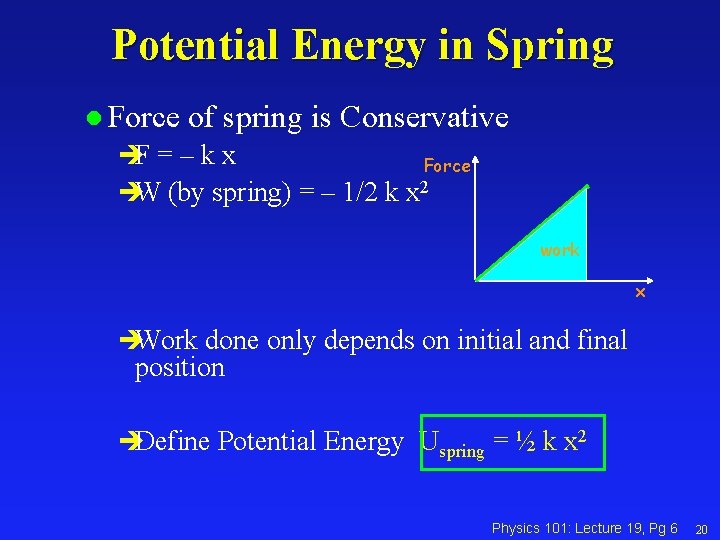
Potential Energy in Spring l Force of spring is Conservative èF = – k x Force èW (by spring) = – 1/2 k x 2 work x èWork done only depends on initial and final position èDefine Potential Energy Uspring = ½ k x 2 Physics 101: Lecture 19, Pg 6 20
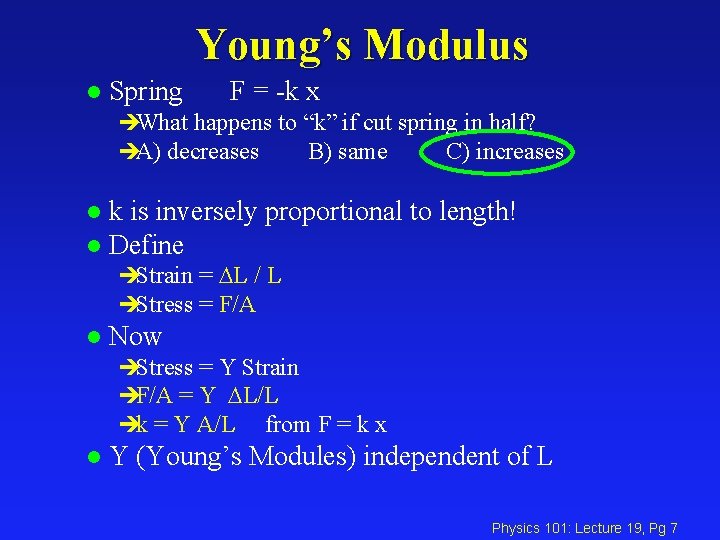
Young’s Modulus l Spring F = -k x èWhat happens to “k” if cut spring in half? èA) decreases B) same C) increases k is inversely proportional to length! l Define l èStrain = DL / L èStress = F/A l Now èStress = Y Strain èF/A = Y DL/L èk = Y A/L from F = k x l Y (Young’s Modules) independent of L Physics 101: Lecture 19, Pg 7
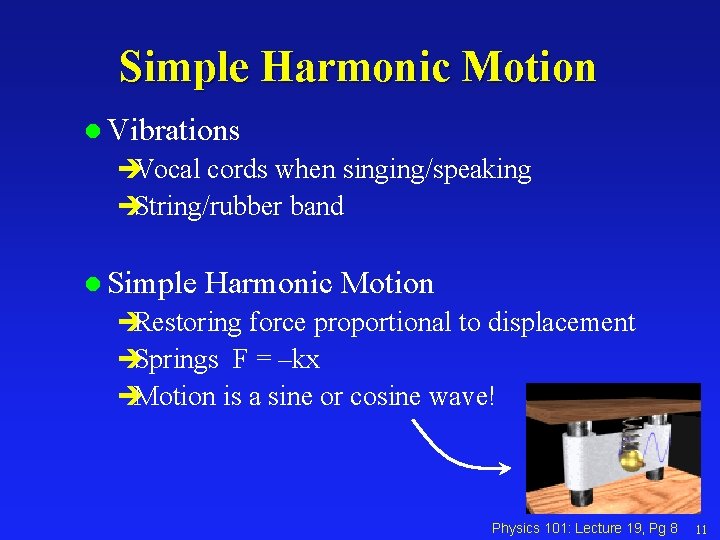
Simple Harmonic Motion l Vibrations èVocal cords when singing/speaking èString/rubber band l Simple Harmonic Motion èRestoring force proportional to displacement èSprings F = –kx èMotion is a sine or cosine wave! Physics 101: Lecture 19, Pg 8 11
Spring ACT II A mass on a spring oscillates up & down with simple harmonic motion of amplitude A. A plot of displacement (x) versus time (t) is shown below. At what points during its oscillation is the magnitude of the acceleration of the block biggest? 1. When x = +A or –A (i. e. maximum displacement) 2. When x = 0 (i. e. zero displacement) 3. The acceleration of the mass is constant +A x t -A Physics 101: Lecture 19, Pg 9 17
Simple Harmonic Motion: Anatomy X=0 a = F/m = -kx/m X=A; v=0; a=-amax X=0; v=-vmax; a=0 X=-A; v=0; a=amax X=0; v=vmax; a=0 X=A; v=0; a=-amax X=-A X=A Physics 101: Lecture 19, Pg 10 32
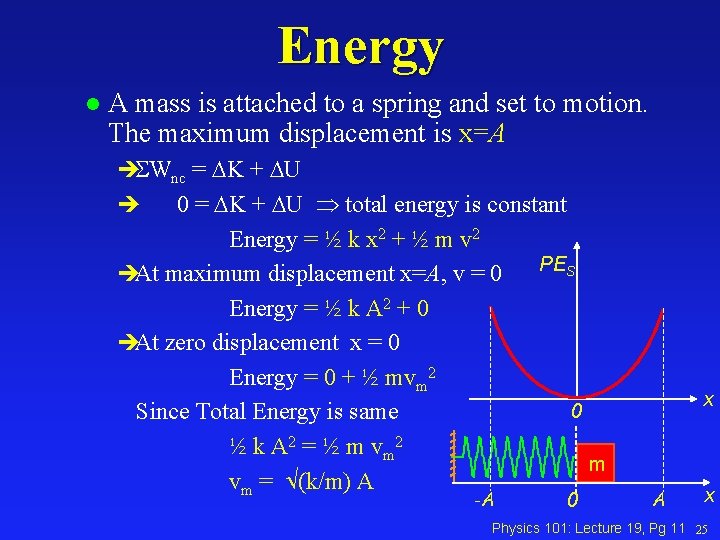
Energy l A mass is attached to a spring and set to motion. The maximum displacement is x=A èSWnc = DK + DU 0 = DK + DU total energy is constant Energy = ½ k x 2 + ½ m v 2 PES èAt maximum displacement x=A, v = 0 Energy = ½ k A 2 + 0 èAt zero displacement x = 0 Energy = 0 + ½ mvm 2 0 Since Total Energy is same ½ k A 2 = ½ m v m 2 m vm = (k/m) A è -A 0 x A x Physics 101: Lecture 19, Pg 11 25
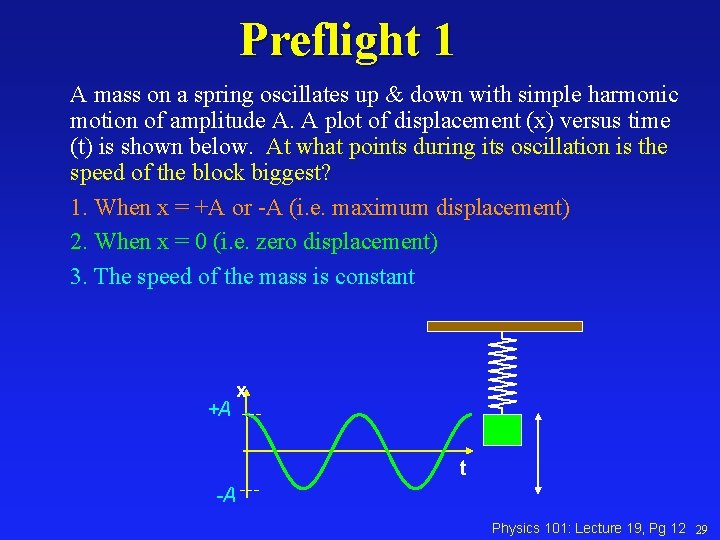
Preflight 1 A mass on a spring oscillates up & down with simple harmonic motion of amplitude A. A plot of displacement (x) versus time (t) is shown below. At what points during its oscillation is the speed of the block biggest? 1. When x = +A or -A (i. e. maximum displacement) 2. When x = 0 (i. e. zero displacement) 3. The speed of the mass is constant +A x t -A Physics 101: Lecture 19, Pg 12 29
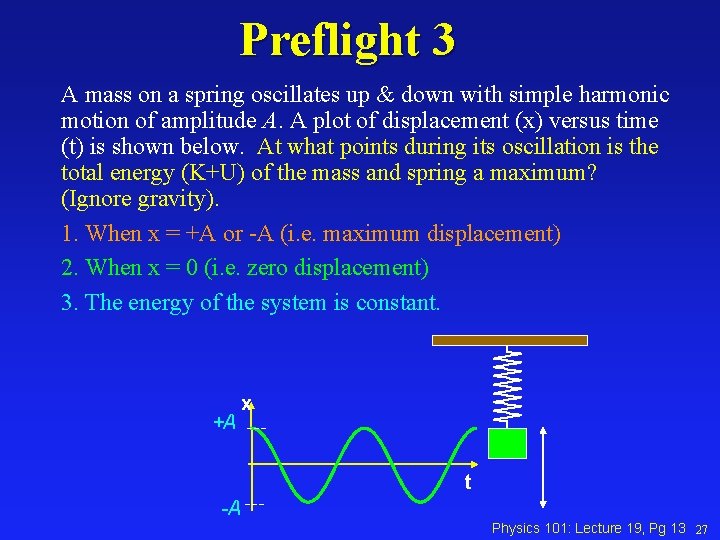
Preflight 3 A mass on a spring oscillates up & down with simple harmonic motion of amplitude A. A plot of displacement (x) versus time (t) is shown below. At what points during its oscillation is the total energy (K+U) of the mass and spring a maximum? (Ignore gravity). 1. When x = +A or -A (i. e. maximum displacement) 2. When x = 0 (i. e. zero displacement) 3. The energy of the system is constant. +A x t -A Physics 101: Lecture 19, Pg 13 27
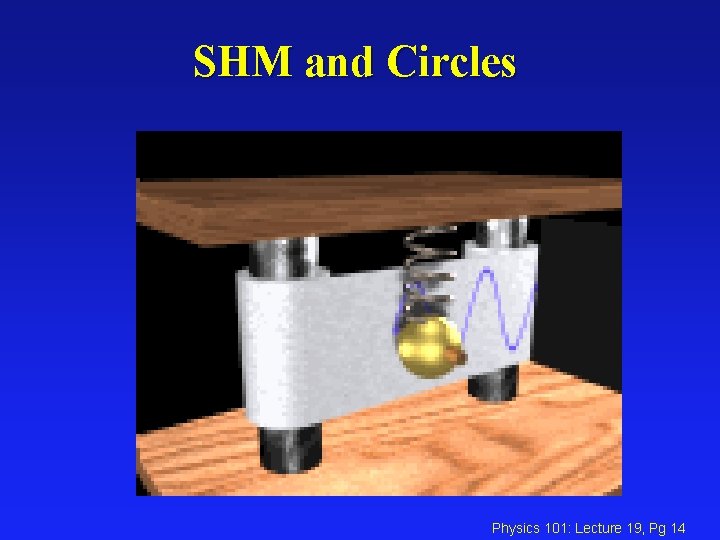
SHM and Circles Physics 101: Lecture 19, Pg 14
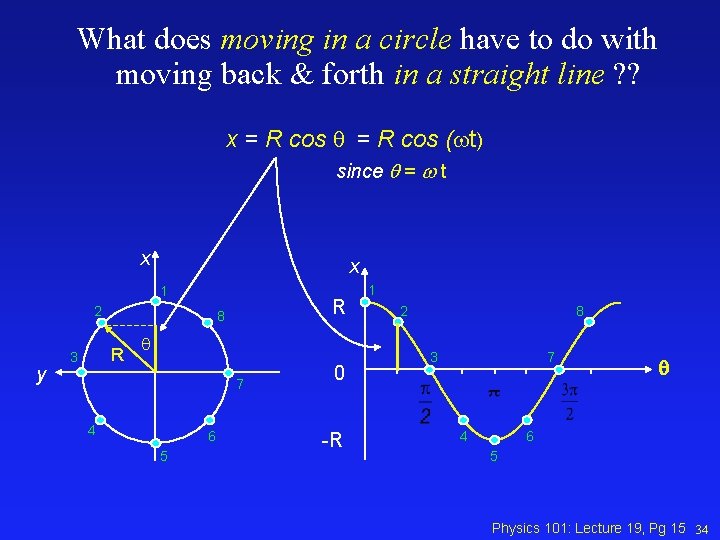
What does moving in a circle have to do with moving back & forth in a straight line ? ? x = R cos q = R cos ( t) since q = w t x x 1 2 y R 3 R 8 q 7 4 6 5 0 -R 1 2 8 7 3 4 6 5 Physics 101: Lecture 19, Pg 15 34
Simple Harmonic Motion: x(t) = [A]cos( t) v(t) = -[A ]sin( t) a(t) = -[A 2]cos( t) x(t) = [A]sin( t) OR v(t) = [A ]cos( t) a(t) = -[A 2]sin( t) xmax = A Period = T (seconds per cycle) vmax = A Frequency = f = 1/T (cycles per second) amax = A 2 Angular frequency = = 2 f = 2 /T Natural freq. for spring: = (k/m) Physics 101: Lecture 19, Pg 16 36
Example A 3 kg mass is attached to a spring (k=24 N/m). It is stretched +5 cm. At time t=0 it is released and oscillates. Which equation describes the position as a function of time x(t) = A) 5 sin( t) B) 5 cos( t) C) 24 sin( t) D) 24 cos( t) E) -24 cos( t) Physics 101: Lecture 19, Pg 17 39
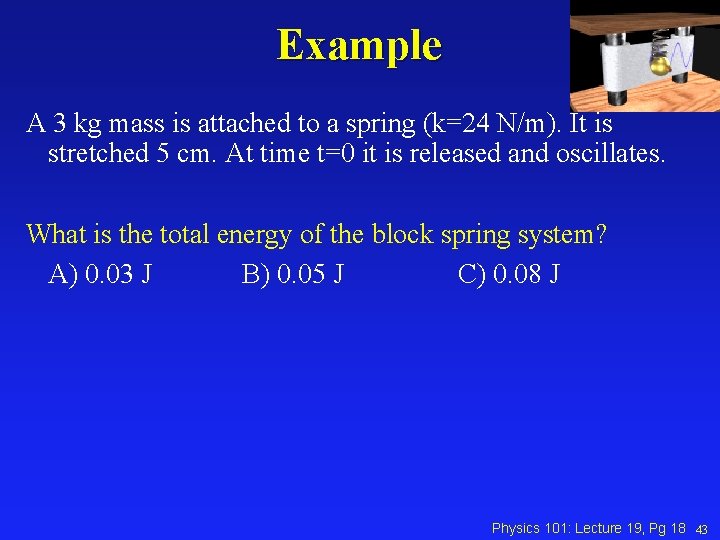
Example A 3 kg mass is attached to a spring (k=24 N/m). It is stretched 5 cm. At time t=0 it is released and oscillates. What is the total energy of the block spring system? A) 0. 03 J B) 0. 05 J C) 0. 08 J Physics 101: Lecture 19, Pg 18 43
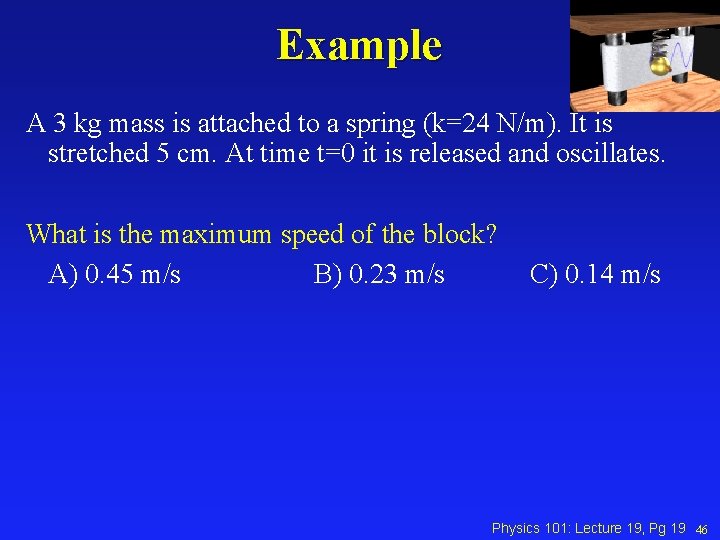
Example A 3 kg mass is attached to a spring (k=24 N/m). It is stretched 5 cm. At time t=0 it is released and oscillates. What is the maximum speed of the block? A) 0. 45 m/s B) 0. 23 m/s C) 0. 14 m/s Physics 101: Lecture 19, Pg 19 46
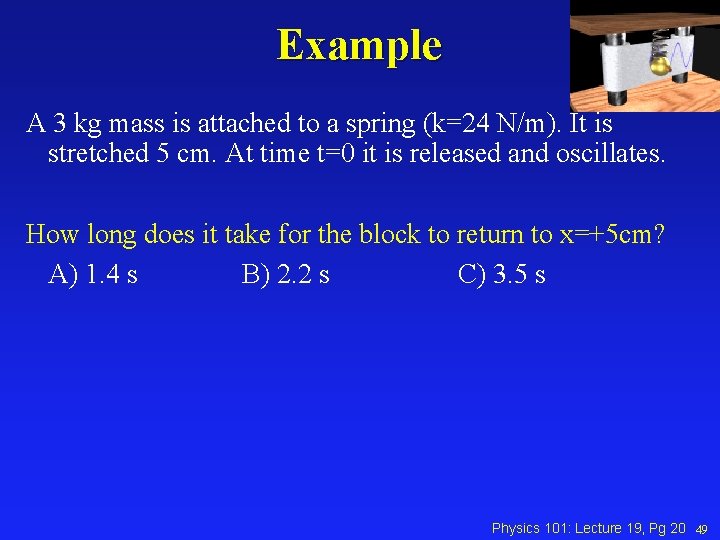
Example A 3 kg mass is attached to a spring (k=24 N/m). It is stretched 5 cm. At time t=0 it is released and oscillates. How long does it take for the block to return to x=+5 cm? A) 1. 4 s B) 2. 2 s C) 3. 5 s Physics 101: Lecture 19, Pg 20 49
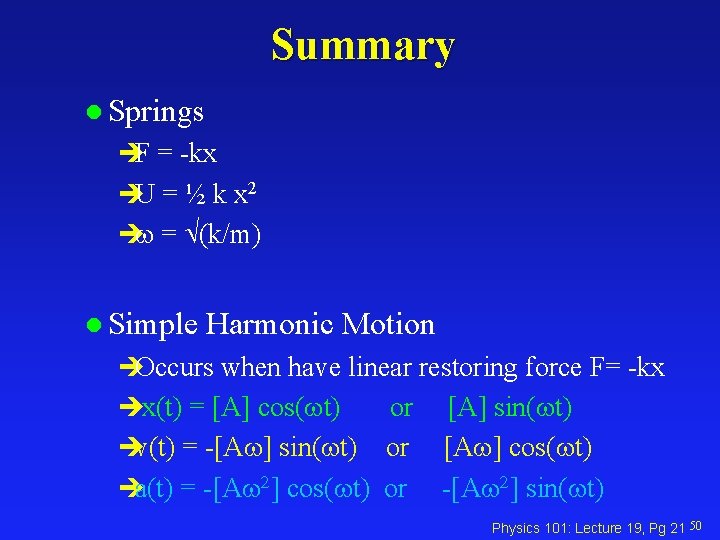
Summary l Springs èF = -kx èU = ½ k x 2 è = (k/m) l Simple Harmonic Motion èOccurs when have linear restoring force F= -kx èx(t) = [A] cos( t) or èv(t) = -[A ] sin( t) or èa(t) = -[A 2] cos( t) or [A] sin( t) [A ] cos( t) -[A 2] sin( t) Physics 101: Lecture 19, Pg 21 50