
PHYSICIST PROFILE Chief Executive Officer American Physical Society
- Slides: 14
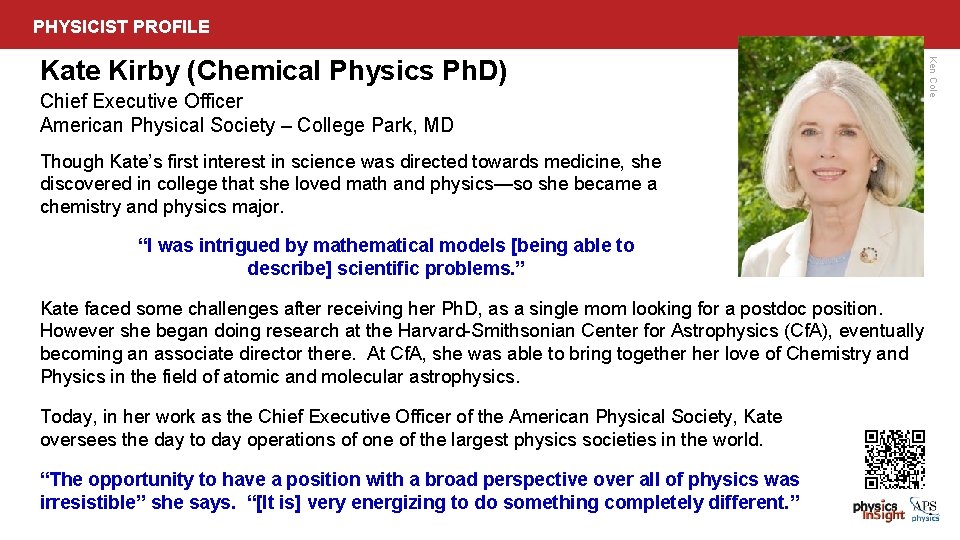
PHYSICIST PROFILE Chief Executive Officer American Physical Society – College Park, MD Though Kate’s first interest in science was directed towards medicine, she discovered in college that she loved math and physics—so she became a chemistry and physics major. “I was intrigued by mathematical models [being able to describe] scientific problems. ” Kate faced some challenges after receiving her Ph. D, as a single mom looking for a postdoc position. However she began doing research at the Harvard-Smithsonian Center for Astrophysics (Cf. A), eventually becoming an associate director there. At Cf. A, she was able to bring together love of Chemistry and Physics in the field of atomic and molecular astrophysics. Today, in her work as the Chief Executive Officer of the American Physical Society, Kate oversees the day to day operations of one of the largest physics societies in the world. “The opportunity to have a position with a broad perspective over all of physics was irresistible” she says. “[It is] very energizing to do something completely different. ” Ken Cole Kate Kirby (Chemical Physics Ph. D)
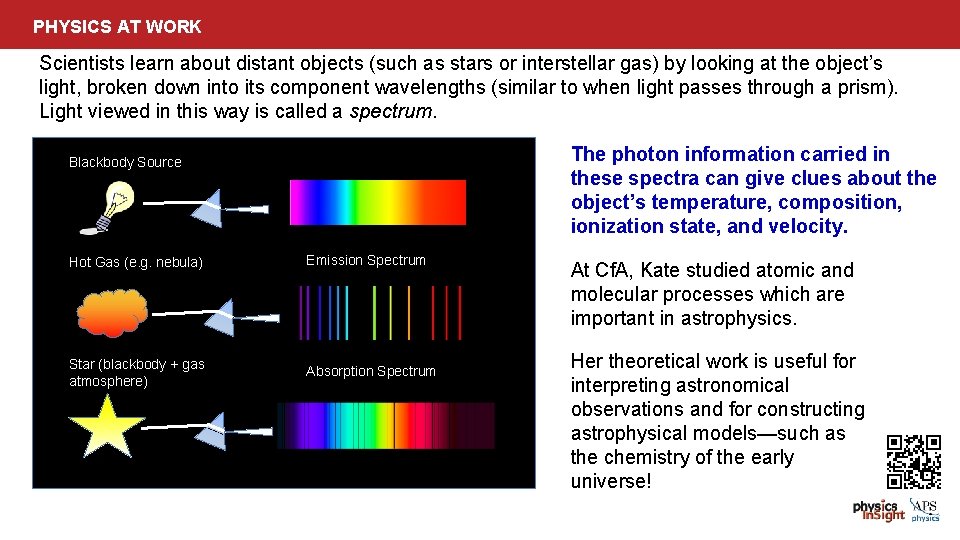
PHYSICS AT WORK Scientists learn about distant objects (such as stars or interstellar gas) by looking at the object’s light, broken down into its component wavelengths (similar to when light passes through a prism). Light viewed in this way is called a spectrum. The photon information carried in these spectra can give clues about the object’s temperature, composition, ionization state, and velocity. Blackbody Source Hot Gas (e. g. nebula) Emission Spectrum Star (blackbody + gas atmosphere) Absorption Spectrum At Cf. A, Kate studied atomic and molecular processes which are important in astrophysics. Her theoretical work is useful for interpreting astronomical observations and for constructing astrophysical models—such as the chemistry of the early universe!
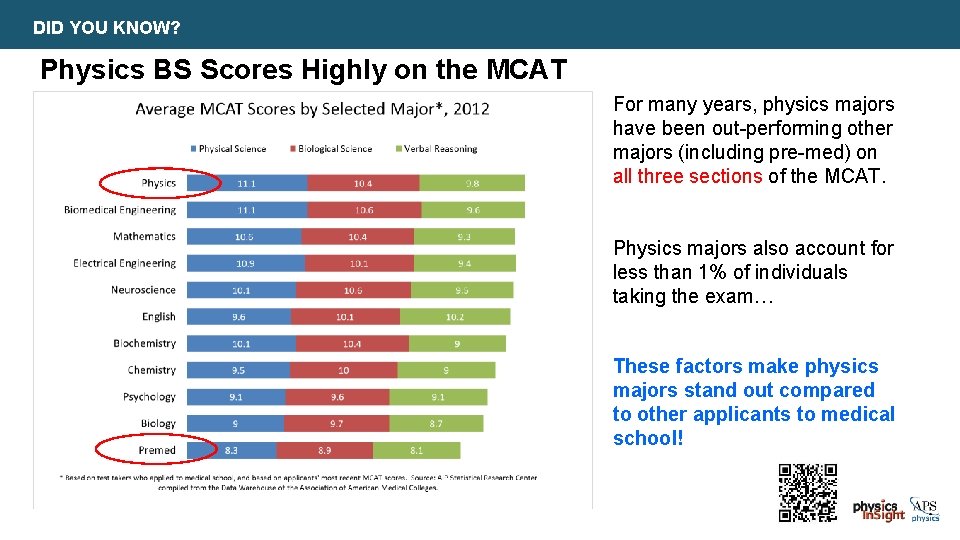
DID YOU KNOW? Physics BS Scores Highly on the MCAT For many years, physics majors have been out-performing other majors (including pre-med) on all three sections of the MCAT. Physics majors also account for less than 1% of individuals taking the exam… These factors make physics majors stand out compared to other applicants to medical school!
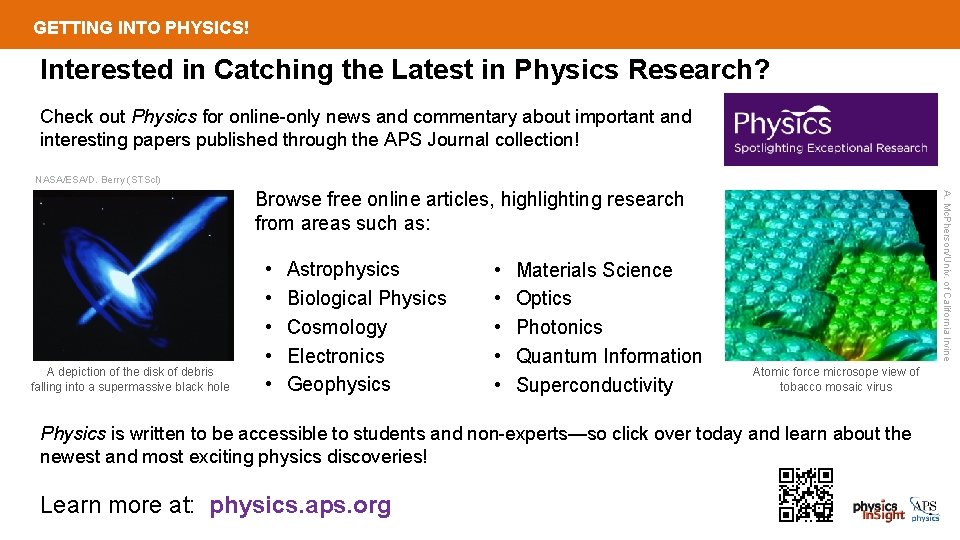
GETTING INTO PHYSICS! Interested in Catching the Latest in Physics Research? Check out Physics for online-only news and commentary about important and interesting papers published through the APS Journal collection! NASA/ESA/D. Berry (STScl) A depiction of the disk of debris falling into a supermassive black hole • • • Astrophysics Biological Physics Cosmology Electronics Geophysics • • • Materials Science Optics Photonics Quantum Information Superconductivity A. Mc. Pherson/Univ. of California Irvine Browse free online articles, highlighting research from areas such as: Atomic force microsope view of tobacco mosaic virus Physics is written to be accessible to students and non-experts—so click over today and learn about the newest and most exciting physics discoveries! Learn more at: physics. aps. org
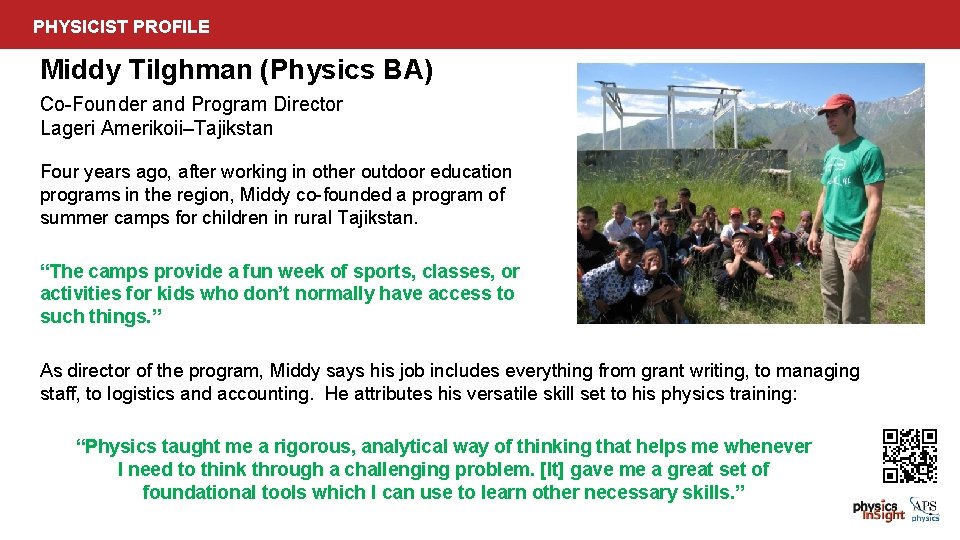
PHYSICIST PROFILE Middy Tilghman (Physics BA) Co-Founder and Program Director Lageri Amerikoii–Tajikstan Four years ago, after working in other outdoor education programs in the region, Middy co-founded a program of summer camps for children in rural Tajikstan. “The camps provide a fun week of sports, classes, or activities for kids who don’t normally have access to such things. ” As director of the program, Middy says his job includes everything from grant writing, to managing staff, to logistics and accounting. He attributes his versatile skill set to his physics training: “Physics taught me a rigorous, analytical way of thinking that helps me whenever I need to think through a challenging problem. [It] gave me a great set of foundational tools which I can use to learn other necessary skills. ”
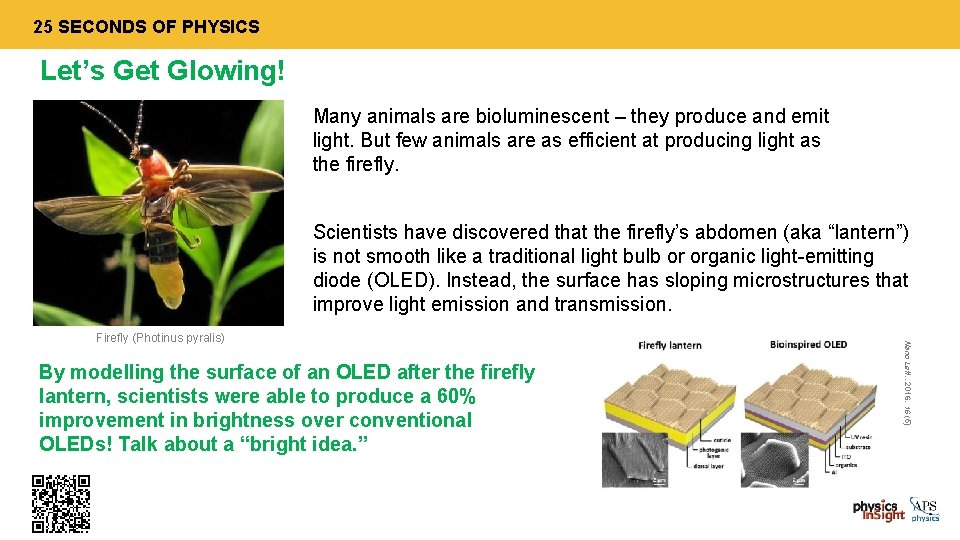
25 SECONDS OF PHYSICS Let’s Get Glowing! Many animals are bioluminescent – they produce and emit light. But few animals are as efficient at producing light as the firefly. Scientists have discovered that the firefly’s abdomen (aka “lantern”) is not smooth like a traditional light bulb or organic light-emitting diode (OLED). Instead, the surface has sloping microstructures that improve light emission and transmission. By modelling the surface of an OLED after the firefly lantern, scientists were able to produce a 60% improvement in brightness over conventional OLEDs! Talk about a “bright idea. ” Nano Lett. , 2016, 16 (5) Firefly (Photinus pyralis)
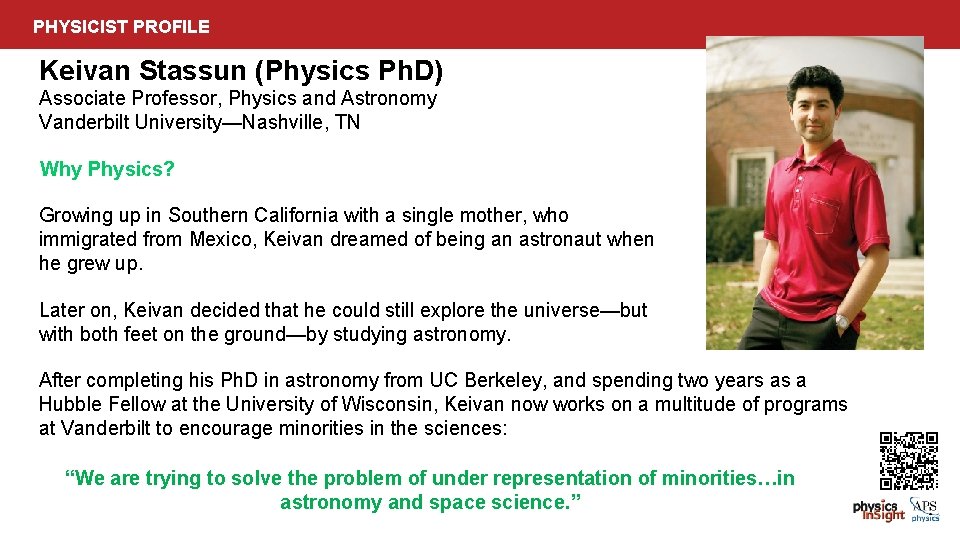
PHYSICIST PROFILE Keivan Stassun (Physics Ph. D) Associate Professor, Physics and Astronomy Vanderbilt University—Nashville, TN Why Physics? Growing up in Southern California with a single mother, who immigrated from Mexico, Keivan dreamed of being an astronaut when he grew up. Later on, Keivan decided that he could still explore the universe—but with both feet on the ground—by studying astronomy. After completing his Ph. D in astronomy from UC Berkeley, and spending two years as a Hubble Fellow at the University of Wisconsin, Keivan now works on a multitude of programs at Vanderbilt to encourage minorities in the sciences: “We are trying to solve the problem of under representation of minorities…in astronomy and space science. ”
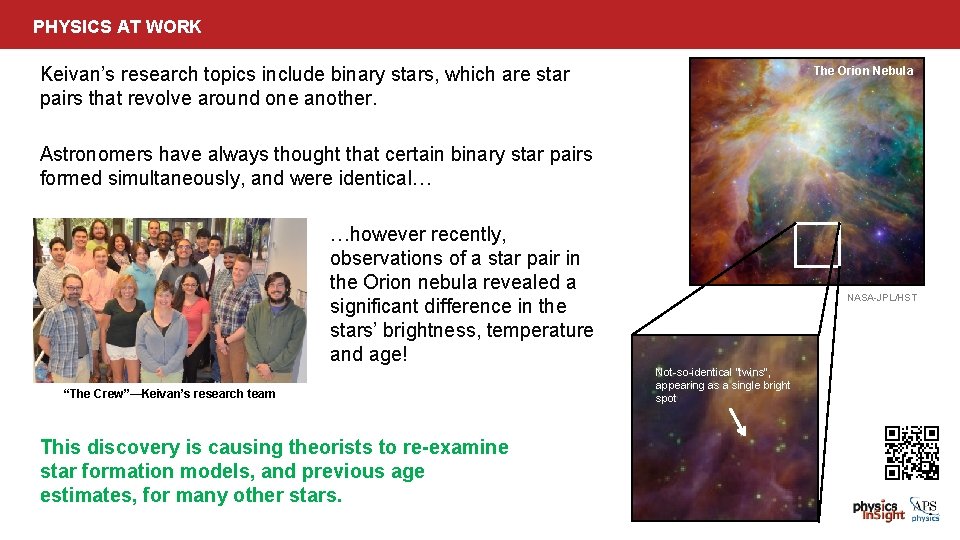
PHYSICS AT WORK Keivan’s research topics include binary stars, which are star pairs that revolve around one another. The Orion Nebula Astronomers have always thought that certain binary star pairs formed simultaneously, and were identical… …however recently, observations of a star pair in the Orion nebula revealed a significant difference in the stars’ brightness, temperature and age! “The Crew”—Keivan’s research team This discovery is causing theorists to re-examine star formation models, and previous age estimates, for many other stars. NASA-JPL/HST Not-so-identical “twins”, appearing as a single bright spot
GETTING INTO PHYSICS! Want to get started on your Physics Career? Visit the APS Online Job Center! Positions for physics graduates are available on our website right now! Job Seekers can: • Search for jobs on the Job Center (totally free)! • Search for positions by location, physics field, job sector, and more! • Store your resume, cover letters, and other materials in your profile on the site. • Apply for positions directly through the Job Center. Don’t wait for all the great opportunities to find you. Take the initiative and start your physics job search today! Visit: careers. aps. org
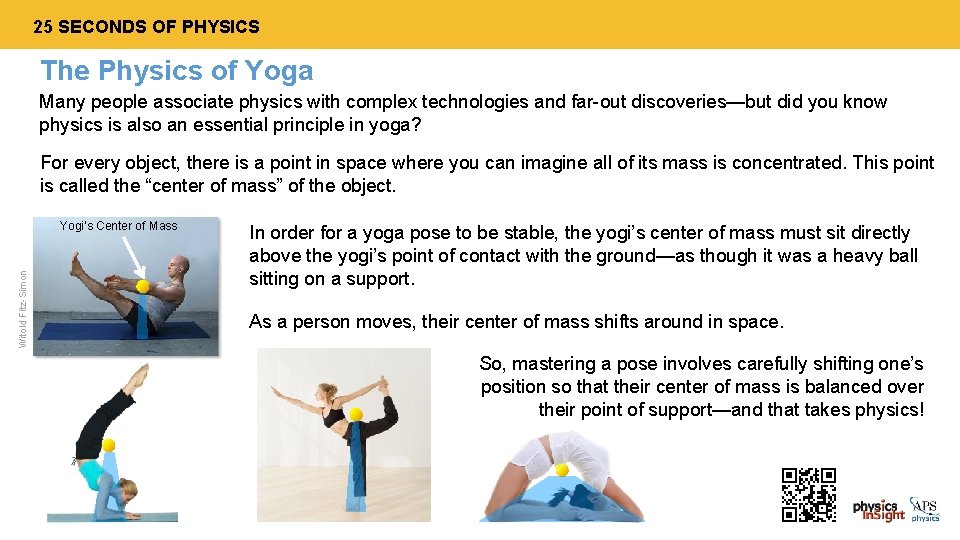
25 SECONDS OF PHYSICS The Physics of Yoga Many people associate physics with complex technologies and far-out discoveries—but did you know physics is also an essential principle in yoga? For every object, there is a point in space where you can imagine all of its mass is concentrated. This point is called the “center of mass” of the object. Witold Fitz-Simon Yogi’s Center of Mass In order for a yoga pose to be stable, the yogi’s center of mass must sit directly above the yogi’s point of contact with the ground—as though it was a heavy ball sitting on a support. As a person moves, their center of mass shifts around in space. So, mastering a pose involves carefully shifting one’s position so that their center of mass is balanced over their point of support—and that takes physics!
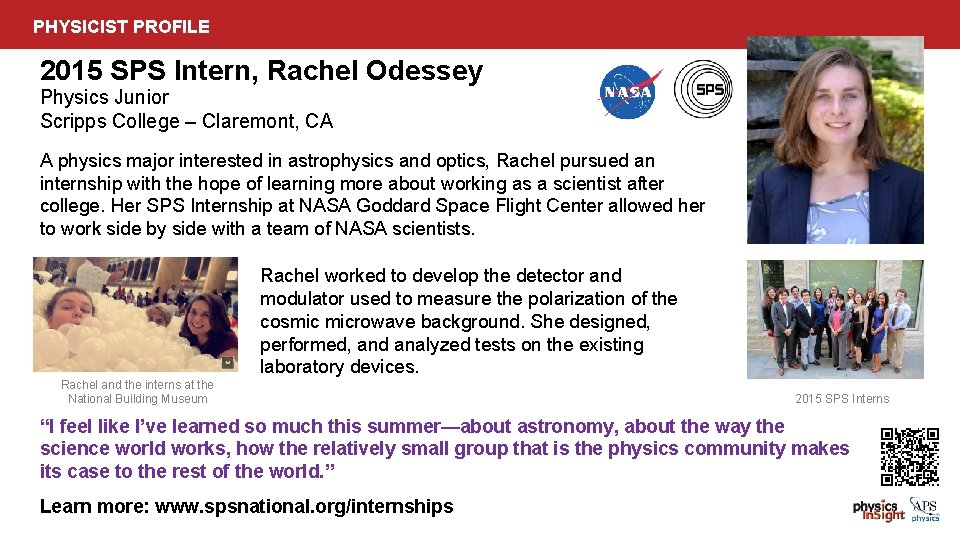
PHYSICIST PROFILE 2015 SPS Intern, Rachel Odessey Physics Junior Scripps College – Claremont, CA A physics major interested in astrophysics and optics, Rachel pursued an internship with the hope of learning more about working as a scientist after college. Her SPS Internship at NASA Goddard Space Flight Center allowed her to work side by side with a team of NASA scientists. Rachel worked to develop the detector and modulator used to measure the polarization of the cosmic microwave background. She designed, performed, and analyzed tests on the existing laboratory devices. Rachel and the interns at the National Building Museum 2015 SPS Interns “I feel like I’ve learned so much this summer—about astronomy, about the way the science world works, how the relatively small group that is the physics community makes its case to the rest of the world. ” Learn more: www. spsnational. org/internships
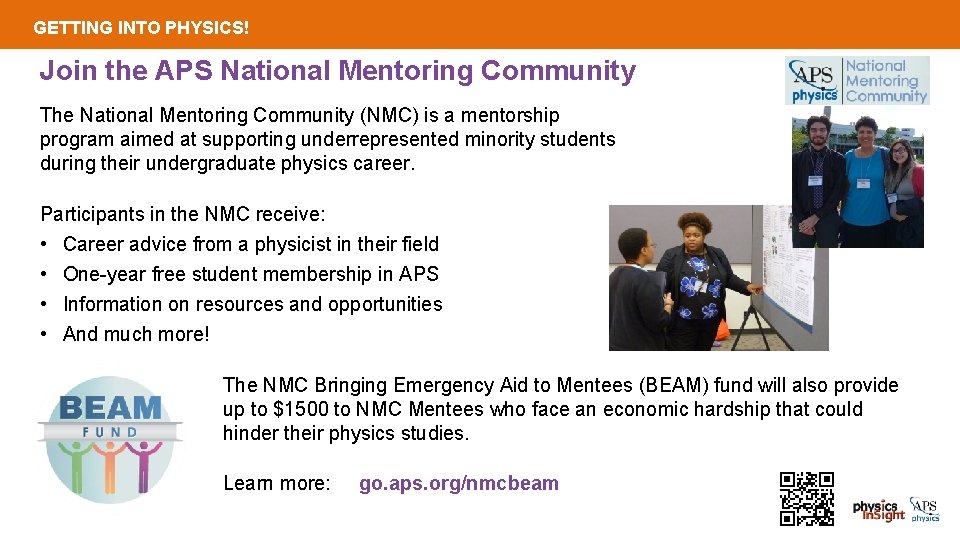
GETTING INTO PHYSICS! Join the APS National Mentoring Community The National Mentoring Community (NMC) is a mentorship program aimed at supporting underrepresented minority students during their undergraduate physics career. Participants in the NMC receive: • Career advice from a physicist in their field • One-year free student membership in APS • Information on resources and opportunities • And much more! The NMC Bringing Emergency Aid to Mentees (BEAM) fund will also provide up to $1500 to NMC Mentees who face an economic hardship that could hinder their physics studies. Learn more: go. aps. org/nmcbeam
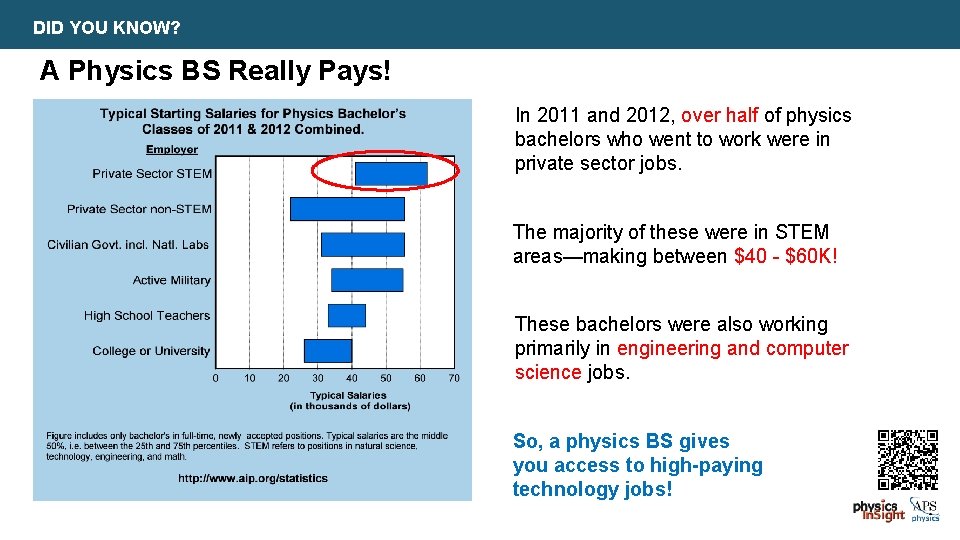
DID YOU KNOW? A Physics BS Really Pays! In 2011 and 2012, over half of physics bachelors who went to work were in private sector jobs. The majority of these were in STEM areas—making between $40 - $60 K! These bachelors were also working primarily in engineering and computer science jobs. So, a physics BS gives you access to high-paying technology jobs!