
Physicians Behaving Badly Dealing with the Disruptive Physician
Physicians Behaving Badly: Dealing with the Disruptive Physician Sanford R. Kimmel, M. D. Professor of Family Medicine University of Toledo College of Medicine Chief of Staff University of Toledo Medical Center
Objectives: Why are disruptive physicians a problem? n How common are disruptive physicians & how frequent is their behavior? n Who are disruptive physicians i. e. what behaviors do they display? n How do you assess and manage the disruptive physician? n
The Joint Commission states that intimidating & disruptive behaviors: Foster medical errors n Contribute to poor patient satisfaction n Contribute to preventable adverse outcomes n Increase the cost of care n Contribute to a hostile work environment n Cause qualified clinicians, staff, & administrators to seek new positions n The Joint Commission Sentinel Event Alert, July 09, 2008.
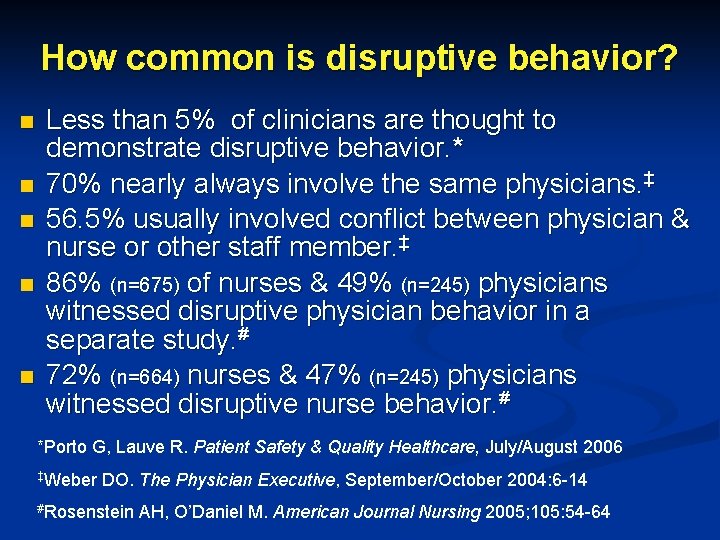
How common is disruptive behavior? n n n Less than 5% of clinicians are thought to demonstrate disruptive behavior. * 70% nearly always involve the same physicians. ‡ 56. 5% usually involved conflict between physician & nurse or other staff member. ‡ 86% (n=675) of nurses & 49% (n=245) physicians witnessed disruptive physician behavior in a separate study. # 72% (n=664) nurses & 47% (n=245) physicians witnessed disruptive nurse behavior. # *Porto G, Lauve R. Patient Safety & Quality Healthcare, July/August 2006 ‡Weber DO. The Physician Executive, September/October 2004: 6 -14 #Rosenstein AH, O’Daniel M. American Journal Nursing 2005; 105: 54 -64
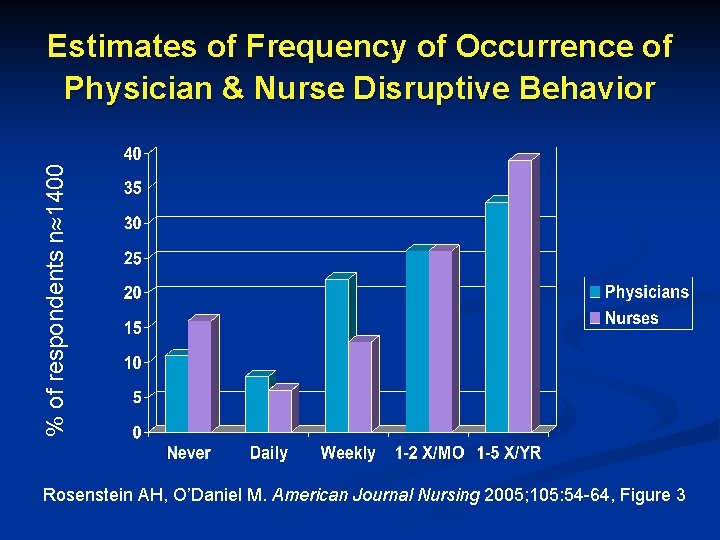
% of respondents n 1400 Estimates of Frequency of Occurrence of Physician & Nurse Disruptive Behavior Rosenstein AH, O’Daniel M. American Journal Nursing 2005; 105: 54 -64, Figure 3
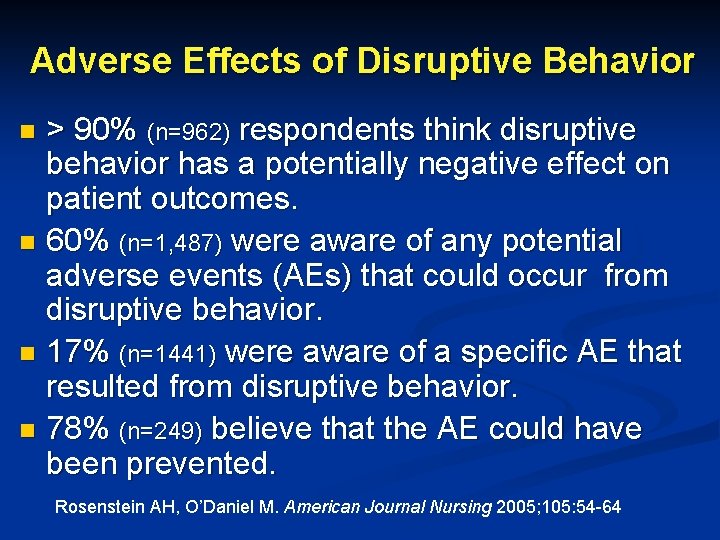
Adverse Effects of Disruptive Behavior > 90% (n=962) respondents think disruptive behavior has a potentially negative effect on patient outcomes. n 60% (n=1, 487) were aware of any potential adverse events (AEs) that could occur from disruptive behavior. n 17% (n=1441) were aware of a specific AE that resulted from disruptive behavior. n 78% (n=249) believe that the AE could have been prevented. n Rosenstein AH, O’Daniel M. American Journal Nursing 2005; 105: 54 -64
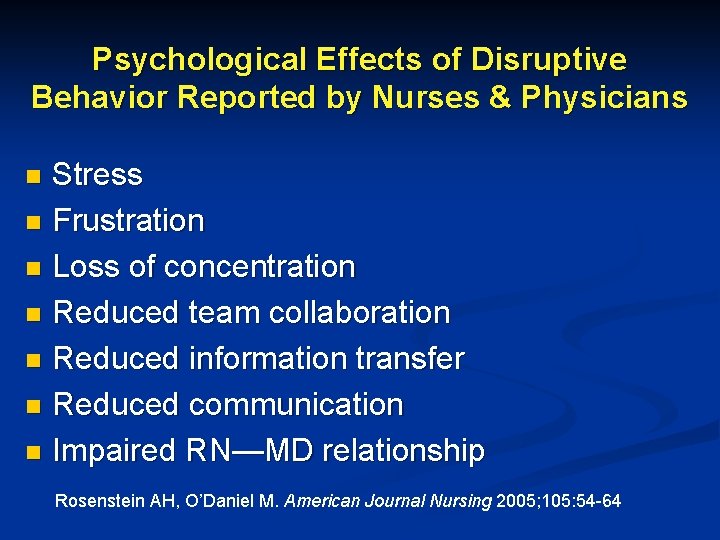
Psychological Effects of Disruptive Behavior Reported by Nurses & Physicians Stress n Frustration n Loss of concentration n Reduced team collaboration n Reduced information transfer n Reduced communication n Impaired RN—MD relationship n Rosenstein AH, O’Daniel M. American Journal Nursing 2005; 105: 54 -64
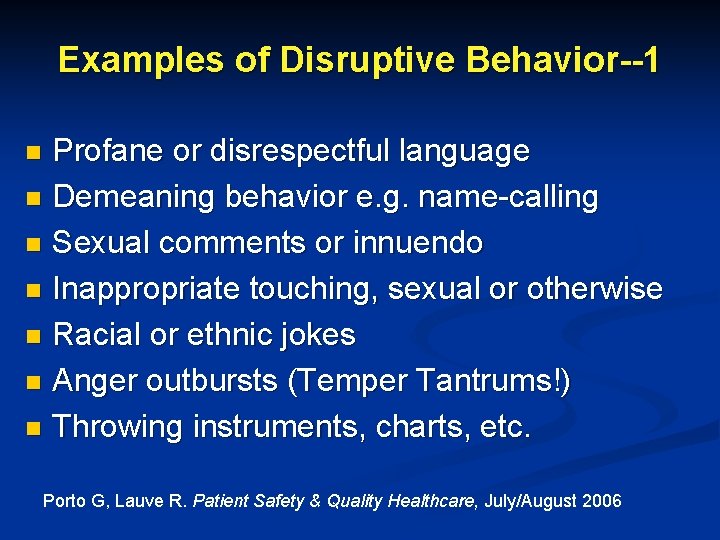
Examples of Disruptive Behavior--1 Profane or disrespectful language n Demeaning behavior e. g. name-calling n Sexual comments or innuendo n Inappropriate touching, sexual or otherwise n Racial or ethnic jokes n Anger outbursts (Temper Tantrums!) n Throwing instruments, charts, etc. n Porto G, Lauve R. Patient Safety & Quality Healthcare, July/August 2006
Examples of Disruptive Behavior--2 n n n Comments undermining a patient’s trust in other caregivers. Comments undermining a caregiver’s selfconfidence in caring for patients. Failure to adequately address safety concerns. Intimidating behavior that discourages input by other healthcare professionals. Failure to adhere to organization policies without adequate reason. Retaliation against any person who reports or investigates violation of the code of conduct. Porto G, Lauve R. Patient Safety & Quality Healthcare, July/August 2006
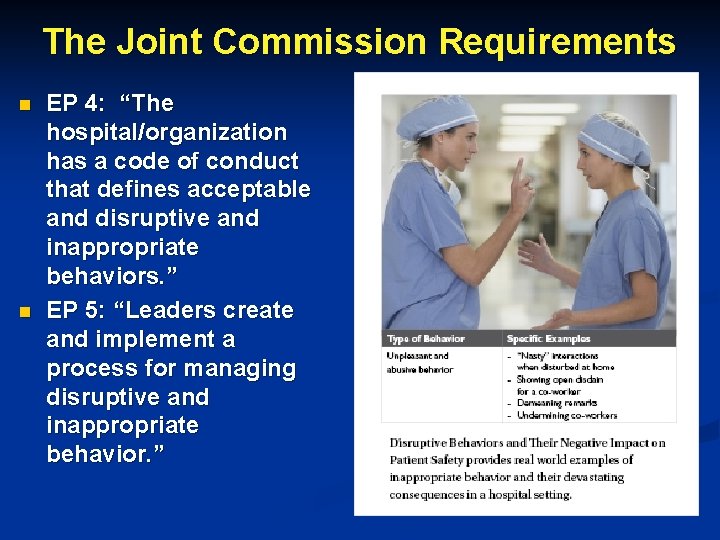
The Joint Commission Requirements n n EP 4: “The hospital/organization has a code of conduct that defines acceptable and disruptive and inappropriate behaviors. ” EP 5: “Leaders create and implement a process for managing disruptive and inappropriate behavior. ”
Policy on Disruptive Behavior Involving Members of the Medical Staff n “Disruptive behavior” means any conduct or behavior including, without limitation, sexual harassment or other forms of inappropriate behavior, which: n n n Jeopardizes or is inconsistent with quality patient care or with the ability of others to provide quality patient care at the hospital; Is unethical; or Constitutes the physical, written, or verbal abuse of others involved with providing patient care including written criticism of care or verbal criticism of care in public places by other providers. Policy number 3364 -87 -10. University of Toledo Medical Center, effective
Policy on Disruptive Behavior Involving Members of the Medical Staff n n n “Sexual harassment” is defined as: unwelcome sexual advances, requests for sexual favors, or verbal or physical activity through which submission to sexual advances is made an explicit or implicit condition of employment or future employment-related decisions; unwelcome conduct of a sexual nature which has the purpose or effect of unreasonably interfering with the employee’s work performance or which creates an offensive, intimidating or otherwise hostile work environment. Policy number 3364 -87 -10. University of Toledo Medical Center, effective 07/14/99
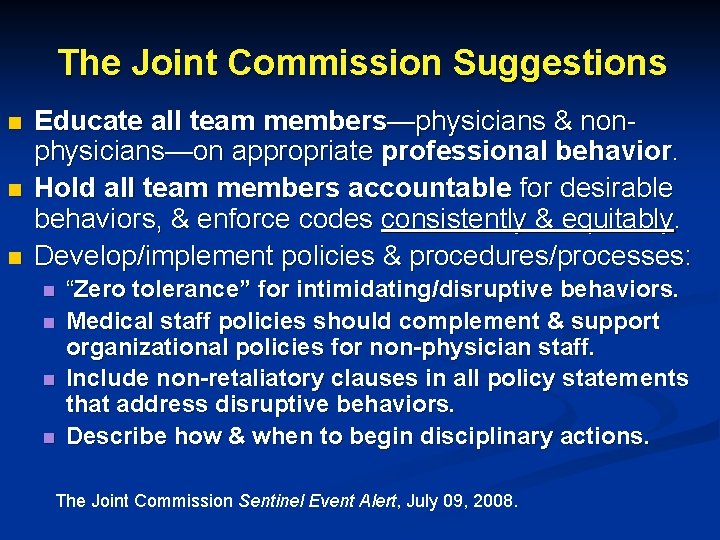
The Joint Commission Suggestions n n n Educate all team members—physicians & nonphysicians—on appropriate professional behavior. Hold all team members accountable for desirable behaviors, & enforce codes consistently & equitably. Develop/implement policies & procedures/processes: n n “Zero tolerance” for intimidating/disruptive behaviors. Medical staff policies should complement & support organizational policies for non-physician staff. Include non-retaliatory clauses in all policy statements that address disruptive behaviors. Describe how & when to begin disciplinary actions. The Joint Commission Sentinel Event Alert, July 09, 2008.
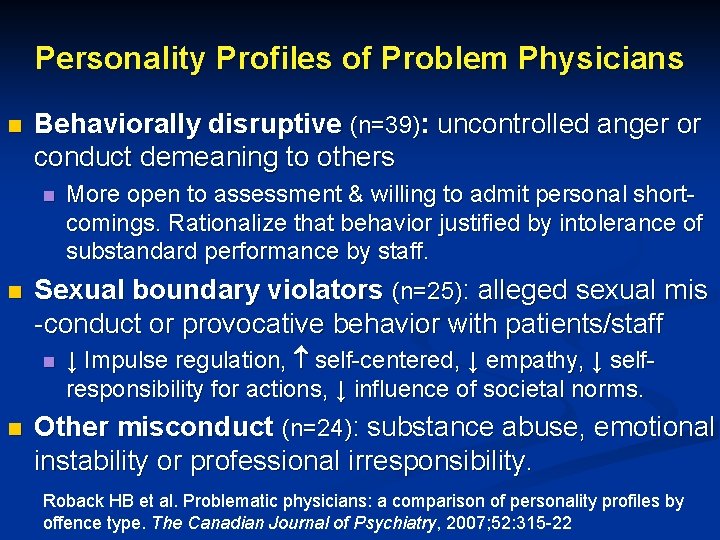
Personality Profiles of Problem Physicians n Behaviorally disruptive (n=39): uncontrolled anger or conduct demeaning to others n n Sexual boundary violators (n=25): alleged sexual mis -conduct or provocative behavior with patients/staff n n More open to assessment & willing to admit personal shortcomings. Rationalize that behavior justified by intolerance of substandard performance by staff. ↓ Impulse regulation, self-centered, ↓ empathy, ↓ selfresponsibility for actions, ↓ influence of societal norms. Other misconduct (n=24): substance abuse, emotional instability or professional irresponsibility. Roback HB et al. Problematic physicians: a comparison of personality profiles by offence type. The Canadian Journal of Psychiatry, 2007; 52: 315 -22
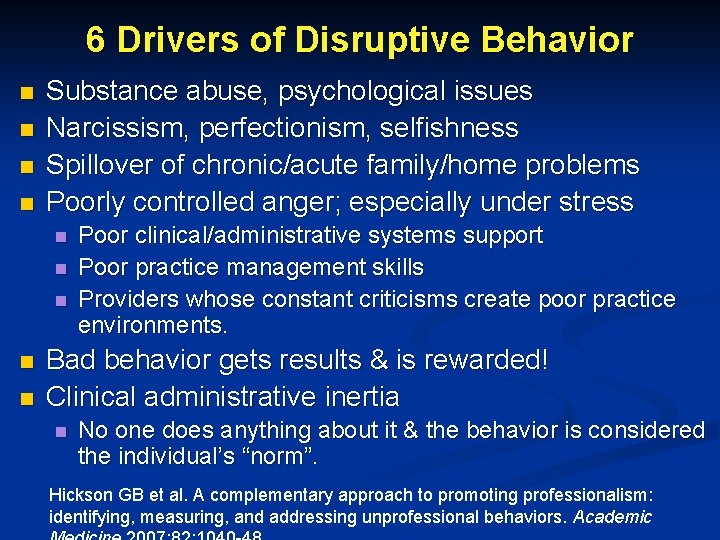
6 Drivers of Disruptive Behavior n n Substance abuse, psychological issues Narcissism, perfectionism, selfishness Spillover of chronic/acute family/home problems Poorly controlled anger; especially under stress n n n Poor clinical/administrative systems support Poor practice management skills Providers whose constant criticisms create poor practice environments. Bad behavior gets results & is rewarded! Clinical administrative inertia n No one does anything about it & the behavior is considered the individual’s “norm”. Hickson GB et al. A complementary approach to promoting professionalism: identifying, measuring, and addressing unprofessional behaviors. Academic
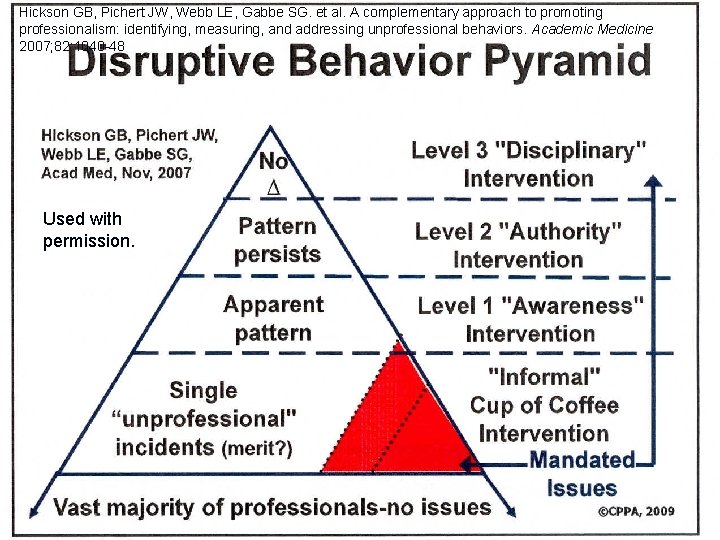
Hickson GB, Pichert JW, Webb LE, Gabbe SG. et al. A complementary approach to promoting professionalism: identifying, measuring, and addressing unprofessional behaviors. Academic Medicine 2007; 82: 1040 -48 Used with permission.
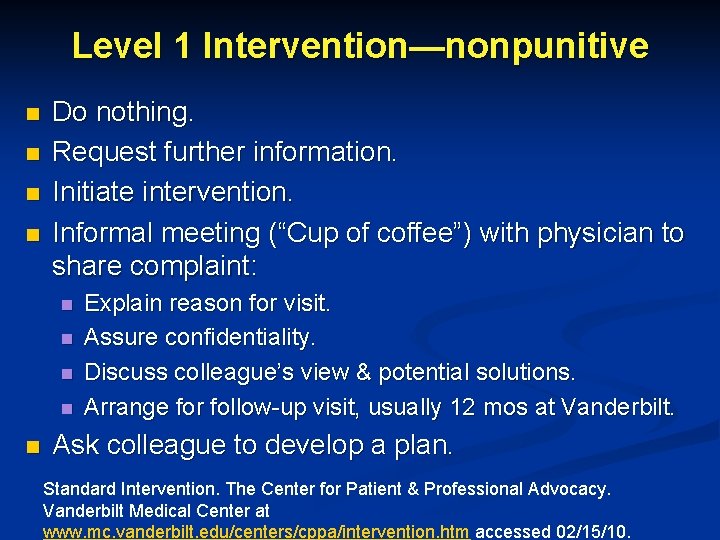
Level 1 Intervention—nonpunitive n n Do nothing. Request further information. Initiate intervention. Informal meeting (“Cup of coffee”) with physician to share complaint: n n n Explain reason for visit. Assure confidentiality. Discuss colleague’s view & potential solutions. Arrange for follow-up visit, usually 12 mos at Vanderbilt. Ask colleague to develop a plan. Standard Intervention. The Center for Patient & Professional Advocacy. Vanderbilt Medical Center at www. mc. vanderbilt. edu/centers/cppa/intervention. htm accessed 02/15/10.
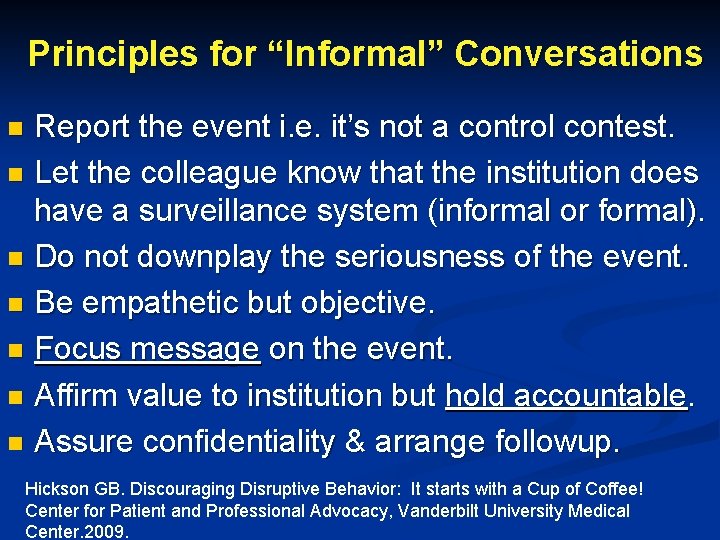
Principles for “Informal” Conversations Report the event i. e. it’s not a control contest. n Let the colleague know that the institution does have a surveillance system (informal or formal). n Do not downplay the seriousness of the event. n Be empathetic but objective. n Focus message on the event. n Affirm value to institution but hold accountable. n Assure confidentiality & arrange followup. n Hickson GB. Discouraging Disruptive Behavior: It starts with a Cup of Coffee! Center for Patient and Professional Advocacy, Vanderbilt University Medical Center. 2009.
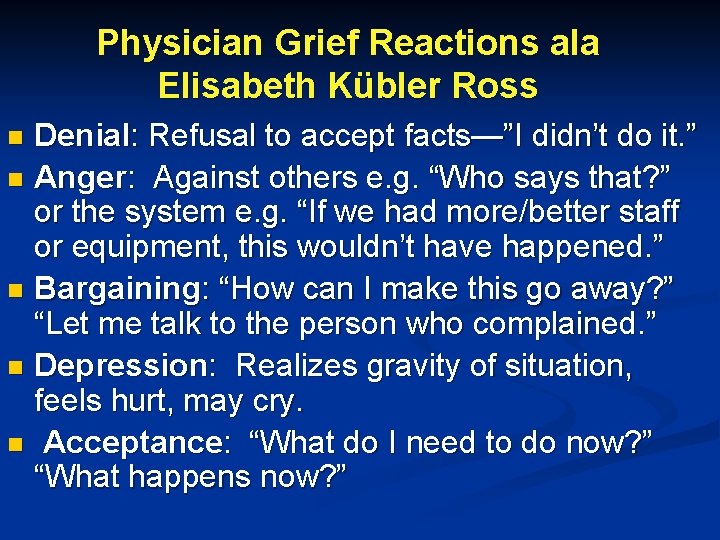
Physician Grief Reactions ala Elisabeth Kübler Ross Denial: Refusal to accept facts—”I didn’t do it. ” n Anger: Against others e. g. “Who says that? ” or the system e. g. “If we had more/better staff or equipment, this wouldn’t have happened. ” n Bargaining: “How can I make this go away? ” “Let me talk to the person who complained. ” n Depression: Realizes gravity of situation, feels hurt, may cry. n Acceptance: “What do I need to do now? ” “What happens now? ” n
Impaired & Disruptive Physician!
Case Presentation—Doctor X* During an operation in the O. R. , Dr. X is unhappy over a missing instrument from the surgical tray. While the circulating nurse is retrieving the instrument, (s)he curses the team for not ensuring the instrument was present. n Does this constitute disruptive behavior? n If so, how would you deal with it? n Dr. X is a fictional character that represents a composite of disruptive behaviors. Any relationship to any real person, either living or dead, is purely coincidental.
Level III Disruptive Behavior n Verbal Abuse which is directed at-large, but has been reasonably perceived by a witness to be disruptive behavior as defined previously. UTMC Policy Number 3364 -87 -10. Disruptive Behavior Involving Members of the Medical Staff.
The Continuing Saga of Doctor X Because it is a long case, the scrub nurse is relieved by another nurse who does not usually scrub in on this type of case. The nurse does not prepare the instruments in as expedient manner as demanded by Doctor X and (s)he becomes more frustrated cursing and stating, “If you can’t do things right, you shouldn’t be in the O. R. ” n Does this constitute disruptive behavior? n If so, how would you deal with this situation? n
Level II Disruptive Behavior n Verbal abuse such as unwarranted yelling, swearing or cursing; threatening, humiliating, sexual or otherwise inappropriate comments directed at a person, or persons, or physical violence or abuse directed in anger at an inanimate object. UTMC Policy Number 3364 -87 -10. Disruptive Behavior Involving Members of the Medical Staff.
Doctor X Escalates Increasingly frustrated at the perceived inefficiency and ineptness, Doctor X tells the scrub nurse to leave the table, and as she is doing so, throws an instrument at her. n As is her right, the nurse files a complaint with the medical staff office. n How will you respond to this situation? n
Level I Disruptive Behavior n Physical violence or other physical abuse which is directed at people. Sexual harassment involving physical contact. UTMC Policy Number 3364 -87 -10. Disruptive Behavior Involving Members of the Medical Staff.
Chief of Staff (COS) Actions n n n Interview the complainant and, if possible, any witnesses promptly after receiving the complaint. The COS & a 2 nd med. staff member shall interview the medical staff member. The med. staff member may respond in writing. The Chief of Staff shall do one or more: n n n Determine that no action is warranted Issue a warning or reprimand Require a written apology to the complainant Refer member to the Medical Staff Impaired Physician Advisory Group Initiate corrective action pursuant to the medical staff bylaws. UTMC Policy Number 3364 -87 -10. Disruptive Behavior Involving Members of the Medical Staff
Benefits of Dealing with Unprofessional Behavior Improve patient safety so that staff are more likely to report problems in patient care. n Reduce liability exposure & risk-management. n Improve staff satisfaction & retention. n Enhance reputation for the medical center. n Create professionals who are role models for students, residents, staff, & each other. n Produce more productive, civil & desirable work environment. n Hickson GB et al. A complementary approach to promoting professionalism: identifying, measuring, and addressing unprofessional behaviors. Academic
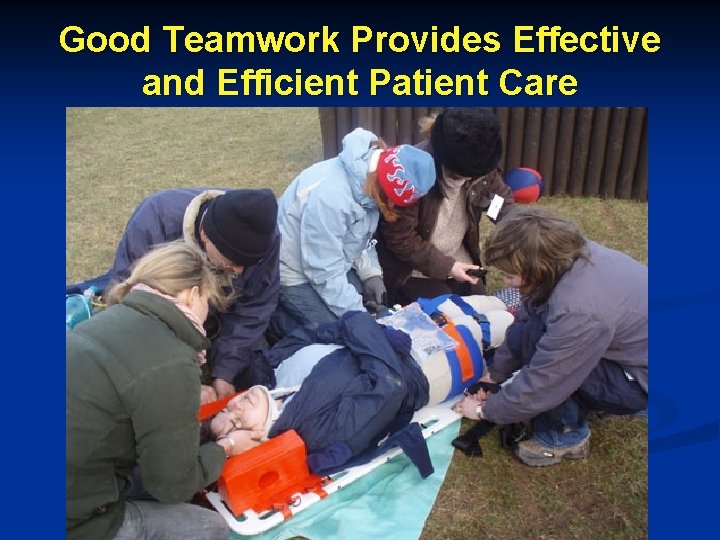
Good Teamwork Provides Effective and Efficient Patient Care
- Slides: 29