
Physician Practice Roundtable Primer on Motivational Interviewing 2
Physician Practice Roundtable Primer on Motivational Interviewing
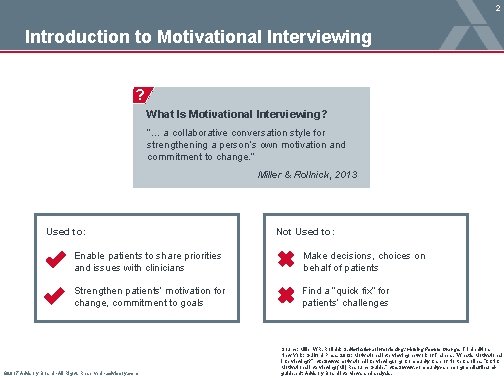
2 Introduction to Motivational Interviewing ? What Is Motivational Interviewing? “… a collaborative conversation style for strengthening a person’s own motivation and commitment to change. ” Miller & Rollnick, 2013 Used to: Not Used to: Enable patients to share priorities and issues with clinicians Make decisions, choices on behalf of patients Strengthen patients’ motivation for change, commitment to goals Find a “quick fix” for patients’ challenges © 2017 Advisory Board • All Rights Reserved • advisory. com Source: Miller WR, Rollnick S, Motivational Interviewing: Helping People Change, Third edition, New York: Guilford Press, 2013; Motivational Interviewing network of Trainers, “What is Motivational Interviewing? ” http: //www. motivationalinterviewing. org; Community Care of North Carolina, “CCNC Motivational Interviewing (MI) Resource Guide, ” https: //www. communitycarenc. org/media/files/miguide. pdf; Advisory Board interviews and analysis.
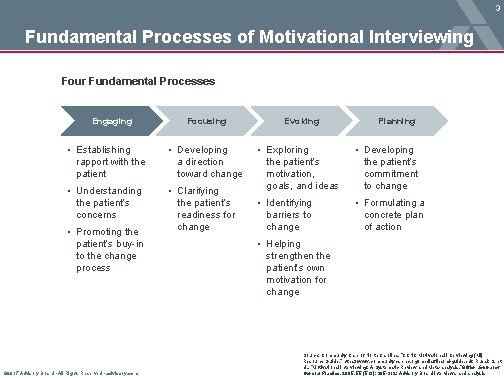
3 Fundamental Processes of Motivational Interviewing Four Fundamental Processes Engaging Focusing • Establishing rapport with the patient • Developing a direction toward change • Understanding the patient’s concerns • Clarifying the patient’s readiness for change • Promoting the patient’s buy-in to the change process © 2017 Advisory Board • All Rights Reserved • advisory. com Evoking Planning • Exploring the patient’s motivation, goals, and ideas • Developing the patient’s commitment to change • Identifying barriers to change • Formulating a concrete plan of action • Helping strengthen the patient’s own motivation for change Source: Community Care of North Carolina, “CCNC Motivational Interviewing (MI) Resource Guide, ” https: //www. communitycarenc. org/media/files/mi-guide. pdf; Rubak S, et al. , “Motivational Interviewing: A Systematic Review and Meta-analysis, ” British Journal of General Practice, 2005, 55 (513): 305 -312; Advisory Board interviews and analysis.
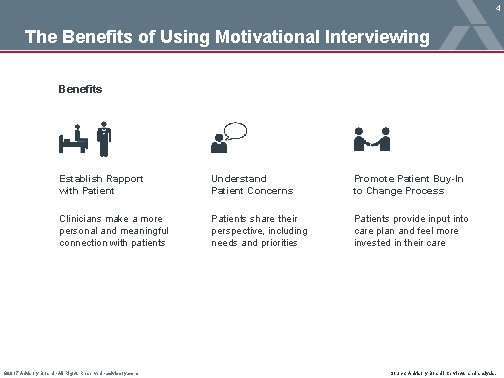
4 The Benefits of Using Motivational Interviewing Benefits Establish Rapport with Patient Understand Patient Concerns Promote Patient Buy-In to Change Process Clinicians make a more personal and meaningful connection with patients Patients share their perspective, including needs and priorities Patients provide input into care plan and feel more invested in their care © 2017 Advisory Board • All Rights Reserved • advisory. com Source: Advisory Board interviews and analysis.

5 OARS: A Communication Framework to Engage Patients Four Skills O: Open Questions A: Affirmations R: Reflective Listening S: Summarizing Ask patients openended questions; allow the patient to reflect and elaborate in response to questions Recognize and reinforce success; express empathy for the patient’s situation Mirror what the patient is saying; rephrase what the patient says in your own words Paraphrase and/or pull out key points from the conversation © 2017 Advisory Board • All Rights Reserved • advisory. com Source: Miller WR, Rollnick S, Motivational Interviewing: Helping People Change, Third edition, New York: Guilford Press, 2013; Community Care of North Carolina, “CCNC Motivational Interviewing (MI) Resource Guide, ” https: //www. communitycarenc. org/media/files/mi-guide. pdf; Oregon Health Authority, “The OARS Model Essential Communication Skills, ” http: //public. health. oregon. gov/Healthy. People. Families/Reproductive. Sexual. Health/ Documents/edmat/OARSEssential. Communication. Techniques. pdf; Advisory Board interviews and analysis.
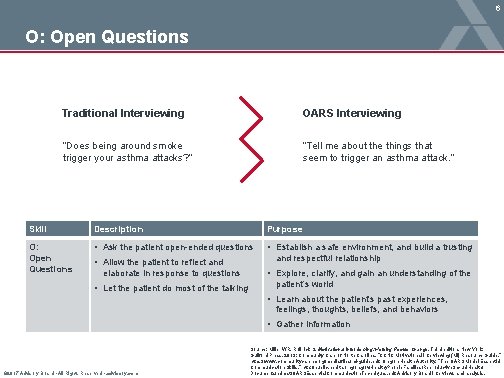
6 O: Open Questions Traditional Interviewing OARS Interviewing “Does being around smoke trigger your asthma attacks? ” “Tell me about the things that seem to trigger an asthma attack. ” Skill Description Purpose O: Open Questions • Ask the patient open-ended questions • Establish a safe environment, and build a trusting • Allow the patient to reflect and elaborate in response to questions • Let the patient do most of the talking and respectful relationship • Explore, clarify, and gain an understanding of the patient’s world • Learn about the patient’s past experiences, feelings, thoughts, beliefs, and behaviors • Gather information © 2017 Advisory Board • All Rights Reserved • advisory. com Source: Miller WR, Rollnick S, Motivational Interviewing: Helping People Change, Third edition, New York: Guilford Press, 2013; Community Care of North Carolina, “CCNC Motivational Interviewing (MI) Resource Guide, ” https: //www. communitycarenc. org/media/files/mi-guide. pdf; Oregon Health Authority, “The OARS Model Essential Communication Skills, ” http: //public. health. oregon. gov/Healthy. People. Families/Reproductive. Sexual. Health/ Documents/edmat/OARSEssential. Communication. Techniques. pdf; Advisory Board interviews and analysis.
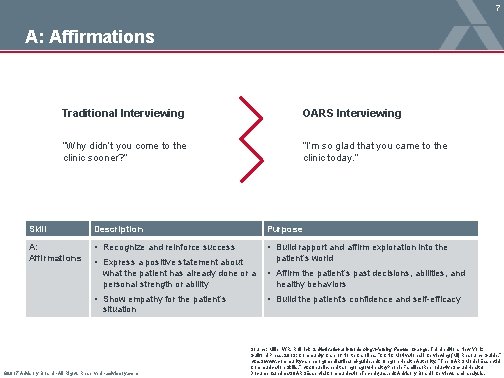
7 A: Affirmations Traditional Interviewing OARS Interviewing “Why didn’t you come to the clinic sooner? ” “I’m so glad that you came to the clinic today. ” Skill Description Purpose A: Affirmations • Recognize and reinforce success • Build rapport and affirm exploration into the patient’s world • Express a positive statement about what the patient has already done or a personal strength or ability • Show empathy for the patient’s • Affirm the patient’s past decisions, abilities, and healthy behaviors • Build the patient’s confidence and self-efficacy situation © 2017 Advisory Board • All Rights Reserved • advisory. com Source: Miller WR, Rollnick S, Motivational Interviewing: Helping People Change, Third edition, New York: Guilford Press, 2013; Community Care of North Carolina, “CCNC Motivational Interviewing (MI) Resource Guide, ” https: //www. communitycarenc. org/media/files/mi-guide. pdf; Oregon Health Authority, “The OARS Model Essential Communication Skills, ” http: //public. health. oregon. gov/Healthy. People. Families/Reproductive. Sexual. Health/ Documents/edmat/OARSEssential. Communication. Techniques. pdf; Advisory Board interviews and analysis.
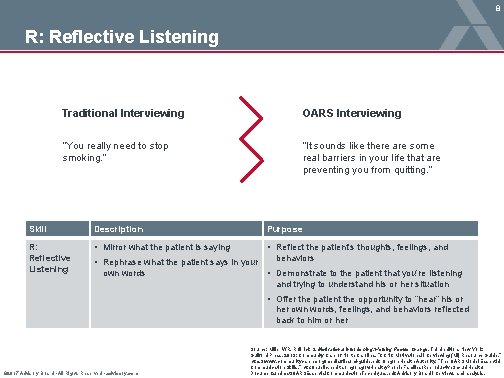
8 R: Reflective Listening Traditional Interviewing OARS Interviewing “You really need to stop smoking. ” “It sounds like there are some real barriers in your life that are preventing you from quitting. ” Skill Description Purpose R: Reflective Listening • Mirror what the patient is saying • Reflect the patient’s thoughts, feelings, and • Rephrase what the patient says in your own words behaviors • Demonstrate to the patient that you’re listening and trying to understand his or her situation • Offer the patient the opportunity to “hear” his or her own words, feelings, and behaviors reflected back to him or her © 2017 Advisory Board • All Rights Reserved • advisory. com Source: Miller WR, Rollnick S, Motivational Interviewing: Helping People Change, Third edition, New York: Guilford Press, 2013; Community Care of North Carolina, “CCNC Motivational Interviewing (MI) Resource Guide, ” https: //www. communitycarenc. org/media/files/mi-guide. pdf; Oregon Health Authority, “The OARS Model Essential Communication Skills, ” http: //public. health. oregon. gov/Healthy. People. Families/Reproductive. Sexual. Health/ Documents/edmat/OARSEssential. Communication. Techniques. pdf; Advisory Board interviews and analysis.
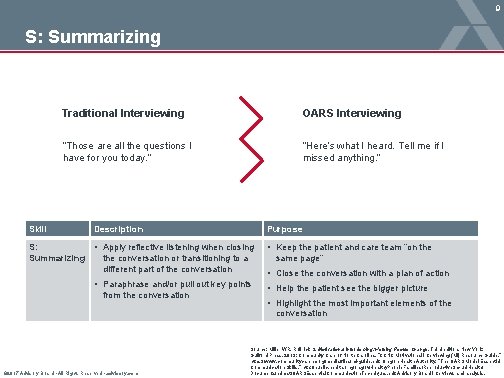
9 S: Summarizing Skill Traditional Interviewing OARS Interviewing “Those are all the questions I have for you today. ” “Here’s what I heard. Tell me if I missed anything. ” Description Purpose S: • Apply reflective listening when closing Summarizing the conversation or transitioning to a different part of the conversation • Paraphrase and/or pull out key points from the conversation • Keep the patient and care team “on the same page” • Close the conversation with a plan of action • Help the patient see the bigger picture • Highlight the most important elements of the conversation © 2017 Advisory Board • All Rights Reserved • advisory. com Source: Miller WR, Rollnick S, Motivational Interviewing: Helping People Change, Third edition, New York: Guilford Press, 2013; Community Care of North Carolina, “CCNC Motivational Interviewing (MI) Resource Guide, ” https: //www. communitycarenc. org/media/files/mi-guide. pdf; Oregon Health Authority, “The OARS Model Essential Communication Skills, ” http: //public. health. oregon. gov/Healthy. People. Families/Reproductive. Sexual. Health/ Documents/edmat/OARSEssential. Communication. Techniques. pdf; Advisory Board interviews and analysis.
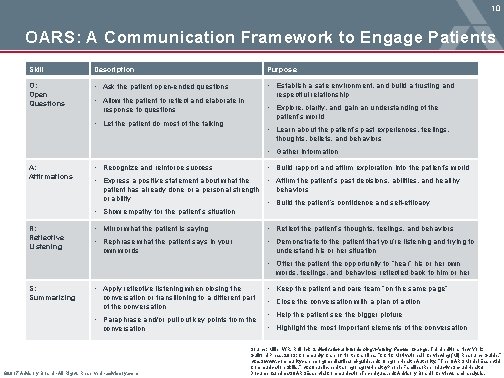
10 OARS: A Communication Framework to Engage Patients Skill Description Purpose O: Open Questions • Ask the patient open-ended questions • Establish a safe environment, and build a trusting and respectful relationship • Allow the patient to reflect and elaborate in • Explore, clarify, and gain an understanding of the response to questions patient’s world • Let the patient do most of the talking • Learn about the patient’s past experiences, feelings, thoughts, beliefs, and behaviors • Gather information A: Affirmations • Recognize and reinforce success • Build rapport and affirm exploration into the patient’s world • Express a positive statement about what the • Affirm the patient’s past decisions, abilities, and healthy patient has already done or a personal strength or ability behaviors • Build the patient’s confidence and self-efficacy • Show empathy for the patient’s situation R: Reflective Listening • Mirror what the patient is saying • Reflect the patient’s thoughts, feelings, and behaviors • Rephrase what the patient says in your • Demonstrate to the patient that you’re listening and trying to own words understand his or her situation • Offer the patient the opportunity to “hear” his or her own words, feelings, and behaviors reflected back to him or her S: Summarizing • Apply reflective listening when closing the • Keep the patient and care team “on the same page” conversation or transitioning to a different part of the conversation • Paraphrase and/or pull out key points from the conversation © 2017 Advisory Board • All Rights Reserved • advisory. com • Close the conversation with a plan of action • Help the patient see the bigger picture • Highlight the most important elements of the conversation Source: Miller WR, Rollnick S, Motivational Interviewing: Helping People Change, Third edition, New York: Guilford Press, 2013; Community Care of North Carolina, “CCNC Motivational Interviewing (MI) Resource Guide, ” https: //www. communitycarenc. org/media/files/mi-guide. pdf; Oregon Health Authority, “The OARS Model Essential Communication Skills, ” http: //public. health. oregon. gov/Healthy. People. Families/Reproductive. Sexual. Health/ Documents/edmat/OARSEssential. Communication. Techniques. pdf; Advisory Board interviews and analysis.
- Slides: 10