
Physician Engagement Learning Objectives To relate what is
Physician Engagement

Learning Objectives • To relate what is meant by physician engagement • To discuss strategies at management and staff levels to enhance physician engagement
What Do We Mean by Engagement? • Engagement: “To involve one self or become occupied; to participate fully and deeply” • Active support of the project
Where Does Engagement Fit? • Work involves technical problems – Evidence – Measurement • Adaptive problems – Engagement of nurses, physicians, leaders, IPs – Competing priorities – Overcoming barriers – Ameliorating safety and teamwork climate
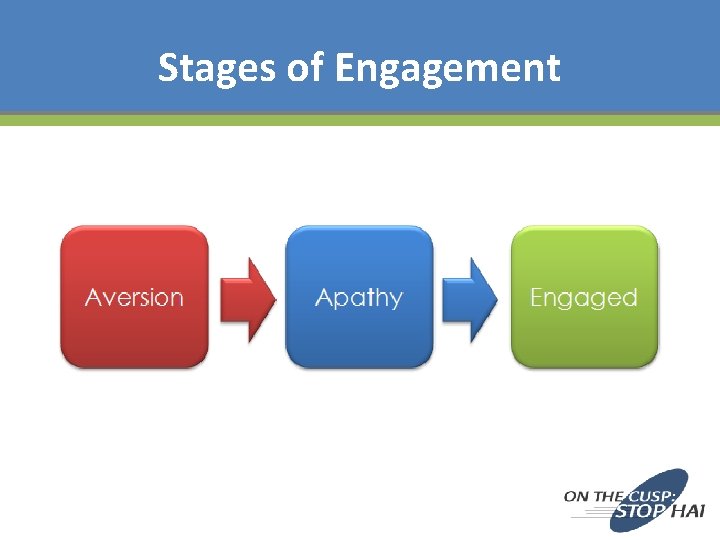
Stages of Engagement
Engage Physician’s Intellect • Show them – The evidence – Your hospital’s CLABSI rates – What others have achieved – That you can do the same
Engage by Creating Trust • Caring – Keep patients as your “North Star, ” your focus – Preventable harm is not acceptable – Tell your own Josie story • Competent – Learn from mistakes and implement teamwork tools – Demonstrate early successes/project results
Physician Engagement Strategies • Management level – Identify physician champion for project • Unit director, chief medical officer, or senior physician • Someone other physicians look up to – Reward physician champions for their efforts • Obtain hospital support for their time • Feature in newsletters • Provide opportunities to present to senior leaders
Physician Engagement Strategies • Management level (continued) – Create a compact (agreement) • Clearly define what is expected of physicians • Review performance regularly
Example: Physician Champion Compact • Hospital will provide support for percent of physicians’ time • In return, physician will – Monitor and improve quality – Implement CUSP and CLABSI toolkit – Hold regular meetings with team – Involve other members of medical staff in quality – Report CLABSI rates and learning from defects results to senior leaders and board
Example: Physician Champion Compact • Further, the physician will – Work with hospital to clarify what will be measured, who will measure it, and who will produce reports – Meet quarterly to discuss progress
Physician Engagement Strategies • Staff level – Create containing vessel (environment) to have a dialogue with physicians (eliminate decoding errors) • M and M, grand rounds, quality meetings, etc. – Identify and overcome barriers to engagement • Clinician, intervention, system • Try physician engagement self-diagnostic tool (safercare. net)
Physician Engagement Strategies • Staff level (continued) – Communicate prior to start of project • No surprises • Who, what, when, where, how – Listen to those who resist/value the dissenter – Create mechanisms to feed results back to physicians
Handling Barriers to Change • Tune in to WIFM (What’s In It For Me? ) • People resist loss, not change – Try to surface and mitigate real and perceived loss – Physician’s time is likely a major concern – Perceived losses often much greater than real loss – Perceived loss high when communication is low
Manage Communication • At each step or meeting – Clarify message – Determine who needs to know – Make time for feedback • Assume that all staff have patient as their “North Star” • Remind staff they are participating in something greater – “Ohana”
Action Plan • • • Cultivate a physician champion for this project Create compact for physician champion role Create containing vessel for communication Develop communication plan for CUSP education Listen to physicians to surface and mitigate loss

- Slides: 18