
PhysicallyBased Locomotion Carl Schissler 20141103 Motivation Need for
Physically-Based Locomotion Carl Schissler 2014/11/03
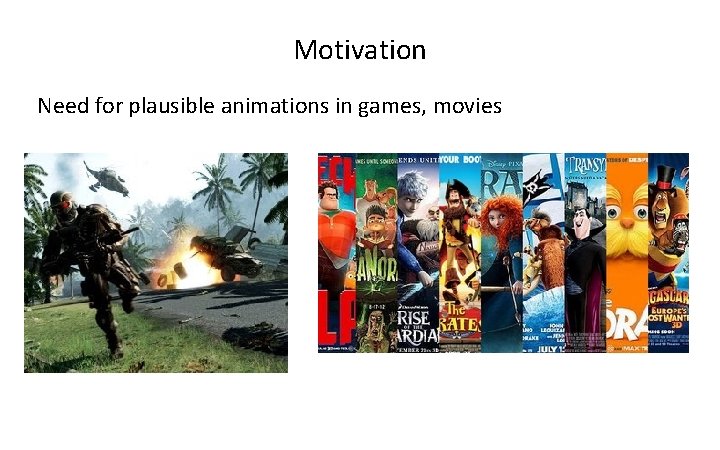
Motivation Need for plausible animations in games, movies
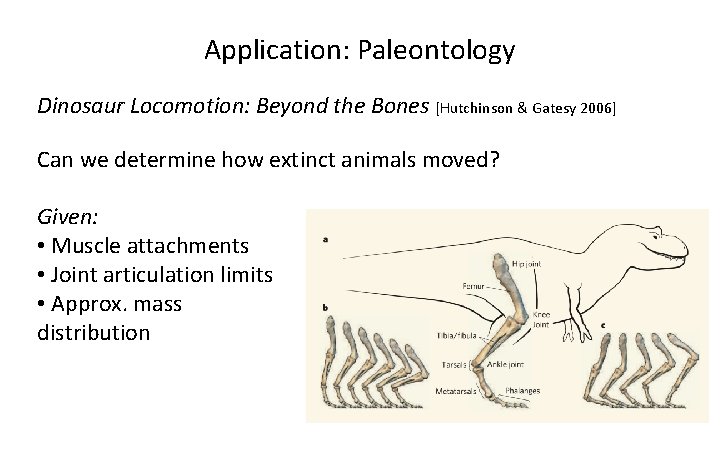
Application: Paleontology Dinosaur Locomotion: Beyond the Bones [Hutchinson & Gatesy 2006] Can we determine how extinct animals moved? Given: • Muscle attachments • Joint articulation limits • Approx. mass distribution
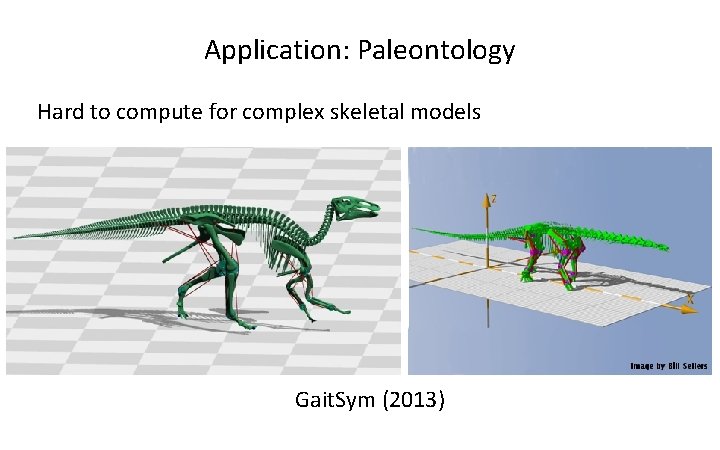
Application: Paleontology Hard to compute for complex skeletal models Gait. Sym (2013)
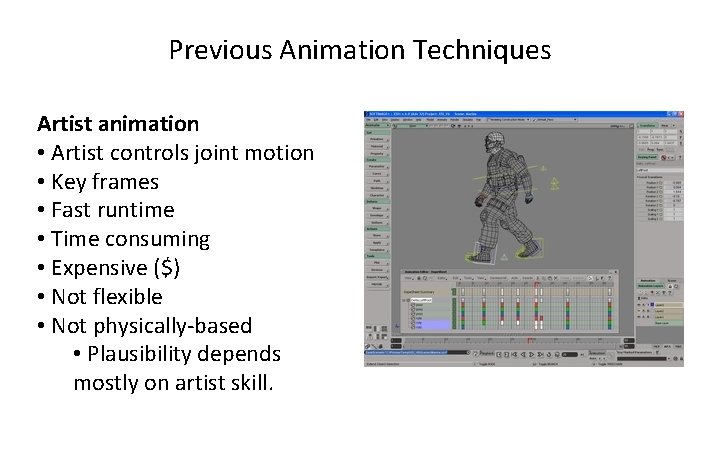
Previous Animation Techniques Artist animation • Artist controls joint motion • Key frames • Fast runtime • Time consuming • Expensive ($) • Not flexible • Not physically-based • Plausibility depends mostly on artist skill.
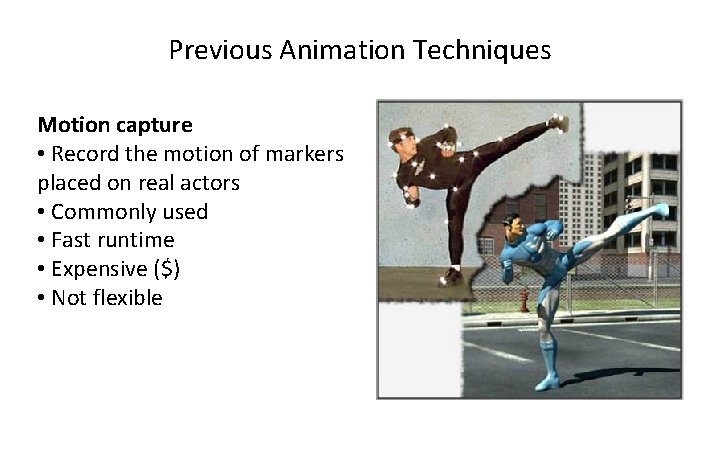
Previous Animation Techniques Motion capture • Record the motion of markers placed on real actors • Commonly used • Fast runtime • Expensive ($) • Not flexible
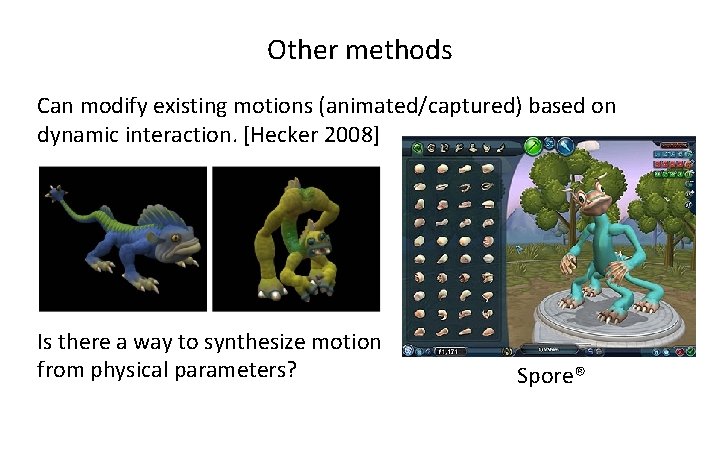
Other methods Can modify existing motions (animated/captured) based on dynamic interaction. [Hecker 2008] Is there a way to synthesize motion from physical parameters? Spore®
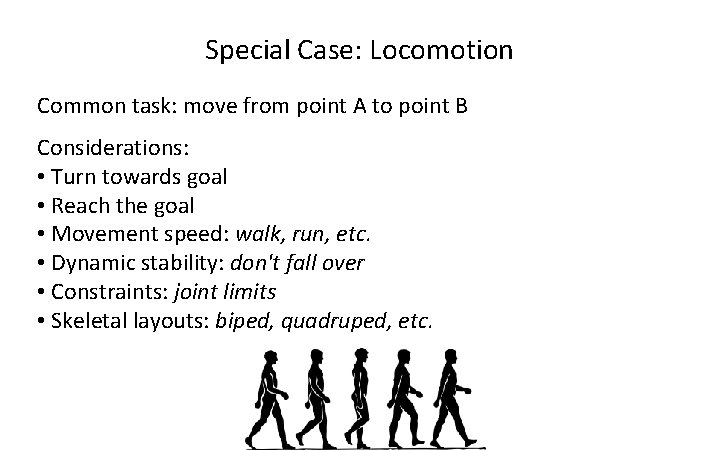
Special Case: Locomotion Common task: move from point A to point B Considerations: • Turn towards goal • Reach the goal • Movement speed: walk, run, etc. • Dynamic stability: don't fall over • Constraints: joint limits • Skeletal layouts: biped, quadruped, etc.
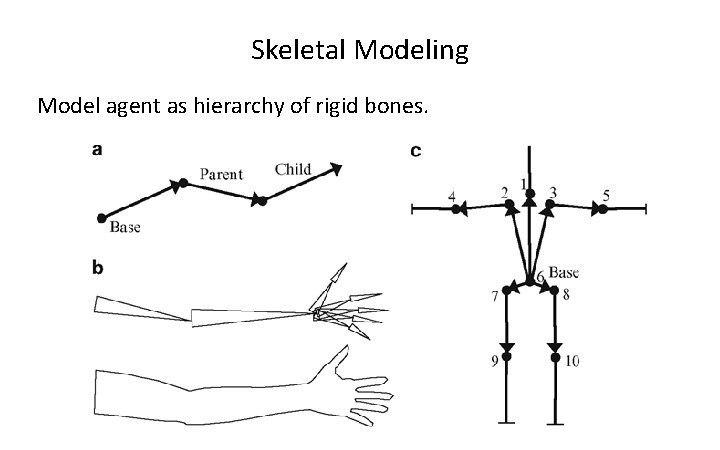
Skeletal Modeling Model agent as hierarchy of rigid bones.
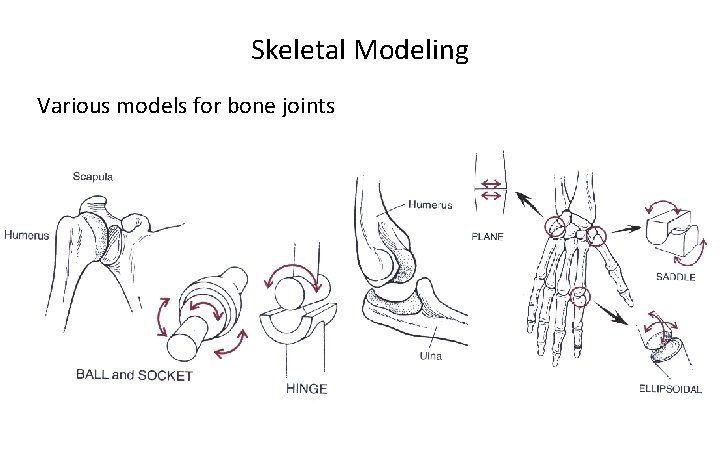
Skeletal Modeling Various models for bone joints
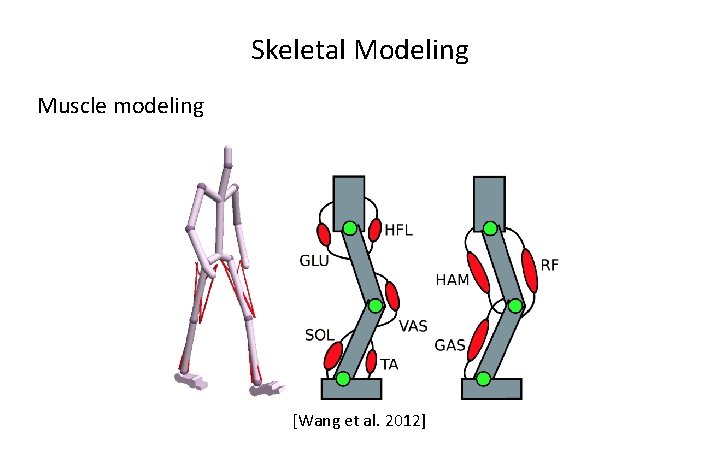
Skeletal Modeling Muscle modeling [Wang et al. 2012]
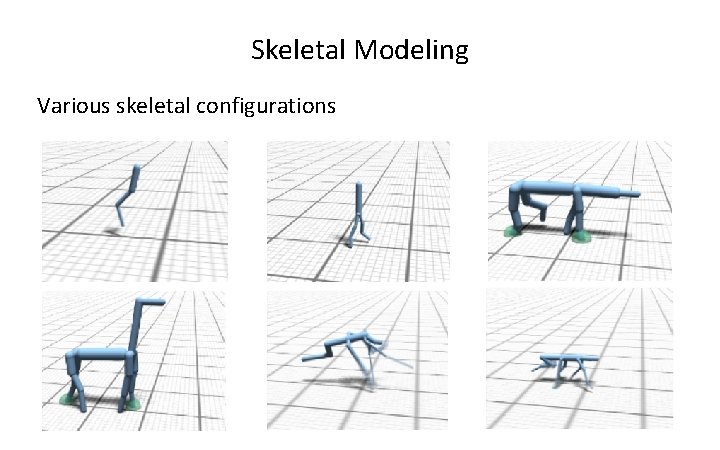
Skeletal Modeling Various skeletal configurations
Problem Overview Goal: determine each joint's torque/force at each time step. Common approach: optimize to achieve task (walk, run) Many DOF Potential methods: • Gradient descent (local minima!) • Genetic algorithms • Constrained optimization • Motion planning
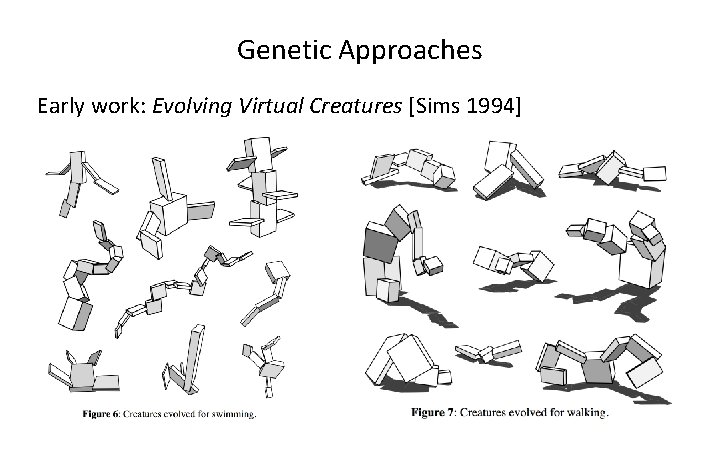
Genetic Approaches Early work: Evolving Virtual Creatures [Sims 1994]
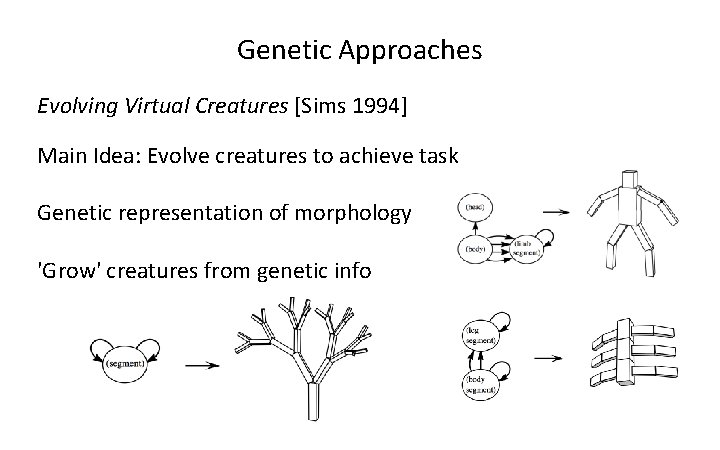
Genetic Approaches Evolving Virtual Creatures [Sims 1994] Main Idea: Evolve creatures to achieve task Genetic representation of morphology 'Grow' creatures from genetic info
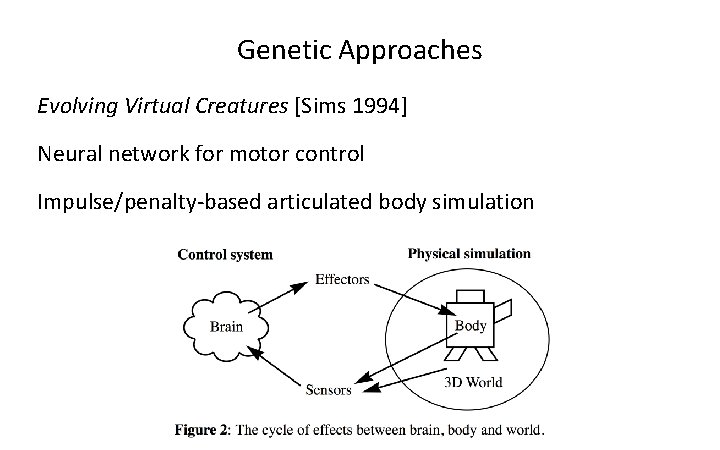
Genetic Approaches Evolving Virtual Creatures [Sims 1994] Neural network for motor control Impulse/penalty-based articulated body simulation
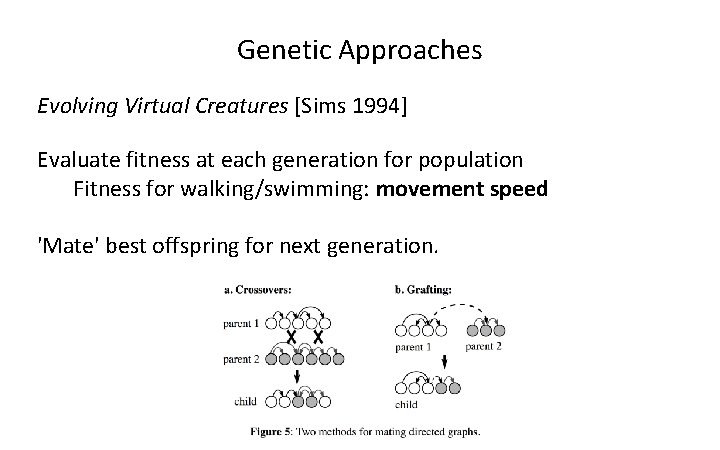
Genetic Approaches Evolving Virtual Creatures [Sims 1994] Evaluate fitness at each generation for population Fitness for walking/swimming: movement speed 'Mate' best offspring for next generation.
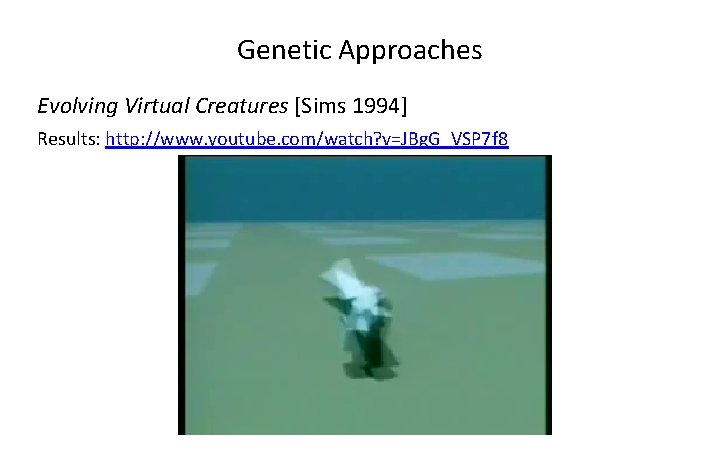
Genetic Approaches Evolving Virtual Creatures [Sims 1994] Results: http: //www. youtube. com/watch? v=JBg. G_VSP 7 f 8
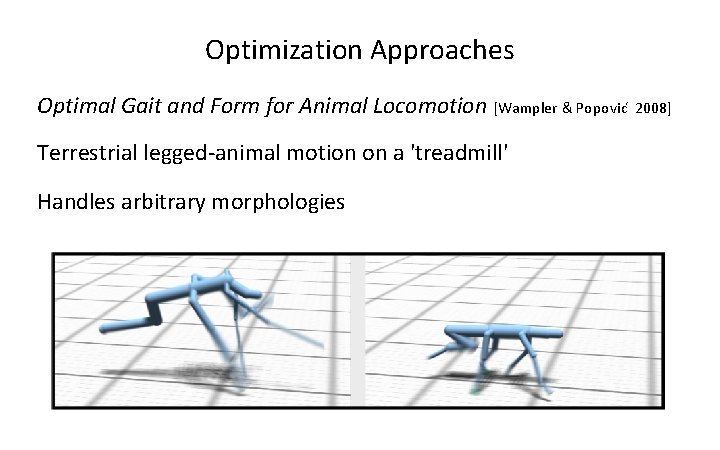
Optimization Approaches Optimal Gait and Form for Animal Locomotion [Wampler & Popovic 2008] Terrestrial legged-animal motion on a 'treadmill' Handles arbitrary morphologies
Optimization Approaches Optimal Gait and Form for Animal Locomotion [Wampler & Popovic 2008] Optimize joint forces f and torques t at each time step Constraints: • Body stays mostly stationary • No self intersection • Motion along one axis • Contact forces within friction cone (no sliding)
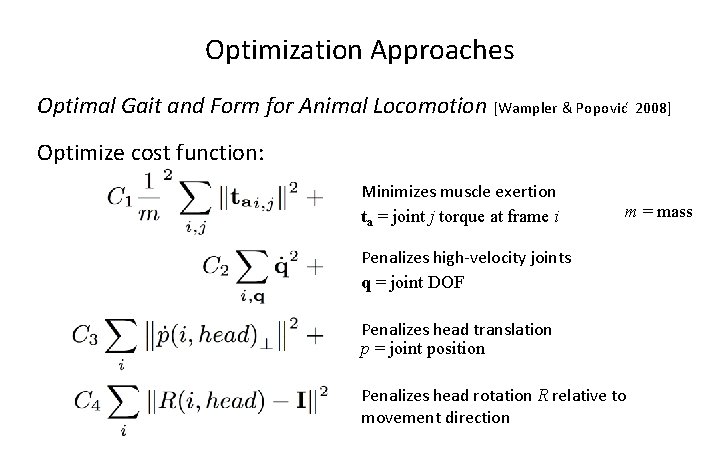
Optimization Approaches Optimal Gait and Form for Animal Locomotion [Wampler & Popovic 2008] Optimize cost function: Minimizes muscle exertion ta = joint j torque at frame i m = mass Penalizes high-velocity joints q = joint DOF Penalizes head translation p = joint position Penalizes head rotation R relative to movement direction
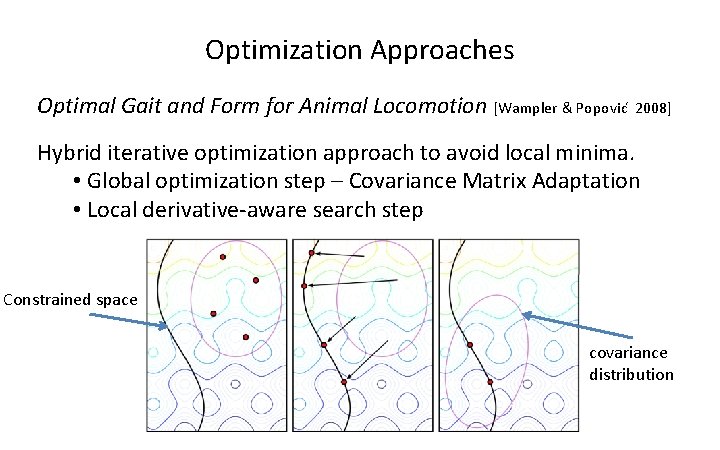
Optimization Approaches Optimal Gait and Form for Animal Locomotion [Wampler & Popovic 2008] Hybrid iterative optimization approach to avoid local minima. • Global optimization step – Covariance Matrix Adaptation • Local derivative-aware search step Constrained space covariance distribution
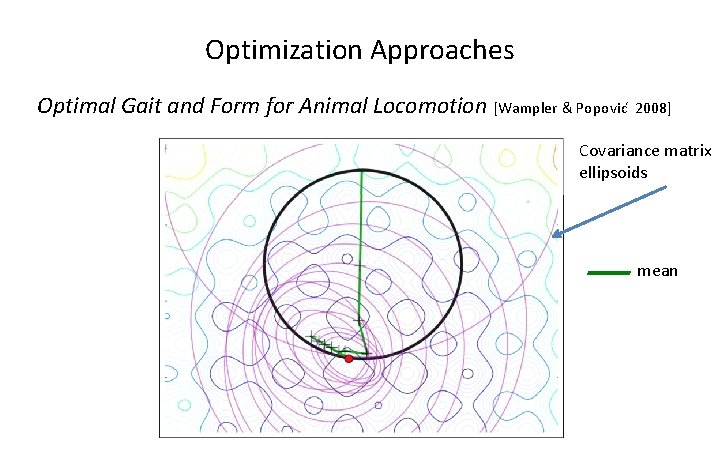
Optimization Approaches Optimal Gait and Form for Animal Locomotion [Wampler & Popovic 2008] Covariance matrix ellipsoids mean
Optimization Approaches Optimal Gait and Form for Animal Locomotion [Wampler & Popovic 2008] Results: http: //grail. cs. washington. edu/projects/animal-morphology/s 2009/movs/morphology. avi
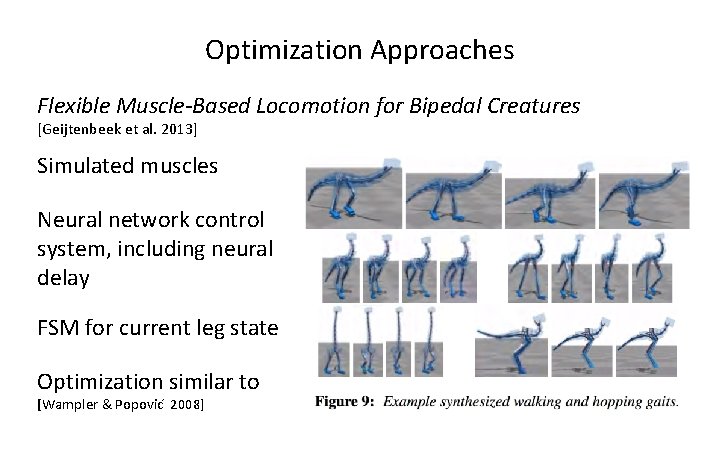
Optimization Approaches Flexible Muscle-Based Locomotion for Bipedal Creatures [Geijtenbeek et al. 2013] Simulated muscles Neural network control system, including neural delay FSM for current leg state Optimization similar to [Wampler & Popovic 2008]
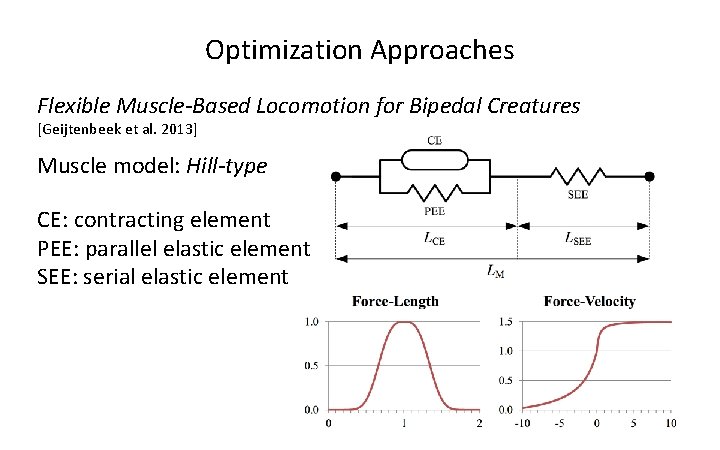
Optimization Approaches Flexible Muscle-Based Locomotion for Bipedal Creatures [Geijtenbeek et al. 2013] Muscle model: Hill-type CE: contracting element PEE: parallel elastic element SEE: serial elastic element
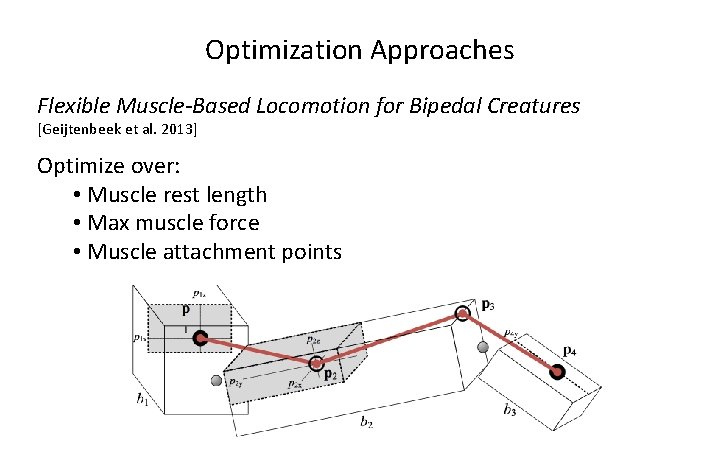
Optimization Approaches Flexible Muscle-Based Locomotion for Bipedal Creatures [Geijtenbeek et al. 2013] Optimize over: • Muscle rest length • Max muscle force • Muscle attachment points
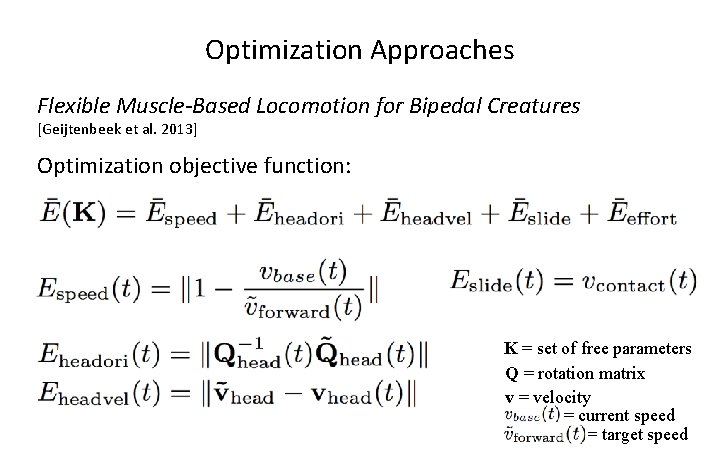
Optimization Approaches Flexible Muscle-Based Locomotion for Bipedal Creatures [Geijtenbeek et al. 2013] Optimization objective function: K = set of free parameters Q = rotation matrix v = velocity = current speed = target speed

Optimization Approaches Flexible Muscle-Based Locomotion for Bipedal Creatures 1. 2. 3. 4.
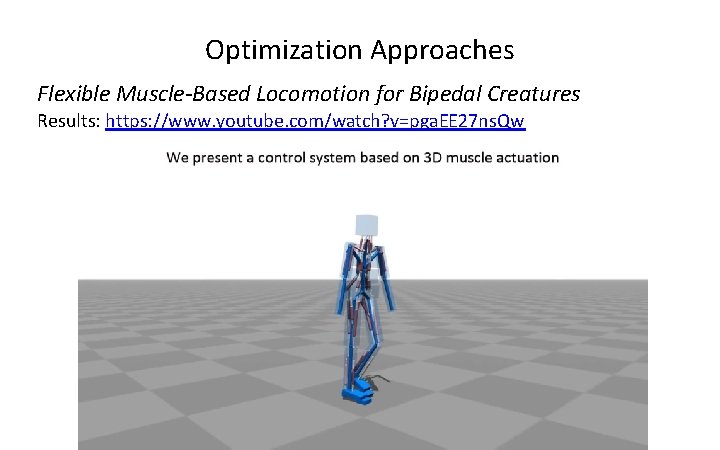
Optimization Approaches Flexible Muscle-Based Locomotion for Bipedal Creatures Results: https: //www. youtube. com/watch? v=pga. EE 27 ns. Qw
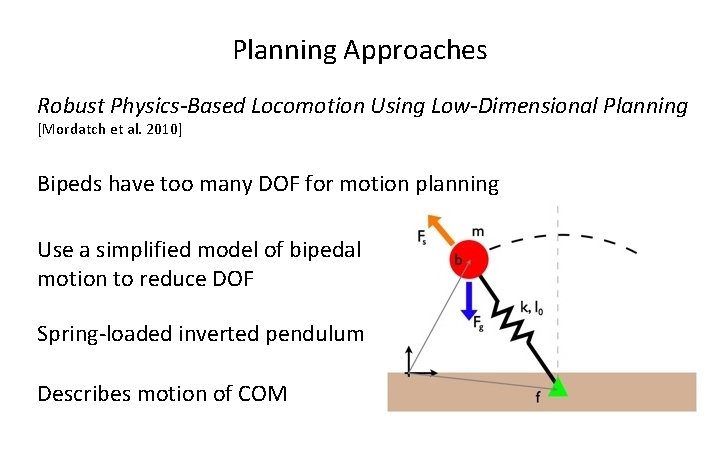
Planning Approaches Robust Physics-Based Locomotion Using Low-Dimensional Planning [Mordatch et al. 2010] Bipeds have too many DOF for motion planning Use a simplified model of bipedal motion to reduce DOF Spring-loaded inverted pendulum Describes motion of COM
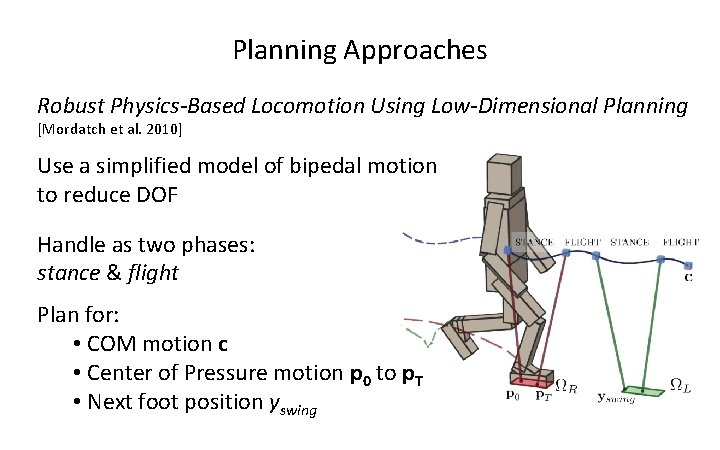
Planning Approaches Robust Physics-Based Locomotion Using Low-Dimensional Planning [Mordatch et al. 2010] Use a simplified model of bipedal motion to reduce DOF Handle as two phases: stance & flight Plan for: • COM motion c • Center of Pressure motion p 0 to p. T • Next foot position yswing
Planning Approaches Robust Physics-Based Locomotion Using Low-Dimensional Planning [Mordatch et al. 2010] Planning done at each step Optimize joint forces, torques to accomplish plan Quadratic programming Objective function: • Minimize deviation of COM/pelvis heading from plan • Head stabilization • Minimize foot contact sliding
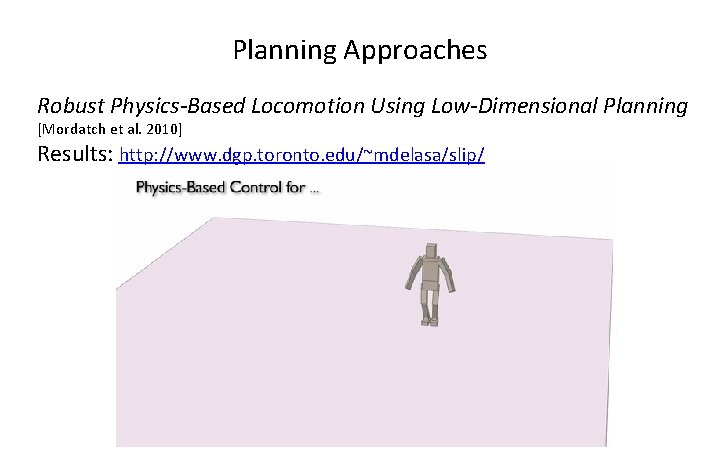
Planning Approaches Robust Physics-Based Locomotion Using Low-Dimensional Planning [Mordatch et al. 2010] Results: http: //www. dgp. toronto. edu/~mdelasa/slip/
Future Work Full-body motion – most methods use simplified models, small range of motion More responsive to turning, dynamic obstacles Deformable models Automatic parameter setting (e. g. for objective function weights) Integration with global planning/local collision avoidance

Questions?
References Evolving Virtual Creatures K Sims ACM SIGGRAPH 1994 http: //excelsior. biosci. ohio-state. edu/~carlson/history/PDFs/ani-papers/sims-virtual-creatures. pdf Beyond the Bones J Hutchinson, S Gatesy Nature, 2006 http: //www. researchgate. net/publication/40664312_Beyond_the_bones/file/9 fcfd 5009947 e 26 dc 8. pdf Optimal Gait and Form for Animal Locomotion K Wampler, Z Popović ACM TOG, 2009 http: //grail. cs. washington. edu/projects/animal-morphology/s 2009/Optimal_Gait_and_Form_for_Animal_Locomotion. pdf Optimizing Walking Controllers JM Wang, DJ Fleet, A Hertzmann ACM TOG 2009 http: //www. cs. toronto. edu/~fleet/research/Papers/optwalk. ACMTrans. Graph. pdf Robust physics-based locomotion using low-dimensional planning I Mordatch, M De Lasa, A Hertzmann ACM TOG, 2010 http: //dl. acm. org/citation. cfm? id=1778808
References Interactive Character Animation using Simulated Physics T Geijtenbeek, N Pronost, A Egges Eurographics 2011 http: //graphics. cmu. edu/nsp/course/15 -869/2012/papers/Physics. Animation_EG 11. pdf Locomotion Skills for Simulated Quadrupeds S Coros, A Karpathy, B Jones, L Reveret ACM TOG, 2011 http: //hal. inria. fr/docs/00/59/76/64/PDF/paper-quadrupeds 2011. pdf Optimizing locomotion controllers using biologically-based actuators and objectives JM Wang, SR Hamner, SL Delp, V Koltun ACM TOG, 2012 http: //146. 163. 150. 3/~wwhite/CS 582/Research. Papers/Lehan_Character. Locomotion/Optimizing. Controllers_ACMTo. G 0712. pdf Flexible Muscle-Based Locomotion for Bipedal Creatures T Geijtenbeek, M van de Panne ACM TOG, 2013 http: //courses. washington. edu/bioen 520/notes/Geijtenbeek_(Trans_on_Graphics_2013). pdf
- Slides: 38