
Physical workload and low back disorders Does fairness
Physical workload and low back disorders: Does fairness matter? Kaori Fujishiro, Ph. D National Institute for Occupational Safety and Health The findings and conclusion in this presentation have not been formally disseminated by the National Institute for Occupational Safety and Health and should not be construed to represent any agency determination or policy.
Acknowledgements n n n Catherine A. Heaney Sue A. Ferguson W. Gary Allread Sato Ashida William S. Marras This study was supported by NIOSH 5 R 01 OH 003914 -03.
Risk Factors for Low Back Disorders n Biomechanical characteristics of the job n n Heavy lifting, pushing, pulling Awkward posture Whole body vibration “Psychosocial factors” n n Psychosocial characteristics of the job (e. g. , job demands, job control) Hartvigsen et al, 2004 Personality traits (e. g. , introvert, extrovert) Marras et al. , 2000 n Mental health (e. g. , depression) Rubin, 2007
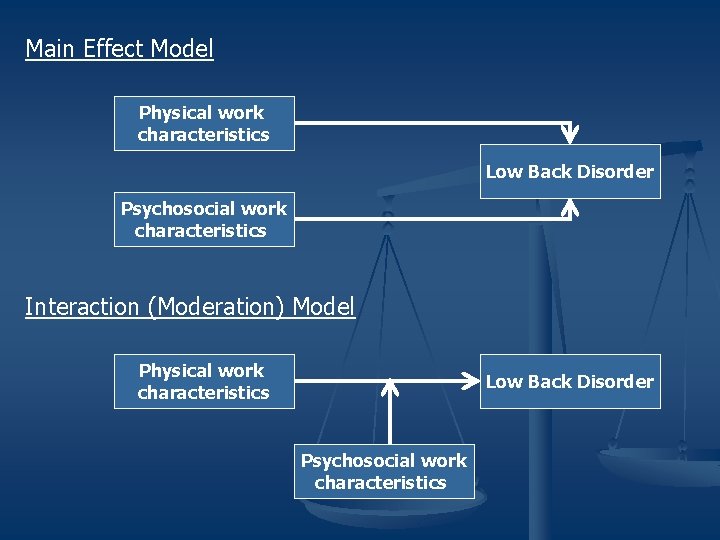
Main Effect Model Physical work characteristics Low Back Disorder Psychosocial work characteristics Interaction (Moderation) Model Physical work characteristics Low Back Disorder Psychosocial work characteristics
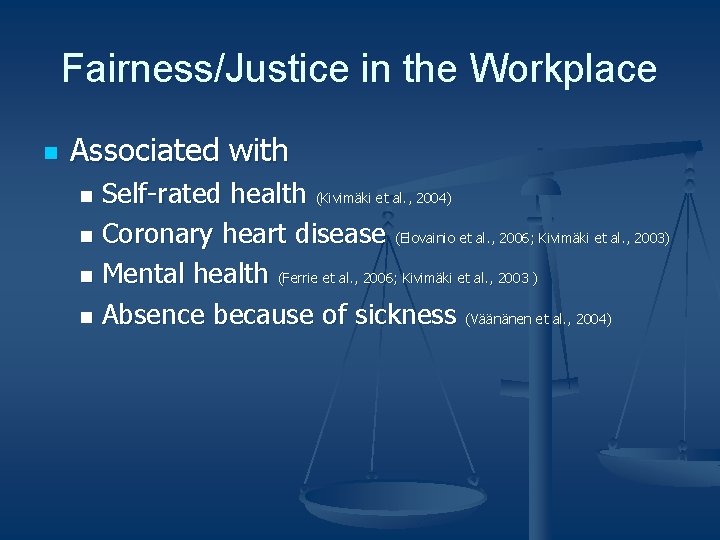
Fairness/Justice in the Workplace n Associated with Self-rated health (Kivimäki et al. , 2004) n Coronary heart disease (Elovainio et al. , 2006; Kivimäki et al. , 2003) n Mental health (Ferrie et al. , 2006; Kivimäki et al. , 2003 ) n Absence because of sickness (Väänänen et al. , 2004) n
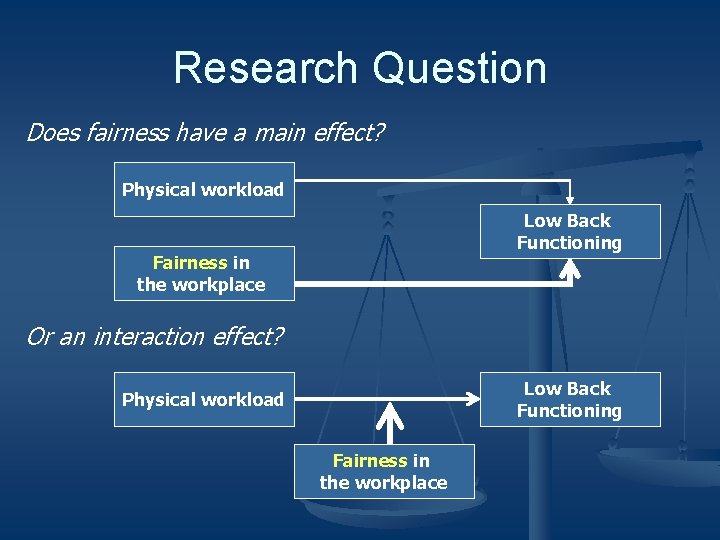
Research Question Does fairness have a main effect? Physical workload Low Back Functioning Fairness in the workplace Or an interaction effect? Low Back Functioning Physical workload Fairness in the workplace
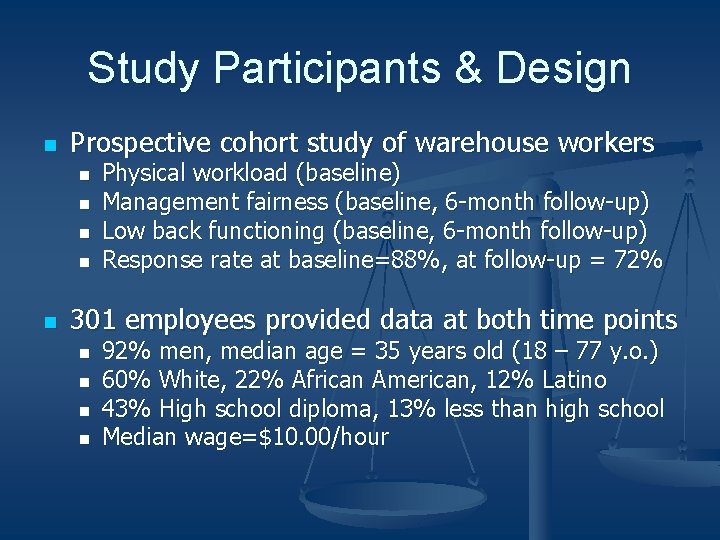
Study Participants & Design n Prospective cohort study of warehouse workers n n n Physical workload (baseline) Management fairness (baseline, 6 -month follow-up) Low back functioning (baseline, 6 -month follow-up) Response rate at baseline=88%, at follow-up = 72% 301 employees provided data at both time points n n 92% men, median age = 35 years old (18 – 77 y. o. ) 60% White, 22% African American, 12% Latino 43% High school diploma, 13% less than high school Median wage=$10. 00/hour
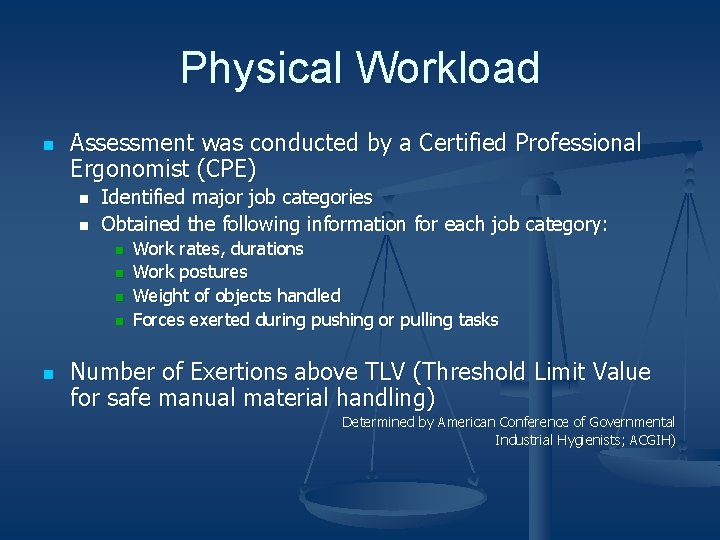
Physical Workload n Assessment was conducted by a Certified Professional Ergonomist (CPE) n n Identified major job categories Obtained the following information for each job category: n n n Work rates, durations Work postures Weight of objects handled Forces exerted during pushing or pulling tasks Number of Exertions above TLV (Threshold Limit Value for safe manual material handling) Determined by American Conference of Governmental Industrial Hygienists; ACGIH)
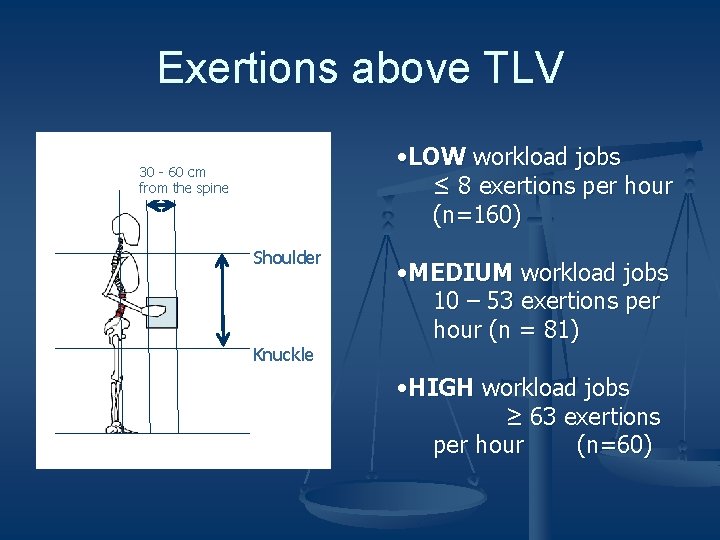
Exertions above TLV • LOW workload jobs ≤ 8 exertions per hour (n=160) 30 - 60 cm from the spine Shoulder Knuckle • MEDIUM workload jobs 10 – 53 exertions per hour (n = 81) • HIGH workload jobs ≥ 63 exertions per hour (n=60)
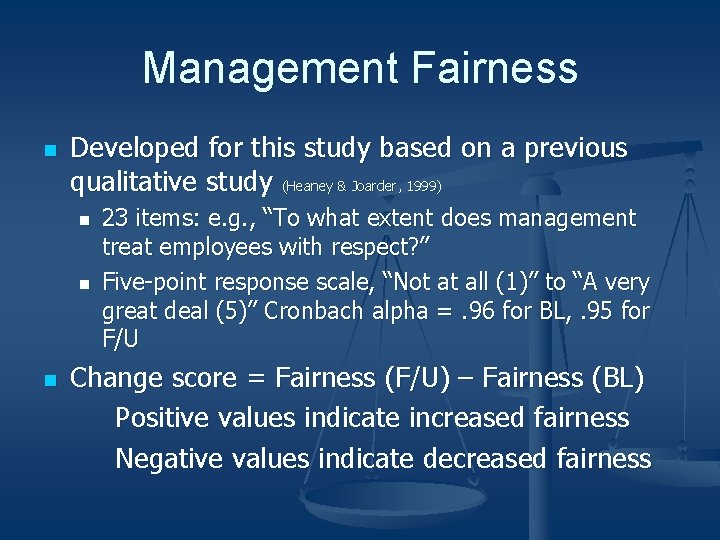
Management Fairness n Developed for this study based on a previous qualitative study (Heaney & Joarder, 1999) n n n 23 items: e. g. , “To what extent does management treat employees with respect? ” Five-point response scale, “Not at all (1)” to “A very great deal (5)” Cronbach alpha =. 96 for BL, . 95 for F/U Change score = Fairness (F/U) – Fairness (BL) Positive values indicate increased fairness Negative values indicate decreased fairness
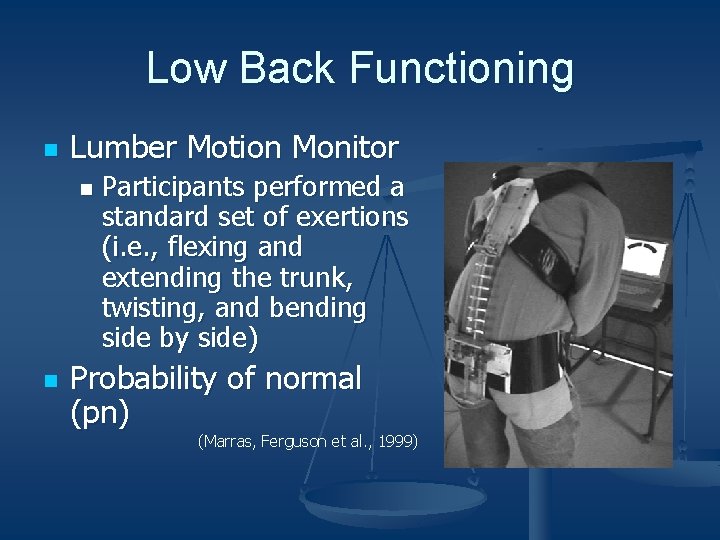
Low Back Functioning n Lumber Motion Monitor n n Participants performed a standard set of exertions (i. e. , flexing and extending the trunk, twisting, and bending side by side) Probability of normal (pn) (Marras, Ferguson et al. , 1999)
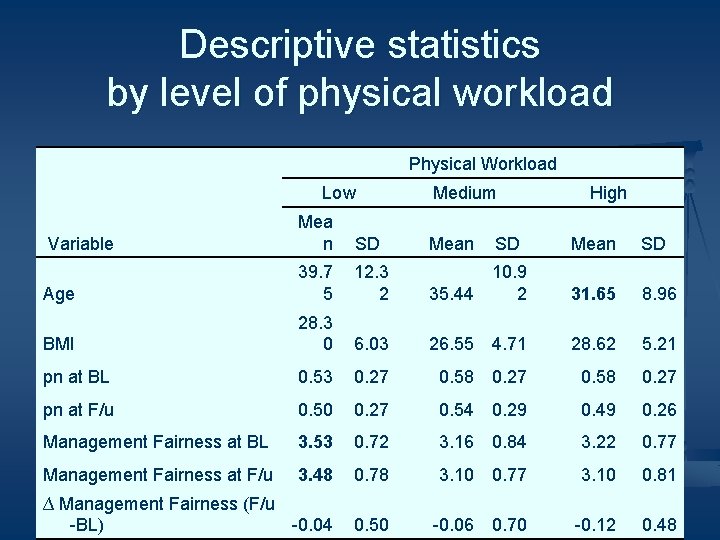
Descriptive statistics by level of physical workload Physical Workload Low Medium Variable Mea n SD Mean Age 39. 7 5 12. 3 2 BMI 28. 3 0 pn at BL SD High Mean SD 10. 9 35. 44 2 31. 65 8. 96 6. 03 26. 55 4. 71 28. 62 5. 21 0. 53 0. 27 0. 58 0. 27 pn at F/u 0. 50 0. 27 0. 54 0. 29 0. 49 0. 26 Management Fairness at BL 3. 53 0. 72 3. 16 0. 84 3. 22 0. 77 Management Fairness at F/u 3. 48 0. 78 3. 10 0. 77 3. 10 0. 81 ∆ Management Fairness (F/u -BL) -0. 04 0. 50 -0. 06 0. 70 -0. 12 0. 48
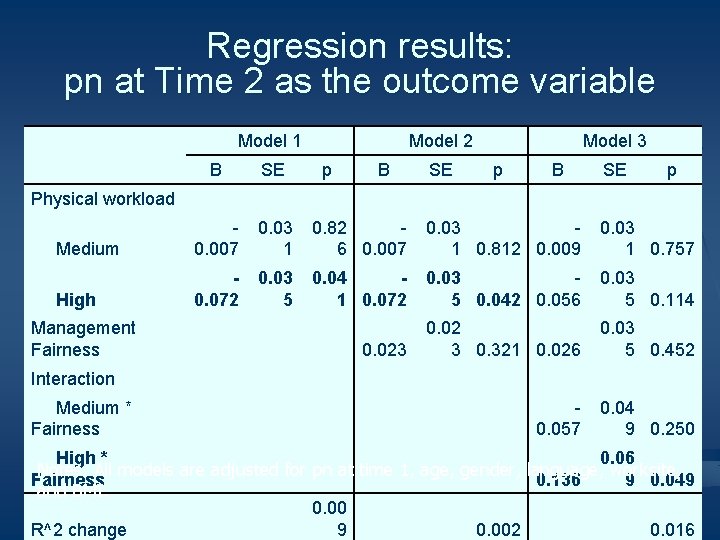
Regression results: pn at Time 2 as the outcome variable Model 1 B Model 2 SE p Physical workload B SE Model 3 p B SE p Medium 0. 007 0. 03 1 0. 82 6 0. 007 0. 03 1 0. 812 0. 009 0. 03 1 0. 757 High 0. 072 0. 03 5 0. 04 1 0. 072 0. 03 5 0. 042 0. 056 0. 03 5 0. 114 Management Fairness 0. 02 3 0. 321 0. 026 0. 03 5 0. 452 Interaction Medium * Fairness 0. 023 0. 057 0. 04 9 0. 250 High * 0. 06 Notes. All models are adjusted for pn at time 1, age, gender, language, worksite, Fairness 0. 136 9 0. 049 and BMI. 0. 00 R^2 change 9 0. 002 0. 016
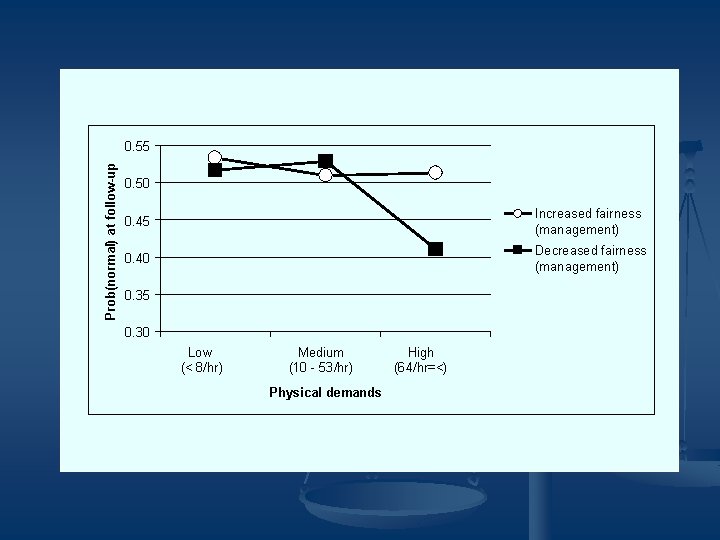
Prob(normal) at follow-up 0. 55 0. 50 0. 45 Increased fairness (management) 0. 40 Decreased fairness (management) 0. 35 0. 30 Low (< 8/hr) Medium (10 - 53/hr) Physical demands High (64/hr=<)
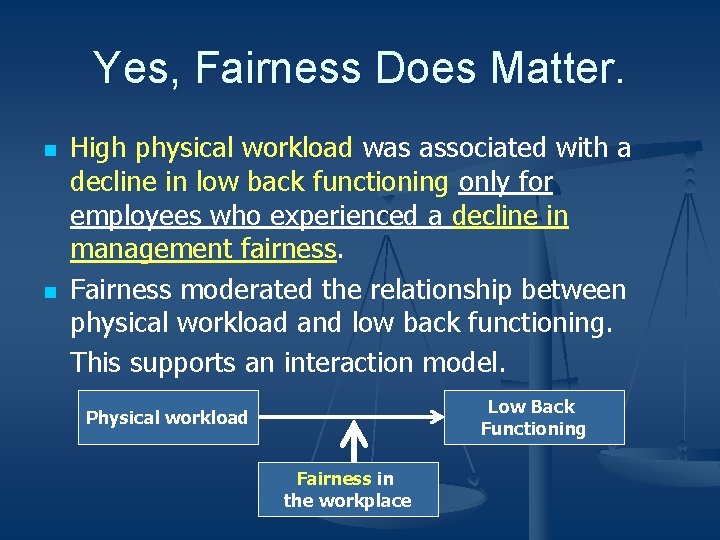
Yes, Fairness Does Matter. n n High physical workload was associated with a decline in low back functioning only for employees who experienced a decline in management fairness. Fairness moderated the relationship between physical workload and low back functioning. This supports an interaction model. Low Back Functioning Physical workload Fairness in the workplace
Implications n Future research n n n Examine interaction effects of psychosocial work characteristics Investigate fairness as a moderator for other health outcomes Intervention n n Assess employees’ perceptions of fairness in the workplace, and address causes of unfairness Consider whether a fair workplace might also enhance the effectiveness of other intervention efforts
- Slides: 16