
Physical versus Chemical Properties The study of matter
- Slides: 18
Physical versus Chemical Properties The study of matter
Reviewing MATTER • Matter: anything that has mass and takes up space – Mass – the amount of matter in something – Volume – the amount of space something occupies • Which of the following is matter? – – A car? A box? You? Sunshine?
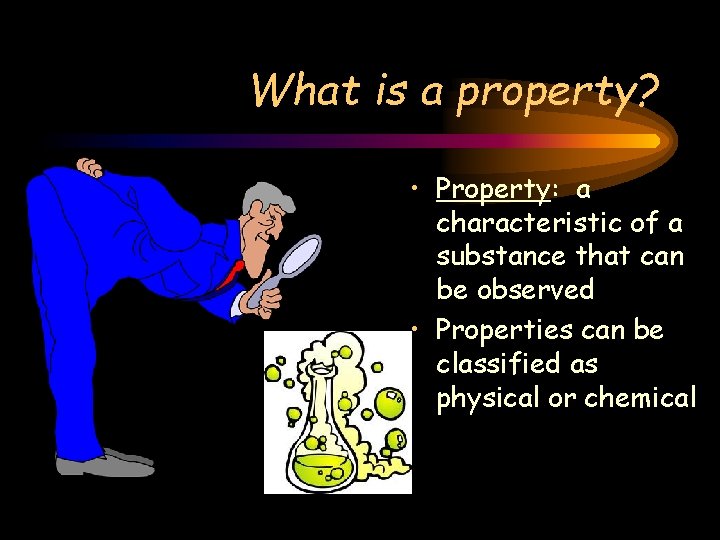
What is a property? • Property: a characteristic of a substance that can be observed • Properties can be classified as physical or chemical
Physical Property Physical property: a property that can be observed without changing the identity of the substance. Examples: • luster • melting point • malleability: the ability to be hammered into a thin sheet • boiling point • ductility: the ability to be stretched into a wire • solubility • density • specific heat
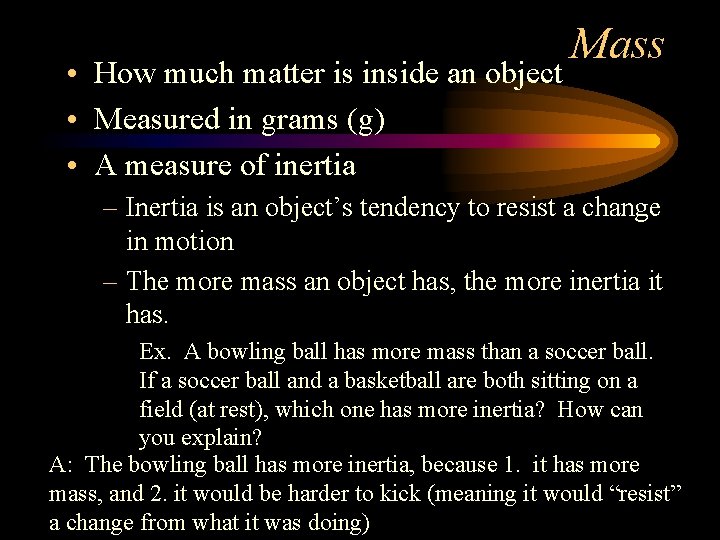
• How much matter is inside an object • Measured in grams (g) • A measure of inertia Mass – Inertia is an object’s tendency to resist a change in motion – The more mass an object has, the more inertia it has. Ex. A bowling ball has more mass than a soccer ball. If a soccer ball and a basketball are both sitting on a field (at rest), which one has more inertia? How can you explain? A: The bowling ball has more inertia, because 1. it has more mass, and 2. it would be harder to kick (meaning it would “resist” a change from what it was doing)
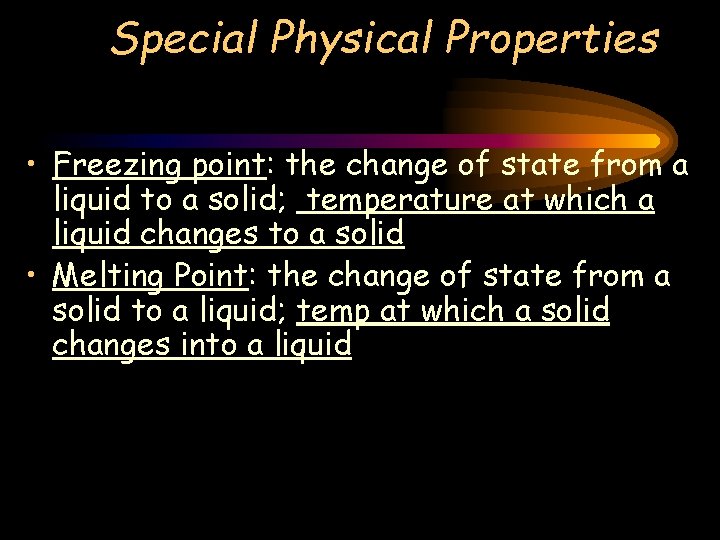
Special Physical Properties • Freezing point: the change of state from a liquid to a solid; temperature at which a liquid changes to a solid • Melting Point: the change of state from a solid to a liquid; temp at which a solid changes into a liquid
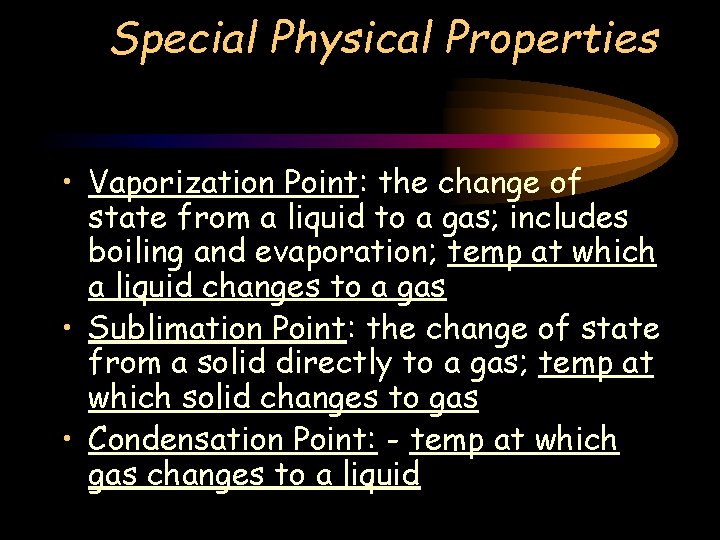
Special Physical Properties • Vaporization Point: the change of state from a liquid to a gas; includes boiling and evaporation; temp at which a liquid changes to a gas • Sublimation Point: the change of state from a solid directly to a gas; temp at which solid changes to gas • Condensation Point: - temp at which gas changes to a liquid
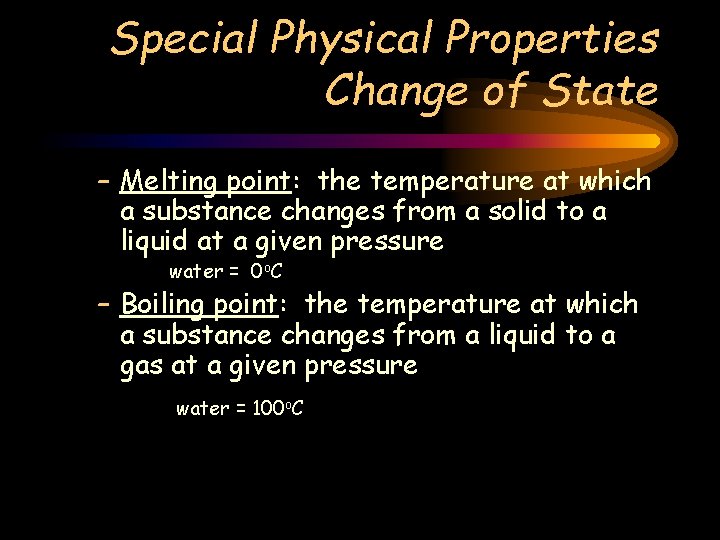
Special Physical Properties Change of State – Melting point: the temperature at which a substance changes from a solid to a liquid at a given pressure water = 0 o. C – Boiling point: the temperature at which a substance changes from a liquid to a gas at a given pressure water = 100 o. C
Density • Density is the amount of mass per unit of volume. • Density can be used to identify a substance. • The density of an object does not change regardless of sample size. • The density of water is 1. 0 g/m. L
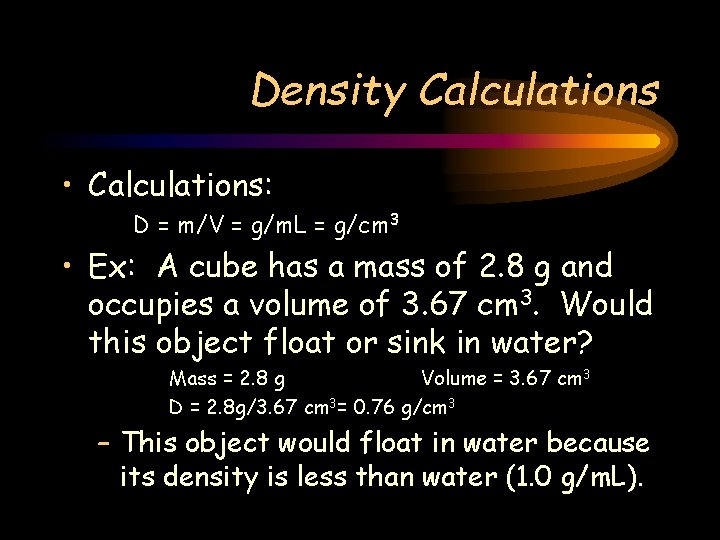
Density Calculations • Calculations: D = m/V = g/m. L = g/cm 3 • Ex: A cube has a mass of 2. 8 g and occupies a volume of 3. 67 cm 3. Would this object float or sink in water? Mass = 2. 8 g Volume = 3. 67 cm 3 D = 2. 8 g/3. 67 cm 3= 0. 76 g/cm 3 – This object would float in water because its density is less than water (1. 0 g/m. L).
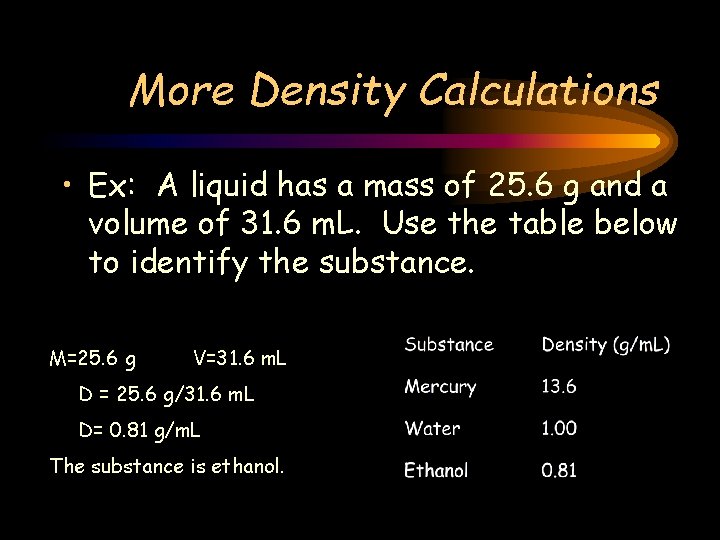
More Density Calculations • Ex: A liquid has a mass of 25. 6 g and a volume of 31. 6 m. L. Use the table below to identify the substance. M=25. 6 g V=31. 6 m. L D = 25. 6 g/31. 6 m. L D= 0. 81 g/m. L The substance is ethanol.
Chemical Properties • Chemical property: a property that can only be observed by changing the identity of the substance Examples: • Flammability • Combustibility • Reactivity
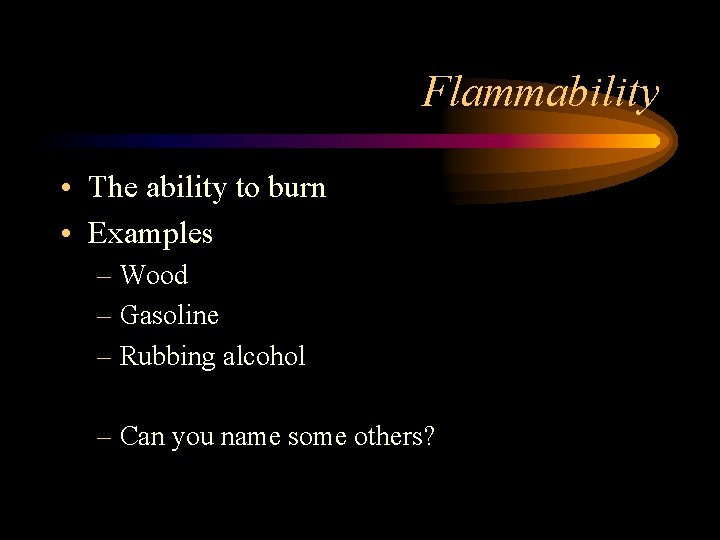
Flammability • The ability to burn • Examples – Wood – Gasoline – Rubbing alcohol – Can you name some others?
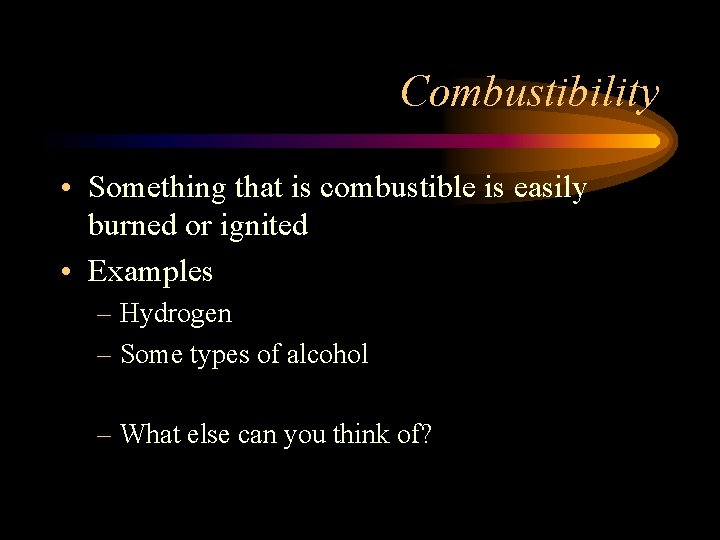
Combustibility • Something that is combustible is easily burned or ignited • Examples – Hydrogen – Some types of alcohol – What else can you think of?
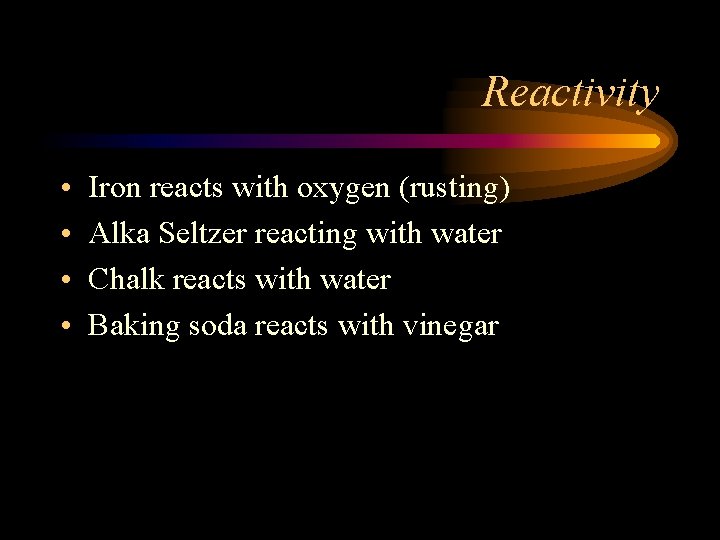
Reactivity • • Iron reacts with oxygen (rusting) Alka Seltzer reacting with water Chalk reacts with water Baking soda reacts with vinegar
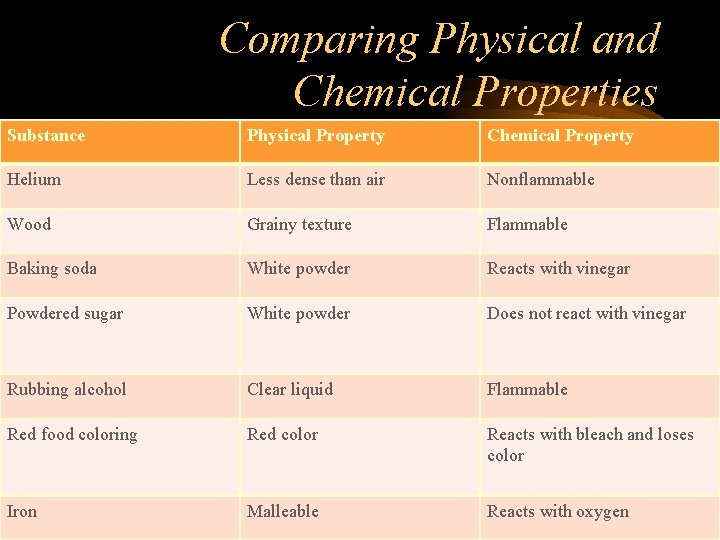
Comparing Physical and Chemical Properties Substance Physical Property Chemical Property Helium Less dense than air Nonflammable Wood Grainy texture Flammable Baking soda White powder Reacts with vinegar Powdered sugar White powder Does not react with vinegar Rubbing alcohol Clear liquid Flammable Red food coloring Red color Reacts with bleach and loses color Iron Malleable Reacts with oxygen
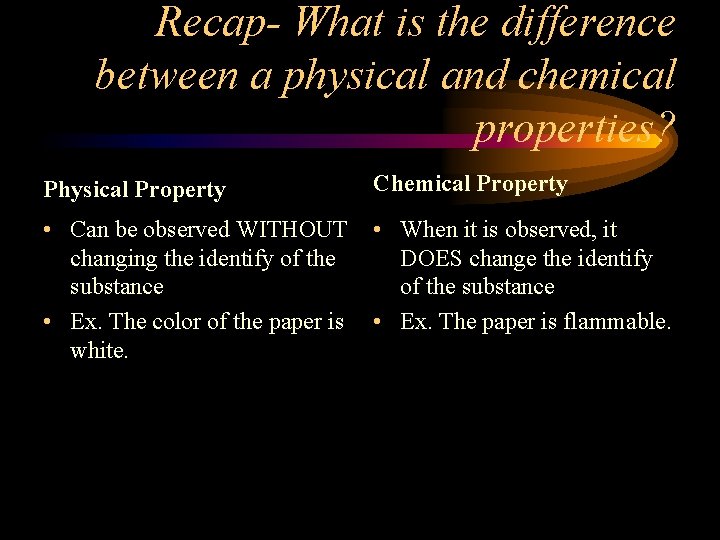
Recap- What is the difference between a physical and chemical properties? Physical Property Chemical Property • Can be observed WITHOUT changing the identify of the substance • Ex. The color of the paper is white. • When it is observed, it DOES change the identify of the substance • Ex. The paper is flammable.
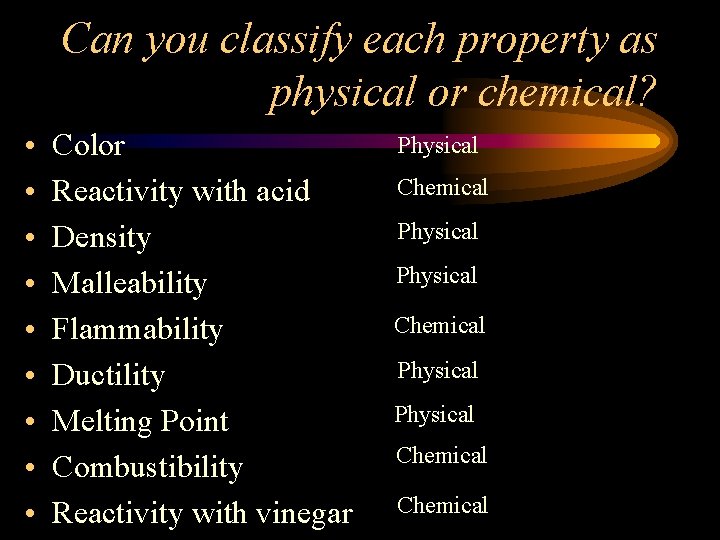
Can you classify each property as physical or chemical? • • • Color Reactivity with acid Density Malleability Flammability Ductility Melting Point Combustibility Reactivity with vinegar Physical Chemical Physical Chemical