
PHYSICAL VERSUS CHEMICAL PROPERTIES The study of matter

- Slides: 9
PHYSICAL VERSUS CHEMICAL PROPERTIES The study of matter
Reviewing MATTER Matter: anything that has mass and takes up space Mass – the amount of matter in something Volume – the amount of space something occupies Which of the following is matter? A car? Yes! A box? Yes! You? Yes! Heat? No!
What is a property? Property: a characteristic of a substance that can be observed
Physical Property Physical property: a property that can be observed without changing the identity of the substance. Examples: • luster • melting point • malleability: the ability to be hammered into a thin sheet • boiling point • ductility: the ability to be stretched into a thin wire • solubility • density • specific heat
Special Physical Properties Melting point: the temperature at which a substance changes from a solid to a liquid at a given pressure water = 0 o. C or 32 o. F Boiling point: the temperature at which a substance changes from a liquid to a gas at a given pressure water = 100 o. C or 212 o. F
Chemical Properties Chemical property: a property that can only be observed by changing the identity of the substance Examples: • flammability • ability to rust • reactivity with vinegar
Density is the amount of mass per unit of volume. Density can be used to identify a substance. The density of water is 1. 0 g/m. L
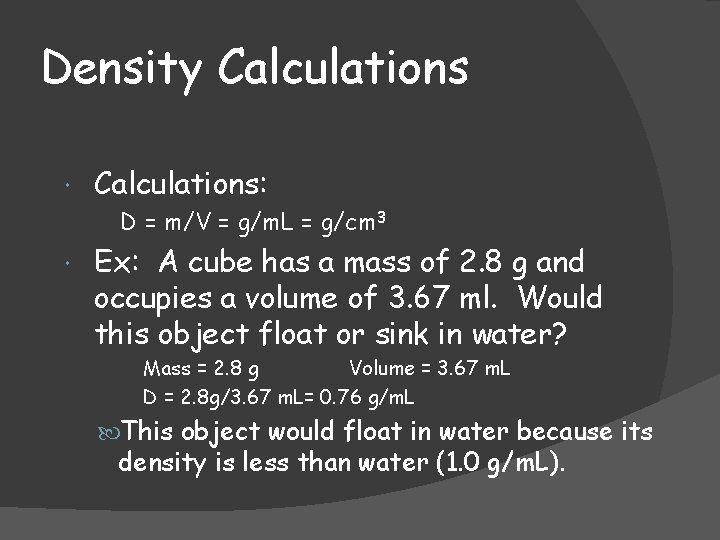
Density Calculations: D = m/V = g/m. L = g/cm 3 Ex: A cube has a mass of 2. 8 g and occupies a volume of 3. 67 ml. Would this object float or sink in water? Mass = 2. 8 g Volume = 3. 67 m. L D = 2. 8 g/3. 67 m. L= 0. 76 g/m. L This object would float in water because its density is less than water (1. 0 g/m. L).
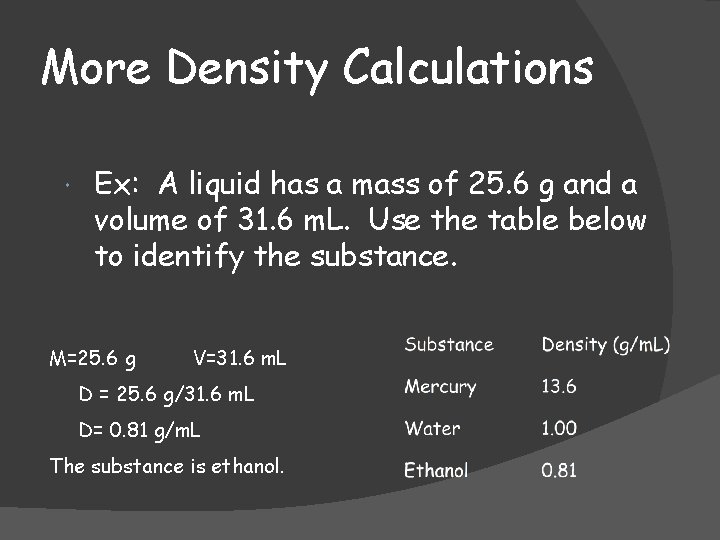
More Density Calculations Ex: A liquid has a mass of 25. 6 g and a volume of 31. 6 m. L. Use the table below to identify the substance. M=25. 6 g V=31. 6 m. L D = 25. 6 g/31. 6 m. L D= 0. 81 g/m. L The substance is ethanol.