
Physical Transmission 1 Physical Transmission Coaxial cable UTP
Physical Transmission 1
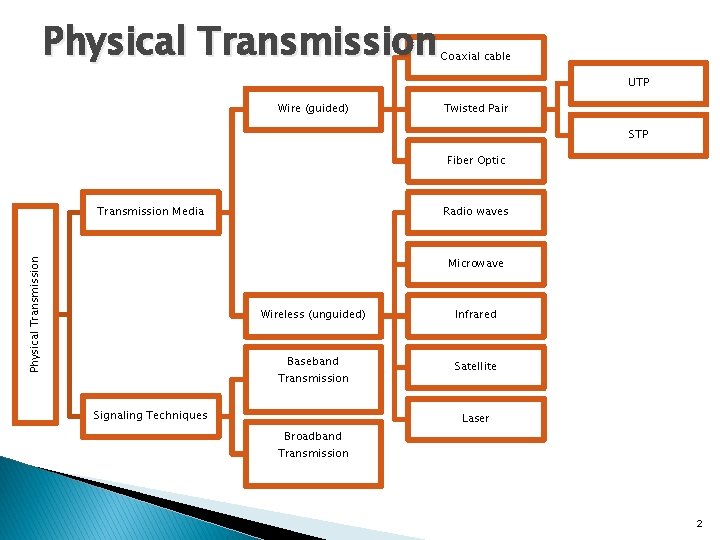
Physical Transmission Coaxial cable UTP Wire (guided) Twisted Pair STP Fiber Optic Transmission Media Radio waves Physical Transmission Microwave Wireless (unguided) Infrared Baseband Transmission Satellite Signaling Techniques Laser Broadband Transmission 2
Wireless media 3
II. Wireless Network � Transmission is sent and received through invisible waves � Less expensive than copper or fiber optic lines. � Allows the user to move freely around the office or campus and still remain connected to the network � Fastest-growing today segment of network media 4
II. Wireless Network � Transmission and reception via antenna � Directional ◦ Signals are sent in one direction. ◦ Use directional antennas - point to point line of sight communications � Omnidirectional ◦ Signal spreads in all directions ◦ Can be received by many antennas 5
II. Wireless Transmissions Electromagnetic Spectrum divided to : � Radio waves � Microwave � Infrared waves � Satellite � Laser 6
II. Wireless Transmissions � Radio waves: ◦ It is electromagnetic waves ranging in frequency between 3 KHz and 1 GHz. ◦ Are omnidirectional, they propagate in all directions. ◦ They can penetrate through walls. ◦ Use omnidirectional antenna � Microwaves: ◦ It is electromagnetic waves ranging in frequency between 1 and 300 GHz. ◦ faster than radio ◦ Are unidirectional ◦ Higher frequency ranges cannot penetrate walls. ◦ Need unidirectional antenna 7
II. Wireless Transmissions � Infrared ◦ ◦ waves: transmits data using infrared (IR) light. Its frequencies from 300 GHz to 400 THz. Used for short-range communication Since it have a high frequency, it cannot penetrate walls. � Satellite: ◦ This is a space station that receive microwave signals from an earth-based station, amplifies the signals, and broadcasts the signal back over a wide area to any number of earth-based station. 8
II. Wireless Transmissions � Laser: ◦ ◦ ◦ Unidirectional, like microwave Higher speed than microwave Uses laser transmitter and receiver at each end Point-to-point, typically between buildings Can be adversely affected by weather 9
Choosing a medium � Copper wire is mature technology and inexpensive; maximum transmission speed is limited � Glass fiber: ◦ ◦ ◦ Higher speed More resistant to electro-magnetic interference Spans longer distances Requires only single fiber More expensive � Radio and microwave don't require physical connection � Radio and infrared can be used for mobile connections � Laser also does not need physical connection and supports higher speeds 10
Data and Signals 11
Data � Analog data: refers to information that is continuous as human voice. � Digital data: refers to information that has discrete states. Data stored in computer memory in forms of 1 s and 0 s. To be transmitted, data (analog or digital) must be transformed to electromagnetic signals. 12
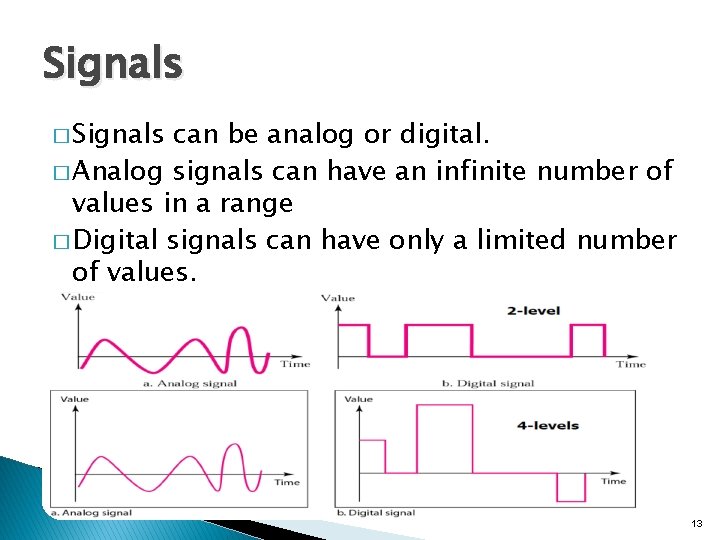
Signals � Signals can be analog or digital. � Analog signals can have an infinite number of values in a range � Digital signals can have only a limited number of values. 13
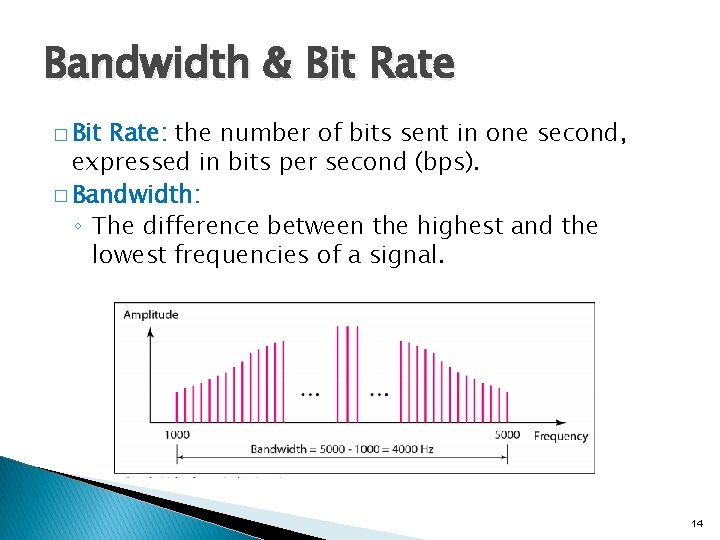
Bandwidth & Bit Rate � Bit Rate: the number of bits sent in one second, expressed in bits per second (bps). � Bandwidth: ◦ The difference between the highest and the lowest frequencies of a signal. 14

Bandwidth & Bit Rate Ø Bit rate and bandwidth are proportional to each other. If we need to send bits faster, we need more bandwidth. Ø Bandwidth also measures the capacity of information that a medium can carry. ◦ Analog bandwidth: Hertz ◦ Digital bandwidth: bits per second (bps) 15
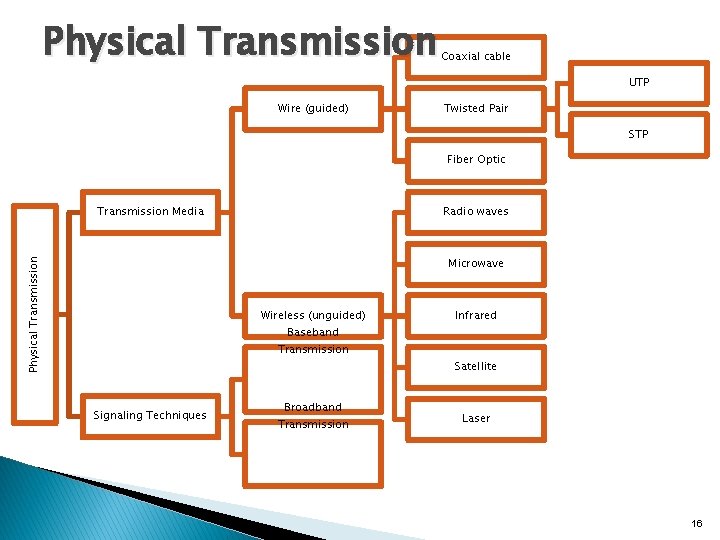
Physical Transmission Coaxial cable UTP Wire (guided) Twisted Pair STP Fiber Optic Transmission Media Radio waves Physical Transmission Microwave Wireless (unguided) Infrared Baseband Transmission Satellite Signaling Techniques Broadband Transmission Laser 16
b. Signaling Techniques There are two ways that a signal is sent across a network medium: � I. Baseband Transmission � II. Broadband Transmission 17
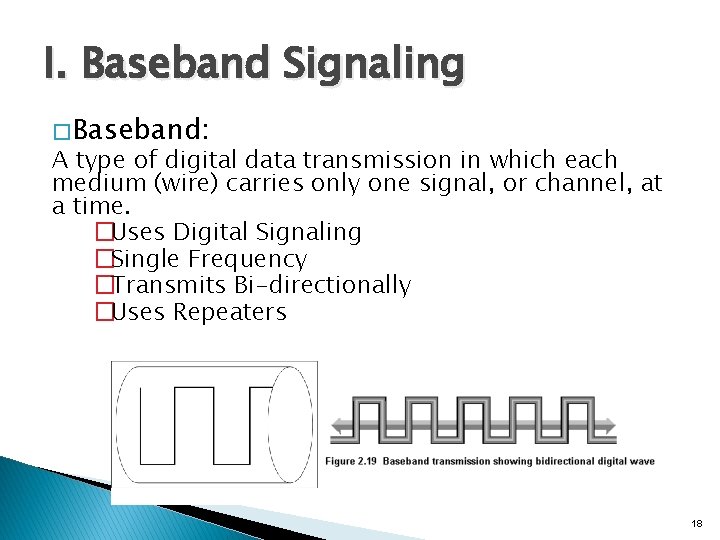
I. Baseband Signaling � Baseband: A type of digital data transmission in which each medium (wire) carries only one signal, or channel, at a time. �Uses Digital Signaling �Single Frequency �Transmits Bi-directionally �Uses Repeaters 18
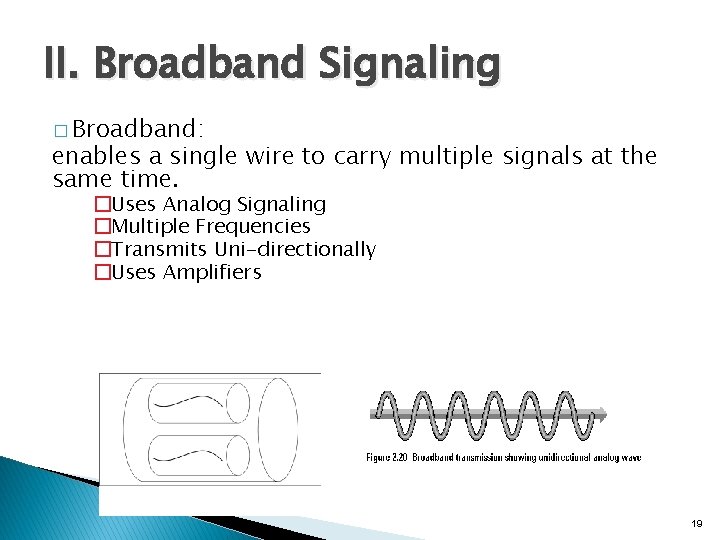
II. Broadband Signaling � Broadband: enables a single wire to carry multiple signals at the same time. �Uses Analog Signaling �Multiple Frequencies �Transmits Uni-directionally �Uses Amplifiers 19
Amplifier � An electronic device that increases the power of the signal. � Unlike repeaters, amplifiers strengthen the signal along with its noise. 20
Repeater � an electronic circuit that receives a signal and retransmits the same signal with a higher power. Therefore, a repeater consists of a signal receiver, an amplifier and a transmitter. � The main purpose of a repeater is to extend the length of the network transmission medium beyond the normal maximum cable lengths. 21
Amplifier and Repeater Difference between Amplifier and Repeater: 1. Amplifier is used to magnify a signal, whereas repeater is used to receive and retransmit a signal with a power gain. 2. Repeater has an amplifier as a part of it. 3. Sometimes, amplifiers introduce some noise to the signal, whereas repeaters contain noise eliminating parts. 22
Transmission Impairments 23
Transmission Impairments � Signals travel through transmission media which are not perfect. � This means that the signal at the beginning of the medium is not the same as the signal at the end of the medium. � In other words, the signal has changed over the medium. . 24
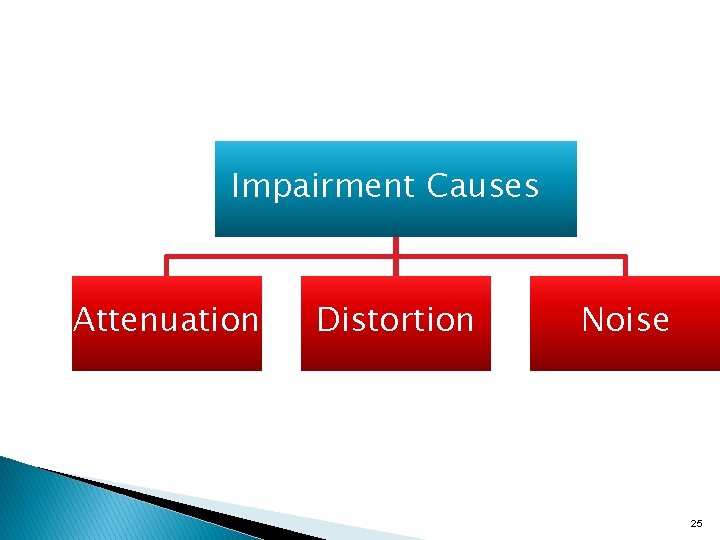
Impairment Causes Attenuation Distortion Noise 25

a) Attenuation � Loss of signal power in time 26
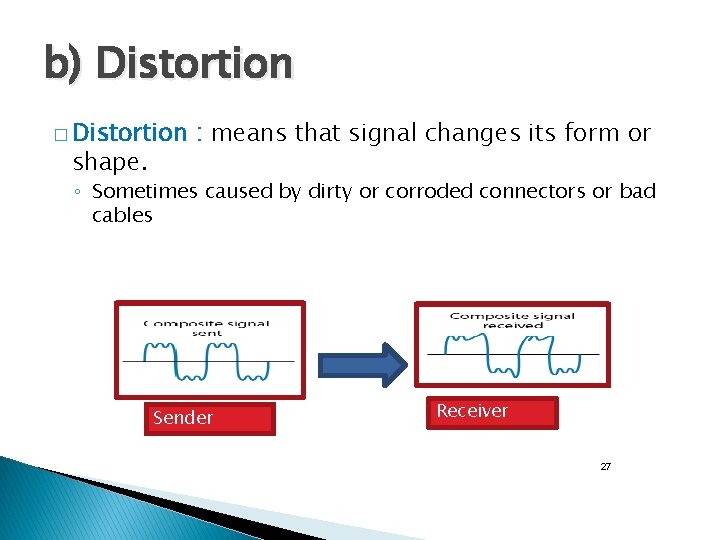
b) Distortion � Distortion shape. : means that signal changes its form or ◦ Sometimes caused by dirty or corroded connectors or bad cables Sender Receiver 27
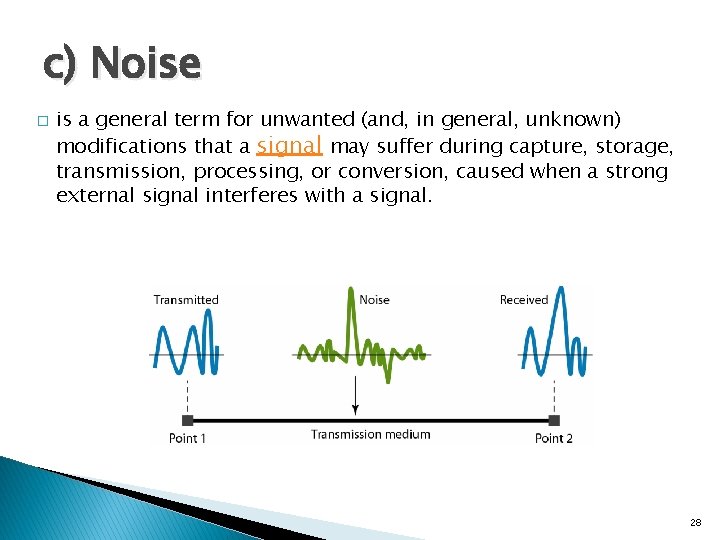
c) Noise � is a general term for unwanted (and, in general, unknown) modifications that a signal may suffer during capture, storage, transmission, processing, or conversion, caused when a strong external signal interferes with a signal. 28
Types of Noise � � Thermal noise : the random motion of electrons in a wire which creates an extra signal not originally sent by the transmitter. Induced noise: Comes from sources such as motors and appliances Crosstalk noise: Is the effect of one wire on the other Impulse Noise: is a spike ( a signal with high energy in a very short time) that comes from power lines, lighting and so on. 29
- Slides: 29