
Physical Transmission 1 Physical Transmission Coaxial cable UTP
Physical Transmission 1
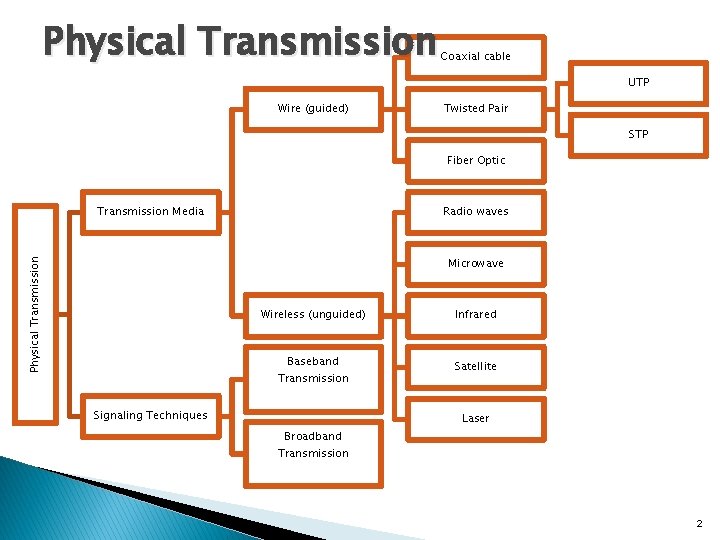
Physical Transmission Coaxial cable UTP Wire (guided) Twisted Pair STP Fiber Optic Transmission Media Radio waves Physical Transmission Microwave Wireless (unguided) Infrared Baseband Transmission Satellite Signaling Techniques Laser Broadband Transmission 2
Wireless media 3
Wireless Network �A wireless network enables people to communicate and access applications and information without wires. This provides freedom of movement and the ability to extend applications to different parts of a building, city, or nearly anywhere in the world. Wireless networks allow people to interact with e-mail or browse the Internet from a location that they prefer. 4
II. Wireless Network � Transmission waves � Less is sent and received through invisible expensive than copper or fiber optic lines. � Allows the user to move freely around the office or campus and still remain connected to the network � Fastest-growing segment of network media today 5
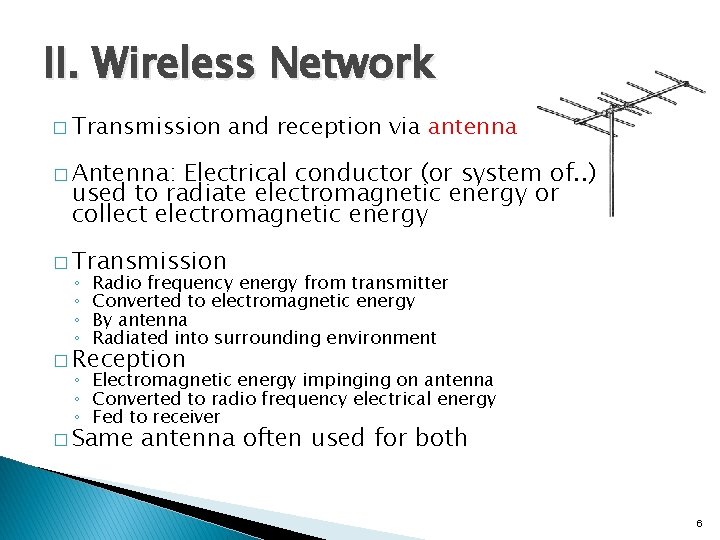
II. Wireless Network � Transmission and reception via antenna � Antenna: Electrical conductor (or system of. . ) used to radiate electromagnetic energy or collect electromagnetic energy � Transmission ◦ ◦ Radio frequency energy from transmitter Converted to electromagnetic energy By antenna Radiated into surrounding environment � Reception ◦ Electromagnetic energy impinging on antenna ◦ Converted to radio frequency electrical energy ◦ Fed to receiver � Same antenna often used for both 6
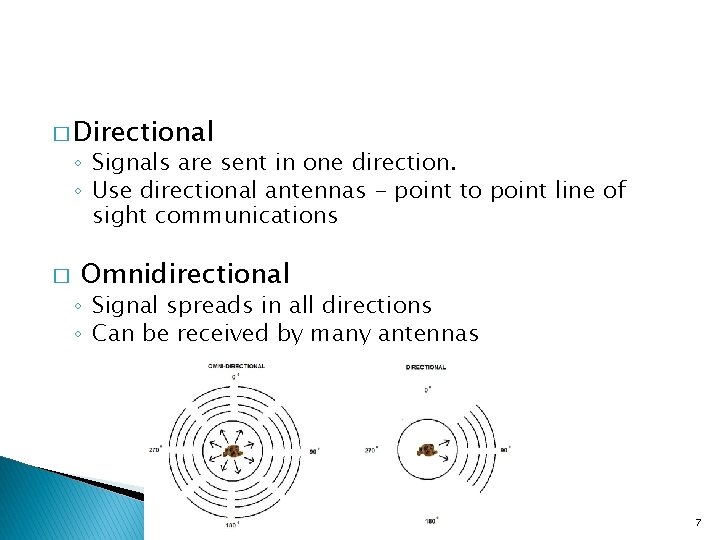
� Directional ◦ Signals are sent in one direction. ◦ Use directional antennas - point to point line of sight communications � Omnidirectional ◦ Signal spreads in all directions ◦ Can be received by many antennas 7
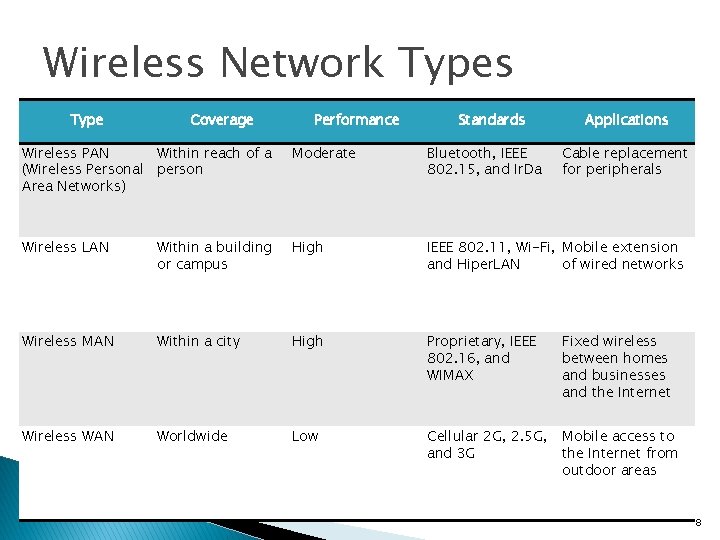
Wireless Network Types Type Coverage Performance Standards Applications Wireless PAN Within reach of a (Wireless Personal person Area Networks) Moderate Bluetooth, IEEE 802. 15, and Ir. Da Cable replacement for peripherals Wireless LAN Within a building or campus High IEEE 802. 11, Wi-Fi, Mobile extension and Hiper. LAN of wired networks Wireless MAN Within a city High Proprietary, IEEE 802. 16, and WIMAX Fixed wireless between homes and businesses and the Internet Wireless WAN Worldwide Low Cellular 2 G, 2. 5 G, and 3 G Mobile access to the Internet from outdoor areas 8
II. Wireless Transmissions Types of wireless media transmission: 1. Radio waves 2. Microwaves 3. Infrared waves 4. Satellite 5. Laser 9
II. Wireless Transmissions � Radio waves: ◦ It is electromagnetic waves ranging in frequency between 3 KHz and 300 GHz. ◦ They can penetrate through walls. ◦ Use omnidirectional antenna ◦ Examples: Police radar, AM & FM radio � Microwaves: ◦ It is electromagnetic waves ranging in frequency between 300 MHz and 300 GHz. ◦ faster than radio ◦ Higher frequency ranges cannot penetrate walls. ◦ Need unidirectional antenna ◦ Examples: cooking , cellular phones , television 10

II. Wireless Transmissions � Infrared waves: transmits data using infrared (IR) light. Its frequencies from 300 GHz to 400 THz. Used for short-range communication Since it have a high frequency, it cannot penetrate walls. ◦ Examples: TV's remote control ◦ ◦ � Satellite: ◦ This is a space station that receive microwave signals from an earth-based station, amplifies the signals, and broadcasts the signal back over a wide area to any number of earth-based station. 11
II. Wireless Transmissions � Laser: ◦ ◦ ◦ Unidirectional, like microwave Higher speed than microwave Uses laser transmitter and receiver at each end Point-to-point, typically between buildings Can be adversely affected by weather 12
Choosing a medium � Copper wire is mature technology and inexpensive; maximum transmission speed is limited � Glass fiber: ◦ ◦ ◦ Higher speed More resistant to electro-magnetic interference Spans longer distances Requires only single fiber More expensive � Radio and microwave don't require physical connection � Radio and infrared can be used for mobile connections � Laser also does not need physical connection and supports higher speeds 13
Data and Signals 14
Data � Analog data: refers to information that is continuous as human voice. � Digital data: refers to information that has discrete states. Data stored in computer memory in forms of 1 s and 0 s. To be transmitted, data (analog or digital) must be transformed to electromagnetic signals. 15
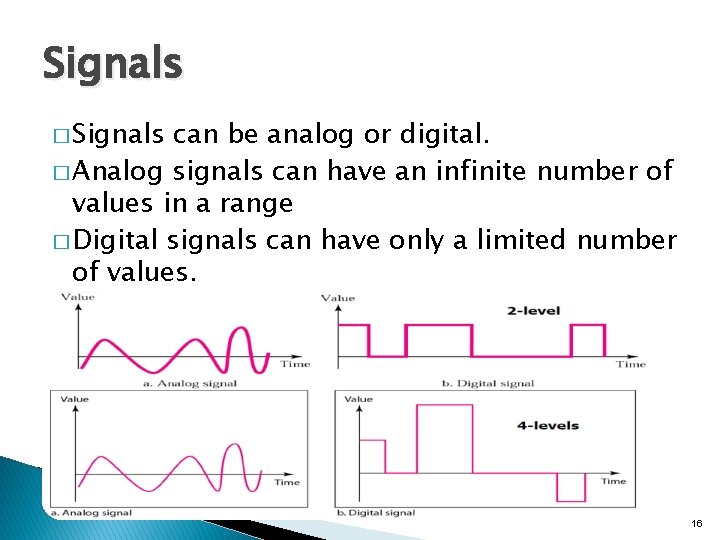
Signals � Signals can be analog or digital. � Analog signals can have an infinite number of values in a range � Digital signals can have only a limited number of values. 16
Bandwidth & Bit Rate � Bit Rate: the number of bits sent in one second, expressed in bits per second (bps). � Bandwidth: the maximum amount of data that can be transferred within a unit time. 17
Bandwidth & Bit Rate Bit rate and bandwidth are proportional to each other. If we need to send bits faster, we need more bandwidth. Ø Main difference between data rate and bandwidth is that bandwidth refers to the range of frequencies that a signal carries, whereas data rate refers to the number of bits that a signal carries per second. 18
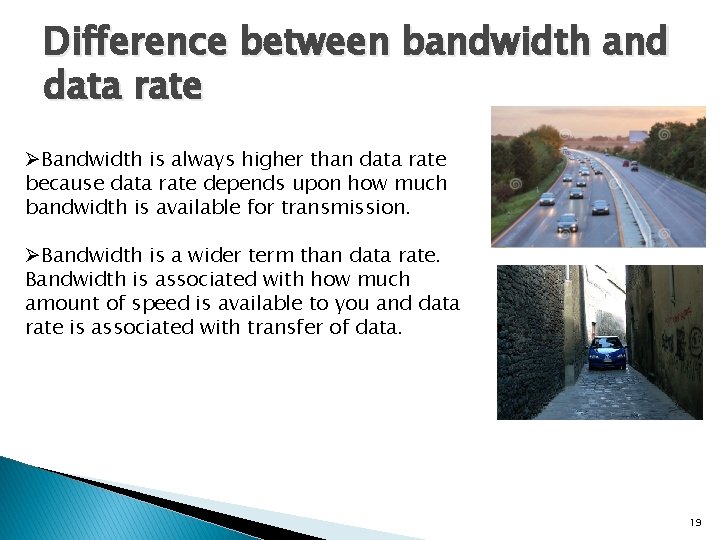
Difference between bandwidth and data rate ØBandwidth is always higher than data rate because data rate depends upon how much bandwidth is available for transmission. ØBandwidth is a wider term than data rate. Bandwidth is associated with how much amount of speed is available to you and data rate is associated with transfer of data. 19
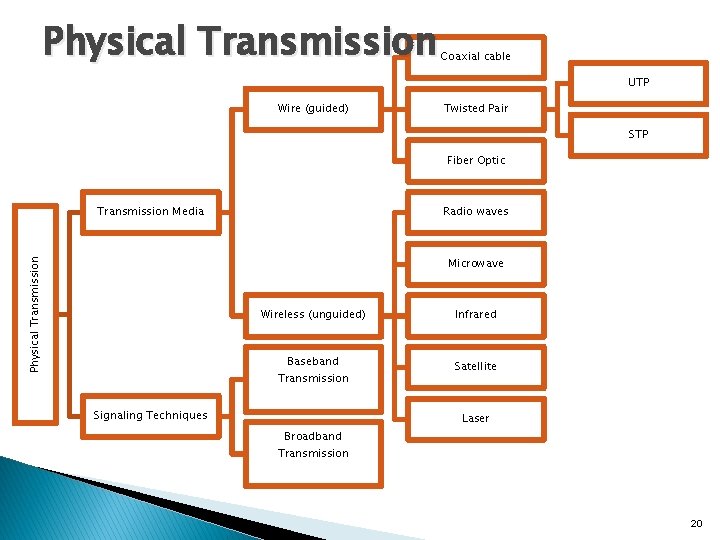
Physical Transmission Coaxial cable UTP Wire (guided) Twisted Pair STP Fiber Optic Transmission Media Radio waves Physical Transmission Microwave Wireless (unguided) Infrared Baseband Transmission Satellite Signaling Techniques Laser Broadband Transmission 20
b. Signaling Techniques There are two ways that a signal is sent across a network medium: � I. Baseband Transmission � II. Broadband Transmission 21
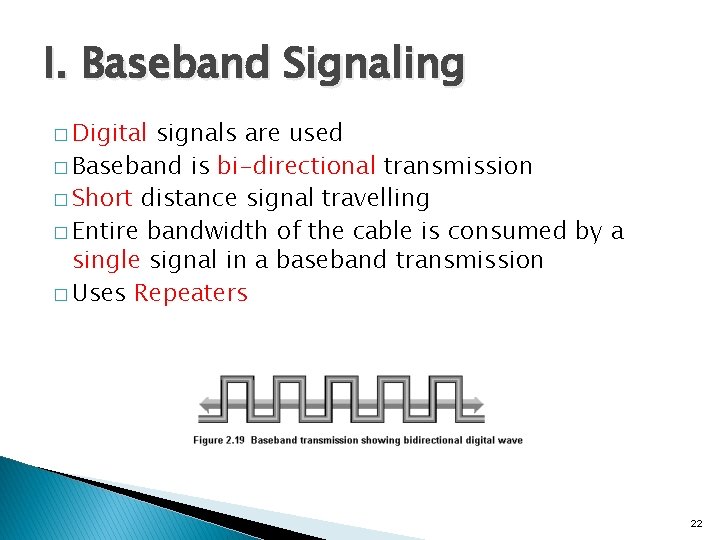
I. Baseband Signaling � Digital signals are used � Baseband is bi-directional transmission � Short distance signal travelling � Entire bandwidth of the cable is consumed by a single signal in a baseband transmission � Uses Repeaters 22
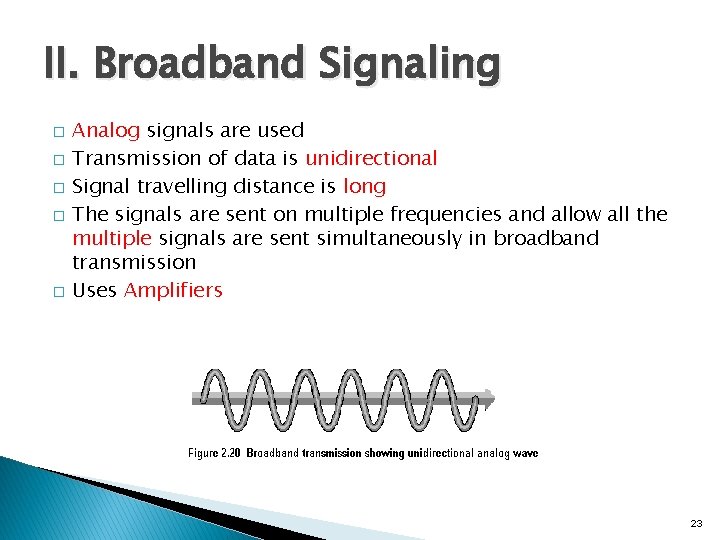
II. Broadband Signaling � � � Analog signals are used Transmission of data is unidirectional Signal travelling distance is long The signals are sent on multiple frequencies and allow all the multiple signals are sent simultaneously in broadband transmission Uses Amplifiers 23
Repeater � an electronic circuit that receives a signal and retransmits the same signal. Therefore, a repeater consists of a signal receiver, an amplifier and a transmitter. � The main purpose of a repeater is to extend the length of the network transmission medium beyond the normal maximum cable lengths. 24
Amplifier � An electronic device that increases the power of the signal. � Unlike repeaters, amplifiers strengthen the signal along with its noise. 25
Amplifier and Repeater Difference between Amplifier and Repeater: 1. Amplifier is used to magnify a signal, whereas repeater is used to receive and retransmit a signal with a power gain. 2. Repeater has an amplifier as a part of it. 3. Sometimes, amplifiers introduce some noise to the signal, whereas repeaters contain noise eliminating parts. 26
Transmission Impairments 27
Transmission Impairments � Signals travel through transmission media which are not perfect. � This means that the signal at the beginning of the medium is not the same as the signal at the end of the medium. � In other words, the signal has changed over the medium. . 28
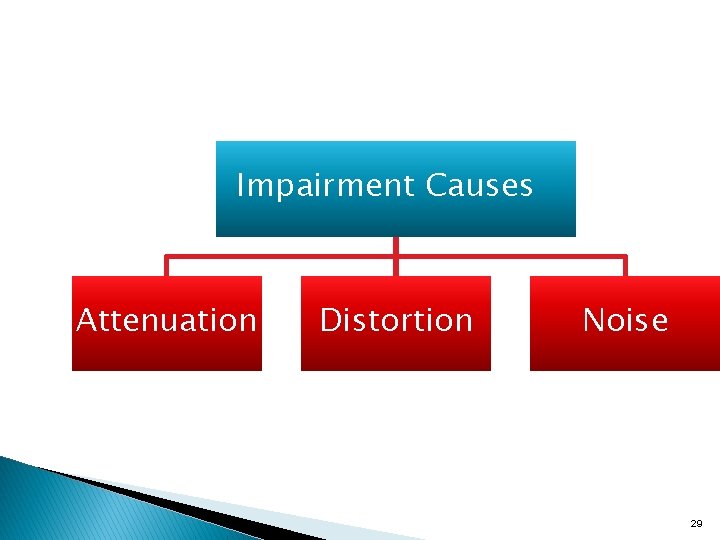
Impairment Causes Attenuation Distortion Noise 29
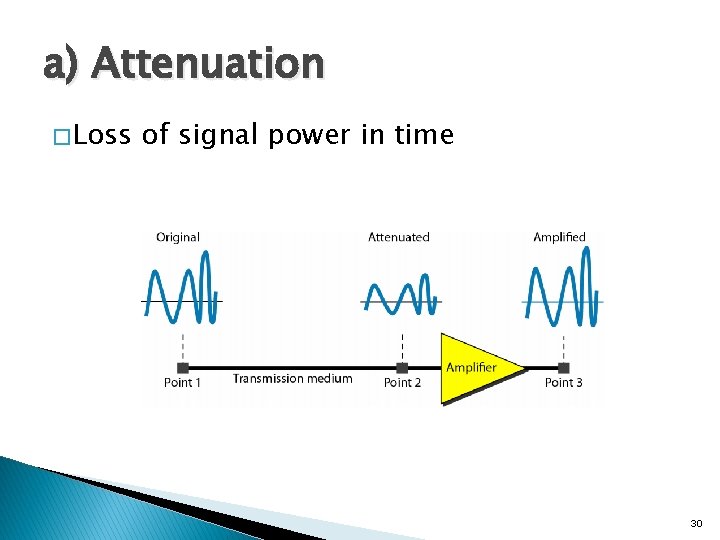
a) Attenuation � Loss of signal power in time 30
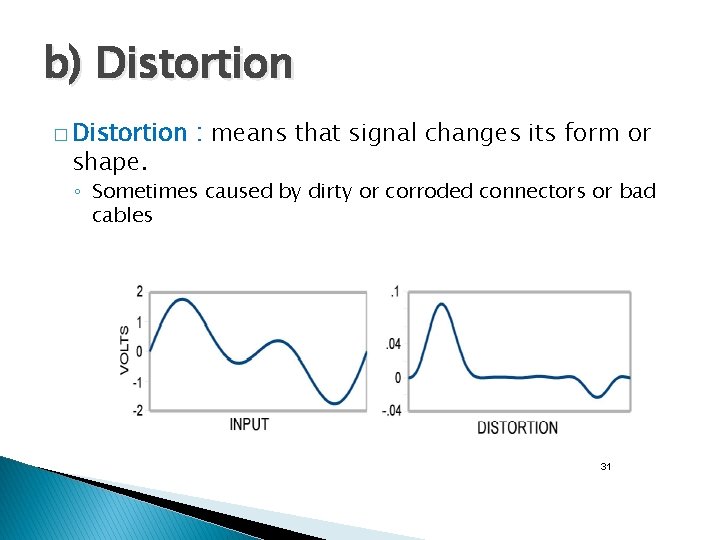
b) Distortion � Distortion shape. : means that signal changes its form or ◦ Sometimes caused by dirty or corroded connectors or bad cables 31
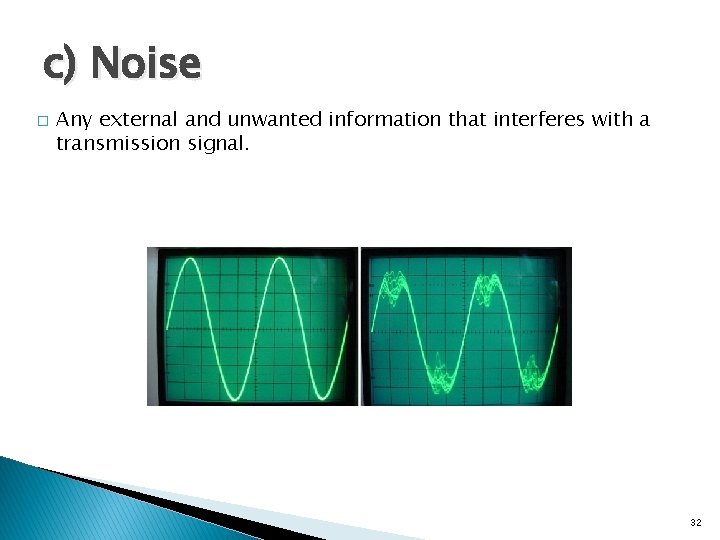
c) Noise � Any external and unwanted information that interferes with a transmission signal. 32
Types of Noise � � Thermal noise : the random motion of electrons in a wire which creates an extra signal not originally sent by the transmitter. Induced noise: Comes from sources such as motors and appliances Crosstalk noise: a signal transmitted on one channel of a transmission system creates an undesired effect in another circuit or channel. Impulse Noise: is a spike ( a signal with high energy in a very short time) that comes from power lines, lighting and so on. 33
- Slides: 33