
Physical transfer cables Cable Detail Optical Fibre An
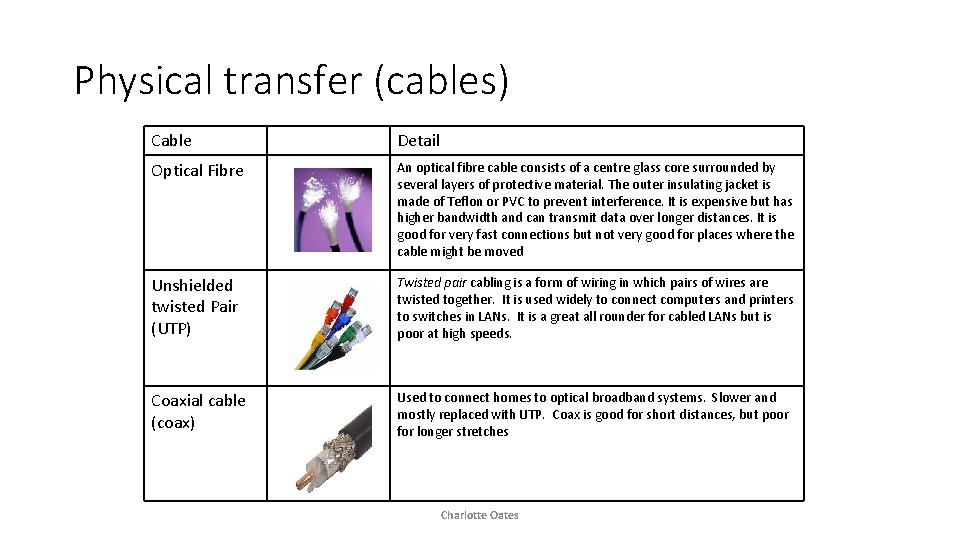
Physical transfer (cables) Cable Detail Optical Fibre An optical fibre cable consists of a centre glass core surrounded by several layers of protective material. The outer insulating jacket is made of Teflon or PVC to prevent interference. It is expensive but has higher bandwidth and can transmit data over longer distances. It is good for very fast connections but not very good for places where the cable might be moved Unshielded twisted Pair (UTP) Twisted pair cabling is a form of wiring in which pairs of wires are twisted together. It is used widely to connect computers and printers to switches in LANs. It is a great all rounder for cabled LANs but is poor at high speeds. Coaxial cable (coax) Used to connect homes to optical broadband systems. Slower and mostly replaced with UTP. Coax is good for short distances, but poor for longer stretches Charlotte Oates

Physical transfer (cables) Unshielded twisted Pair (UTP) Optical Fibre Physical methods of transferring data Optical Fibre Coaxial cable (coax) Benefits Drawbacks This connection is faster then any other wire. This allows more phone lines to go over the same cable or more channels to come through the cable into your cable TV box. . Optical fibres are more fragile than electrical wires. Optical fibres cannot be joined together as a easily as copper cable and requires additional training of personnel and expensive precision splicing and measurement equipment. Generally speaking, unshielded twisted pair cable is more prone to electricity noise and interference than other types of networking media. Unshielded twisted Pair (UTP) A common implementation of UTP is 100 Base. T, which allows for a maximum cable length segment of 100 metres. Coaxial cable (coax) Coaxial cables assemblies are one of the most basic and popular components in electrical applications. Charlotte Oates Coaxial cable is still the most common means of data transmission over short distances. Coax has a sufficient frequency range to support multiple channels, which allows for much greater throughput.
- Slides: 2