
Physical Training Models for Robotic Blood Vessel Dissection
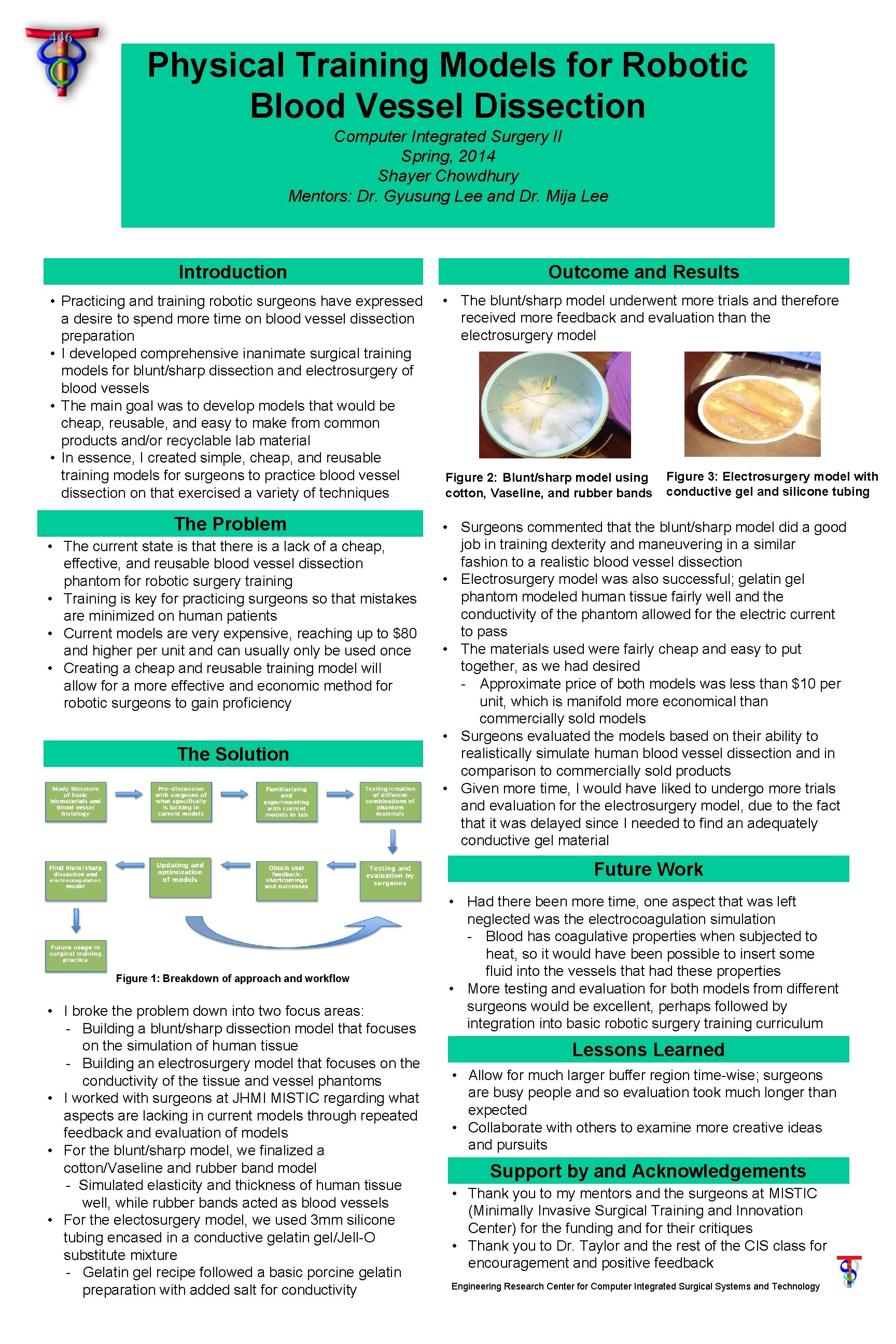
Physical Training Models for Robotic Blood Vessel Dissection Computer Integrated Surgery II Spring, 2014 Shayer Chowdhury Mentors: Dr. Gyusung Lee and Dr. Mija Lee Introduction Outcome and Results • Practicing and training robotic surgeons have expressed a desire to spend more time on blood vessel dissection preparation • I developed comprehensive inanimate surgical training models for blunt/sharp dissection and electrosurgery of blood vessels • The main goal was to develop models that would be cheap, reusable, and easy to make from common products and/or recyclable lab material • In essence, I created simple, cheap, and reusable training models for surgeons to practice blood vessel dissection on that exercised a variety of techniques • The blunt/sharp model underwent more trials and therefore received more feedback and evaluation than the electrosurgery model The Problem • The current state is that there is a lack of a cheap, effective, and reusable blood vessel dissection phantom for robotic surgery training • Training is key for practicing surgeons so that mistakes are minimized on human patients • Current models are very expensive, reaching up to $80 and higher per unit and can usually only be used once • Creating a cheap and reusable training model will allow for a more effective and economic method for robotic surgeons to gain proficiency The Solution Figure 2: Blunt/sharp model using cotton, Vaseline, and rubber bands Figure 3: Electrosurgery model with conductive gel and silicone tubing • Surgeons commented that the blunt/sharp model did a good job in training dexterity and maneuvering in a similar fashion to a realistic blood vessel dissection • Electrosurgery model was also successful; gelatin gel phantom modeled human tissue fairly well and the conductivity of the phantom allowed for the electric current to pass • The materials used were fairly cheap and easy to put together, as we had desired - Approximate price of both models was less than $10 per unit, which is manifold more economical than commercially sold models • Surgeons evaluated the models based on their ability to realistically simulate human blood vessel dissection and in comparison to commercially sold products • Given more time, I would have liked to undergo more trials and evaluation for the electrosurgery model, due to the fact that it was delayed since I needed to find an adequately conductive gel material Future Work Figure 1: Breakdown of approach and workflow • I broke the problem down into two focus areas: - Building a blunt/sharp dissection model that focuses on the simulation of human tissue - Building an electrosurgery model that focuses on the conductivity of the tissue and vessel phantoms • I worked with surgeons at JHMI MISTIC regarding what aspects are lacking in current models through repeated feedback and evaluation of models • For the blunt/sharp model, we finalized a cotton/Vaseline and rubber band model - Simulated elasticity and thickness of human tissue well, while rubber bands acted as blood vessels • For the electosurgery model, we used 3 mm silicone tubing encased in a conductive gelatin gel/Jell-O substitute mixture - Gelatin gel recipe followed a basic porcine gelatin preparation with added salt for conductivity • Had there been more time, one aspect that was left neglected was the electrocoagulation simulation - Blood has coagulative properties when subjected to heat, so it would have been possible to insert some fluid into the vessels that had these properties • More testing and evaluation for both models from different surgeons would be excellent, perhaps followed by integration into basic robotic surgery training curriculum Lessons Learned • Allow for much larger buffer region time-wise; surgeons are busy people and so evaluation took much longer than expected • Collaborate with others to examine more creative ideas and pursuits Support by and Acknowledgements • Thank you to my mentors and the surgeons at MISTIC (Minimally Invasive Surgical Training and Innovation Center) for the funding and for their critiques • Thank you to Dr. Taylor and the rest of the CIS class for encouragement and positive feedback Engineering Research Center for Computer Integrated Surgical Systems and Technology
- Slides: 1