
Physical Therapy Rehabilitation Focusing on Functional Mobility and
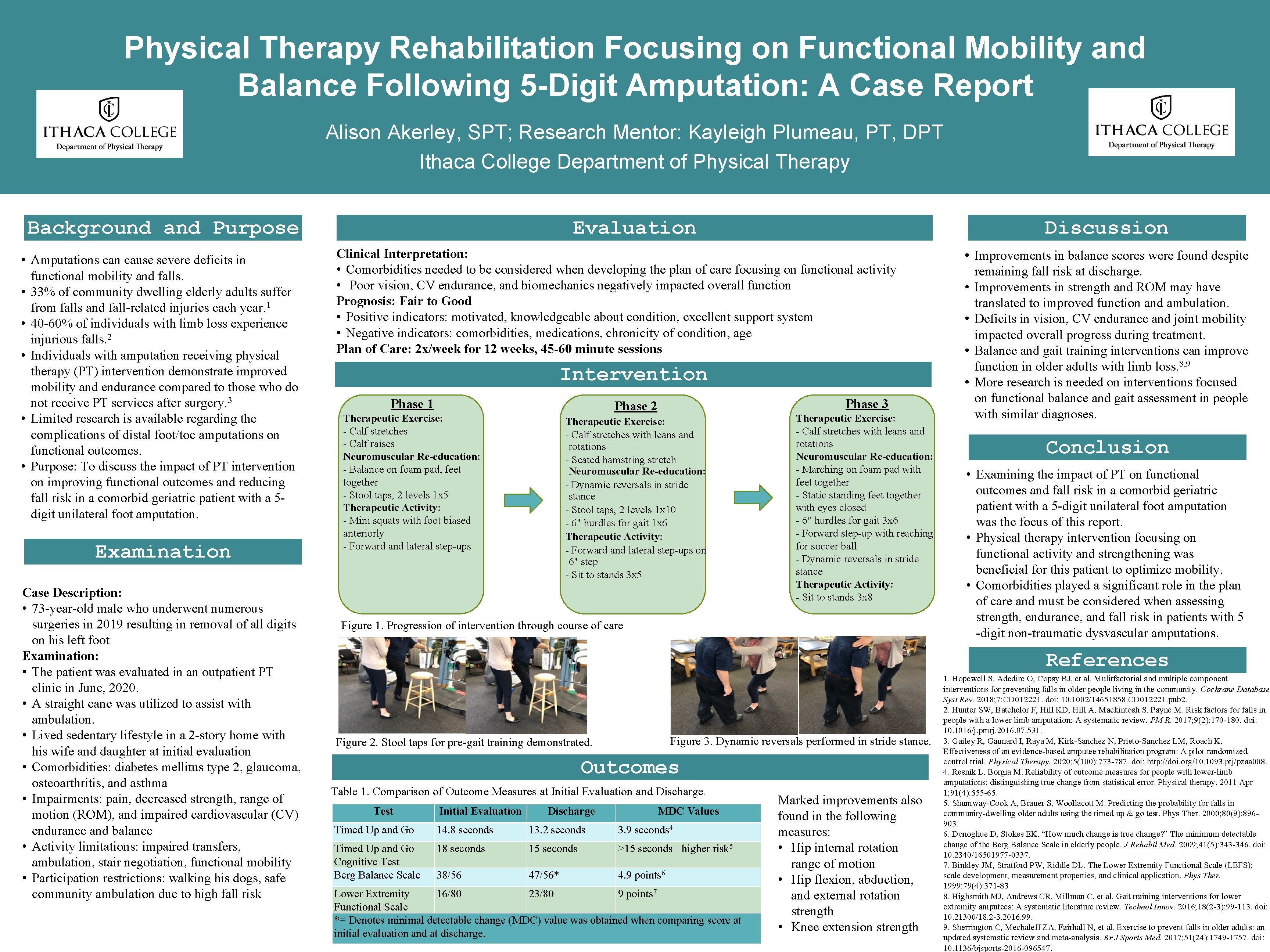
Physical Therapy Rehabilitation Focusing on Functional Mobility and Balance Following 5 -Digit Amputation: A Case Report Alison Akerley, SPT; Research Mentor: Kayleigh Plumeau, PT, DPT Ithaca College Department of Physical Therapy Background and Purpose • Amputations can cause severe deficits in functional mobility and falls. • 33% of community dwelling elderly adults suffer from falls and fall-related injuries each year. 1 • 40 -60% of individuals with limb loss experience injurious falls. 2 • Individuals with amputation receiving physical therapy (PT) intervention demonstrate improved mobility and endurance compared to those who do not receive PT services after surgery. 3 • Limited research is available regarding the complications of distal foot/toe amputations on functional outcomes. • Purpose: To discuss the impact of PT intervention on improving functional outcomes and reducing fall risk in a comorbid geriatric patient with a 5 digit unilateral foot amputation. Examination Case Description: • 73 -year-old male who underwent numerous surgeries in 2019 resulting in removal of all digits on his left foot Examination: • The patient was evaluated in an outpatient PT clinic in June, 2020. • A straight cane was utilized to assist with ambulation. • Lived sedentary lifestyle in a 2 -story home with his wife and daughter at initial evaluation • Comorbidities: diabetes mellitus type 2, glaucoma, osteoarthritis, and asthma • Impairments: pain, decreased strength, range of motion (ROM), and impaired cardiovascular (CV) endurance and balance • Activity limitations: impaired transfers, ambulation, stair negotiation, functional mobility • Participation restrictions: walking his dogs, safe community ambulation due to high fall risk Evaluation Discussion Clinical Interpretation: • Comorbidities needed to be considered when developing the plan of care focusing on functional activity • Poor vision, CV endurance, and biomechanics negatively impacted overall function Prognosis: Fair to Good • Positive indicators: motivated, knowledgeable about condition, excellent support system • Negative indicators: comorbidities, medications, chronicity of condition, age Plan of Care: 2 x/week for 12 weeks, 45 -60 minute sessions Intervention Phase 1 Phase 3 Phase 2 Therapeutic Exercise: - Calf stretches - Calf raises Neuromuscular Re-education: - Balance on foam pad, feet together - Stool taps, 2 levels 1 x 5 Therapeutic Activity: - Mini squats with foot biased anteriorly - Forward and lateral step-ups Therapeutic Exercise: - Calf stretches with leans and rotations - Seated hamstring stretch Neuromuscular Re-education: - Dynamic reversals in stride stance - Stool taps, 2 levels 1 x 10 - 6" hurdles for gait 1 x 6 Therapeutic Activity: - Forward and lateral step-ups on 6" step - Sit to stands 3 x 5 Therapeutic Exercise: - Calf stretches with leans and rotations Neuromuscular Re-education: - Marching on foam pad with feet together - Static standing feet together with eyes closed - 6" hurdles for gait 3 x 6 - Forward step-up with reaching for soccer ball - Dynamic reversals in stride stance Therapeutic Activity: - Sit to stands 3 x 8 Figure 1. Progression of intervention through course of care • Improvements in balance scores were found despite remaining fall risk at discharge. • Improvements in strength and ROM may have translated to improved function and ambulation. • Deficits in vision, CV endurance and joint mobility impacted overall progress during treatment. • Balance and gait training interventions can improve function in older adults with limb loss. 8, 9 • More research is needed on interventions focused on functional balance and gait assessment in people with similar diagnoses. Conclusion • Examining the impact of PT on functional outcomes and fall risk in a comorbid geriatric patient with a 5 -digit unilateral foot amputation was the focus of this report. • Physical therapy intervention focusing on functional activity and strengthening was beneficial for this patient to optimize mobility. • Comorbidities played a significant role in the plan of care and must be considered when assessing strength, endurance, and fall risk in patients with 5 -digit non-traumatic dysvascular amputations. References Figure 3. Dynamic reversals performed in stride stance. Figure 2. Stool taps for pre-gait training demonstrated. Outcomes Table 1. Comparison of Outcome Measures at Initial Evaluation and Discharge. Test Initial Evaluation Discharge MDC Values Timed Up and Go 14. 8 seconds 13. 2 seconds 3. 9 seconds 4 Timed Up and Go Cognitive Test Berg Balance Scale 18 seconds 15 seconds >15 seconds= higher risk 5 38/56 47/56* 4. 9 points 6 Lower Extremity 16/80 23/80 9 points 7 Functional Scale *= Denotes minimal detectable change (MDC) value was obtained when comparing score at initial evaluation and at discharge. Marked improvements also found in the following measures: • Hip internal rotation range of motion • Hip flexion, abduction, and external rotation strength • Knee extension strength 1. Hopewell S, Adedire O, Copsy BJ, et al. Mulitfactorial and multiple component interventions for preventing falls in older people living in the community. Cochrane Database Syst Rev. 2018; 7: CD 012221. doi: 10. 1002/14651858. CD 012221. pub 2. 2. Hunter SW, Batchelor F, Hill KD, Hill A, Mackintosh S, Payne M. Risk factors for falls in people with a lower limb amputation: A systematic review. PM R. 2017; 9(2): 170 -180. doi: 10. 1016/j. pmrj. 2016. 07. 531. 3. Gailey R, Gaunard I, Raya M, Kirk-Sanchez N, Prieto-Sanchez LM, Roach K. Effectiveness of an evidence-based amputee rehabilitation program: A pilot randomized control trial. Physical Therapy. 2020; 5(100): 773 -787. doi: http: //doi. org/10. 1093. ptj/pzaa 008. 4. Resnik L, Borgia M. Reliability of outcome measures for people with lower-limb amputations: distinguishing true change from statistical error. Physical therapy. 2011 Apr 1; 91(4): 555 -65. 5. Shumway-Cook A, Brauer S, Woollacott M. Predicting the probability for falls in community-dwelling older adults using the timed up & go test. Phys Ther. 2000; 80(9): 896903. 6. Donoghue D, Stokes EK. “How much change is true change? ” The minimum detectable change of the Berg Balance Scale in elderly people. J Rehabil Med. 2009; 41(5): 343 -346. doi: 10. 2340/16501977 -0337. 7. Binkley JM, Stratford PW, Riddle DL. The Lower Extremity Functional Scale (LEFS): scale development, measurement properties, and clinical application. Phys Ther. 1999; 79(4): 371 -83 8. Highsmith MJ, Andrews CR, Millman C, et al. Gait training interventions for lower extremity amputees: A systematic literature review. Technol Innov. 2016; 18(2 -3): 99 -113. doi: 10. 21300/18. 2 -3. 2016. 99. 9. Sherrington C, Mechaleff ZA, Fairhall N, et al. Exercise to prevent falls in older adults: an updated systematic review and meta-analysis. Br J Sports Med. 2017; 51(24): 1749 -1757. doi: 10. 1136/bjsports-2016 -096547.
- Slides: 1