
Physical submodels to be included in the main
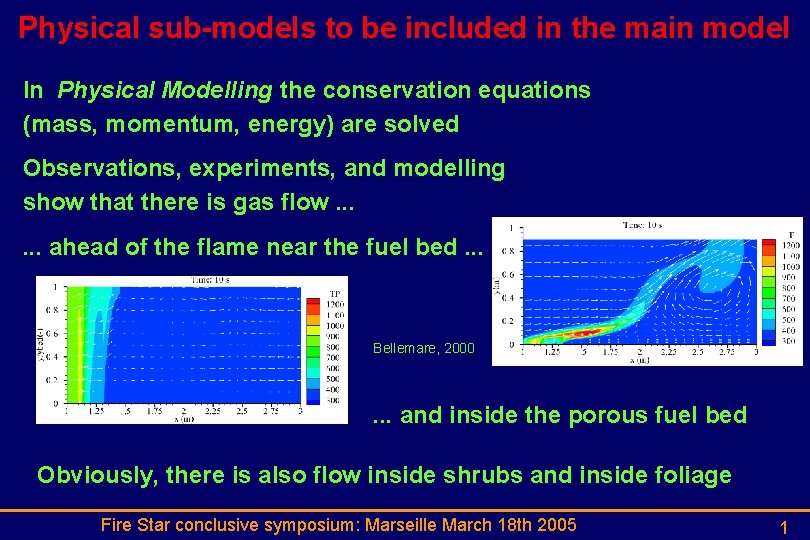
Physical sub-models to be included in the main model In Physical Modelling the conservation equations (mass, momentum, energy) are solved Observations, experiments, and modelling show that there is gas flow. . . ahead of the flame near the fuel bed. . . Bellemare, 2000 . . . and inside the porous fuel bed Obviously, there is also flow inside shrubs and inside foliage Fire Star conclusive symposium: Marseille March 18 th 2005 1
Physical sub-models to be included in the main model Several sub-models are used to deal with a number of phenomena The temperatures of fuel bed, shrubs, foliage, and of the gas that flows inside them are not necessarely the same heat transfer between the gas and these fuel matrixes occurs This energy exchange plays an important role in the decrease of fuel moisture content and in the fuel pyrolysis The flow inside the fuel matrices is subjected to aerodynamic drag sub-models for heat transfer and aerodynamic drag are, therefore, necessary Fire Star conclusive symposium: Marseille March 18 th 2005 2
Physical sub-models to be included in the main model There is no data on porous beds similar to forest fire fuel matrices Data on packed beds from chemical engineering have been used But. . . chemical packed beds are very different from the forest fuel matrices Objective : - to measure the heat transfer coefficient h and pressure drop through matrices of forest fuels Fire Star conclusive symposium: Marseille March 18 th 2005 3
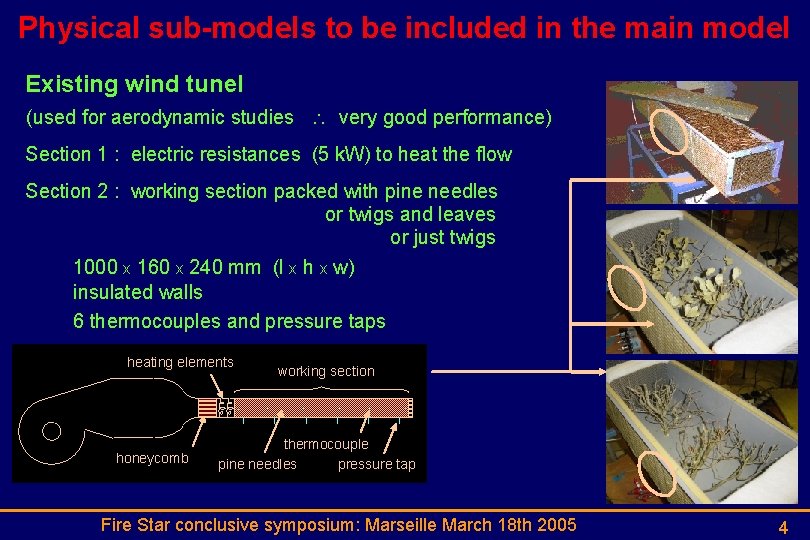
Physical sub-models to be included in the main model Existing wind tunel (used for aerodynamic studies very good performance) Section 1 : electric resistances (5 k. W) to heat the flow Section 2 : working section packed with pine needles or twigs and leaves or just twigs 1000 x 160 x 240 mm (l x h x w) insulated walls 6 thermocouples and pressure taps heating elements working section o honeycomb o o o thermocouple pressure tap pine needles Fire Star conclusive symposium: Marseille March 18 th 2005 4
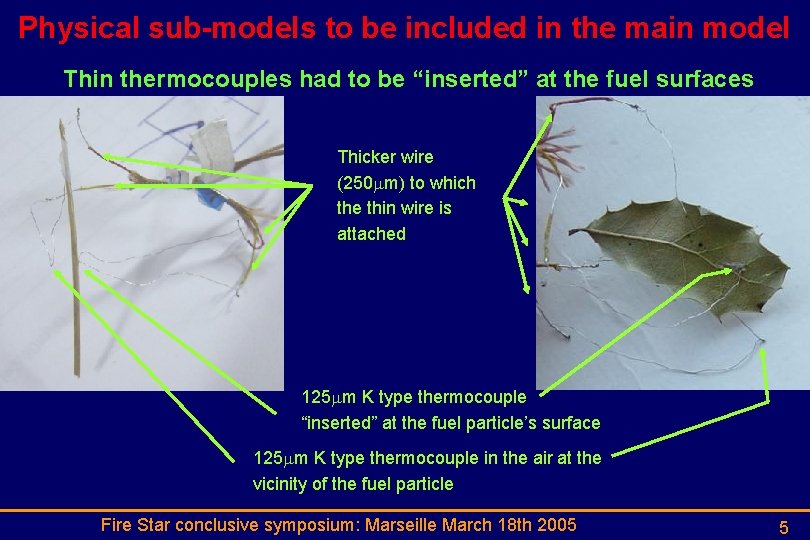
Physical sub-models to be included in the main model Thin thermocouples had to be “inserted” at the fuel surfaces Thicker wire (250 m) to which the thin wire is attached 125 m K type thermocouple “inserted” at the fuel particle’s surface 125 m K type thermocouple in the air at the vicinity of the fuel particle Fire Star conclusive symposium: Marseille March 18 th 2005 5
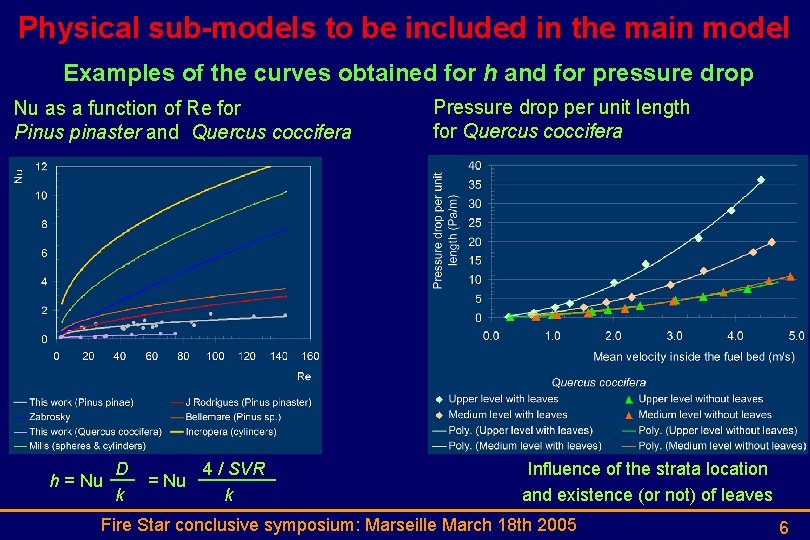
Physical sub-models to be included in the main model Examples of the curves obtained for h and for pressure drop Nu as a function of Re for Pinus pinaster and Quercus coccifera h = Nu D k = Nu 4 / SVR k Pressure drop per unit length for Quercus coccifera Influence of the strata location and existence (or not) of leaves Fire Star conclusive symposium: Marseille March 18 th 2005 6
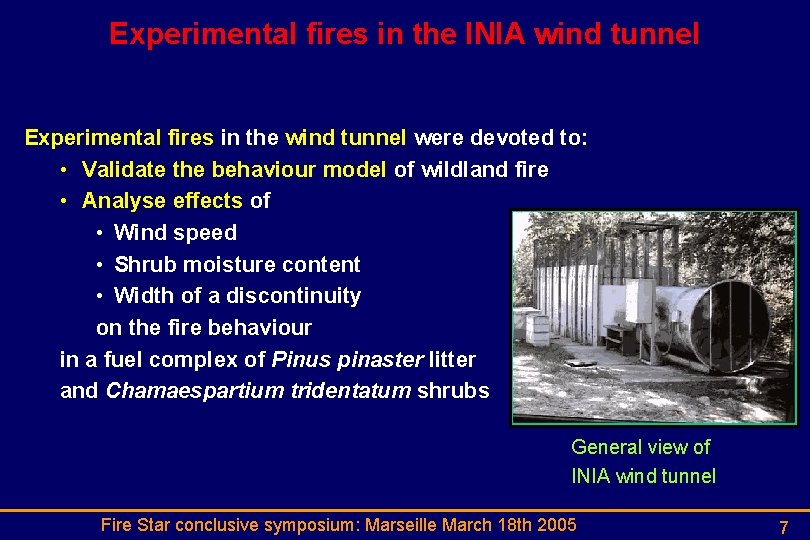
Experimental fires in the INIA wind tunnel Experimental fires in the wind tunnel were devoted to: • Validate the behaviour model of wildland fire • Analyse effects of • Wind speed • Shrub moisture content • Width of a discontinuity on the fire behaviour in a fuel complex of Pinus pinaster litter and Chamaespartium tridentatum shrubs General view of INIA wind tunnel Fire Star conclusive symposium: Marseille March 18 th 2005 7
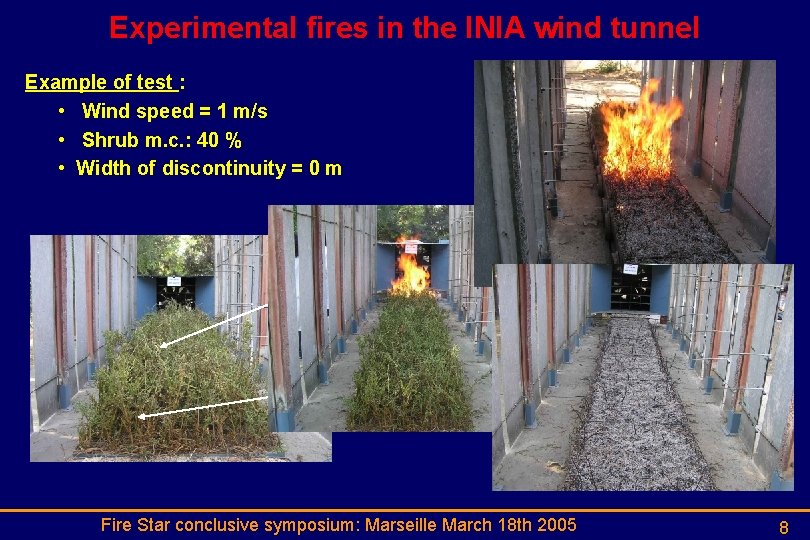
Experimental fires in the INIA wind tunnel Example of test : • Wind speed = 1 m/s • Shrub m. c. : 40 % • Width of discontinuity = 0 m C. tridentatum shrubs P. pinaster litter Fire Star conclusive symposium: Marseille March 18 th 2005 8
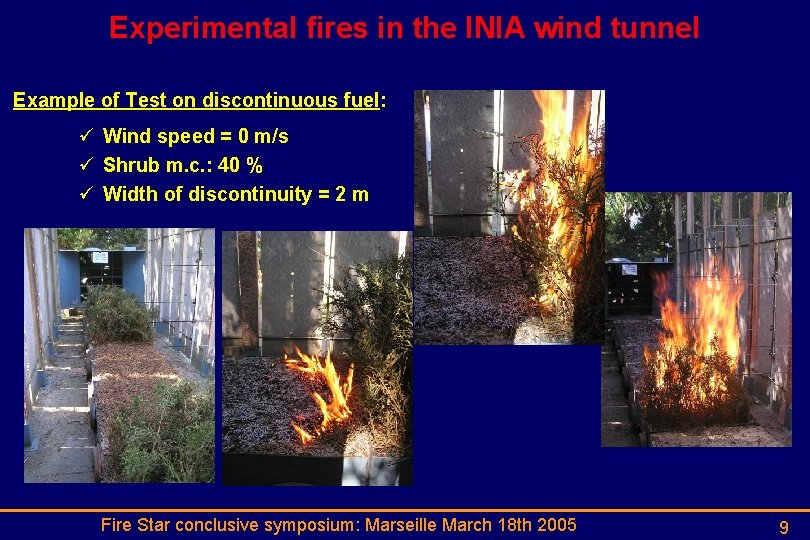
Experimental fires in the INIA wind tunnel Example of Test on discontinuous fuel: ü Wind speed = 0 m/s ü Shrub m. c. : 40 % ü Width of discontinuity = 2 m Fire Star conclusive symposium: Marseille March 18 th 2005 9
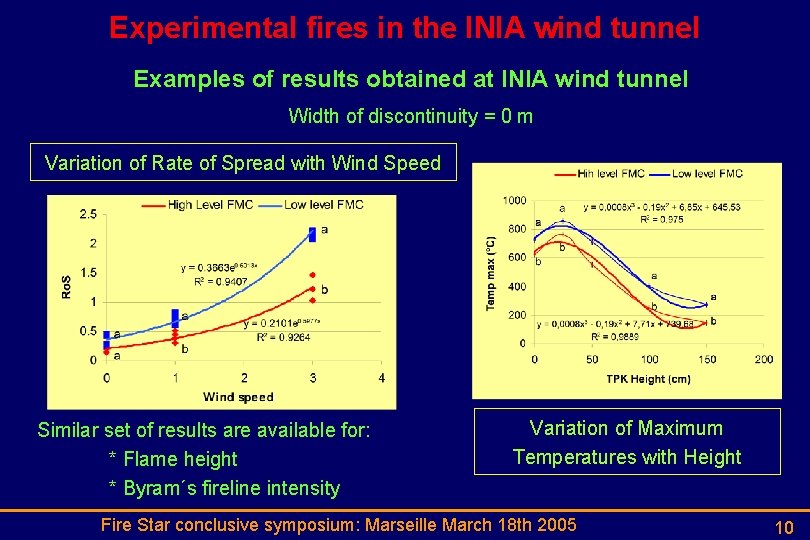
Experimental fires in the INIA wind tunnel Examples of results obtained at INIA wind tunnel Width of discontinuity = 0 m Variation of Rate of Spread with Wind Speed Similar set of results are available for: * Flame height * Byram´s fireline intensity Variation of Maximum Temperatures with Height Fire Star conclusive symposium: Marseille March 18 th 2005 10
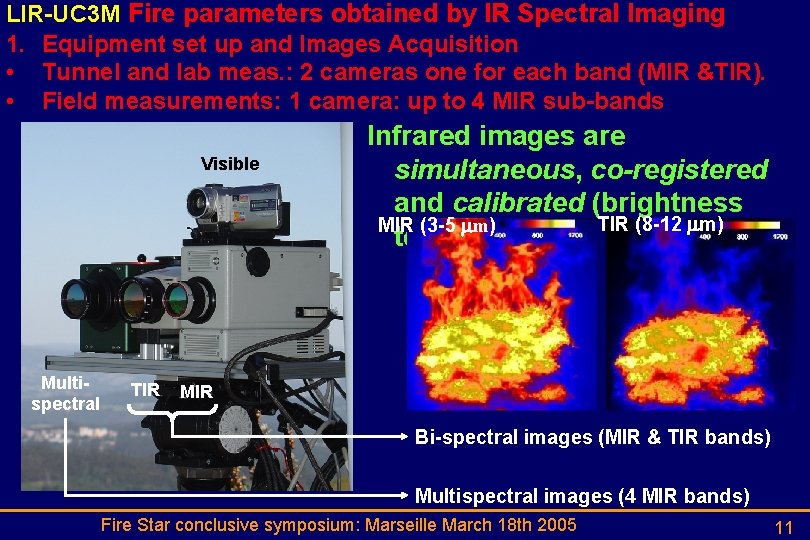
LIR-UC 3 M Fire parameters obtained by IR Spectral Imaging 1. Equipment set up and Images Acquisition • Tunnel and lab meas. : 2 cameras one for each band (MIR &TIR). • Field measurements: 1 camera: up to 4 MIR sub-bands Visible Multispectral TIR Infrared images are simultaneous, co-registered and calibrated (brightness TIR (8 -12 m) MIR (3 -5 m) temperatures) MIR Bi-spectral images (MIR & TIR bands) Multispectral images (4 MIR bands) Fire Star conclusive symposium: Marseille March 18 th 2005 11
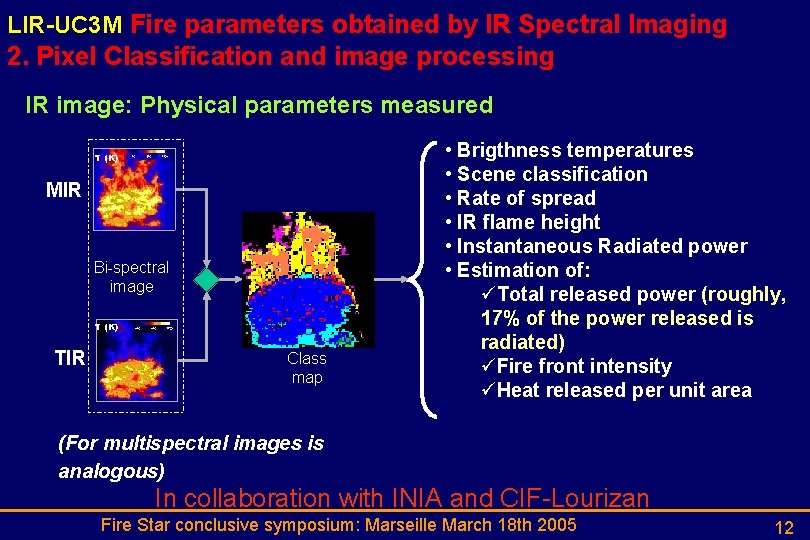
LIR-UC 3 M Fire parameters obtained by IR Spectral Imaging 2. Pixel Classification and image processing IR image: Physical parameters measured T (K) MIR Bi-spectral image T (K) TIR Class map • Brigthness temperatures • Scene classification • Rate of spread • IR flame height • Instantaneous Radiated power • Estimation of: üTotal released power (roughly, 17% of the power released is radiated) üFire front intensity üHeat released per unit area (For multispectral images is analogous) In collaboration with INIA and CIF-Lourizan Fire Star conclusive symposium: Marseille March 18 th 2005 12
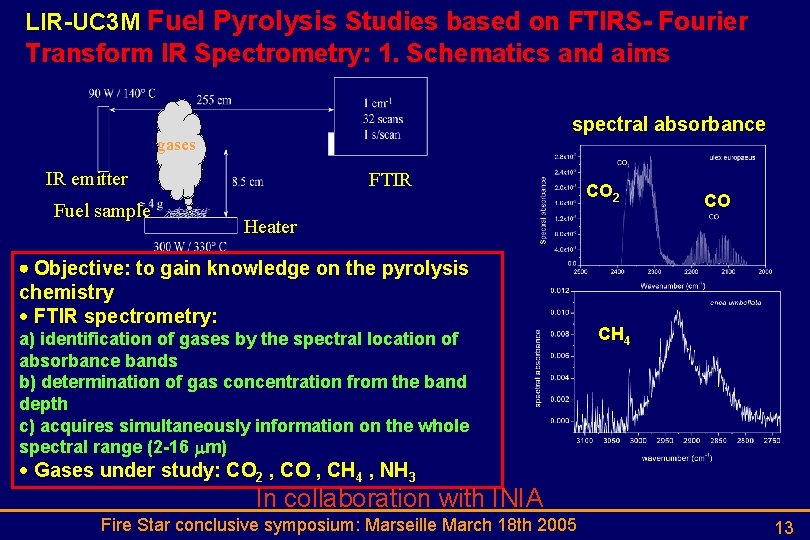
LIR-UC 3 M Fuel Pyrolysis Studies based on FTIRS- Fourier Transform IR Spectrometry: 1. Schematics and aims spectral absorbance gases IR emitter Fuel sample FTIR CO 2 CO Heater Objective: to gain knowledge on the pyrolysis chemistry · FTIR spectrometry: a) identification of gases by the spectral location of absorbance bands b) determination of gas concentration from the band depth c) acquires simultaneously information on the whole spectral range (2 -16 m) CH 4 · Gases under study: CO 2 , CO , CH 4 , NH 3 In collaboration with INIA Fire Star conclusive symposium: Marseille March 18 th 2005 13
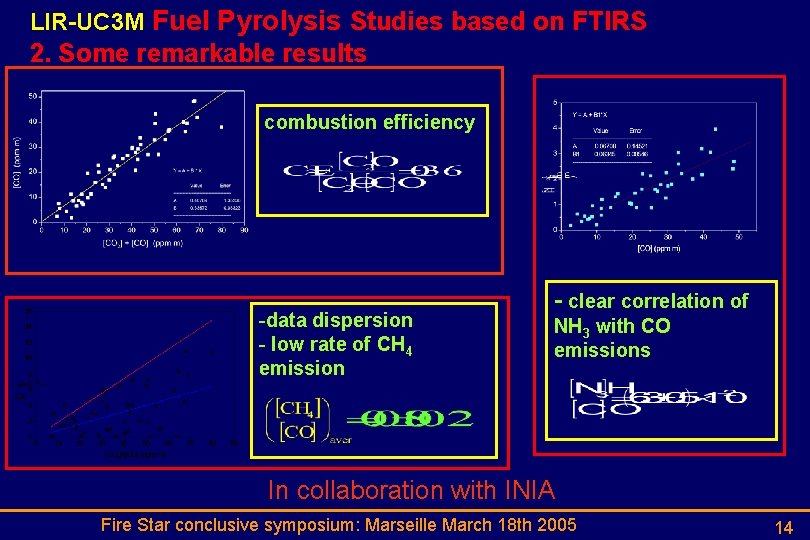
LIR-UC 3 M Fuel Pyrolysis Studies based on FTIRS 2. Some remarkable results combustion efficiency -data dispersion - low rate of CH 4 emission - clear correlation of NH 3 with CO emissions In collaboration with INIA Fire Star conclusive symposium: Marseille March 18 th 2005 14
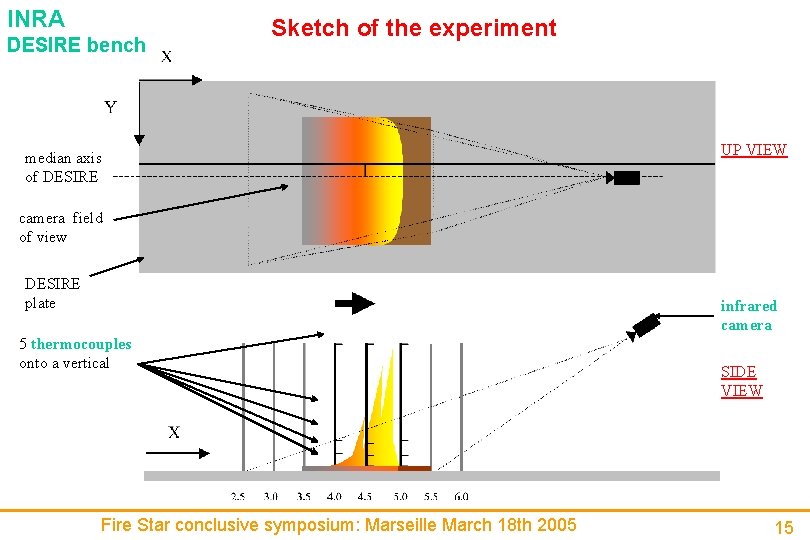
INRA DESIRE bench Sketch of the experiment median axis of DESIRE UP VIEW camera field of view DESIRE plate infrared camera 5 thermocouples onto a vertical Fire Star conclusive symposium: Marseille March 18 th 2005 SIDE VIEW 15
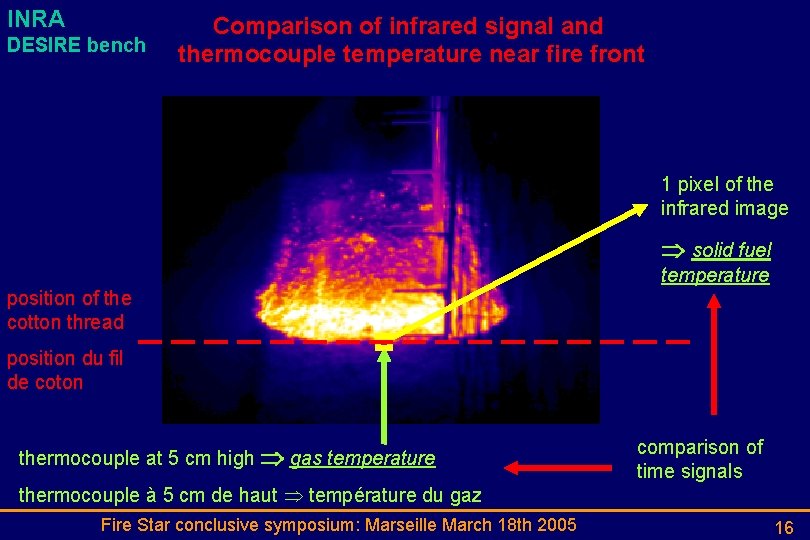
INRA DESIRE bench Comparison of infrared signal and thermocouple temperature near fire front 1 pixel of the infrared image solid fuel temperature position of the cotton thread position du fil de coton thermocouple at 5 cm high gas temperature thermocouple à 5 cm de haut température du gaz Fire Star conclusive symposium: Marseille March 18 th 2005 comparison of time signals 16
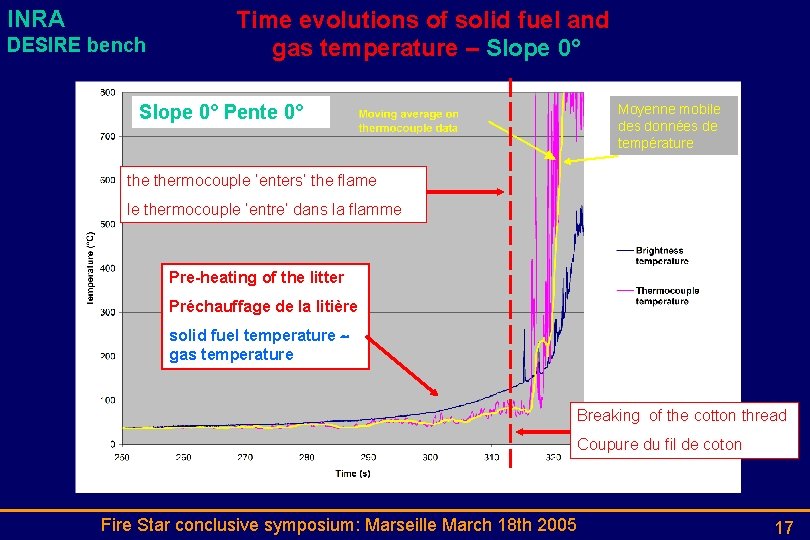
INRA DESIRE bench Time evolutions of solid fuel and gas temperature – Slope 0° Pente 0° Moyenne mobile des données de température thermocouple ‘enters’ the flame le thermocouple ‘entre’ dans la flamme Pre-heating of the litter Préchauffage de la litière solid fuel temperature gas temperature Breaking of the cotton thread Coupure du fil de coton Fire Star conclusive symposium: Marseille March 18 th 2005 17
INRA DESIRE bench Time evolutions of solid fuel and gas temperature – Slope 30° Pente 30° thermocouple ‘enters’ the flame le thermocouple ‘entre’ dans la flamme Pre-heating of the litter Préchauffage de la litière solid fuel temperature gas temperature Breaking of the cotton thread Coupure du fil de coton Fire Star conclusive symposium: Marseille March 18 th 2005 18
- Slides: 18