
PHYSICAL SCIENCE Waves Part 3 Wave Interactions Section
- Slides: 14
PHYSICAL SCIENCE Waves Part 3: Wave Interactions
Section 3 Wave Interactions Objectives Ø Describe how waves behave when they meet an obstacle, pass into another medium, or pass through another wave. Ø Explain what happens when two waves interfere. Ø Distinguish between constructive interference and destructive interference. Ø Explain how standing waves are formed.
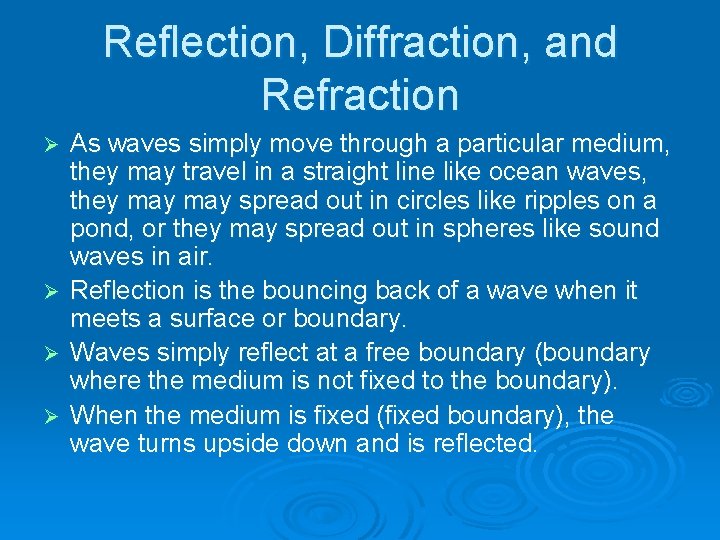
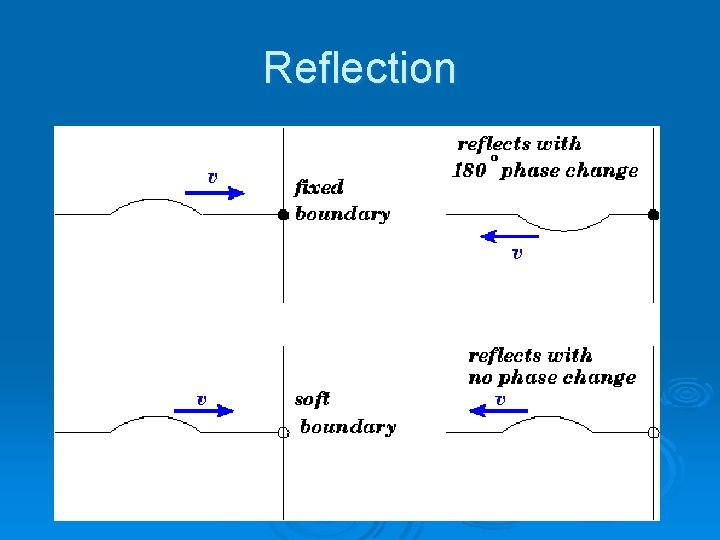
Reflection, Diffraction, and Refraction Ø Ø As waves simply move through a particular medium, they may travel in a straight line like ocean waves, they may spread out in circles like ripples on a pond, or they may spread out in spheres like sound waves in air. Reflection is the bouncing back of a wave when it meets a surface or boundary. Waves simply reflect at a free boundary (boundary where the medium is not fixed to the boundary). When the medium is fixed (fixed boundary), the wave turns upside down and is reflected.
Reflection
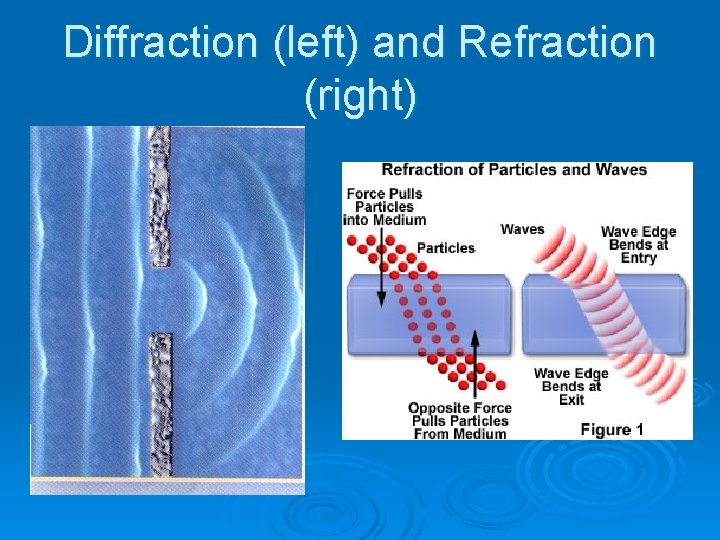
Reflection, Diffraction, and Refraction Diffraction is the bending of a wave as it passes an edge or an opening. Ø We can hear sound coming from a room with the door open from down the hall because the sound waves diffract as they exit the doorway. Ø Refraction is the bending of waves as they pass from one medium to another. Ø When we view a spoon in a glass of water, it appears to be broken at the water line because of the refraction of light waves. Ø
Diffraction (left) and Refraction (right)
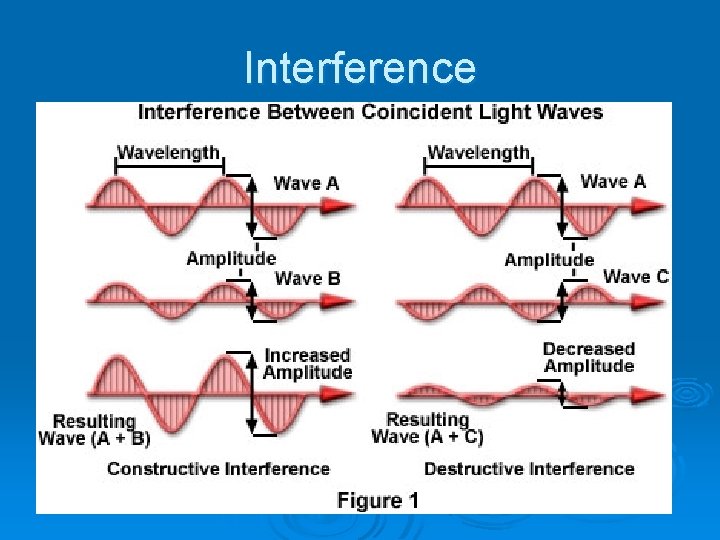
Interference Ø Interference is the combination of two or more waves that exist in the same place at the same time. l l Ø Constructive interference is any interference in which waves combine so that the resulting wave is bigger than the original waves Destructive interference is any interference in which waves combine so that the resulting wave is smaller than the largest of the original waves In constructive interference, amplitudes are added; in destructive interference, amplitudes are subtracted.
Interference
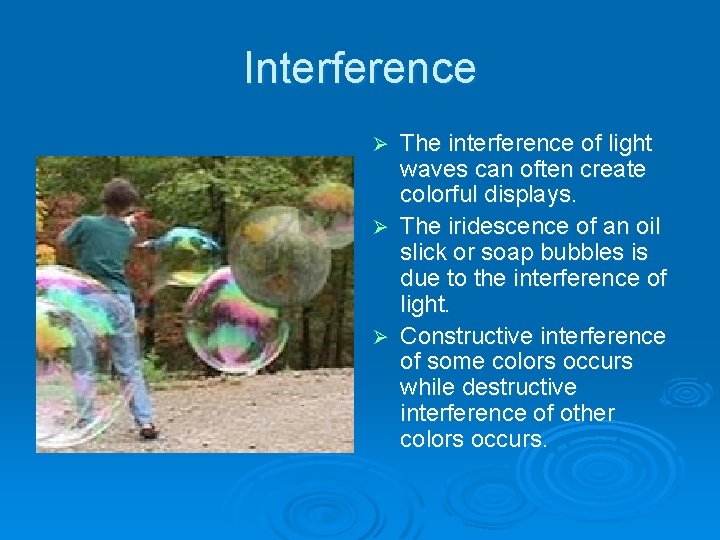
Interference The interference of light waves can often create colorful displays. Ø The iridescence of an oil slick or soap bubbles is due to the interference of light. Ø Constructive interference of some colors occurs while destructive interference of other colors occurs. Ø
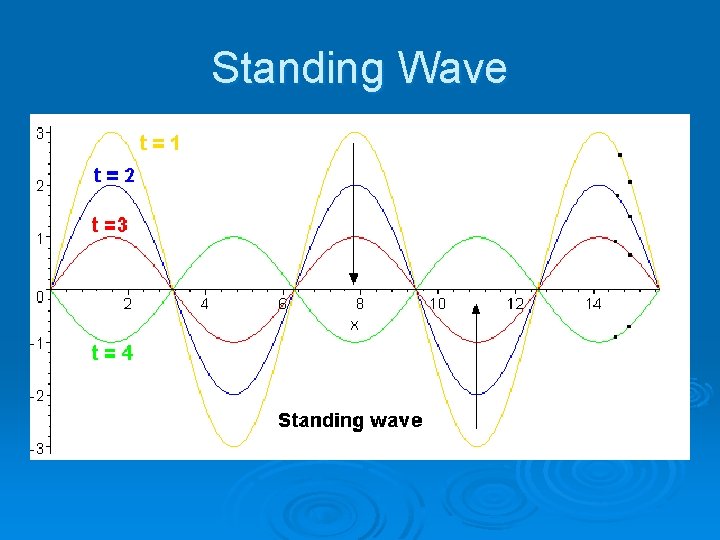
Standing Waves A standing wave is a wave form caused by interference that appears not to move along the medium and that shows some regions of no vibration (nodes) and other regions of maximum vibration (antinodes). Ø If a wave is sent down a string and is reflected, it may meet with more waves of the same amplitude and frequency sent down the string. Ø This would cause a standing wave to form causing the medium (string) to vibrate in a loop or a series of loops. Ø
Standing Waves Ø Ø Ø Nodes lie at the point where the crest of one wave meets with the trough of another wave causing complete destructive interference. The antinodes are points of maximum vibration that lie midway between two nodes. Antinodes lie where the crest of one wave meets the crest of another reflected wave so that complete constructive interference occurs. Only a few wavelengths can form standing waves in any given string. In general, standing waves can exist whenever a multiple of half-wavelengths will fit exactly in the length of the string.
Standing Wave
References Reflection http: //www. physics. upenn. edu/courses/gladney/ phys 151/lectures/images/wave_reflection_trans mission. gif Ø Diffraction http: //www. physics. upenn. edu/courses/gladney/ phys 151/lectures/images/wave_reflection_trans mission. gif Ø Refraction http: //micro. magnet. fsu. edu/primer/java/particleo rwave/refraction/particlerefractionfigure 1. jpg Ø
References Interference http: //micro. magnet. fsu. edu/primer/java/interfere nce/waveinteractions/wavesjavafigure 1. jpg Ø Bubbles http: //www. mountainthyme. com/images/Bubbles. jpg Ø Standing Wave http: //upload. wikimedia. org/wikipedia/en/6/64/St anding-wave 05. png Ø