
Physical Science Lecture 6 Instructor John H Hamilton
- Slides: 19
Physical Science Lecture 6 Instructor: John H. Hamilton
Lecture overview • Position – Coordinate system • Change in position with respect to time – Velocity • Average velocity • Instantaneous velocity • Speed • Graphical analysis – Slopes – Areas
Position • Position describes an objects location within space – For complete description we need 3 dimensions. But in many instances for analysis we can get by with 2 or even one dimension
Position examples
Motion is relative • Motion is always relative to a reference frame – This is because if something is moving what we observe is it moving relative to something else • Examples – On a train – On the earth
Change in Position with respect to time • Velocity- change in position with respect to time. Includes both the magnitude and direction. Example 45 km/hr North – Average velocity- this is the average velocity a body experiences over a given amount of time. It can be found be dividing the total change in displacement by the total time elapsed during that displacement – Instantaneous velocity-this is the velocity of an object at any given instant in time. • Speed- is the magnitude of velocity without direction. Example- 45 km/hr – instantaneous – average
Velocity example • Making a round trip
Velocity example • Going around a curve
Velocity example • Taking a trip where ones speed varies
Analyzing graphs for position and Velocity • Remember the tables and graphs from the lecture on graphing
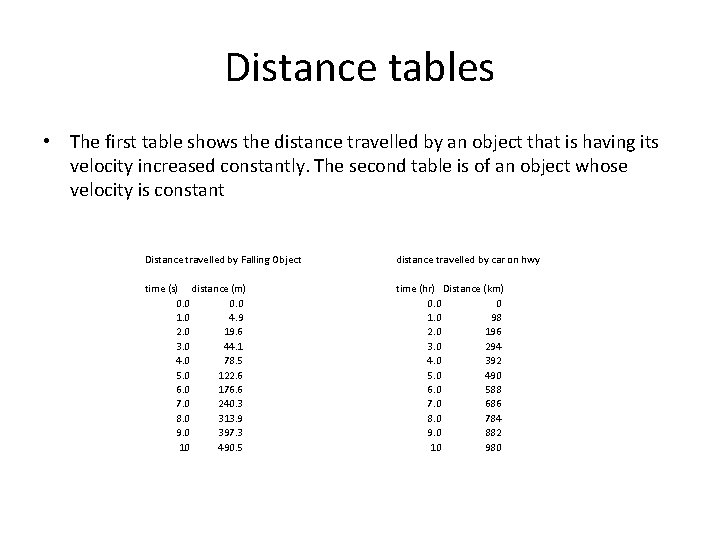
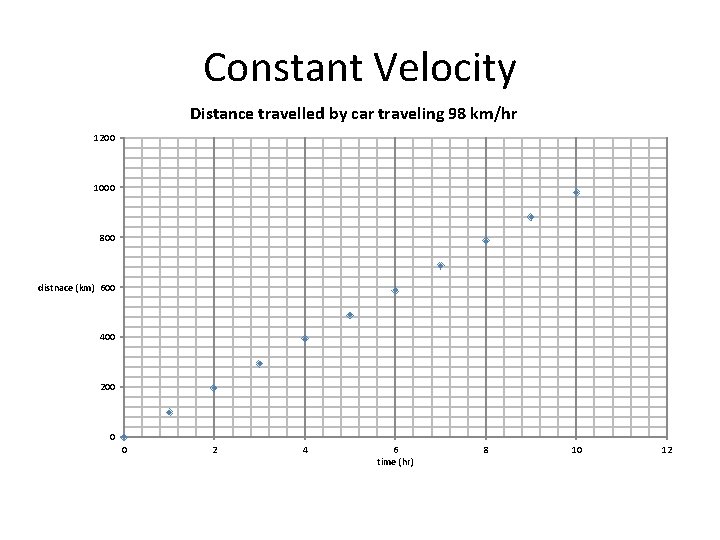
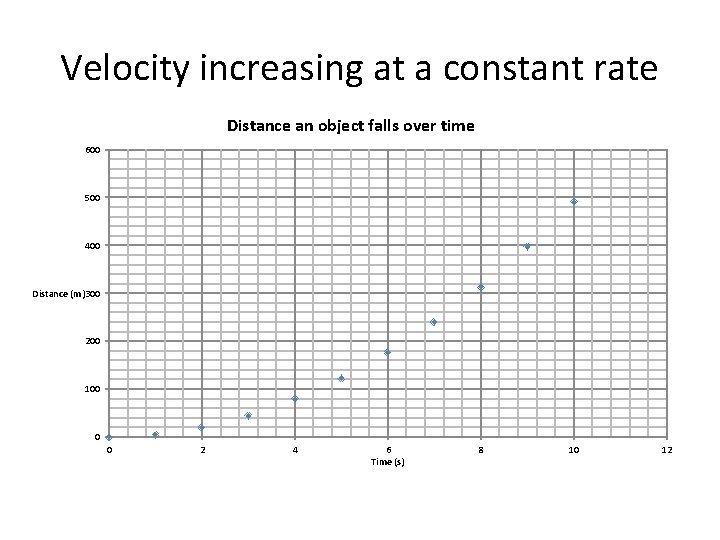
Distance tables • The first table shows the distance travelled by an object that is having its velocity increased constantly. The second table is of an object whose velocity is constant Distance travelled by Falling Object distance travelled by car on hwy time (s) distance (m) 0. 0 1. 0 4. 9 2. 0 19. 6 3. 0 44. 1 4. 0 78. 5 5. 0 122. 6 6. 0 176. 6 7. 0 240. 3 8. 0 313. 9 9. 0 397. 3 10 490. 5 time (hr) Distance (km) 0. 0 0 1. 0 98 2. 0 196 3. 0 294 4. 0 392 5. 0 490 6. 0 588 7. 0 686 8. 0 784 9. 0 882 10 980
Constant Velocity Distance travelled by car traveling 98 km/hr 1200 1000 800 distnace (km) 600 400 200 0 0 2 4 6 time (hr) 8 10 12
Velocity increasing at a constant rate Distance an object falls over time 600 500 400 Distance (m)300 200 100 0 0 2 4 6 Time (s) 8 10 12
Velocity can be thought of… • As the slope of the curve or line on a displacement/time graph. The slope of the curve at any particular point can be used to describe the Instantaneous velocity
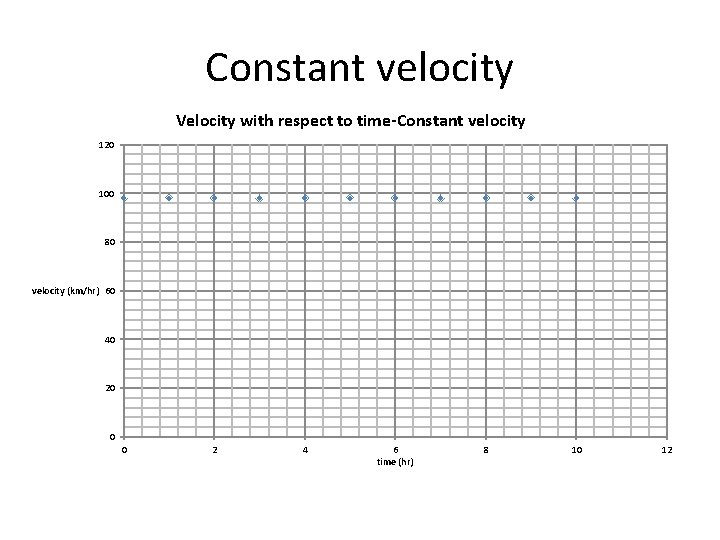
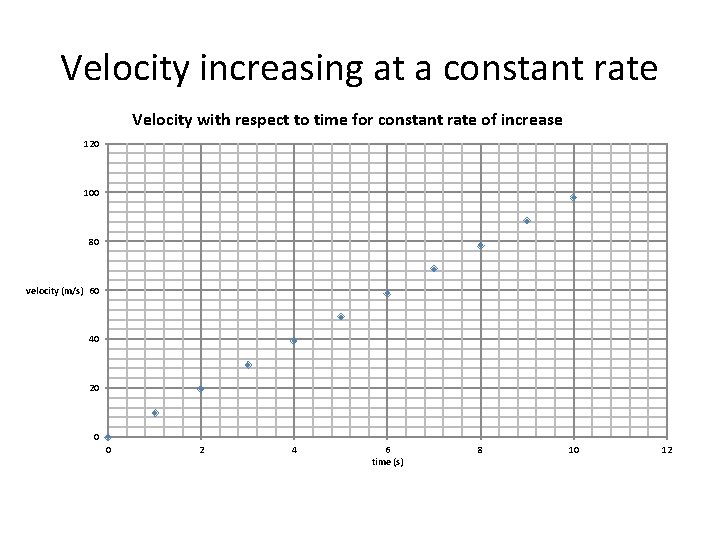
Plotting velocity as a function of time • If we plot velocity with respect to time then – The area under the curve represents the distance travelled
Constant velocity Velocity with respect to time-Constant velocity 120 100 80 velocity (km/hr) 60 40 20 0 0 2 4 6 time (hr) 8 10 12
Velocity increasing at a constant rate Velocity with respect to time for constant rate of increase 120 100 80 velocity (m/s) 60 40 20 0 0 2 4 6 time (s) 8 10 12
Lecture Review • Position – Coordinate system • Change in position with respect to time – Velocity • Average velocity • Instantaneous velocity • Speed • Graphical analysis – Slopes – Areas
Recommended activities • Make the spreadsheet that shows velocity of a falling object as a function of time for 20 seconds. Estimate the distance the object has traveled after 5 seconds, after 15 seconds, and after 20 seconds by estimating the area • Make the spreadsheet that shows position of a falling object and estimate the velocity at 5 seconds, 15 seconds, and thirty seconds