
Physical Science Forces in Fluids What is Pressure
- Slides: 32
Physical Science Forces in Fluids
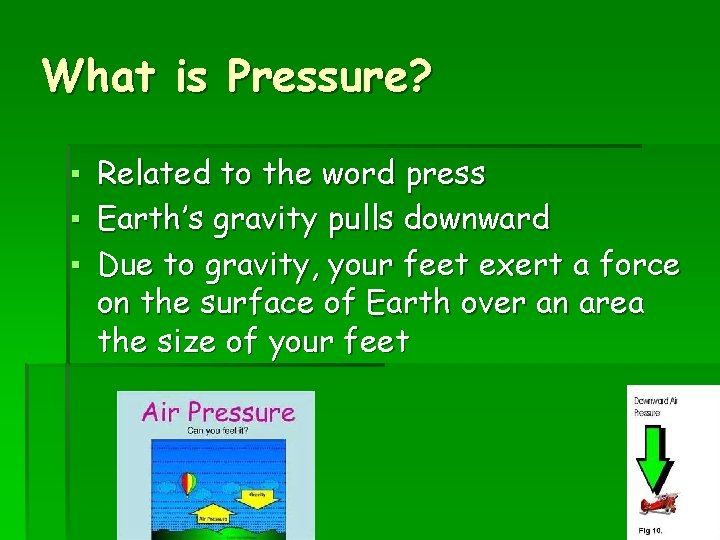
What is Pressure? ▪ ▪ ▪ Related to the word press Earth’s gravity pulls downward Due to gravity, your feet exert a force on the surface of Earth over an area the size of your feet
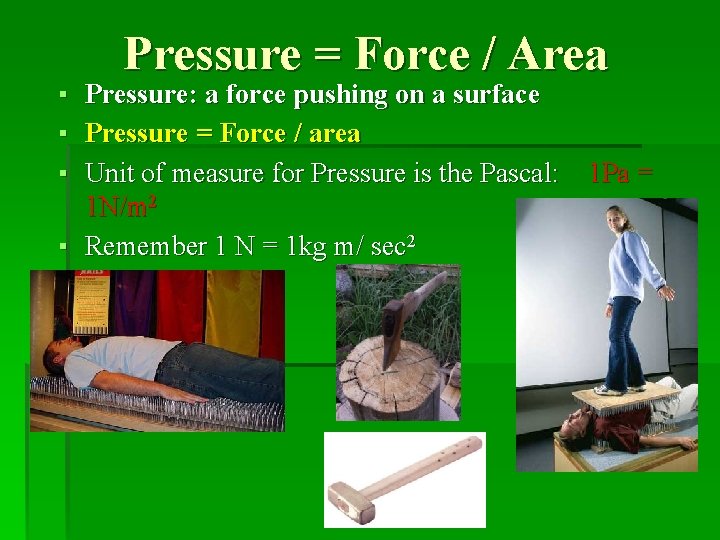
Pressure = Force / Area ▪ Pressure: a force pushing on a surface ▪ Pressure = Force / area ▪ Unit of measure for Pressure is the Pascal: 1 Pa = 1 N/m 2 ▪ Remember 1 N = 1 kg m/ sec 2
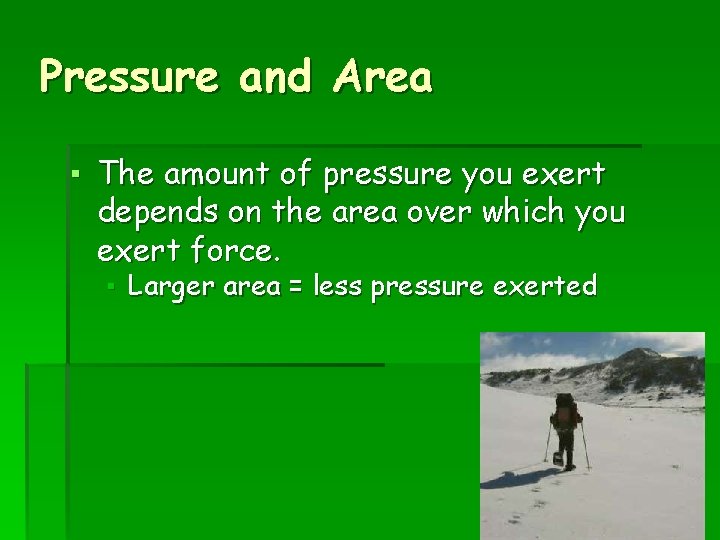
Pressure and Area ▪ The amount of pressure you exert depends on the area over which you exert force. ▪ Larger area = less pressure exerted
Pressure ▪ Can be calculated by dividing the force exerted by a fluid by the total area over which the force acts ▪ When force is measured in Newtons (N) and area is measured in square centimeters (cm 2), pressure is measured in Newtons per square centimeter (N/cm 2)
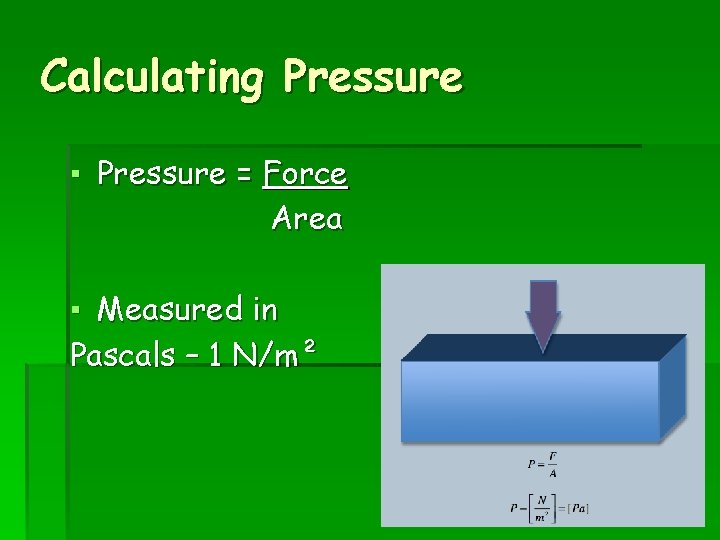
Calculating Pressure ▪ Pressure = Force Area ▪ Measured in Pascals – 1 N/m²
Pressure ▪ The pressure a fluid exerts is due to the fact that the fluid is made of particles that have weight and motion. ▪ The weight of the particles in a fluid cause them to push against objects
Pressure Problems ▪ What is the force water applies to your hand when you dive to bottom of a swimming pool? Assume your hand has an area of 0. 008 m 2 and the water pressure is 120, 000 Pa. ▪ Solution: ▪ P = F/A, F = P ·A, A = F/P, ▪ F = (. 008) x (120, 000) = 960 N
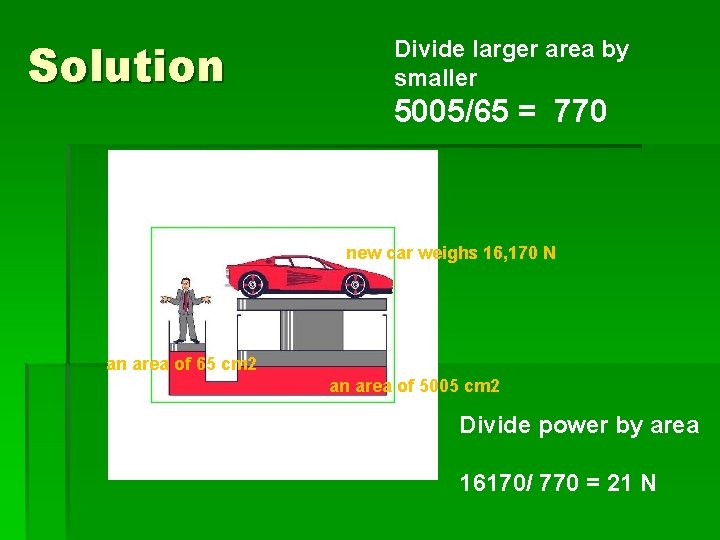
Pressure Problems ▪ Your brand new car weighs 16, 170 N and you need to get your first oil change. You pull it onto the hydraulic lift, which has an area of 5005 cm 2. The mechanic applies a force to a small piston that has an area of 6. 5 cm 2. What force does he apply to lift your car? ▪ Solution: ▪ P = F/A, F = P ·A, A = F/P,
Solution Divide larger area by smaller 5005/65 = 770 new car weighs 16, 170 N an area of 65 cm 2 an area of 5005 cm 2 Divide power by area 16170/ 770 = 21 N
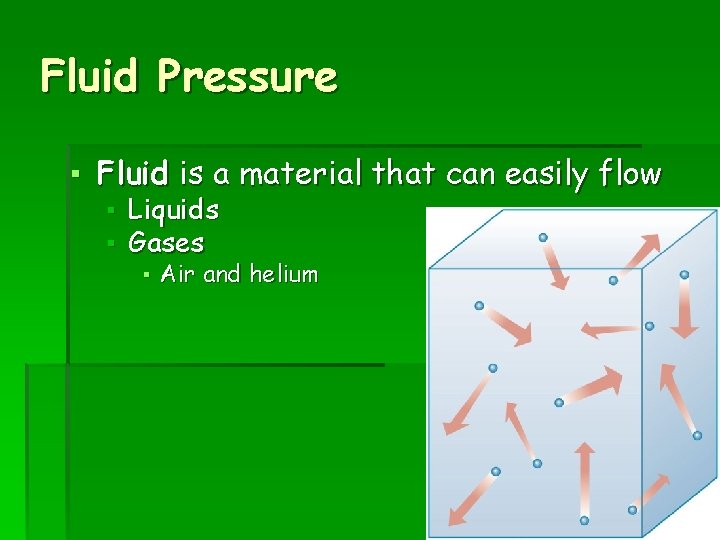
Fluid Pressure ▪ Fluid is a material that can easily flow ▪ Liquids ▪ Gases ▪ Air and helium
Fluid Pressure ▪ Fluid is a material that can easily flow. All Liquids and Gases are fluids. ▪ In a fluid, all of the forces exerted by the individual particles combine to make up the pressure exerted by the fluid.
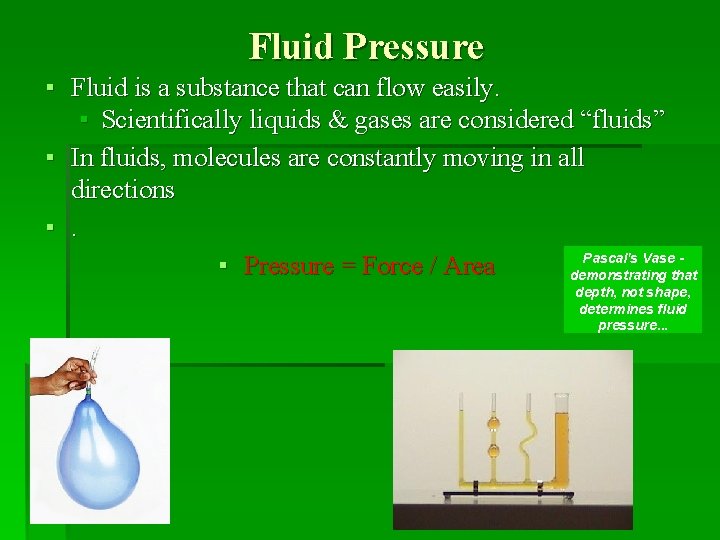
Fluid Pressure ▪ Fluid is a substance that can flow easily. ▪ Scientifically liquids & gases are considered “fluids” ▪ In fluids, molecules are constantly moving in all directions ▪. Pascal's Vase ▪ Pressure = Force / Area demonstrating that depth, not shape, determines fluid pressure. . .
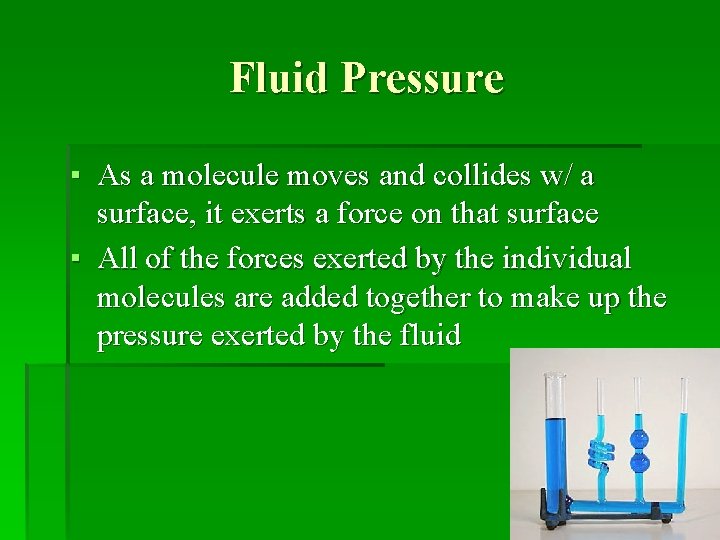
Fluid Pressure ▪ As a molecule moves and collides w/ a surface, it exerts a force on that surface ▪ All of the forces exerted by the individual molecules are added together to make up the pressure exerted by the fluid
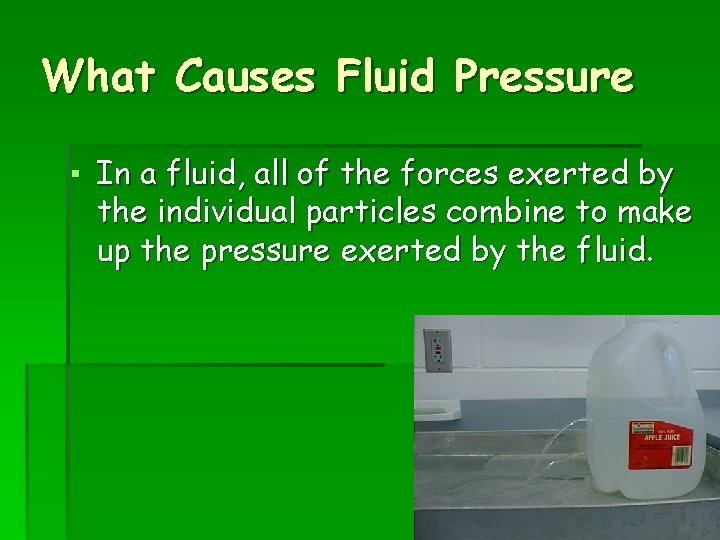
What Causes Fluid Pressure ▪ In a fluid, all of the forces exerted by the individual particles combine to make up the pressure exerted by the fluid.
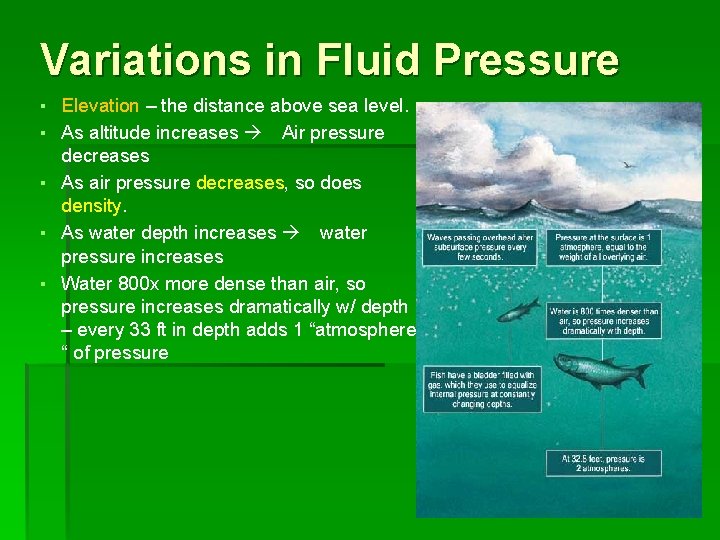
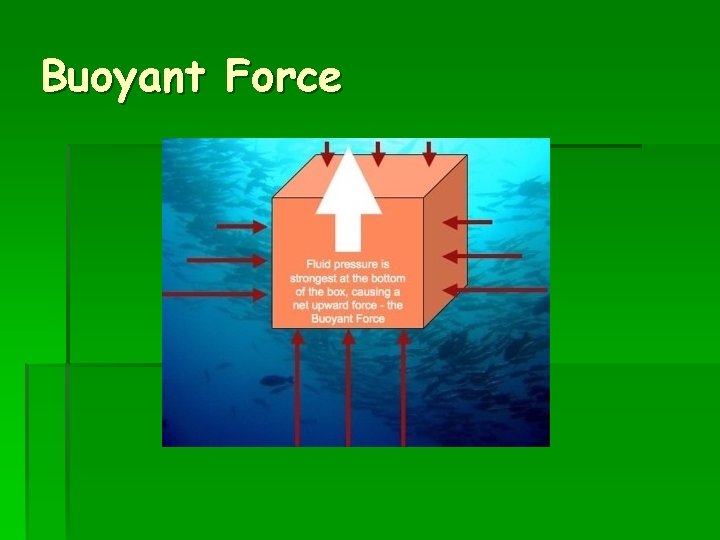
Variations in Fluid Pressure ▪ Elevation – the distance above sea level. ▪ As altitude increases Air pressure decreases ▪ As air pressure decreases, so does density. ▪ As water depth increases water pressure increases ▪ Water 800 x more dense than air, so pressure increases dramatically w/ depth – every 33 ft in depth adds 1 “atmosphere “ of pressure
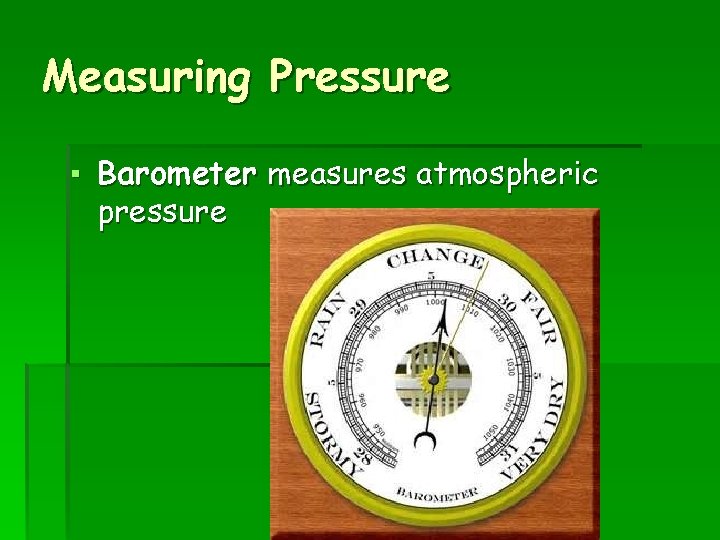
Measuring Pressure ▪ Barometer measures atmospheric pressure
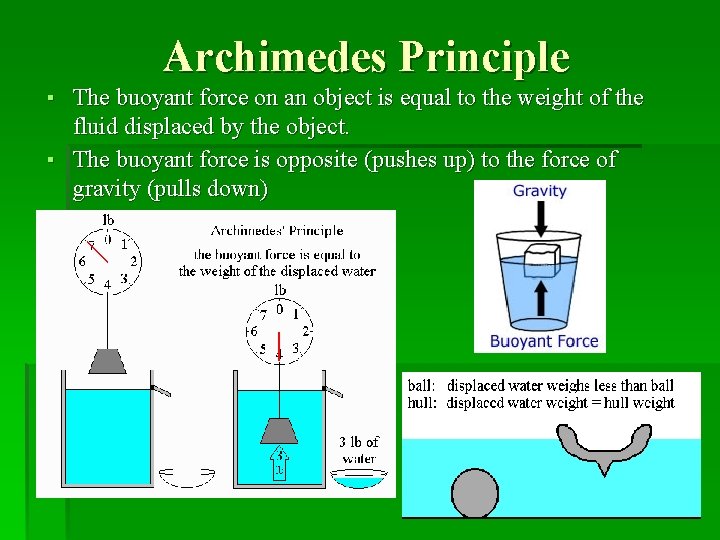
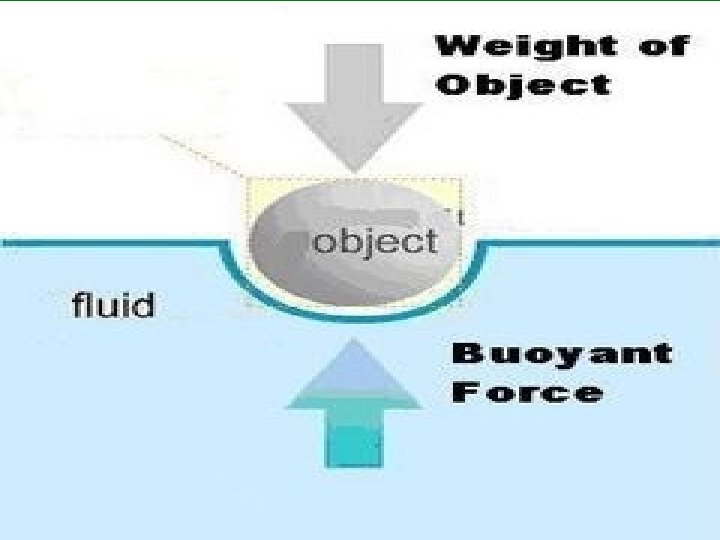
Archimedes Principle ▪ The buoyant force on an object is equal to the weight of the fluid displaced by the object. ▪ The buoyant force is opposite (pushes up) to the force of gravity (pulls down)
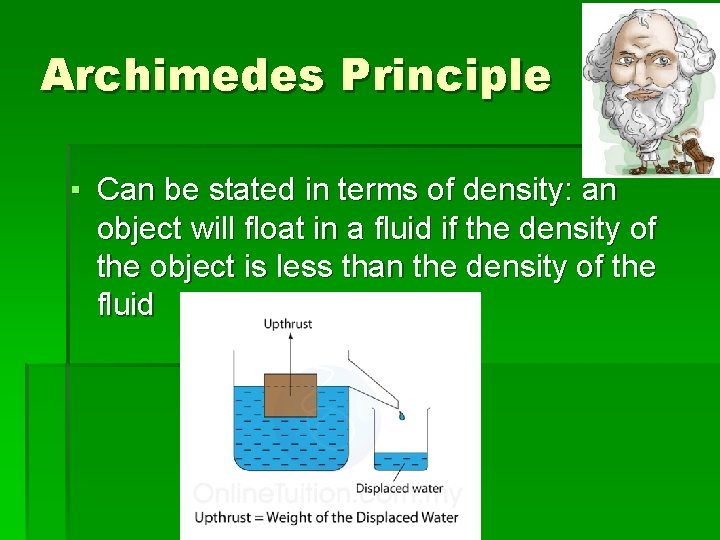
Archimedes Principle ▪ Can be stated in terms of density: an object will float in a fluid if the density of the object is less than the density of the fluid
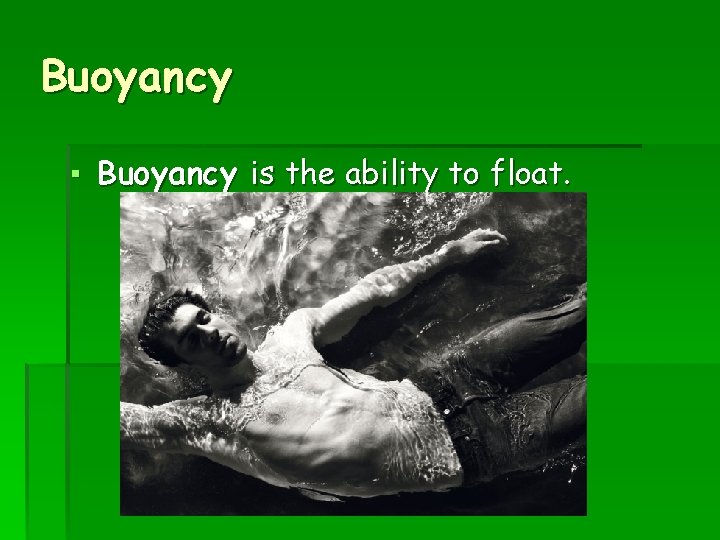
Buoyancy ▪ Buoyancy is the ability to float.
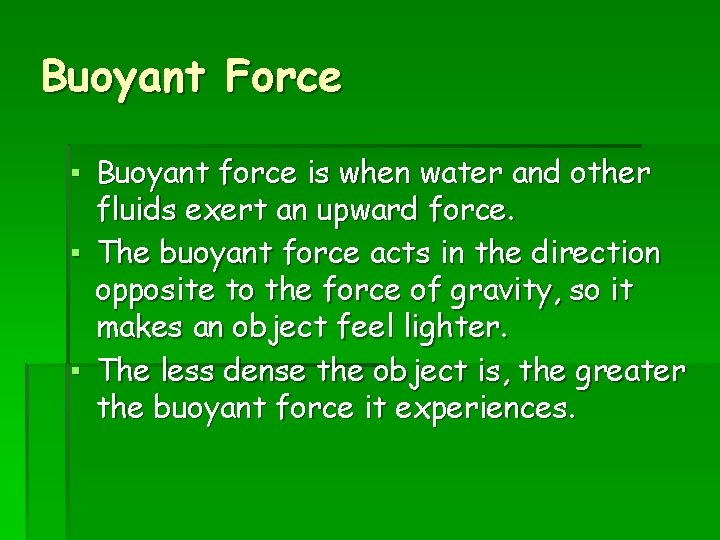
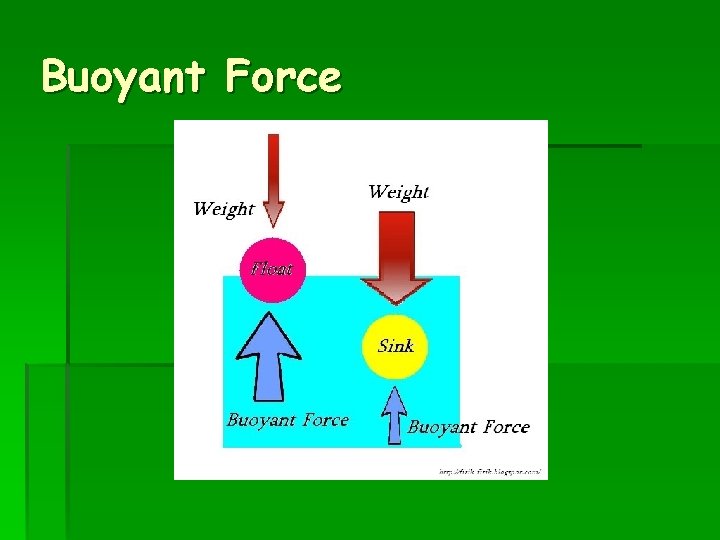
Buoyant Force ▪ Buoyant force is when water and other fluids exert an upward force. ▪ The buoyant force acts in the direction opposite to the force of gravity, so it makes an object feel lighter. ▪ The less dense the object is, the greater the buoyant force it experiences.
Buoyant Force
Buoyant Force
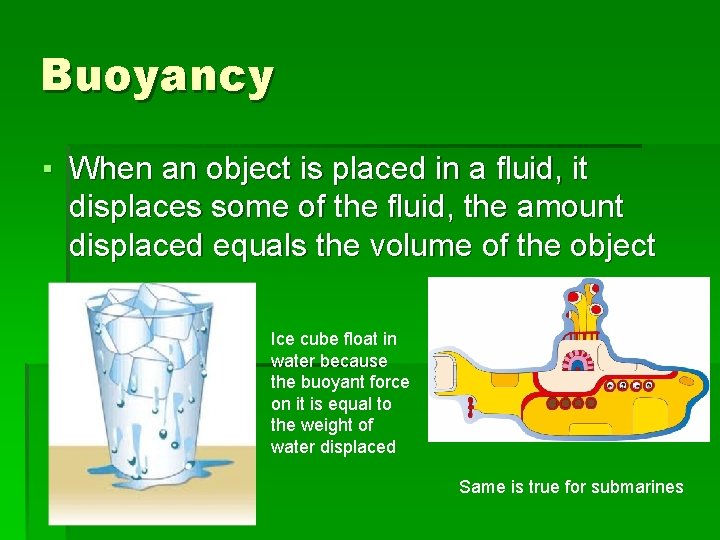
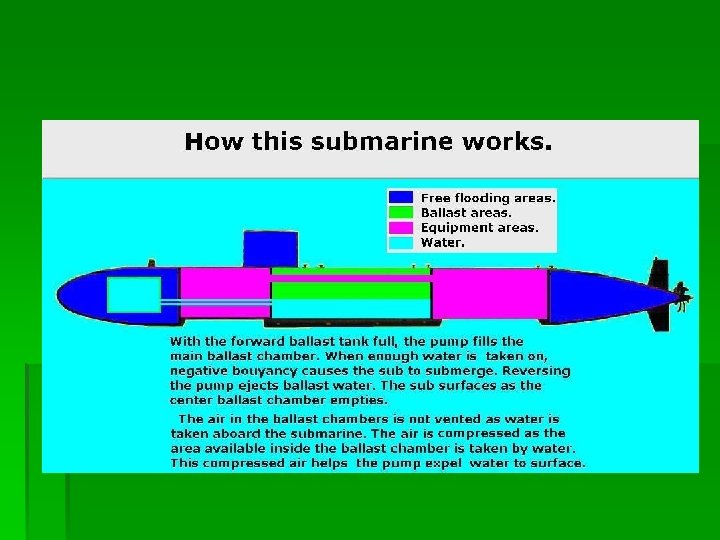
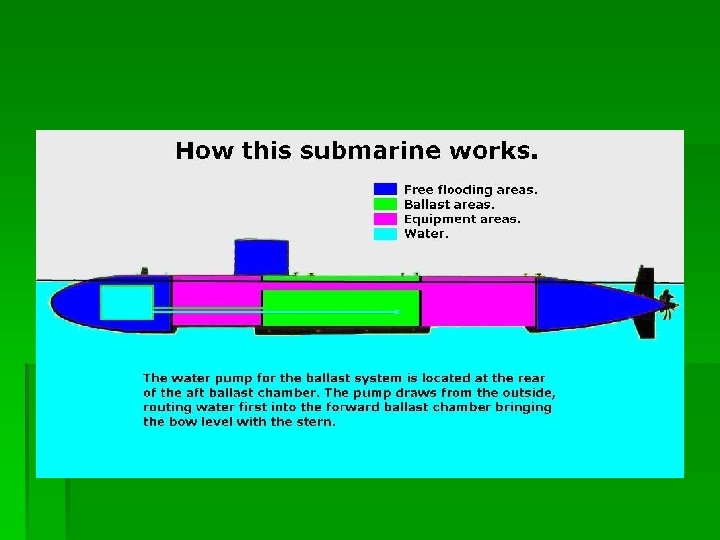
Buoyancy ▪ When an object is placed in a fluid, it displaces some of the fluid, the amount displaced equals the volume of the object Ice cube float in water because the buoyant force on it is equal to the weight of water displaced Same is true for submarines
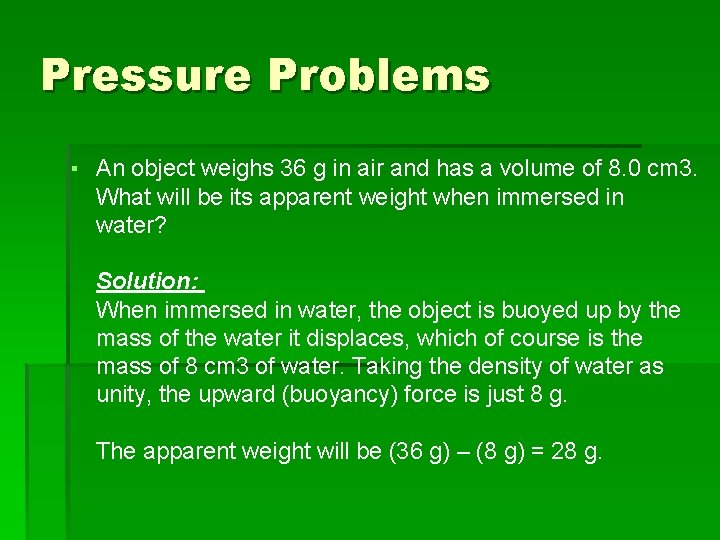
Pressure Problems ▪ An object weighs 36 g in air and has a volume of 8. 0 cm 3. What will be its apparent weight when immersed in water? Solution: When immersed in water, the object is buoyed up by the mass of the water it displaces, which of course is the mass of 8 cm 3 of water. Taking the density of water as unity, the upward (buoyancy) force is just 8 g. The apparent weight will be (36 g) – (8 g) = 28 g.
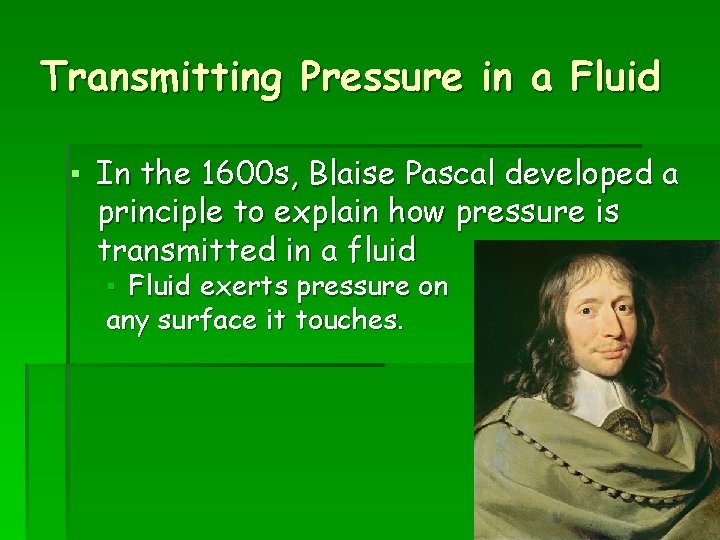
Transmitting Pressure in a Fluid ▪ In the 1600 s, Blaise Pascal developed a principle to explain how pressure is transmitted in a fluid ▪ Fluid exerts pressure on any surface it touches.
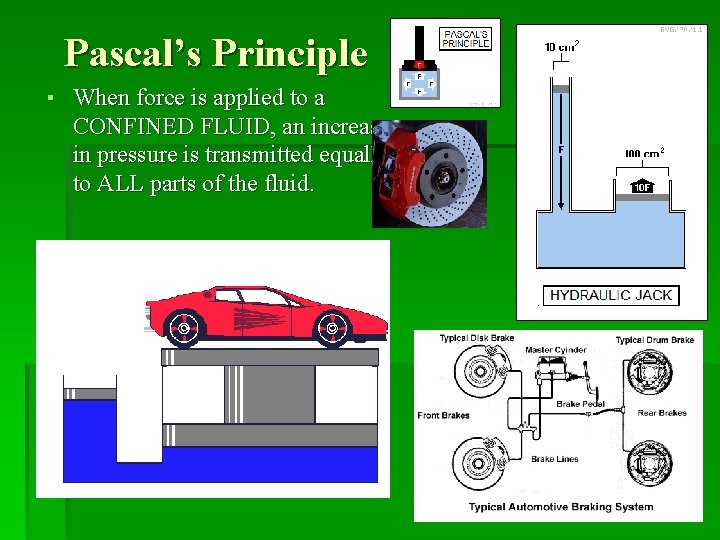
Pascal’s Principle ▪ When force is applied to a CONFINED FLUID, an increase in pressure is transmitted equally to ALL parts of the fluid.
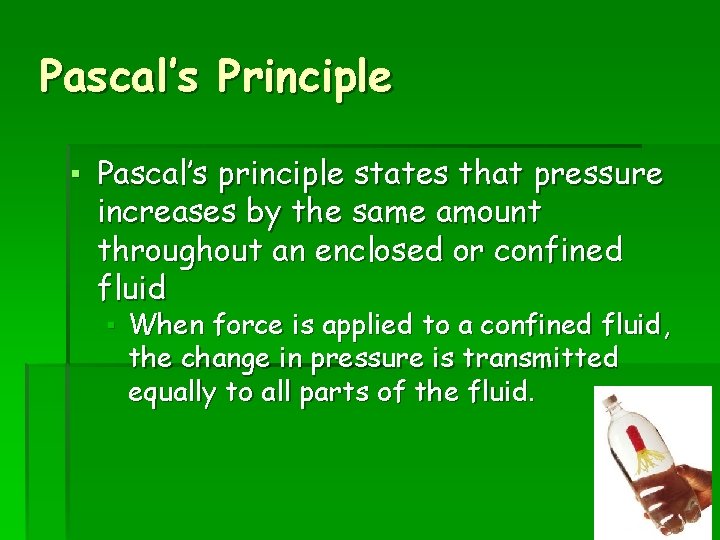
Pascal’s Principle ▪ Pascal’s principle states that pressure increases by the same amount throughout an enclosed or confined fluid ▪ When force is applied to a confined fluid, the change in pressure is transmitted equally to all parts of the fluid.
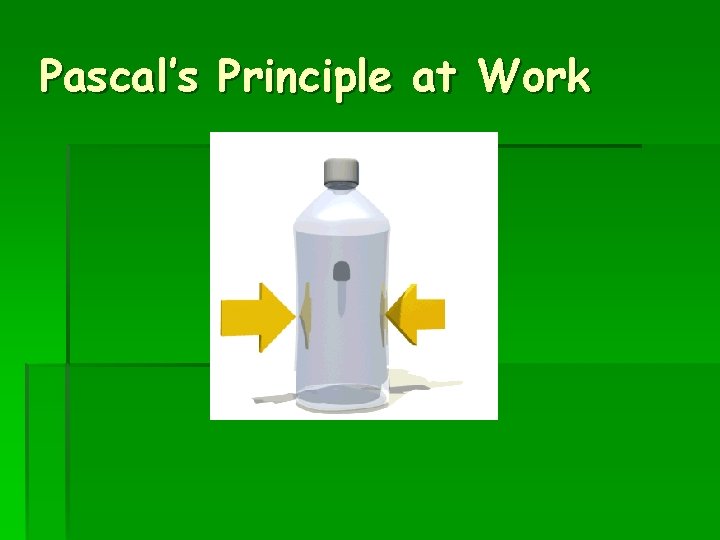
Pascal’s Principle at Work