
Physical Science Chapter 12 Forces and Motion Forces
- Slides: 38
Physical Science Chapter 12 Forces and Motion
Forces and Motion § What is a Force? l l l A Force is a Push or Pull Exerted on an Object. Forces cause Objects to Speed up, Slow down, or Change Direction as they Move. A Force Exerted on an Object Causes that Object’s Velocity to Change; that is, All Forces Cause an Acceleration
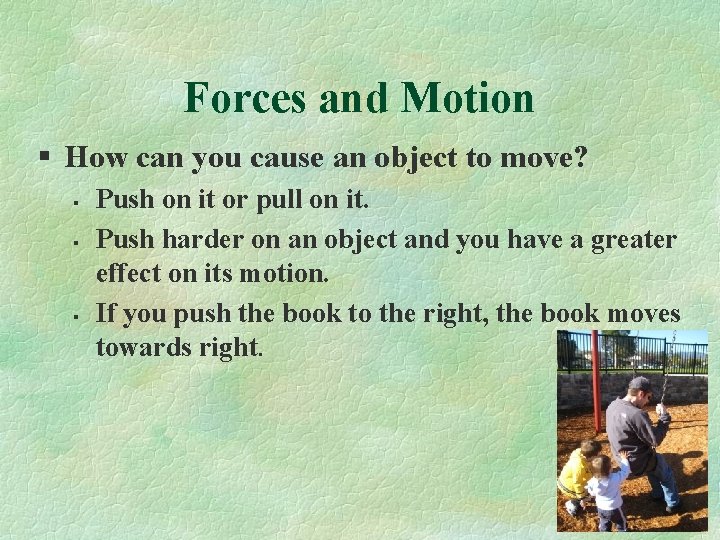
Forces and Motion § How can you cause an object to move? § § § Push on it or pull on it. Push harder on an object and you have a greater effect on its motion. If you push the book to the right, the book moves towards right.
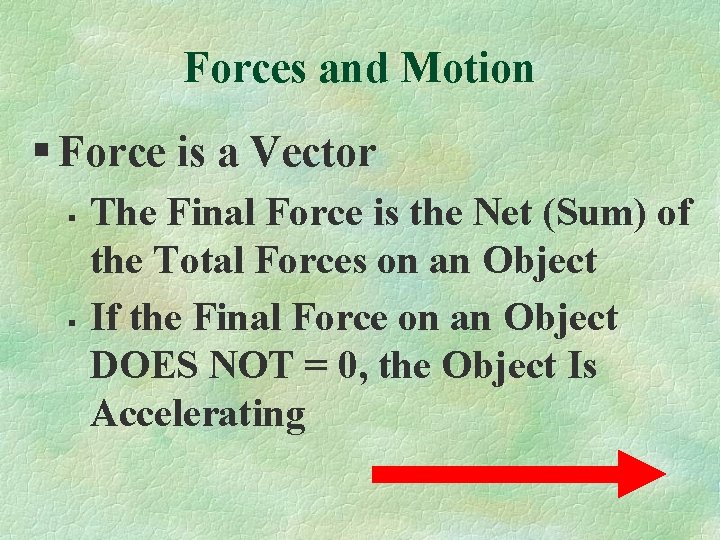
Forces and Motion § Force is a Vector § § The Final Force is the Net (Sum) of the Total Forces on an Object If the Final Force on an Object DOES NOT = 0, the Object Is Accelerating
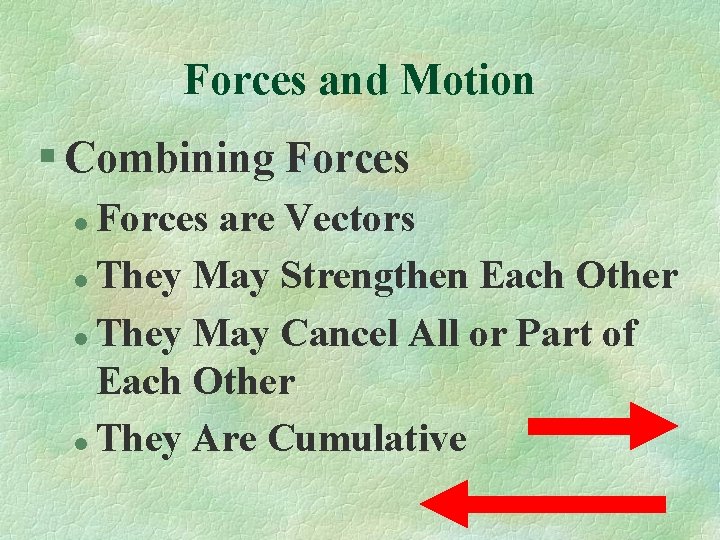
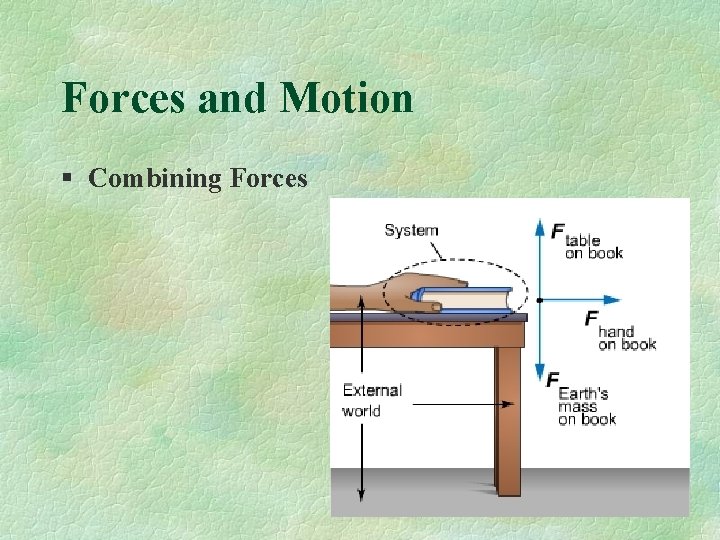
Forces and Motion § Combining Forces are Vectors l They May Strengthen Each Other l They May Cancel All or Part of Each Other l They Are Cumulative l
Units § Forces are measured in units known as § Newtons =N
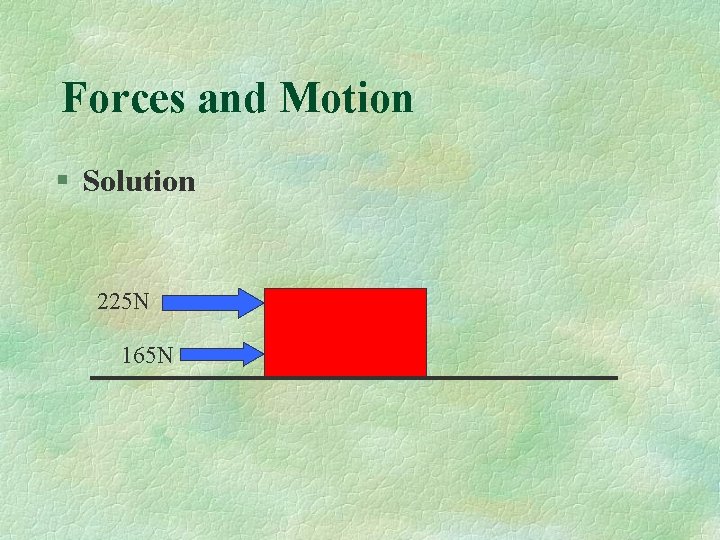
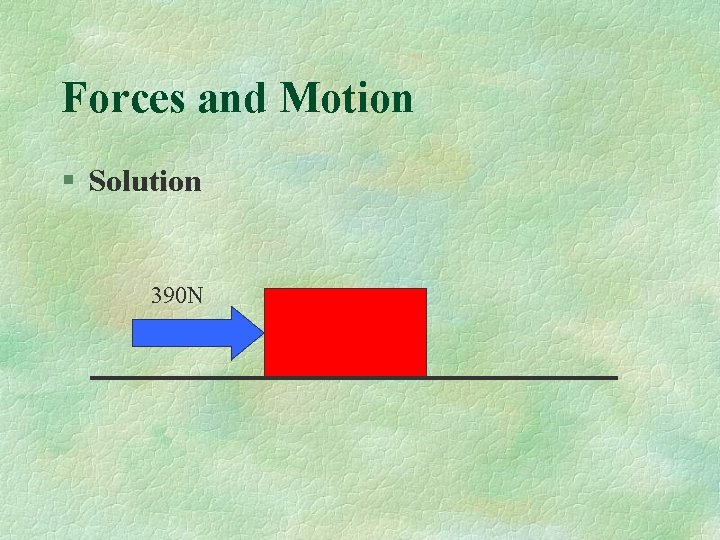
Forces and Motion § Example Problem l Two horizontal forces of 225 N and 165 N are exerted in the same direction on a crate. What is the net force on the crate?
Forces and Motion § Solution 225 N 165 N
Forces and Motion § Solution 390 N
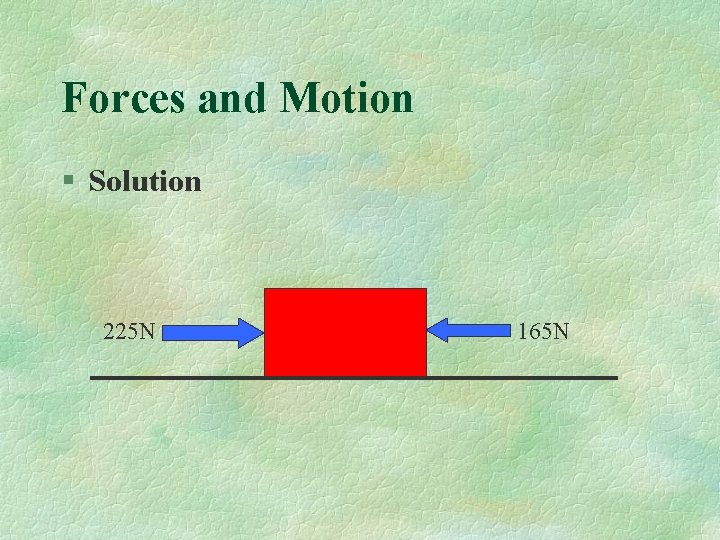
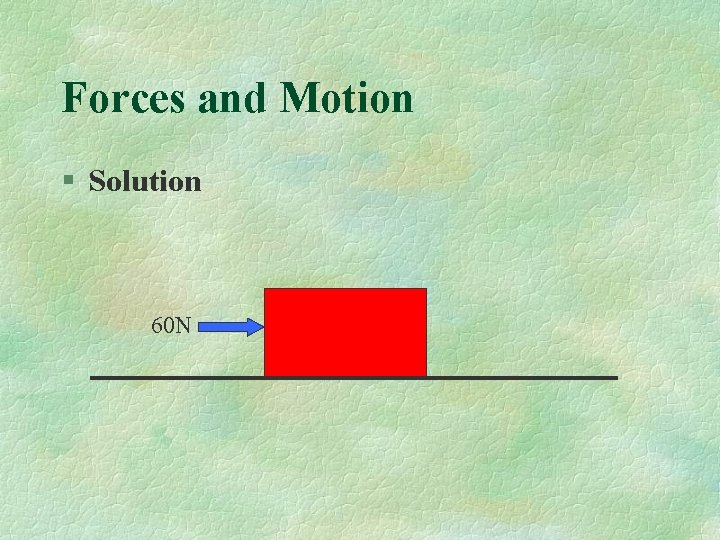
Forces and Motion § Example Problem l If the same two horizontal forces of 225 N and 165 N are exerted in opposite directions on the crate. What is the net force on the crate?
Forces and Motion § Solution 225 N 165 N
Forces and Motion § Solution 60 N
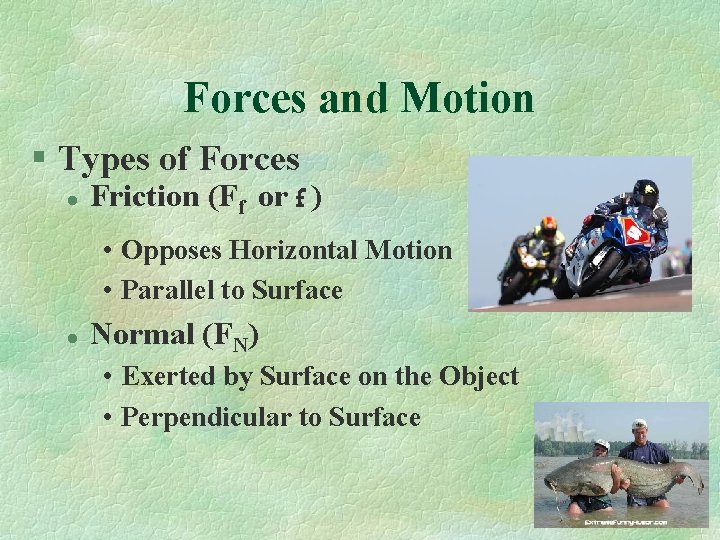
Forces and Motion § Types of Forces l Friction (Ff or f ) • Opposes Horizontal Motion • Parallel to Surface l Normal (FN) • Exerted by Surface on the Object • Perpendicular to Surface
Forces and Motion § Types of Forces l Tension (FT) • Pull or Push Exerted by Secondary Object • Parallel to Secondary Object l Weight (Fg) • Long Range Force Exerted by Gravity on the Object • Toward the Center of the Earth
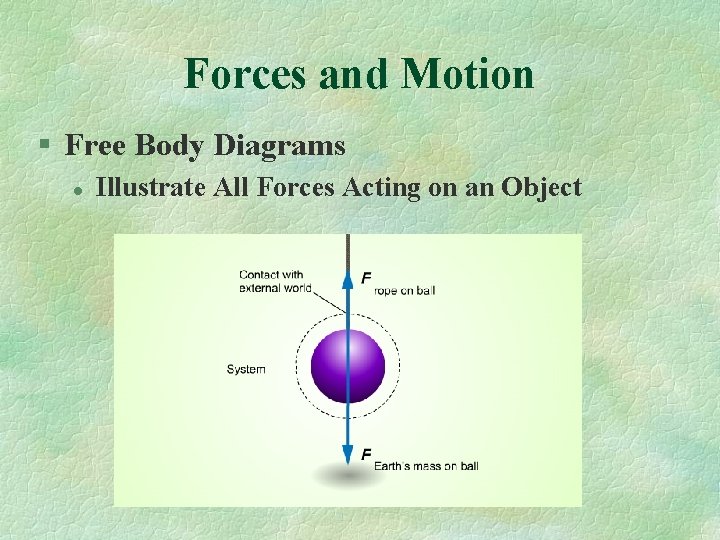
Forces and Motion § Free Body Diagrams l Illustrate All Forces Acting on an Object
Forces and Motion § Combining Forces
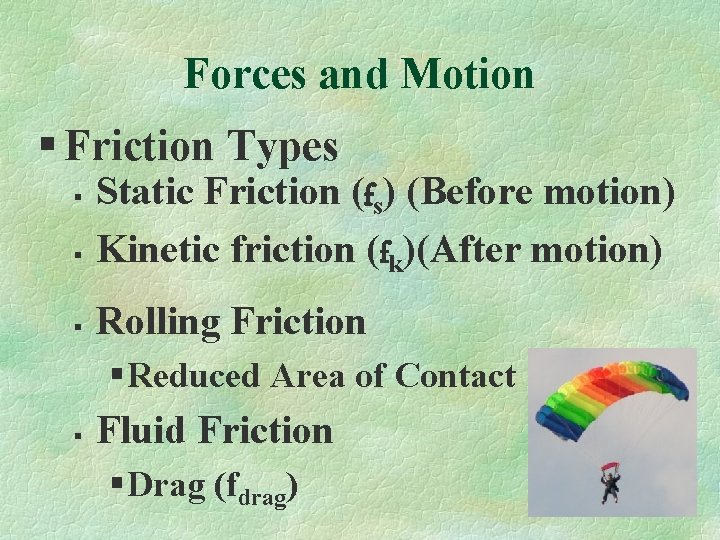
Forces and Motion § Friction Types § § § Static Friction (fs) (Before motion) Kinetic friction (fk)(After motion) Rolling Friction § Reduced Area of Contact § Fluid Friction § Drag (fdrag)
Forces and Motion § Earth’s Gravity l Force Pulling all Objects Toward the Center of the Earth • g is the acceleration of Gravity (-9. 8 m/s 2) • Galileo Galilei (1564 -1642)
Newton’s Laws of Motion 1
Forces and Motion § Newton’s First Law of Motion l “Every Body Continues In Its State of Rest, Or of Uniform Motion In A Straight Line, Unless It is Compelled to Change That State by Forces Impressed Upon It. ”
Forces and Motion § Newton’s First Law of Motion l l “Every Body Continues In Its State of Rest, Or of Uniform Motion In A Straight Line, Unless It is Compelled to Change That State by Forces Impressed Upon It. ” aka “The Law of Inertia”
Forces and Motion § Inertia l The Tendency of an Object to Resist a Change in Movement § Equilibrium l Net Force = 0
Newton’s Laws of Motion 2
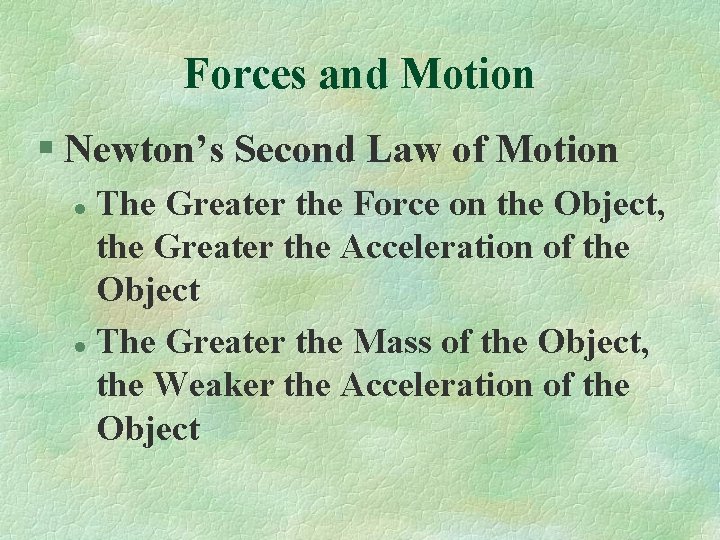
Forces and Motion § Newton’s Second Law of Motion l “The Acceleration of a Body is Directly Proportional to the Net Force Acting on the Body and Inversely Proportional to the Mass of the Body. ”
Forces and Motion § Newton’s Second Law of Motion The Greater the Force on the Object, the Greater the Acceleration of the Object l The Greater the Mass of the Object, the Weaker the Acceleration of the Object l
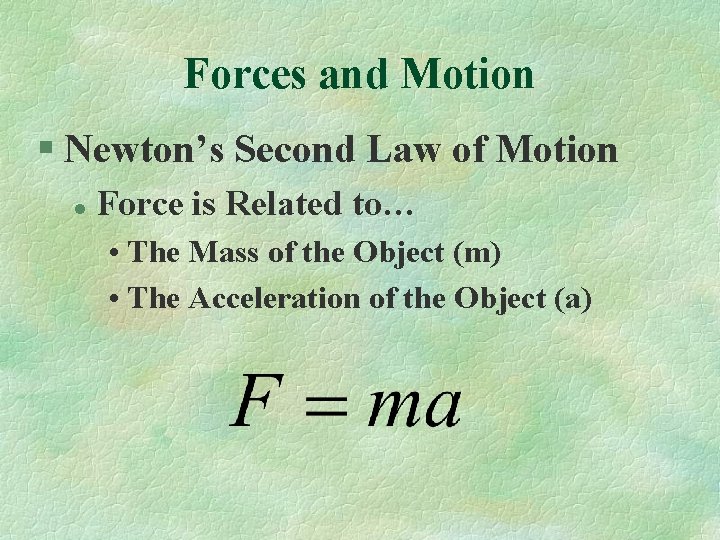
Forces and Motion § Newton’s Second Law of Motion l Force is Related to… • The Mass of the Object (m) • The Acceleration of the Object (a)
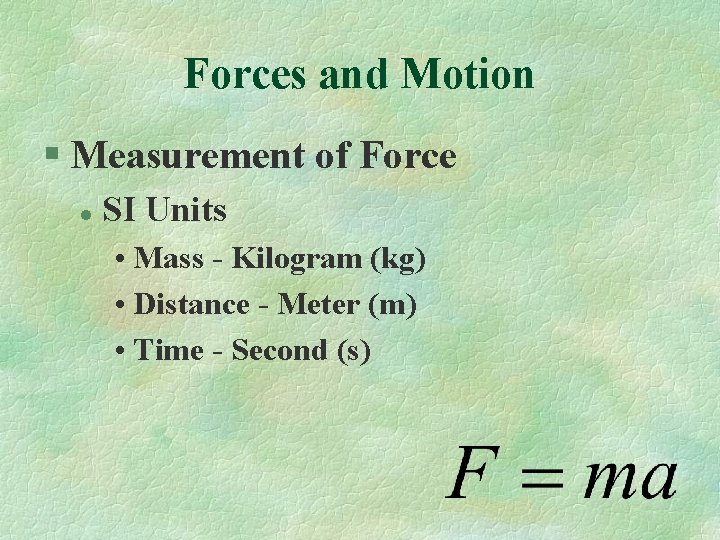
Forces and Motion § Measurement of Force l SI Units • Mass - Kilogram (kg) • Distance - Meter (m) • Time - Second (s)
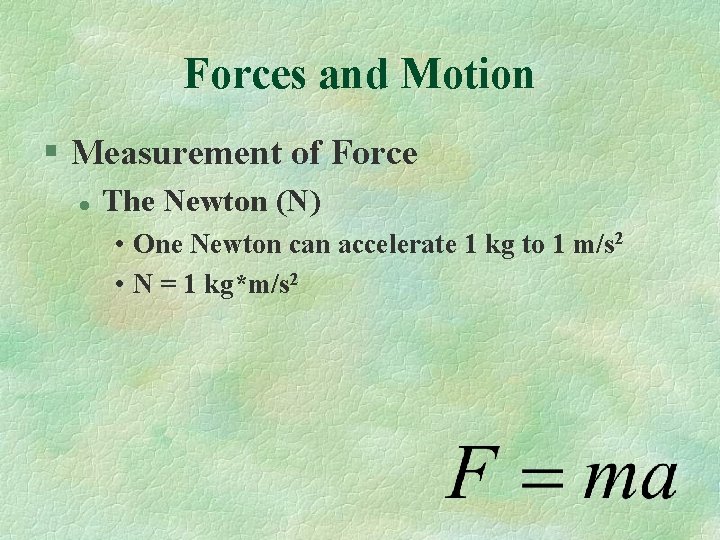
Forces and Motion § Measurement of Force l The Newton (N) • One Newton can accelerate 1 kg to 1 m/s 2 • N = 1 kg*m/s 2
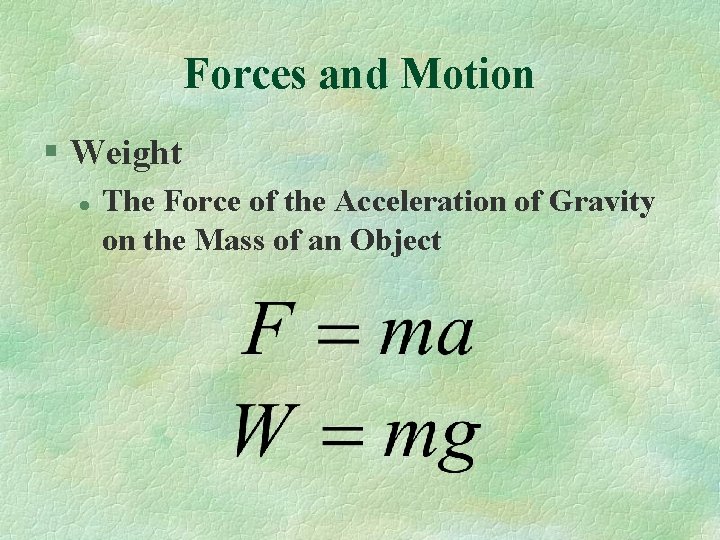
Forces and Motion § Weight l The Force of the Acceleration of Gravity on the Mass of an Object
Newton’s Laws of Motion 3
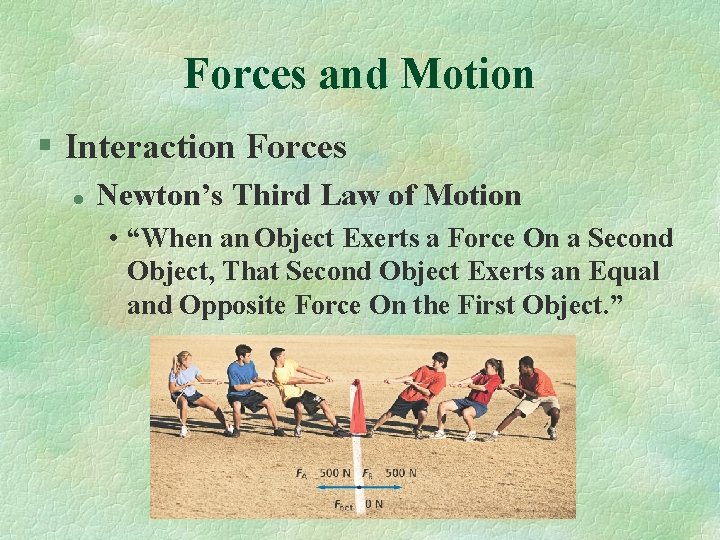
Forces and Motion § Interaction Forces l Newton’s Third Law of Motion • “When an Object Exerts a Force On a Second Object, That Second Object Exerts an Equal and Opposite Force On the First Object. ”
Forces and Motion § Interaction Forces l Newton’s Third Law of Motion • “For Every Action There is an Equal and Opposite Reaction”
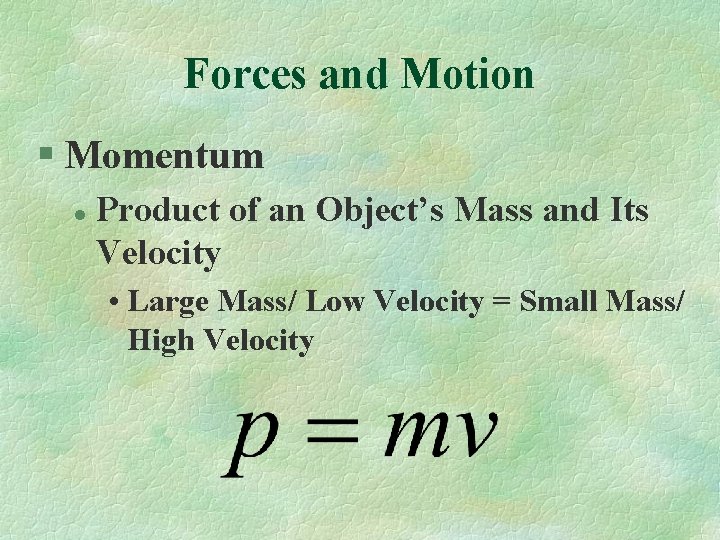
Forces and Motion § Momentum l Product of an Object’s Mass and Its Velocity • Large Mass/ Low Velocity = Small Mass/ High Velocity
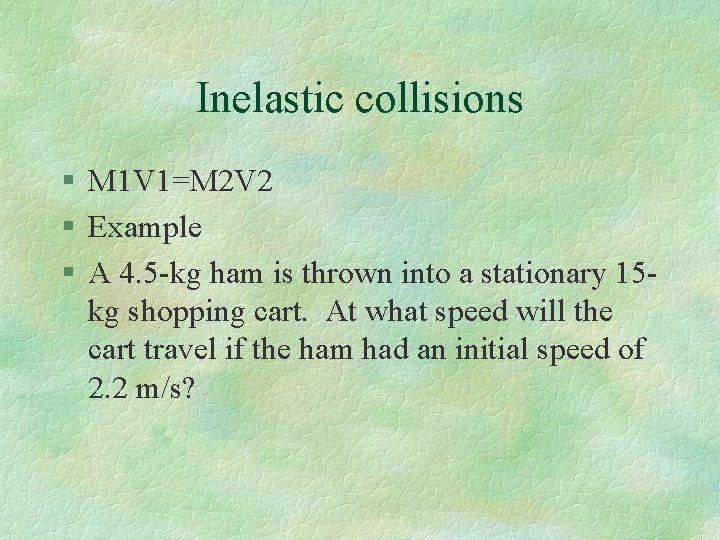
Inelastic collisions § M 1 V 1=M 2 V 2 § Example § A 4. 5 -kg ham is thrown into a stationary 15 kg shopping cart. At what speed will the cart travel if the ham had an initial speed of 2. 2 m/s?
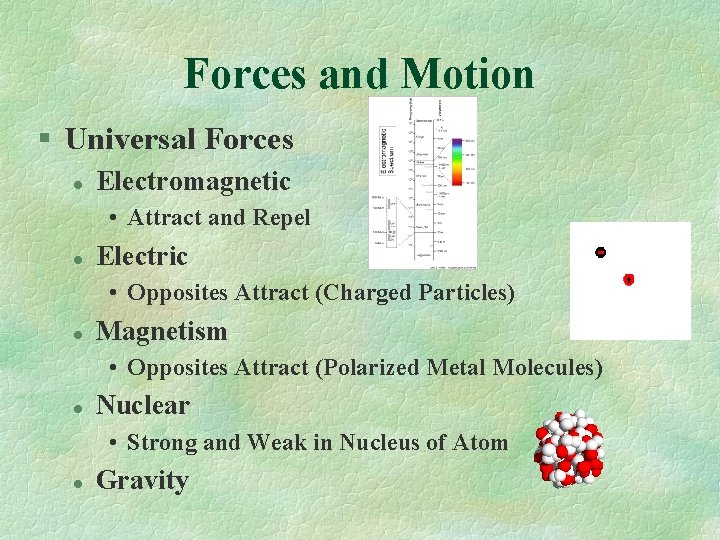
Forces and Motion § Universal Forces l Electromagnetic • Attract and Repel l Electric • Opposites Attract (Charged Particles) l Magnetism • Opposites Attract (Polarized Metal Molecules) l Nuclear • Strong and Weak in Nucleus of Atom l Gravity
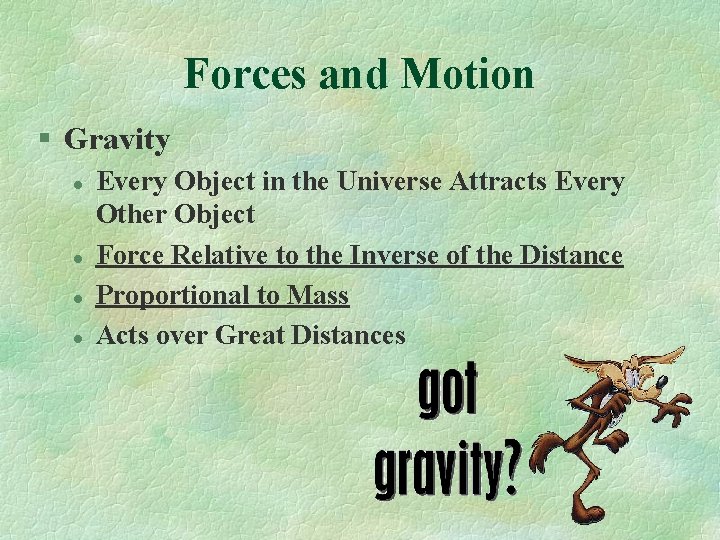
Forces and Motion § Gravity l l Every Object in the Universe Attracts Every Other Object Force Relative to the Inverse of the Distance Proportional to Mass Acts over Great Distances
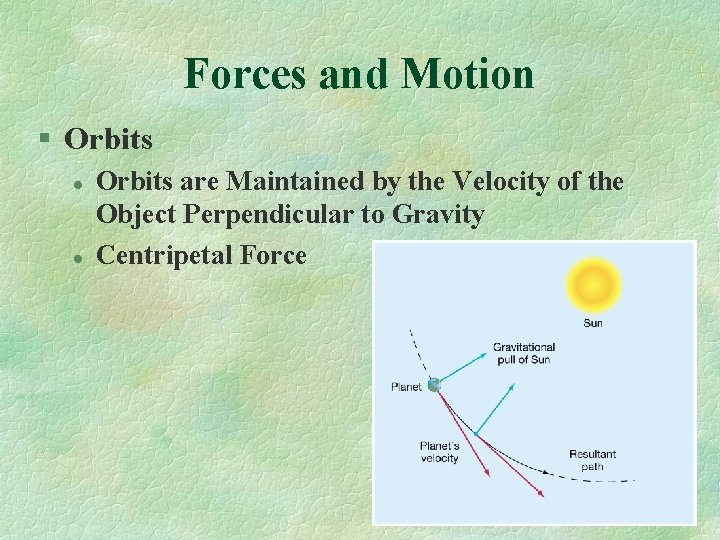
Forces and Motion § Orbits l l Orbits are Maintained by the Velocity of the Object Perpendicular to Gravity Centripetal Force
Forces and Motion § Homework