
Physical Science Chapter 12 2 Notes Newtons First
- Slides: 14
Physical Science Chapter 12. 2 Notes Newton’s First and Second Laws of Motion Pg 363 - 369
Aristotle, Galileo and Newton- Pg. 363 1. Aristotle incorrectly proposed that force is required to keep an object moving 2. Galileo studied how gravity produced constant acceleration 3. Newton defined force and mass and introduced laws of motion.
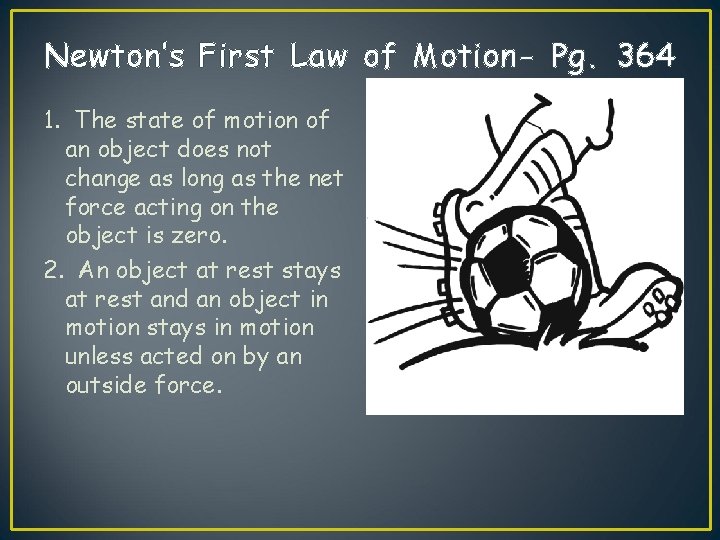
Newton’s First Law of Motion- Pg. 364 1. The state of motion of an object does not change as long as the net force acting on the object is zero. 2. An object at rest stays at rest and an object in motion stays in motion unless acted on by an outside force.
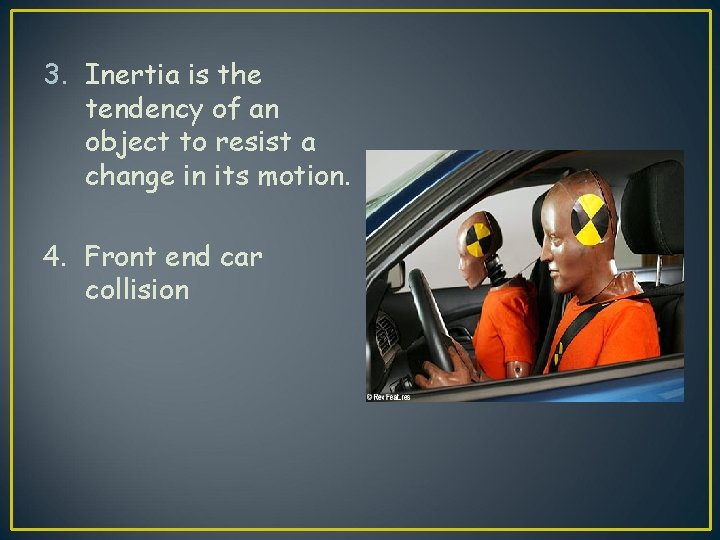
3. Inertia is the tendency of an object to resist a change in its motion. 4. Front end car collision
Newton’s Second Law of Motion-Pg. 365 1. Unbalanced force causes objects velocity to change (object accelerates) 2. The acceleration of an object is equal to the net force acting on it divided by the objects mass.
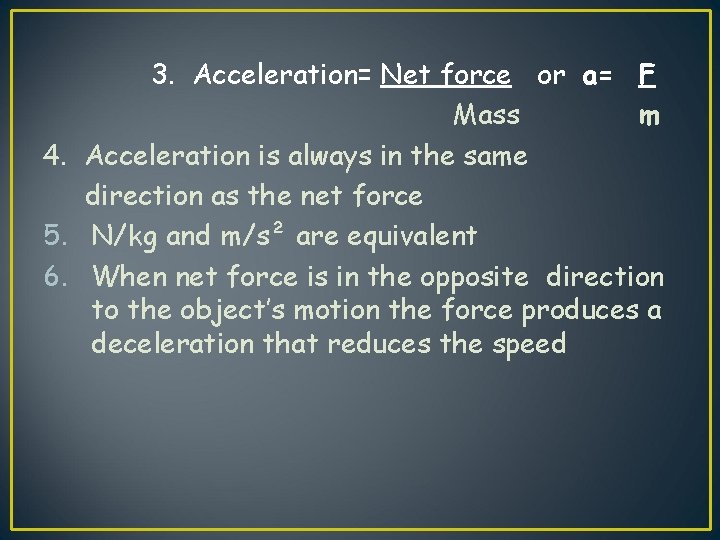
3. Acceleration= Net force or a= F Mass m 4. Acceleration is always in the same direction as the net force 5. N/kg and m/s² are equivalent 6. When net force is in the opposite direction to the object’s motion the force produces a deceleration that reduces the speed
7. If m= 1000 kg and F= 4000 N, what does A =?
8. If you push on 1 shopping cart vs many shopping carts with the same force, the acceleration of the many shopping carts is much less than that of the single cart
D. Weight and Mass- Pg 368 1. Weight is force of gravity acting on an object 2. Weight = mass X acceleration due to gravity or W=mg 3. g= 9. 8 m/s²
4. If an astronaut has a mass of 112 kg what is his weight on Earth?
5. Mass and weight are proportional. Doubling the mass of an object also doubles the weight 6. Mass is a measure of the inertia of an object; weight is the force of gravity acting on an object.
Assessment Questions 1. What is inertia? a. b. c. d. the force of gravity acting on an object forces of friction slowing an object’s motion the mass of an object the tendency of an object to resist change in its motion
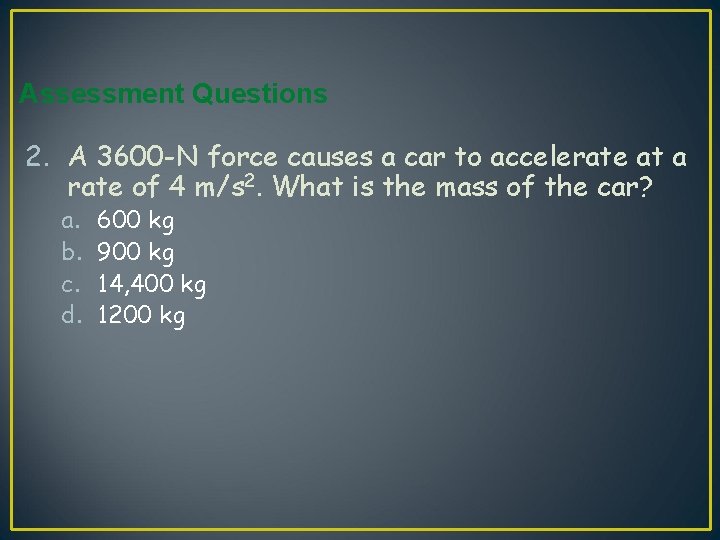
Assessment Questions 2. A 3600 -N force causes a car to accelerate at a rate of 4 m/s 2. What is the mass of the car? a. b. c. d. 600 kg 900 kg 14, 400 kg 1200 kg
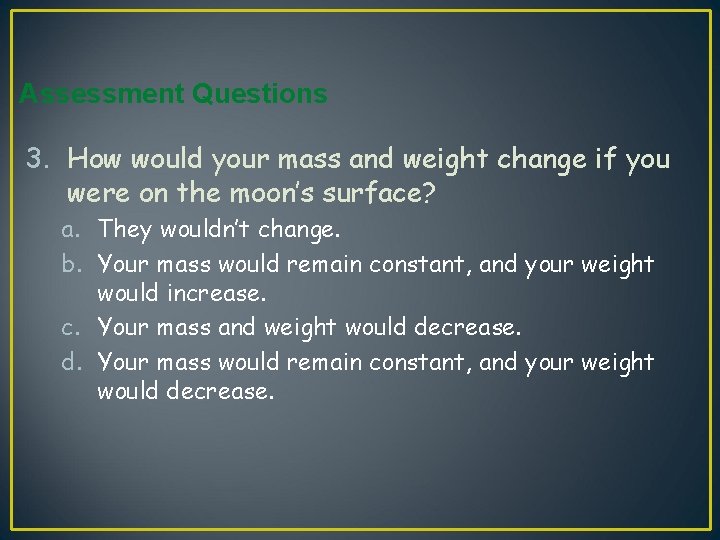
Assessment Questions 3. How would your mass and weight change if you were on the moon’s surface? a. They wouldn’t change. b. Your mass would remain constant, and your weight would increase. c. Your mass and weight would decrease. d. Your mass would remain constant, and your weight would decrease.