
Physical Science 7 3 Electrical Energy Electrical Energy

- Slides: 22
Physical Science 7. 3 Electrical Energy
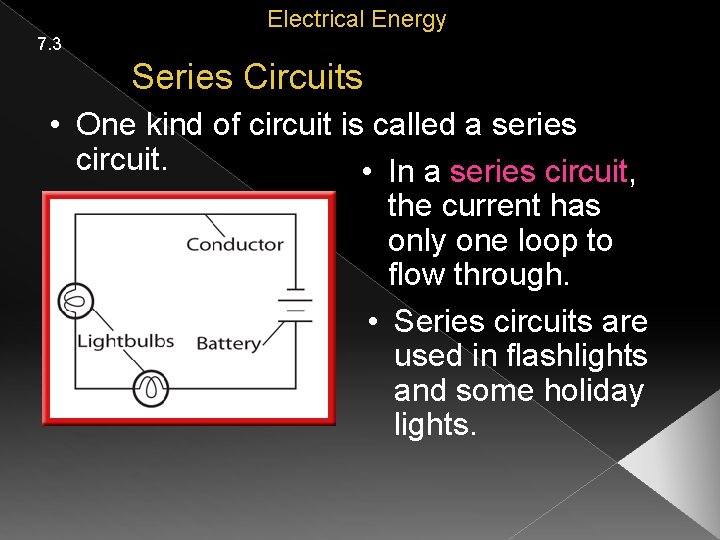
Electrical Energy 7. 3 Series Circuits • One kind of circuit is called a series circuit. • In a series circuit, the current has only one loop to flow through. • Series circuits are used in flashlights and some holiday lights.
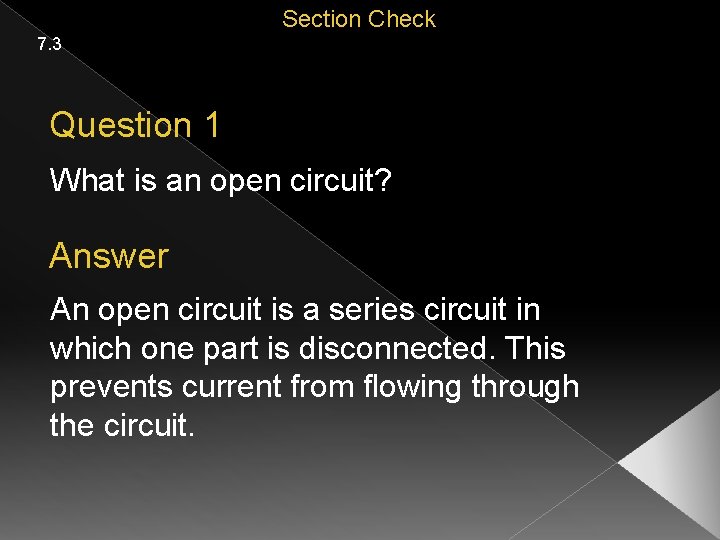
Electrical Energy 7. 3 Open Circuit • How can one faulty bulb cause a whole string of lights to go out? • When any part of a series circuit is disconnected, no current flows through the circuit. • This is called an open circuit. The burned-out bulb causes an open circuit in the string of lights.
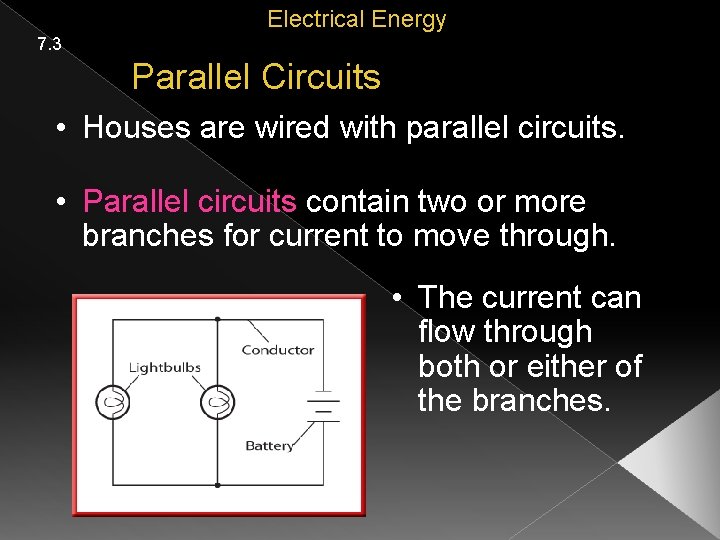
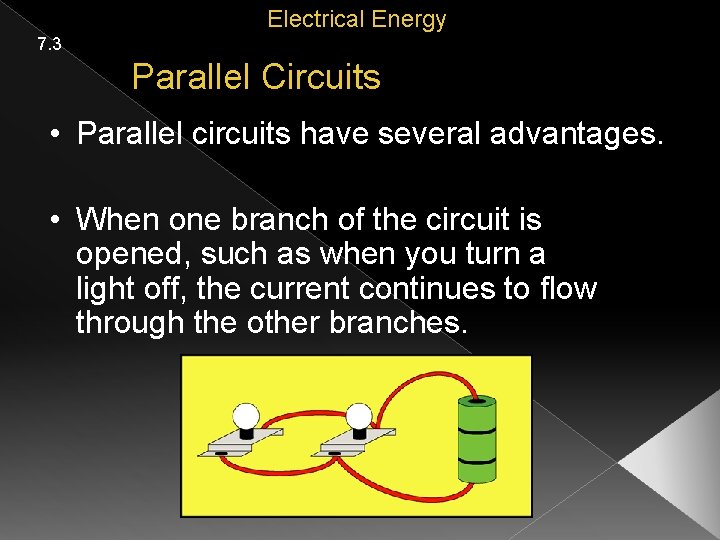
Electrical Energy 7. 3 Parallel Circuits • Houses are wired with parallel circuits. • Parallel circuits contain two or more branches for current to move through. • The current can flow through both or either of the branches.
Electrical Energy 7. 3 Parallel Circuits • Parallel circuits have several advantages. • When one branch of the circuit is opened, such as when you turn a light off, the current continues to flow through the other branches.
Electrical Energy 7. 3 Household Circuits • The wiring in a house must allow for the individual use of various appliances and fixtures. • This wiring is mostly a combination of parallel circuits connected in an organized and logical network.
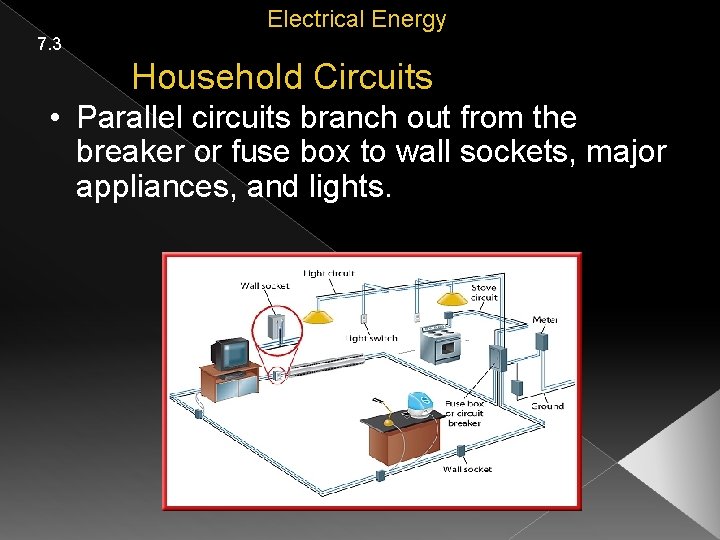
Electrical Energy 7. 3 Household Circuits • The main switch and circuit breaker or fuse box serve as an electrical headquarters for your home.
Electrical Energy 7. 3 Household Circuits • Parallel circuits branch out from the breaker or fuse box to wall sockets, major appliances, and lights.
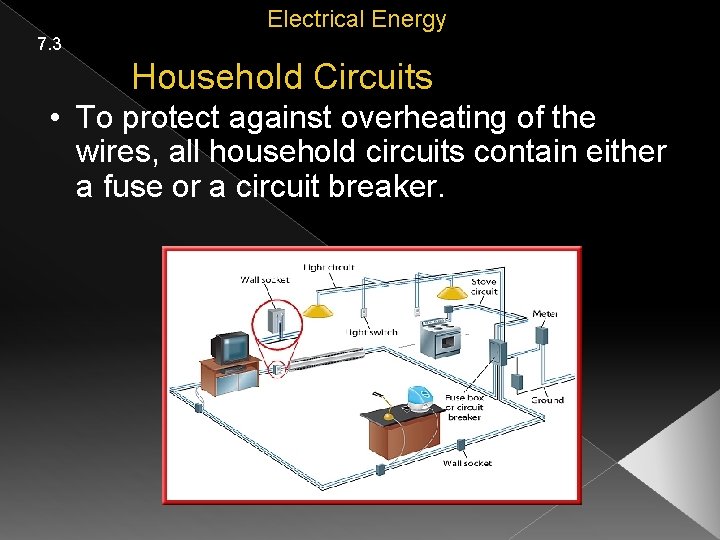
Electrical Energy 7. 3 Household Circuits • To protect against overheating of the wires, all household circuits contain either a fuse or a circuit breaker.
Electrical Energy 7. 3 Fuses • An electrical fuse contains a small piece of metal that melts if the current becomes too high. • When it melts, it causes a break in the circuit, stopping the flow of current through the overloaded circuit.
Electrical Energy 7. 3 Fuses • To enable current to flow again in the circuit, you must replace the blown fuse with a new one. • Too many appliances in use at the same time is the most likely cause for the overheating of the circuit.
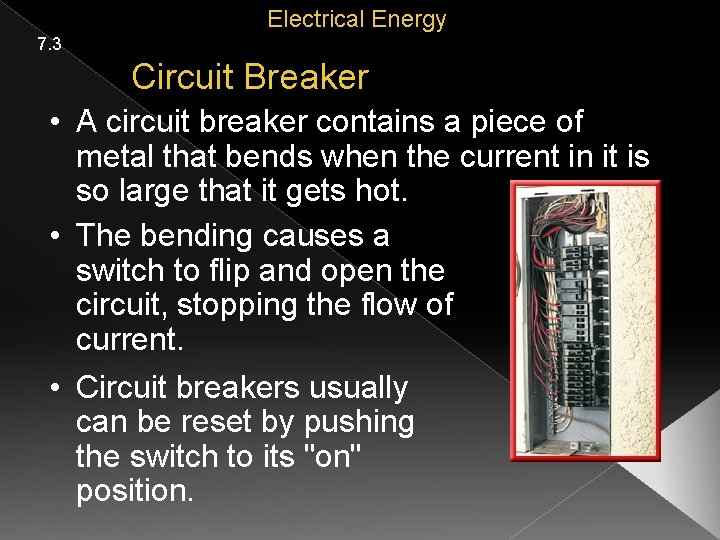
Electrical Energy 7. 3 Circuit Breaker • A circuit breaker contains a piece of metal that bends when the current in it is so large that it gets hot. • The bending causes a switch to flip and open the circuit, stopping the flow of current. • Circuit breakers usually can be reset by pushing the switch to its "on" position.
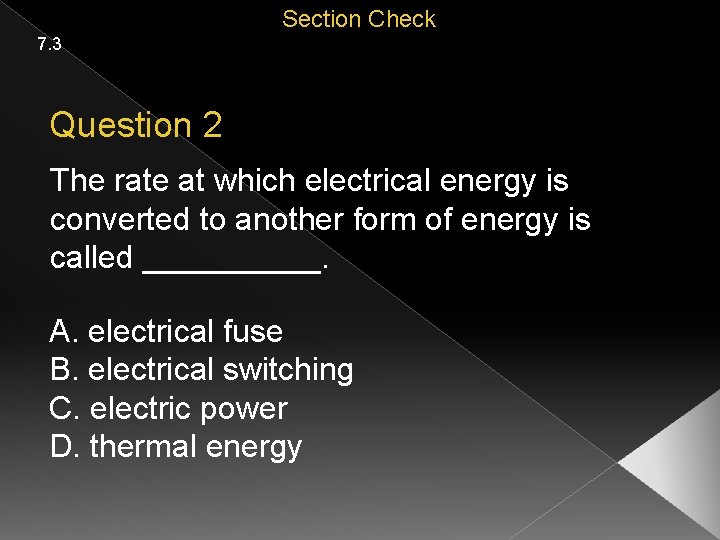
Electrical Energy 7. 3 Electric Power • The reason that electricity is so useful is that electrical energy is converted easily to other types of energy. • The rate at which electrical energy is converted to another form of energy is the electric power.
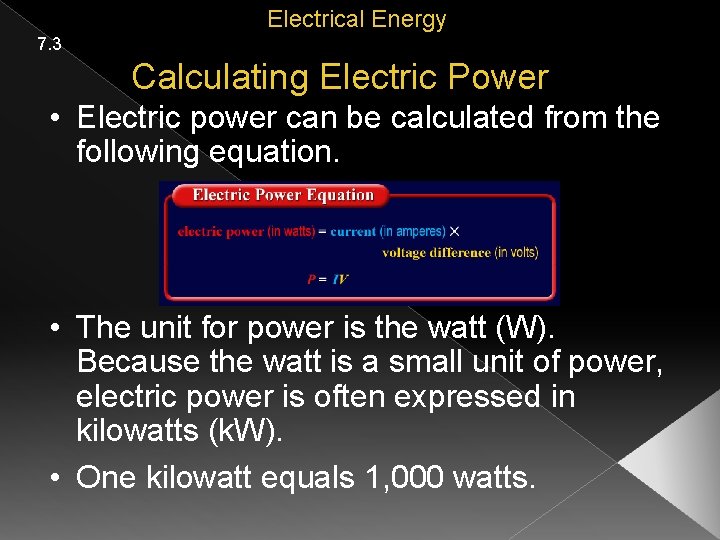
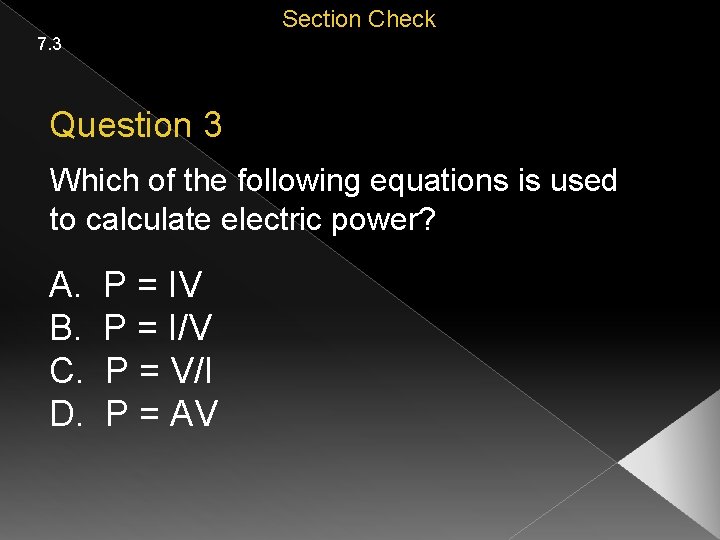
Electrical Energy 7. 3 Calculating Electric Power • Electric power can be calculated from the following equation. • The unit for power is the watt (W). Because the watt is a small unit of power, electric power is often expressed in kilowatts (k. W). • One kilowatt equals 1, 000 watts.
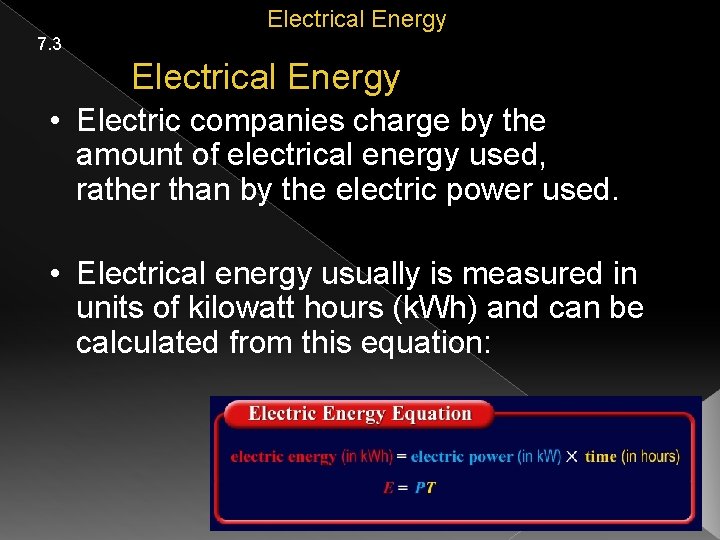
Electrical Energy 7. 3 Electrical Energy • Electric companies charge by the amount of electrical energy used, rather than by the electric power used. • Electrical energy usually is measured in units of kilowatt hours (k. Wh) and can be calculated from this equation:
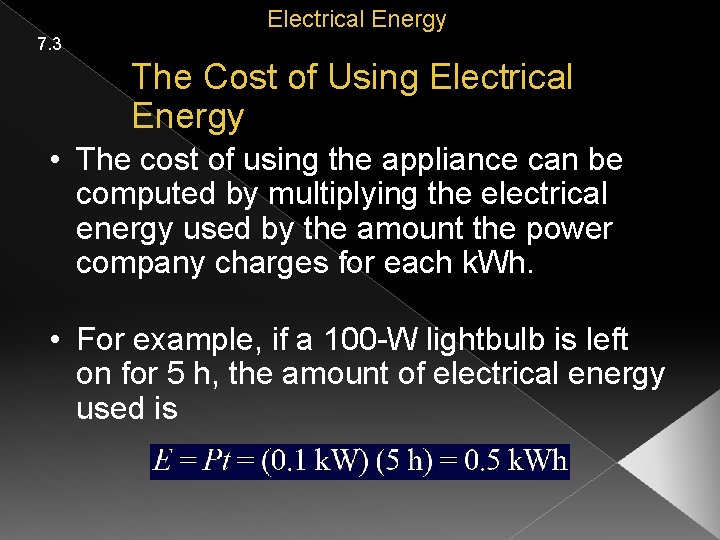
Electrical Energy 7. 3 The Cost of Using Electrical Energy • The cost of using the appliance can be computed by multiplying the electrical energy used by the amount the power company charges for each k. Wh. • For example, if a 100 -W lightbulb is left on for 5 h, the amount of electrical energy used is
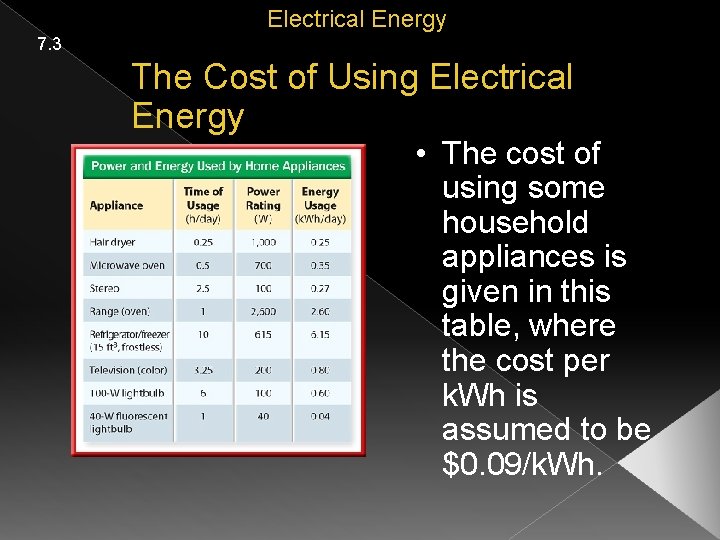
Electrical Energy 7. 3 The Cost of Using Electrical Energy • The cost of using some household appliances is given in this table, where the cost per k. Wh is assumed to be $0. 09/k. Wh.
Section Check 7. 3 Question 1 What is an open circuit? Answer An open circuit is a series circuit in which one part is disconnected. This prevents current from flowing through the circuit.
Section Check 7. 3 Question 2 The rate at which electrical energy is converted to another form of energy is called _____. A. electrical fuse B. electrical switching C. electric power D. thermal energy
Section Check 7. 3 Answer The answer is C. Electric power is the rate of energy conversion and is measured in watts.
Section Check 7. 3 Question 3 Which of the following equations is used to calculate electric power? A. B. C. D. P = IV P = I/V P = V/I P = AV
Section Check 7. 3 Answer The answer is A. Electric power is equal to the current, I, multiplied by the voltage difference, V.