
Physical Randomness Extractor x device Extx 0 Extx




- Slides: 26
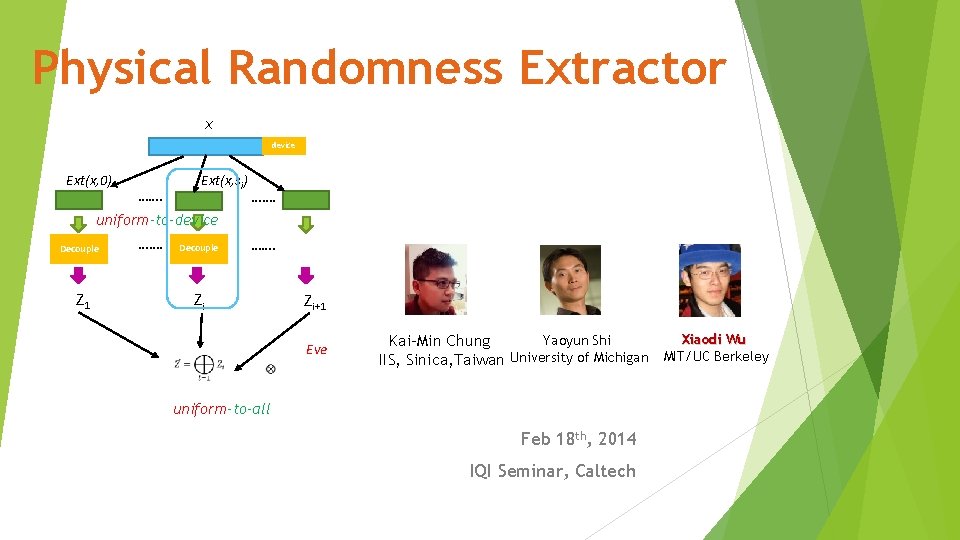
Physical Randomness Extractor x device Ext(x, 0) ……. Ext(x, si) ……. uniform-to-device Decouple Z 1 ……. Decouple ……. Zi Zi+1 Eve Xiaodi Wu Yaoyun Shi Kai-Min Chung IIS, Sinica, Taiwan University of Michigan MIT/UC Berkeley uniform-to-all Feb 18 th, 2014 IQI Seminar, Caltech
Randomness is PRECIOUS • • Digital security Randomized algorithms • • • Scientific simulations Gambling Statistics, Samplings, ….
We are not always getting it …. From the introduction: “Ultimately of our Heningerthe et results al. broke the study should serve as a wake-up keys of many SSH hosts call that secure random number by exploiting insufficient generation continues to be an unsolved problem in important randomness. areas of practice. ”
Wish list for Randomness • • • High quality • close to uniform small error • Secure classical/quantum adversary Large quantity • 1 trillion bits/day? efficiency Minimum assumptions • least amount of trust
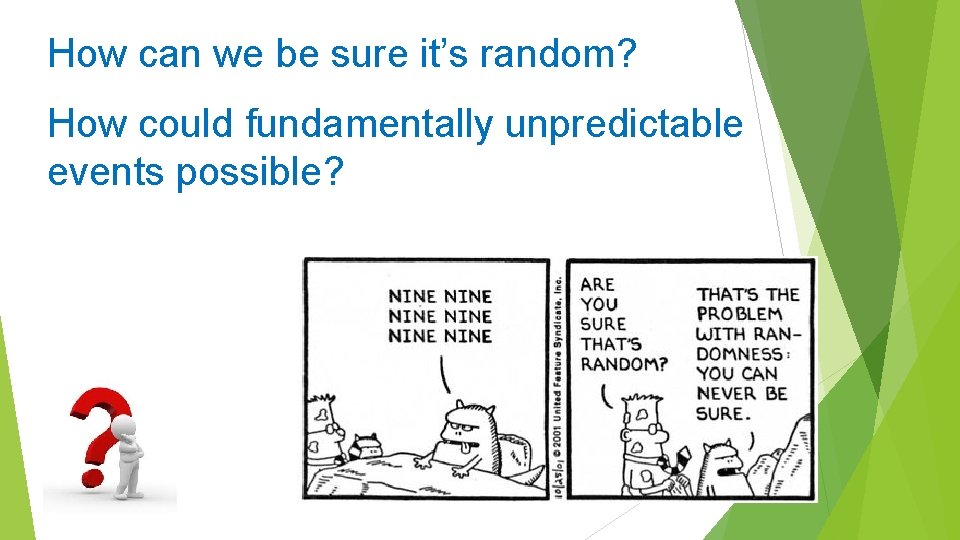
How can we be sure it’s random? How could fundamentally unpredictable events possible?
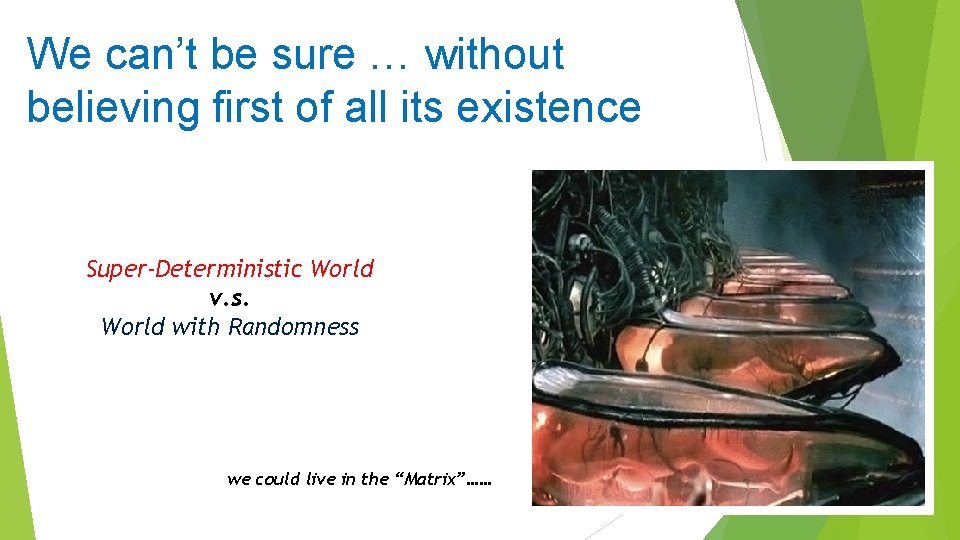
We can’t be sure … without believing first of all its existence Super-Deterministic World v. s. World with Randomness we could live in the “Matrix”……
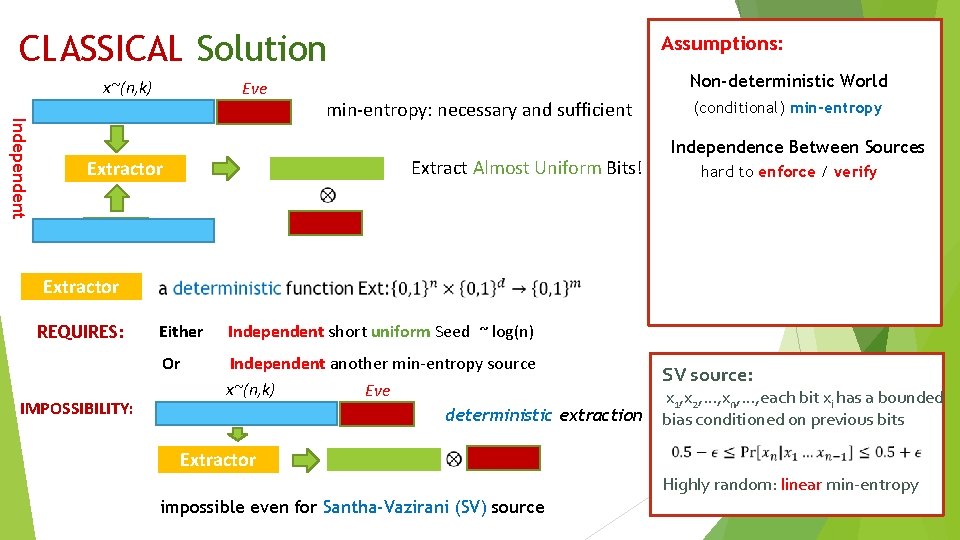
CLASSICAL Solution x~(n, k) Eve Assumptions: Non-deterministic World Independent min-entropy: necessary and sufficient Extract Almost Uniform Bits! Extractor (conditional) min-entropy Independence Between Sources hard to enforce / verify Extractor REQUIRES: IMPOSSIBILITY: Either Independent short uniform Seed ~ log(n) Or Independent another min-entropy source x~(n, k) Eve deterministic extraction SV source: x 1, x 2, …, xn, …, each bit xi has a bounded bias conditioned on previous bits Extractor Highly random: linear min-entropy impossible even for Santha-Vazirani (SV) source
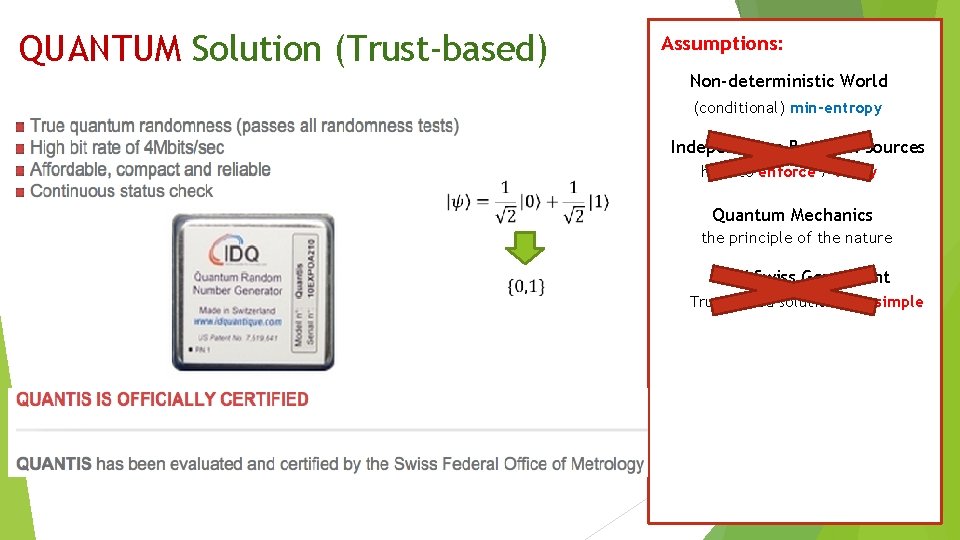
QUANTUM Solution (Trust-based) Assumptions: Non-deterministic World (conditional) min-entropy Independence Between Sources hard to enforce / verify Quantum Mechanics the principle of the nature IDQ/ Swiss Goverment Trust-based solutions are simple
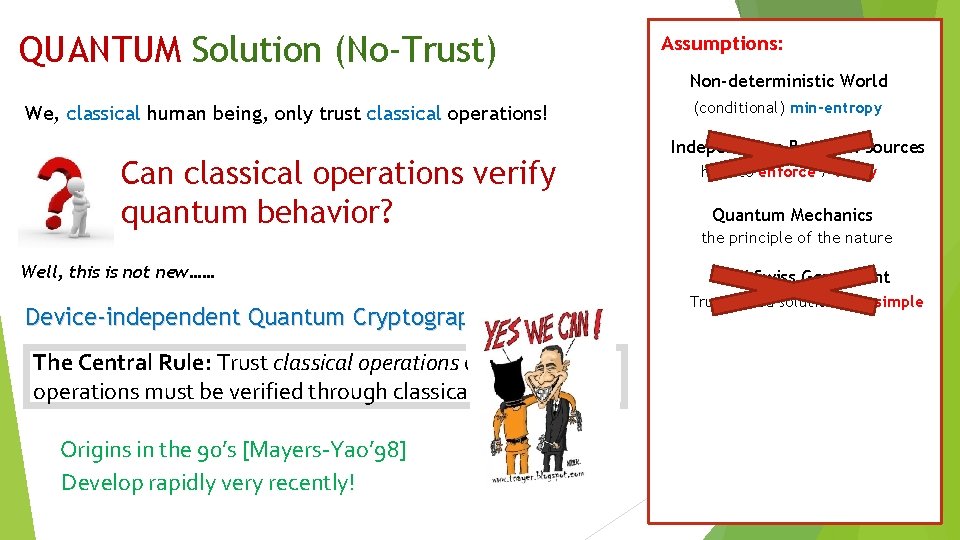
QUANTUM Solution (No-Trust) Assumptions: Non-deterministic World We, classical human being, only trust classical operations! Can classical operations verify quantum behavior? Well, this is not new…… Device-independent Quantum Cryptography The Central Rule: Trust classical operations only. Quantum operations must be verified through classical means. Origins in the 90’s [Mayers-Yao’ 98] Develop rapidly very recently! (conditional) min-entropy Independence Between Sources hard to enforce / verify Quantum Mechanics the principle of the nature IDQ/ Swiss Goverment Trust-based solutions are simple
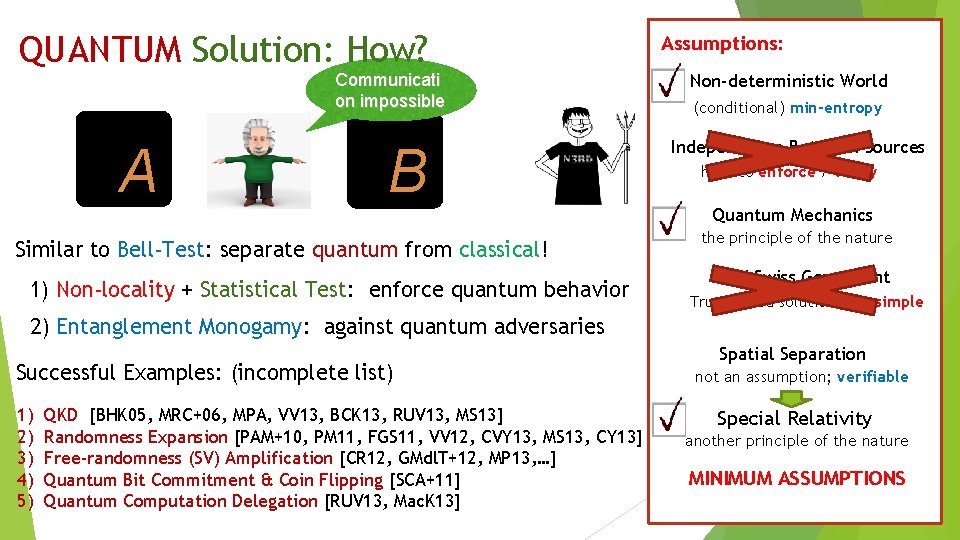
QUANTUM Solution: How? Communicati on impossible A B Similar to Bell-Test: separate quantum from classical! 1) Non-locality + Statistical Test: enforce quantum behavior Assumptions: Non-deterministic World (conditional) min-entropy Independence Between Sources hard to enforce / verify Quantum Mechanics the principle of the nature IDQ/ Swiss Goverment Trust-based solutions are simple 2) Entanglement Monogamy: against quantum adversaries Successful Examples: (incomplete list) 1) 2) 3) 4) 5) QKD [BHK 05, MRC+06, MPA, VV 13, BCK 13, RUV 13, MS 13] Randomness Expansion [PAM+10, PM 11, FGS 11, VV 12, CVY 13, MS 13, CY 13] Free-randomness (SV) Amplification [CR 12, GMdl. T+12, MP 13, …] Quantum Bit Commitment & Coin Flipping [SCA+11] Quantum Computation Delegation [RUV 13, Mac. K 13] Spatial Separation not an assumption; verifiable Special Relativity another principle of the nature MINIMUM ASSUMPTIONS
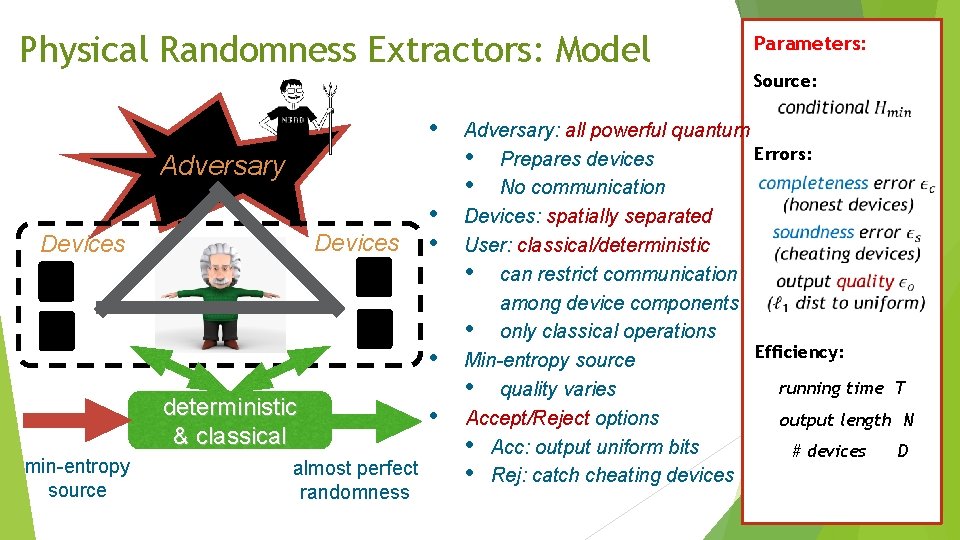
Physical Randomness Extractors: Model Parameters: Source: • Adversary Devices • • • deterministic & classical min-entropy source almost perfect randomness • Adversary: all powerful quantum Errors: • Prepares devices • No communication Devices: spatially separated User: classical/deterministic • can restrict communication among device components • only classical operations Efficiency: Min-entropy source running time T • quality varies Accept/Reject options output length N • Acc: output uniform bits # devices D • Rej: catch cheating devices
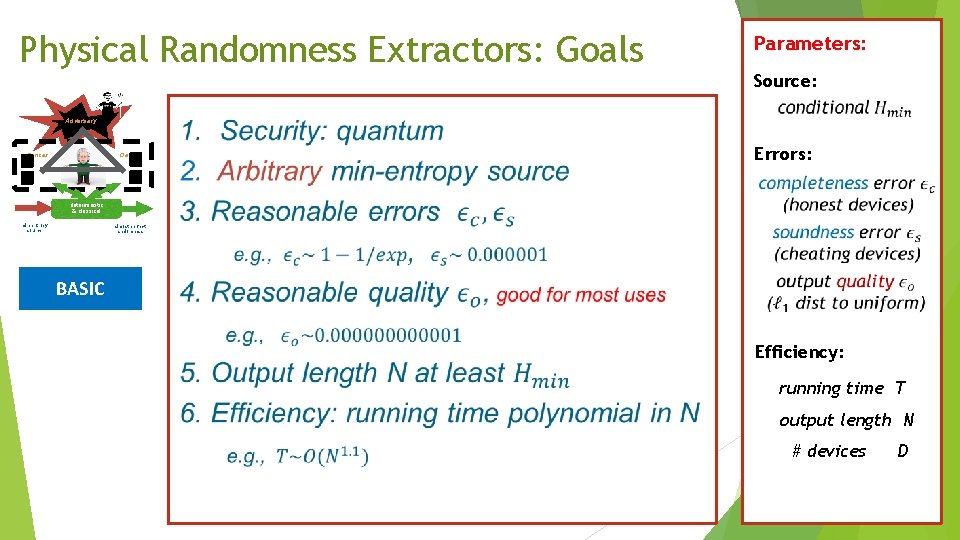
Physical Randomness Extractors: Goals Parameters: Source: Adversary Devices Errors: deterministic & classical min-entropy source almost perfect randomness BASIC Efficiency: running time T output length N # devices D
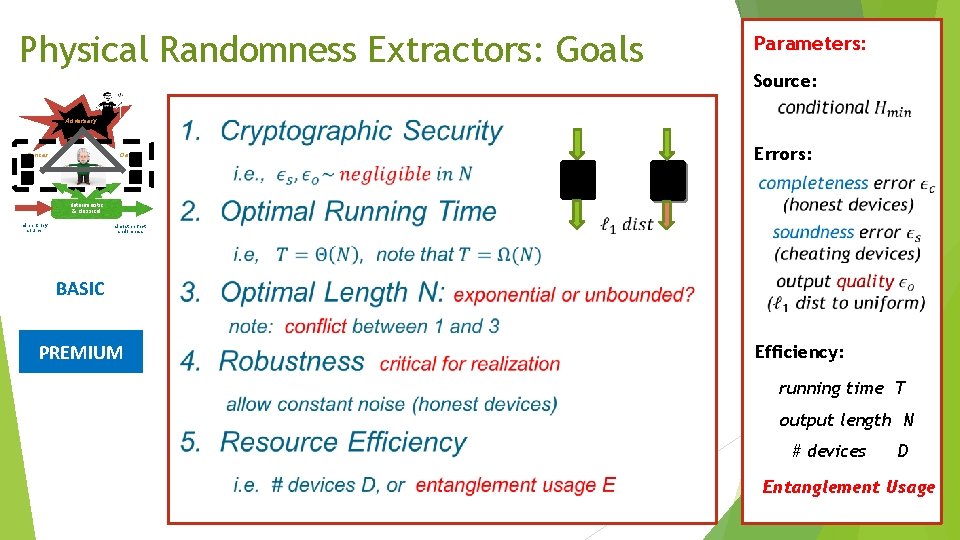
Physical Randomness Extractors: Goals Parameters: Source: Adversary Devices Errors: deterministic & classical min-entropy source almost perfect randomness BASIC PREMIUM Efficiency: running time T output length N # devices D Entanglement Usage
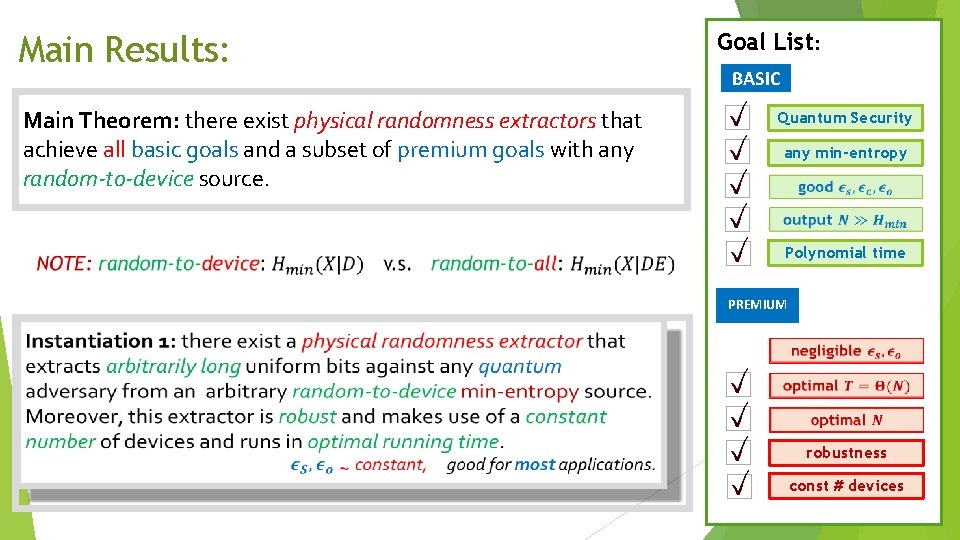
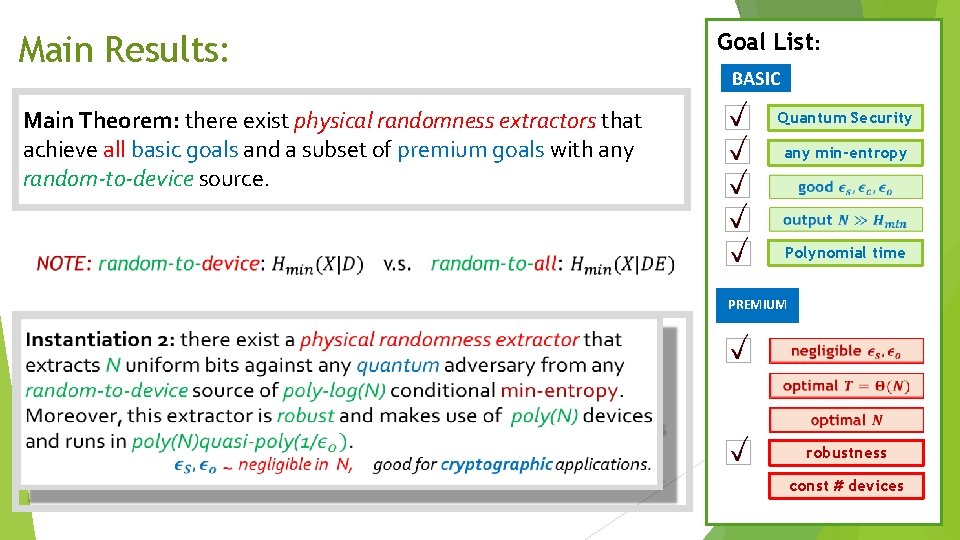
Main Results: Main Theorem: there exist physical randomness extractors that achieve all basic goals and a subset of premium goals with any random-to-device source. Goal List: BASIC Quantum Security any min-entropy Polynomial time PREMIUM robustness const # devices
Main Results: Main Theorem: there exist physical randomness extractors that achieve all basic goals and a subset of premium goals with any random-to-device source. Goal List: BASIC Quantum Security any min-entropy Polynomial time PREMIUM robustness const # devices
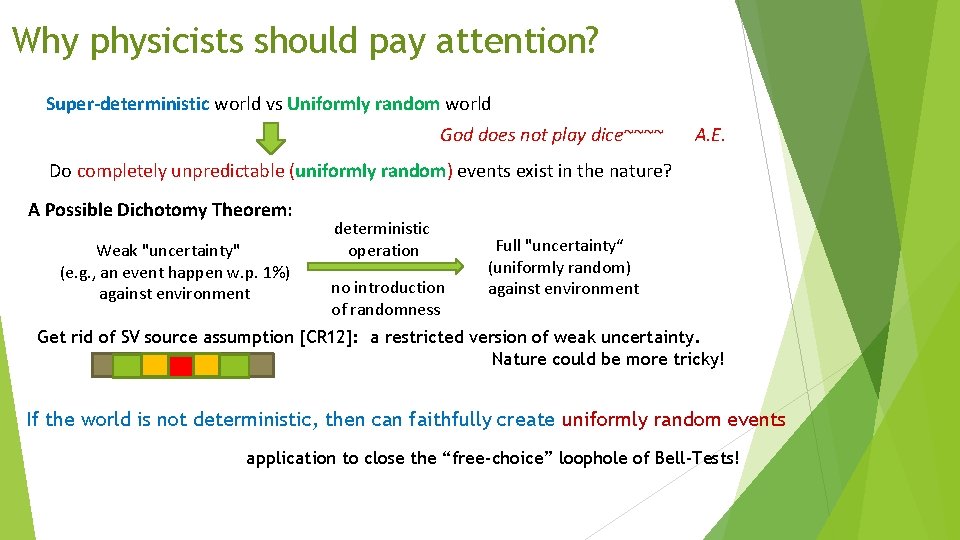
Why physicists should pay attention? Super-deterministic world vs Uniformly random world God does not play dice~~~~ A. E. Do completely unpredictable (uniformly random) events exist in the nature? A Possible Dichotomy Theorem: Weak "uncertainty" (e. g. , an event happen w. p. 1%) against environment deterministic operation no introduction of randomness Full "uncertainty“ (uniformly random) against environment Get rid of SV source assumption [CR 12]: a restricted version of weak uncertainty. Nature could be more tricky! If the world is not deterministic, then can faithfully create uniformly random events application to close the “free-choice” loophole of Bell-Tests!
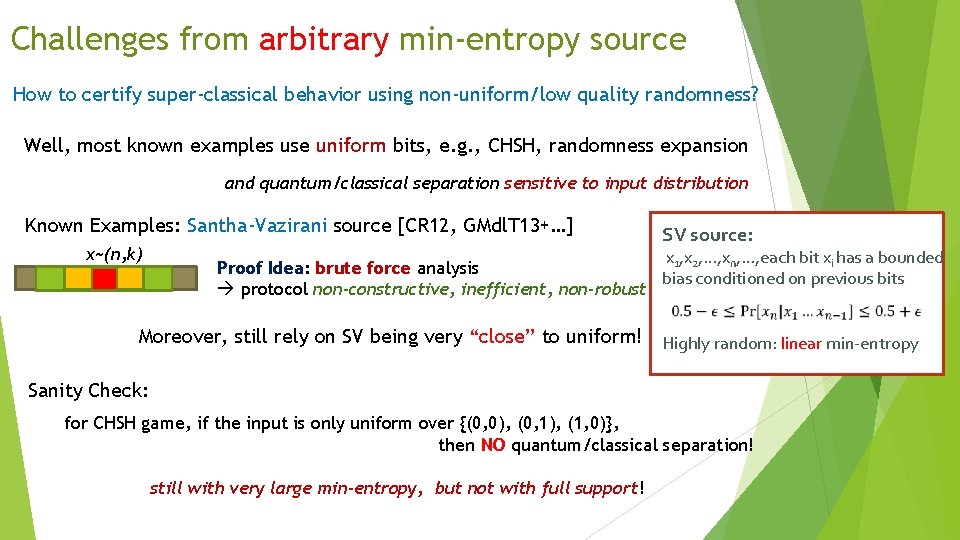
Challenges from arbitrary min-entropy source How to certify super-classical behavior using non-uniform/low quality randomness? Well, most known examples use uniform bits, e. g. , CHSH, randomness expansion and quantum/classical separation sensitive to input distribution Known Examples: Santha-Vazirani source [CR 12, GMdl. T 13+…] x~(n, k) SV source: x 1, x 2, …, xn, …, each bit xi has a bounded Proof Idea: brute force analysis bias conditioned on previous bits protocol non-constructive, inefficient, non-robust Moreover, still rely on SV being very “close” to uniform! Highly random: linear min-entropy Sanity Check: for CHSH game, if the input is only uniform over {(0, 0), (0, 1), (1, 0)}, then NO quantum/classical separation! still with very large min-entropy, but not with full support!
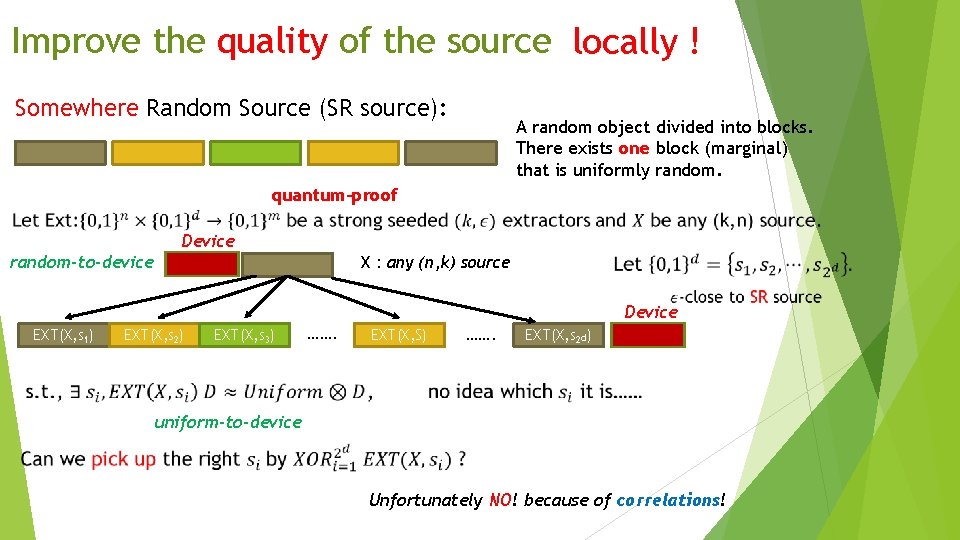
Improve the quality of the source locally ! Somewhere Random Source (SR source): A random object divided into blocks. There exists one block (marginal) that is uniformly random. quantum-proof Device random-to-device X : any (n, k) source Device EXT(X, s 1) EXT(X, s 2) EXT(X, s 3) ……. EXT(X, S) ……. EXT(X, s 2 d) uniform-to-device Unfortunately NO! because of correlations!
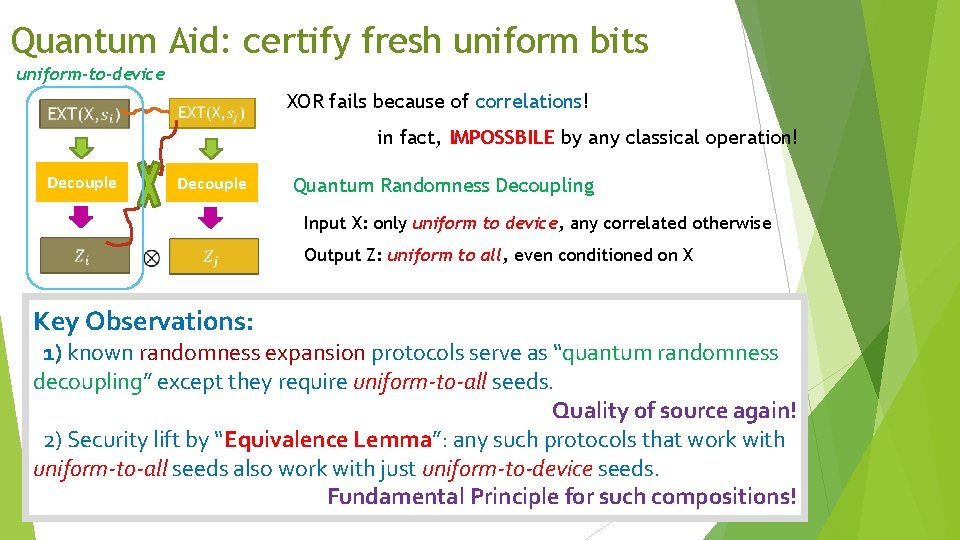
Quantum Aid: certify fresh uniform bits uniform-to-device XOR fails because of correlations! in fact, IMPOSSBILE by any classical operation! Decouple Quantum Randomness Decoupling Input X: only uniform to device, any correlated otherwise Output Z: uniform to all, even conditioned on X Key Observations: 1) known randomness expansion protocols serve as “quantum randomness decoupling” except they require uniform-to-all seeds. Quality of source again! 2) Security lift by “Equivalence Lemma”: any such protocols that work with uniform-to-all seeds also work with just uniform-to-device seeds. Fundamental Principle for such compositions!
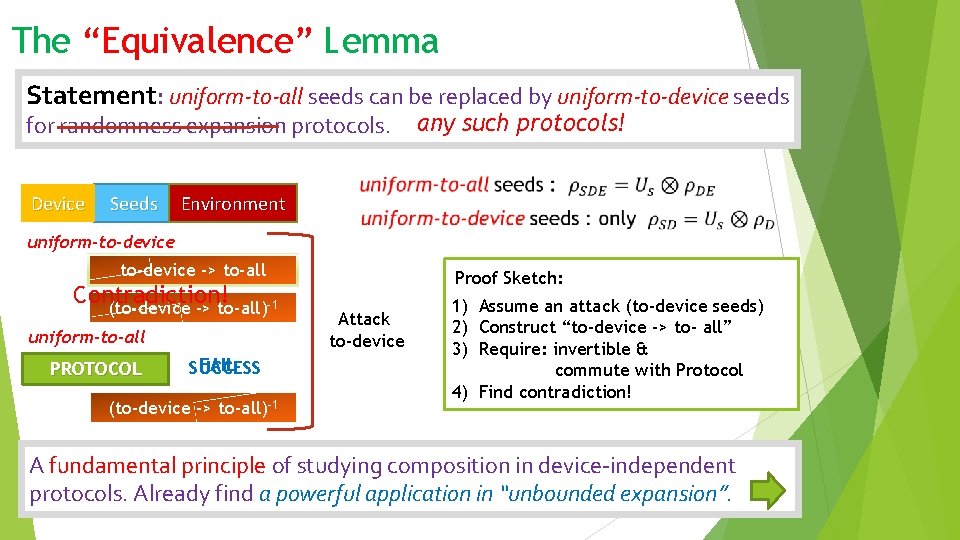
The “Equivalence” Lemma Statement: uniform-to-all seeds can be replaced by uniform-to-device seeds for randomness expansion protocols. Device Seeds any such protocols! Environment uniform-to-device -> to-all Contradiction! (to-device -> to-all)-1 uniform-to-all PROTOCOL FAIL SUCCESS (to-device -> to-all)-1 Proof Sketch: Attack to-device 1) Assume an attack (to-device seeds) 2) Construct “to-device -> to- all” 3) Require: invertible & commute with Protocol 4) Find contradiction! A fundamental principle of studying composition in device-independent protocols. Already find a powerful application in “unbounded expansion”.
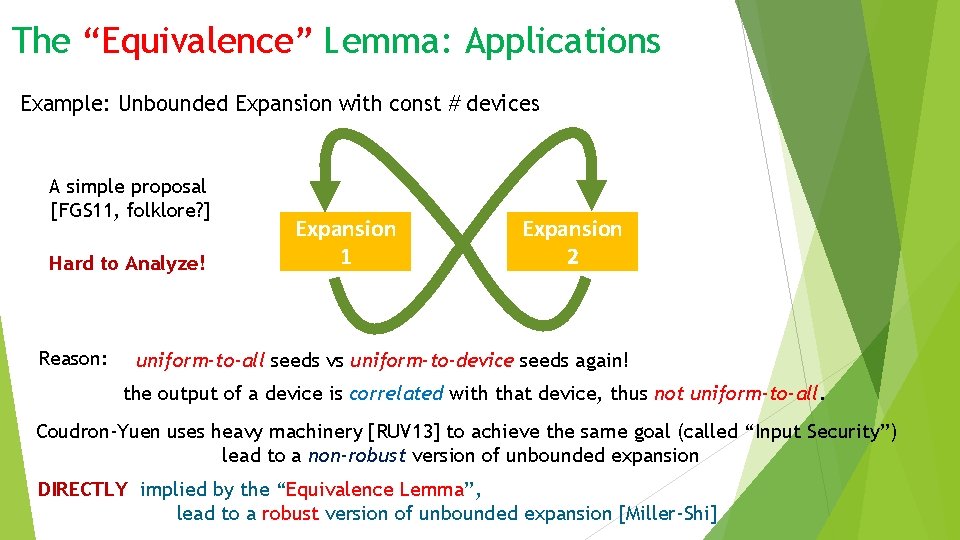
The “Equivalence” Lemma: Applications Example: Unbounded Expansion with const # devices A simple proposal [FGS 11, folklore? ] Hard to Analyze! Reason: Expansion 1 Expansion 2 uniform-to-all seeds vs uniform-to-device seeds again! the output of a device is correlated with that device, thus not uniform-to-all. Coudron-Yuen uses heavy machinery [RUV 13] to achieve the same goal (called “Input Security”) lead to a non-robust version of unbounded expansion DIRECTLY implied by the “Equivalence Lemma”, lead to a robust version of unbounded expansion [Miller-Shi]
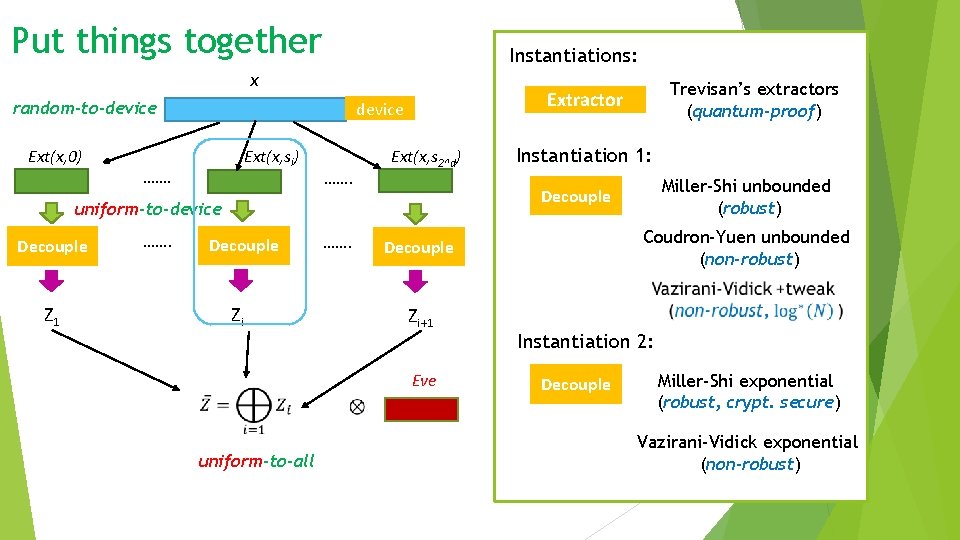
Put things together Instantiations: x random-to-device Ext(x, 0) device Ext(x, si) ……. Ext(x, s 2^d) Z 1 ……. Decouple Zi ……. Miller-Shi unbounded (robust) Coudron-Yuen unbounded (non-robust) Decouple Zi+1 Eve uniform-to-all Instantiation 1: Decouple uniform-to-device Decouple Trevisan’s extractors (quantum-proof) Extractor Instantiation 2: Decouple Miller-Shi exponential (robust, crypt. secure) Vazirani-Vidick exponential (non-robust)
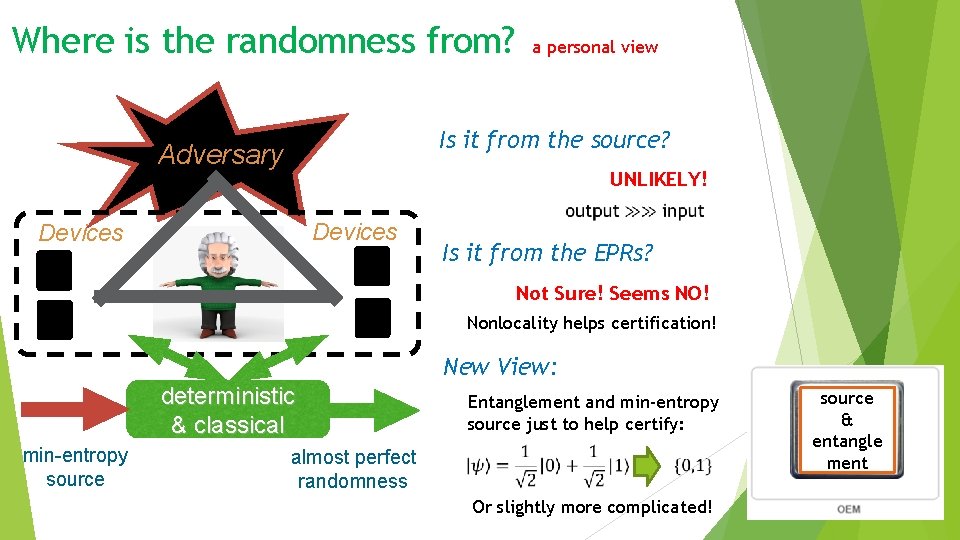
Where is the randomness from? a personal view Is it from the source? Adversary UNLIKELY! Devices Is it from the EPRs? Not Sure! Seems NO! Nonlocality helps certification! New View: deterministic & classical min-entropy source Entanglement and min-entropy source just to help certify: almost perfect randomness Or slightly more complicated! source & entangle ment
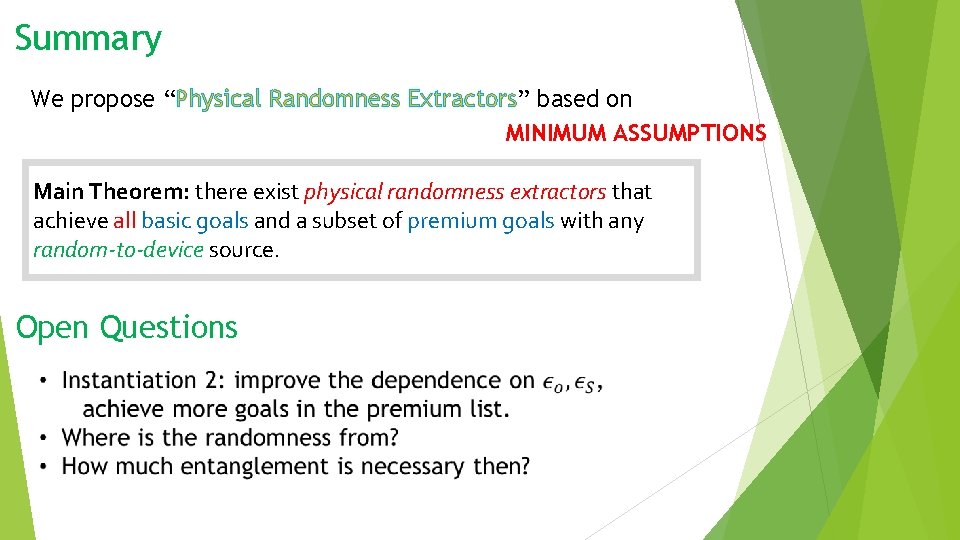
Summary We propose “Physical Randomness Extractors” based on MINIMUM ASSUMPTIONS Main Theorem: there exist physical randomness extractors that achieve all basic goals and a subset of premium goals with any random-to-device source. Open Questions
Thank You! Q & A