
Physical Properties of Molecules and Chromatography Biotech I
Physical Properties of Molecules and Chromatography Biotech I A brief introduction
Background ¢ ¢ Any study of life must include the study of water Nearly all biological molecules assume their shape and therefore their functions in response to the physical and chemical properties of water All organisms require water Dipole: a pair of electric charges or magnetic poles, of equal magnitude and opposite charge or polarity. Separation of charge between two covalently bonded atoms.
Physical Properties of water ¢ Water is Colorless and tasteless l A strong solvent due to its unique physical properties l Is considered a universal solvent l Consists of 2 hydrogens (H+) and 1 oxygen (O 2) l A polar molecule with electrostatic attractions between the dipoles and is held together by hydrogen bonds l
Water as a Solvent ¢ Water is a good solvent because: The dipoles combine with salt ions l The dipoles can combine with ions in acids l The dipoles can combine with ions in bases l The dipoles can combine with other polar molecules (hydrophilic) l Cannot combine with non polar molecules l
Physical Properties of Water ¢ ¢ Water is one of the few substances that expands when frozen. What would happen if water contracted when frozen? (think about iceburgs) l ¢ What are the phases of water? l l ¢ They would sink and would be permanently frozen Melting: solid to liquid Boiling: liquid to gas What characteristic about a molecule determines it melting point? l Its shape
Water and Oil ¢ If water is polar, what is oil? l ¢ If water is the universal solvent, what can it NOT dissolve? l ¢ Non polar (hydrophobic) Oil Solubility is affected by the following: l l l Molecular size Polarity Temperature: why do things dissolve better at higher temps? • Water molecule spreads out at higher temp and can hold more solute
Other physical factors Size ¢ Shape ¢ Density/gravity ¢ Charge ¢ State (solid, liquid, gas) ¢ Phase changes (mp, bp, evap) ¢
Check your knowledge ¢ Explain why water and oil do not mix. l ¢ List the 3 factors for solubility l ¢ Molecular size, polarity, temperature What happens when water boils? l ¢ Polar and non polar molecules Liquid to gas Why can more solute be dissolved at higher temperatures? l The molecule spreads out
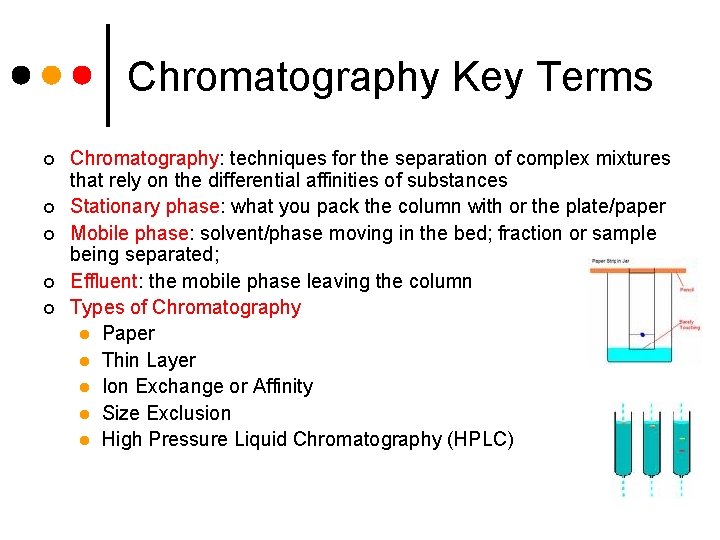
Chromatography Key Terms ¢ ¢ ¢ Chromatography: techniques for the separation of complex mixtures that rely on the differential affinities of substances Stationary phase: what you pack the column with or the plate/paper Mobile phase: solvent/phase moving in the bed; fraction or sample being separated; Effluent: the mobile phase leaving the column Types of Chromatography l Paper l Thin Layer l Ion Exchange or Affinity l Size Exclusion l High Pressure Liquid Chromatography (HPLC)
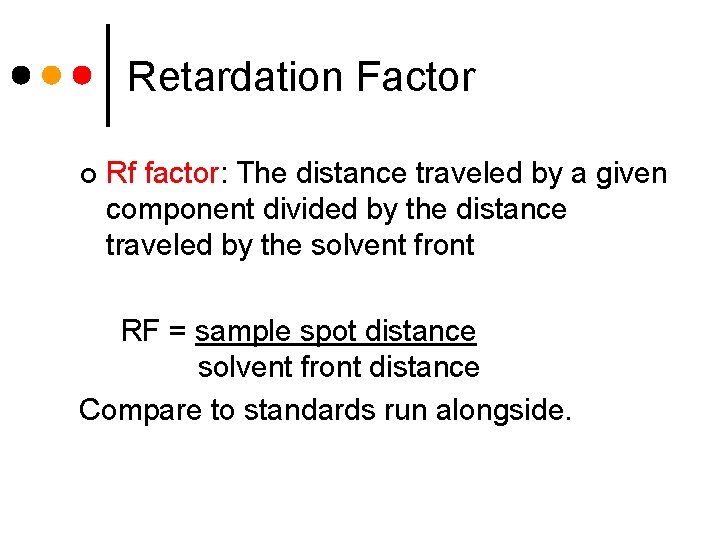
Retardation Factor ¢ Rf factor: The distance traveled by a given component divided by the distance traveled by the solvent front RF = sample spot distance solvent front distance Compare to standards run alongside.
Advantages of Chromatography ¢ Adaptable to wide range of compounds, because variety of separation principles (retention mechanisms), and types of experimental setup (planar or column - gas and liquid phase elution) ¢ Separated analyte is immediately available for identification or quantification ¢ Can be scaled up for preparative use
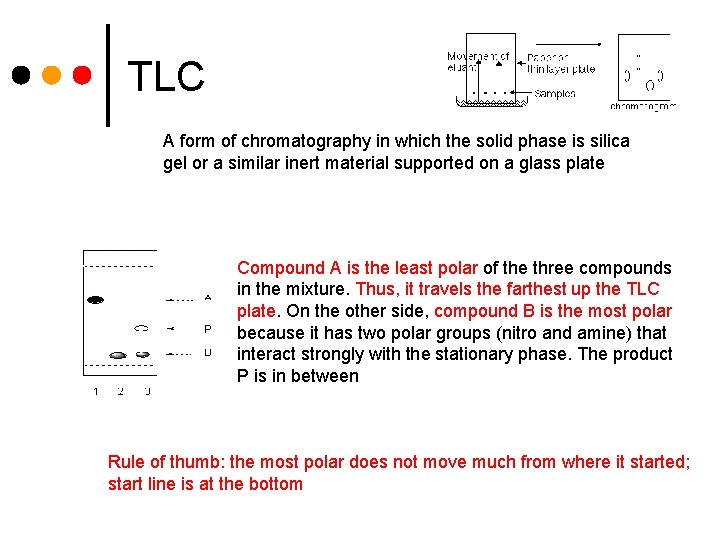
TLC A form of chromatography in which the solid phase is silica gel or a similar inert material supported on a glass plate Compound A is the least polar of the three compounds in the mixture. Thus, it travels the farthest up the TLC plate. On the other side, compound B is the most polar because it has two polar groups (nitro and amine) that interact strongly with the stationary phase. The product P is in between Rule of thumb: the most polar does not move much from where it started; start line is at the bottom
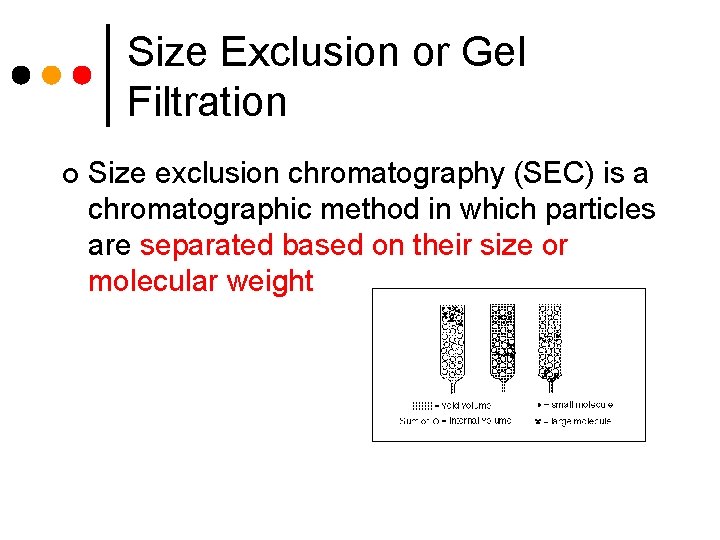
Size Exclusion or Gel Filtration ¢ Size exclusion chromatography (SEC) is a chromatographic method in which particles are separated based on their size or molecular weight
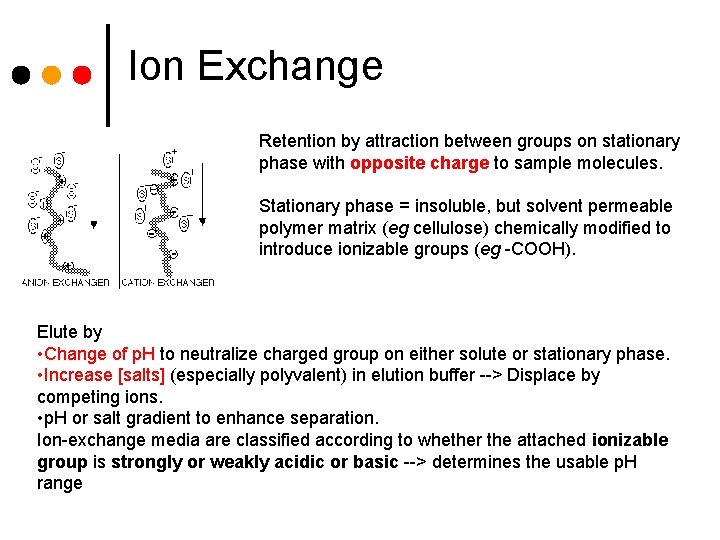
Ion Exchange Retention by attraction between groups on stationary phase with opposite charge to sample molecules. Stationary phase = insoluble, but solvent permeable polymer matrix (eg cellulose) chemically modified to introduce ionizable groups (eg -COOH). Elute by • Change of p. H to neutralize charged group on either solute or stationary phase. • Increase [salts] (especially polyvalent) in elution buffer --> Displace by competing ions. • p. H or salt gradient to enhance separation. Ion-exchange media are classified according to whether the attached ionizable group is strongly or weakly acidic or basic --> determines the usable p. H range
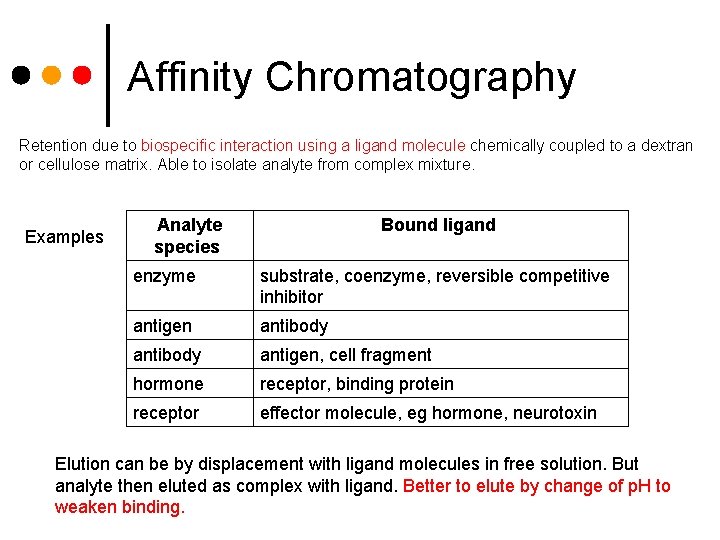
Affinity Chromatography Retention due to biospecific interaction using a ligand molecule chemically coupled to a dextran or cellulose matrix. Able to isolate analyte from complex mixture. Examples Analyte species enzyme Bound ligand substrate, coenzyme, reversible competitive inhibitor antigen antibody receptor antigen, cell fragment hormone receptor, binding protein effector molecule, eg hormone, neurotoxin Elution can be by displacement with ligand molecules in free solution. But analyte then eluted as complex with ligand. Better to elute by change of p. H to weaken binding.
HPLC Components in a mixture are separated on a column packed with silica-based particles (referred to as stationary phase) by pumping a solvent (referred to as mobile phase) through the column. Depending on the unique affinity of each component (referred to as the analyte) between the mobile phase and the stationary phase, each analyte migrates along the column at different speeds and emerges from the column at different times, thus establishing a separation of the mixture. Both stationary and mobile phases are solvents.
Check your knowledge ¢ What type of chromatography separate by size? l ¢ What type of chromatography separates by charge of molecule? l ¢ Ion exchange What do we call the material which is packed in the column? l ¢ Size exclusion or gel filtration Stationary phase How is Rf calculated? l Distance spot moves divided by distance solvent front moves
- Slides: 17