
Physical properties of halogens Can you complete the
- Slides: 34
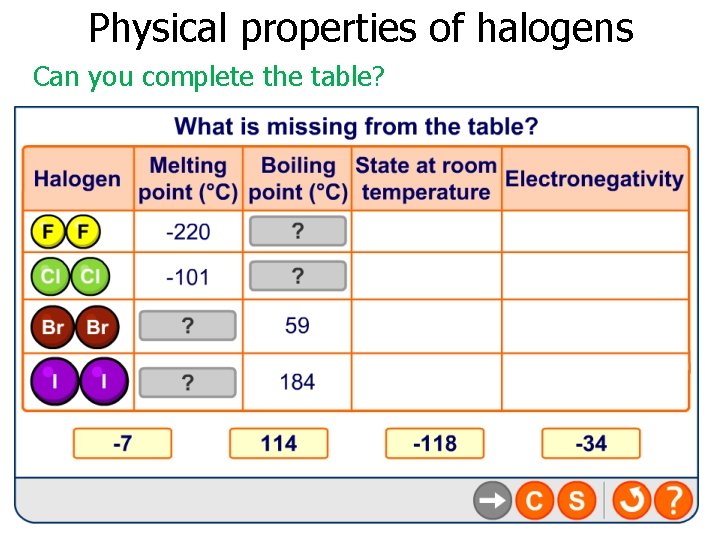
Physical properties of halogens Can you complete the table?
Group 7 elements properties 25 October 2021
Group 7 (the Halogens) elements properties • understand reasons for the trends in melting and boiling temperatures, physical • state at room temperature, and electronegativity for Group 7 elements • understand reasons for the trend in reactivity of Group 7 elements down the group • understand the trend in reactivity of Group 7 elements in terms of the redox reactions of Cl 2, Br 2 and I with halide ions in aqueous solution, followed by the addition of an organic solvent • be able to make predictions about fluorine and astatine and their compounds, in terms of knowledge of trends in halogen chemistry • the disproportionation reaction of chlorine with water and the use of chlorine in water treatment • the disproportionation reaction of chlorine with cold, dilute aqueous sodium hydroxide to form bleach • the disproportionation reaction of chlorine with hot alkali • reactions analogous to those specified above
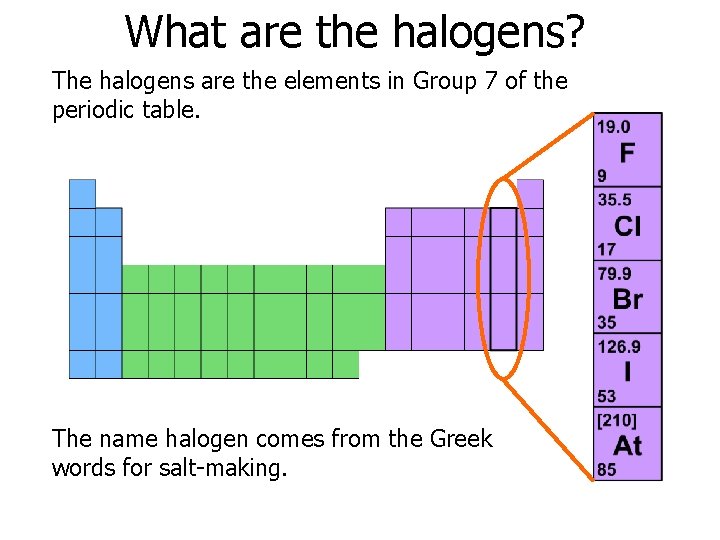
What are the halogens? The halogens are the elements in Group 7 of the periodic table. The name halogen comes from the Greek words for salt-making.
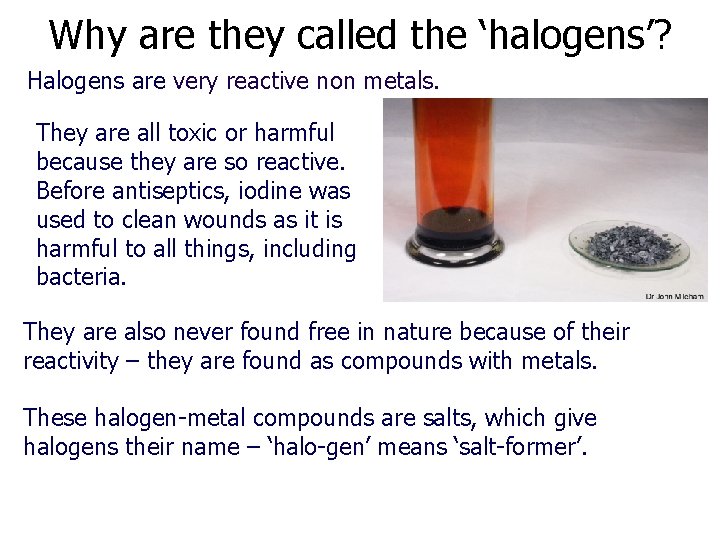
Why are they called the ‘halogens’? Halogens are very reactive non metals. They are all toxic or harmful because they are so reactive. Before antiseptics, iodine was used to clean wounds as it is harmful to all things, including bacteria. They are also never found free in nature because of their reactivity – they are found as compounds with metals. These halogen-metal compounds are salts, which give halogens their name – ‘halo-gen’ means ‘salt-former’.
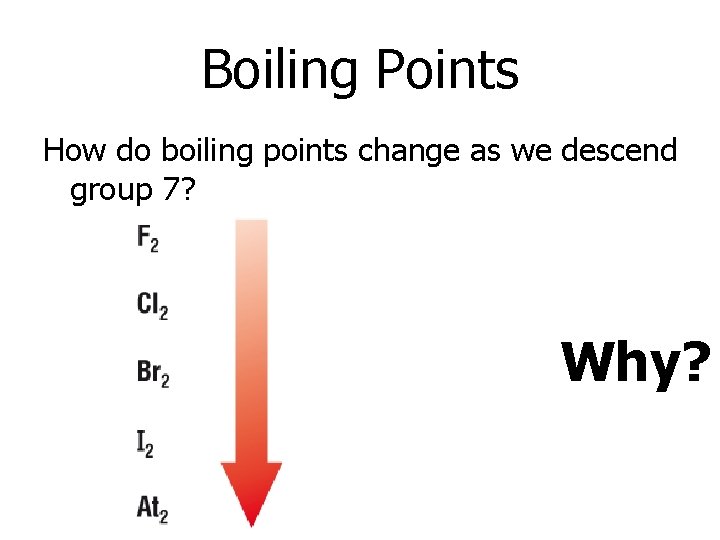
Boiling Points How do boiling points change as we descend group 7? Why?
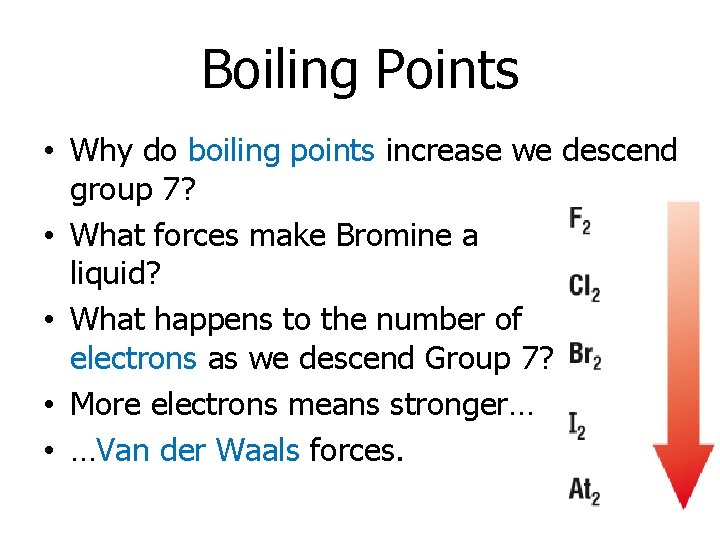
Boiling Points • Why do boiling points increase we descend group 7? • What forces make Bromine a liquid? • What happens to the number of electrons as we descend Group 7? • More electrons means stronger… • …Van der Waals forces.
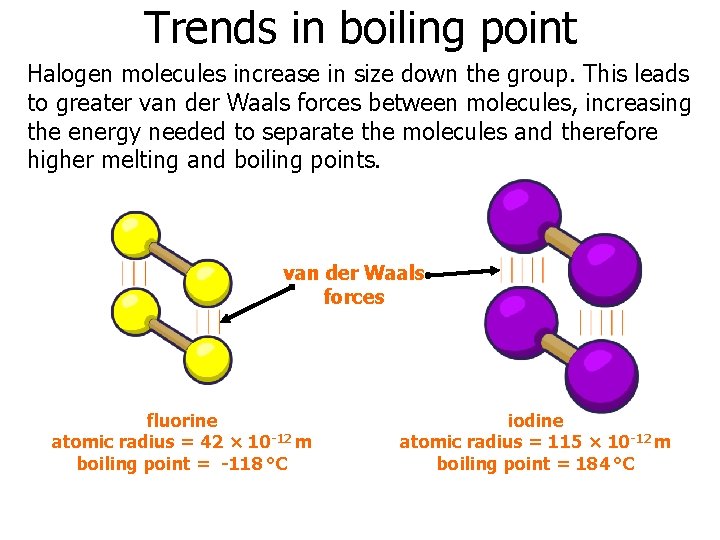
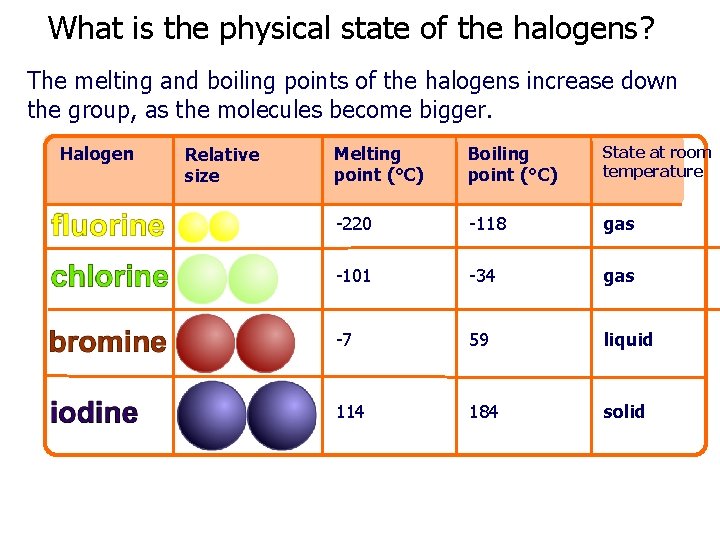
Trends in boiling point Halogen molecules increase in size down the group. This leads to greater van der Waals forces between molecules, increasing the energy needed to separate the molecules and therefore higher melting and boiling points. van der Waals forces fluorine atomic radius = 42 × 10 -12 m boiling point = -118 °C iodine atomic radius = 115 × 10 -12 m boiling point = 184 °C
What is the physical state of the halogens? The melting and boiling points of the halogens increase down the group, as the molecules become bigger. Halogen Relative size Melting point (°C) Boiling point (°C) State at room temperature -220 -118 gas -101 -34 gas -7 59 liquid 114 184 solid
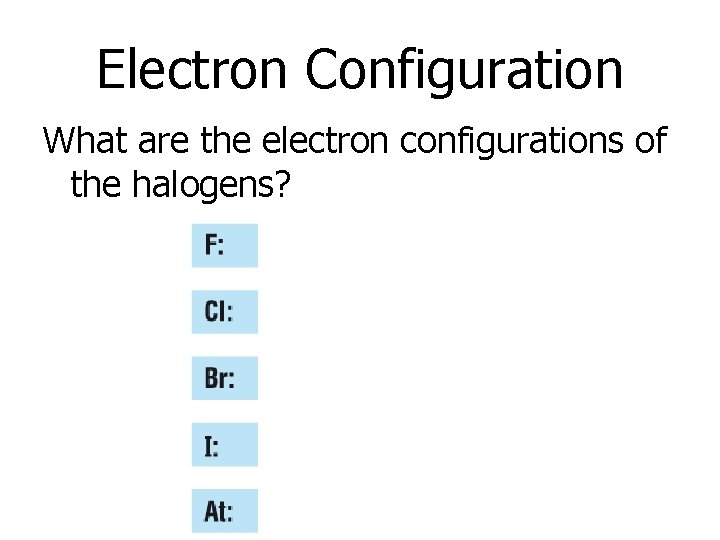
Electron Configuration What are the electron configurations of the halogens?
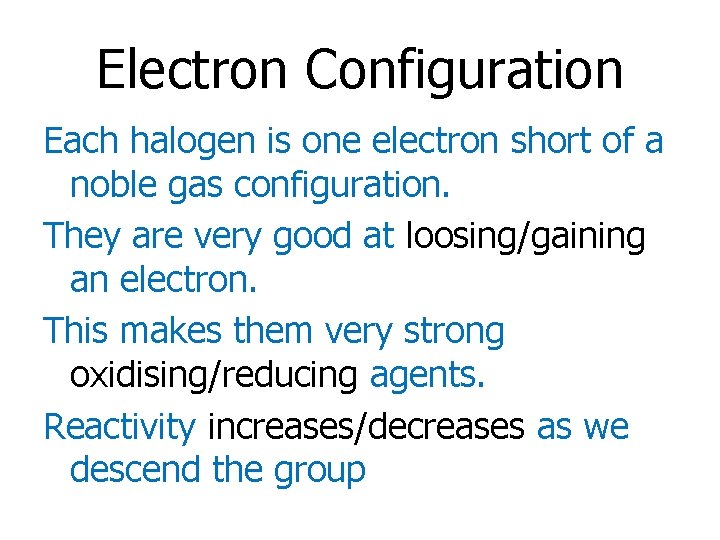
Electron Configuration Each halogen is one electron short of a noble gas configuration. They are very good at loosing/gaining an electron. This makes them very strong oxidising/reducing agents. Reactivity increases/decreases as we descend the group
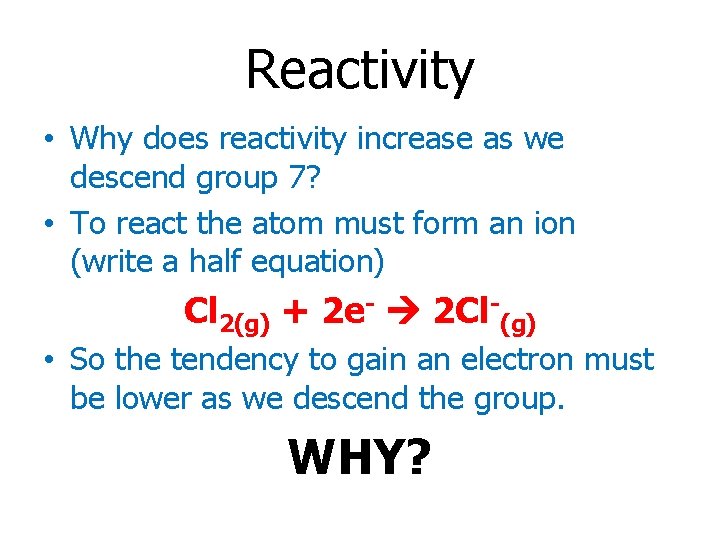
Reactivity • Why does reactivity increase as we descend group 7? • To react the atom must form an ion (write a half equation) Cl 2(g) + 2 e- 2 Cl-(g) • So the tendency to gain an electron must be lower as we descend the group. WHY?
Reactivity Why does the tendency to gain an electron reduce as we descend the group? • Number of protons increases!!! BUT this is outweighed by: • Increasing atomic radius • Increasing electron shielding
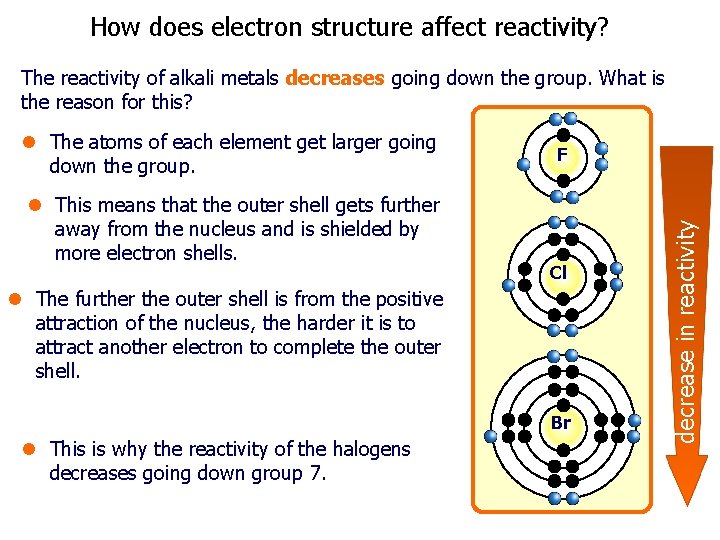
How does electron structure affect reactivity? The reactivity of alkali metals decreases going down the group. What is the reason for this? l This means that the outer shell gets further away from the nucleus and is shielded by more electron shells. F Cl l The further the outer shell is from the positive attraction of the nucleus, the harder it is to attract another electron to complete the outer shell. Br l This is why the reactivity of the halogens decreases going down group 7. decrease in reactivity l The atoms of each element get larger going down the group.
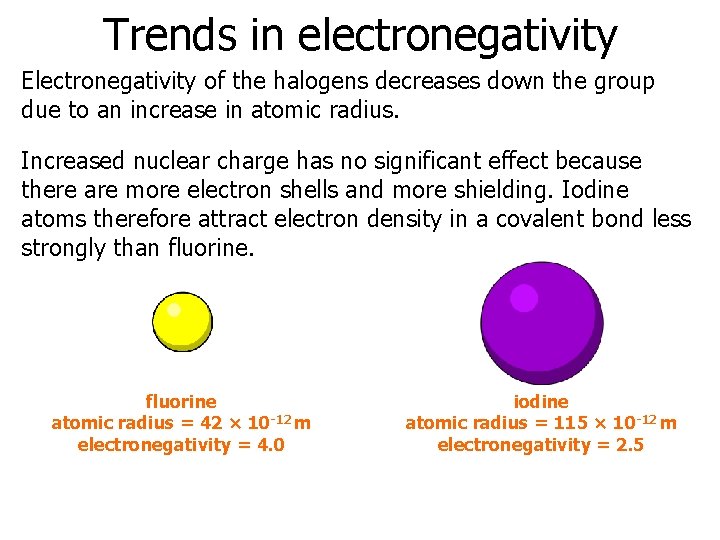
Trends in electronegativity Electronegativity of the halogens decreases down the group due to an increase in atomic radius. Increased nuclear charge has no significant effect because there are more electron shells and more shielding. Iodine atoms therefore attract electron density in a covalent bond less strongly than fluorine atomic radius = 42 × 10 -12 m electronegativity = 4. 0 iodine atomic radius = 115 × 10 -12 m electronegativity = 2. 5
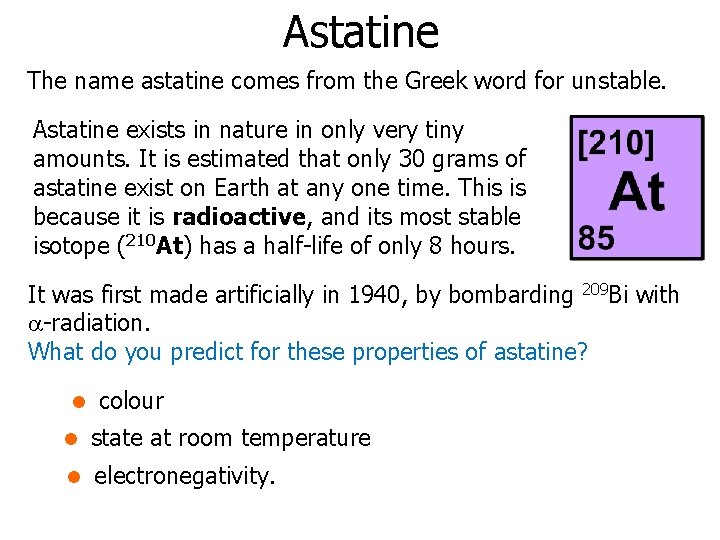
Astatine The name astatine comes from the Greek word for unstable. Astatine exists in nature in only very tiny amounts. It is estimated that only 30 grams of astatine exist on Earth at any one time. This is because it is radioactive, and its most stable isotope (210 At) has a half-life of only 8 hours. It was first made artificially in 1940, by bombarding 209 Bi with a-radiation. What do you predict for these properties of astatine? l colour l state at room temperature l electronegativity.
Group 7 (the Halogens) elements properties • understand reasons for the trends in melting and boiling temperatures, physical • state at room temperature, and electronegativity for Group 7 elements • understand reasons for the trend in reactivity of Group 7 elements down the group • understand the trend in reactivity of Group 7 elements in terms of the redox reactions of Cl 2, Br 2 and I with halide ions in aqueous solution, followed by the addition of an organic solvent • be able to make predictions about fluorine and astatine and their compounds, in terms of knowledge of trends in halogen chemistry • the disproportionation reaction of chlorine with water and the use of chlorine in water treatment • the disproportionation reaction of chlorine with cold, dilute aqueous sodium hydroxide to form bleach • the disproportionation reaction of chlorine with hot alkali • reactions analogous to those specified above
Practical • On worksheet • Note some differences to equipment • Hexane (or cyclohexane) must be stoppered in test tubes when not been used. • Answer questions at bottom page
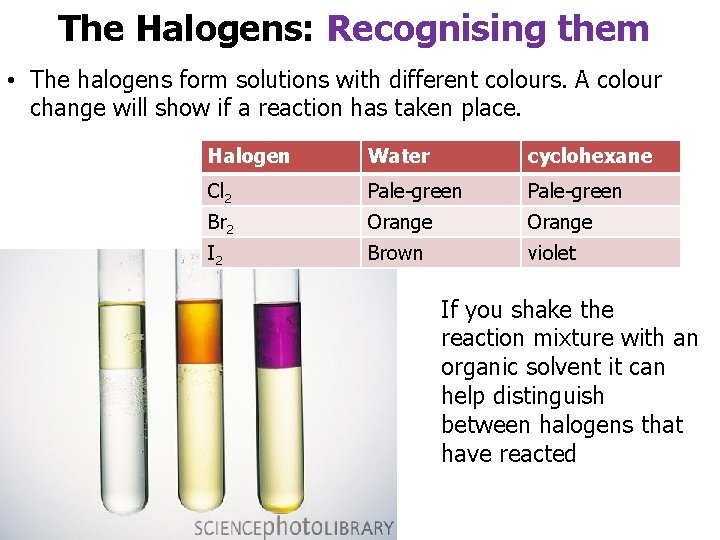
The Halogens: Recognising them • The halogens form solutions with different colours. A colour change will show if a reaction has taken place. Halogen Water cyclohexane Cl 2 Pale-green Br 2 Orange I 2 Brown violet If you shake the reaction mixture with an organic solvent it can help distinguish between halogens that have reacted
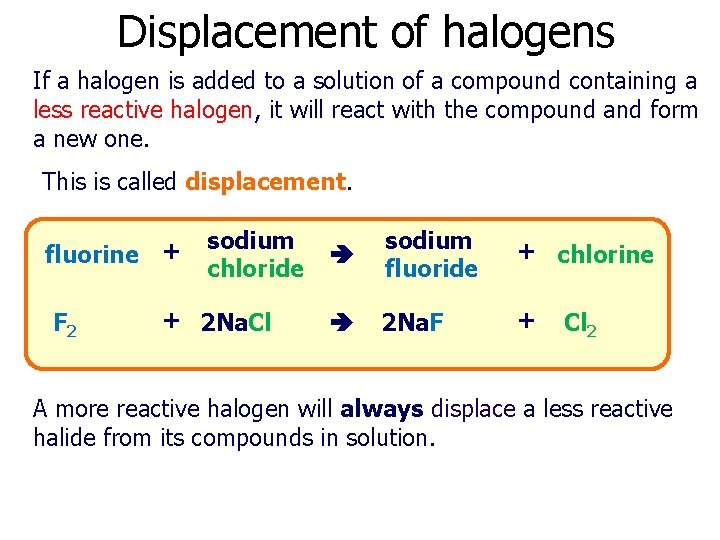
Displacement of halogens If a halogen is added to a solution of a compound containing a less reactive halogen, it will react with the compound and form a new one. This is called displacement. fluorine + F 2 sodium chloride + 2 Na. Cl sodium fluoride + chlorine 2 Na. F + Cl 2 A more reactive halogen will always displace a less reactive halide from its compounds in solution.
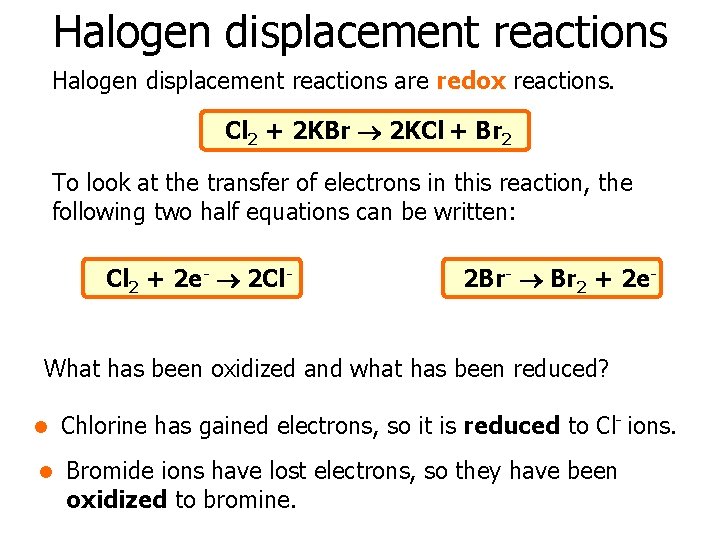
Halogen displacement reactions are redox reactions. Cl 2 + 2 KBr 2 KCl + Br 2 To look at the transfer of electrons in this reaction, the following two half equations can be written: Cl 2 + 2 e- 2 Cl- 2 Br- Br 2 + 2 e- What has been oxidized and what has been reduced? l Chlorine has gained electrons, so it is reduced to Cl- ions. l Bromide ions have lost electrons, so they have been oxidized to bromine.
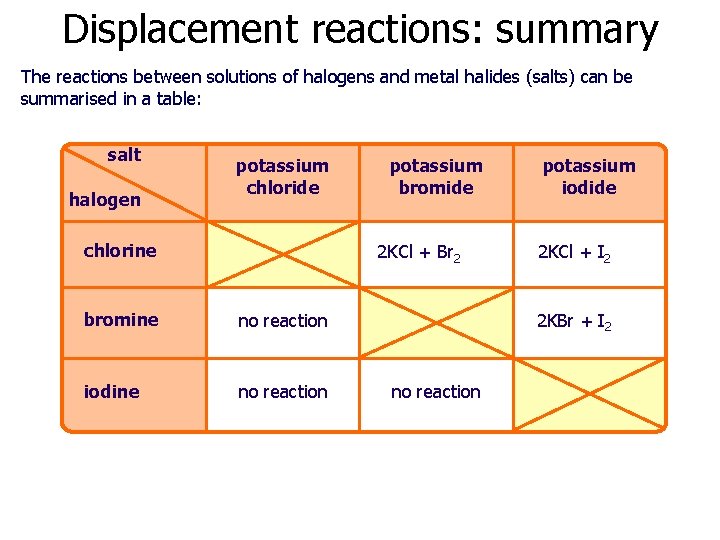
Displacement reactions: summary The reactions between solutions of halogens and metal halides (salts) can be summarised in a table: salt halogen potassium chloride chlorine potassium bromide 2 KCl + Br 2 bromine no reaction iodine no reaction potassium iodide 2 KCl + I 2 2 KBr + I 2 no reaction
Group 7 (the Halogens) elements properties • understand reasons for the trends in melting and boiling temperatures, physical • state at room temperature, and electronegativity for Group 7 elements • understand reasons for the trend in reactivity of Group 7 elements down the group • understand the trend in reactivity of Group 7 elements in terms of the redox reactions of Cl 2, Br 2 and I with halide ions in aqueous solution, followed by the addition of an organic solvent • be able to make predictions about fluorine and astatine and their compounds, in terms of knowledge of trends in halogen chemistry • the disproportionation reaction of chlorine with water and the use of chlorine in water treatment • the disproportionation reaction of chlorine with cold, dilute aqueous sodium hydroxide to form bleach • the disproportionation reaction of chlorine with hot alkali • reactions analogous to those specified above
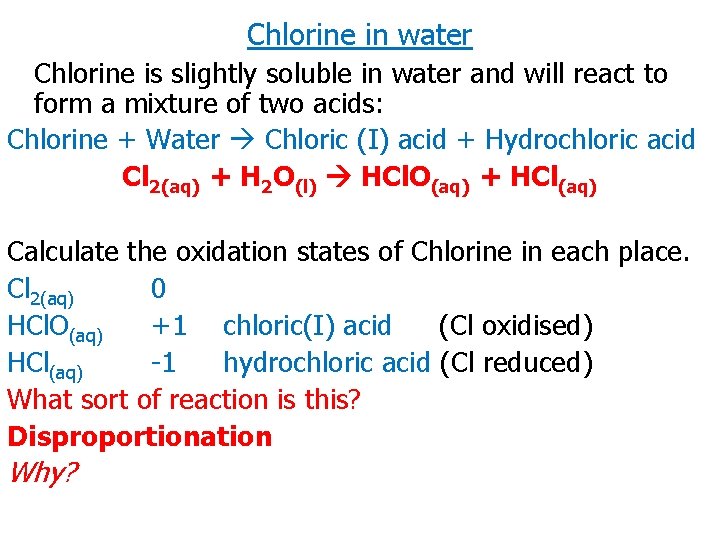
Chlorine in water Chlorine is slightly soluble in water and will react to form a mixture of two acids: Chlorine + Water Chloric (I) acid + Hydrochloric acid Cl 2(aq) + H 2 O(l) HCl. O(aq) + HCl(aq) Calculate the oxidation states of Chlorine in each place. Cl 2(aq) 0 HCl. O(aq) +1 chloric(I) acid (Cl oxidised) HCl(aq) -1 hydrochloric acid (Cl reduced) What sort of reaction is this? Disproportionation Why?
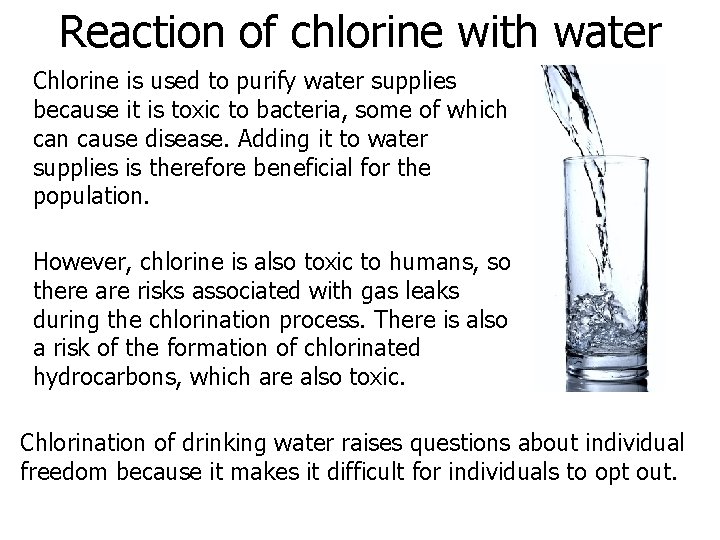
Reaction of chlorine with water Chlorine is used to purify water supplies because it is toxic to bacteria, some of which can cause disease. Adding it to water supplies is therefore beneficial for the population. However, chlorine is also toxic to humans, so there are risks associated with gas leaks during the chlorination process. There is also a risk of the formation of chlorinated hydrocarbons, which are also toxic. Chlorination of drinking water raises questions about individual freedom because it makes it difficult for individuals to opt out.
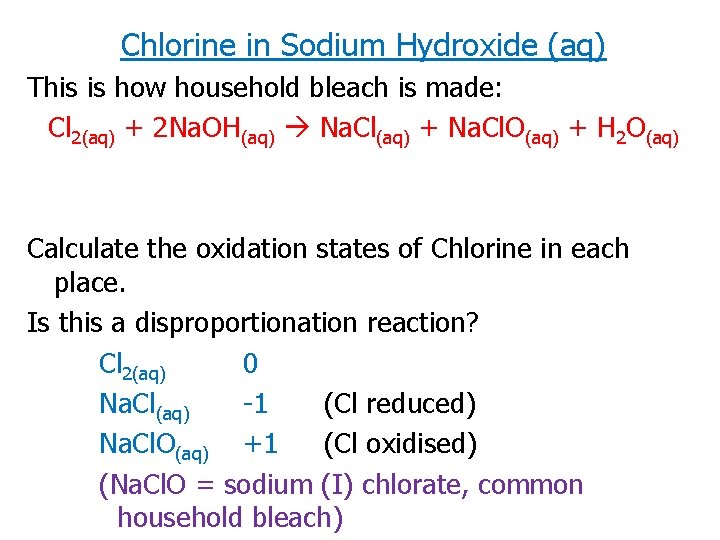
Chlorine in Sodium Hydroxide (aq) This is how household bleach is made: Cl 2(aq) + 2 Na. OH(aq) Na. Cl(aq) + Na. Cl. O(aq) + H 2 O(aq) Calculate the oxidation states of Chlorine in each place. Is this a disproportionation reaction? Cl 2(aq) 0 Na. Cl(aq) -1 (Cl reduced) Na. Cl. O(aq) +1 (Cl oxidised) (Na. Cl. O = sodium (I) chlorate, common household bleach)
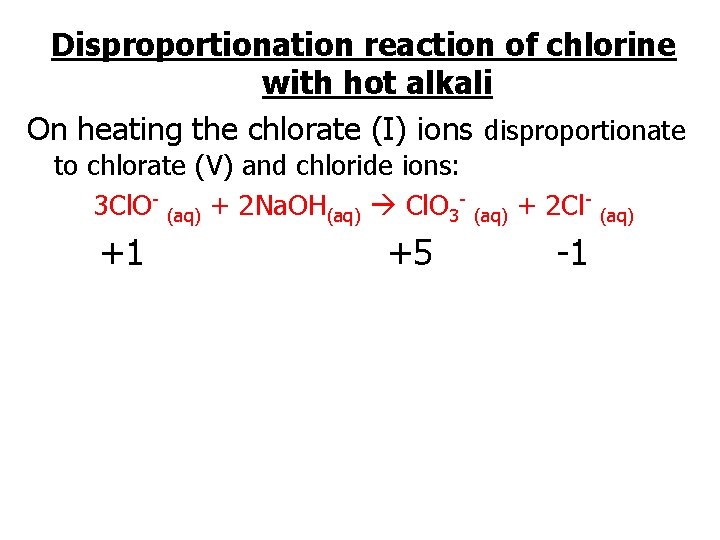
Disproportionation reaction of chlorine with hot alkali On heating the chlorate (I) ions disproportionate to chlorate (V) and chloride ions: 3 Cl. O- (aq) + 2 Na. OH(aq) Cl. O 3 - +1 +5 (aq) + 2 Cl- -1 (aq)
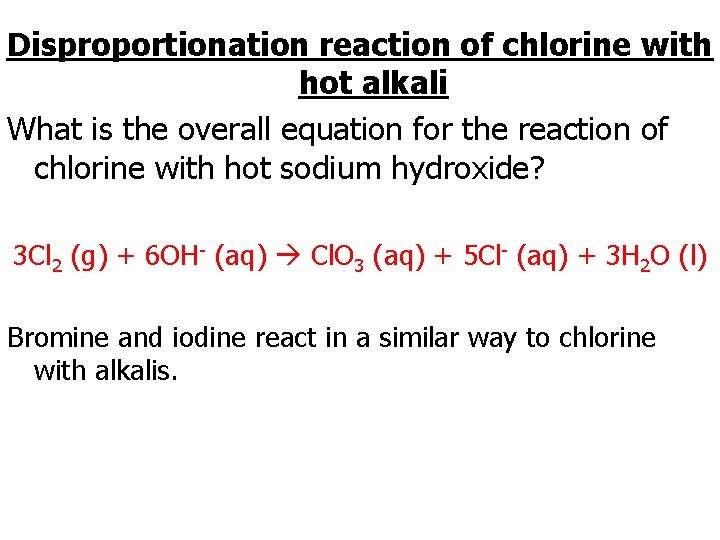
Disproportionation reaction of chlorine with hot alkali What is the overall equation for the reaction of chlorine with hot sodium hydroxide? 3 Cl 2 (g) + 6 OH- (aq) Cl. O 3 (aq) + 5 Cl- (aq) + 3 H 2 O (l) Bromine and iodine react in a similar way to chlorine with alkalis.
Group 7 (the Halogens) elements properties • understand reasons for the trends in melting and boiling temperatures, physical • state at room temperature, and electronegativity for Group 7 elements • understand reasons for the trend in reactivity of Group 7 elements down the group • understand the trend in reactivity of Group 7 elements in terms of the redox reactions of Cl 2, Br 2 and I with halide ions in aqueous solution, followed by the addition of an organic solvent • be able to make predictions about fluorine and astatine and their compounds, in terms of knowledge of trends in halogen chemistry • the disproportionation reaction of chlorine with water and the use of chlorine in water treatment • the disproportionation reaction of chlorine with cold, dilute aqueous sodium hydroxide to form bleach • the disproportionation reaction of chlorine with hot alkali • reactions analogous to those specified above
Questions, based on practical
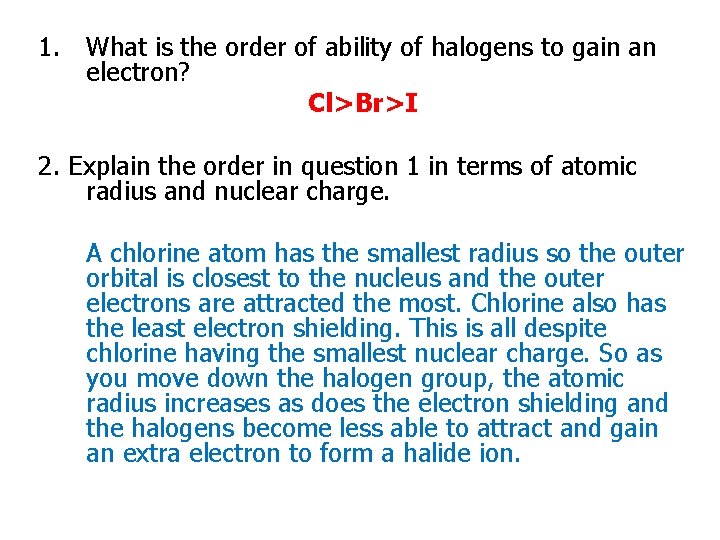
1. What is the order of ability of halogens to gain an electron? Cl>Br>I 2. Explain the order in question 1 in terms of atomic radius and nuclear charge. A chlorine atom has the smallest radius so the outer orbital is closest to the nucleus and the outer electrons are attracted the most. Chlorine also has the least electron shielding. This is all despite chlorine having the smallest nuclear charge. So as you move down the halogen group, the atomic radius increases as does the electron shielding and the halogens become less able to attract and gain an extra electron to form a halide ion.
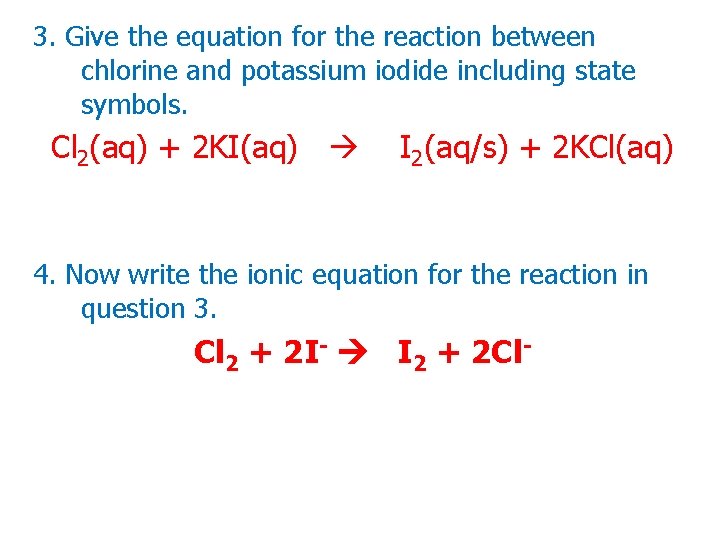
3. Give the equation for the reaction between chlorine and potassium iodide including state symbols. Cl 2(aq) + 2 KI(aq) I 2(aq/s) + 2 KCl(aq) 4. Now write the ionic equation for the reaction in question 3. Cl 2 + 2 I- I 2 + 2 Cl-
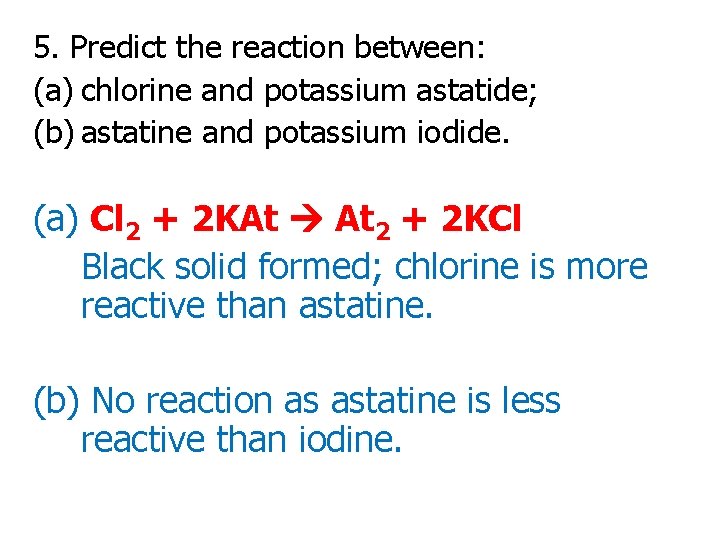
5. Predict the reaction between: (a) chlorine and potassium astatide; (b) astatine and potassium iodide. (a) Cl 2 + 2 KAt At 2 + 2 KCl Black solid formed; chlorine is more reactive than astatine. (b) No reaction as astatine is less reactive than iodine.
Group 7 (the Halogens) elements properties • understand reasons for the trends in melting and boiling temperatures, physical • state at room temperature, and electronegativity for Group 7 elements • understand reasons for the trend in reactivity of Group 7 elements down the group • understand the trend in reactivity of Group 7 elements in terms of the redox reactions of Cl 2, Br 2 and I with halide ions in aqueous solution, followed by the addition of an organic solvent • be able to make predictions about fluorine and astatine and their compounds, in terms of knowledge of trends in halogen chemistry • the disproportionation reaction of chlorine with water and the use of chlorine in water treatment • the disproportionation reaction of chlorine with cold, dilute aqueous sodium hydroxide to form bleach • the disproportionation reaction of chlorine with hot alkali • reactions analogous to those specified above