
Physical processes erosion transportation and deposition Getting started
- Slides: 19
Physical processes – erosion, transportation and deposition
Getting started You’ll need a notepad on which to make notes as you go along, or you could make notes, paste images, etc. on your device. You can view these slides: • as a slide-show for any animations and to follow links • in ‘normal’ view if you want to add call-outs or extra slides to make notes, paste images, answer questions. © Geographical Association, 2020
What are processes? • In geography we talk about river processes, glacial processes, coastal processes – but what do we mean by processes? • A process is an action or series of actions that have a particular result. • A food processor, for example, processes fruit chunks into a tasty smoothie. • A teacher, for another example, might say, ‘You can’t learn all of GCSE geography in one lesson. It’s a process. ’ © Geographical Association, 2020 Resource How tomato ketchup is made Activity Watch this video about the ketchup-making process. Make a list of the verbs you hear, such as squeeze, weigh, transport, put, pack.
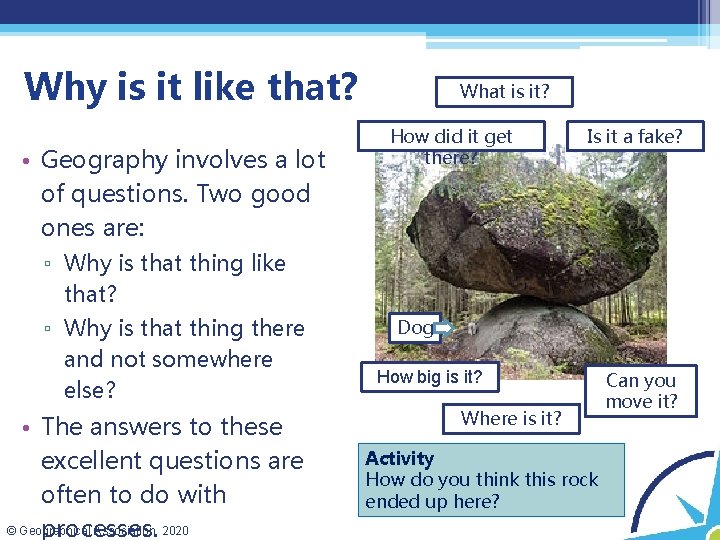
Why is it like that? • Geography involves a lot of questions. Two good ones are: What is it? How did it get there? Is it a fake? ▫ Why is that thing like that? ▫ Why is that thing there and not somewhere else? • The answers to these excellent questions are often to do with © Geographical Association, 2020 processes. Dog How big is it? Where is it? Activity How do you think this rock ended up here? Can you move it?
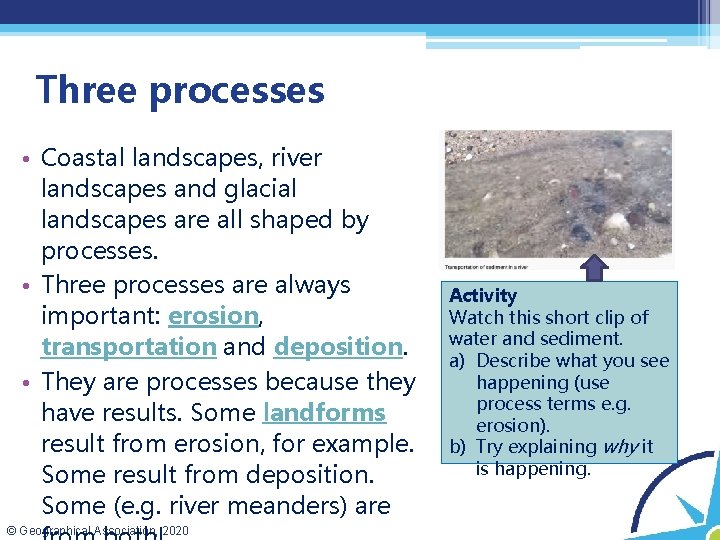
Three processes • Coastal landscapes, river landscapes and glacial landscapes are all shaped by processes. • Three processes are always important: erosion, transportation and deposition. • They are processes because they have results. Some landforms result from erosion, for example. Some result from deposition. Some (e. g. river meanders) are © Geographical Association, 2020 Activity Watch this short clip of water and sediment. a) Describe what you see happening (use process terms e. g. erosion). b) Try explaining why it is happening.
Energy and processes • Physical processes depend on energy. • For example, if a river has enough energy, it will erode sediment. If it loses energy, it will stop transporting sediment, and deposit it. • For example, a glacier has a lot of energy for erosion because of its enormous mass. • And a destructive wave powered by a winter storm has a lot of energy for erosion. © Geographical Association, 2020 Activity Watch this short clip about energy. a) What is kinetic energy? b) What is potential energy? c) What kind of energy does moving water have? d) Why might water high up in the mountains have more gravitational potential energy than water close to sea level?
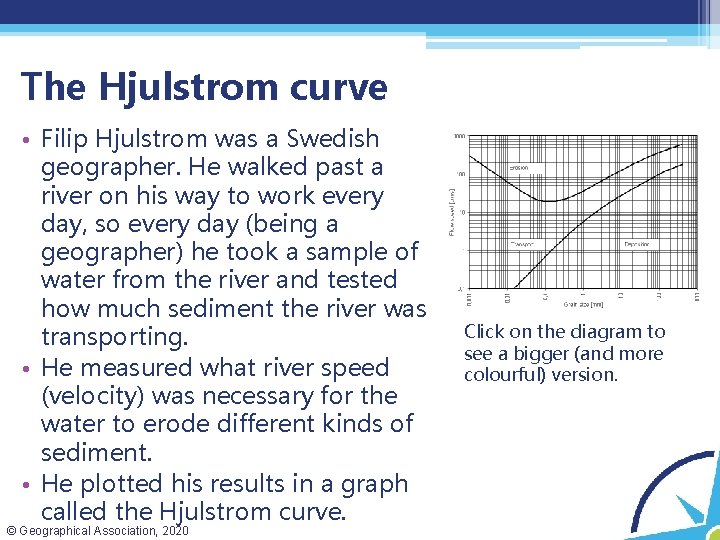
The Hjulstrom curve • Filip Hjulstrom was a Swedish geographer. He walked past a river on his way to work every day, so every day (being a geographer) he took a sample of water from the river and tested how much sediment the river was transporting. • He measured what river speed (velocity) was necessary for the water to erode different kinds of sediment. • He plotted his results in a graph called the Hjulstrom curve. © Geographical Association, 2020 Click on the diagram to see a bigger (and more colourful) version.
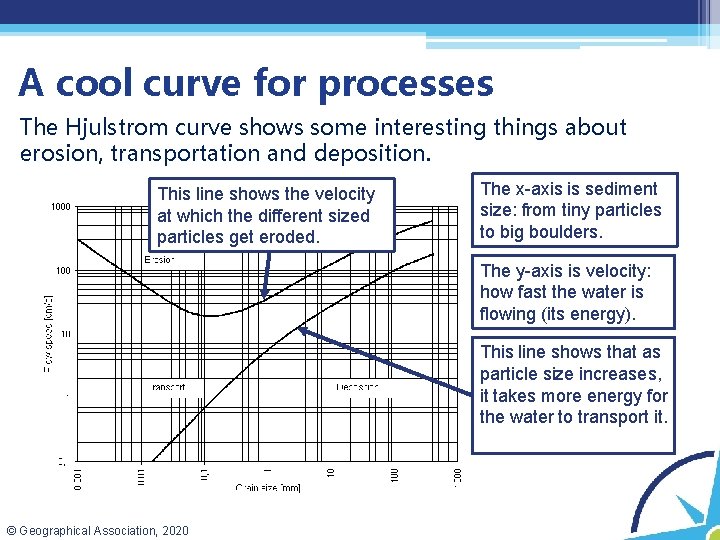
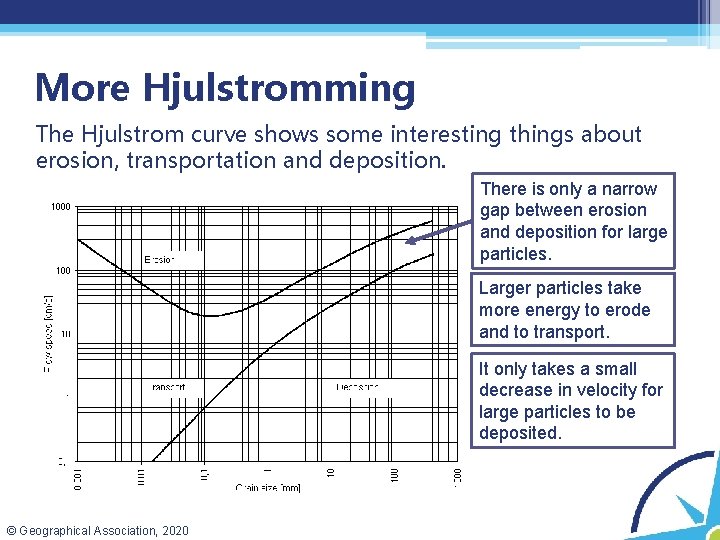
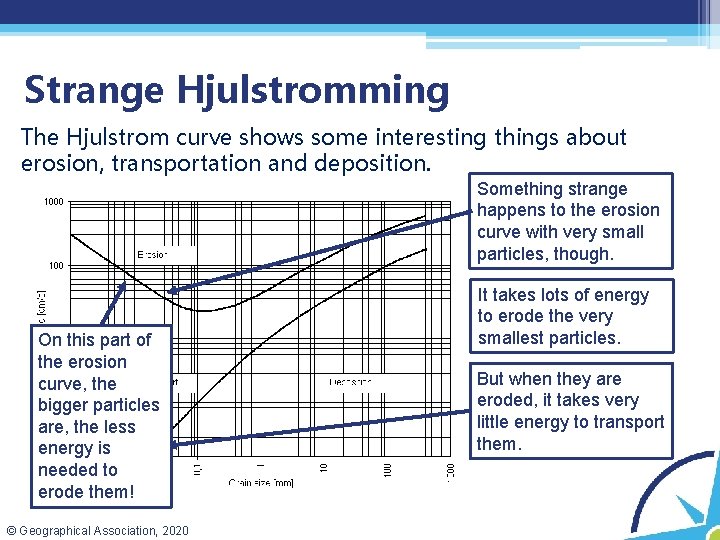
A cool curve for processes The Hjulstrom curve shows some interesting things about erosion, transportation and deposition. This line shows the velocity at which the different sized particles get eroded. The x-axis is sediment size: from tiny particles to big boulders. The y-axis is velocity: how fast the water is flowing (its energy). This line shows that as particle size increases, it takes more energy for the water to transport it. © Geographical Association, 2020
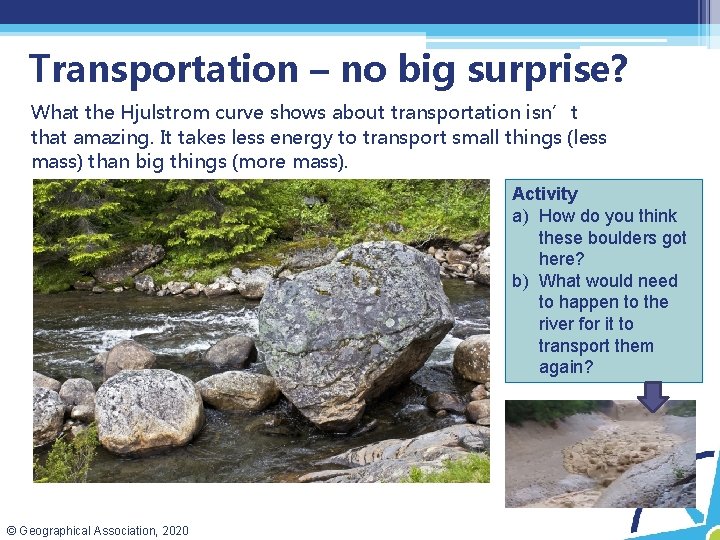
Transportation – no big surprise? What the Hjulstrom curve shows about transportation isn’t that amazing. It takes less energy to transport small things (less mass) than big things (more mass). Activity a) How do you think these boulders got here? b) What would need to happen to the river for it to transport them again? © Geographical Association, 2020
More Hjulstromming The Hjulstrom curve shows some interesting things about erosion, transportation and deposition. There is only a narrow gap between erosion and deposition for large particles. Larger particles take more energy to erode and to transport. It only takes a small decrease in velocity for large particles to be deposited. © Geographical Association, 2020
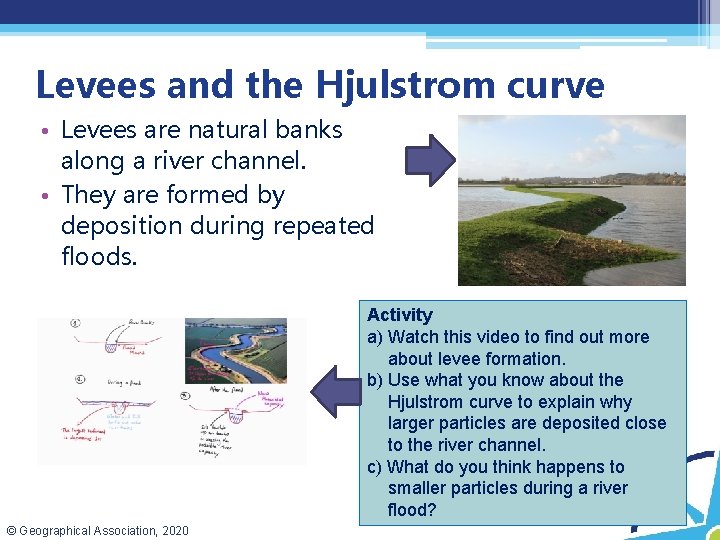
Levees and the Hjulstrom curve • Levees are natural banks along a river channel. • They are formed by deposition during repeated floods. Activity a) Watch this video to find out more about levee formation. b) Use what you know about the Hjulstrom curve to explain why larger particles are deposited close to the river channel. c) What do you think happens to smaller particles during a river flood? © Geographical Association, 2020
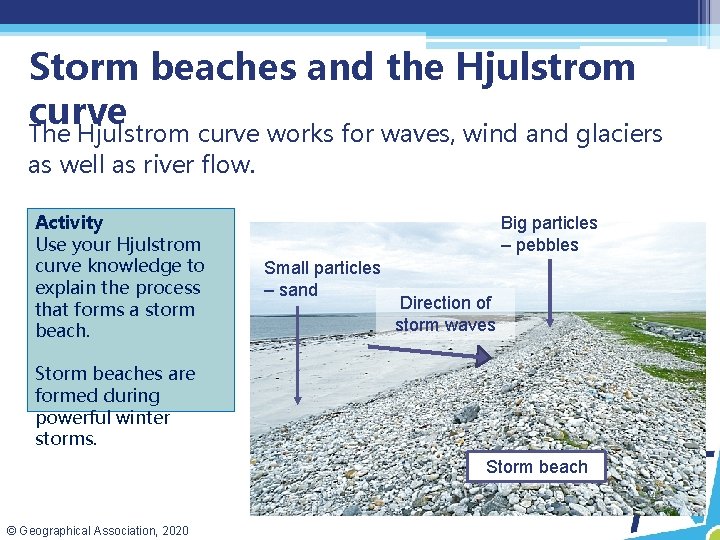
Storm beaches and the Hjulstrom curve The Hjulstrom curve works for waves, wind and glaciers as well as river flow. Activity Use your Hjulstrom curve knowledge to explain the process that forms a storm beach. Big particles – pebbles Small particles – sand Direction of storm waves Storm beaches are formed during powerful winter storms. Storm beach © Geographical Association, 2020
Strange Hjulstromming The Hjulstrom curve shows some interesting things about erosion, transportation and deposition. Something strange happens to the erosion curve with very small particles, though. On this part of the erosion curve, the bigger particles are, the less energy is needed to erode them! © Geographical Association, 2020 It takes lots of energy to erode the very smallest particles. But when they are eroded, it takes very little energy to transport them.
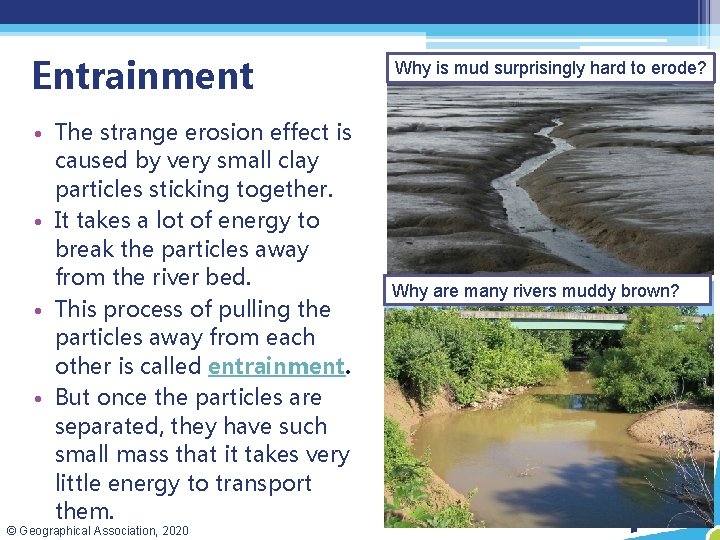
Entrainment • The strange erosion effect is caused by very small clay particles sticking together. • It takes a lot of energy to break the particles away from the river bed. • This process of pulling the particles away from each other is called entrainment. • But once the particles are separated, they have such small mass that it takes very little energy to transport them. © Geographical Association, 2020 Why is mud surprisingly hard to erode? Why are many rivers muddy brown?
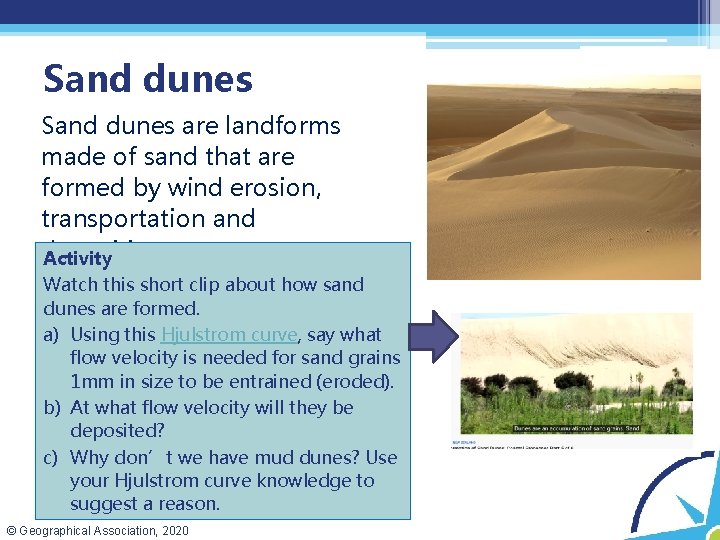
Sand dunes are landforms made of sand that are formed by wind erosion, transportation and deposition. Activity Watch this short clip about how sand dunes are formed. a) Using this Hjulstrom curve, say what flow velocity is needed for sand grains 1 mm in size to be entrained (eroded). b) At what flow velocity will they be deposited? c) Why don’t we have mud dunes? Use your Hjulstrom curve knowledge to suggest a reason. © Geographical Association, 2020
Summary • Processes work to produce a result. • Processes depend on energy – kinetic and potential. • The Hjulstrom curve shows that the bigger particles are, the more energy they need to be transported. • That helps us explain levee landforms and also storm beaches. • That is true for erosion, too, for particles the size of a grain of sand upwards. • But the stickiness of the smallest particles means less energy is needed to erode bigger particles than smaller ones – strange! • That could be a reason why we have sand dunes, but not mud dunes! © Geographical Association, 2020
Glossary • • • • Deposition: the process of dropping material. Energy: this is the capacity for doing work. Entrainment: when a fluid picks up sediment. Erosion: the process in which worn-away material is transported away by flows of wind, water, ice. Gravitational potential energy: potential energy that comes from being higher than a zero level, e. g. sea level. Kinetic energy: energy because of motion. Landforms: these are features of the Earth’s surface. Mass: the amount of matter something contains. Potential energy: energy stored because of something’s position (e. g. a coiled spring). Process: an action or series of actions that has/have a particular result. Sea level: the level of the sea’s surface. Sediment: material broken down by weathering or erosion. Transportation: the process of carrying material. © Geographical Association, 2020
Links Awarding bodies: Topic AQA 3. 1. 3. 2, 3. 1. 3. 3, 3. 1. 3. 4 Coastal, river, glacial landscapes Edexcel A 1: The changing landscape of the UK Edexcel B 4: The UK’s evolving physical landscape Eduqas A 1: Landscapes and physical processes Eduqas B 2. 1: Shaping the landscape OCR A 1. 1 Landscapes of the UK OCR B 3 Distinctive landscapes WJEC 1: Landscapes and physical processes © Geographical Association, 2020 Find out more: • A Show. Me video explaining the Hjulstrom curve. • Find out more about erratics (slide 4) here. • Glaciers are great for processes – this clip shows processes working together to achieve a glacial mass balance.
Acknowledgements This presentation has been written by Rob Bircher, an experienced author, publisher and secretary of the Worcester Branch of the GA. Figures • Slide 4: Photo source: https: //en. wikipedia. org/wiki/Kummakivi#/media/File: Kummakivi _balancing_rock_in_Ruokolahti, _Finland. jpg by Kotivalo • Slide 9: Photo source: https: //pxhere. com/en/photo/454871 • Slide 11: Photo source: https: //www. geograph. org. uk/photo/1673513 • Slide 12: Photo source: https: //en. wikipedia. org/wiki/Storm_beach#/media/File: Storm_Be ach_-_geograph. org. uk_-_1370159. jpg • Slide 14: Photos source: https: //www. geograph. org. uk/photo/2859762 © Geographical Association, 2020