
Physical Modeling of the Atmospheric Boundary Layer in
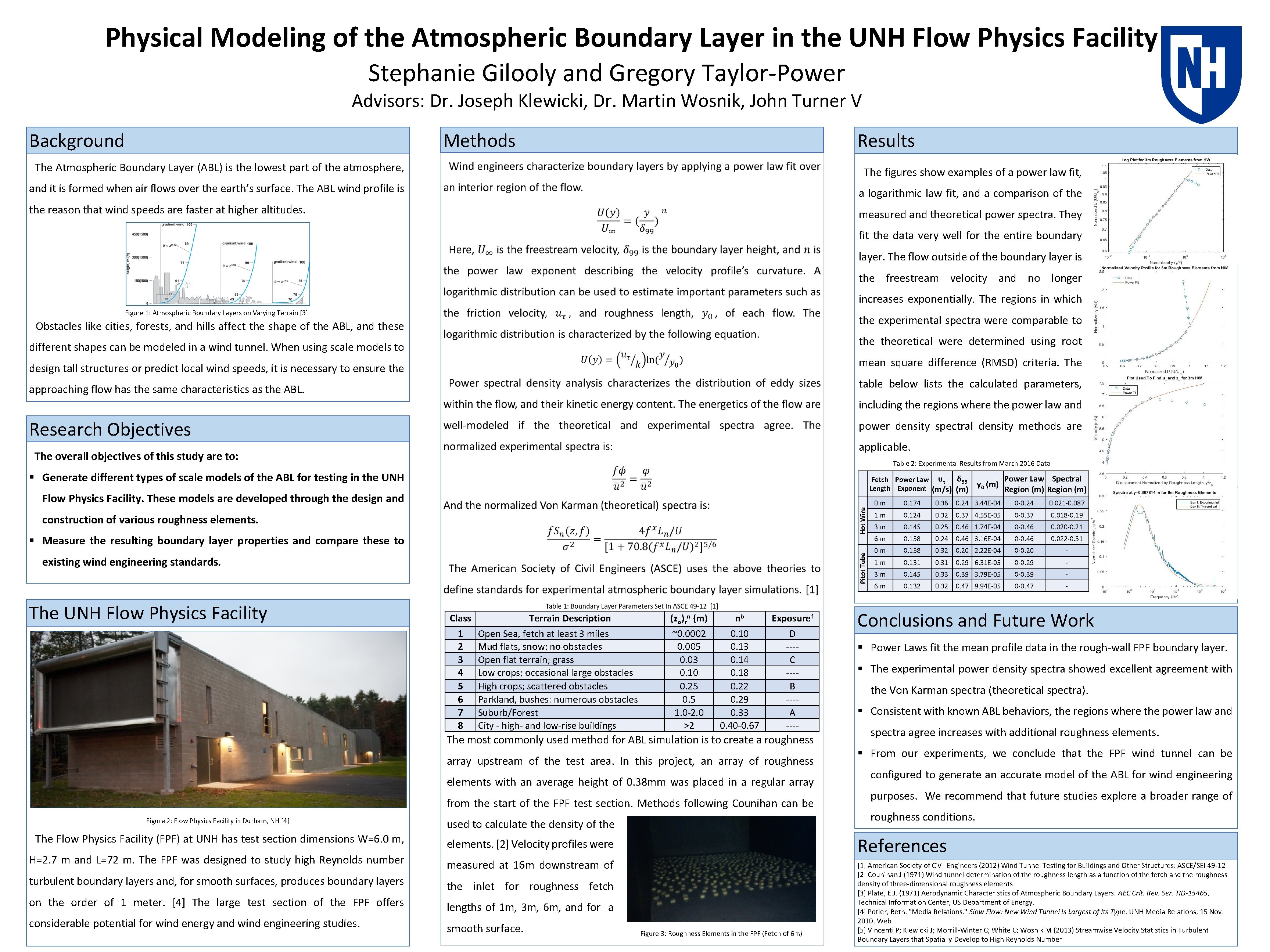
Physical Modeling of the Atmospheric Boundary Layer in the UNH Flow Physics Facility Stephanie Gilooly and Gregory Taylor-Power Advisors: Dr. Joseph Klewicki, Dr. Martin Wosnik, John Turner V Background Methods Results The Atmospheric Boundary Layer (ABL) is the lowest part of the atmosphere, The figures show examples of a power law fit, and it is formed when air flows over the earth’s surface. The ABL wind profile is a logarithmic law fit, and a comparison of the reason that wind speeds are faster at higher altitudes. measured and theoretical power spectra. They fit the data very well for the entire boundary layer. The flow outside of the boundary layer is the freestream velocity and no longer increases exponentially. The regions in which Figure 1: Atmospheric Boundary Layers on Varying Terrain [3] Obstacles like cities, forests, and hills affect the shape of the ABL, and these the experimental spectra were comparable to different shapes can be modeled in a wind tunnel. When using scale models to theoretical were determined using root design tall structures or predict local wind speeds, it is necessary to ensure the mean square difference (RMSD) criteria. The approaching flow has the same characteristics as the ABL. table below lists the calculated parameters, including the regions where the power law and Research Objectives power density spectral density methods are applicable. The overall objectives of this study are to: Table 2: Experimental Results from March 2016 Data § Generate different types of scale models of the ABL for testing in the UNH Fetch Power Law Length Exponent Hot Wire Flow Physics Facility. These models are developed through the design and construction of various roughness elements. Pitot Tube § Measure the resulting boundary layer properties and compare these to existing wind engineering standards. The UNH Flow Physics Facility Class 1 2 3 4 5 6 7 8 Terrain Description Open Sea, fetch at least 3 miles Mud flats, snow; no obstacles Open flat terrain; grass Low crops; occasional large obstacles High crops; scattered obstacles Parkland, bushes: numerous obstacles Suburb/Forest City - high- and low-rise buildings (zo)rn (m) ~0. 0002 0. 005 0. 03 0. 10 0. 25 0. 5 1. 0 -2. 0 >2 nb 0. 10 0. 13 0. 14 0. 18 0. 22 0. 29 0. 33 0. 40 -0. 67 Exposuref D ---C ---B ---A ---- The most commonly used method for ABL simulation is to create a roughness array upstream of the test area. In this project, an array of roughness elements with an average height of 0. 38 mm was placed in a regular array from the start of the FPF test section. Methods following Counihan can be Figure 2: Flow Physics Facility in Durham, NH [4] used to calculate the density of the uτ δ 99 Power Law Spectral y 0 (m) (m/s) (m) Region (m) 0 m 0. 174 0. 36 0. 24 3. 44 E-04 0 -0. 24 0. 021 -0. 087 1 m 0. 124 0. 32 0. 37 4. 55 E-05 0 -0. 37 0. 018 -0. 19 3 m 0. 145 0. 25 0. 46 1. 74 E-04 0 -0. 46 0. 020 -0. 21 6 m 0. 158 0. 24 0. 46 3. 16 E-04 0 -0. 46 0. 022 -0. 31 0 m 0. 158 0. 32 0. 20 2. 22 E-04 0 -0. 20 - 1 m 0. 131 0. 29 6. 31 E-05 0 -0. 29 - 3 m 0. 145 0. 33 0. 39 3. 79 E-05 0 -0. 39 - 6 m 0. 132 0. 47 9. 94 E-05 0 -0. 47 - Conclusions and Future Work § Power Laws fit the mean profile data in the rough-wall FPF boundary layer. § The experimental power density spectra showed excellent agreement with the Von Karman spectra (theoretical spectra). § Consistent with known ABL behaviors, the regions where the power law and spectra agree increases with additional roughness elements. § From our experiments, we conclude that the FPF wind tunnel can be configured to generate an accurate model of the ABL for wind engineering purposes. We recommend that future studies explore a broader range of roughness conditions. The Flow Physics Facility (FPF) at UNH has test section dimensions W=6. 0 m, elements. [2] Velocity profiles were H=2. 7 m and L=72 m. The FPF was designed to study high Reynolds number References measured at 16 m downstream of turbulent boundary layers and, for smooth surfaces, produces boundary layers the inlet for roughness fetch on the order of 1 meter. [4] The large test section of the FPF offers lengths of 1 m, 3 m, 6 m, and for a considerable potential for wind energy and wind engineering studies. smooth surface. [1] American Society of Civil Engineers (2012) Wind Tunnel Testing for Buildings and Other Structures: ASCE/SEI 49 -12 [2] Counihan J (1971) Wind tunnel determination of the roughness length as a function of the fetch and the roughness density of three-dimensional roughness elements [3] Plate, E. J. (1971) Aerodynamic Characteristics of Atmospheric Boundary Layers. AEC Crit. Rev. Ser. TID-15465, Technical Information Center, US Department of Energy. [4] Potier, Beth. "Media Relations. " Slow Flow: New Wind Tunnel Is Largest of Its Type. UNH Media Relations, 15 Nov. 2010. Web [5] Vincenti P; Klewicki J; Morrill-Winter C; White C; Wosnik M (2013) Streamwise Velocity Statistics in Turbulent Boundary Layers that Spatially Develop to High Reynolds Number Figure 3: Roughness Elements in the FPF (Fetch of 6 m)
- Slides: 1