
Physical method of waste disposal Waste management or
- Slides: 41
Physical method of waste disposal
Waste management or Waste disposal It is all the activities and actions required to manage waste from its inception (A first part or stage) to its final disposal. Waste are generated during the extraction of raw materials, the processing of raw materials into intermediate and final products, the consumption of final products, or other human activities. This includes collection, transport, treatment and disposal of waste together with monitoring and regulation
Functional Elements of solid waste management system There are six functional elements in the activities associated with the management of solid wastes from the point of generation to final disposal site. These are: � � � 1. Waste generation 2. On-site handling (sorting, storage and processing) 3. Collection 4. Transfer and transport 5. Processing and recovery 6. Disposal
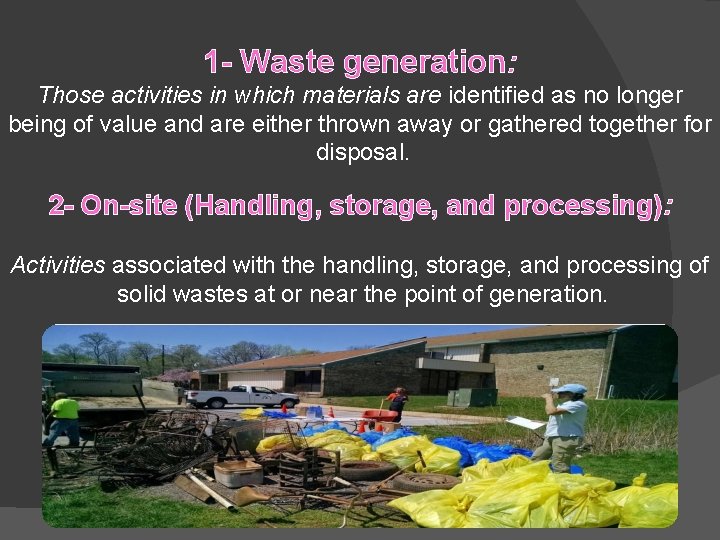
1 - Waste generation: Those activities in which materials are identified as no longer being of value and are either thrown away or gathered together for disposal. 2 - On-site (Handling, storage, and processing): Activities associated with the handling, storage, and processing of solid wastes at or near the point of generation.
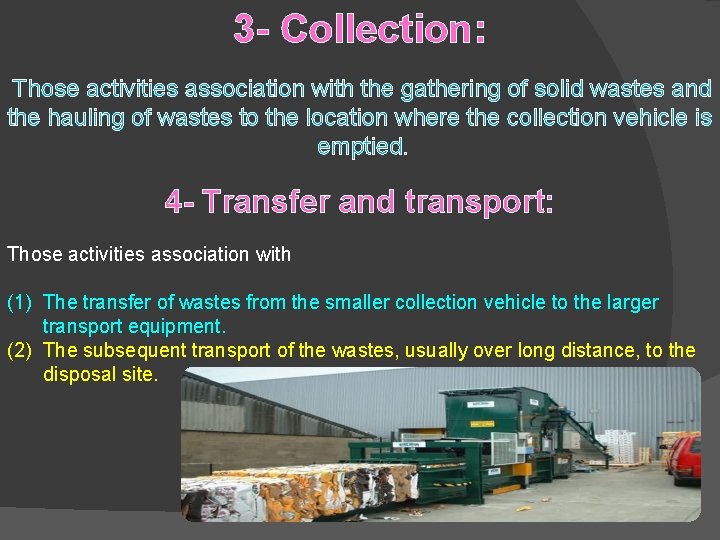
3 - Collection: Those activities association with the gathering of solid wastes and the hauling of wastes to the location where the collection vehicle is emptied. 4 - Transfer and transport: Those activities association with (1) The transfer of wastes from the smaller collection vehicle to the larger transport equipment. (2) The subsequent transport of the wastes, usually over long distance, to the disposal site.
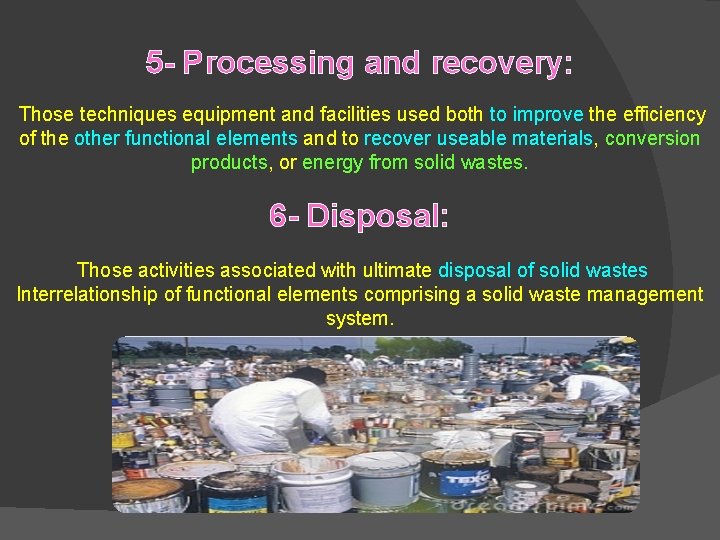
5 - Processing and recovery: Those techniques equipment and facilities used both to improve the efficiency of the other functional elements and to recover useable materials, conversion products, or energy from solid wastes. 6 - Disposal: Those activities associated with ultimate disposal of solid wastes Interrelationship of functional elements comprising a solid waste management system.
Factors to Consider in Treating and Disposing of Solid Waste 1 - Disposal Final operational state for cleanliness. 2 - Process Manipulation of waste, after disposal. 3 - Treatment Process to achieve sanitary results by reduction of hazardous effects to human and environment.
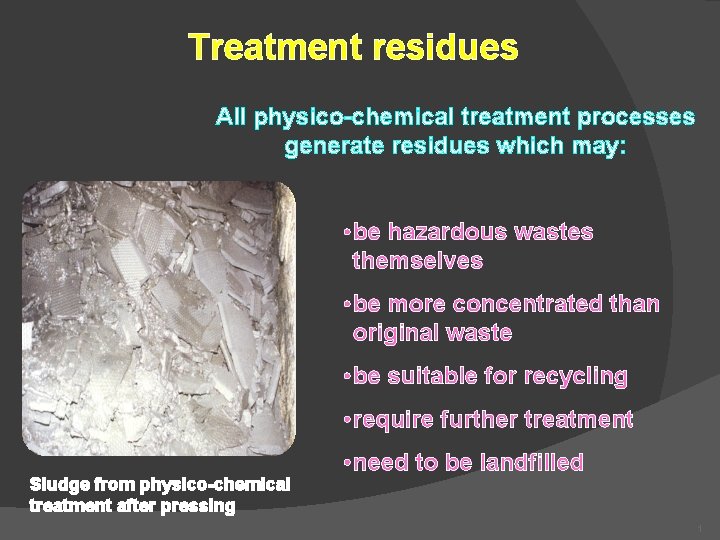
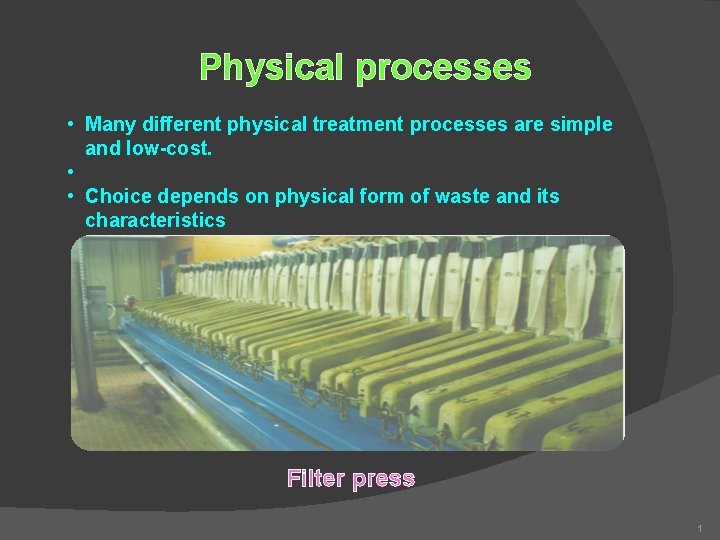
Treatment residues All physico-chemical treatment processes generate residues which may: • be hazardous wastes themselves • be more concentrated than original waste • be suitable for recycling • require further treatment Sludge from physico-chemical treatment after pressing • need to be landfilled 1
Physical processes • Many different physical treatment processes are simple and low-cost. • • Choice depends on physical form of waste and its characteristics Filter press 1
Physical Method of wastes disposal 1. 2. 3. 4. 5. 6. 7. 8. 9. Machine processing Thermal Processes Incineration Pyrolysis Screening Oil Separation Sedimentation Flotation Land Fill 10. COMPACTION 11. Filtration 12. Burial
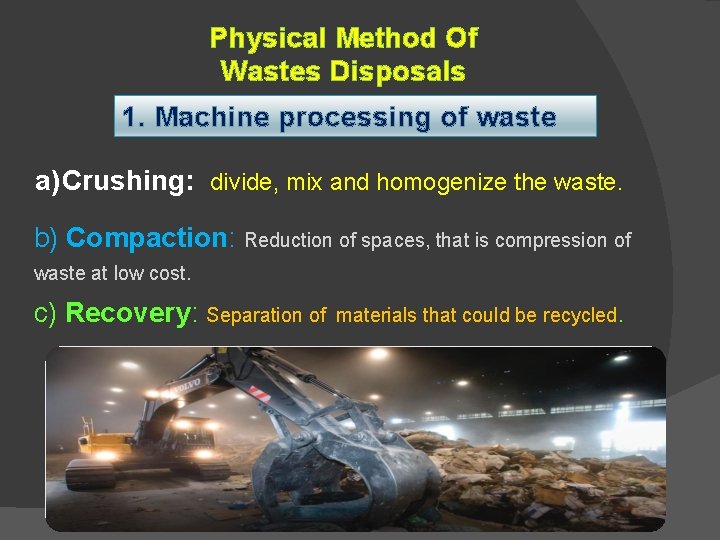
Physical Method Of Wastes Disposals 1. Machine processing of waste a) Crushing: divide, mix and homogenize the waste. b) Compaction: Reduction of spaces, that is compression of waste at low cost. c) Recovery: Separation of materials that could be recycled.
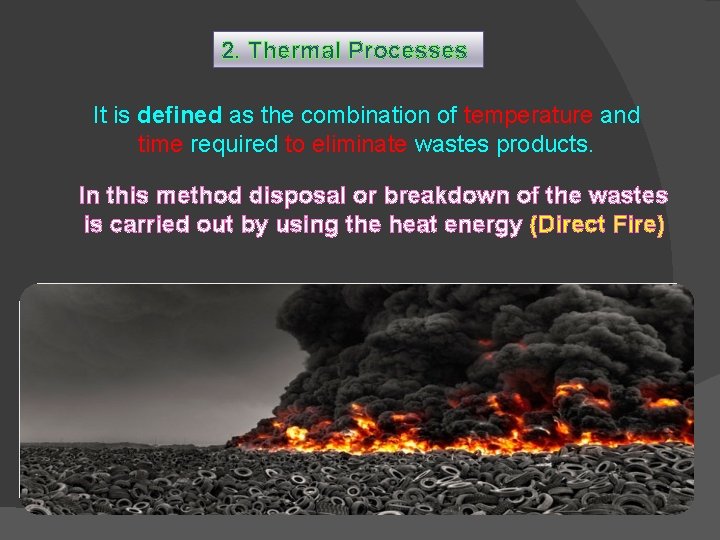
2. Thermal Processes It is defined as the combination of temperature and time required to eliminate wastes products. In this method disposal or breakdown of the wastes is carried out by using the heat energy (Direct Fire)
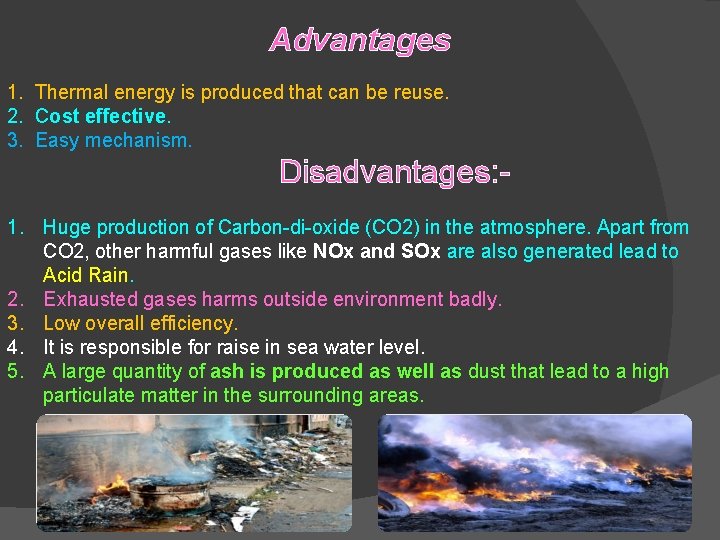
Advantages 1. Thermal energy is produced that can be reuse. 2. Cost effective. 3. Easy mechanism. Disadvantages: 1. Huge production of Carbon-di-oxide (CO 2) in the atmosphere. Apart from CO 2, other harmful gases like NOx and SOx are also generated lead to Acid Rain. 2. Exhausted gases harms outside environment badly. 3. Low overall efficiency. 4. It is responsible for raise in sea water level. 5. A large quantity of ash is produced as well as dust that lead to a high particulate matter in the surrounding areas.
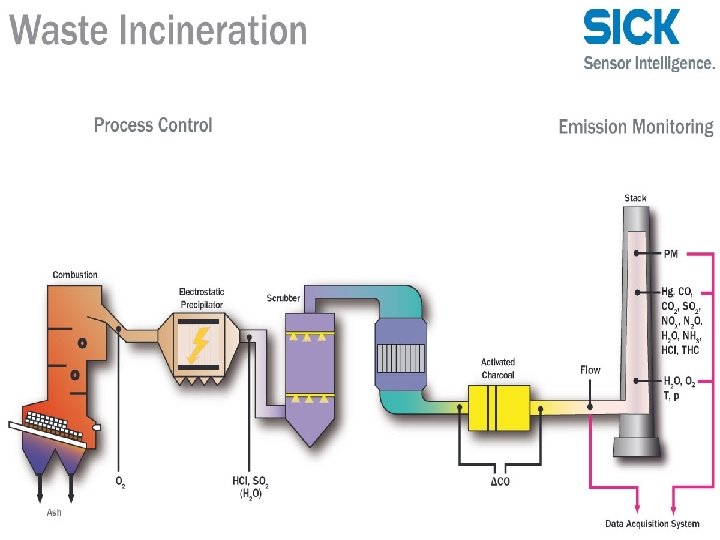
3 - Incineration is a waste treatment process that involves the combustion of solid waste at 1000 °C in furnace. ü Waste materials are converted into ash, flue gas, and heat. ü The ash is mostly formed by the inorganic constituents of the waste and gases due to organic waste. ü The heat generated by incineration is used to generate electric power. ü Incineration converts waste into ash, flue gas (A passage to carry off smoke) and heat. ü The flue gases can be dispersed into the atmosphere, but first they must be cleaned of any gaseous and particulate pollutants.
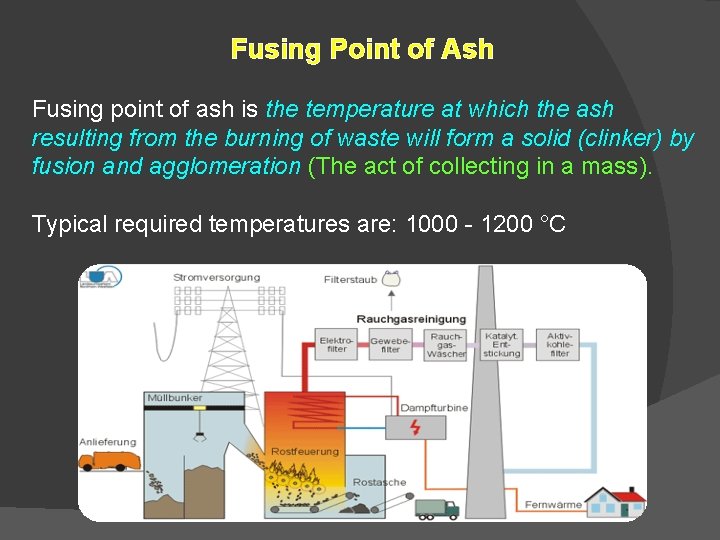
Fusing Point of Ash Fusing point of ash is the temperature at which the ash resulting from the burning of waste will form a solid (clinker) by fusion and agglomeration (The act of collecting in a mass). Typical required temperatures are: 1000 - 1200 °C
ADVANTAGES The weight of the waste is reduced to 25% of the initial value. � No risk of polluting local streams and ground waters as in landfills. � Incineration plants can be located close to residential areas. � Gases are used to generate power. � DISADVANTAGES Expensive � Required skilled labor. � The chemicals that would be released into the air could be strong pollutants and may destroy ozone layer (major disadvantage). � High energy requirement. �
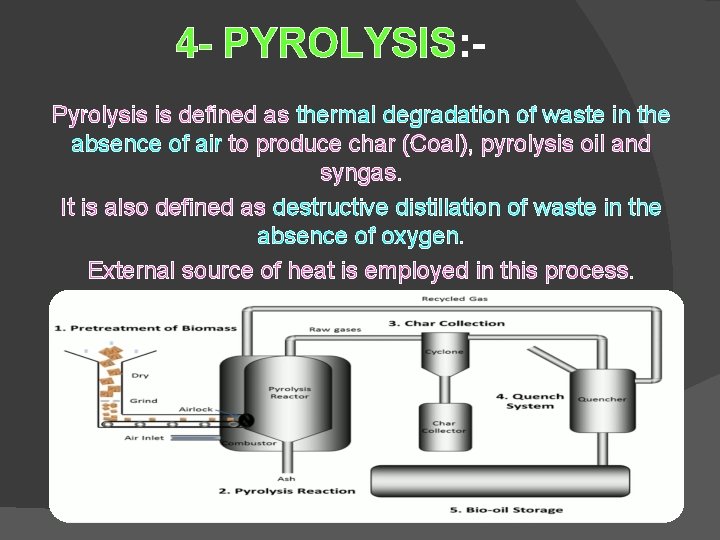
4 - PYROLYSIS: Pyrolysis is defined as thermal degradation of waste in the absence of air to produce char (Coal), pyrolysis oil and syngas. It is also defined as destructive distillation of waste in the absence of oxygen. External source of heat is employed in this process.
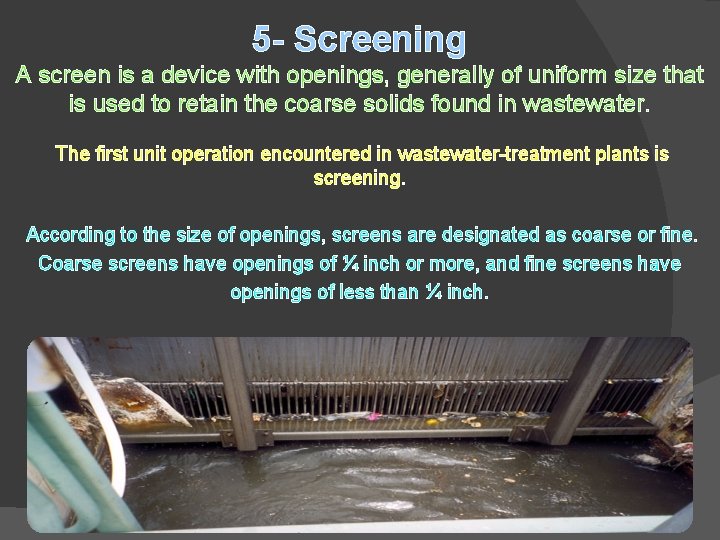
5 - Screening A screen is a device with openings, generally of uniform size that is used to retain the coarse solids found in wastewater. The first unit operation encountered in wastewater-treatment plants is screening. According to the size of openings, screens are designated as coarse or fine. Coarse screens have openings of ¼ inch or more, and fine screens have openings of less than ¼ inch.
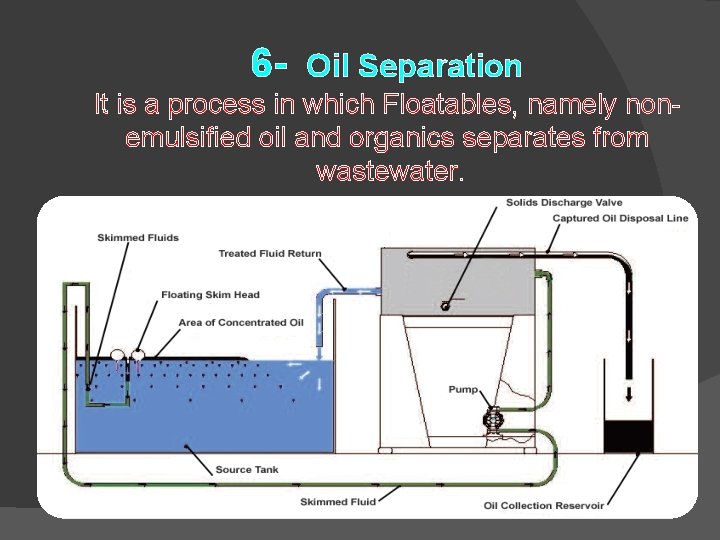
6 - Oil Separation It is a process in which Floatables, namely nonemulsified oil and organics separates from wastewater.
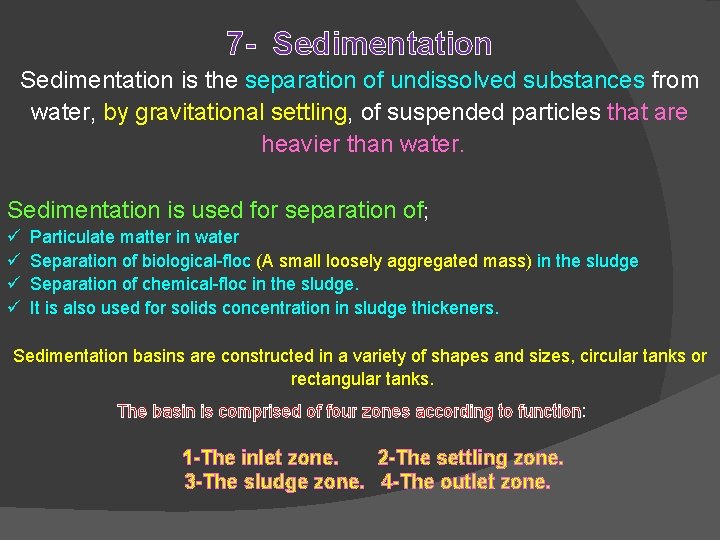
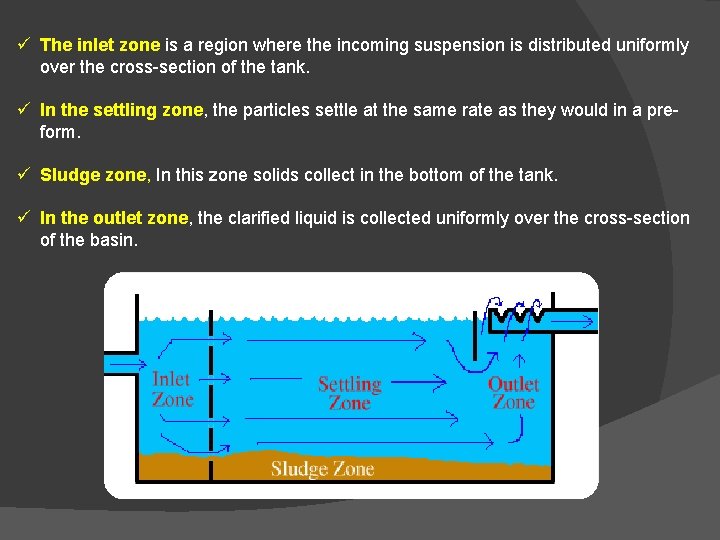
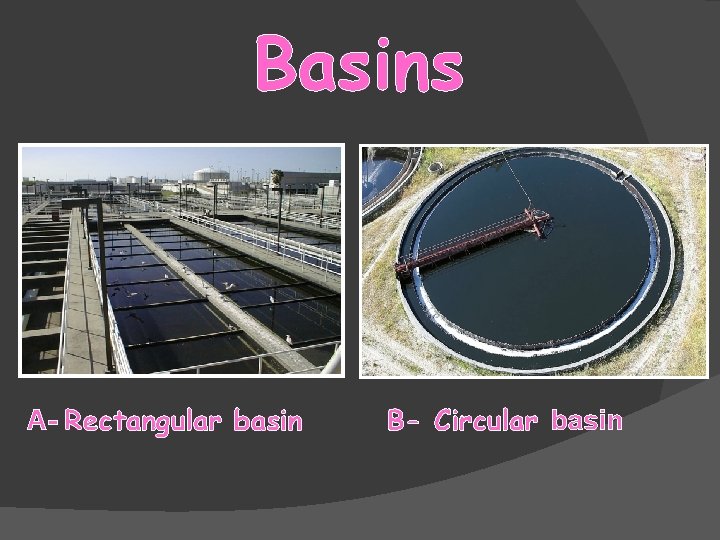
7 - Sedimentation is the separation of undissolved substances from water, by gravitational settling, of suspended particles that are heavier than water. Sedimentation is used for separation of; ü ü Particulate matter in water Separation of biological-floc (A small loosely aggregated mass) in the sludge Separation of chemical-floc in the sludge. It is also used for solids concentration in sludge thickeners. Sedimentation basins are constructed in a variety of shapes and sizes, circular tanks or rectangular tanks. The basin is comprised of four zones according to function: 1 -The inlet zone. 2 -The settling zone. 3 -The sludge zone. 4 -The outlet zone.
ü The inlet zone is a region where the incoming suspension is distributed uniformly over the cross-section of the tank. ü In the settling zone, the particles settle at the same rate as they would in a preform. ü Sludge zone, In this zone solids collect in the bottom of the tank. ü In the outlet zone, the clarified liquid is collected uniformly over the cross-section of the basin.
Basins A- Rectangular basin B- Circular basin
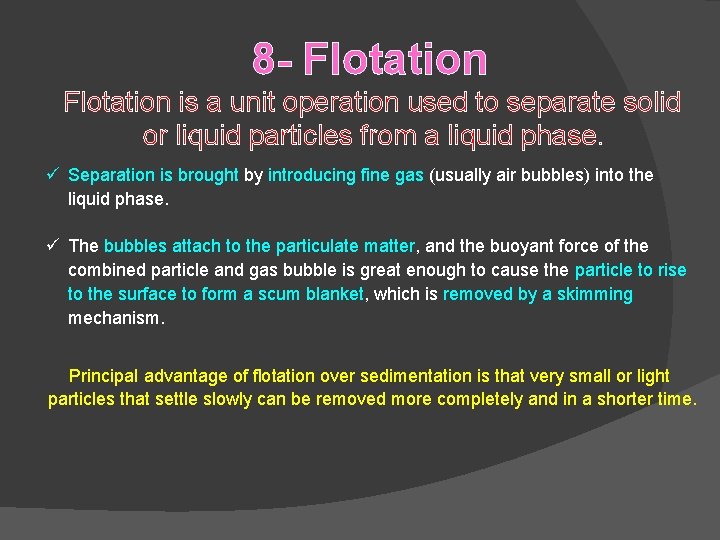
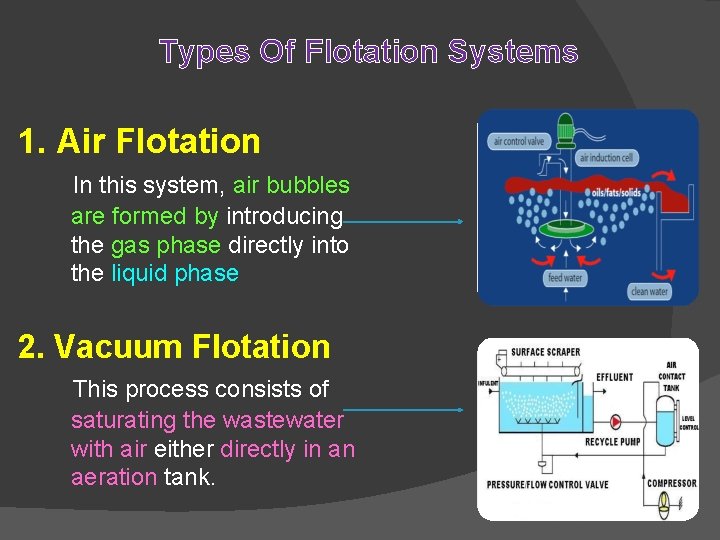
8 - Flotation is a unit operation used to separate solid or liquid particles from a liquid phase. ü Separation is brought by introducing fine gas (usually air bubbles) into the liquid phase. ü The bubbles attach to the particulate matter, and the buoyant force of the combined particle and gas bubble is great enough to cause the particle to rise to the surface to form a scum blanket, which is removed by a skimming mechanism. Principal advantage of flotation over sedimentation is that very small or light particles that settle slowly can be removed more completely and in a shorter time.
Types Of Flotation Systems 1. Air Flotation In this system, air bubbles are formed by introducing the gas phase directly into the liquid phase 2. Vacuum Flotation This process consists of saturating the wastewater with air either directly in an aeration tank.
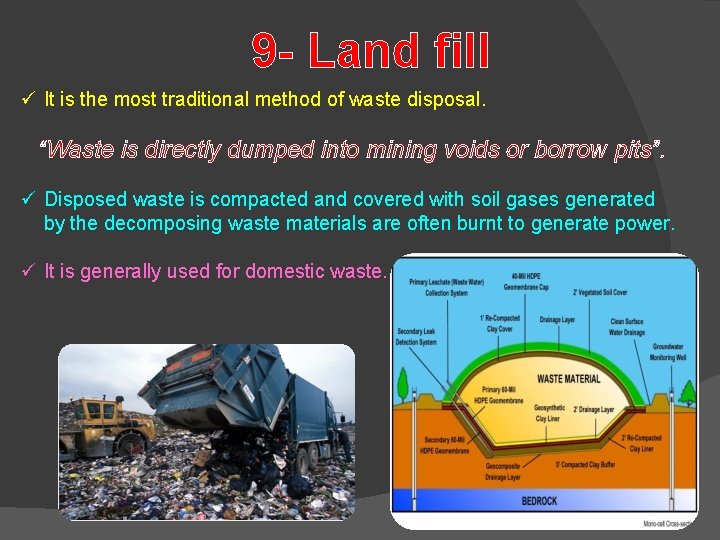
9 - Land fill ü It is the most traditional method of waste disposal. “Waste is directly dumped into mining voids or borrow pits”. ü Disposed waste is compacted and covered with soil gases generated by the decomposing waste materials are often burnt to generate power. ü It is generally used for domestic waste.
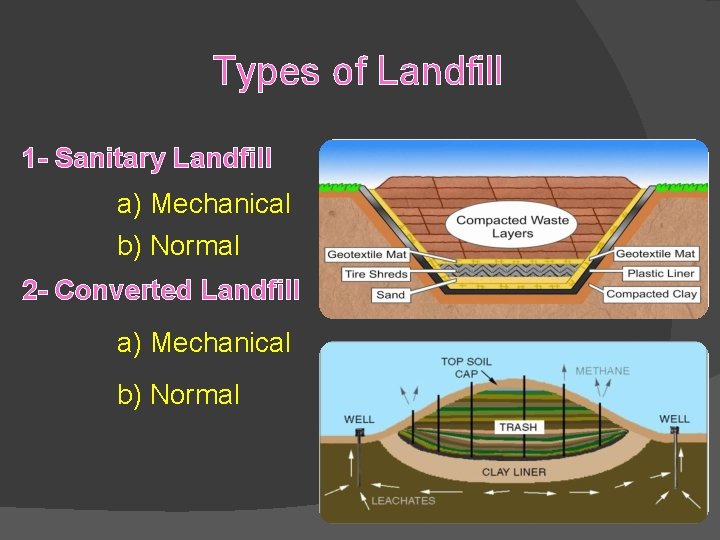
Types of Landfill 1 - Sanitary Landfill a) Mechanical b) Normal 2 - Converted Landfill a) Mechanical b) Normal
Site Selection and Assessment These issues should be considered during site selection and assessment: All conditions ü Ecology on the site ü Flora and Fauna ü Geology/Topography ü Hydrology ü Soil ü Climate ü Other Activities ü Operational Plan ü Investments and Costs ü Implementation Plan
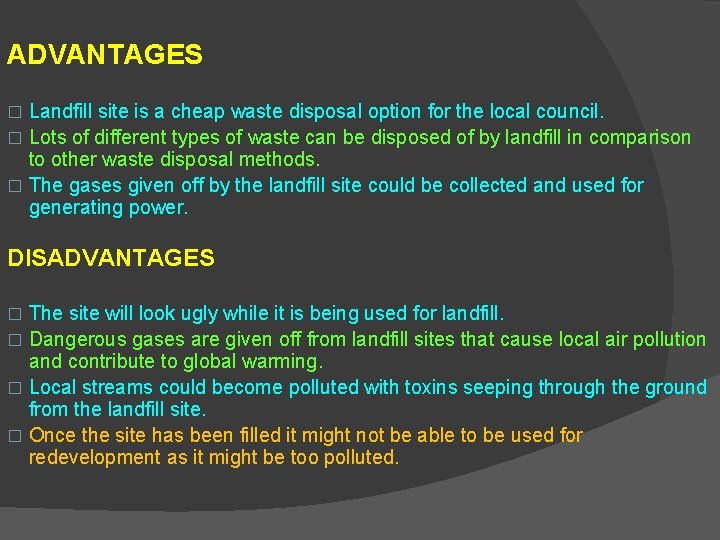
ADVANTAGES Landfill site is a cheap waste disposal option for the local council. � Lots of different types of waste can be disposed of by landfill in comparison to other waste disposal methods. � The gases given off by the landfill site could be collected and used for generating power. � DISADVANTAGES The site will look ugly while it is being used for landfill. � Dangerous gases are given off from landfill sites that cause local air pollution and contribute to global warming. � Local streams could become polluted with toxins seeping through the ground from the landfill site. � Once the site has been filled it might not be able to be used for redevelopment as it might be too polluted. �
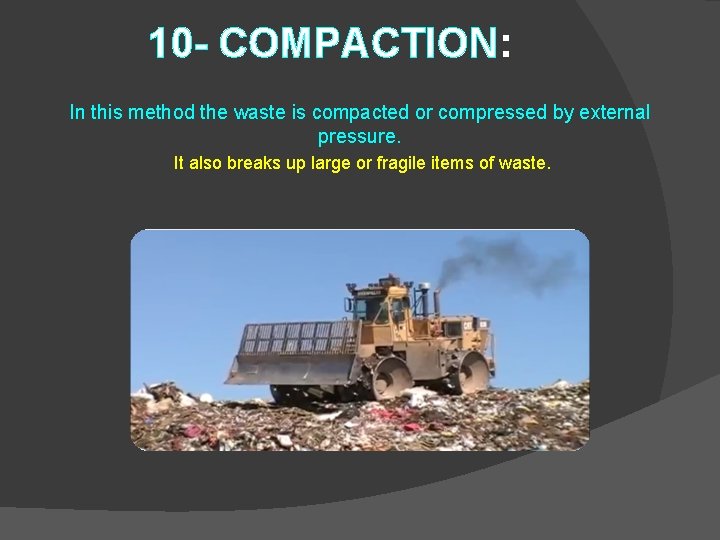
10 - COMPACTION: In this method the waste is compacted or compressed by external pressure. It also breaks up large or fragile items of waste.
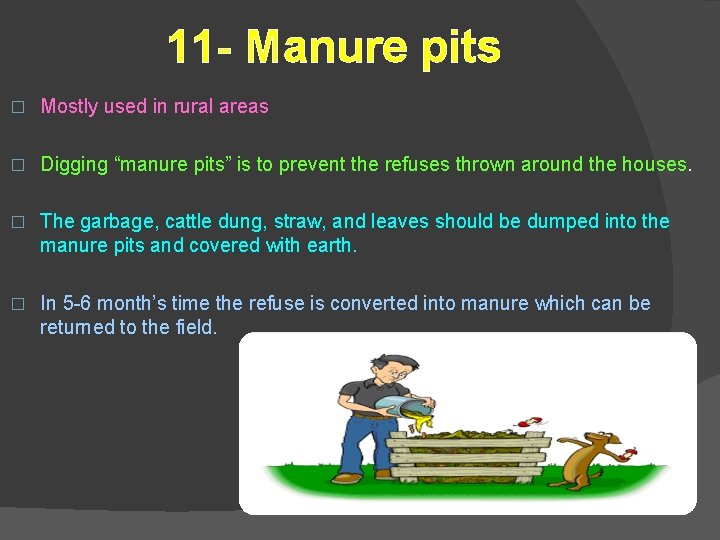
11 - Manure pits � Mostly used in rural areas � Digging “manure pits” is to prevent the refuses thrown around the houses. � The garbage, cattle dung, straw, and leaves should be dumped into the manure pits and covered with earth. � In 5 -6 month’s time the refuse is converted into manure which can be returned to the field.
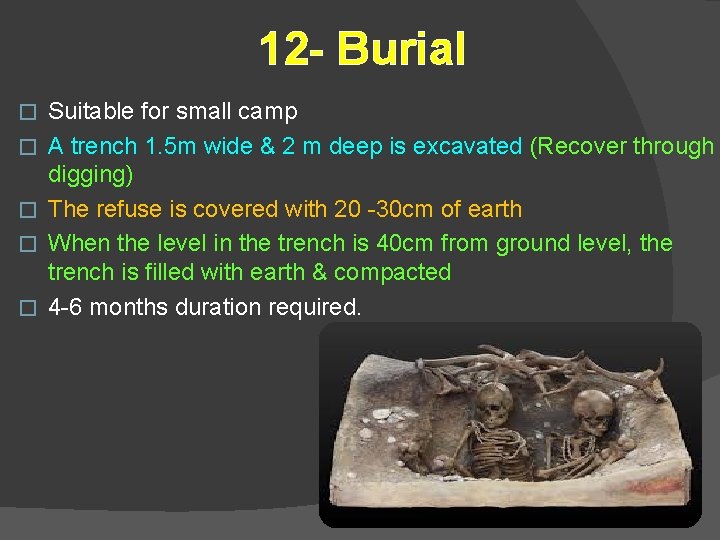
12 - Burial � � � Suitable for small camp A trench 1. 5 m wide & 2 m deep is excavated (Recover through digging) The refuse is covered with 20 -30 cm of earth When the level in the trench is 40 cm from ground level, the trench is filled with earth & compacted 4 -6 months duration required.
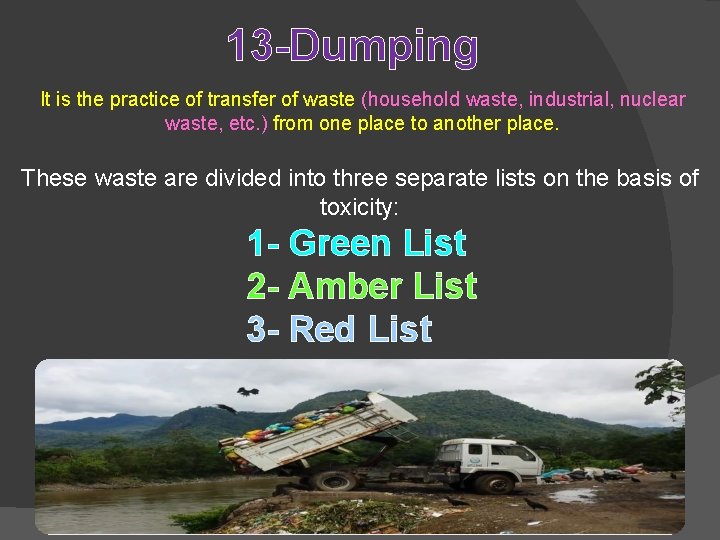
13 -Dumping It is the practice of transfer of waste (household waste, industrial, nuclear waste, etc. ) from one place to another place. These waste are divided into three separate lists on the basis of toxicity: 1 - Green List 2 - Amber List 3 - Red List
1 -Green List These items are considered to be non-hazardous and more environmentally friendly. Some of these items may include paper and plastic that can be recycled. 2 - Amber List Materials are consider that containing both non-hazardous and hazardous parts. These materials can contain metal bearing wastes, organic and inorganic wastes or organic or inorganic constituents. 3 - Red List This includes reasonably hazardous materials. These materials contain principally organic or inorganic constituents, which include polychlorinated biphenyl (PCBs) as well as Radio active wastes.
Other methods Immobilization It is a collective term for a range of treatment processes that primarily aim to make hazardous waste safe for disposal by reducing the potential for waste component leaching Stabilization Techniques by which hazardous wastes are converted into a more stable form. Solidification Techniques that create a solid mass of either the original waste, or waste that has been stabilized.
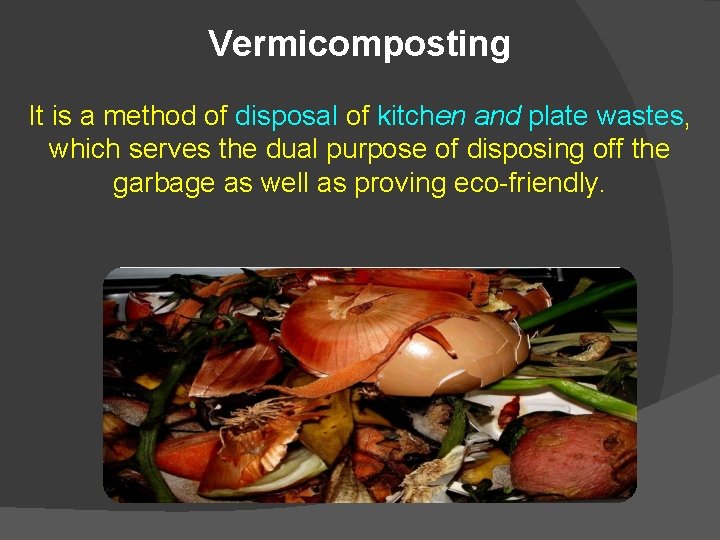
Vermicomposting It is a method of disposal of kitchen and plate wastes, which serves the dual purpose of disposing off the garbage as well as proving eco-friendly.
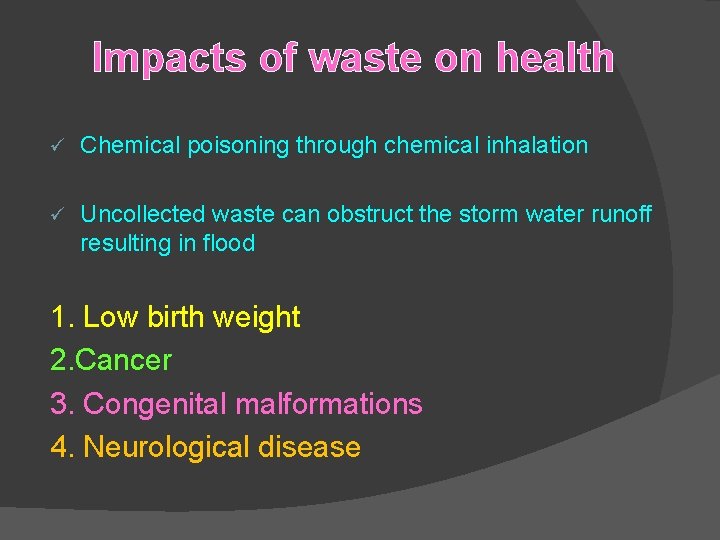
Impacts of waste on health ü Chemical poisoning through chemical inhalation ü Uncollected waste can obstruct the storm water runoff resulting in flood 1. Low birth weight 2. Cancer 3. Congenital malformations 4. Neurological disease
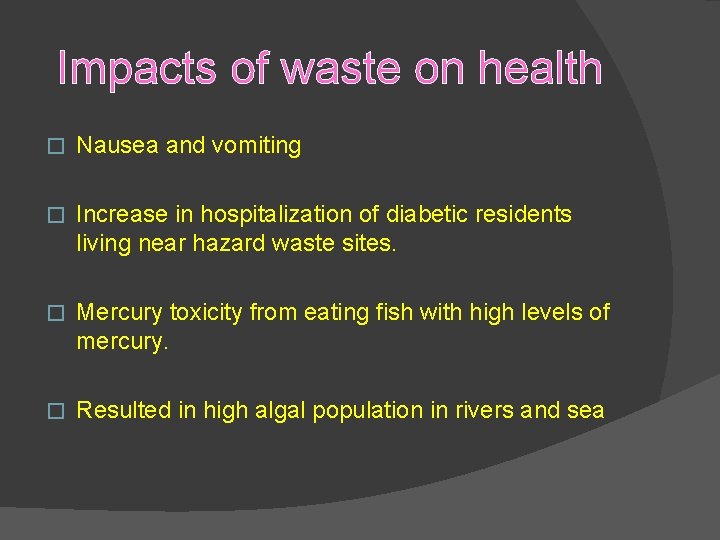
Impacts of waste on health � Nausea and vomiting � Increase in hospitalization of diabetic residents living near hazard waste sites. � Mercury toxicity from eating fish with high levels of mercury. � Resulted in high algal population in rivers and sea
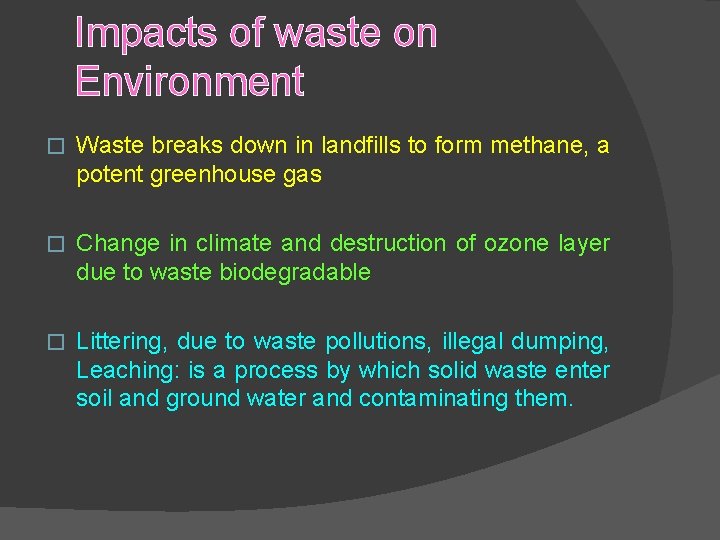
Impacts of waste on Environment � Waste breaks down in landfills to form methane, a potent greenhouse gas � Change in climate and destruction of ozone layer due to waste biodegradable � Littering, due to waste pollutions, illegal dumping, Leaching: is a process by which solid waste enter soil and ground water and contaminating them.
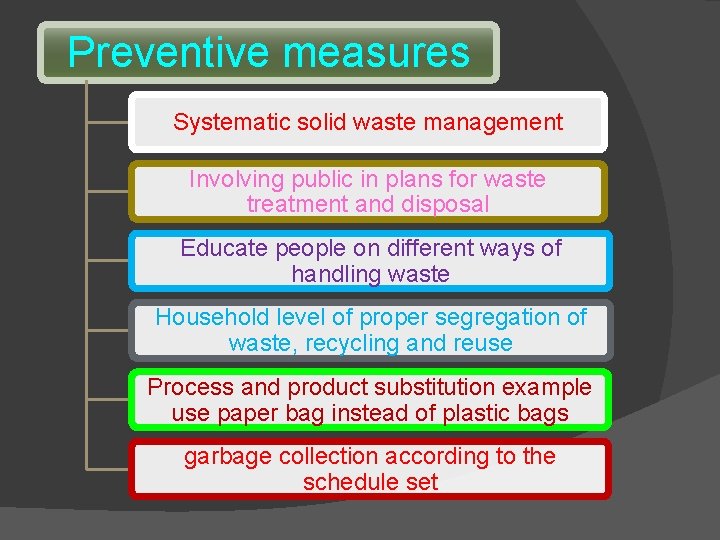
Preventive measures Systematic solid waste management Involving public in plans for waste treatment and disposal Educate people on different ways of handling waste Household level of proper segregation of waste, recycling and reuse Process and product substitution example use paper bag instead of plastic bags garbage collection according to the schedule set