
Physical Medicine and Rehabilitation Kelly M Scott MD
Physical Medicine and Rehabilitation Kelly M. Scott, MD Associate Professor, PM&R UTSW Medical Center Sept 21, 2015
What is Physical Medicine and Rehabilitation? “The Best Kept Secret in Medicine!”
Physical Medicine and Rehabilitation PM&R Physiatry (fizz-ee-AT-tree or fizz-EYE -a-tree) Rehabilitation Medicine PM&R doctors are also called: Physiatrists Rehab doctors
PM&R “Physiatrists, or rehabilitation physicians, are nerve, muscle, and bone experts who treat injuries or illnesses that affect how you move. ” -from the AAPM&R website My definition: ◦ “I am a medical doctor (MD) who treats disorders of muscles, nerves, and joints and the way that those things interact with each other to cause people to have problems with pain and function. ”
Physiatrists are… A ◦ ◦ ◦ cross between: Orthopedists (non-operative) Neurologists Rheumatologists Internists Psychiatrists Social Workers

What types of patients? There is a large diversity of different patient populations and disease states that we treat in PM&R ◦ Some physiatrists treat a little bit of everything, and some specialize in treating one or two things PM&R docs work both inpatient and outpatient, depending on types of patients seen, acuity of patient presentation, and MD preference Most physiatrists find their niche and excel at that You can pick a few varied things, have a schedule where you do different things on different days – keeps life interesting
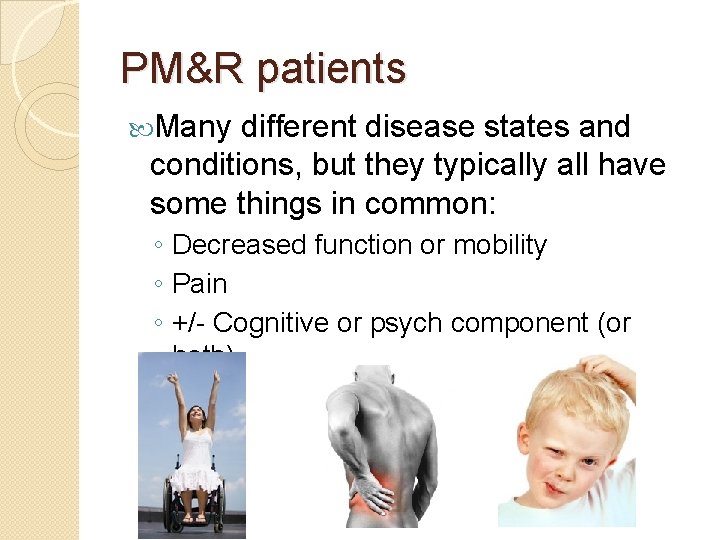
PM&R patients Many different disease states and conditions, but they typically all have some things in common: ◦ Decreased function or mobility ◦ Pain ◦ +/- Cognitive or psych component (or both)
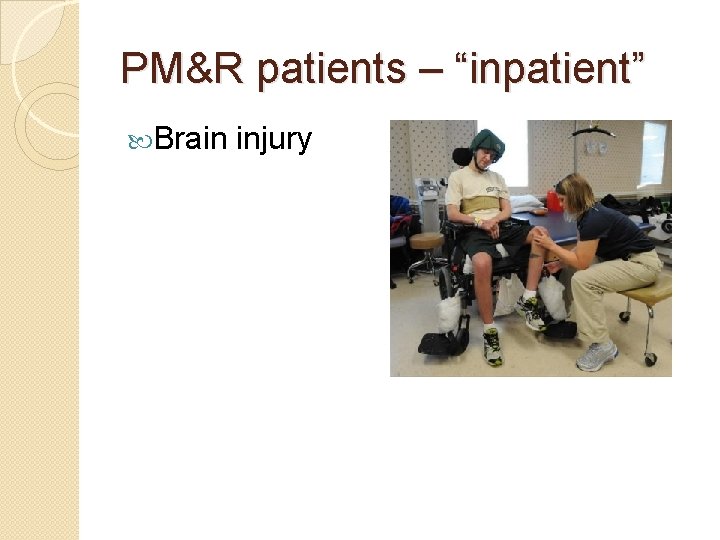
PM&R patients – “inpatient” Brain injury
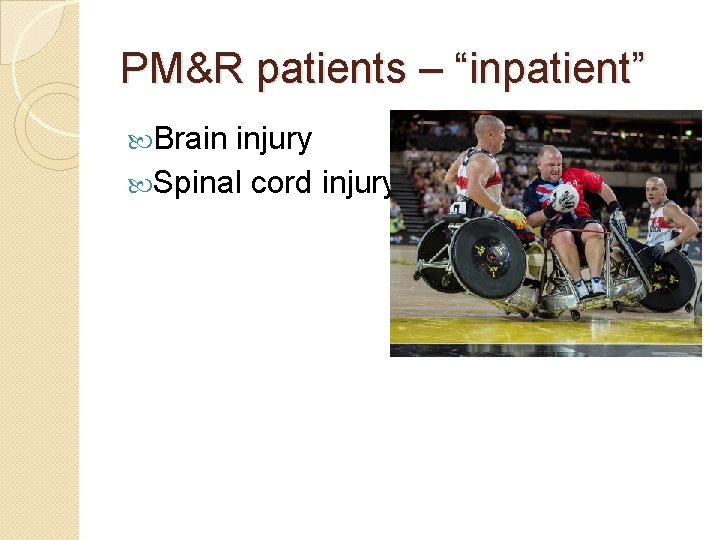
PM&R patients – “inpatient” Brain injury Spinal cord injury
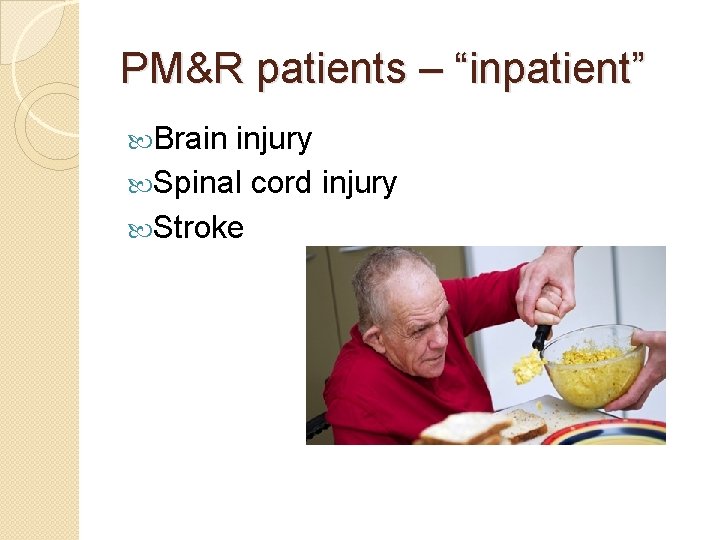
PM&R patients – “inpatient” Brain injury Spinal cord injury Stroke
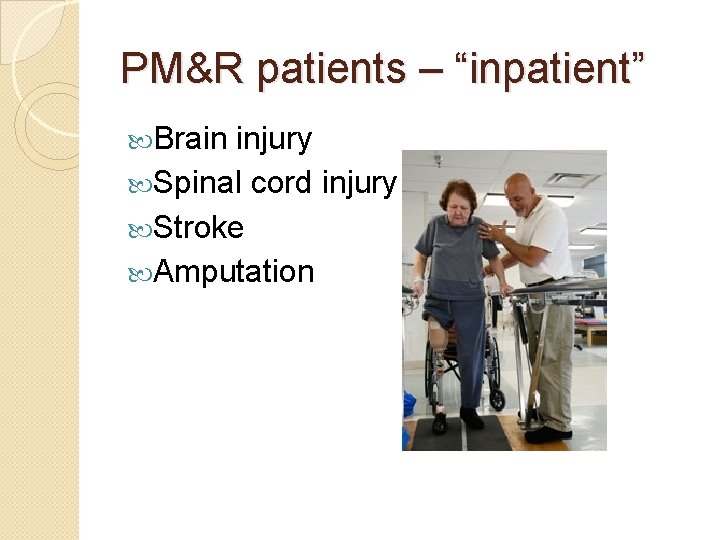
PM&R patients – “inpatient” Brain injury Spinal cord injury Stroke Amputation
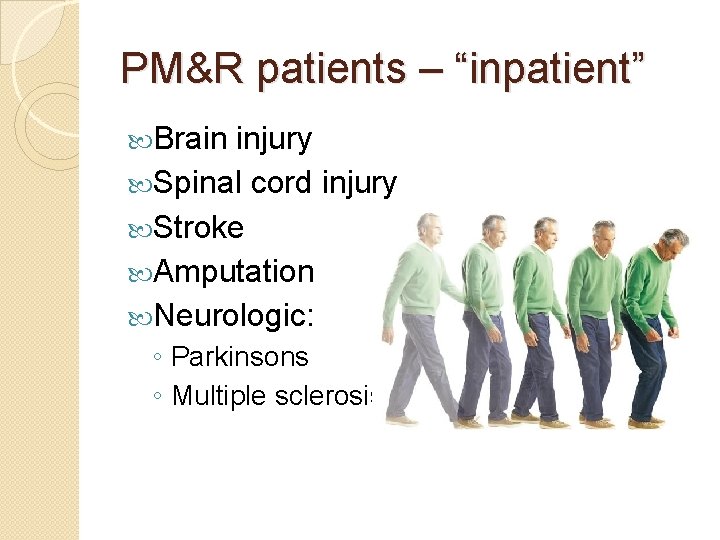
PM&R patients – “inpatient” Brain injury Spinal cord injury Stroke Amputation Neurologic: ◦ Parkinsons ◦ Multiple sclerosis
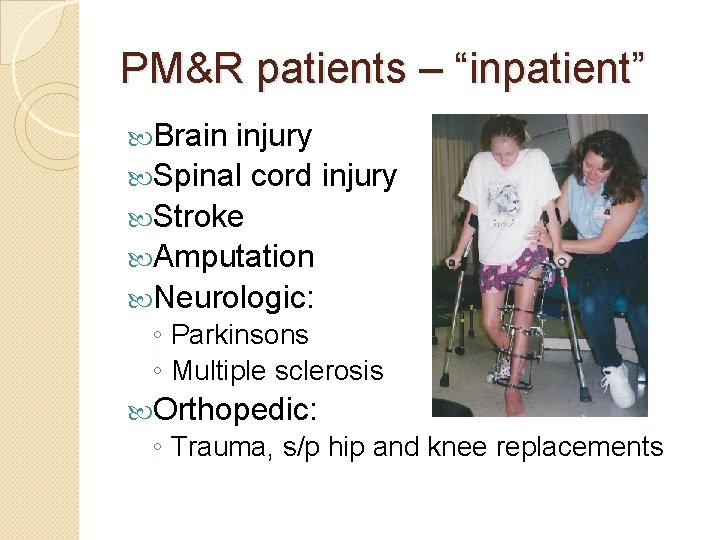
PM&R patients – “inpatient” Brain injury Spinal cord injury Stroke Amputation Neurologic: ◦ Parkinsons ◦ Multiple sclerosis Orthopedic: ◦ Trauma, s/p hip and knee replacements
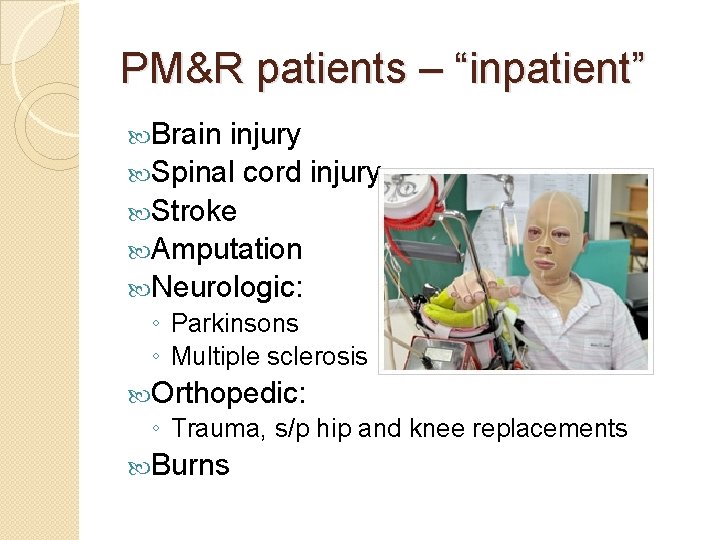
PM&R patients – “inpatient” Brain injury Spinal cord injury Stroke Amputation Neurologic: ◦ Parkinsons ◦ Multiple sclerosis Orthopedic: ◦ Trauma, s/p hip and knee replacements Burns
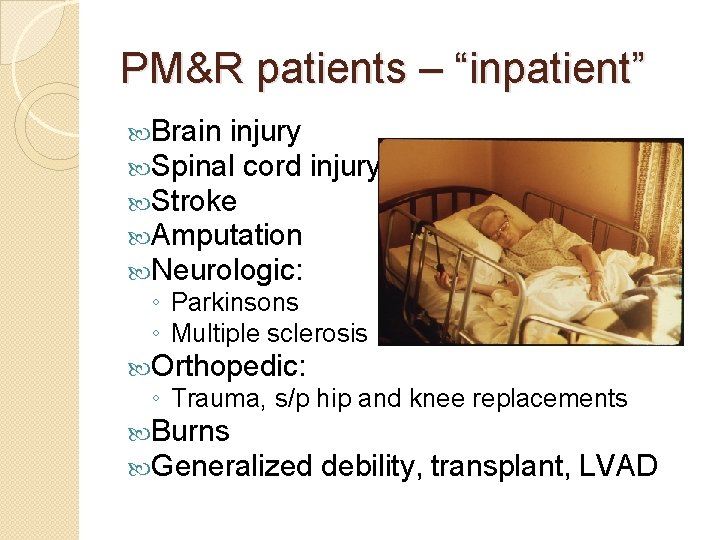
PM&R patients – “inpatient” Brain injury Spinal cord injury Stroke Amputation Neurologic: ◦ Parkinsons ◦ Multiple sclerosis Orthopedic: ◦ Trauma, s/p hip and knee replacements Burns Generalized debility, transplant, LVAD
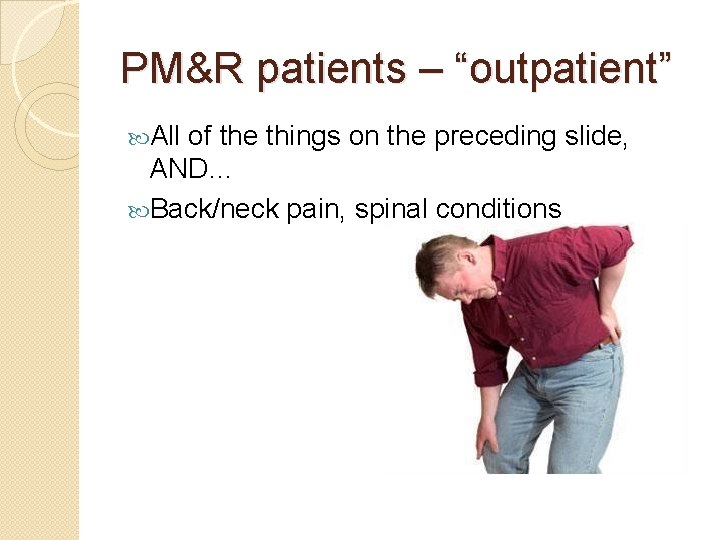
PM&R patients – “outpatient” All of the things on the preceding slide, AND… Back/neck pain, spinal conditions
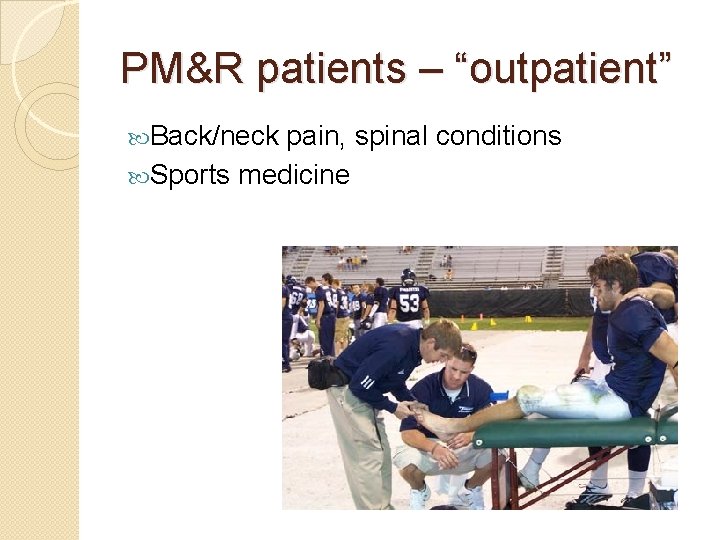
PM&R patients – “outpatient” Back/neck pain, spinal conditions Sports medicine
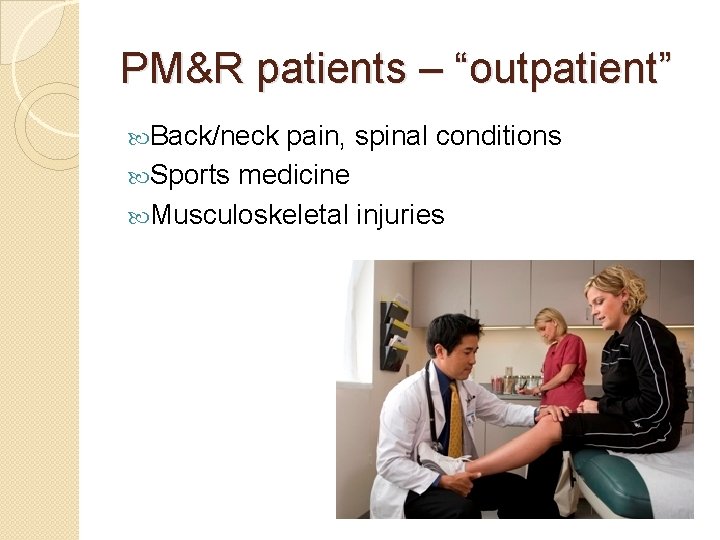
PM&R patients – “outpatient” Back/neck pain, spinal conditions Sports medicine Musculoskeletal injuries
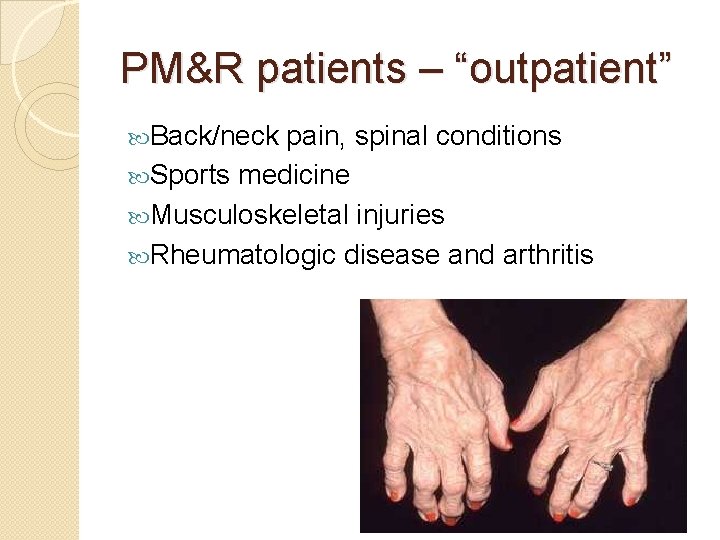
PM&R patients – “outpatient” Back/neck pain, spinal conditions Sports medicine Musculoskeletal injuries Rheumatologic disease and arthritis
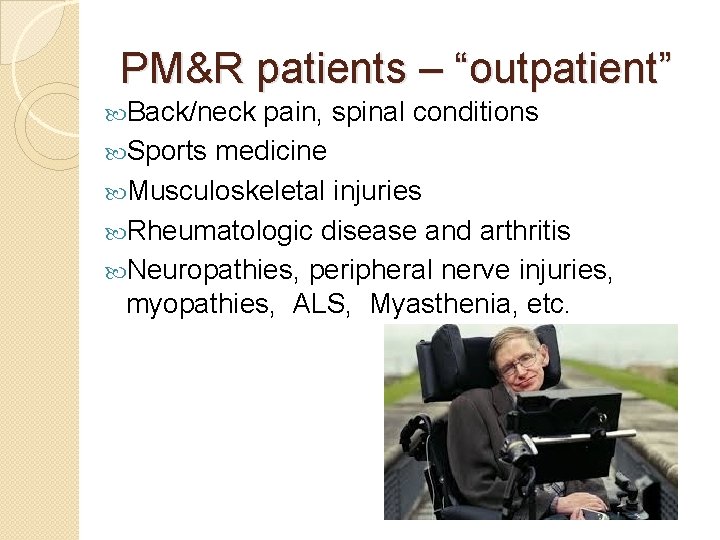
PM&R patients – “outpatient” Back/neck pain, spinal conditions Sports medicine Musculoskeletal injuries Rheumatologic disease and arthritis Neuropathies, peripheral nerve injuries, myopathies, ALS, Myasthenia, etc.
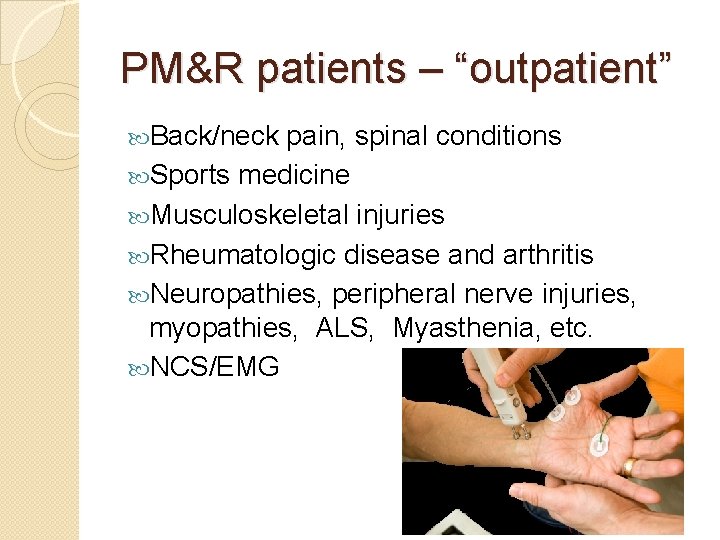
PM&R patients – “outpatient” Back/neck pain, spinal conditions Sports medicine Musculoskeletal injuries Rheumatologic disease and arthritis Neuropathies, peripheral nerve injuries, myopathies, ALS, Myasthenia, etc. NCS/EMG
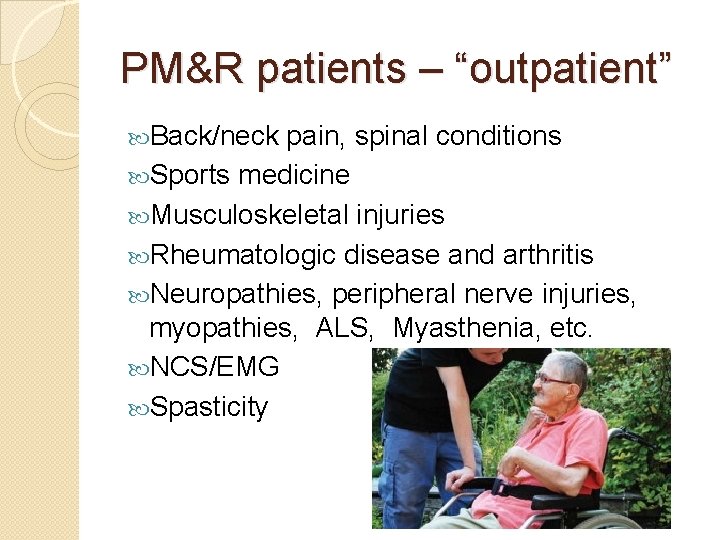
PM&R patients – “outpatient” Back/neck pain, spinal conditions Sports medicine Musculoskeletal injuries Rheumatologic disease and arthritis Neuropathies, peripheral nerve injuries, myopathies, ALS, Myasthenia, etc. NCS/EMG Spasticity
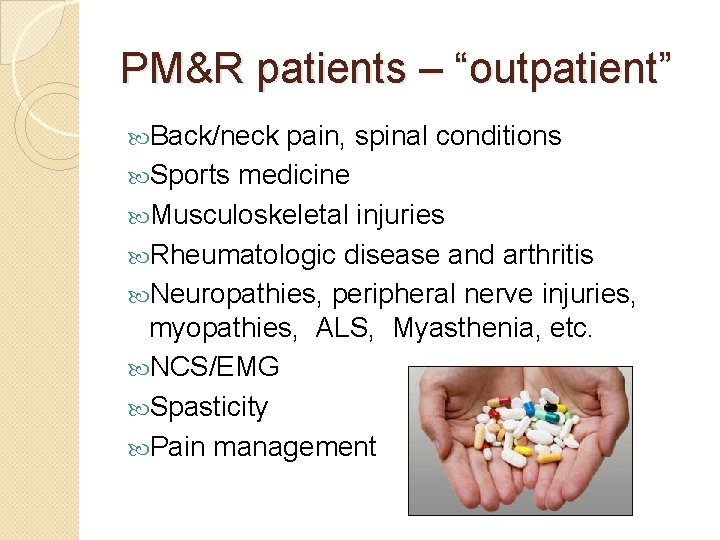
PM&R patients – “outpatient” Back/neck pain, spinal conditions Sports medicine Musculoskeletal injuries Rheumatologic disease and arthritis Neuropathies, peripheral nerve injuries, myopathies, ALS, Myasthenia, etc. NCS/EMG Spasticity Pain management
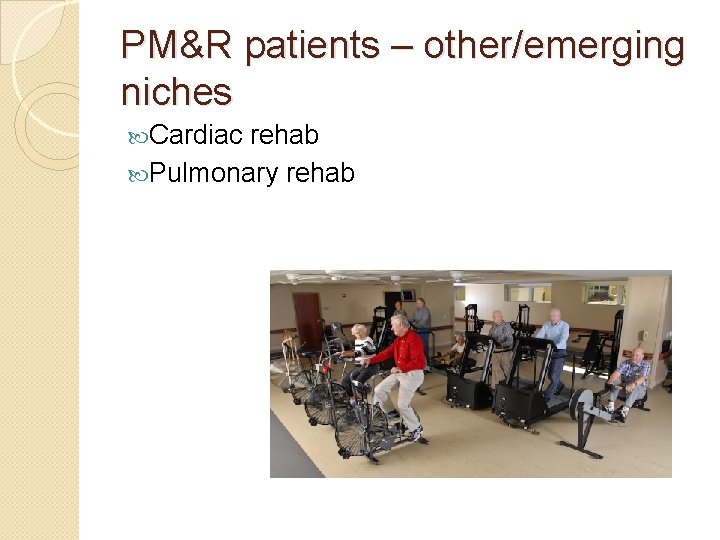
PM&R patients – other/emerging niches Cardiac rehab Pulmonary rehab
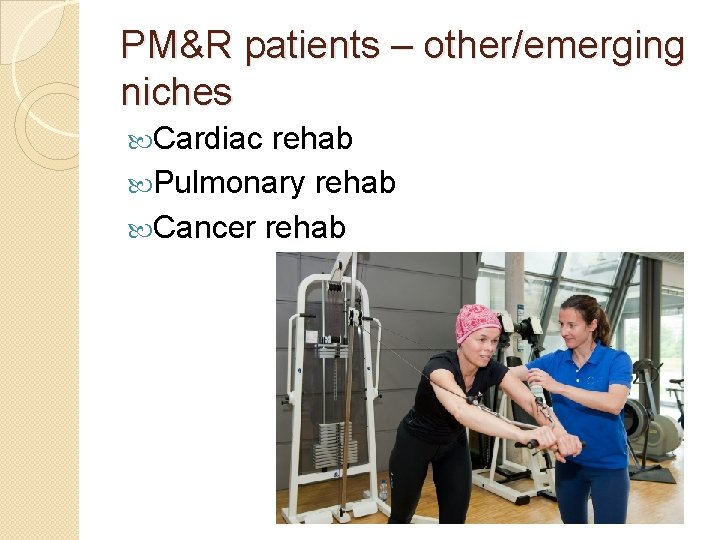
PM&R patients – other/emerging niches Cardiac rehab Pulmonary rehab Cancer rehab
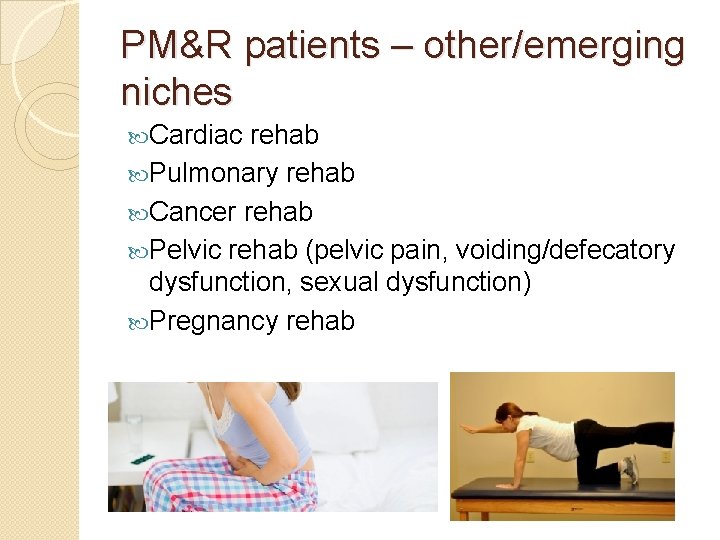
PM&R patients – other/emerging niches Cardiac rehab Pulmonary rehab Cancer rehab Pelvic rehab (pelvic pain, voiding/defecatory dysfunction, sexual dysfunction) Pregnancy rehab
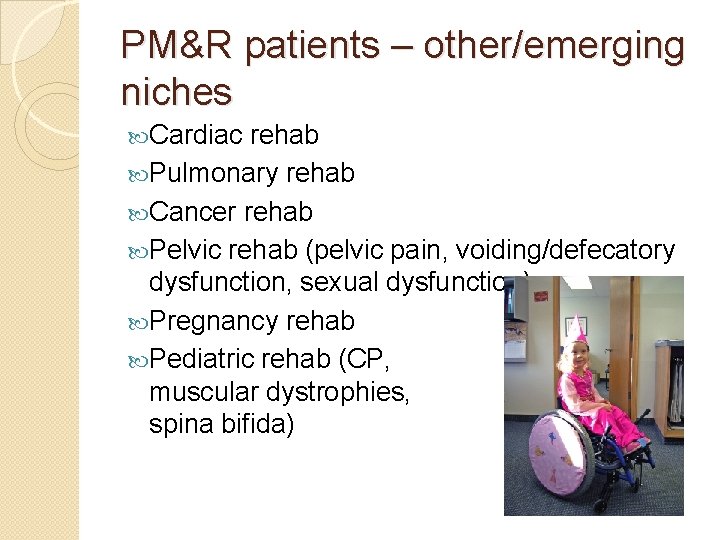
PM&R patients – other/emerging niches Cardiac rehab Pulmonary rehab Cancer rehab Pelvic rehab (pelvic pain, voiding/defecatory dysfunction, sexual dysfunction) Pregnancy rehab Pediatric rehab (CP, muscular dystrophies, spina bifida)
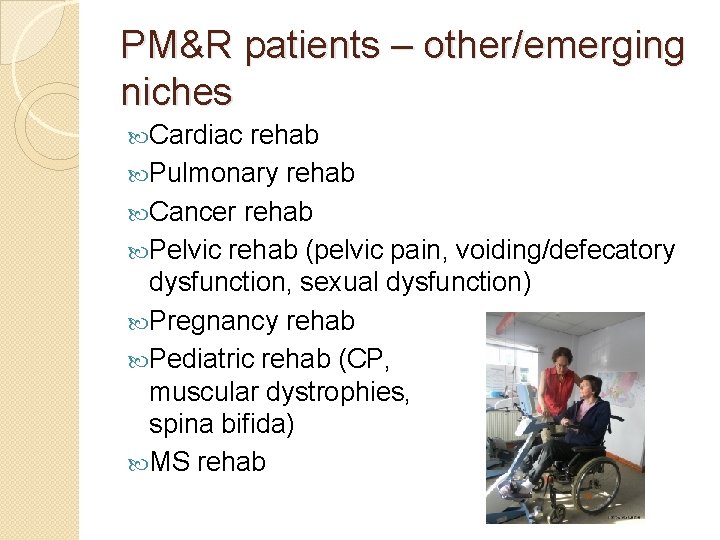
PM&R patients – other/emerging niches Cardiac rehab Pulmonary rehab Cancer rehab Pelvic rehab (pelvic pain, voiding/defecatory dysfunction, sexual dysfunction) Pregnancy rehab Pediatric rehab (CP, muscular dystrophies, spina bifida) MS rehab
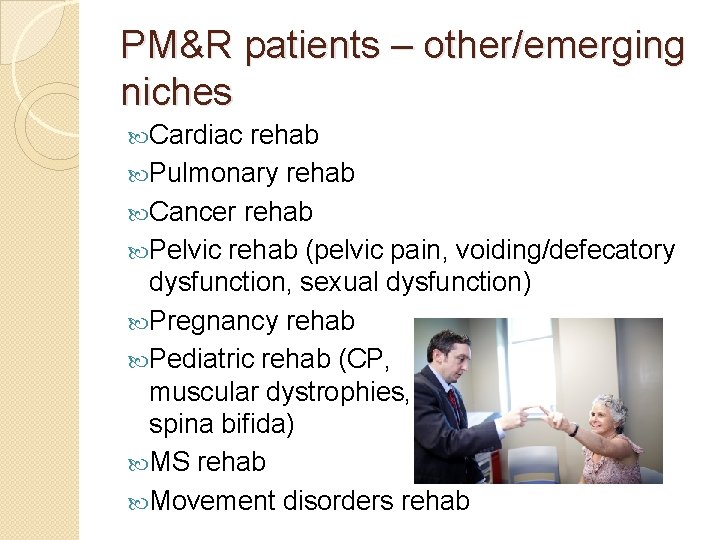
PM&R patients – other/emerging niches Cardiac rehab Pulmonary rehab Cancer rehab Pelvic rehab (pelvic pain, voiding/defecatory dysfunction, sexual dysfunction) Pregnancy rehab Pediatric rehab (CP, muscular dystrophies, spina bifida) MS rehab Movement disorders rehab
PM&R patients – other/emerging niches Cardiac rehab Pulmonary rehab Cancer rehab Pelvic rehab (pelvic pain, voiding/defecatory dysfunction, sexual dysfunction) Pregnancy rehab Pediatric rehab (CP, muscular dystrophies, spina bifida) MS rehab Movement disorders rehab Performing arts medicine
PM&R patients – other/emerging niches Cardiac rehab Pulmonary rehab Cancer rehab Pelvic rehab (pelvic pain, voiding/defecatory dysfunction, sexual dysfunction) Pregnancy rehab Pediatric rehab (CP, muscular dystrophies, spina bifida) MS rehab Movement disorders rehab Performing arts medicine Palliative rehab
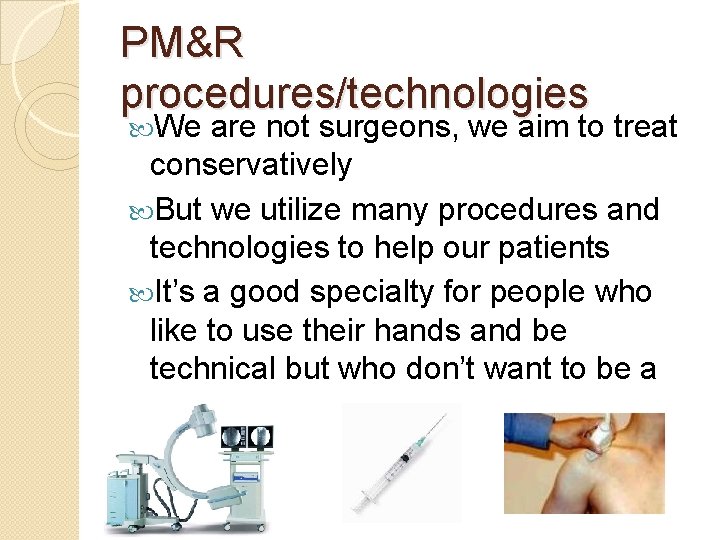
PM&R procedures/technologies We are not surgeons, we aim to treat conservatively But we utilize many procedures and technologies to help our patients It’s a good specialty for people who like to use their hands and be technical but who don’t want to be a surgeon
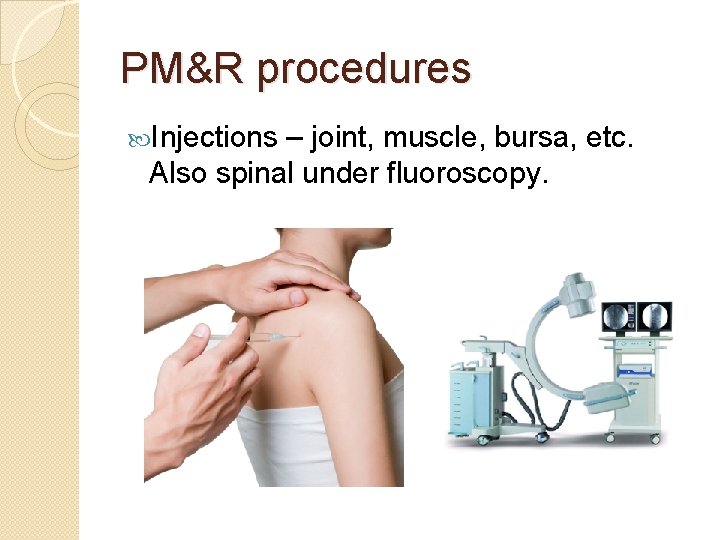
PM&R procedures Injections – joint, muscle, bursa, etc. Also spinal under fluoroscopy.
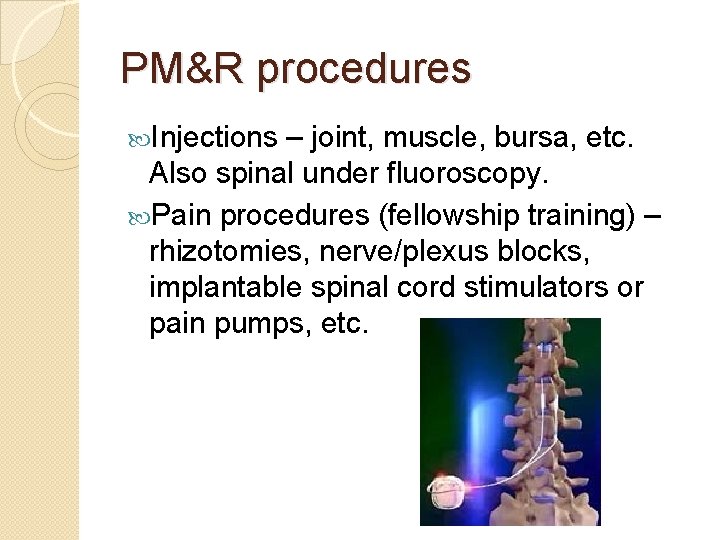
PM&R procedures Injections – joint, muscle, bursa, etc. Also spinal under fluoroscopy. Pain procedures (fellowship training) – rhizotomies, nerve/plexus blocks, implantable spinal cord stimulators or pain pumps, etc.
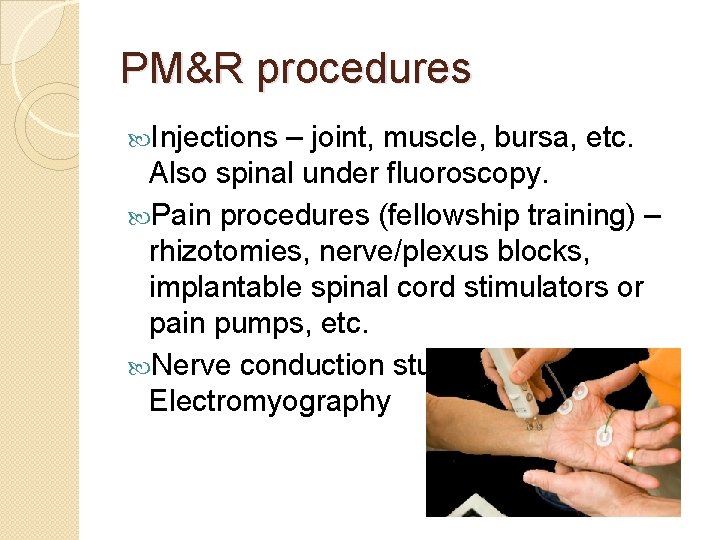
PM&R procedures Injections – joint, muscle, bursa, etc. Also spinal under fluoroscopy. Pain procedures (fellowship training) – rhizotomies, nerve/plexus blocks, implantable spinal cord stimulators or pain pumps, etc. Nerve conduction studies / Electromyography
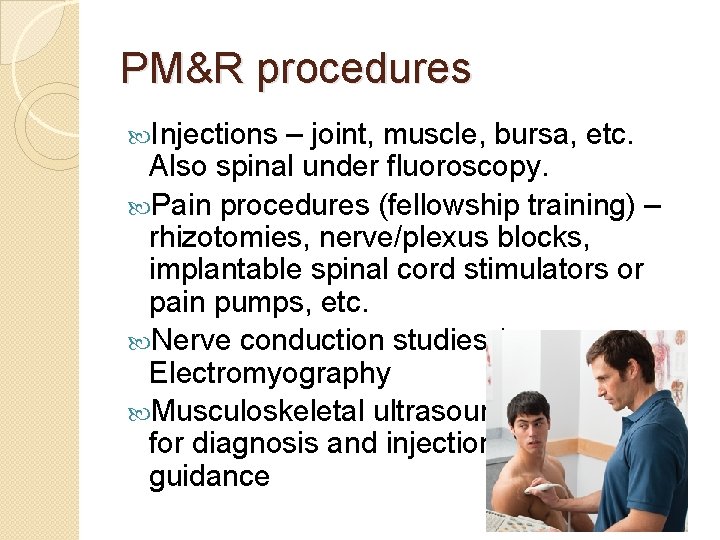
PM&R procedures Injections – joint, muscle, bursa, etc. Also spinal under fluoroscopy. Pain procedures (fellowship training) – rhizotomies, nerve/plexus blocks, implantable spinal cord stimulators or pain pumps, etc. Nerve conduction studies / Electromyography Musculoskeletal ultrasound for diagnosis and injection guidance
PM&R procedures Injections – joint, muscle, bursa, etc. Also spinal under fluoroscopy. Pain procedures (fellowship training) – rhizotomies, nerve/plexus blocks, implantable spinal cord stimulators or pain pumps, etc. Nerve conduction studies / Electromyography Musculoskeletal ultrasound for diagnosis and injection guidance Botox/phenol injections for spasticity Baclofen and morphine pump management
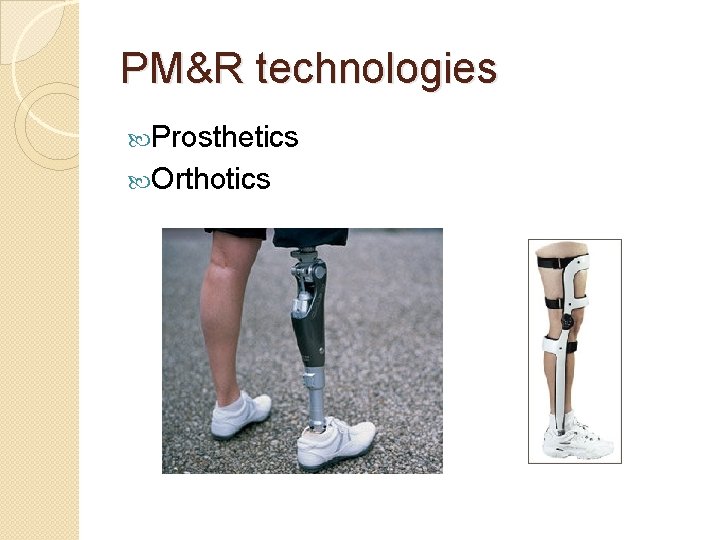
PM&R technologies Prosthetics Orthotics
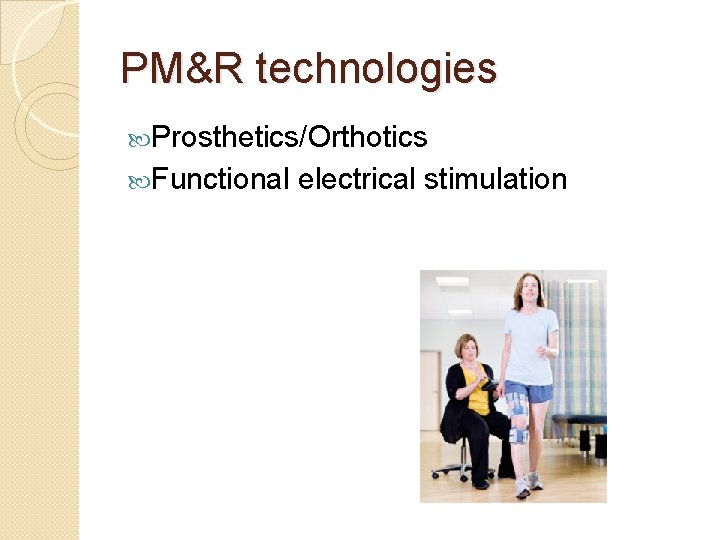
PM&R technologies Prosthetics/Orthotics Functional electrical stimulation
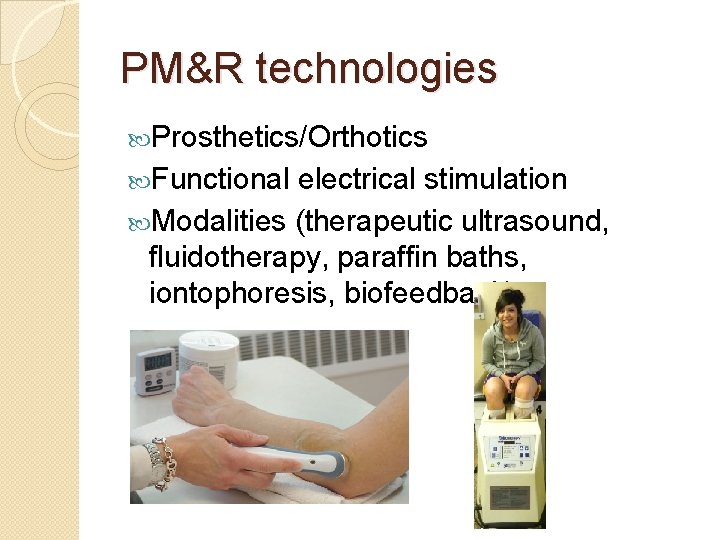
PM&R technologies Prosthetics/Orthotics Functional electrical stimulation Modalities (therapeutic ultrasound, fluidotherapy, paraffin baths, iontophoresis, biofeedback)
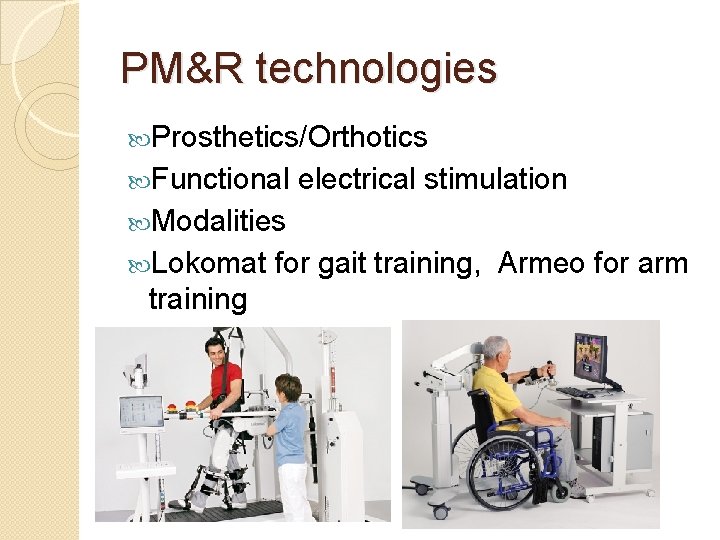
PM&R technologies Prosthetics/Orthotics Functional electrical stimulation Modalities Lokomat training for gait training, Armeo for arm
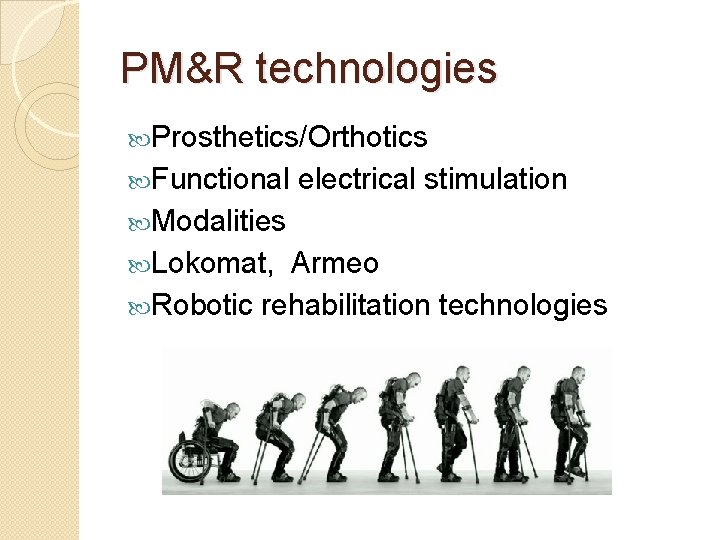
PM&R technologies Prosthetics/Orthotics Functional electrical stimulation Modalities Lokomat, Armeo Robotic rehabilitation technologies
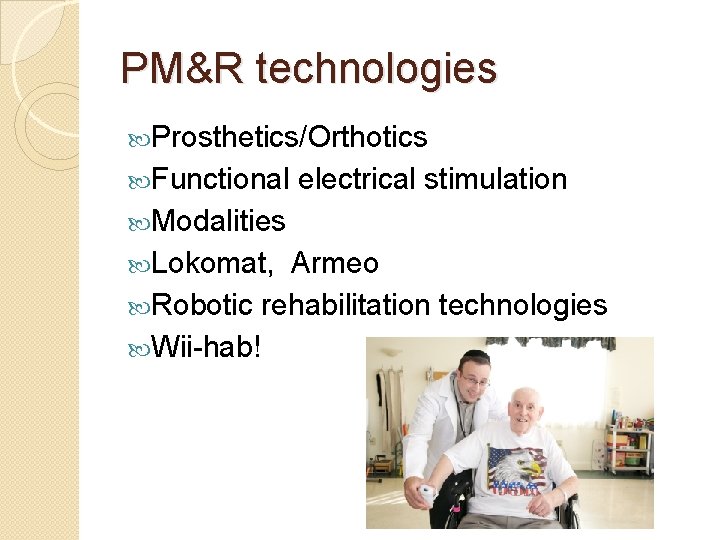
PM&R technologies Prosthetics/Orthotics Functional electrical stimulation Modalities Lokomat, Armeo Robotic rehabilitation technologies Wii-hab!
PM&R technologies Prosthetics/Orthotics Functional electrical stimulation Modalities Lokomat, Armeo Robotic rehabilitation technologies Wii-hab! Many different other high-tech gadgets for patients with SCI, TBI, stroke, amputation
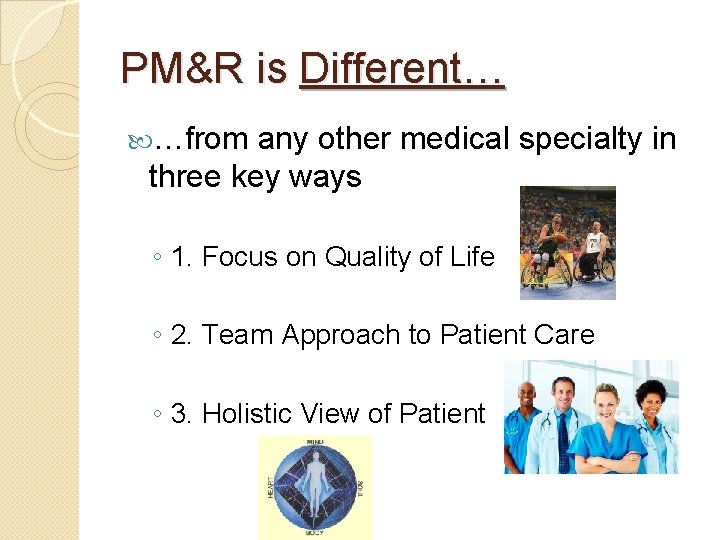
PM&R is Different… …from any other medical specialty in three key ways ◦ 1. Focus on Quality of Life ◦ 2. Team Approach to Patient Care ◦ 3. Holistic View of Patient
1. Focus on Quality of Life Most every other medical specialty: ◦ Diagnose the problem and cure/fix it! (or at least improve it as much as you can…) ◦ If you can’t fix it, what do you do? Tell the patient to live with it! PM&R is different because we start with the assumption that there are some things are NOT fixable. ◦ Spinal cord injuries, nerve injuries, chronic pain, severe spinal spondylosis, amputations, strokes, brain injuries, etc.
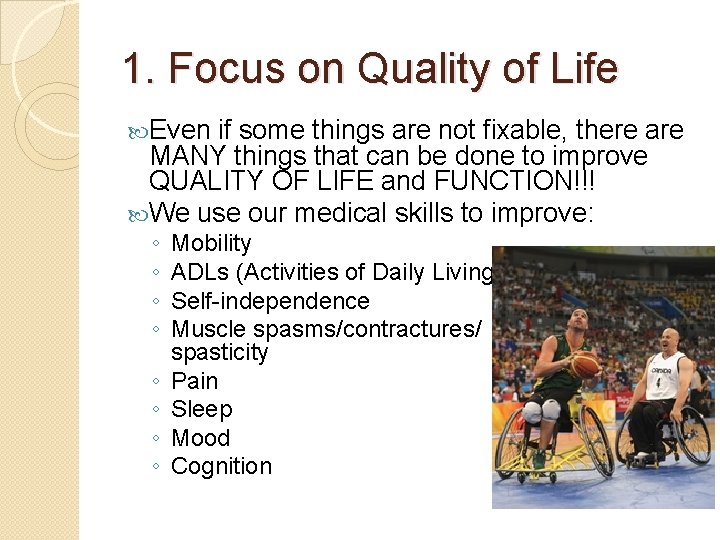
1. Focus on Quality of Life Even if some things are not fixable, there are MANY things that can be done to improve QUALITY OF LIFE and FUNCTION!!! We use our medical skills to improve: ◦ ◦ ◦ ◦ Mobility ADLs (Activities of Daily Living) Self-independence Muscle spasms/contractures/ spasticity Pain Sleep Mood Cognition
1. Focus on Quality of Life “Isn’t it depressing to work with people who have disabilities and chronic pain all day long? ” ◦ NO! It is actually one of the most uplifting and rewarding specialties because: You help the patient and their family to understand that their life is not over! You guide them through a process of gradual recovery of self-independence, self-esteem, and improved life quality
Myth: Physiatrists don’t diagnose anything… True or False? FALSE!!! All the time, on inpatient and outpatient, your patients will present diagnostic challenges ◦ You may not be the one to tell them they’ve had their initial stroke, but you will be the one to figure out why they are nauseous, or have shoulder pain, or have new arm weakness
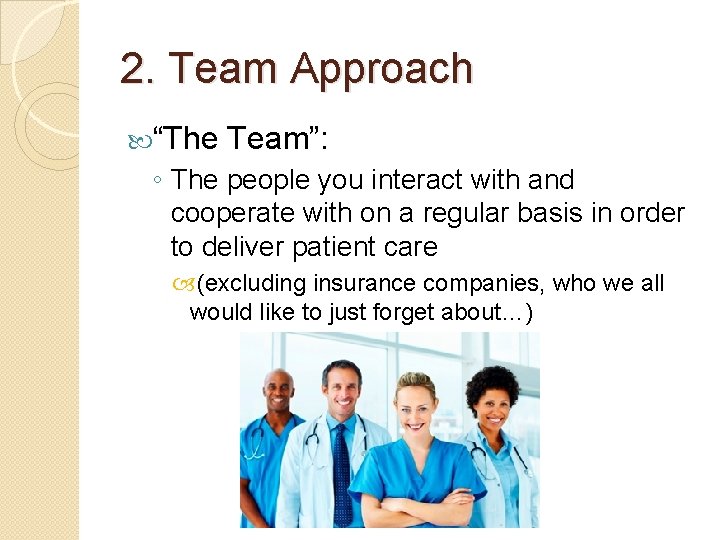
2. Team Approach “The Team”: ◦ The people you interact with and cooperate with on a regular basis in order to deliver patient care (excluding insurance companies, who we all would like to just forget about…)
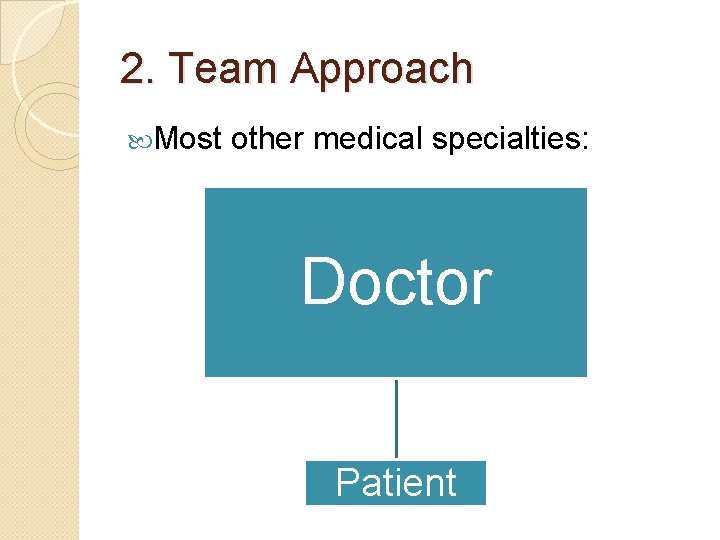
2. Team Approach Most other medical specialties: Doctor Patient
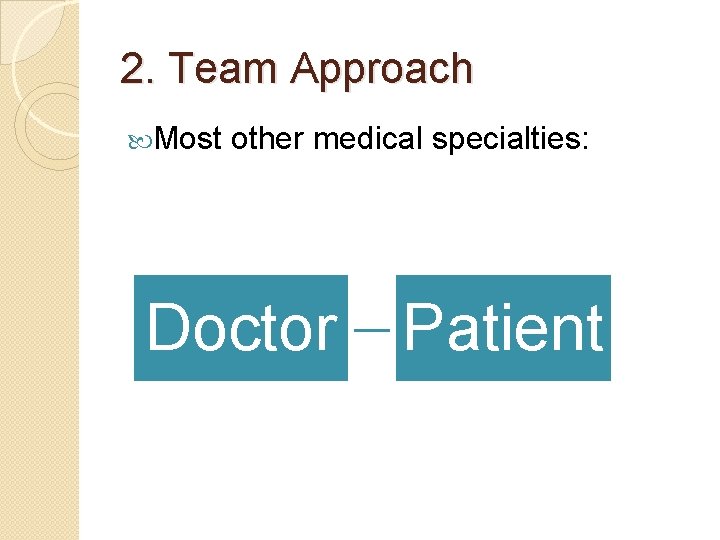
2. Team Approach Most other medical specialties: Doctor Patient
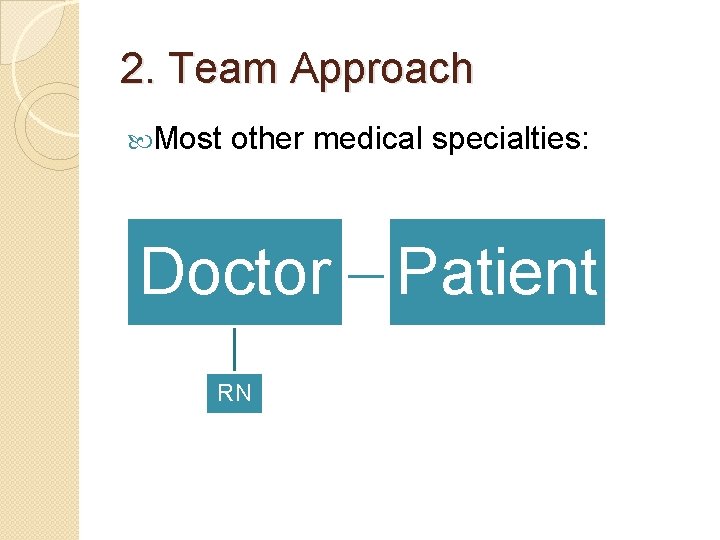
2. Team Approach Most other medical specialties: Doctor RN Patient
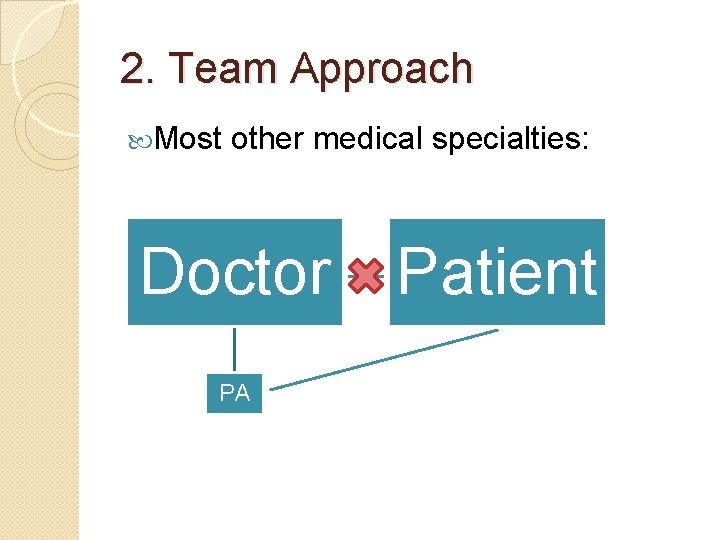
2. Team Approach Most other medical specialties: Doctor PA Patient
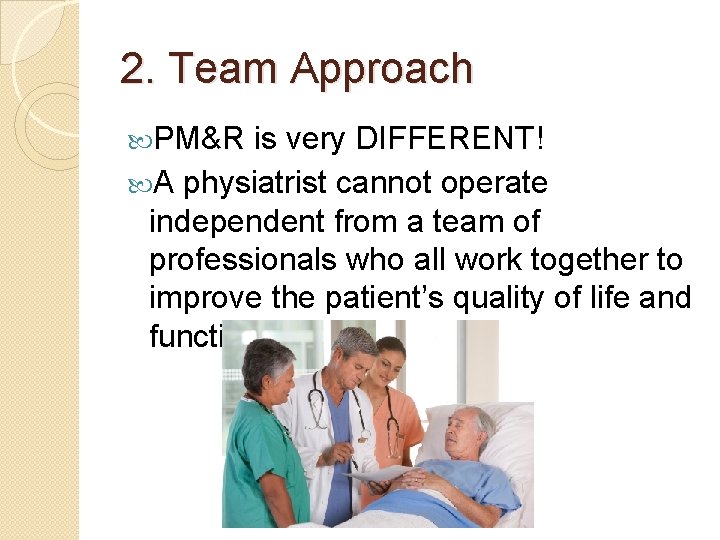
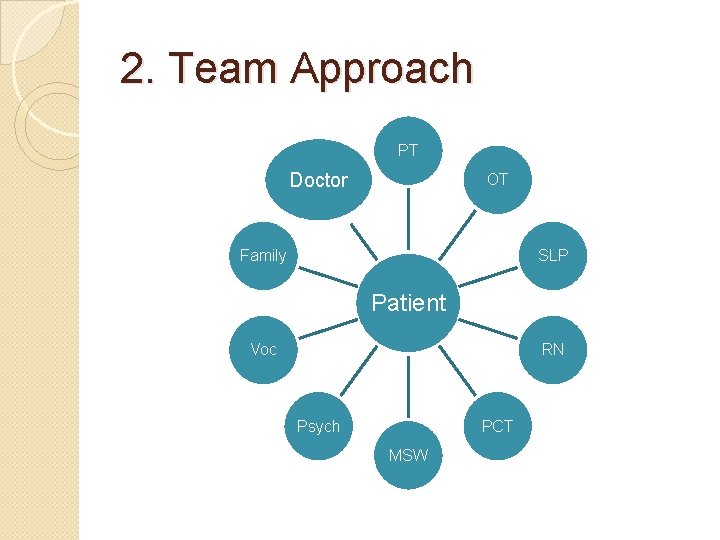
2. Team Approach PM&R is very DIFFERENT! A physiatrist cannot operate independent from a team of professionals who all work together to improve the patient’s quality of life and function
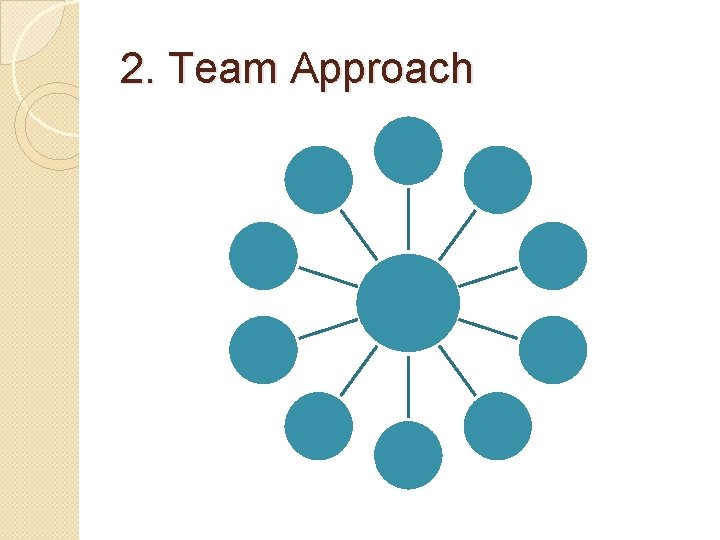
2. Team Approach PT Doctor OT Family SLP Patient Voc RN Psych PCT MSW
2. Team Approach PT Doctor OT Family SLP Patient Voc RN Psych PCT MSW
2. Team Approach Manifests in different ways depending on the type of PM&R you practice ◦ Inpatient: weekly or twice weekly meeting with the entire team in attendance, everyone discussing the same patient in the same room at the same time face to face Often with patient and family in attendance ◦ Outpatient: variable… a good outpatient physiatrist will still have weekly or other regular meetings with their team to discuss patients face to face
3. Holistic View of Patient By holistic, I do not mean the use of non -mainstream medicine (chiropractic, naturopathic, acupuncture, homeopathy, etc. ) ◦ Although some physiatrists do fully embrace these things and even practice them, particularly acupuncture Holistic - relating to or concerned with wholes or with complete systems rather than with the analysis of, treatment of, or dissection into parts (Merriam Webster)
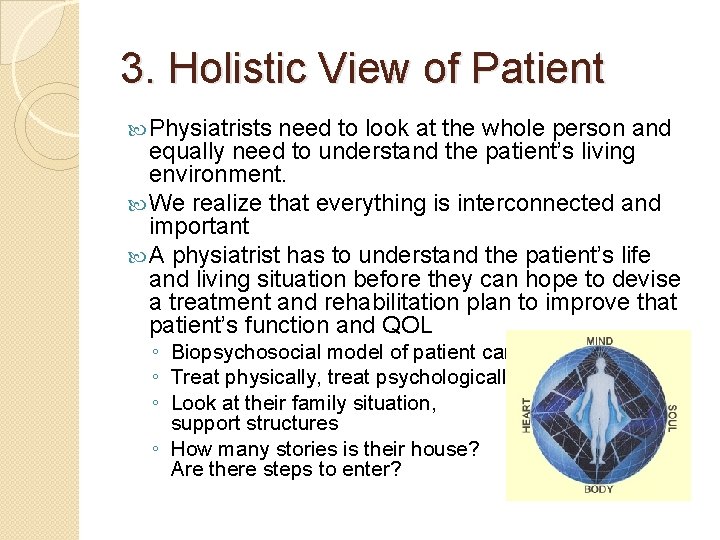
3. Holistic View of Patient Physiatrists need to look at the whole person and equally need to understand the patient’s living environment. We realize that everything is interconnected and important A physiatrist has to understand the patient’s life and living situation before they can hope to devise a treatment and rehabilitation plan to improve that patient’s function and QOL ◦ Biopsychosocial model of patient care ◦ Treat physically, treat psychologically ◦ Look at their family situation, support structures ◦ How many stories is their house? Are there steps to enter?
The stuff you really care about: What is residency like? What is the resident’s quality of life? How competitive is it to get in? What fellowships are available? What is it like to practice as a physiatrist? What would my quality of life be in PM&R? $ or $$$$$$$?
PM&R Residency 3 years after an internship/transitional year ◦ There a handful of 4 year programs as well that incorporate the internship year Including… UTSW!!! The internship/transitional year: ◦ You want to get a lot of medicine, you need to feel comfortable managing GIM problems – a lot of our acute rehab patients are very sick
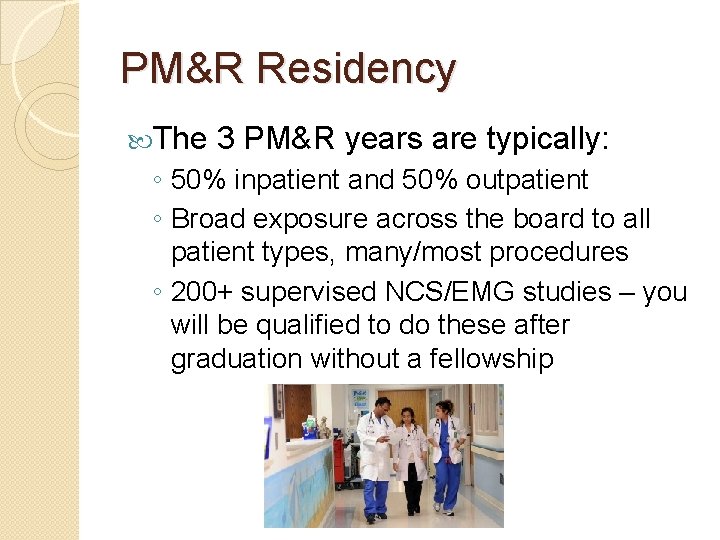
PM&R Residency The 3 PM&R years are typically: ◦ 50% inpatient and 50% outpatient ◦ Broad exposure across the board to all patient types, many/most procedures ◦ 200+ supervised NCS/EMG studies – you will be qualified to do these after graduation without a fellowship
PM&R Residency PM&R resident QOL: ◦ Internship: variable, mainly sucks ◦ PGY 2 -4: also somewhat variable, but basically PM&R residents have it good ◦ Our UTSW PM&R residents: Rarely stay past 5: 00 pm PGY 2 and 3: on call 24 times per year (twice a month on average), 6 -7 weekend days per year PGY 4 year: no call, no weekends
PM&R Residency and Competitiveness Not bad, but getting worse by the year… Quality of applicants, test scores increasing dramatically as more people find out about us Less foreign/carribbean applicants are admitted Lots of DOs interested, you compete with them as well PM&R one of a handful to completely fill at the match – no spots left to scramble for UTSW students ◦ ◦ 2012 -2013: 6 applied to PM&R 2013 -2014: 4 applied to PM&R 2014 -2015: 3 applied to PM&R This year: at least 10 applying to PM&R!!!
PM&R Fellowships You don’t have to do a fellowship, usually 5070% of our residents do not But if you want to: ◦ ◦ ◦ ◦ ◦ Pain - ACGME Sports Medicine - ACGME Brain injury - ACGME Spinal cord injury - ACGME Neuromuscular (ALS, MG, NCS/EMG) - ACGME Pediatric rehab (1 -2 years) - ACGME Palliative care – ACGME Spine/Musculoskeletal Cancer, multiple sclerosis, stroke, EMG, neuro rehab, amputee
Practicing physiatrist’s life Inpatient vs outpatient or both Generalist vs highly specialized ◦ See only SCI patients, do only EMGs Highly procedural vs no procedures at all Rural vs city Academic vs private practice Lots of expansion in the VA system (wounded warriors) Growth: ◦ We are a growing specialty, the need is there and will continue to be there for more physiatrists Baby boomers are aging 19. 3% of Americans over age 5 currently have a disability – 2000 census 10% or 1 in 10 have a severe disability (also from 2000 census) ◦ No problem getting a job!
Practicing physiatrist’s QOL Very good! Not paged away from your kids soccer game Typically 9 -5 job, M-F Call: variable (depending on academic, group private, or solo private practice). Typically home call. ◦ My call: 3 times a year for a week of home call (where I receive 0 -3 pages per week), and I have to come in 5 weekends per year for 30 -60 min each day
Salary Better than an internist, family medicine, pediatrics Less than a surgeon, radiologist, some other specialties Depends a lot of type of practice and practice location Starting salary (nonfellowship): typically $120 -180, 000
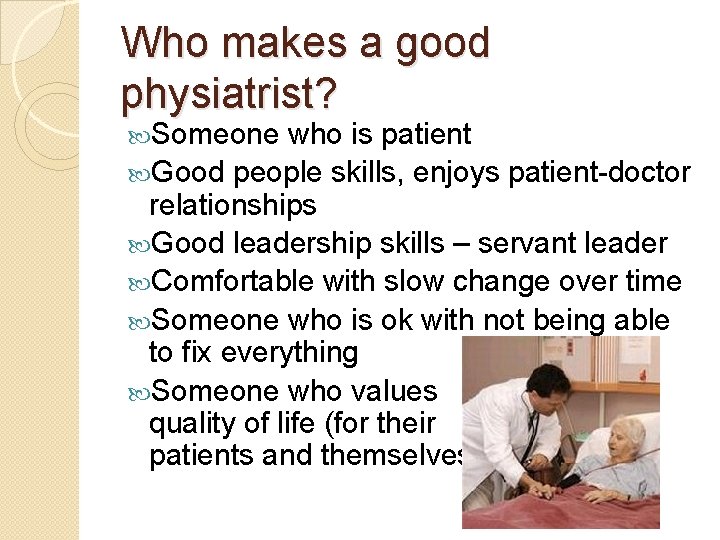
Who makes a good physiatrist? Someone who is patient Good people skills, enjoys patient-doctor relationships Good leadership skills – servant leader Comfortable with slow change over time Someone who is ok with not being able to fix everything Someone who values quality of life (for their patients and themselves)
Drawbacks of PM&R Not many… You have to be humble – no one will have heard of you or know what you do (not patients, fellow doctors) ◦ Not the field to enter for a lot of glory Not many opportunities for the “adrenaline rush” You have to be ok with dealing with sad stuff You have to be able to give bad news You have to be ok with dealing with a lot of psychiatric illness
For more information… Dr. Sam Bierner – residency director Terri Isbell – residency coordinator Kimberly King – med student coordinator Myself (Dr. Kelly Scott), Dr. Ben Nguyen, Heather Adair, Dr. John Thottakara, Dr. Jennifer Yang – med student committee members ◦ Firstname. lastname@utsouthwestern. edu PM&R Student Interest Group Monthly SIG lectures by PM&R faculty on diverse topics within our field www. aapmr. org – American Academy of Physical Medicine and Rehabilitation Dr.
RIC Summer Externship Rehabilitation Institute of Chicago Summer Externship for students between 1 st and 2 nd year of medical school 8 week program, $3000 stipend Learn about PM&R, participate in clinical care, do research project Applications are due in early January…
In summary PM&R totally rocks and you should all go into PM&R! QUESTIONS?
- Slides: 74