
Physical Layer Security 1 Outline Overview Physical Security


- Slides: 39
Physical Layer Security 1
Outline § Overview § Physical Security in Wired Networks § Physical Security in Wireless Networks 2
Overview § Networks are made up of devices and communication links § Devices and links can be physically threatened § Vandalism, lightning, fire, excessive pull force, corrosion, wildlife, wear-down, wiretapping, crosstalk, jamming § We need to make networks mechanically resilient and trustworthy 3
3
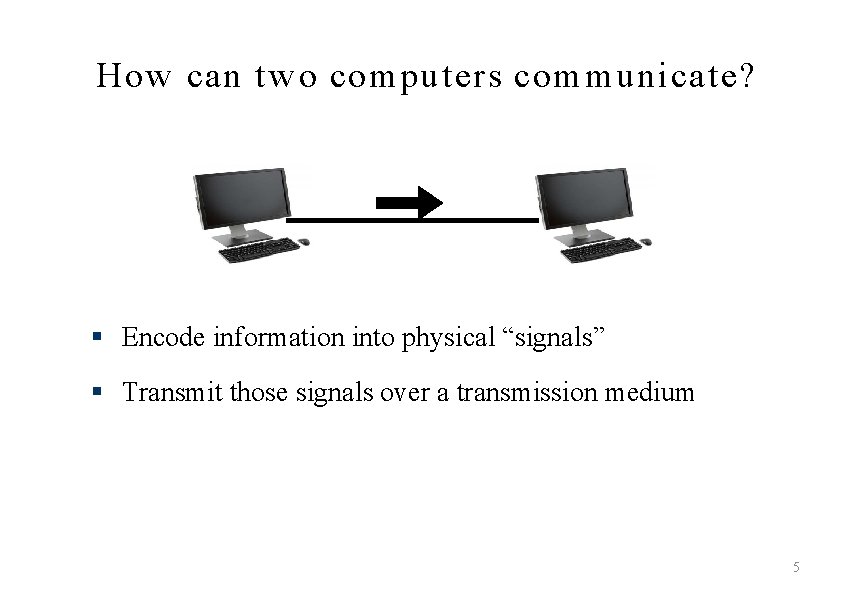
How can tw o com puters com m unicate? § Encode information into physical “signals” § Transmit those signals over a transmission medium 5
Types of Media § Metal (e. g. , copper): wired § EM/RF (e. g. , IEEE 802. 11): wireless § Light (e. g. , optical fiber) 6
Outline § Overview § Physical Security in Wired Networks Threats and § Physical Security in Wireless Networks Cryptography 7
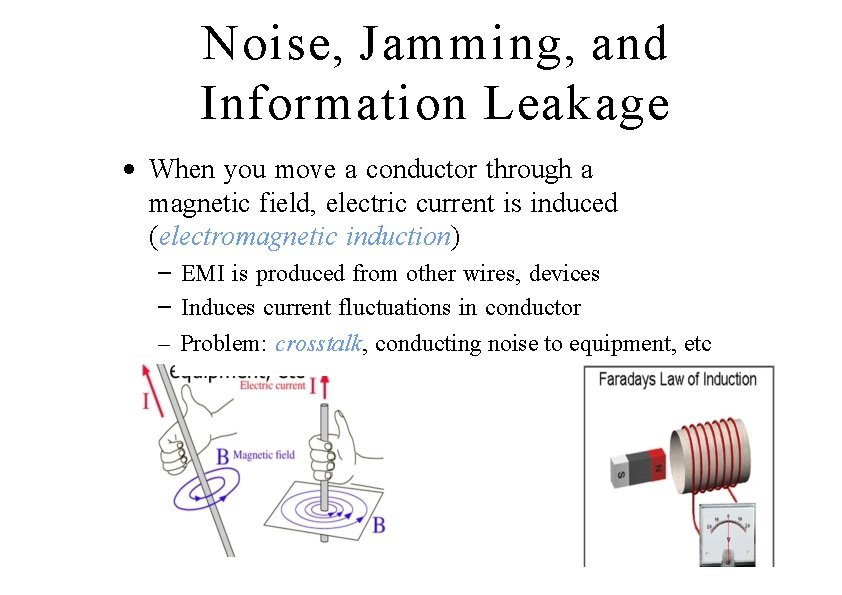
Noise, Jamming, and Information Leakage • When you move a conductor through a magnetic field, electric current is induced (electromagnetic induction) – EMI is produced from other wires, devices – Induces current fluctuations in conductor – Problem: crosstalk, conducting noise to equipment, etc 16
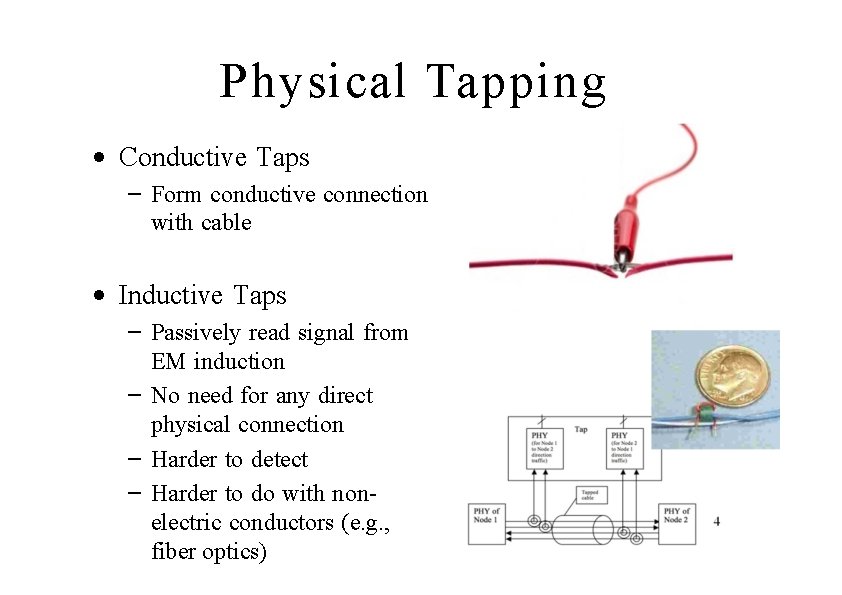
Physical Tapping • Conductive Taps – Form conductive connection with cable • Inductive Taps – Passively read signal from EM induction – No need for any direct physical connection – Harder to detect – Harder to do with nonelectric conductors (e. g. , fiber optics) 24
Tapping Cable: Counterm easures • Physical inspection • Physical protection – E. g. , encase cable in pressurized gas • Use faster bitrate • Monitor electrical properties of cable – TDR: sort of like a hard-wired radar – Power monitoring, spectrum analysis 25
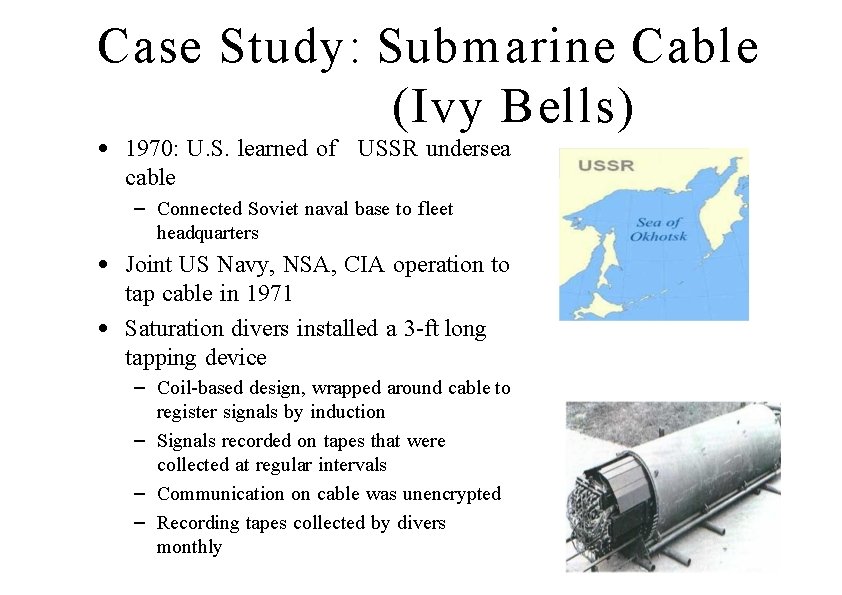
Case Study: Submarine Cable (Ivy Bells) • 1970: U. S. learned of USSR undersea cable – Connected Soviet naval base to fleet headquarters • Joint US Navy, NSA, CIA operation to tap cable in 1971 • Saturation divers installed a 3 -ft long tapping device – Coil-based design, wrapped around cable to register signals by induction – Signals recorded on tapes that were collected at regular intervals – Communication on cable was unencrypted – Recording tapes collected by divers monthly 26
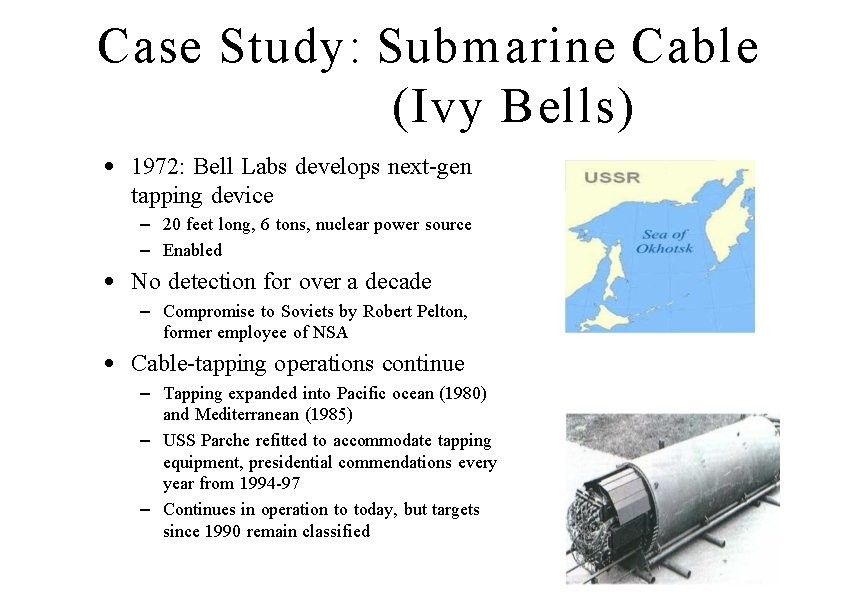
Case Study: Submarine Cable (Ivy Bells) • 1972: Bell Labs develops next-gen tapping device – 20 feet long, 6 tons, nuclear power source – Enabled • No detection for over a decade – Compromise to Soviets by Robert Pelton, former employee of NSA • Cable-tapping operations continue – Tapping expanded into Pacific ocean (1980) and Mediterranean (1985) – USS Parche refitted to accommodate tapping equipment, presidential commendations every year from 1994 -97 – Continues in operation to today, but targets since 1990 remain classified 27
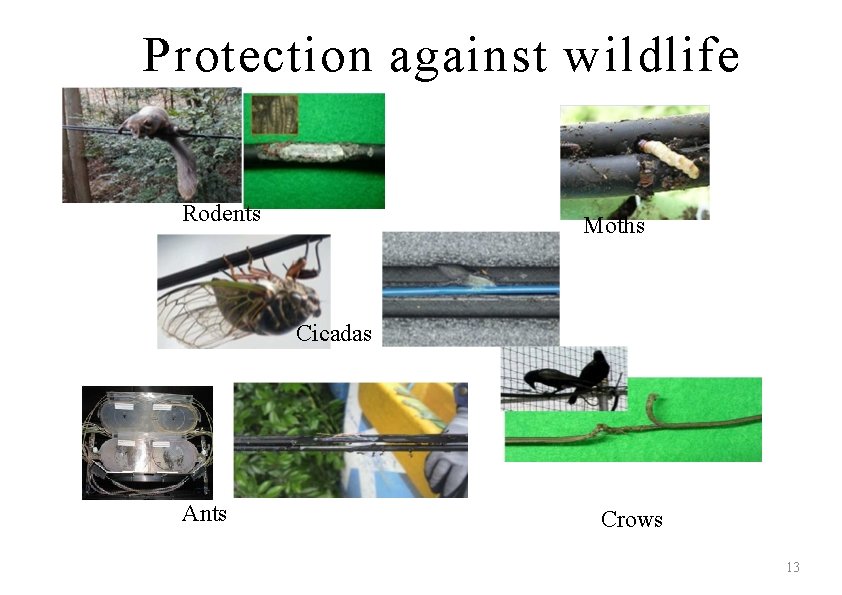
Protection against w ildlife Rodents Moths Cicadas Ants Crows 13
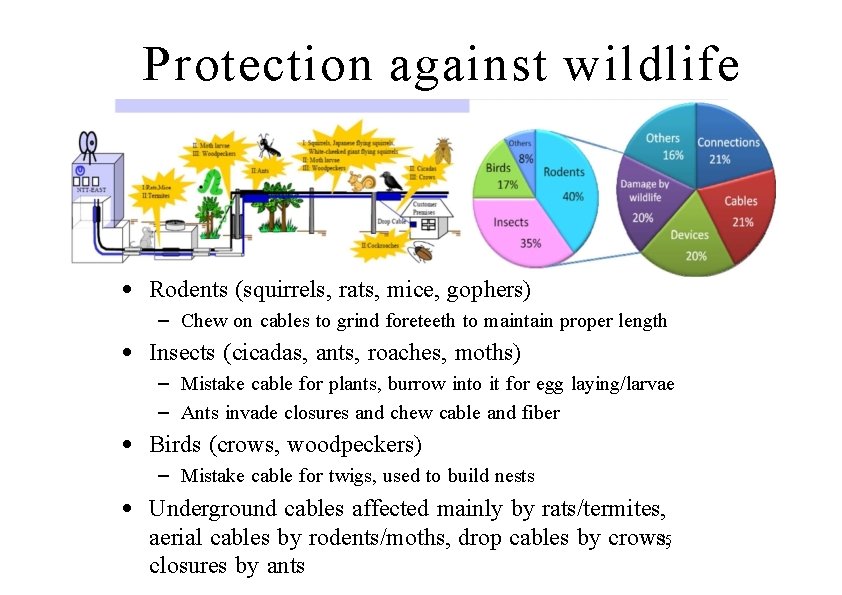
Protection against w ildlife • Rodents (squirrels, rats, mice, gophers) – Chew on cables to grind foreteeth to maintain proper length • Insects (cicadas, ants, roaches, moths) – Mistake cable for plants, burrow into it for egg laying/larvae – Ants invade closures and chew cable and fiber • Birds (crows, woodpeckers) – Mistake cable for twigs, used to build nests • Underground cables affected mainly by rats/termites, aerial cables by rodents/moths, drop cables by crows 35, closures by ants
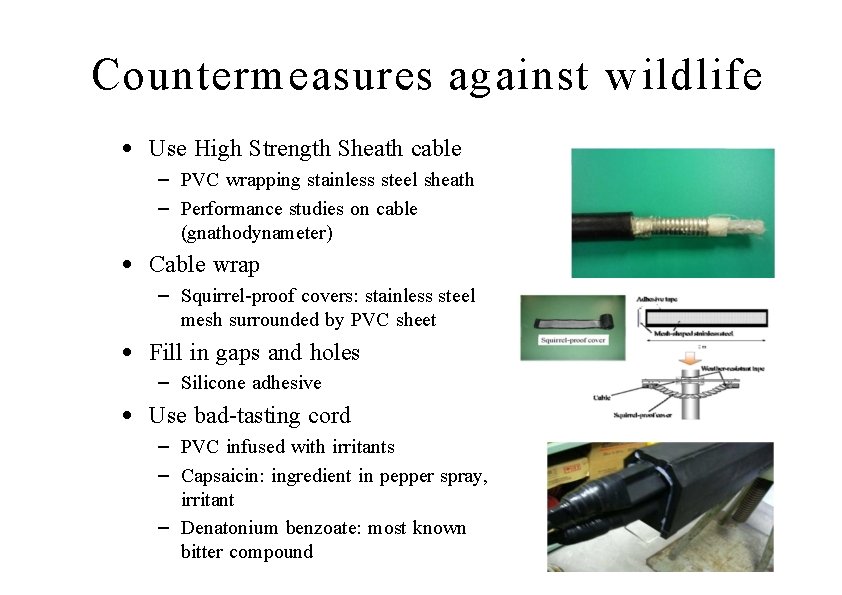
Countermeasures against w ildlife • Use High Strength Sheath cable – PVC wrapping stainless steel sheath – Performance studies on cable (gnathodynameter) • Cable wrap – Squirrel-proof covers: stainless steel mesh surrounded by PVC sheet • Fill in gaps and holes – Silicone adhesive • Use bad-tasting cord – PVC infused with irritants – Capsaicin: ingredient in pepper spray, irritant – Denatonium benzoate: most known bitter compound 36
Outline § Overview § Physical Security in Wired Networks § Physical Security in Wireless Networks Cryptography 16
Physical Attacks in WSNs: What & Why? • Physical attacks: destroy sensors physically • Physical attacks are inevitable in sensor networks – Sensor network applications that operate in hostile environments Ø Volcanic monitoring Ø Battlefield applications – Small form factor of sensors – Unattended and distributed nature of deployment • Different from other types of electronic attacks – Can be fatal to sensor networks – Simple to launch • Defending against physical attacks – Tampering-resistant packaging helps, but not enough – We propose a sacrificial node based defense approach to search-based physical attacks 17
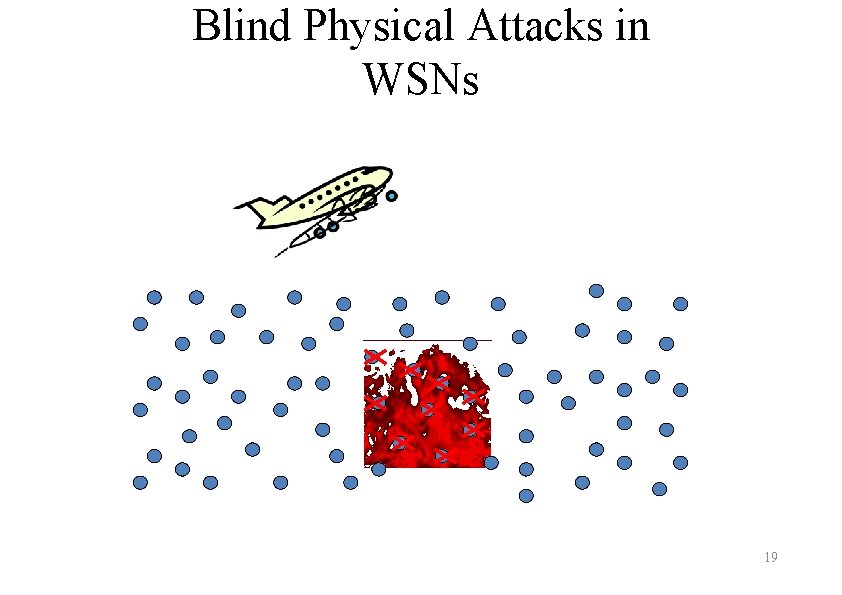
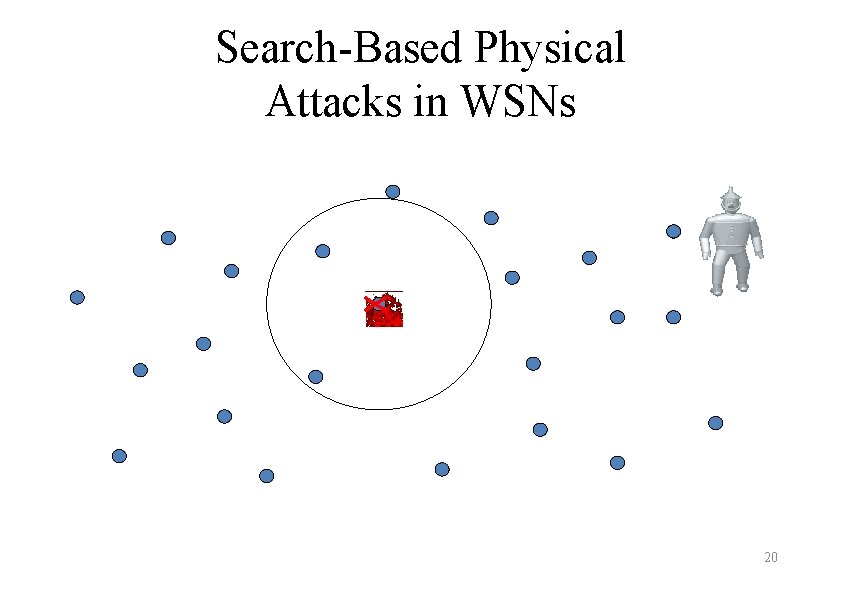
Physical Attacks in WSNs – A General Description • Two phases – Targeting phase – Destruction phase • Two broad types of physical attacks: – Blind physical attacks – Search-based physical attacks 18
Blind Physical Attacks in WSNs 19
Search-Based Physical Attacks in WSNs 20
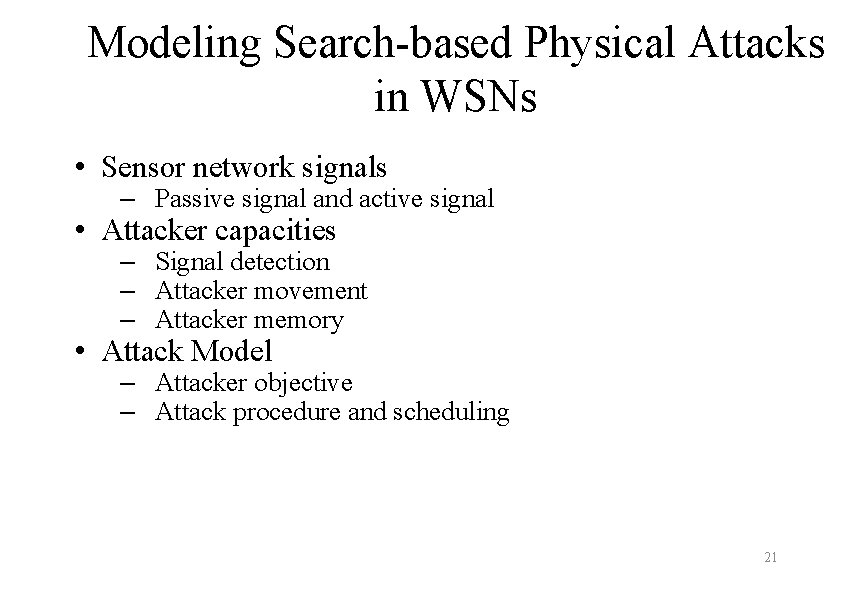
Modeling Search-based Physical Attacks in WSNs • Sensor network signals – Passive signal and active signal • Attacker capacities – Signal detection – Attacker movement – Attacker memory • Attack Model – Attacker objective – Attack procedure and scheduling 21
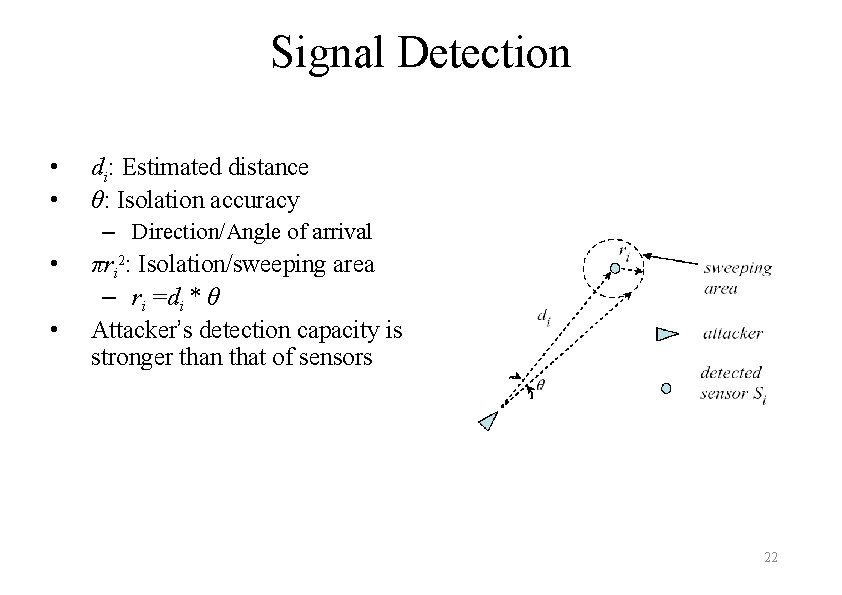
Signal Detection • • di: Estimated distance θ: Isolation accuracy – Direction/Angle of arrival • • πri 2: Isolation/sweeping area – ri =di * θ Attacker’s detection capacity is stronger than that of sensors 22
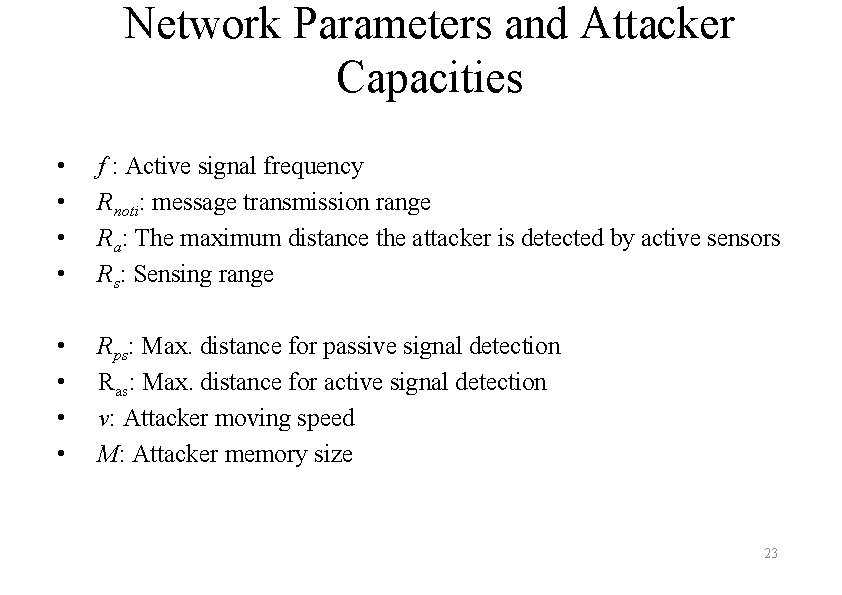
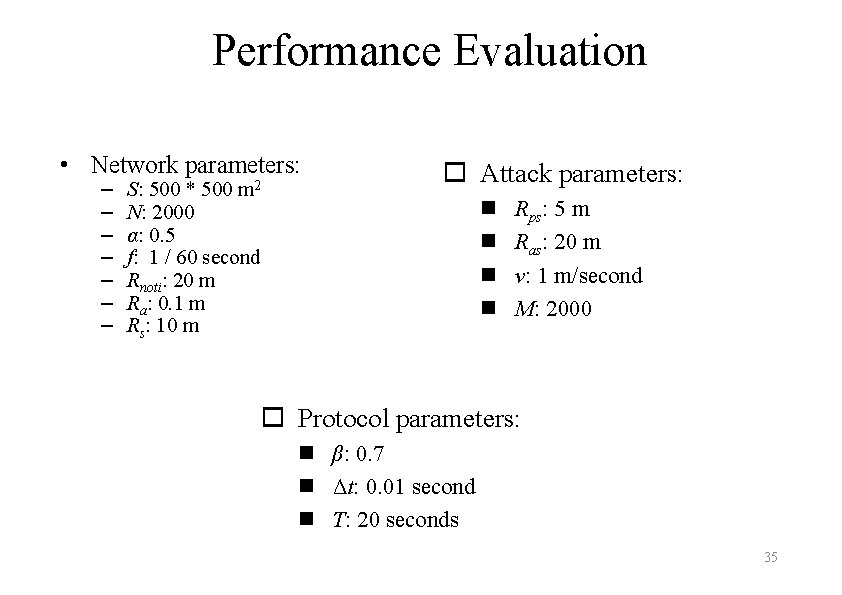
Network Parameters and Attacker Capacities • • f : Active signal frequency Rnoti: message transmission range Ra: The maximum distance the attacker is detected by active sensors Rs: Sensing range • • Rps: Max. distance for passive signal detection Ras: Max. distance for active signal detection v: Attacker moving speed M: Attacker memory size 23
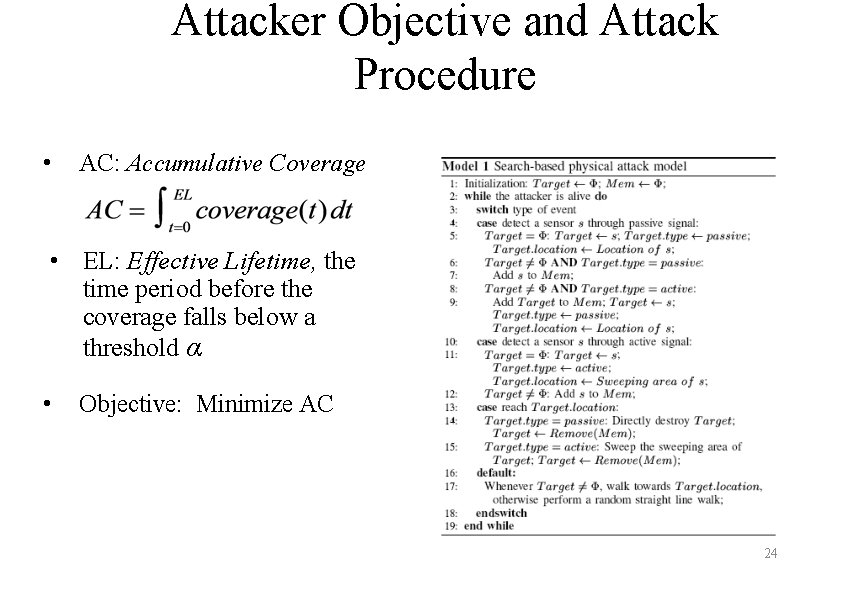
Attacker Objective and Attack Procedure • AC: Accumulative Coverage • EL: Effective Lifetime, the time period before the coverage falls below a threshold α • Objective: Minimize AC 24
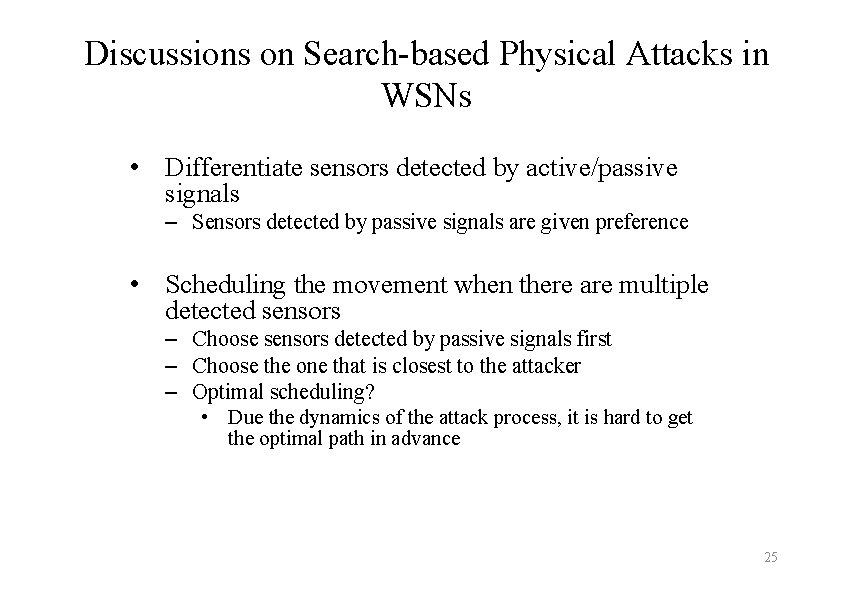
Discussions on Search-based Physical Attacks in WSNs • Differentiate sensors detected by active/passive signals – Sensors detected by passive signals are given preference • Scheduling the movement when there are multiple detected sensors – Choose sensors detected by passive signals first – Choose the one that is closest to the attacker – Optimal scheduling? • Due the dynamics of the attack process, it is hard to get the optimal path in advance 25
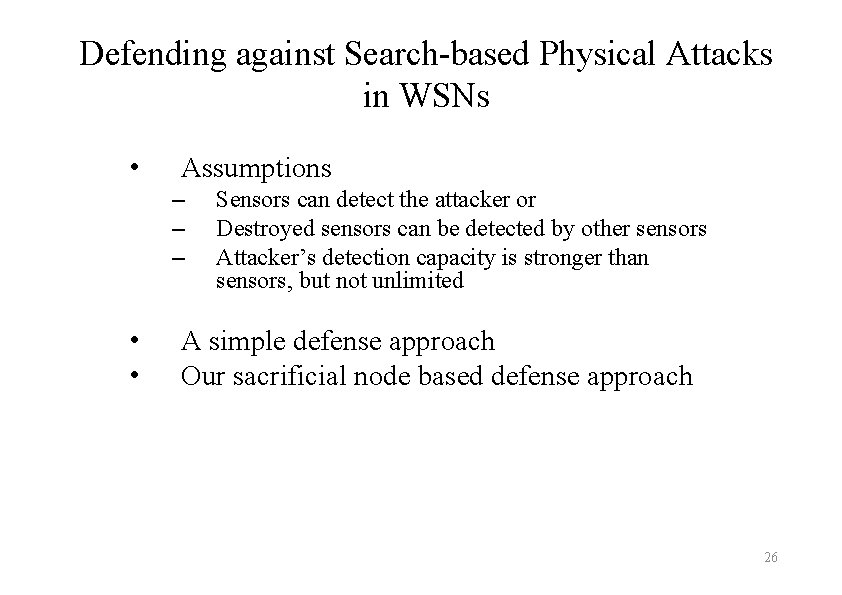
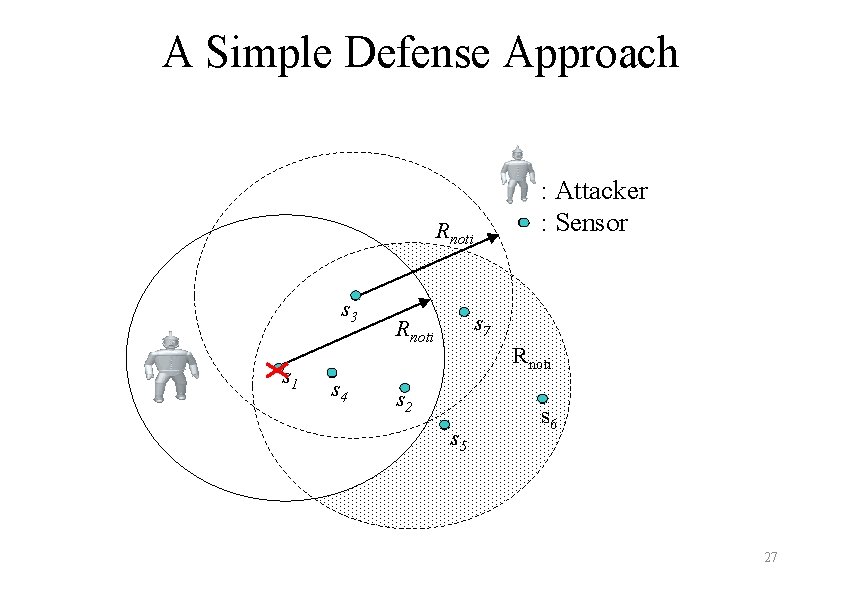
Defending against Search-based Physical Attacks in WSNs • Assumptions – – – • • Sensors can detect the attacker or Destroyed sensors can be detected by other sensors Attacker’s detection capacity is stronger than sensors, but not unlimited A simple defense approach Our sacrificial node based defense approach 26
A Simple Defense Approach : Attacker : Sensor Rnoti s 3 s 1 s 4 s 7 Rnoti s 2 s 5 s 6 27
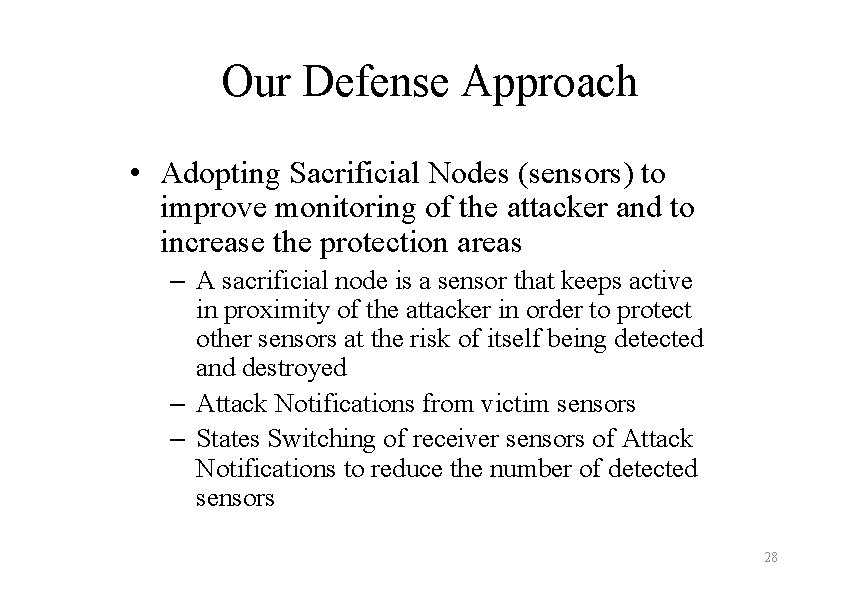
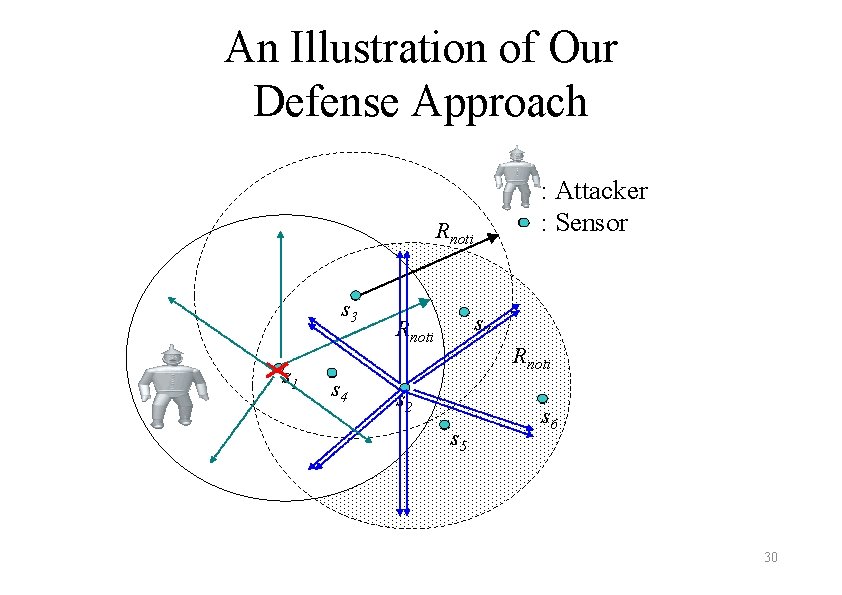
Our Defense Approach • Adopting Sacrificial Nodes (sensors) to improve monitoring of the attacker and to increase the protection areas – A sacrificial node is a sensor that keeps active in proximity of the attacker in order to protect other sensors at the risk of itself being detected and destroyed – Attack Notifications from victim sensors – States Switching of receiver sensors of Attack Notifications to reduce the number of detected sensors 28
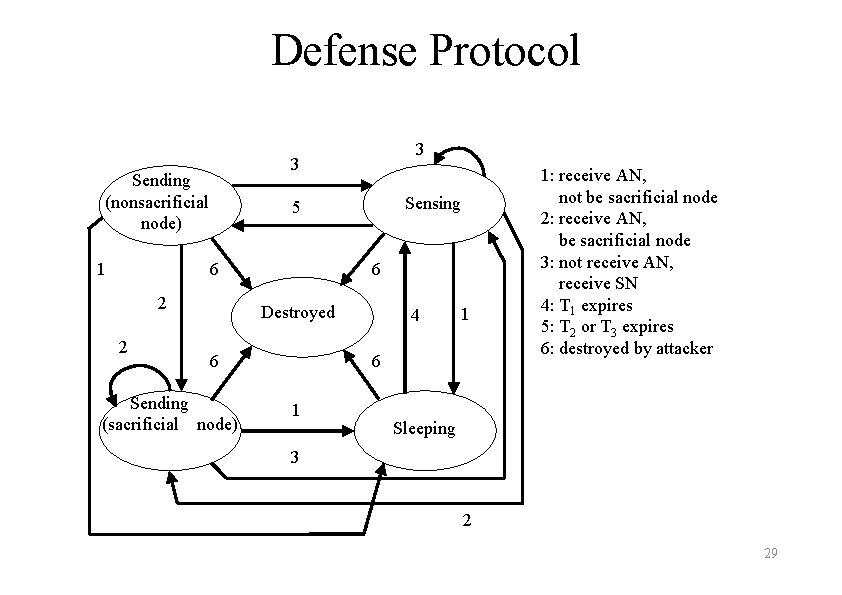
Defense Protocol 3 Sending (nonsacrificial node) 1 Sensing 5 6 2 2 3 6 Destroyed 6 Sending (sacrificial node) 4 1 6 1 1: receive AN, not be sacrificial node 2: receive AN, be sacrificial node 3: not receive AN, receive SN 4: T 1 expires 5: T 2 or T 3 expires 6: destroyed by attacker Sleeping 3 2 29
An Illustration of Our Defense Approach : Attacker : Sensor Rnoti s 3 s 1 s 4 s 7 Rnoti s 2 s 5 s 6 30
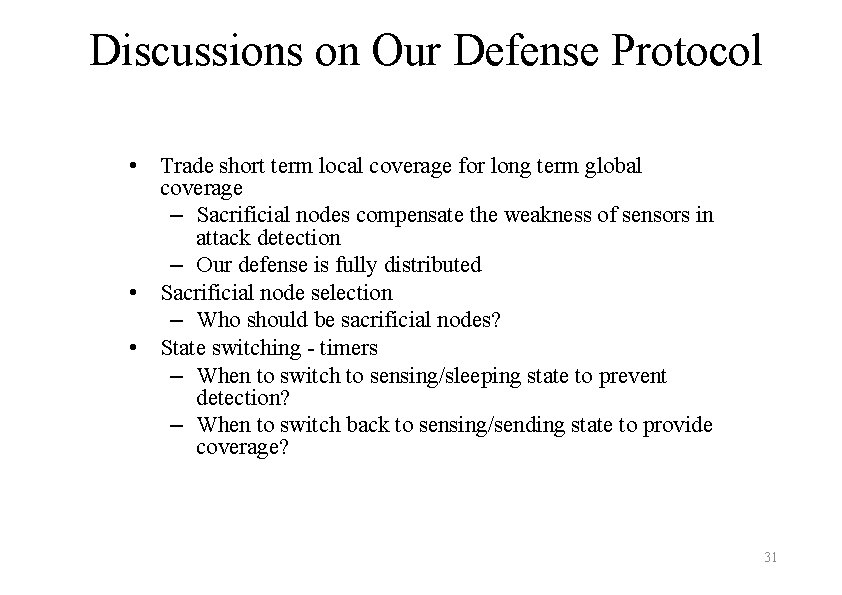
Discussions on Our Defense Protocol • Trade short term local coverage for long term global coverage – Sacrificial nodes compensate the weakness of sensors in attack detection – Our defense is fully distributed • Sacrificial node selection – Who should be sacrificial nodes? • State switching - timers – When to switch to sensing/sleeping state to prevent detection? – When to switch back to sensing/sending state to provide coverage? 31
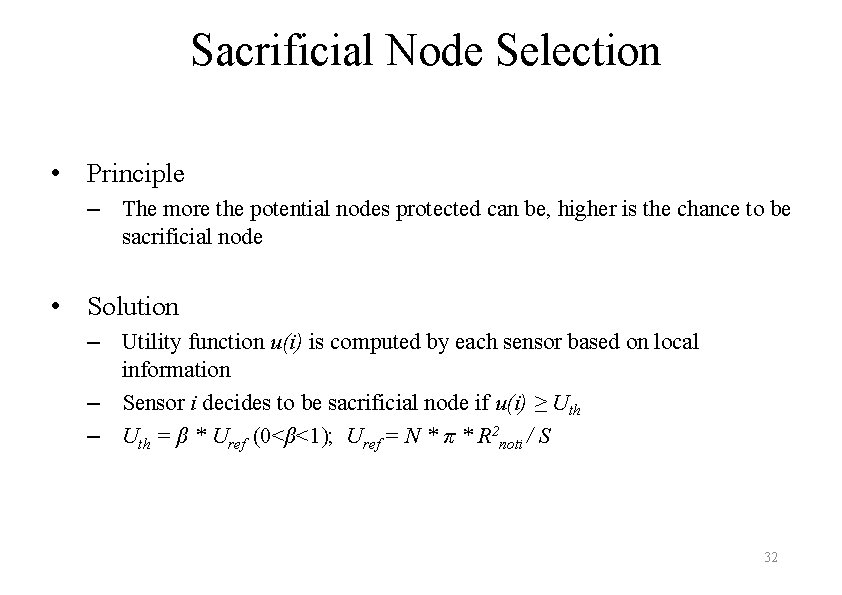
Sacrificial Node Selection • Principle – The more the potential nodes protected can be, higher is the chance to be sacrificial node • Solution – Utility function u(i) is computed by each sensor based on local information – Sensor i decides to be sacrificial node if u(i) ≥ Uth – Uth = β * Uref (0<β<1); Uref = N * π * R 2 noti / S 32
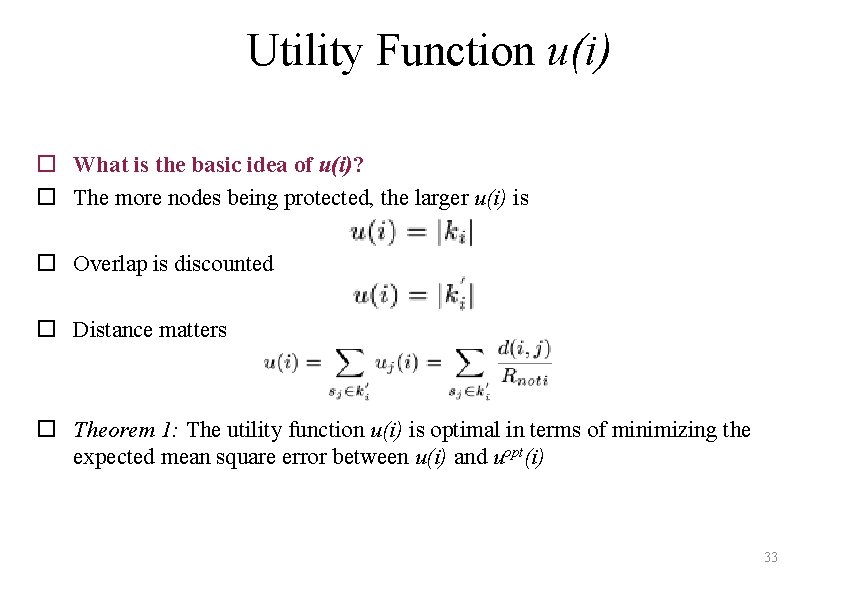
Utility Function u(i) o What is the basic idea of u(i)? o The more nodes being protected, the larger u(i) is o Overlap is discounted o Distance matters o Theorem 1: The utility function u(i) is optimal in terms of minimizing the expected mean square error between u(i) and uopt(i) 33
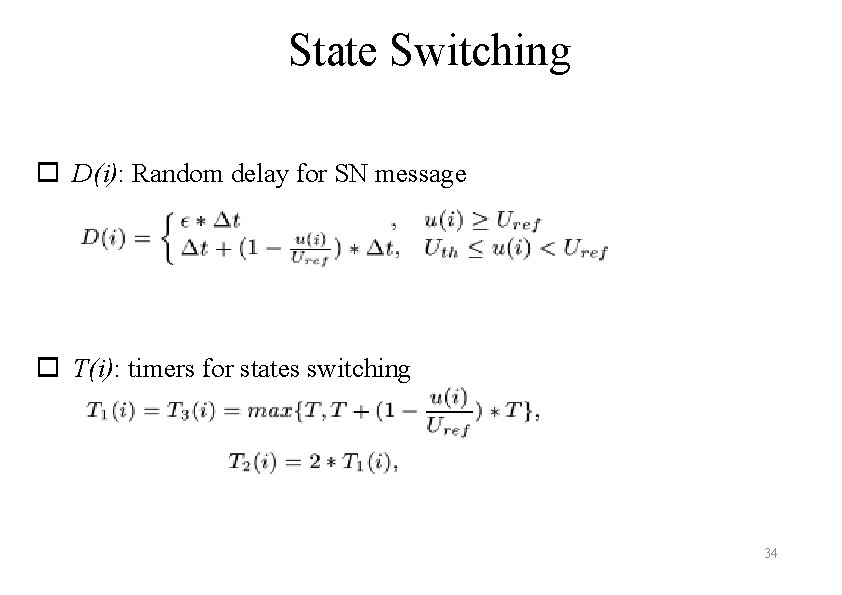
State Switching o D(i): Random delay for SN message o T(i): timers for states switching 34
Performance Evaluation • Network parameters: – – – – m 2 S: 500 * 500 N: 2000 α: 0. 5 f: 1 / 60 second Rnoti: 20 m Ra: 0. 1 m Rs: 10 m o Attack parameters: n n Rps: 5 m Ras: 20 m v: 1 m/second M: 2000 o Protocol parameters: n β: 0. 7 n Δt: 0. 01 second n T: 20 seconds 35
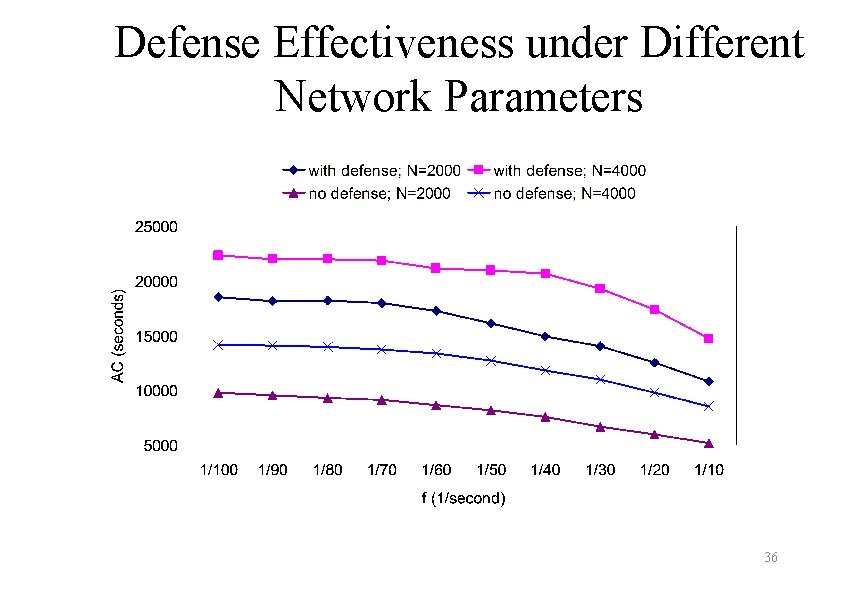
Defense Effectiveness under Different Network Parameters 36
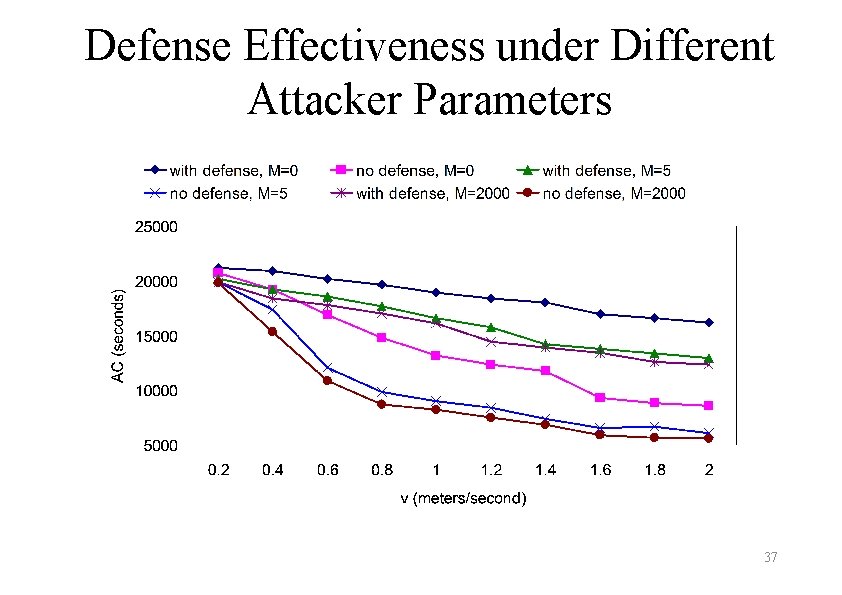
Defense Effectiveness under Different Attacker Parameters 37
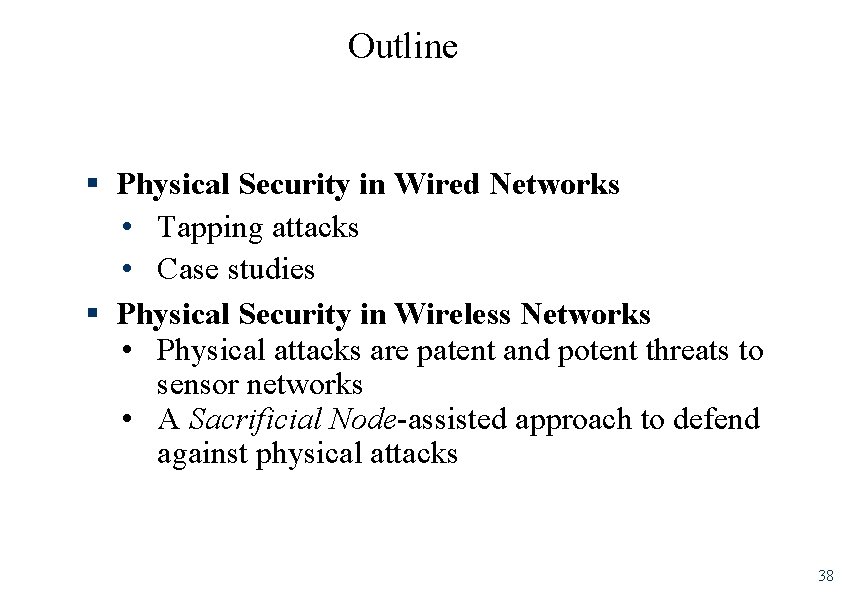
Outline § Physical Security in Wired Networks • Tapping attacks • Case studies § Physical Security in Wireless Networks • Physical attacks are patent and potent threats to sensor networks • A Sacrificial Node-assisted approach to defend against physical attacks Cryptography 38
Acknowledgement These slides are partially from: Matthew Caesar’s slides on Physical Network Security: http: //www. cs. illinois. edu/%7 Ecaesar/courses/CS 598. S 13/slides/lec_02_physicallayer. p df Dong Xuan’s slides on Physical Attacks in Wireless Sensor Networks http: //www. cse. ohio-state. edu/~xuan/papers/05_mass_gwcxl. ppt 39