
Physical Layer How bits are sent Goal Physical
Physical Layer – How bits are sent
Goal • Physical layer design goal: send out bits as fast as possible with acceptable low error ratio • Goal of this lecture: get to know the basics of physical layer design, the constraints, the solutions, should be able to solve some simple problems
Some simple schemes • There is a wire between A and B. If A wants to send a bit `1’, he connects the wire to the positive end of a battery. Otherwise he disconnects it from the battery. • Or A can hold a radio, if `1’, he sends at frequency f 1 and if `0’ he sends at frequency f 2. • Or there is an optical fiber between A and B and if `1’ A lit up a light and if `0’ A does nothing.
Ethernet • So, why not simply do that? We can let a electronic switch to do the switching between 0 s and 1 s. • In fact, yes we can. • This is what is done in 10 Mbs Ethernet.
Ethernet • But what problem do you see in simply pulling the voltage up and down according to the bits? • The receiver needs to synchronize with the sender, i. e. , use the same clock as the sender, but a stream of `1’ or `0’ is a DC voltage with no clock information.
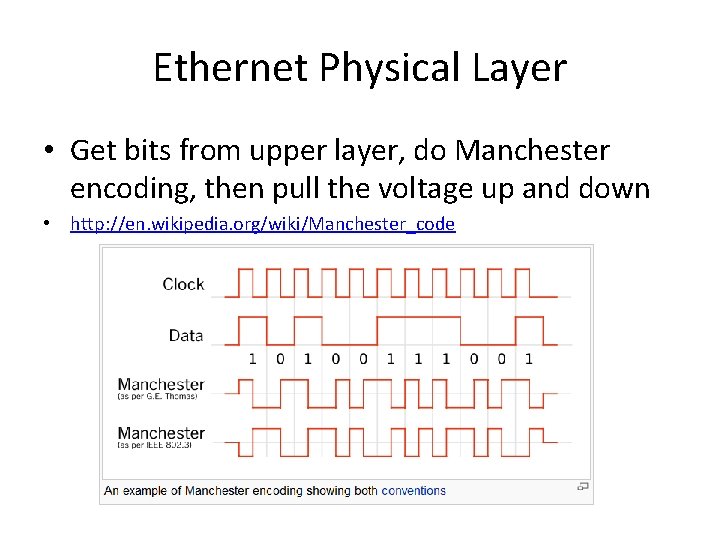
Ethernet Physical Layer • Get bits from upper layer, do Manchester encoding, then pull the voltage up and down • http: //en. wikipedia. org/wiki/Manchester_code
The Limit of Speed – Bandwidth and Noise
Bandwidth and noise • Bandwidth basically means how fast your signal can change or how fast can you send out symbols. – Symbol is something you send out to represent bit(s) • Noise means that although you sent 1 to me, I may receive something like 1+x, where x is the noise added by the media.
Bandwidth and Noise • The bandwidth is always limited because of many reasons – The wire itself, if too long, is a capacitor and slows down voltage transition – In wireless transmissions, the whole spectrum shared by many communication parties and each can have only a limited chunk of it • Noise is always there
Ideal case • If the bandwidth is infinite and absolutely no noise, how fast can you send/receive data?
Bandwidth • If the media is of infinite bandwidth but with some noise, how fast can you send/receive data? Assuming that your device is fast enough.
Noise • If there is absolutely no noise but the bandwidth is limited, how fast can you send/receive data? Assuming that your device is fine enough to tell the slightest differences of signal voltage.
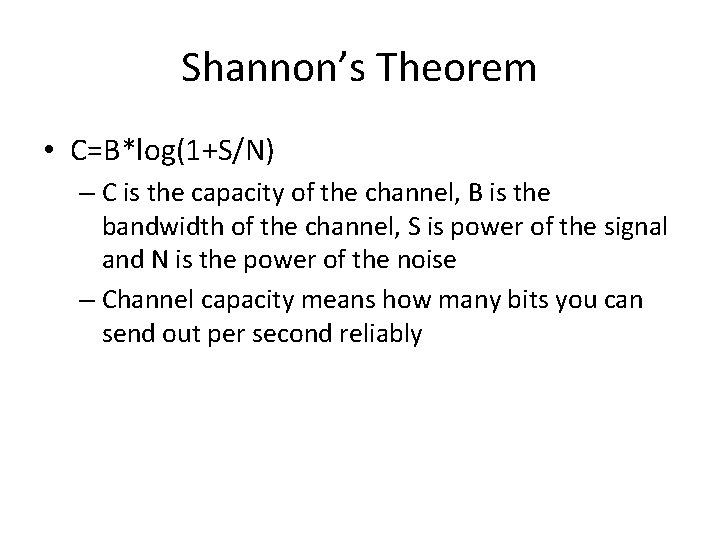
Shannon’s Theorem • C=B*log(1+S/N) – C is the capacity of the channel, B is the bandwidth of the channel, S is power of the signal and N is the power of the noise – Channel capacity means how many bits you can send out per second reliably
Shannon’s Theorem • There is actually a very simple way to understand Shannon’s theorem – B means how fast can you send out symbols – S/N determines how many bits each symbol carries – why there is a log?
- Slides: 14