
Physical Geography Subsystems of the Earth Physical Processes

Physical Geography Subsystems of the Earth

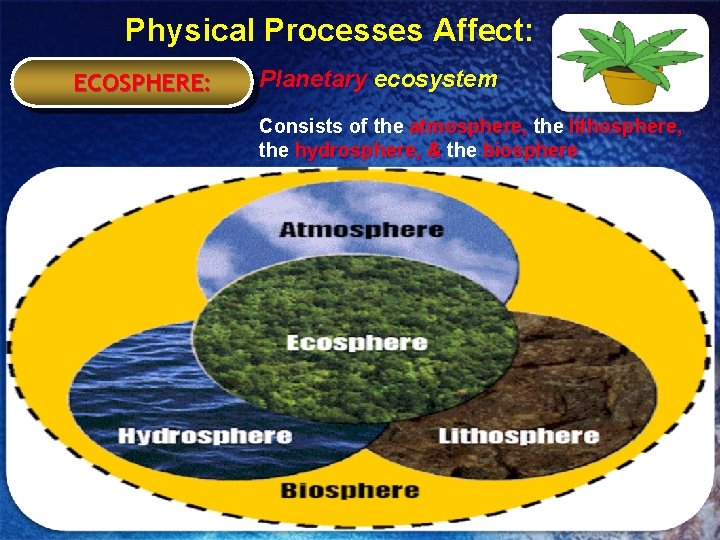
Physical Processes Affect: ECOSPHERE: Planetary ecosystem Consists of the atmosphere, the lithosphere, the hydrosphere, & the biosphere

LITHOSPHERE: Solid, rocky crust covering entire planet • Three main layers: • the core, or the inner layer • the mantle, in the middle • the crust, outer layer 100 kilometers (60 miles) deep in most places, includes the brittle upper portion of the mantle and the crust It is broken into huge sections called tectonic plates The movement of the lithosphere, called plate tectonics, is the reason behind a lot of Earth's most dramatic geologic events • Always moving; very slowly http: //mediatheek. thinkquest. nl/~ll 125/images/struct. jpg

ATMOSPHERE: The air surrounding Earth • 78% Nitrogen • Just under 21% Oxygen • less than 1% argon, carbon dioxide, & other gasses • Water vapor and dust are also part of Earth’s atmosphere Acts as a gigantic filter, keeping out most ultraviolet radiation while letting in the sun’s warming rays www. space. gc. ca

HYDROSPHERE: All the water on or near the Earth • The hydrosphere can be liquid, vapor, or ice • Exists on the surface in oceans, lakes and rivers • Exists below ground—as groundwater, in wells & aquifers • Water vapor is most visible as clouds and fog

BIOSPHERE: Composed of all living organisms • Made up of the parts of Earth where life exists • Since life exists on the ground, in the air, and in the water, the biosphere overlaps all of Earth’s spheres • Measures about 20 kilometers (12 miles) from top to bottom Almost all life exists between about 500 meters) below the ocean’s surface to about 6 kilometers above sea level • Plants • Animals • One-celled organisms

7 Continents=Africa, Asia, Antarctica, South America, North America, Europe, & Australia 5 Oceans=Southern, Arctic, Pacific, Indian, & Atlantic
- Slides: 8