
Physical Geography Features River Nile Deserts Egypt The
- Slides: 1
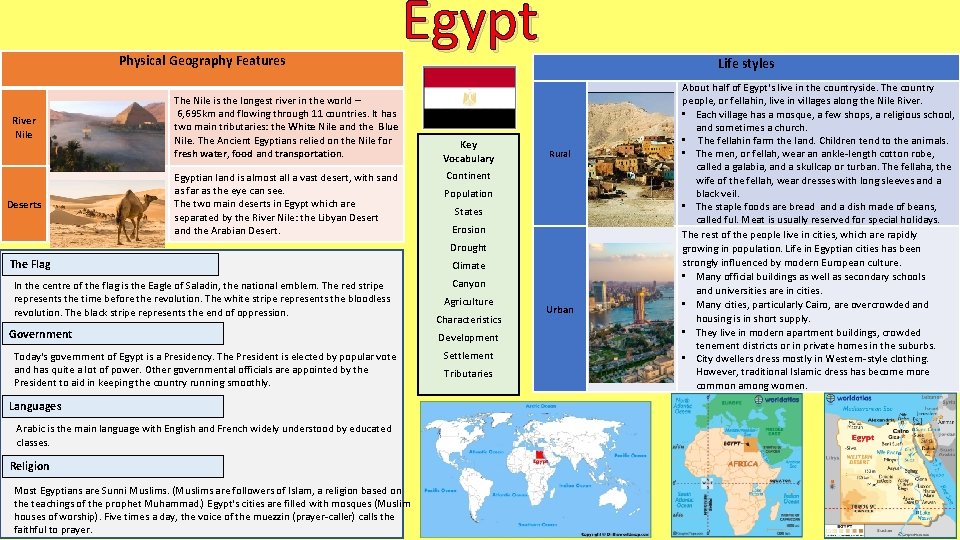
Physical Geography Features River Nile Deserts Egypt The Nile is the longest river in the world – 6, 695 km and flowing through 11 countries. It has two main tributaries: the White Nile and the Blue Nile. The Ancient Egyptians relied on the Nile for fresh water, food and transportation. Egyptian land is almost all a vast desert, with sand as far as the eye can see. The two main deserts in Egypt which are separated by the River Nile: the Libyan Desert and the Arabian Desert. Key Vocabulary Life styles Rural Continent Population States Erosion Drought The Flag In the centre of the flag is the Eagle of Saladin, the national emblem. The red stripe represents the time before the revolution. The white stripe represents the bloodless revolution. The black stripe represents the end of oppression. Government Today's government of Egypt is a Presidency. The President is elected by popular vote and has quite a lot of power. Other governmental officials are appointed by the President to aid in keeping the country running smoothly. Languages Arabic is the main language with English and French widely understood by educated classes. Religion Most Egyptians are Sunni Muslims. (Muslims are followers of Islam, a religion based on the teachings of the prophet Muhammad. ) Egypt's cities are filled with mosques (Muslim houses of worship). Five times a day, the voice of the muezzin (prayer-caller) calls the faithful to prayer. Climate Canyon Agriculture Characteristics Development Settlement Tributaries Urban About half of Egypt's live in the countryside. The country people, or fellahin, live in villages along the Nile River. • Each village has a mosque, a few shops, a religious school, and sometimes a church. • The fellahin farm the land. Children tend to the animals. • The men, or fellah, wear an ankle-length cotton robe, called a galabia, and a skullcap or turban. The fellaha, the wife of the fellah, wear dresses with long sleeves and a black veil. • The staple foods are bread and a dish made of beans, called ful. Meat is usually reserved for special holidays. The rest of the people live in cities, which are rapidly growing in population. Life in Egyptian cities has been strongly influenced by modern European culture. • Many official buildings as well as secondary schools and universities are in cities. • Many cities, particularly Cairo, are overcrowded and housing is in short supply. • They live in modern apartment buildings, crowded tenement districts or in private homes in the suburbs. • City dwellers dress mostly in Western-style clothing. However, traditional Islamic dress has become more common among women.