
PHYSICAL EXAMINATION of the VASCULAR SYSTEM Hugh Gelabert
PHYSICAL EXAMINATION of the VASCULAR SYSTEM Hugh Gelabert, M. D. Vascular Surgery Division UCLA School of Medicine
Today’s Objective • To review the examination of the Vascular System • To review exam techniques • To discuss common findings • To review the correlation between patient symptoms and exam findings
Goal of Medical History • To record the patient’s symptoms at time of presentation. • To organize the events which have lead to presentation. • To summarize the evidence which supports diagnostic hypothesis. • To provide basis and direction for care.
Goals of Physical Exam • To record the state of patient’s health at the time of the examination. • To provide a longitudinal record of the patient’s health. • Allow assessment of progression of disease. • Allow prognostication of natural history. • Allow recommendations for care.
Vascular Physical Exam Arterial Anatomy Goals • establish presence and quality of pulses • establish presence or absence of findings: aneurysms, arterial bruit, signs of ischemia, signs of venous disease
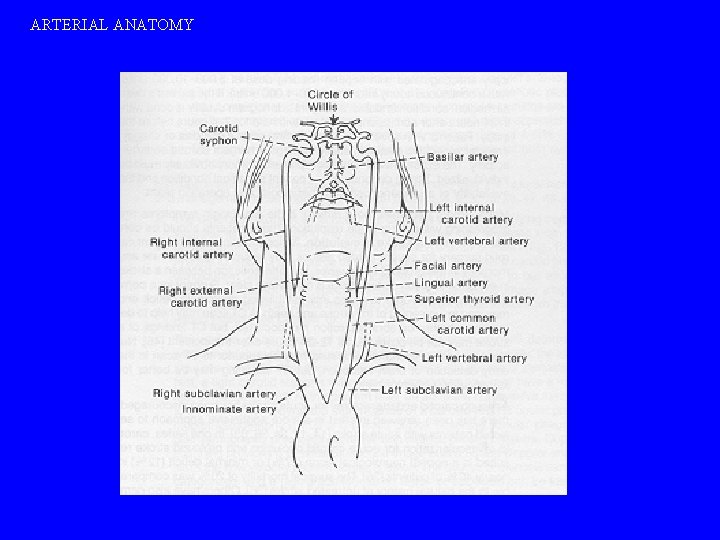
ARTERIAL ANATOMY
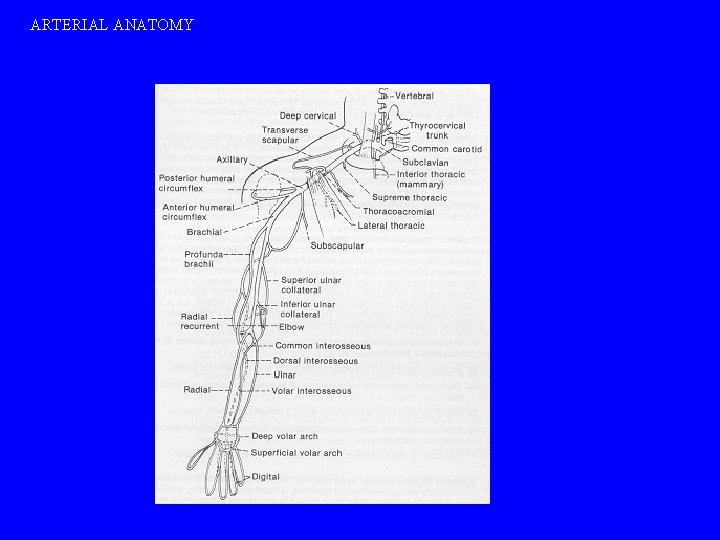
ARTERIAL ANATOMY
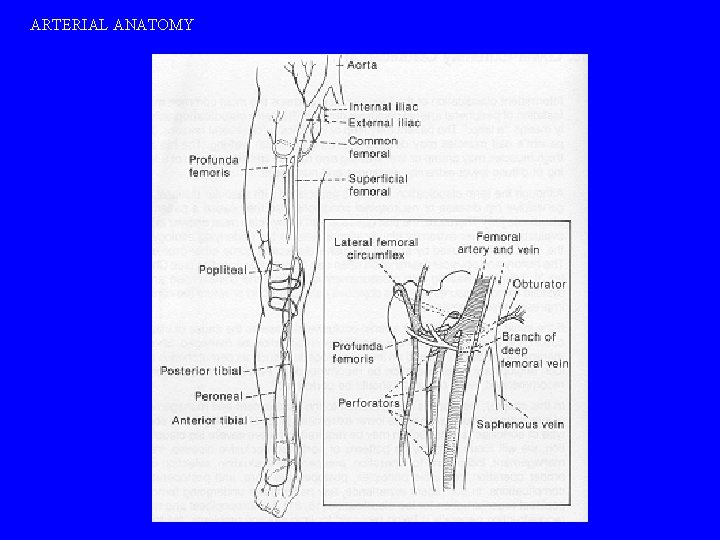
ARTERIAL ANATOMY
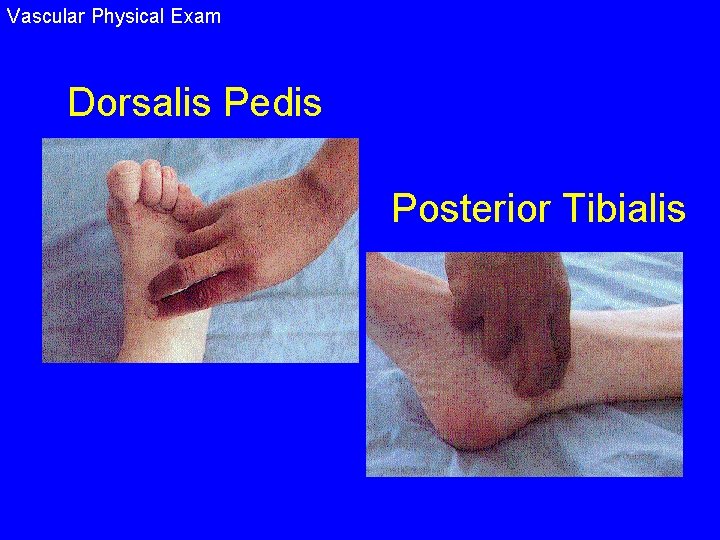
Vascular Physical Exam Dorsalis Pedis Posterior Tibialis
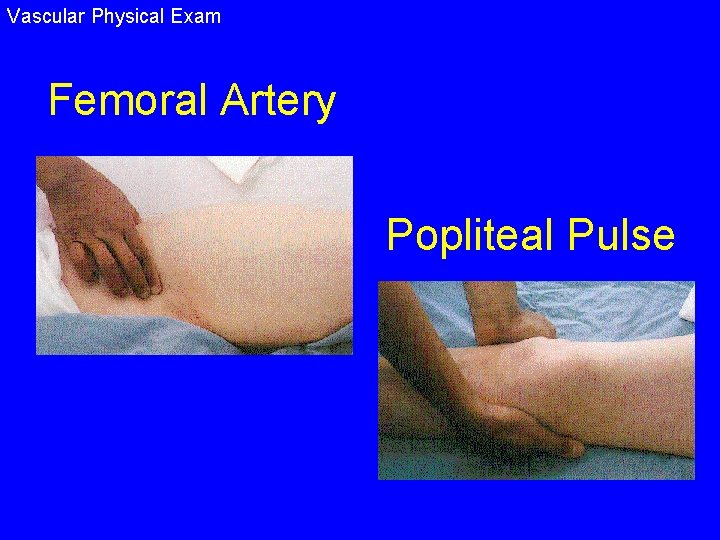
Vascular Physical Exam Femoral Artery Popliteal Pulse
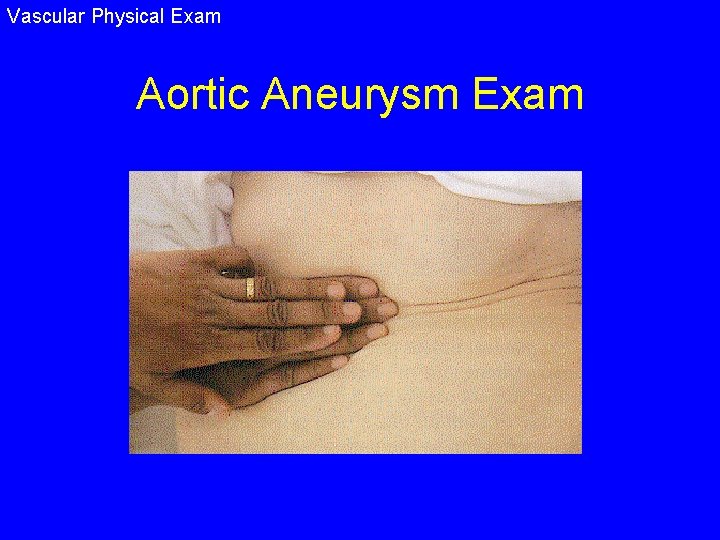
Vascular Physical Exam Aortic Aneurysm Exam
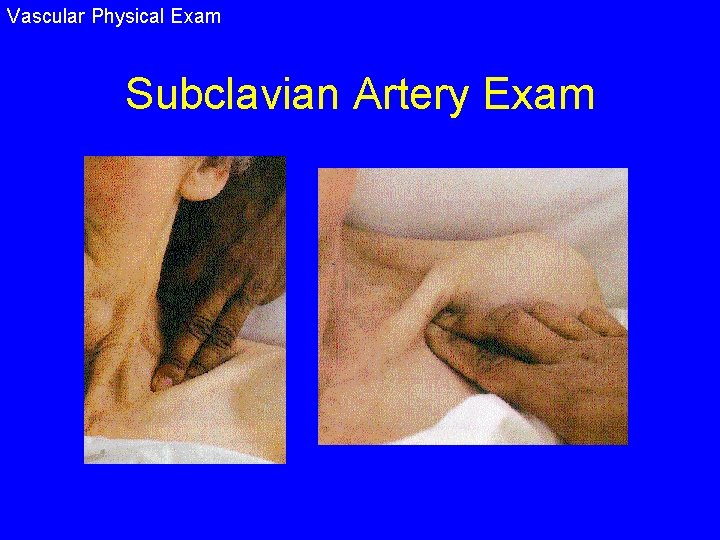
Vascular Physical Exam Subclavian Artery Exam
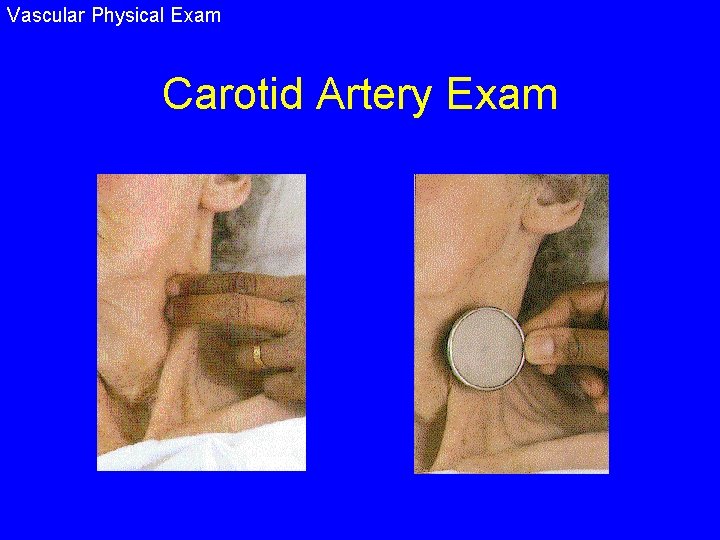
Vascular Physical Exam Carotid Artery Exam
Vascular Physical Exam Bruit • Sound made by vibrating arterial wall • Caused by turbulent blood flow making arterial wall vibrate • Indicates the presence of an arterial lesion
Vascular Physical Exam Vascular Findings • Generally related to – Blockage of blood vessel – Dilatation of blood vessel • Subsequent events – Ischemic tissue – Gangrenous tissue
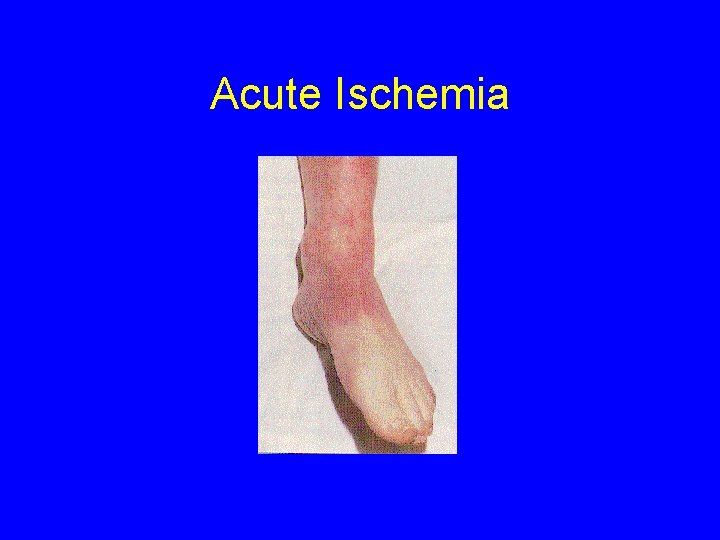
Vascular Physical Exam Ischemia • Decreased blood supply results in metabolic compromise. • Grades of severity reflect acuity of condition as well as the magnitude of the reduction in circulation. • ACUTE vs CHRONIC
Vascular Physical Exam Acute Ischemia • 5 ‘P’s – Pulseless – Pain – Pallor – Paresthesia – Paralysis – Poikilothermia (Cold)
Acute Ischemia
Vascular Physical Exam Acute Ischemia • An abrupt disruption of the normal blood supply to a vascular bed. • Example: • • Gunshot wound Fracture Tourniquette Embollus
Vascular Physical Exam Acute Ischemia • Implies that without prompt restoration of blood supply there will be significant permanent damage to tissues. • Susceptibility to Acute Ischemic Injury – Nerve +++ – Muscle ++ – Tendon and Bone +
Vascular Physical Exam Chronic Ischemia • A process where the gradual onset and magnitude of ischemia has allowed the body time to compensate for the decreased blood supply. • Key Concept: “Collateral Circulation” • Compensation is never as good as original. • The vascular bed survives with less blood.
Vascular Physical Exam Chronic Ischemia • Changes in the Limbs – Skin …………………. . . Growth slowed – Nails beds …………… Growth slowed – Hair follicles ……. Lost – Sebaceous glands …… Lost • Result: Thin, dry, skin with loss of hair, abnormal nail growth / fungal infections.
Vascular Physical Exam Capillary Refill • The time required for capillary system to refill following compression of the nail bed or finger pad. • Normal should be rapid (1 sec or less) • Decreased – – Normal physiologic response (eg. cold) Abnormal vasomotor tone (eg. Raynaud’s) Acute Ischemia Chronic Ischemia
Vascular Physical Exam Capillary Refill • In the chronic ischemic limb: – Pallor on Elevation • Insufficient arterial pressure to perfuse when leg elevated above level of heart. • Limb drains of blood. – Dependent Rubror • Blood pooling in maximally dilated capillary bed • Cyanosis -- when blood is de-oxygenated
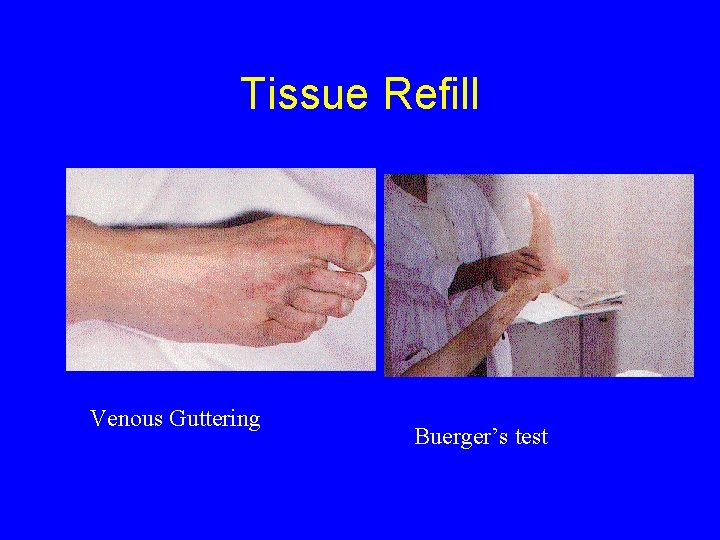
Tissue Refill Venous Guttering Buerger’s test
Vascular Physical Exam Capillary Refill • In Acute Ischemia – Cyanosis noted because blood hemoglobin is desaturated of oxygen – Compression of digit results in evacuation of blood from capillaries – Refill of blood is sluggish because of decreased arterial pressure. – In severe cases the blood in capillaries may thrombose and will not blanch on palpation
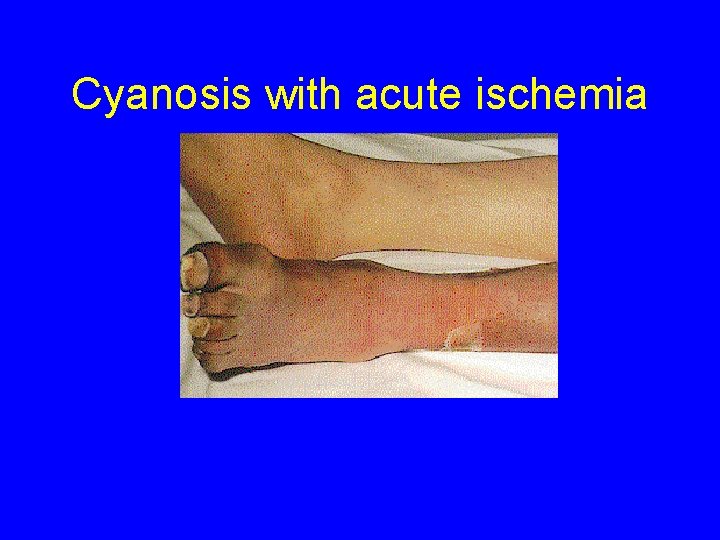
Cyanosis with acute ischemia

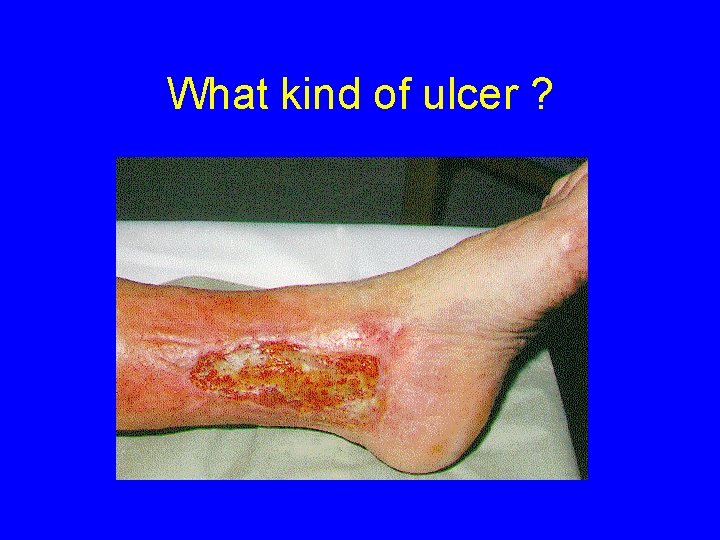
Vascular Physical Exam Ulceration • A discontinuity in the integrity of the skin which persists despite sufficient time for healing. • Must be able to distinguish three types: Arterial, Venous, Neuropathic.
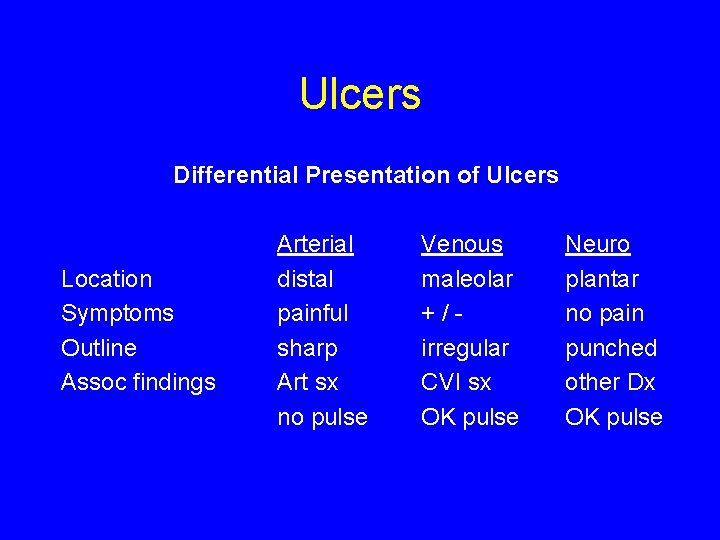
Ulcers Differential Presentation of Ulcers Location Symptoms Outline Assoc findings Arterial distal painful sharp Art sx no pulse Venous maleolar + / irregular CVI sx OK pulse Neuro plantar no pain punched other Dx OK pulse
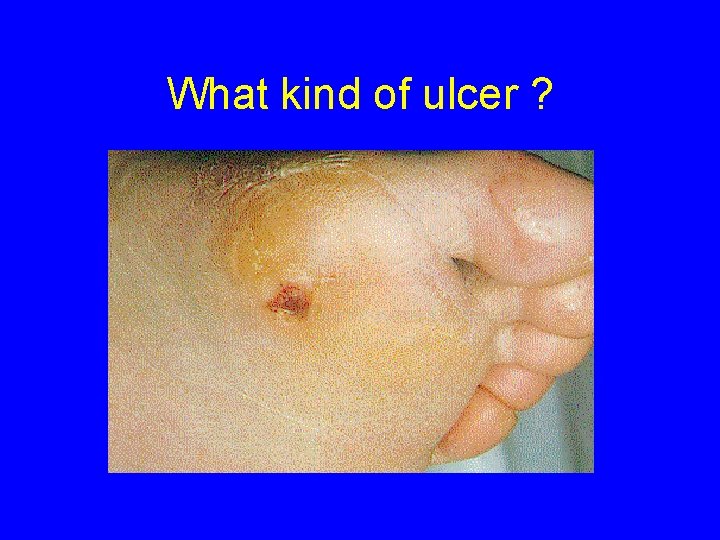
What kind of ulcer ?
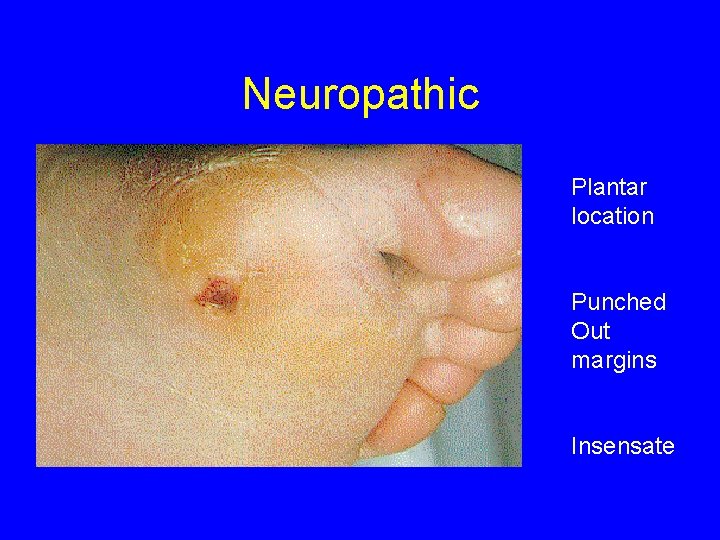
Neuropathic Plantar location Punched Out margins Insensate
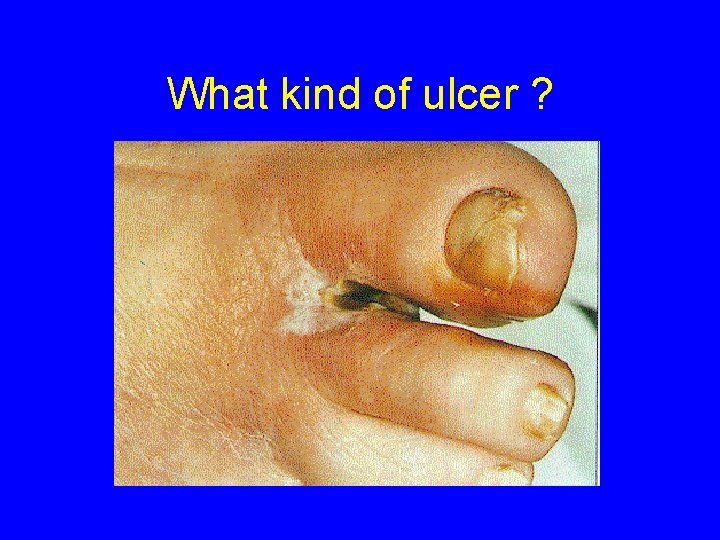
What kind of ulcer ?
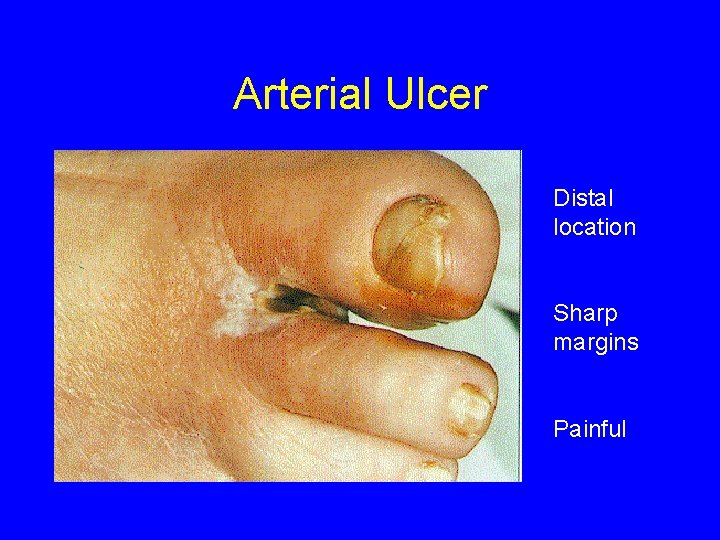
Arterial Ulcer Distal location Sharp margins Painful
What kind of ulcer ?
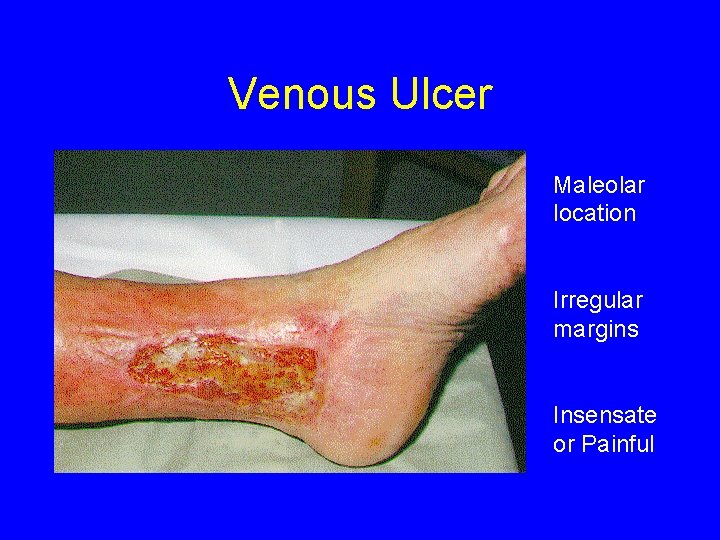
Venous Ulcer Maleolar location Irregular margins Insensate or Painful
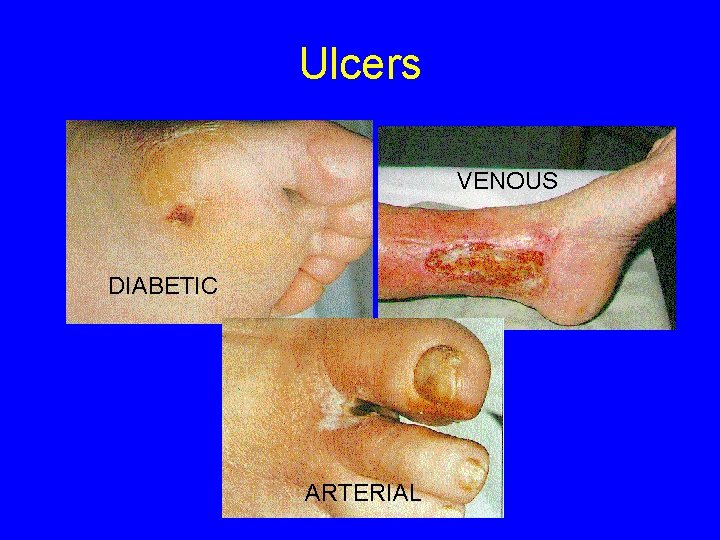
Ulcers VENOUS DIABETIC ARTERIAL
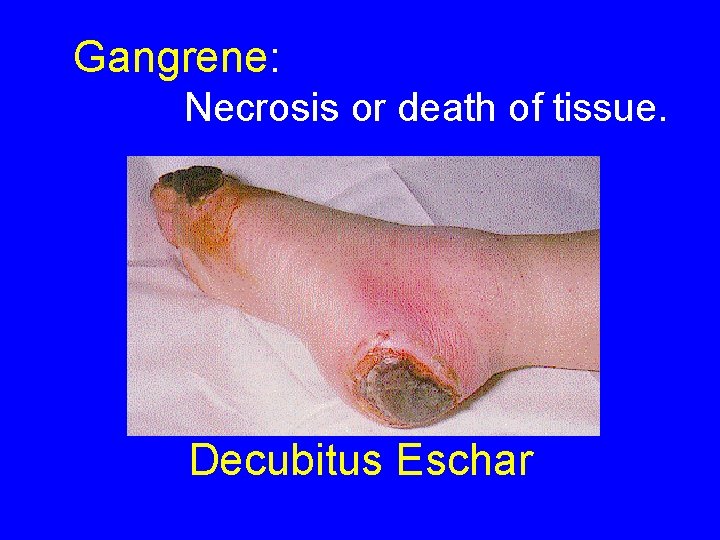
Gangrene: Necrosis or death of tissue. Decubitus Eschar
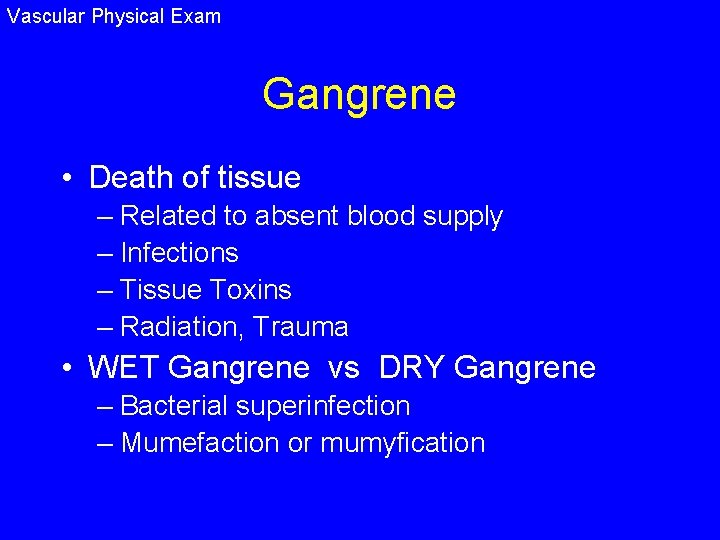
Vascular Physical Exam Gangrene • Death of tissue – Related to absent blood supply – Infections – Tissue Toxins – Radiation, Trauma • WET Gangrene vs DRY Gangrene – Bacterial superinfection – Mumefaction or mumyfication
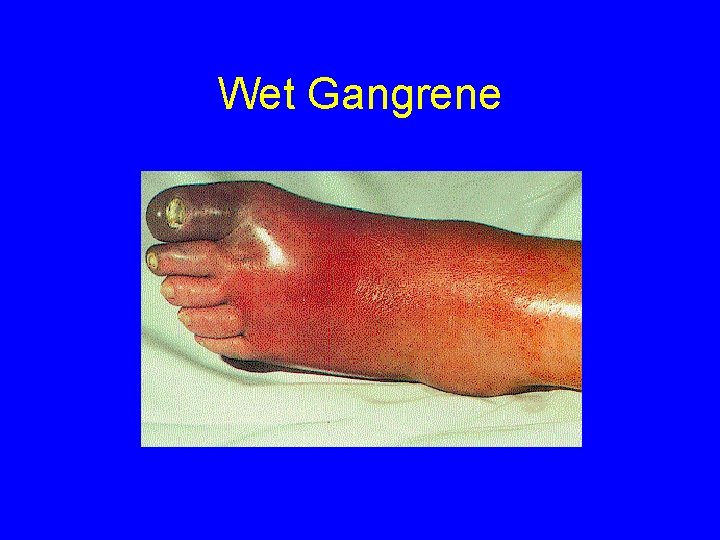
Wet Gangrene
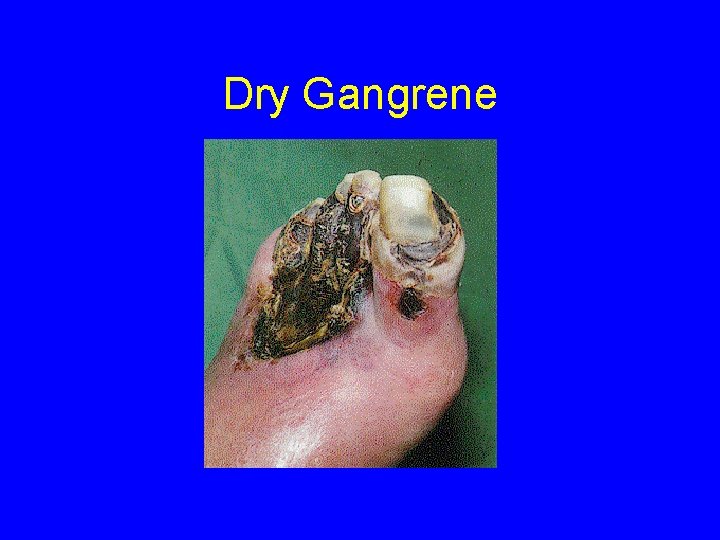
Dry Gangrene
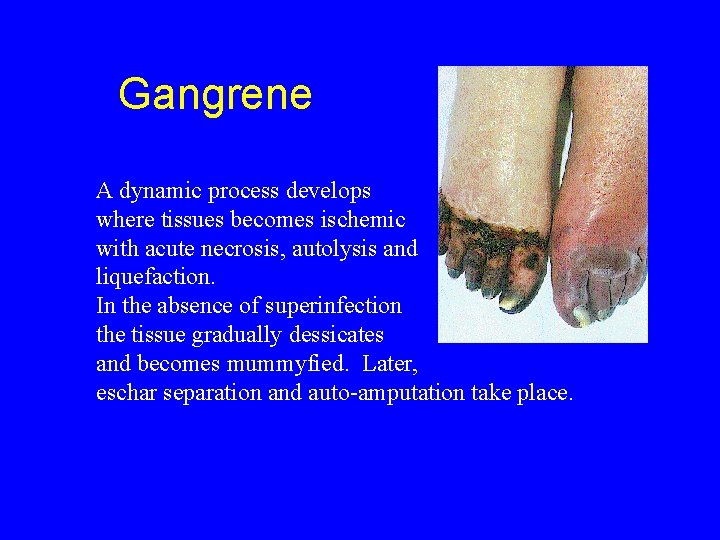
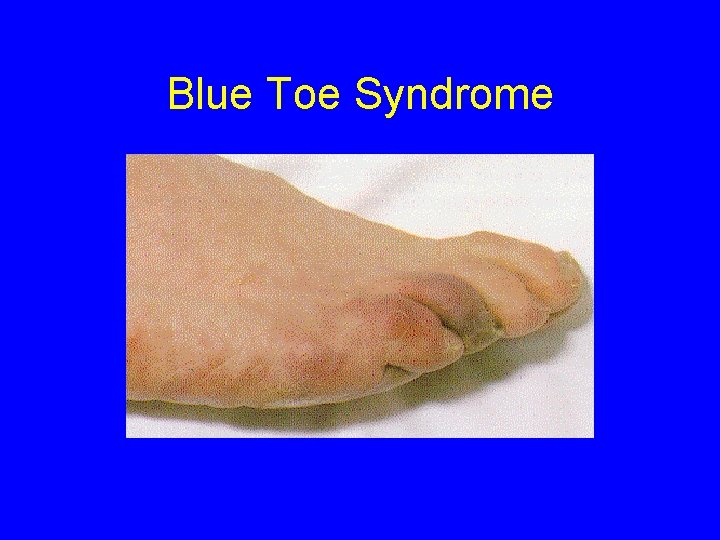
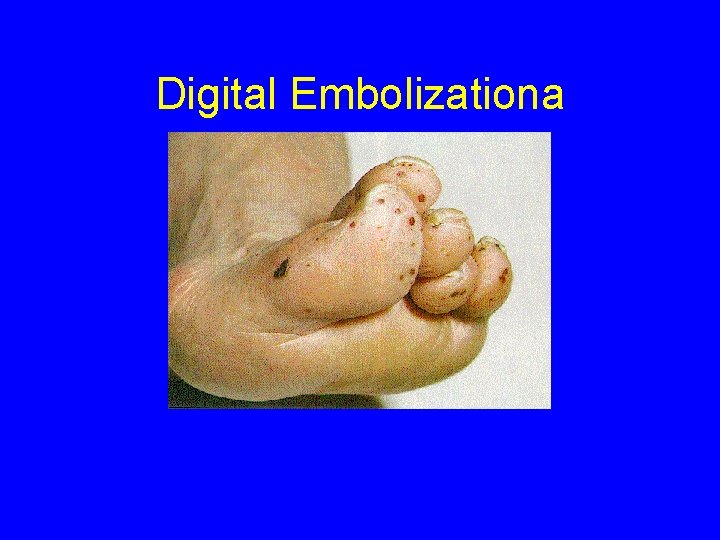
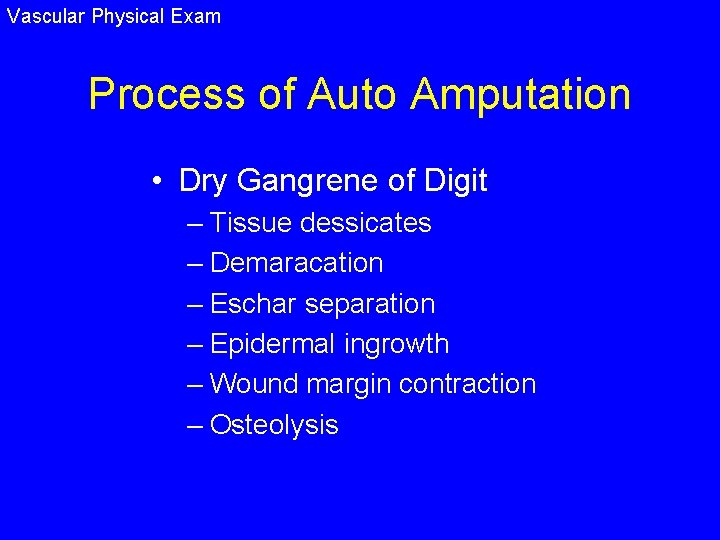
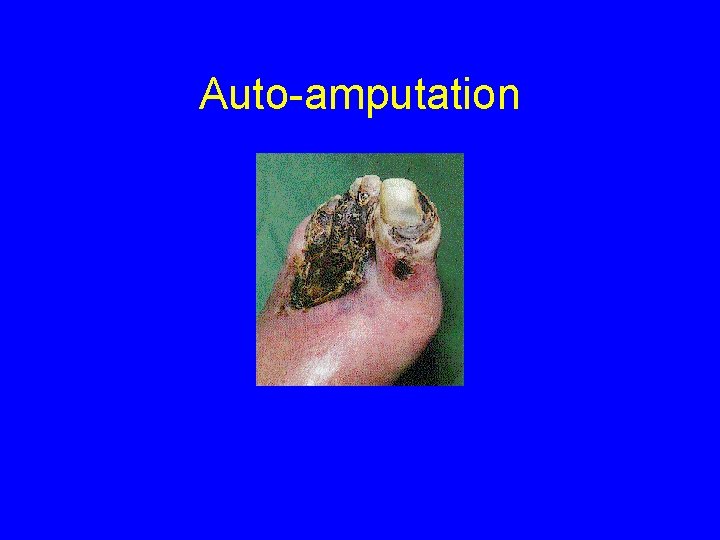
Gangrene A dynamic process develops where tissues becomes ischemic with acute necrosis, autolysis and liquefaction. In the absence of superinfection the tissue gradually dessicates and becomes mummyfied. Later, eschar separation and auto-amputation take place.
Blue Toe Syndrome
Digital Embolizationa
Vascular Physical Exam Process of Auto Amputation • Dry Gangrene of Digit – Tissue dessicates – Demaracation – Eschar separation – Epidermal ingrowth – Wound margin contraction – Osteolysis
Auto-amputation
Vascular Physical Exam Methods: Prepare your patient for exam: • • be sure room temperature is correct be sure limb position is as needed be sure privacy is respected place patient in correct position: supine on exam table is generally best • uncover area to be examined
Vascular Physical Exam Methods: Discuss what you are about to do • inform patient of intention of examination • explain how exam will be conducted
Vascular Physical Exam Methods: Prepare Yourself for the Exam • approach exam systematically • compare bilaterally • review patient complaints as exam progresses
Vascular Physical Exam Methods: Follow Exam Sequence • • • observe auscultate lightly touch palpate compress
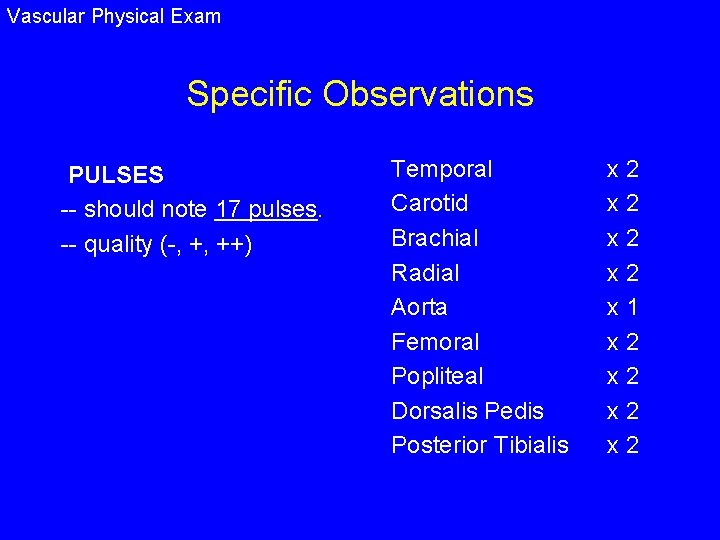
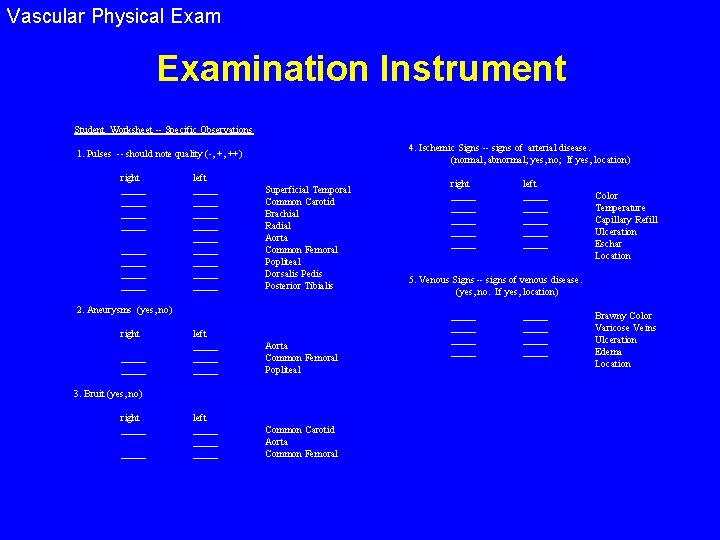
Vascular Physical Exam Specific Observations PULSES -- should note 17 pulses. -- quality (-, +, ++) Temporal Carotid Brachial Radial Aorta Femoral Popliteal Dorsalis Pedis Posterior Tibialis x 2 x 2 x 1 x 2 x 2
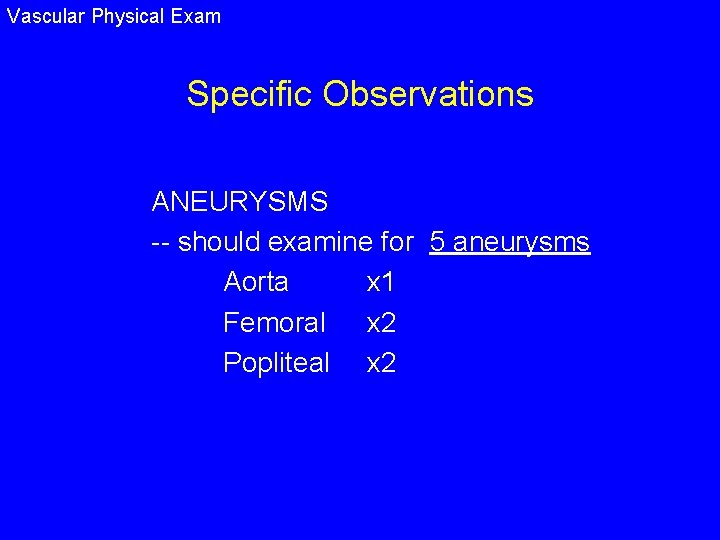
Vascular Physical Exam Specific Observations ANEURYSMS -- should examine for 5 aneurysms Aorta x 1 Femoral x 2 Popliteal x 2
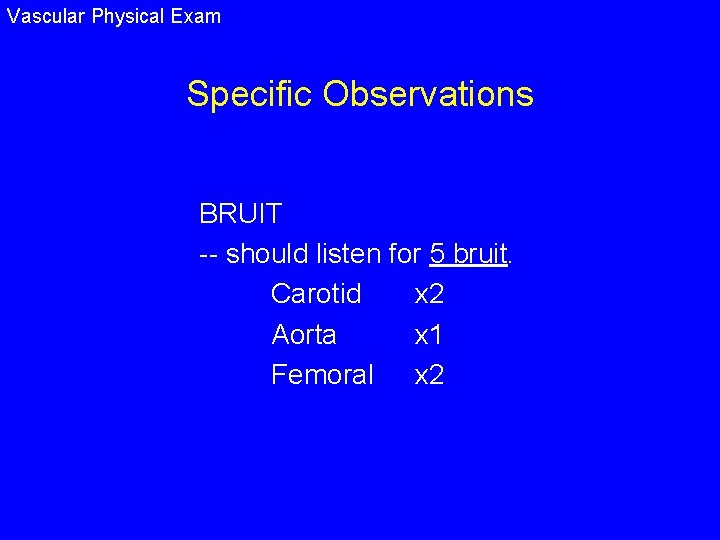
Vascular Physical Exam Specific Observations BRUIT -- should listen for 5 bruit. Carotid x 2 Aorta x 1 Femoral x 2
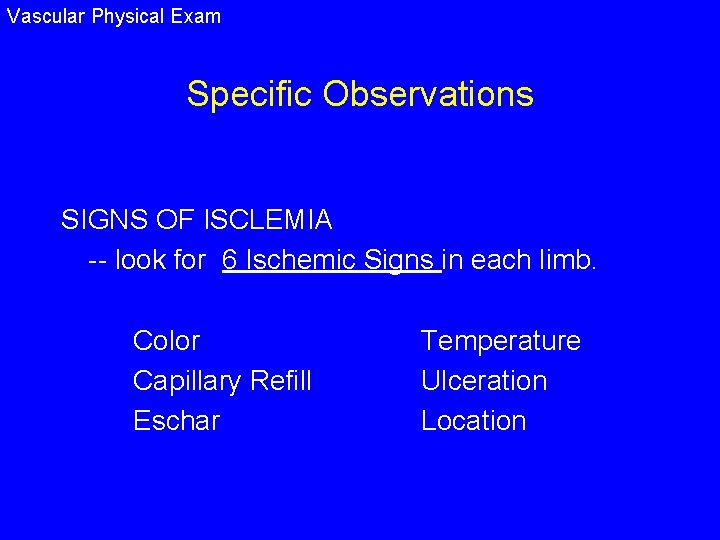
Vascular Physical Exam Specific Observations SIGNS OF ISCLEMIA -- look for 6 Ischemic Signs in each limb. Color Temperature Capillary Refill Ulceration Eschar Location
Vascular Physical Exam Specific Observations VENOUS SIGNS -- look for 5 Venous Signs in each limb Brawny Color Varicose Veins Ulceration Edema Location
Vascular Physical Exam Evidence Testing • • • Scenario #1: Patient complains of calf claudication Scenario #2: Patient complains of thigh claudication Scenario #3: Patient complains of buttock claudication Scenario #4: Patient complains of leg swelling Scenario #5: Patient complains of cold feet Scenario #6: Patient complains of pulsatile mass in abdomen
Evidence Testing • Scenario #1: Patient complains of calf claudication • Consider that the ischemic symptom develops in the affected muscle bed. • The affected muscle bed lies downstream from the causative lesion.
Evidence Testing • Scenario #1: Patient complains of calf claudication • Femoral pulses would be present • Distal (DP / PT) would probably be absent • Popliteal pulses may be present, but more commonly the arterial lesion is in the SFA and the popliteal pulse is absent. • Distal signs of chronic ischemia would be present
Vascular Physical Examination Instrument Student Worksheet -- Specific Observations 1. Pulses -- should note quality (-, +, ++) right left _____ _____ _____ _____ _____ Superficial Temporal Common Carotid Brachial Radial Aorta Common Femoral Popliteal Dorsalis Pedis Posterior Tibialis 2. Aneurysms (yes, no) right _____ left _____ Aorta Common Femoral Popliteal 3. Bruit (yes, no) right _____ left _____ Common Carotid Aorta Common Femoral 4. Ischemic Signs -- signs of arterial disease. (normal, abnormal; yes, no; If yes, location) right left _____ Color _____ Temperature _____ Capillary Refill _____ Ulceration _____ Eschar Location 5. Venous Signs -- signs of venous disease. (yes, no. If yes, location) _____ Brawny Color _____ Varicose Veins _____ Ulceration _____ Edema Location
Conclusion • • Reviewed the Vascular exam Reviewed exam techniques Discussed common findings Discussed relation between patient symptoms and exam findings • Next step … Med West
Vascular Physical Exam PE Module -- Organization • • • Med West clinical examination facility exam rooms available today model patients All normal exams Goal: Practice normal exam on different patients • Goal: Practice self-evaluation
Vascular Physical Exam PE Module -- Organization • • • 34 students 8 model patients Students subdivide into Groups of 4 4 patient exams per Groups rotate exam every 20 min Assemble at end for discussion
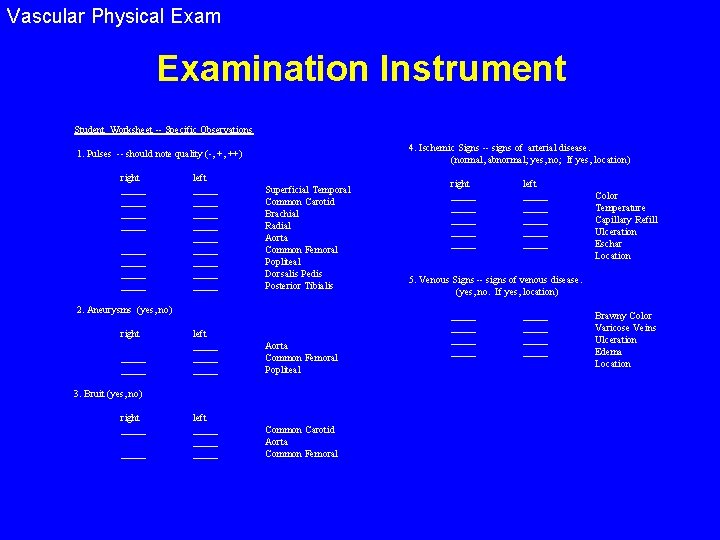
Vascular Physical Examination Instrument Student Worksheet -- Specific Observations 1. Pulses -- should note quality (-, +, ++) right left _____ _____ _____ _____ _____ Superficial Temporal Common Carotid Brachial Radial Aorta Common Femoral Popliteal Dorsalis Pedis Posterior Tibialis 2. Aneurysms (yes, no) right _____ left _____ Aorta Common Femoral Popliteal 3. Bruit (yes, no) right _____ left _____ Common Carotid Aorta Common Femoral 4. Ischemic Signs -- signs of arterial disease. (normal, abnormal; yes, no; If yes, location) right left _____ Color _____ Temperature _____ Capillary Refill _____ Ulceration _____ Eschar Location 5. Venous Signs -- signs of venous disease. (yes, no. If yes, location) _____ Brawny Color _____ Varicose Veins _____ Ulceration _____ Edema Location
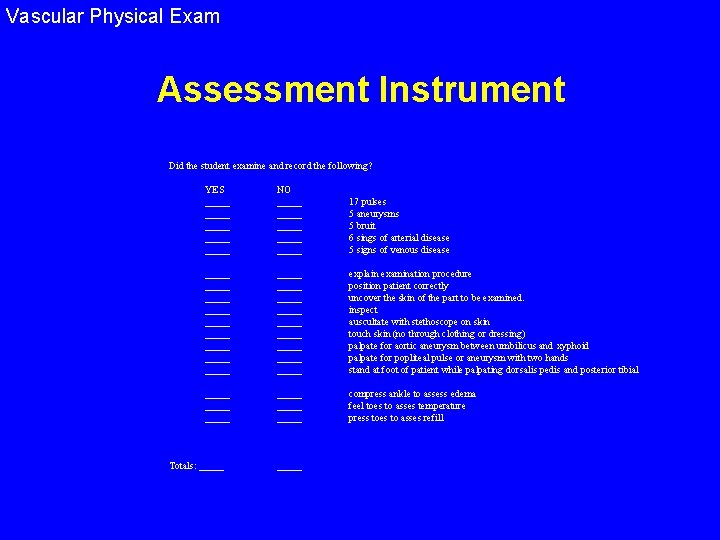
Vascular Physical Exam Assessment Instrument Did the student examine and record the following? YES NO _____ 17 pulses _____ 5 aneurysms _____ 5 bruit _____ 6 sings of arterial disease _____ 5 signs of venous disease _____ explain examination procedure _____ position patient correctly _____ uncover the skin of the part to be examined. _____ inspect _____ auscultate with stethoscope on skin _____ touch skin (no through clothing or dressing) _____ palpate for aortic aneurysm between umbilicus and xyphoid _____ palpate for popliteal pulse or aneurysm with two hands _____ stand at foot of patient while palpating dorsalis pedis and posterior tibial _____ Totals: _____ _____ compress ankle to assess edema feel toes to asses temperature press toes to asses refill
- Slides: 63