
Physical Examination and restraining of Dogs and Cats







- Slides: 39
Physical Examination and restraining of Dogs and Cats 08 Jan, 2020
General considerations • Danger potential: canine teeth • Behavioral characteristics: vary with breed to breed • Physical examination/restraints – A good physical examination can detect minor abnormalities before they become serious problems – Careful pre-operative assessment is necessary for selection of appropriate anesthetic protocols
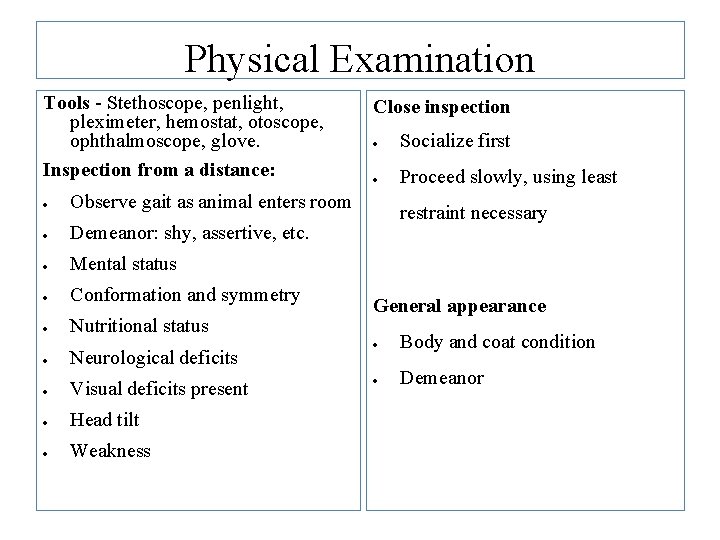
General considerations • Be consistent and thorough: head to tail • Write it down • Back off: Don’t forget to back up and examine the animal from a distance. Note how he or she walks, sits, breathes, etc. • Use restraint • Say Hello • Learn from your experience • Tools: Stethoscope, penlight, pleximeter, hemostat, otoscope, ophthalmoscope, glove.
Component of physical examination • Requires concentration and consistency in performance • Always use the same order of examination, head to tail
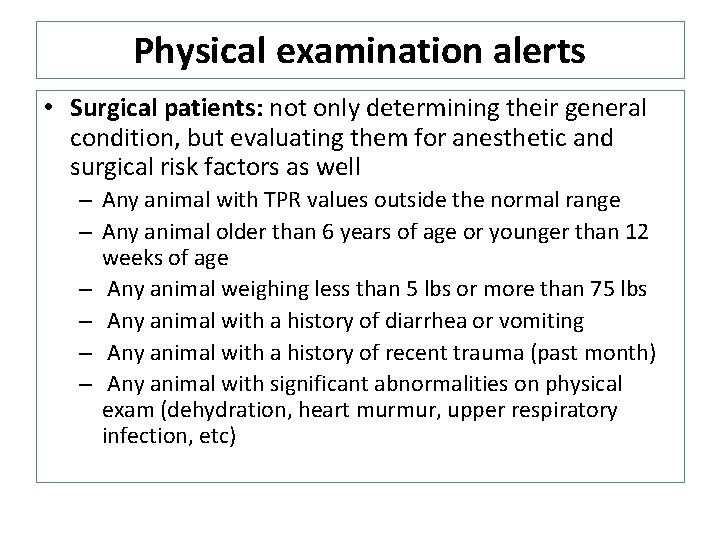
Physical examination alerts • Surgical patients: not only determining their general condition, but evaluating them for anesthetic and surgical risk factors as well – Any animal with TPR values outside the normal range – Any animal older than 6 years of age or younger than 12 weeks of age – Any animal weighing less than 5 lbs or more than 75 lbs – Any animal with a history of diarrhea or vomiting – Any animal with a history of recent trauma (past month) – Any animal with significant abnormalities on physical exam (dehydration, heart murmur, upper respiratory infection, etc)
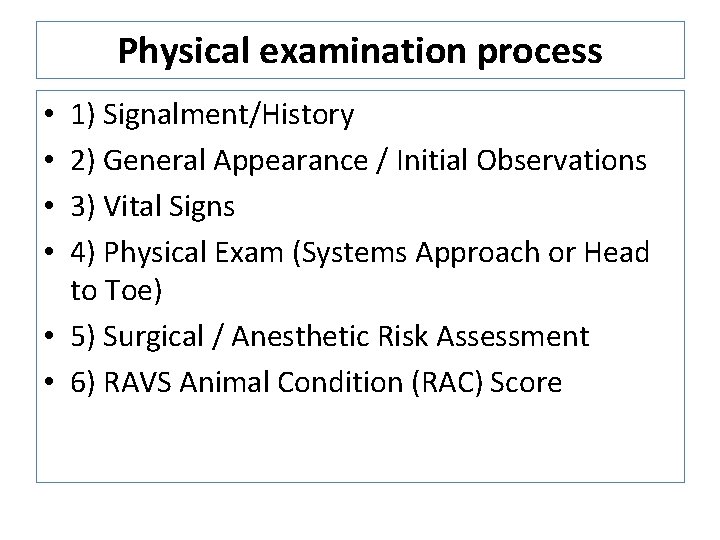
Physical examination process 1) Signalment/History 2) General Appearance / Initial Observations 3) Vital Signs 4) Physical Exam (Systems Approach or Head to Toe) • 5) Surgical / Anesthetic Risk Assessment • 6) RAVS Animal Condition (RAC) Score • •
Physical examination process • Signalment – Complete description of the animal – Species, Breed, Age, Sex, Reproductive status, other distinguishing characteristics – Always double-check client reported information (sex, age, etc) – Keep this information in mind as you examine the animal and make clinical judgments. • History – Greet the client and pet by name at the beginning of the office visit. Continue to talk to the animal and call it by name during the examination – Try to make the examination enjoyable for the pet or at least as least stressful as possible. Owners are impressed if you know the breed of their pet.
Physical examination process – Includes environment, diet, medical history, reproductive history, vaccination status and current medications. – Description and history of chief/presenting complaint – Reported concerns should be followed up with additional questions to clarify nature of the complaint – Avoid leading questions: asking “Have you seen the animal’s stool recently? ” instead of “Has the animal had diarrhea? ” – Record observations, not interpretations
Physical examination process Past history • Vaccination history - Type and dates. • Major medical, surgical problems • Family history of the pet. Have any related animals displayed similar signs or problems? • Home environment-indoor/outdoor, confinement, other pets? Health of other pets? • Travel history-some diseases are endemic to certain areas of U. S. • Diet- Type, frequency, any recent changes in diet? History of present illness • Has the pet received any medications? Have they altered the clinical signs? • Duration of clinical signs?
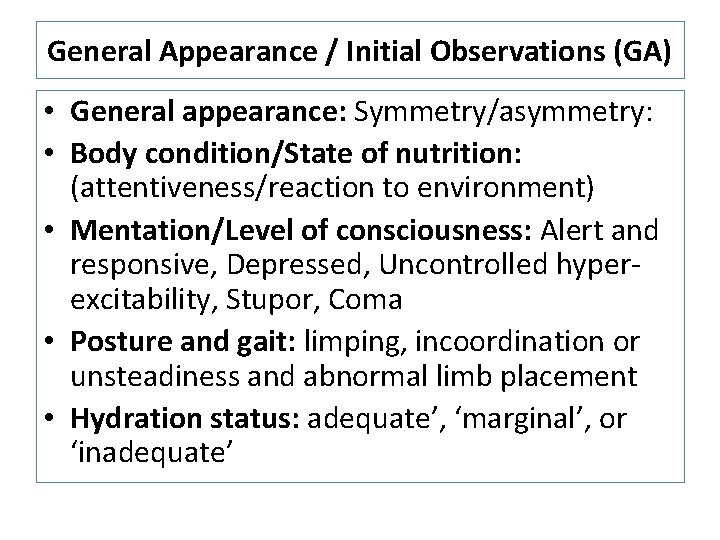
General Appearance / Initial Observations (GA) • General appearance: Symmetry/asymmetry: • Body condition/State of nutrition: (attentiveness/reaction to environment) • Mentation/Level of consciousness: Alert and responsive, Depressed, Uncontrolled hyperexcitability, Stupor, Coma • Posture and gait: limping, incoordination or unsteadiness and abnormal limb placement • Hydration status: adequate’, ‘marginal’, or ‘inadequate’
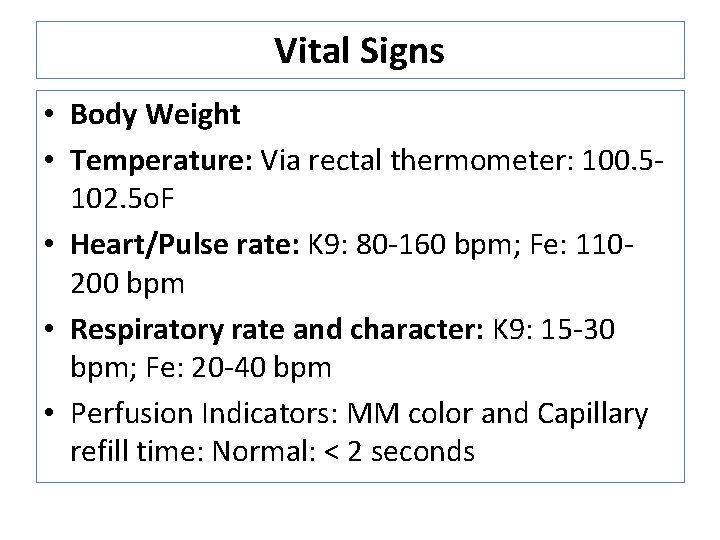
Vital Signs • Body Weight • Temperature: Via rectal thermometer: 100. 5102. 5 o. F • Heart/Pulse rate: K 9: 80 -160 bpm; Fe: 110200 bpm • Respiratory rate and character: K 9: 15 -30 bpm; Fe: 20 -40 bpm • Perfusion Indicators: MM color and Capillary refill time: Normal: < 2 seconds
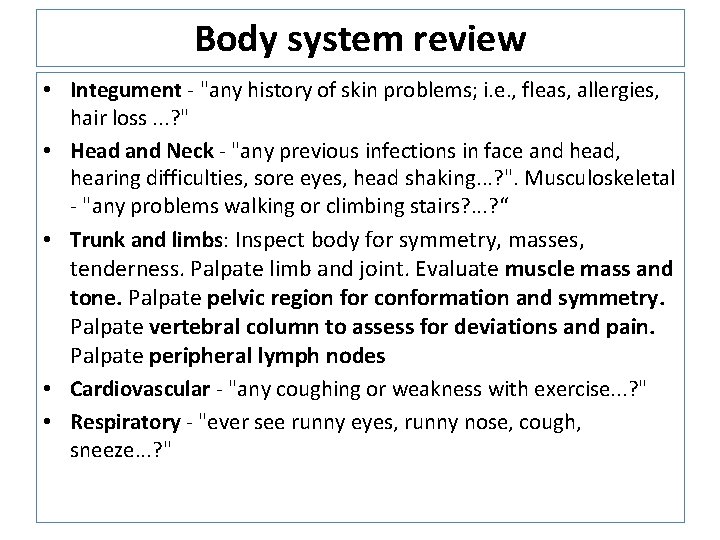
Body system review • Integument - "any history of skin problems; i. e. , fleas, allergies, hair loss. . . ? " • Head and Neck - "any previous infections in face and head, hearing difficulties, sore eyes, head shaking. . . ? ". Musculoskeletal - "any problems walking or climbing stairs? . . . ? “ • Trunk and limbs: Inspect body for symmetry, masses, tenderness. Palpate limb and joint. Evaluate muscle mass and tone. Palpate pelvic region for conformation and symmetry. Palpate vertebral column to assess for deviations and pain. Palpate peripheral lymph nodes • Cardiovascular - "any coughing or weakness with exercise. . . ? " • Respiratory - "ever see runny eyes, runny nose, cough, sneeze. . . ? "
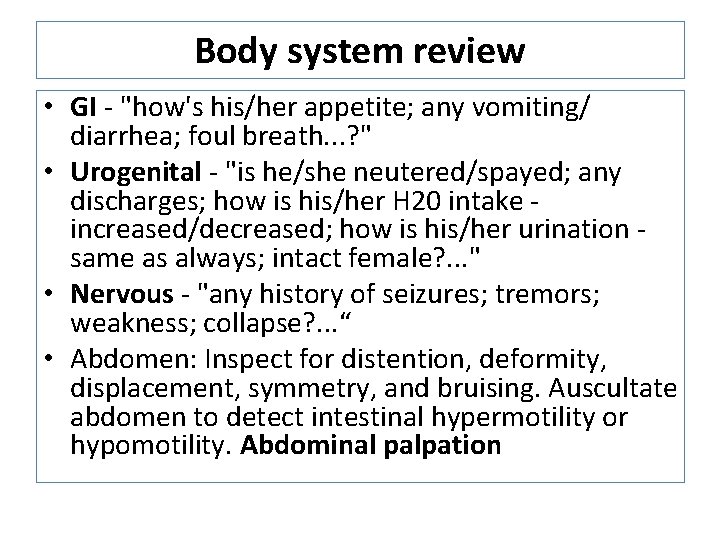
Body system review • GI - "how's his/her appetite; any vomiting/ diarrhea; foul breath. . . ? " • Urogenital - "is he/she neutered/spayed; any discharges; how is his/her H 20 intake increased/decreased; how is his/her urination same as always; intact female? . . . " • Nervous - "any history of seizures; tremors; weakness; collapse? . . . “ • Abdomen: Inspect for distention, deformity, displacement, symmetry, and bruising. Auscultate abdomen to detect intestinal hypermotility or hypomotility. Abdominal palpation
Surgical / Anesthetic Risk Factors • Aspiration pneumonia • Fetal death • Comma
Physical Examination Tools - Stethoscope, penlight, pleximeter, hemostat, otoscope, ophthalmoscope, glove. Inspection from a distance: Observe gait as animal enters room Demeanor: shy, assertive, etc. Mental status Conformation and symmetry Nutritional status Neurological deficits Visual deficits present Head tilt Weakness Close inspection Socialize first Proceed slowly, using least restraint necessary General appearance Body and coat condition Demeanor
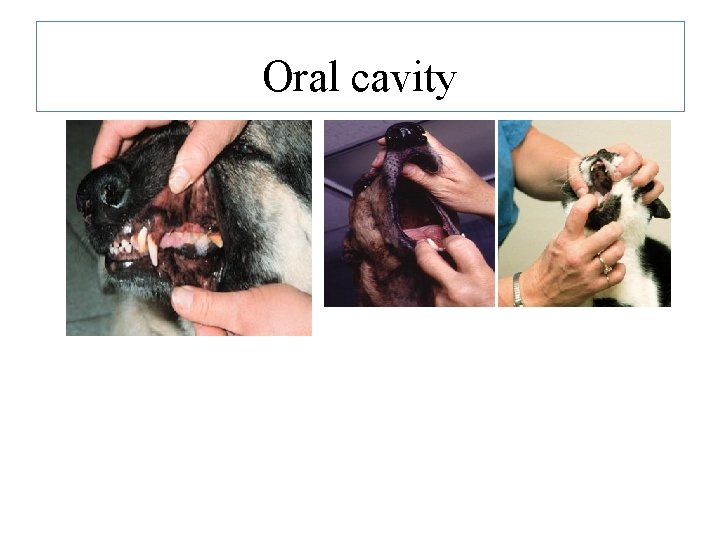
Oral cavity
Body defense system • Organisms and host are live in hostile environment and unfriendly • Assaulted by hordes of microorganisms • Repair and replace is a continuous process
Immunity • Body has developed an efficient system of defense against disease-producing agentsimmune system: petrol the body 24 h a day • Activity of this system- called immunity • No immunity impossible survive • Two type immunity – Non-specific immunity – Specific immunity
Immunity Non-specific immunity: The system responds to all antigenic insults in the same manner, not specifically to any one type of pathogenic organism • Species resistance: canine – NOT infected by feline leukemia • Mechanical and chemical barriers – Skin: sebum, mucus, and enzymes that act to inhibit or destroy pathogens – Mucous membrane: defense against the world of microorganisms. It is called the “first line of defense. ” • Interferon and complement
Immunity • Inflammatory response: – “second line of defense” Tissue is invaded by microorganisms or injured in any way>>>>> release enzymes – mediators: attract WBC to the area (chemotaxis), dilate blood vessels, and increase the permeability of the vessels- characteristic signs of inflammation—heat, redness, swelling, and pain. Neutrophils attracted to the area will begin to “gobble up” the invading foreign materials- phagocytosis. • Interferon and complement – Interferon is a substance that interferes with the ability of viruses to cause disease by preventing their replication within the host cell. – Complement, another group of enzymes, is activated during infections. Complement binds to the invading cell wall, producing small holes in the membrane. This results in rupture, or lysis, of the foreign cell
Immunity • Specific immunity: Third line of defense. Two types of lymphocytes are involved to produce specific immunity (B- and T- lymphocytes). – B-Lymphocytes: produce antibody in response to specific antigen stimulation (humoral response). – T-lymphocytes interact more directly with the pathogens by combining directly with the foreign cell and destroying- this response is more direct than B-cell, cell mediated immunity
Immunity – Humoral Immunity: B-cell response (humoral) is a slower type of immune response.
Handling • Before handling the animal get his/her attention. Call the pet by name and encourage him/her to come to you • Never surprise the animal by approaching from behind. • Let the animal sniff your hand, then slowly move your hand to touch the side of the face then stroke the top of the head.
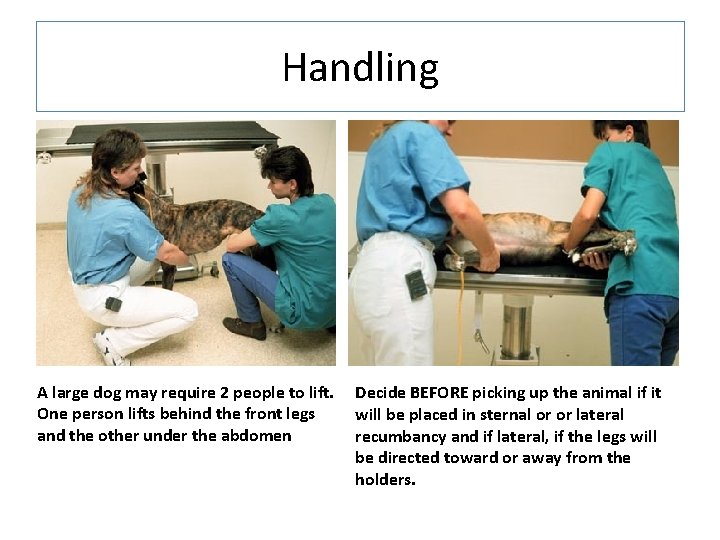
Handling A large dog may require 2 people to lift. One person lifts behind the front legs and the other under the abdomen Decide BEFORE picking up the animal if it will be placed in sternal or or lateral recumbancy and if lateral, if the legs will be directed toward or away from the holders.
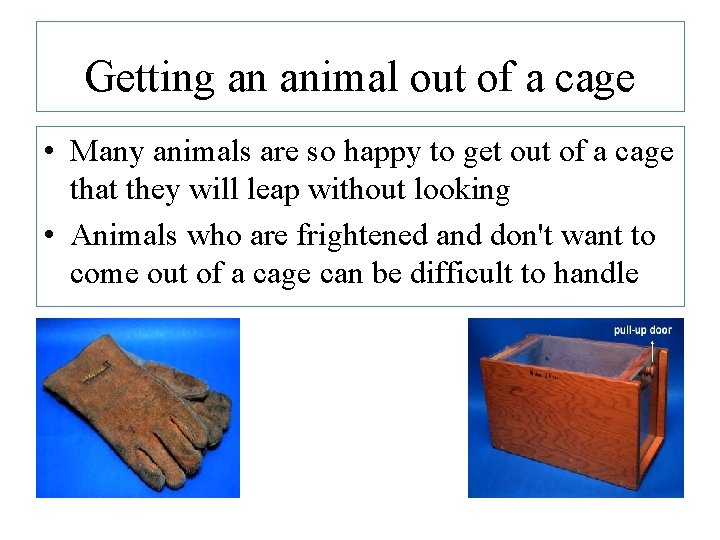
Getting an animal out of a cage • Many animals are so happy to get out of a cage that they will leap without looking • Animals who are frightened and don't want to come out of a cage can be difficult to handle
Getting an animal out of a cage This net bag can be opened and used to catch a small animal in a cage, then closed, trapping the animal in the net. The animal can be handled through the netting to give injections or place catheters
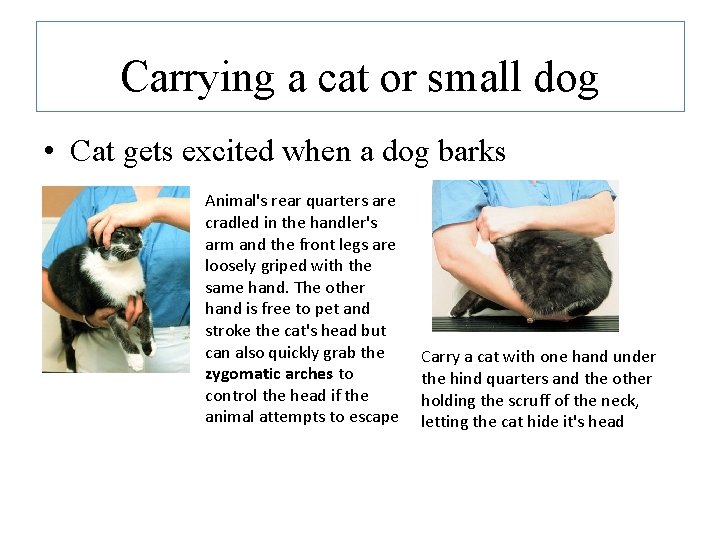
Carrying a cat or small dog • Cat gets excited when a dog barks Animal's rear quarters are cradled in the handler's arm and the front legs are loosely griped with the same hand. The other hand is free to pet and stroke the cat's head but can also quickly grab the zygomatic arches to control the head if the animal attempts to escape Carry a cat with one hand under the hind quarters and the other holding the scruff of the neck, letting the cat hide it's head
Restraint • More is NOT better. The LEAST amount of restraint that is needed should be applied • Excessive restraint becomes a test of wills and animals become stubborn and not give up • "Talk to the animals" Many dogs and cats can be comforted by being talked to in a quiet, soothing voice. What you say is not important. . . the tone of voice is.
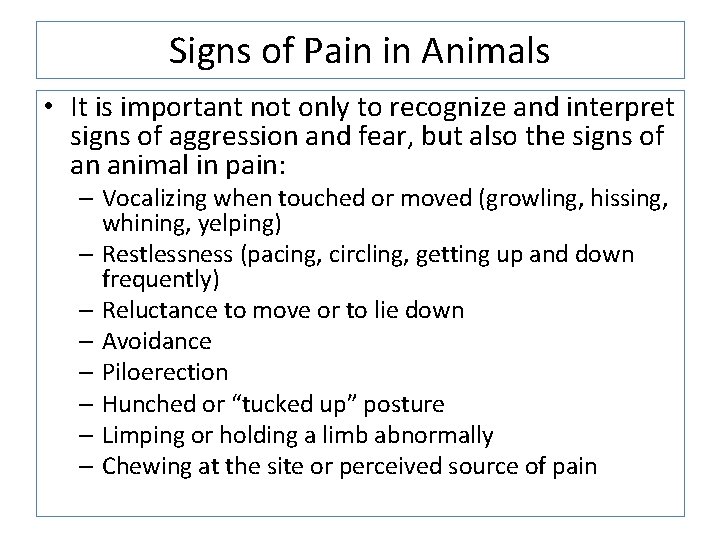
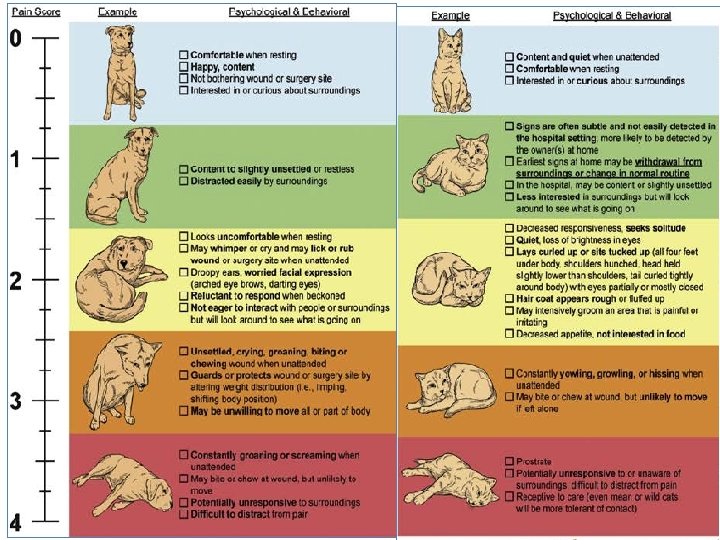
Signs of Pain in Animals • It is important not only to recognize and interpret signs of aggression and fear, but also the signs of an animal in pain: – Vocalizing when touched or moved (growling, hissing, whining, yelping) – Restlessness (pacing, circling, getting up and down frequently) – Reluctance to move or to lie down – Avoidance – Piloerection – Hunched or “tucked up” posture – Limping or holding a limb abnormally – Chewing at the site or perceived source of pain
Methods of restraint • Physical restrain: Physical restraint means that the animal is physically held by a person in such a manner that it cannot escape or cause harm to itself or to personnel. • Chemical restraint: sedative or a tranquilizer
Purpose • To safely and securely control the patient for a variety of procedures • To move the patient from one area of the facility to another • To provide for the safety of the patient and the staff
Complications • • • Trauma including bruises and lacerations Fracture of long bones and spinal injury Asphyxia and strangulation Evacuation of bladder, bowel, and anal sacs Exacerbating existing injuries Injury to personnel
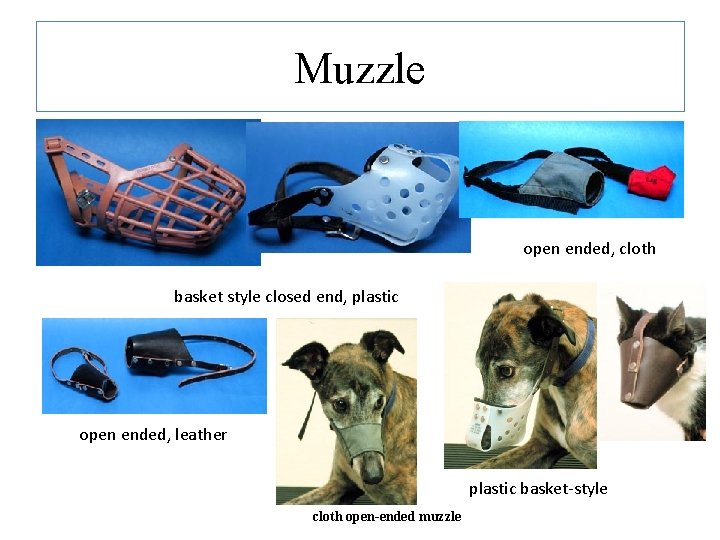
Muzzle open ended, cloth basket style closed end, plastic open ended, leather plastic basket-style cloth open-ended muzzle
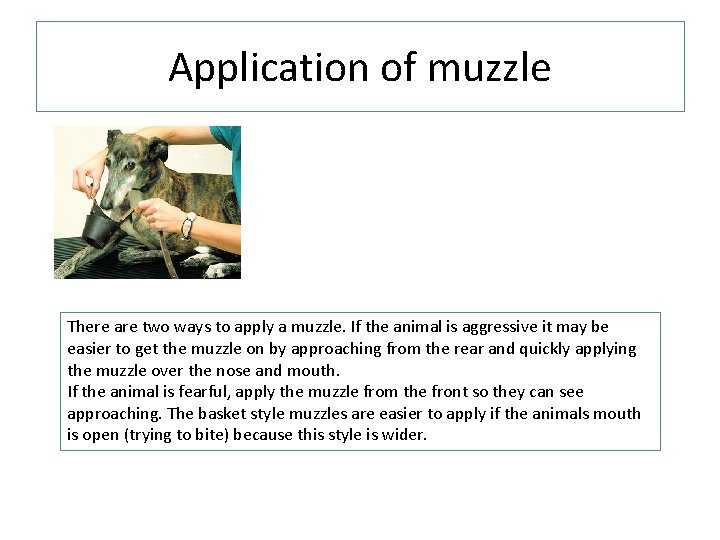
Application of muzzle There are two ways to apply a muzzle. If the animal is aggressive it may be easier to get the muzzle on by approaching from the rear and quickly applying the muzzle over the nose and mouth. If the animal is fearful, apply the muzzle from the front so they can see approaching. The basket style muzzles are easier to apply if the animals mouth is open (trying to bite) because this style is wider.
Application of muzzle
Cat restraint bag
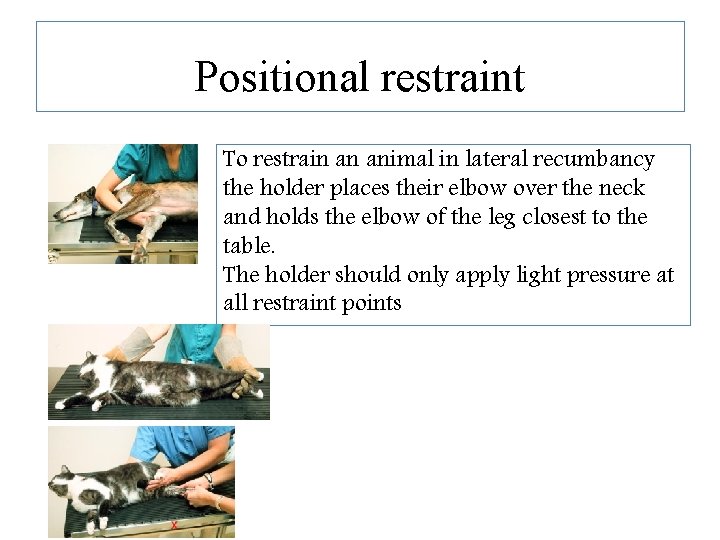
Positional restraint To restrain an animal in lateral recumbancy the holder places their elbow over the neck and holds the elbow of the leg closest to the table. The holder should only apply light pressure at all restraint points
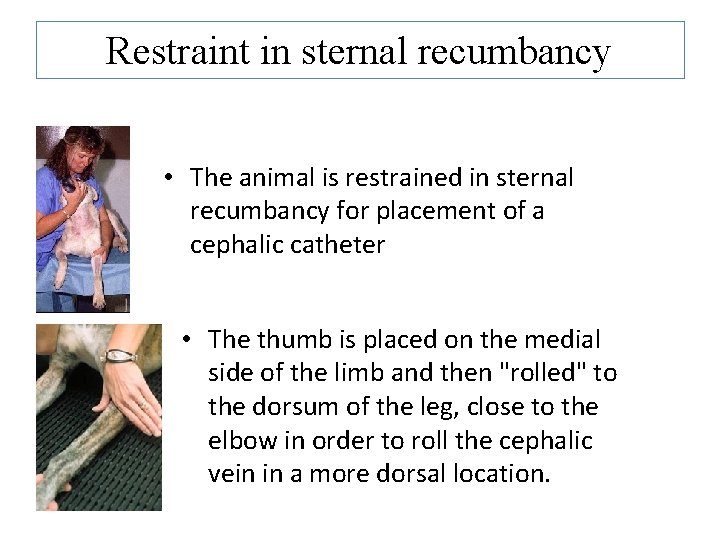
Restraint in sternal recumbancy • The animal is restrained in sternal recumbancy for placement of a cephalic catheter • The thumb is placed on the medial side of the limb and then "rolled" to the dorsum of the leg, close to the elbow in order to roll the cephalic vein in a more dorsal location.