
Physical Exam of the Newborn LOG 3 RET
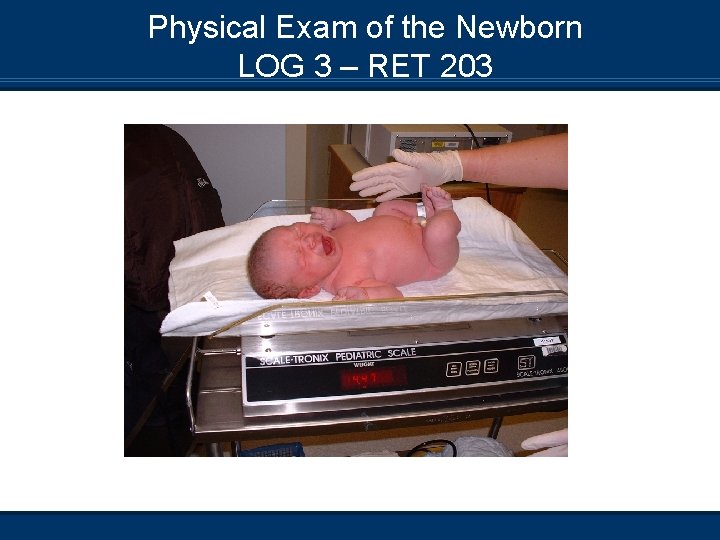
Physical Exam of the Newborn LOG 3 – RET 203
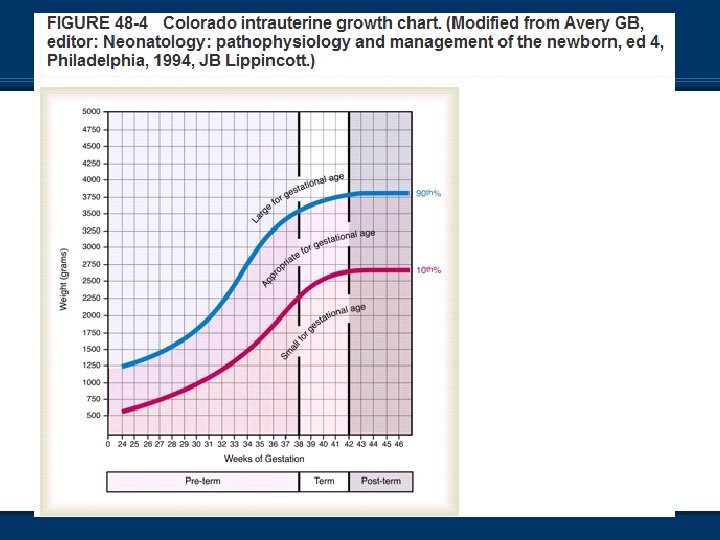
Prematurity n 37 - 40 Weeks’ gestation is considered “Term” n 32 - 36 Prematurity – Lower percentage of infants ventilated n 28 - 32 Prematurity – Half the infants in need of mechanical ventilation n 24 - 28 Severe prematurity – Frequently in need of mechanical ventilation
Gestational Age Assessment Evaluating gestational age requires consideration of several factors. The three main factors are as follows n Gestational duration based on the last menstrual cycle n Prenatal ultrasound evaluation n Postnatal findings based on physical and neurologic examinations
Dubowitz Assessment Obtained during a routine physical exam Examines 11 physical signs and 10 neurological signs Each area is assigned a point value Points added up for a score that reflects a gestational age n Accurate to within 2 weeks and is used in the first 5 days of life n Problem – Takes a lot of time to do. n Both Dubowitz and Ballard are reliable, but the Ballard system is quicker n n
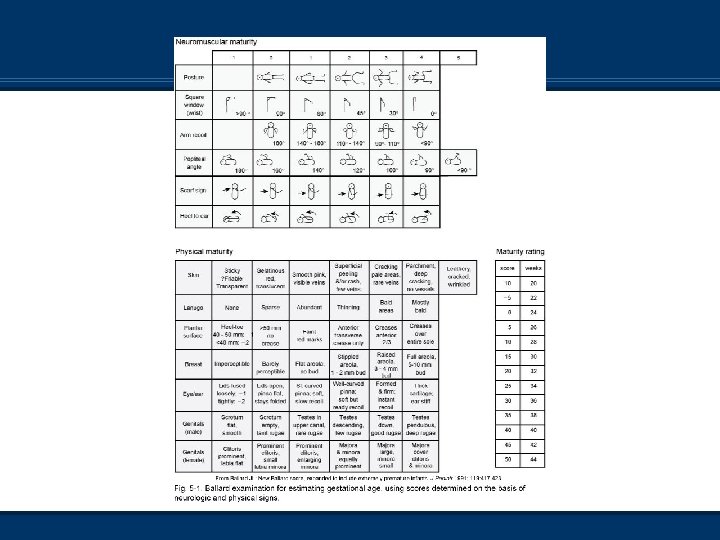
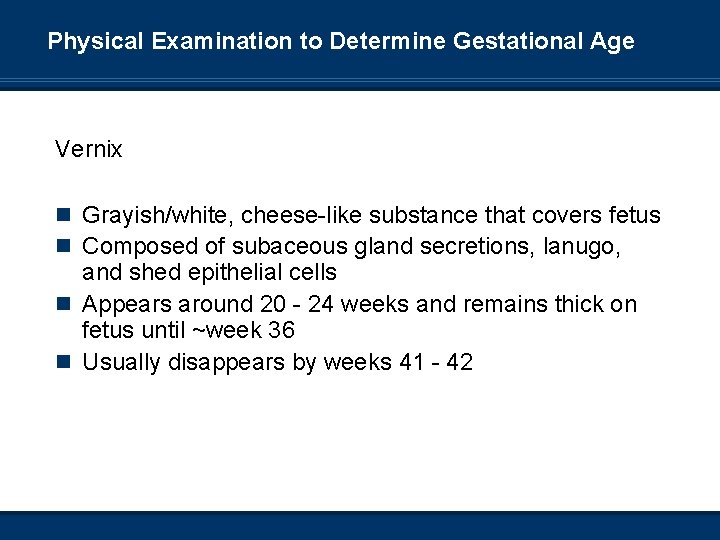
Physical Examination to Determine Gestational Age EXTERNAL CRITERIA: Vernix n Grayish/white, cheese-like substance that covers fetus n Composed of subaceous gland secretions, lanugo, and shed epithelial cells n Appears around 20 - 24 weeks and remains thick on fetus until ~week 36 n Usually disappears by weeks 41 - 42
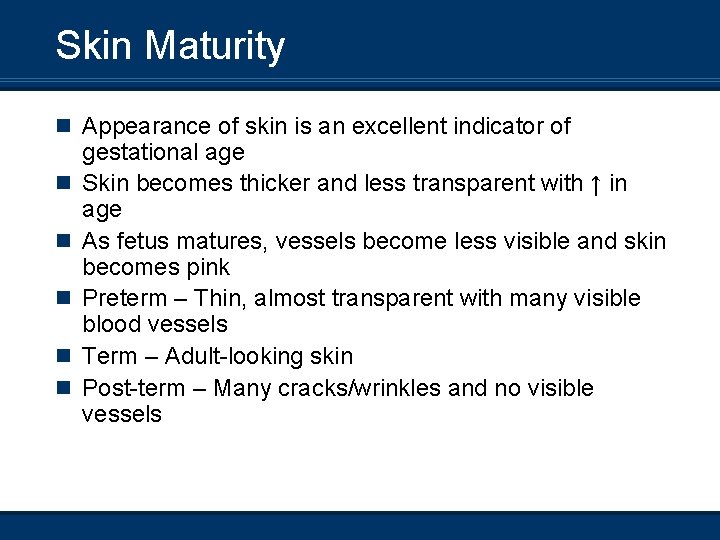
Skin Maturity n Appearance of skin is an excellent indicator of n n n gestational age Skin becomes thicker and less transparent with ↑ in age As fetus matures, vessels become less visible and skin becomes pink Preterm – Thin, almost transparent with many visible blood vessels Term – Adult-looking skin Post-term – Many cracks/wrinkles and no visible vessels
Nails n Always present n Post-term – Long fingernails Lanugo n Fine, downy hair that covers the fetal body n Appears at ~ week 26 and covers the thorax, head, and extremities n Slowly disappears as fetus matures n Term – Might have some lanugo on the shoulders and forehead, but usually gone by 40 weeks n More common in neonates with dark skin
Ear recoil n Examination of pinna (External portion of the ear) n Cartilage in ear is not fully present until around 34 weeks n At 25 - 26 weeks the pinna is basically flat and will remain folded if doubled over n As the cartilage grows, the recoil will increase n Recoils and looks similar to an adult at term Breast tissue/areola n 25 - 26 weeks – The breast is barely visible n 27 weeks – The areola is a bit visible but there is no palpable tissue n As fetus matures, areola grows and breast tissue increases

Sole creases n Creases on the soles of the foot (Plantar creases) n Increase in wrinkles as gestation increases n Prem – Starts as faint red lines, by term the entire sole is covered with deep creases
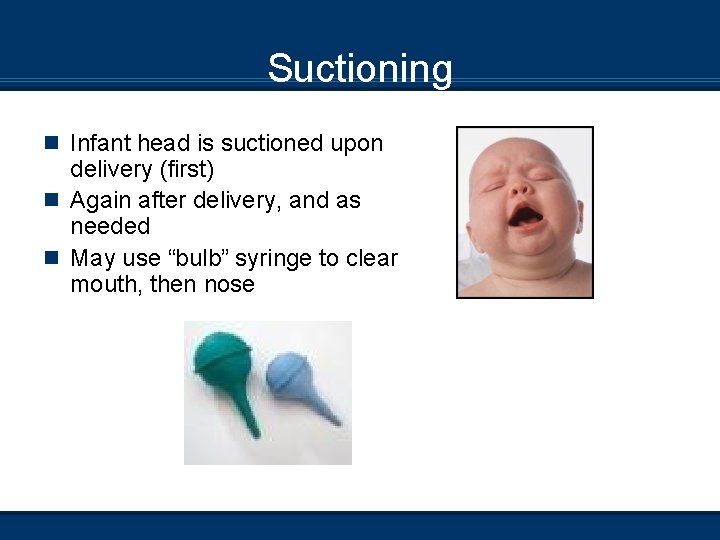
Suctioning n Infant head is suctioned upon delivery (first) n Again after delivery, and as needed n May use “bulb” syringe to clear mouth, then nose
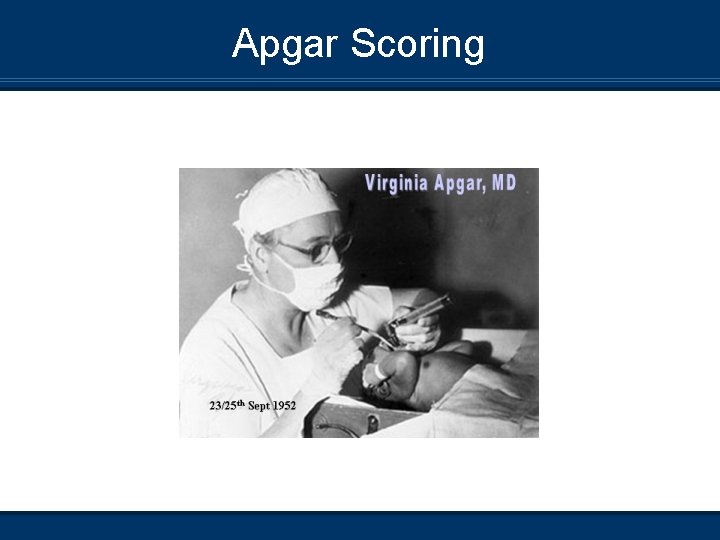
Apgar Scoring
Apgar n n n A – Appearance (Colour) P – Pulse G – Grimace (Reflex irritability) A – Activity (Muscle tone) R – Respiratory rate n Each of these categories is scored with 0, 1, or 2, depending on the observed condition of the newborn
Apgar Score Heart rate n Heart rate is evaluated by stethoscope. This is the most important assessment n If there is no heartbeat = scores 0 n Less than 100 beats per minute = scores 1 n Greater than 100 beats per minute = scores 2
Apgar Score Heart rate Assessed by 1. Palpating the base of the umbilical cord 2. Auscultating 3. Palpating the brachial/femoral artery
Apgar Score Respiratory effort n No respirations = scores 0 n Respirations are slow or irregular = scores 1 n Good crying = scores 2
Apgar Score Muscle tone n Muscle tone is flaccid = scores 0 n Some flexion of the extremities = scores 1 n Active motion = scores 2
Apgar Score Reflex irritability n Reflex irritability is a term describing the level of newborn irritation in response to stimuli (Such as a mild pinch) n No reaction = scores 0 n Grimacing = scores 1 n Grimacing and a cough, sneeze, or a vigorous cry = scores 2
Apgar Score Colour n Pale blue (Cyanotic) = scores 0 n Body is pink and the extremities are blue (Acrocyanosis) = scores 1 n Entire body is pink = scores 2
Apgar Score n The 1 -minute APGAR score assesses how well the infant tolerated the birthing process n The 5 -minute APGAR score assesses how well the newborn is adapting to the environment
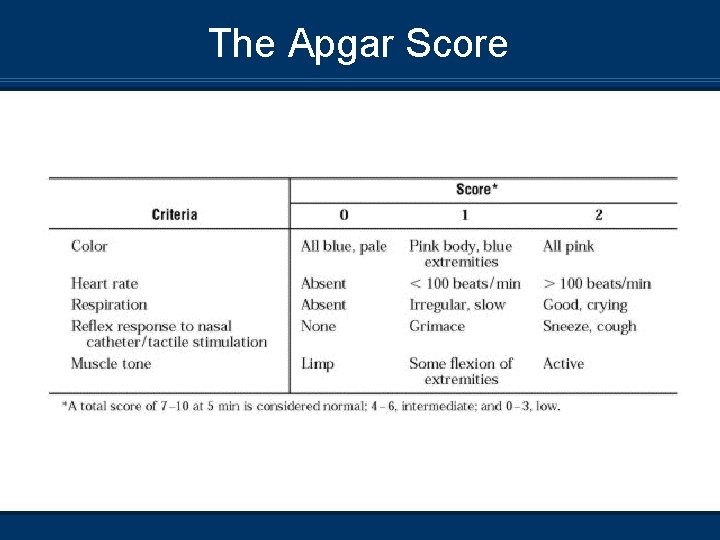
The Apgar Score
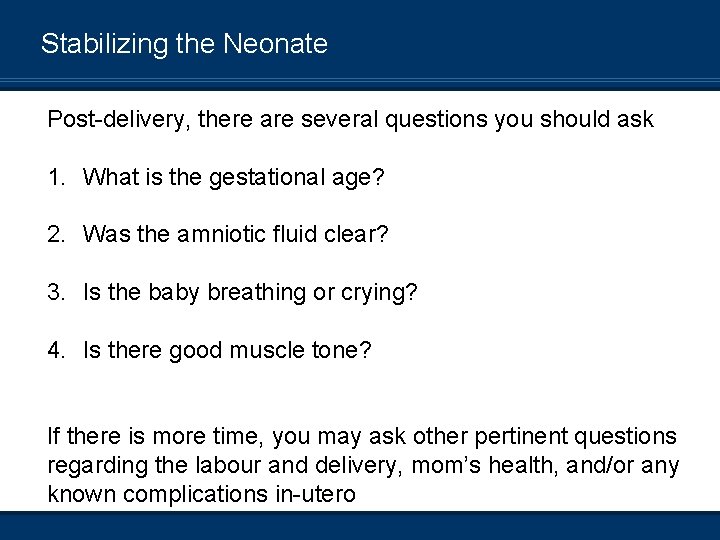
Stabilizing the Neonate Post-delivery, there are several questions you should ask 1. What is the gestational age? 2. Was the amniotic fluid clear? 3. Is the baby breathing or crying? 4. Is there good muscle tone? If there is more time, you may ask other pertinent questions regarding the labour and delivery, mom’s health, and/or any known complications in-utero
Stabilizing the Neonate Once the baby is presented in front of you, you should 1. Dry/warm the infant 2. Position the infant 3. Suction – Clear the airway
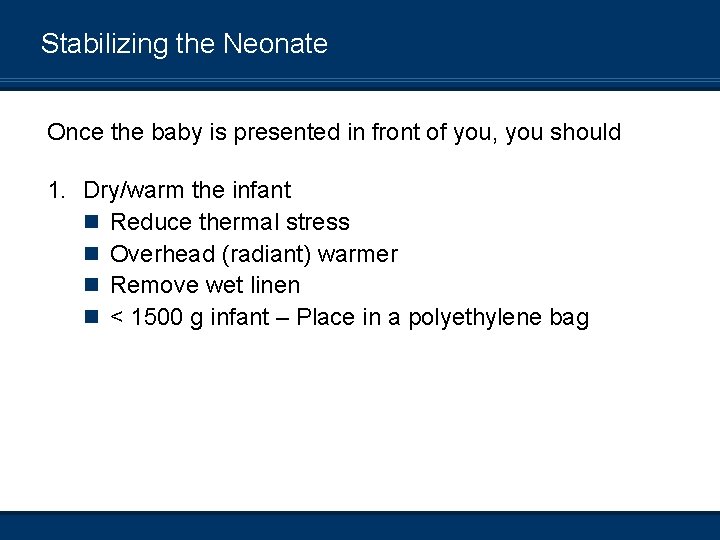
Stabilizing the Neonate Once the baby is presented in front of you, you should 1. Dry/warm the infant n Reduce thermal stress n Overhead (radiant) warmer n Remove wet linen n < 1500 g infant – Place in a polyethylene bag
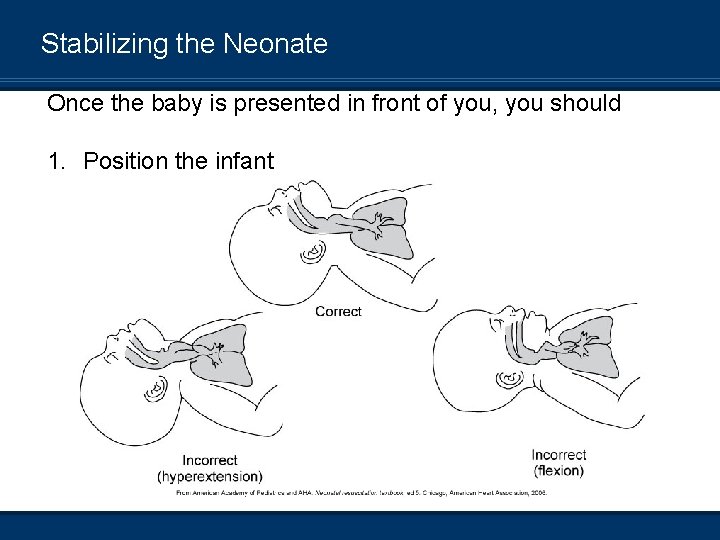
Stabilizing the Neonate Once the baby is presented in front of you, you should 1. Position the infant
Stabilizing the Neonate 3. Suction – Clear the airway n Clearing the a/w should be performed when there are ineffective respirations n Suctioning is performed with a bulb suction n Mouth first n Nares second n 90 - 100 mm. Hg vacuum pressure
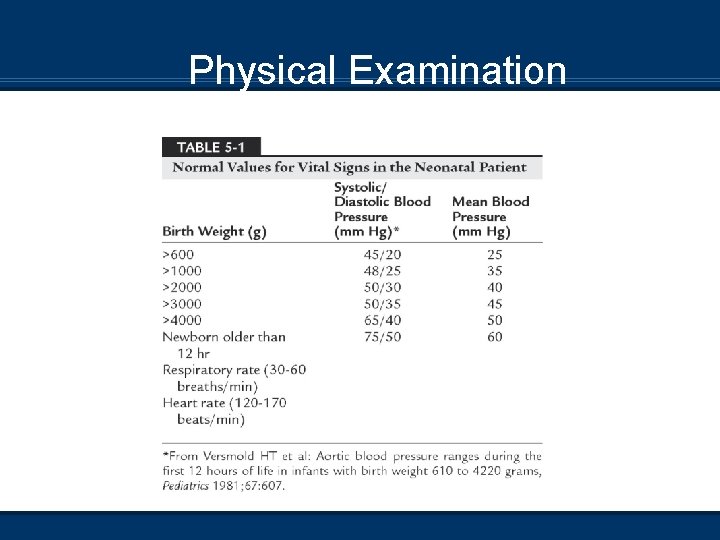
Physical Examination
Physical Examination General inspection n Body position and symmetry n Birth injury n Skin n Colour n Vernix caseosa n Lanugo
Physical Examination (cont. ) Respiratory function n n n Rate Rhythm Silverman score Auscultation Chest radiography ABGs
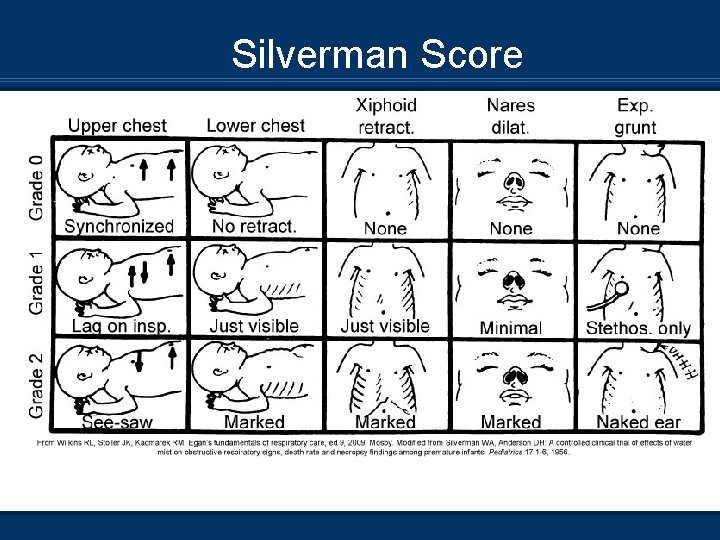
Silverman Score
Physical Examination n Crying n n Strength Sound
Respiratory Distress Nasal Flaring (ALAE NASI) • “Air Hunger” Pressure needed to move air = degree of flaring
Grunting n Positive pressure on expiration to prevent alveolar collapse n Exhalation against a partially closed glottis (Partial valsalva)) n Mild to severe
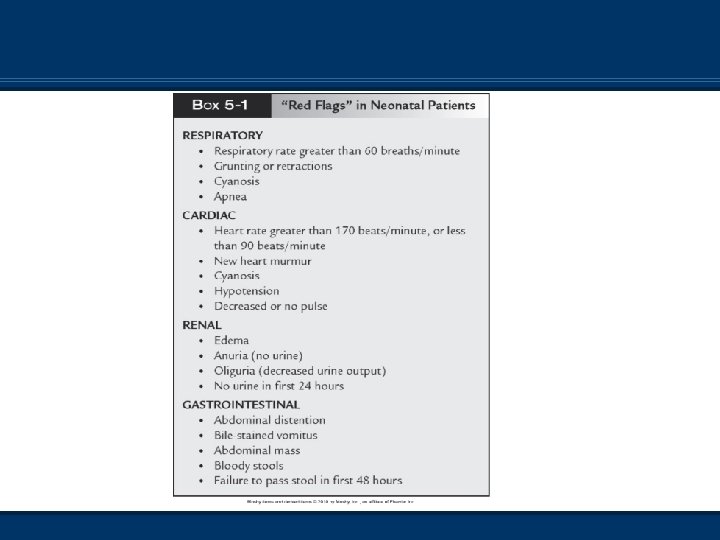
Respiratory Rate n RR > 60 =Tachypnea n True apnea 15 - 20 seconds
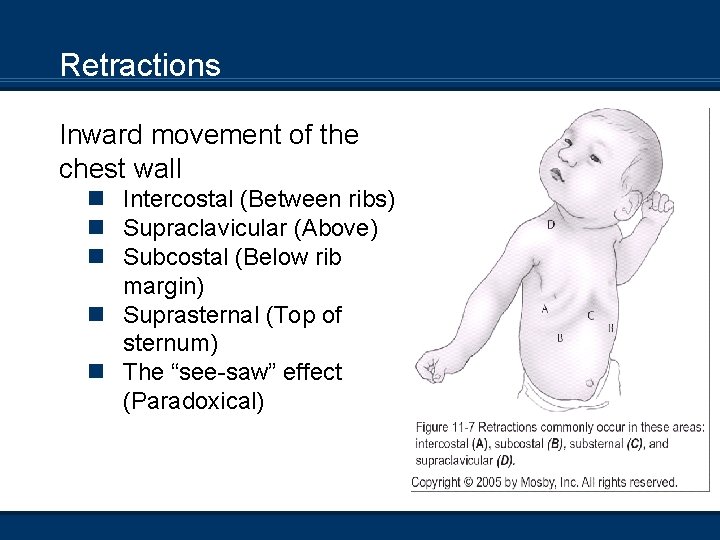
Retractions Inward movement of the chest wall n Intercostal (Between ribs) n Supraclavicular (Above) n Subcostal (Below rib margin) n Suprasternal (Top of sternum) n The “see-saw” effect (Paradoxical)
Cyanosis n Peripheral n Central
Physical Examination Chest and cardiovascular system n n n Chest configuration Point of Maximal cardiac Impulse (PMI) Transillumination (Pneumothorax)
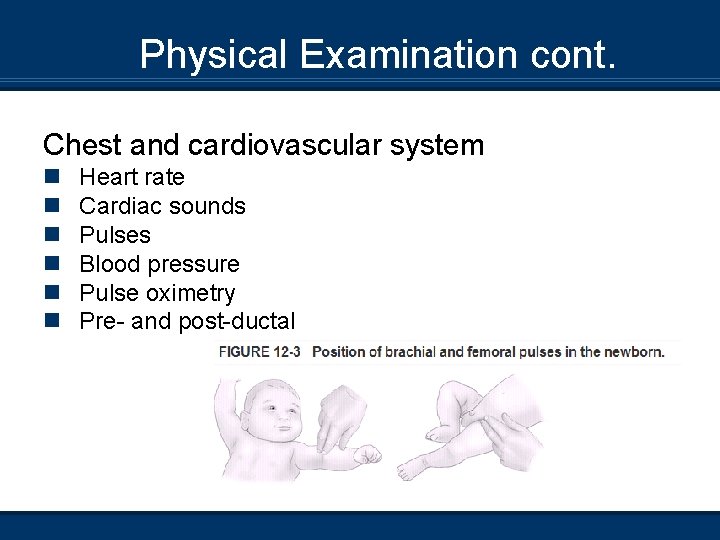
Physical Examination cont. Chest and cardiovascular system n n n Heart rate Cardiac sounds Pulses Blood pressure Pulse oximetry Pre- and post-ductal
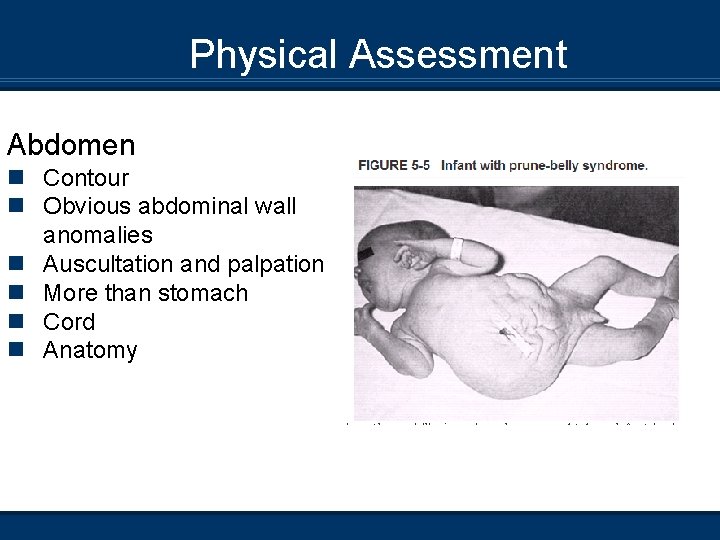
Physical Assessment Abdomen n Contour n Obvious abdominal wall anomalies n Auscultation and palpation n More than stomach n Cord n Anatomy
Physical Examination Head and neck n Shape of head n Fontanelles n Scalp edema n Face n Dysmorphic n Edema n Ears
Physical Examination cont. Head and neck n Nares n Mouth n Lips n Oral cavity n Neck n Clavicles
Physical Examination cont. Musculoskeletal system, spine, and extremities n n Dysmorphic Number of digits Abnormal positioning of joints Spine
Neurologic Examination n Depends on maturation n Movement, crying, response to touch and body tone are all checked for neurologic well-being n Neonatal reflex tests n Rooting n Suck n Grasp n Moro reflex
The Newborn Baby’s Capacities Reflexes – An inborn, automatic response to a particular form of stimulation
Newborn Reflexes n Some reflexes have survival value n Some reflexes may have had significance in our evolutionary past n Reflexes’ disappearance is due to increase in voluntary control over behaviour n Way of assessing the health of the baby’s nervous system
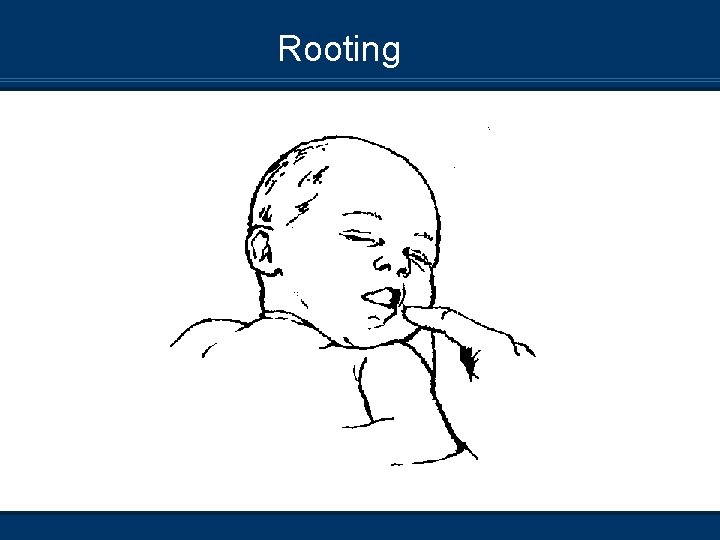
Rooting
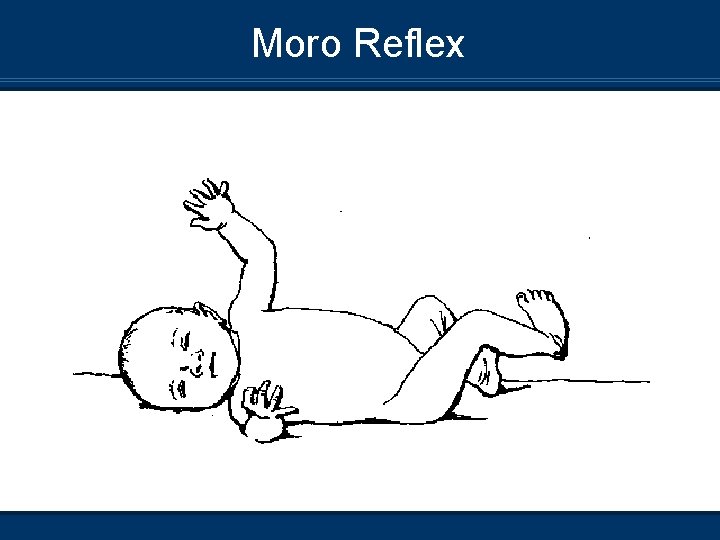
Moro Reflex
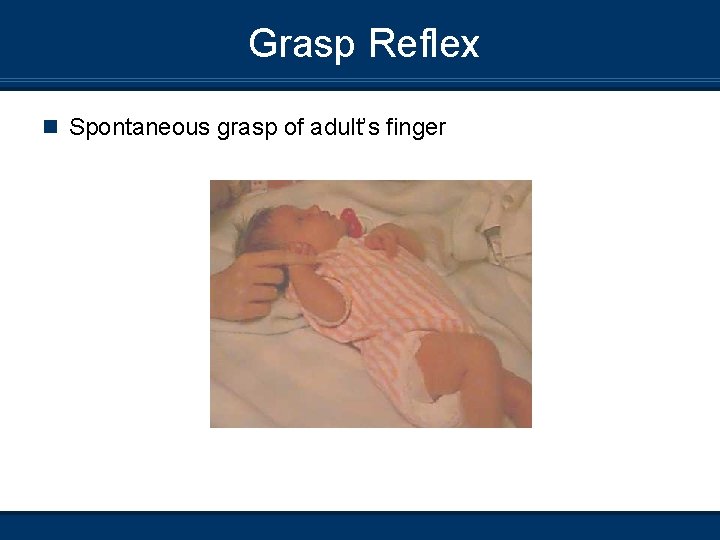
Grasp Reflex n Spontaneous grasp of adult’s finger
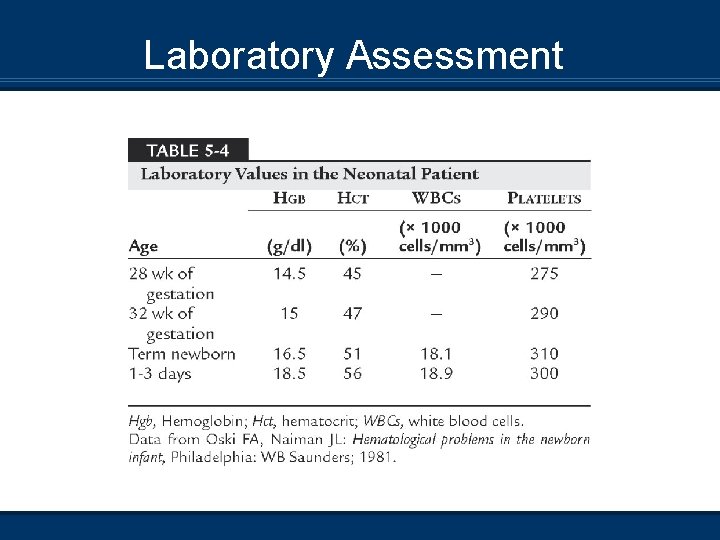
Laboratory Assessment
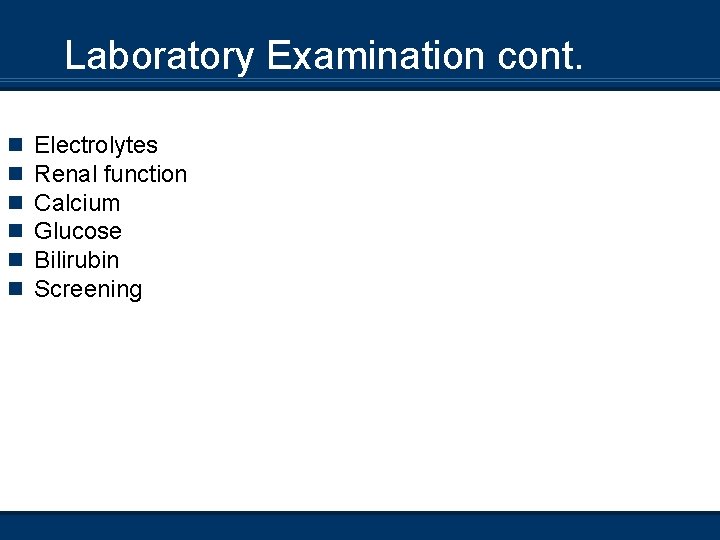
Laboratory Examination cont. n n n Electrolytes Renal function Calcium Glucose Bilirubin Screening
- Slides: 52