
Physical Evidence Hair Fibers Glass Mrs Schultz Types

Physical Evidence: Hair, Fibers, Glass Mrs. Schultz

Types of Evidence • Physical Evidence – tangible objects • Documentary Evidence – writing, sound, or video recording • Demonstrative Evidence – illustrate, demonstrate, or recreate a prior event • Testimony – witness speaking under oath in court

Locard’s Principle of Interchange 1910 – EDMOND LOCARD: “Every criminal leaves something at a crime scene that wasn’t there before and takes away something that he didn’t have when he arrived. ”

Examples of Physical Evidence • • • Blood Documents Drugs Explosives Fibers Fingerprints Firearms and ammunition Glass Hair Impressions Organs and body fluids (run toxicology tests) Paint

Examples of Physical Evidence • • Plastic bags Plastic, rubber, man-made polymers Powder residues Serial numbers Soil and minerals Tool marks Vehicle lights Wood and other vegetative matter

Identification • What is the physical or chemical identity of the substance?

Comparison • Compare a crime-scene specimen to a standard/reference specimen to see if they come from the same source
Individual Characteristics • Evidence that can be linked to a single source with a high degree of probability Example: Fingerprints, marks on a bullet, tool marks

Class Characteristics • Evidence that can be associated with a group, but not with a single source. Example: Blood type

What tools do you think a forensic scientist might use to help identify a substance?

Compound Microscope http: //www. microscopeworld. com/MSWorld/images/scopeparts. jpg

Stereoscope http: //www. newton. dep. anl. gov/york/labshots/microscopes/stereoscope. jpg

Comparison Microscope http: //www. tradevv. com/Tradevv. Image/productimages/Comparison-Microscope-A 1 d 209. jpg

Scanning Electron Microscope M O S Q U I T O http: //www. cbc. ca/news/background/consumers/gfx/mosquitoes 327255. jpg http: //www. microscopehelp. com/images/06. jpg Provides magnification of more than 100, 000 times! P O L L E N http: //www. allergy-details. com/files/pollen-electron-microscope-allergy-causing. jpg

Polarizing Microscope • Used to determine the types of minerals present in a geological sample • Used to identify human made fibers and paint http: //www. cartage. org. lb/en/themes/sciences/Physics/Optical. Instruments/Microscope/Polarizing/ml 9200. jpg

Microspectrophotometers • Combines a microscope with a spectrophotometer • Use the microscope to hone in on a section of interest • Use the spectrophotometer to identify the substance in the section using the way light from the sample is separated • http: //www. maine. gov/dps/msp/criminal_investigation/crimelab/images/microspectrophotometer. JPG

Chromatography • Separating a sample into its components based on how far the components move with the help of a solvent Chromatograph of black ink http: //www. readysetbio. ie/images/photos/chromotography-experiment. jpg http: //www. dkimages. com/discover/previews/893/95022321. JPG
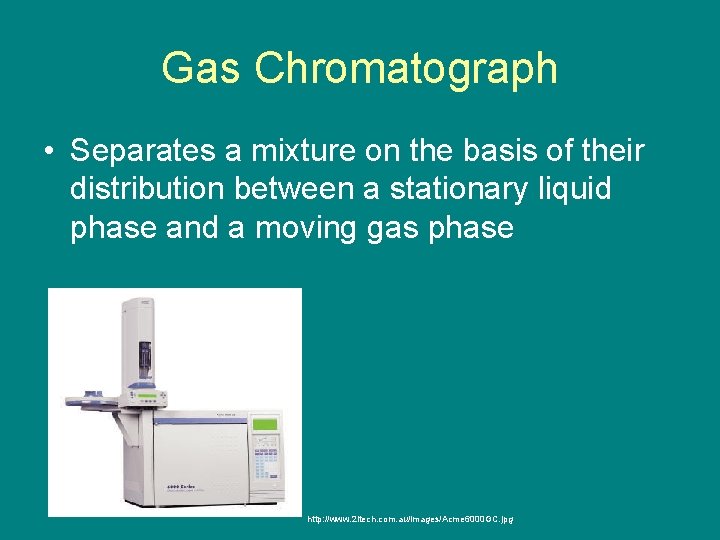
Gas Chromatograph • Separates a mixture on the basis of their distribution between a stationary liquid phase and a moving gas phase http: //www. 2 itech. com. au/images/Acme 6000 GC. jpg

Chromatographs of two types of latex paint http: //www. sisweb. com/referenc/applnote/ap 8 -a. htm

Let’s look at three types of physical evidence in more detail…. • Hair • Fibers • Glass

Hair Evidence Rabbit hair http: //www. bna-naturalists. org/educ/ident/rabbit-hair. jpeg Human hair http: //www. masonworld. com/wordpress/wp-content/uploads/2008/04/human-hair. jpg

Hair is composed of keratin • Keratin is a strong protein that makes hair resistant to chemical and structural changes Ramses II – 3200 years old http: //www. foxnews. com/images/242830/1_61_mummy_ramses. jpg

Unfortunately, in most cases hair cannot be individualized Not only is there variation between, there is variation within one single person To be sure you have an adequate reference: Collect 50 scalp hairs Collect 24 pubic hairs The sample can be individualized if the follicular tag (with DNA) is obtained.

What hair can and can’t tell us Hair can’t tell us The body area of the sample Scalp hairs show little diameter variation and a uniform distribution of pigment Pubic hairs are short and curly Beard hairs are coarse Race (in many cases) – but there are patterns, especially between Caucasian and those of African descent If the hair was forcibly removed (it will have root sheath cells attached) Age or sex

Cross section of skin showing hair growth http: //www. madphysics. com/ask/images/razor/hair. jpg
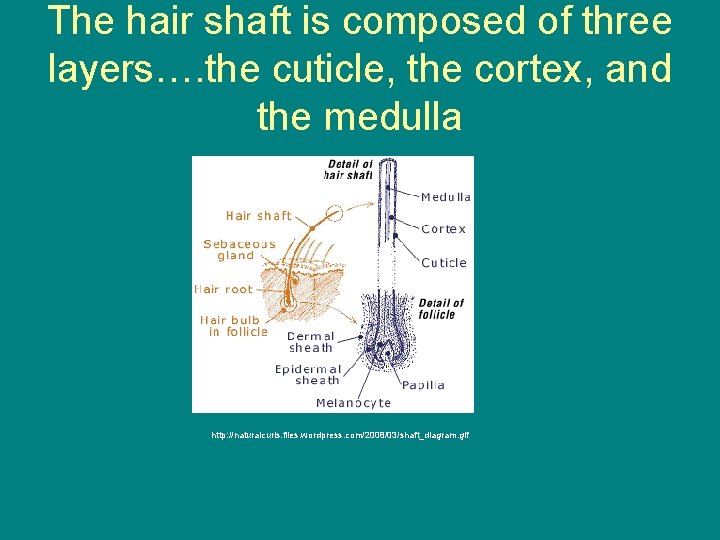
The hair shaft is composed of three layers…. the cuticle, the cortex, and the medulla http: //naturalcurls. files. wordpress. com/2008/03/shaft_diagram. gif

Hair is composed of three layers…the cuticle: Cuticle – the outside covering formed by overlapping keratinized scales. Different species have different scale patterns. HUMAN Imbricate Cuticle MINK Spinous Cuticle http: //www. fbi. gov/hq/lab/fsc/backissu/jan 2004/research/2004_01_research 01 b. htm http: //www. hairflatiron. org/images/hair_cuticle_cell_85781. gif

Hair is composed of three layers…the cortex: Cortex – inside the cuticle, contains pigment to give hair its color http: //www. ecobyte. com. au/a_Basic_Hair_struc_Xsec. jpg
Hair is composed of three layers…the medulla: Medulla – canal that runs through the center of the hair. The medullary index is a measure of the diameter of the medulla relative to the diameter of the hair shaft. humans – this number is <1/3 other animals – this number is >1/2
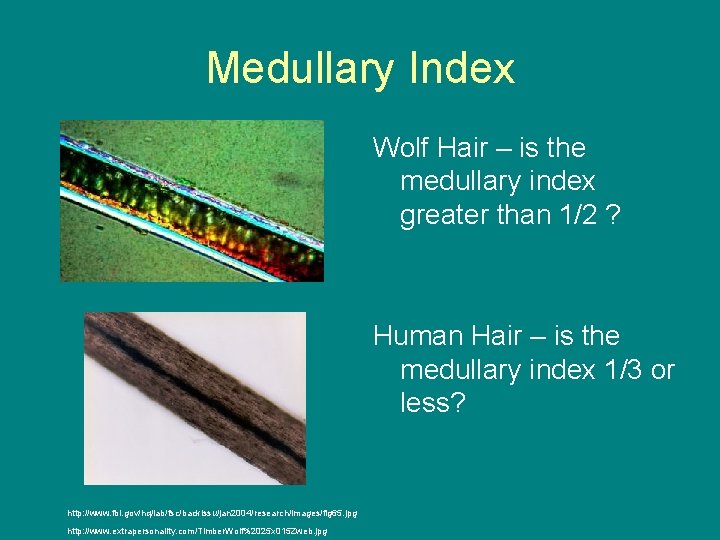
Medullary Index Wolf Hair – is the medullary index greater than 1/2 ? Human Hair – is the medullary index 1/3 or less? http: //www. fbi. gov/hq/lab/fsc/backissu/jan 2004/research/images/fig 65. jpg http: //www. extrapersonality. com/Timber. Wolf%2025 x 015 Zweb. jpg

Medulla Patterns a. Fragmented b. Interrupted c. Continuous *Mongoloid race usually have continuous medulla *Different species have different medulla shapes http: //www. awta. com. au/upload/Images/Fibres/Medullation_1. jpg

Medulla Patterns are Different Between Species http: //www. personal. psu. edu/users/c/l/clv 14/sci 101/images/standardhair%20 copy. jpg

Medulla Shapes: Human, Rabbit, Goat, Siamese Cat RABBIT SIAMESE CAT HUMAN GOAT http: //www. extrapersonality. com/hair. html

Phases of Hair Growth • Anagen – the hair follicle is actively producing hair. Hair pulled out in this phase may have a follicular tag attached (this is important because of getting a DNA sample) • Catagen – the root bulb shrinks and is pushed out of the follicle • Telogen – hair becomes lose and falls out

Phases of Hair Growth http: //www. urbanbodylaser. com/images/laserhair_growthcycles. jpg

Is Hair Analysis Reliable?

Fiber Evidence • A fiber is any long, thin, solid object • Most fibers do not undergo physical, biological, or chemical degradation while at the crime scene. If they do, measurements can usually be taken elsewhere on the fiber

Natural Fibers • Fibers derived entirely from plant or animal sources – Animal fibers include wool, mohair, cashmere, silk, mink, rabbit, beaver, etc. – Plant fibers include cotton
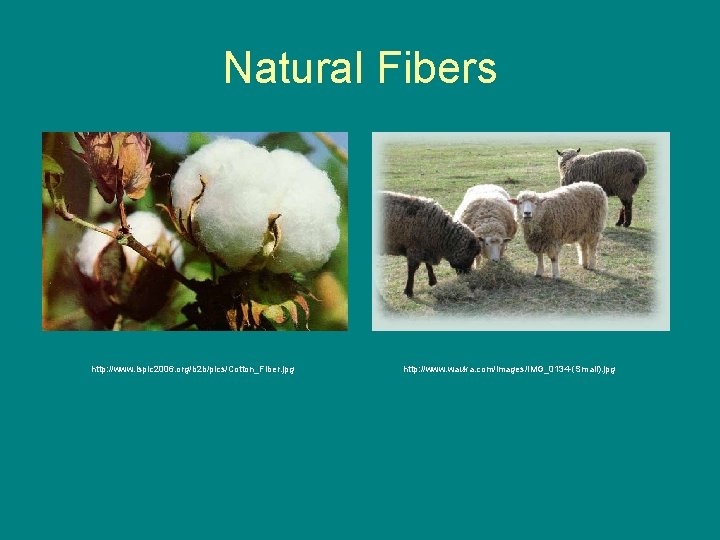
Natural Fibers http: //www. isplc 2006. org/b 2 b/pics/Cotton_Fiber. jpg http: //www. wauka. com/images/IMG_0134 -(Small). jpg

Man-Made Fibers • 1911 – Rayon is introduced • 1939 – Nylon is introduced • Synthetic fibers are produced from polymers – long molecules with repeating subunits. http: //www. chemheritage. org/Educational. Services/NYLON/chem 04. gif

To get an idea of fibers and their characteristics, lets look at pages 208 and 209 in the text book

Fibers in forensics • It’s nice when scientists can match up ripped fabric, but that doesn’t happen frequently. • More often, a crime scene may contain a few fibers that scientists must identify.
• Use a microscope to compare color and diameter of a fiber • Look for lengthwise striations • Look at the cross sectional shape of a fiber • Use a microspectrophotometer to compare colors of fibers • Use chromatography to determine dye composition.
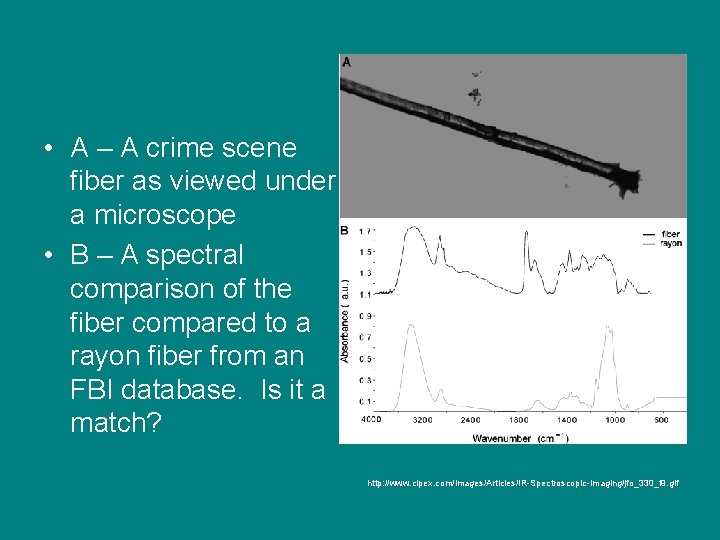
• A – A crime scene fiber as viewed under a microscope • B – A spectral comparison of the fiber compared to a rayon fiber from an FBI database. Is it a match? http: //www. clpex. com/images/Articles/IR-Spectroscopic-Imaging/jfo_330_f 9. gif

Collecting Fibers • Fiber evidence is frequently microscopic and be discovered back at the lab. • Package clothing in separate bags. • Fold carpets, rugs, bedding to protect areas which may contain fibers • Cover car seats with polyethylene sheets • Cover knife blades • Use adhesive tape to lift fibers from a body that may have been wrapped in something • If a fiber is spotted, remove it with forceps and place in a small sheet of paper.

Fiber collection is tedious work…. but it might catch a criminal John Joubert, 1983, Nebraska • • • http: //www. criminaljusticeschools. org/blog/10 -famous-cases-cracked-by-forensics A boy’s body was found tied with a rope investigators couldn’t identify Every rope manufacturer in the U. S. was checked International manufacturers were checked, particularly in the Far East where much rope is made, with no match. When Joubert was caught, rope in his trunk was found – a very rare kind brought back from Korea by his scoutmaster. It matched the crime scene rope. On the day he was arrested, the FBI let Nebraska authorities know the rope was probably made for the military in the Far East.

Glass Fragments http: //www. cepolina. com/freephoto/f/nature. stones/glass. fragments. detail. bg. jpg

Glass • Imagine you walk in your bedroom and discover your window broken and your ipod, cell phone, and laptop stolen. Later, you go out with some friends and one of them has little pieces of glass in the cuffs of her pants. You ask accusingly, “Where were you earlier today? ” She says she was in a car accident and the glass is from the headlights. Is there any way to tell if she is lying?
Glass Evidence • Glass is mostly sand, but different types of glass vary from each other in other ways. • Forensic scientists first want to determine the broader class to which glass belongs and then to individualize glass to one source. This isn’t easy.
Glass samples vary from each other in terms of: • Type - Soda lime glass: Used in windows and bottles. - Borosilicates: Used in automobile headlights and heat resistant glass (like Pyrex). - Tempered: This glass is rapidly heated and cooled to make it stronger. It doesn’t shatter. It’s used in side and rear windows of cars. - Laminated: This glass has a layer of plastic between two pieces of ordinary window glass. It’s used in windshields.

Glass Types – Which is which? TEMPERED SODA-LIME LAMINATED BOROSILICATE
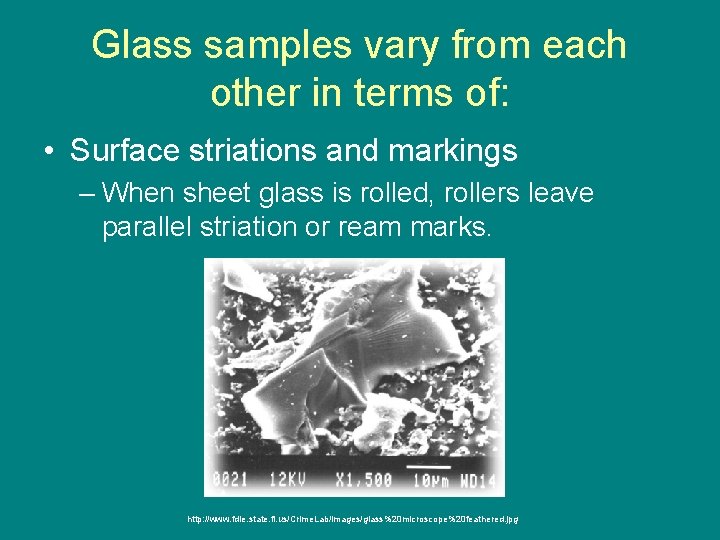
Glass samples vary from each other in terms of: • Surface striations and markings – When sheet glass is rolled, rollers leave parallel striation or ream marks. http: //www. fdle. state. fl. us/Crime. Lab/images/glass%20 microscope%20 feathered. jpg
Glass samples vary from each other in terms of: • Surface contaminants – Paint or putty on the glass might help 1. determine how pieces fit together 2. individualize the glass to a particular place/person
Glass samples vary from each other in terms of physical characteristics such as: • • • Thickness Hardness Color Density* Refractive Index* *these two properties are the most successful in characterizing glass fragments
To compare densities: • Use flotation A glass chip is added to a mixture of bromoform and bromobenzene. Add more of the mixture until the chip is suspended. Then, add other glass chips to see which other samples are suspended as well. Ones that are suspended have the same density.
To compare refractive index: • Measure how much the light is bent as it enters a glass sample. • To do this, place the glass in oils whose refractive indices are known. • Heat the oil to change its refractive index. • As the oil warms, its refractive index drops. • When the index of the oil matches the index of the glass, the Becke line disappears (this is the bright halo you see around a glass fragment when it is in a liquid).
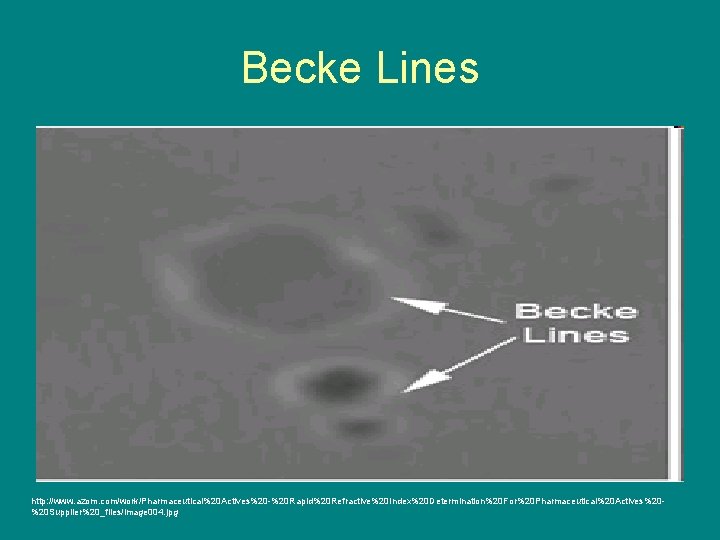
Becke Lines http: //www. azom. com/work/Pharmaceutical%20 Actives%20 -%20 Rapid%20 Refractive%20 Index%20 Determination%20 For%20 Pharmaceutical%20 Actives%20%20 Supplier%20_files/image 004. jpg

An interesting note… • When comparing glass, you should not use color. – Color can be altered by natural processes within soils over time. – Color can be altered by heat or by intentional tampering.

And two more things that can be determined from glass…

Where did the bullet come from? The exit hole is always larger than the entrance hole. http: //shs. westport. k 12. ct. us/forensics/02 -evidence/bullet_holes_in_glass. jpg

Which bullet hole formed first? Radial fractures terminate when they have been relieved in the material or when they hit another fracture. http: //shs. westport. k 12. ct. us/forensics/02 -evidence/bullet_holes_in_glass. jpg
- Slides: 61