
Physical Education Training Day Aims of the session
- Slides: 29
Physical Education Training Day
Aims of the session • • To appreciate the value of Physical Education, including enabling children to be ‘confident in a way which supports their health and fitness… build character and help to embed values such as fairness and respect. To know the aspects included in the National Curriculum for PE and develop own subject knowledge in these. • To understand how skills and knowledge of PE should progress across FS, KS 1 and KS 2 building in these fundamental movements • To begin to develop a bank of activities and strategies for use in PE lessons • To know how to plan a PE lesson and a begin to know about sequences of PE lessons that enable children to develop & apply skills. • To have strategies for adapting the activities to suit needs of all pupils within lessons • To know how to organise and manage a PE lesson • Understand the need to warm up and cool down in PE lessons • ELG - Children show good control and co-ordination in large and small movements. They move confidently in a range of ways, safely negotiating space. • ELG - Children know the importance for good health of physical exercise, and a healthy diet, and talk about ways to keep healthy and safe.
Teachers’ Standards 1. Set high expectations which inspire, motivate and challenge pupils 2. Promote good progress and outcomes by pupils 3. Demonstrate good subject and curriculum knowledge 4. Plan and teach well structured lessons 5. Adapt teaching to respond to the strengths and needs of all pupils 6. Make accurate and productive use of assessment 7. Manage behaviour effectively to ensure a good and safe learning environment 8. Fulfil wider professional responsibilities
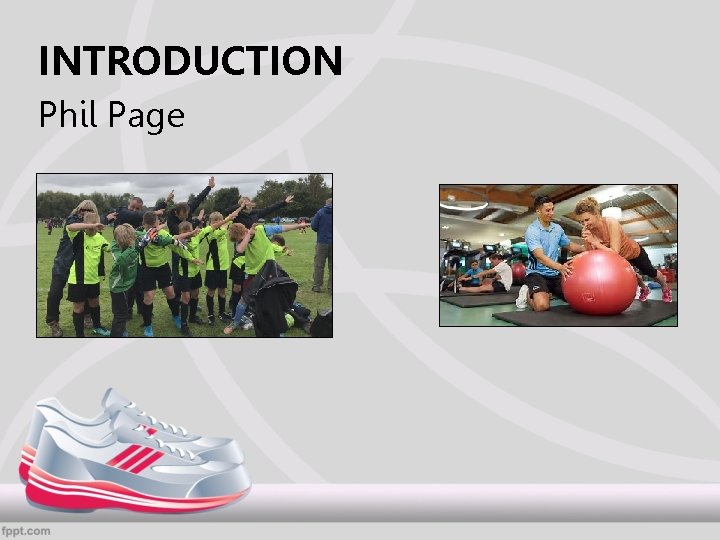
INTRODUCTION Phil Page
Your thoughts/ experiences on PE • What have you seen/ been involved in? • Your views on PE • Your experiences, bad and good • Your attitude towards PE – Be honest!
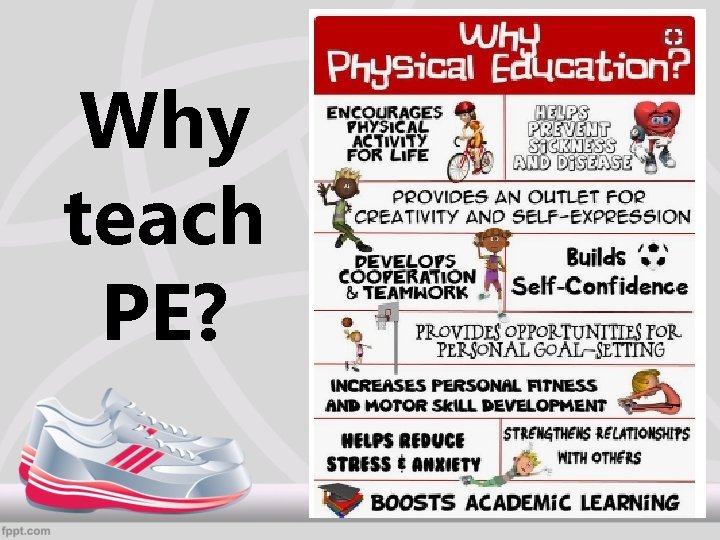
Why teach PE?
What do we need to teach in PE?
Primary PE expectations Key Stage 1 Key Stage 2 Pupils should develop fundamental movement skills, become increasingly competent and confident and access a broad range of opportunities to extend their agility, balance and coordination, individually and with others. They should be able to engage in competitive (both against self and against others) and co-operative physical activities, in a range of increasingly challenging situations. Pupils should continue to apply and develop a broader range of skills, learning how to use them in different ways and to link them to make actions and sequences of movement. They should enjoy communicating, collaborating and competing with each other. They should develop an understanding of how to improve in different physical activities and sports and learn how to evaluate and recognise their own success.
What does it look like? Key Stage 1 Pupils should be taught to: • master basic movements including running, jumping, throwing and catching, as well as developing balance, agility and co-ordination, and begin to apply these in a range of activities • participate in team games, developing simple tactics for attacking and defending • perform dances using simple movement patterns. Key Stage 2 • • Pupils should be taught to: use running, jumping, throwing and catching in isolation and in combination play competitive games, modified where appropriate [for example, badminton, basketball, cricket, football, hockey, netball, rounders and tennis], and apply basic principles suitable for attacking and defending develop flexibility, strength, technique, control and balance [for example, through athletics and gymnastics] perform dances using a range of movement patterns take part in outdoor and adventurous activity challenges both individually and within a team compare their performances with previous ones and demonstrate improvement to achieve their personal best.
Swimming • Swimming and water safety All schools must provide swimming instruction either in key stage 1 or key stage 2. • In particular, pupils should be taught to: • swim competently, confidently and proficiently over a distance of at least 25 metres • use a range of strokes effectively [for example, front crawl, backstroke and breaststroke] • perform safe self-rescue in different water-based situations. Taken from National Curriculum * All schools will have to report the % of children who have achieved the above statements by the end of year 6.
What makes an effective PE lesson? • • Learning objective Success criteria Children being engaged Children being active for 85% + of the session. • Children being able to apply their skills and knowledge • Inclusive • Needs to be fun!
What makes an effective PE lesson? • Space / Safety (Check area, clothing, equipment check) • Task / Time (Full use of time, progression) • Equipment/Engaging (Varied and age appropriate) • People (Age & ability appropriate, differentiation) How will you get the children’s attention?
Practical - Fundamental Movement
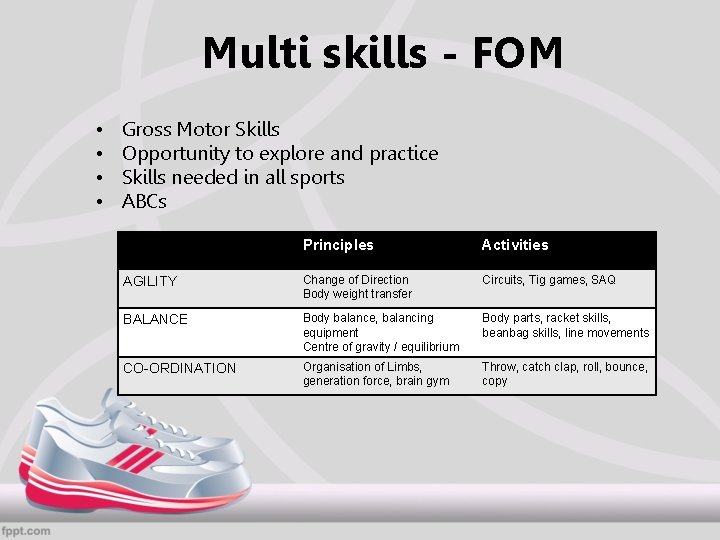
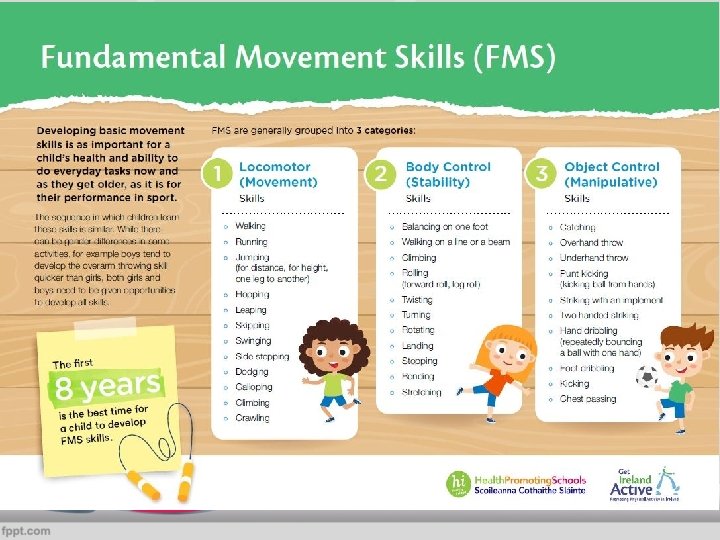
Multi skills - FOM • • Gross Motor Skills Opportunity to explore and practice Skills needed in all sports ABCs Principles Activities AGILITY Change of Direction Body weight transfer Circuits, Tig games, SAQ BALANCE Body balance, balancing equipment Centre of gravity / equilibrium Body parts, racket skills, beanbag skills, line movements CO-ORDINATION Organisation of Limbs, generation force, brain gym Throw, catch clap, roll, bounce, copy
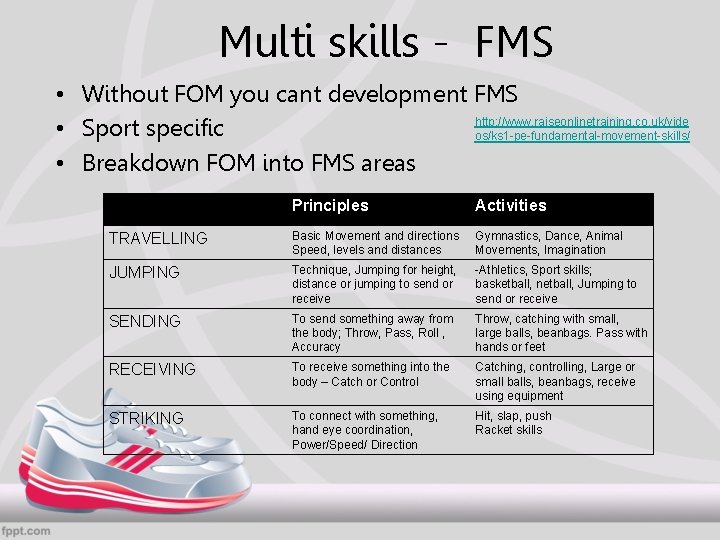
Multi skills - FMS • Without FOM you cant development FMS http: //www. raiseonlinetraining. co. uk/vide • Sport specific os/ks 1 -pe-fundamental-movement-skills/ • Breakdown FOM into FMS areas Principles Activities TRAVELLING Basic Movement and directions Speed, levels and distances Gymnastics, Dance, Animal Movements, Imagination JUMPING Technique, Jumping for height, distance or jumping to send or receive -Athletics, Sport skills; basketball, netball, Jumping to send or receive SENDING To send something away from the body; Throw, Pass, Roll , Accuracy Throw, catching with small, large balls, beanbags. Pass with hands or feet RECEIVING To receive something into the body – Catch or Control Catching, controlling, Large or small balls, beanbags, receive using equipment STRIKING To connect with something, hand eye coordination, Power/Speed/ Direction Hit, slap, push Racket skills
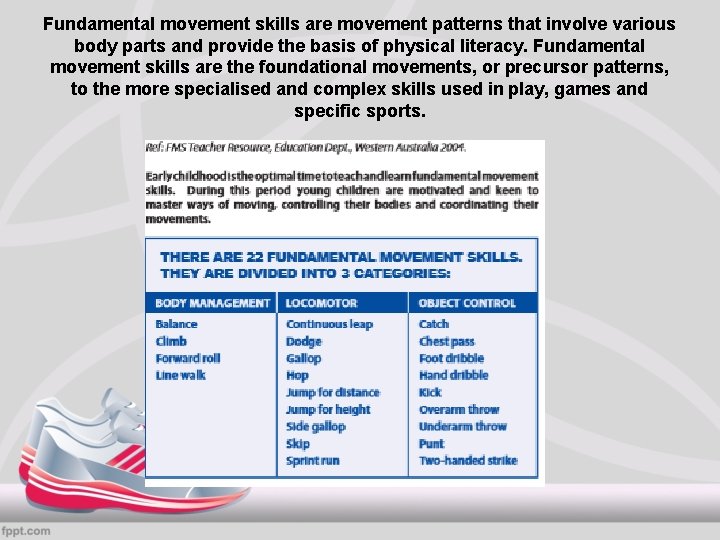
Fundamental movement skills are movement patterns that involve various body parts and provide the basis of physical literacy. Fundamental movement skills are the foundational movements, or precursor patterns, to the more specialised and complex skills used in play, games and specific sports.
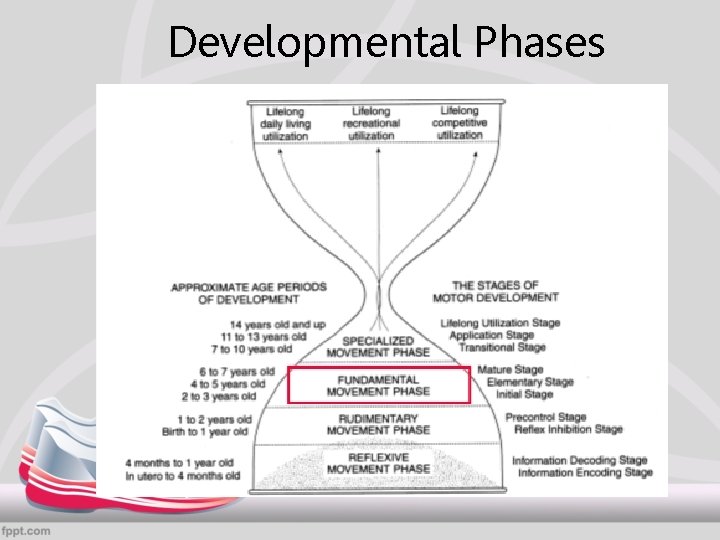
Developmental Phases /
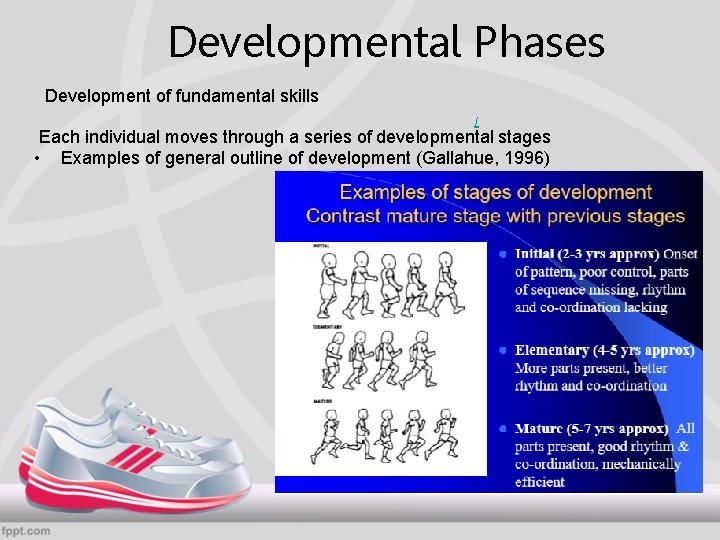
Developmental Phases Development of fundamental skills / Each individual moves through a series of developmental stages • Examples of general outline of development (Gallahue, 1996)
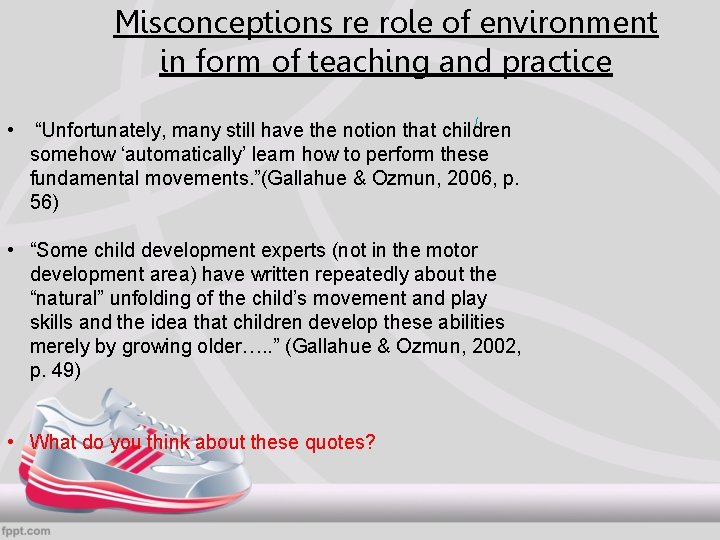
Misconceptions re role of environment in form of teaching and practice • / “Unfortunately, many still have the notion that children somehow ‘automatically’ learn how to perform these fundamental movements. ”(Gallahue & Ozmun, 2006, p. 56) • “Some child development experts (not in the motor development area) have written repeatedly about the “natural” unfolding of the child’s movement and play skills and the idea that children develop these abilities merely by growing older…. . ” (Gallahue & Ozmun, 2002, p. 49) • What do you think about these quotes?
Plan your own session • In 3’s you will be given a fundamental movement skill you will need to teach to 6 children • You will have to plan for the session, there are resources available on VLE • Session will be for 20 mins (approx. ) • Consider: • What you want the children to learn • What resources you will need • Ways to simplify and extend the learning, responding to pupils needs. • How to utilize everyone in the group • How you will assess throughout the lesson
Lunch (break)
Ready, Steady, Go pin ing g catch lea thr ow in g hopping
Review of session • Each group to feedback about your session: • How did the session go? • Was the key learning met? • What have you learnt? • What improvements would you make if you did this again? • Observers feedback to teachers aswell
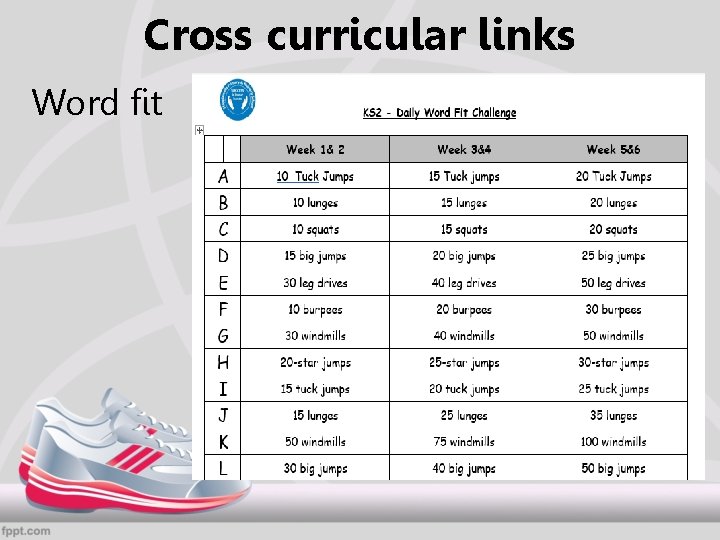
Cross curricular links Word fit
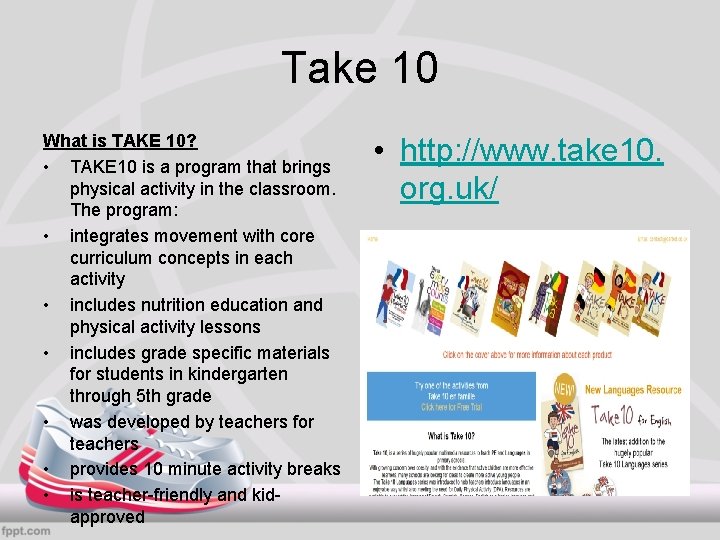
Take 10 What is TAKE 10? • TAKE 10 is a program that brings physical activity in the classroom. The program: • integrates movement with core curriculum concepts in each activity • includes nutrition education and physical activity lessons • includes grade specific materials for students in kindergarten through 5 th grade • was developed by teachers for teachers • provides 10 minute activity breaks • is teacher-friendly and kidapproved • http: //www. take 10. org. uk/
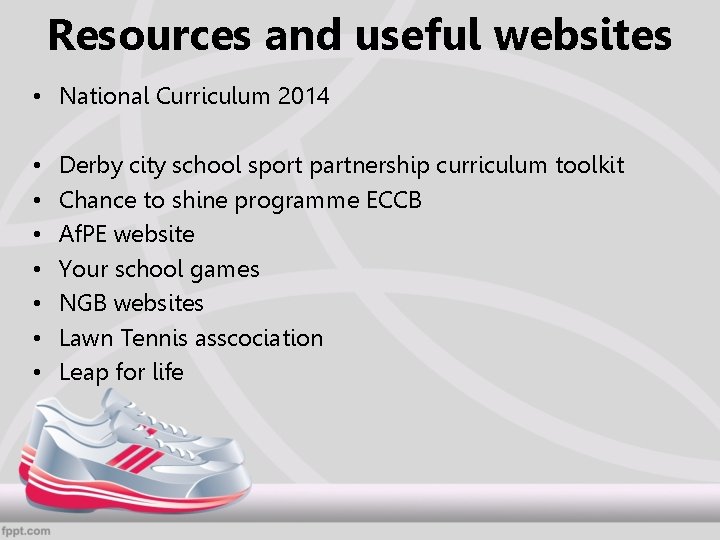
Resources and useful websites • National Curriculum 2014 • • Derby city school sport partnership curriculum toolkit Chance to shine programme ECCB Af. PE website Your school games NGB websites Lawn Tennis asscociation Leap for life
Tasks before next session • Talk to the PE subject leader in your school about the current initiatives they are driving in school. • Can you offer your services in any way? • Find out about how PE is assessed in your school. Bring notes with you next time. • Plan, deliver and assess at least 1 PE lesson (ideally a sequence) in your current placement school.
Review of session • What did you learn from the session? • What impact will the training have on your teaching? • What would you like further support with?