
Physical Distancing and Clinical Competencies www maerb org
Physical Distancing and Clinical Competencies www. maerb. org
Rules of the Road • Muted Participants • Question Box/Chat • Close with Questions • Reminder: This presentation will be recorded. www. maerb. org

Karon Walton, MAERB Chair Goals of this presentation • Discuss the achievement of clinical competencies in a laboratory setting in a COVID-19 environment • Share some of the information that the MAERB office has received. • Program Directors/Program Representatives share their plans. • Question and Answer • MAERB’s Ongoing Activities www. maerb. org
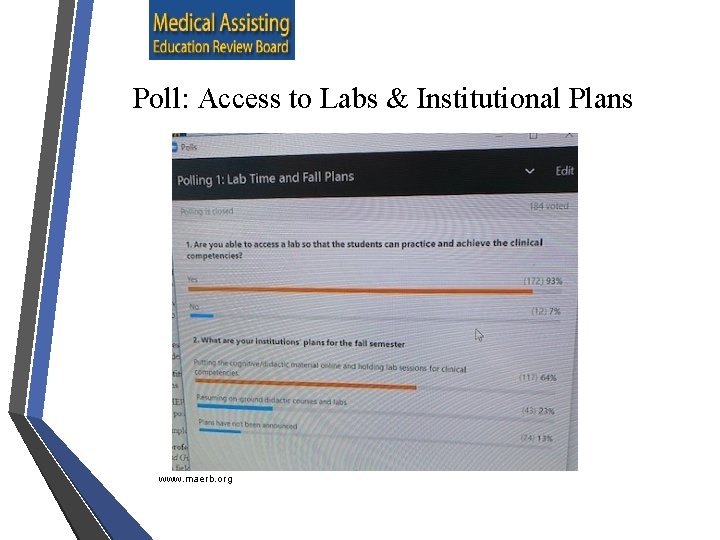
Poll: Access to Labs & Institutional Plans www. maerb. org
Summer/Fall Plans: Be Prepared for Anything! • Programs/Institutions are putting the cognitive/didactic material online and holding lab sessions for clinical competencies. • Instructions to frontload work that require physical presence • Program/Institutions are resuming on-ground didactic courses and labs: • Limited capacity or multiple classrooms • Eliminating breaks/ending before Thanksgiving • Instructions to frontload work that require physical presence www. maerb. org
CAAHEP Standards and Guidelines • III. C. 1: The curriculum must ensure the achievement of program goals and learning domains. Instruction must be an appropriate sequence of classroom, laboratory, and clinical activities. Instruction must be based on clearly written course syllabi or addendum to the syllabi that include course description, learning objectives, methods of evaluation, topic outline, and competencies required for graduation. • V. C. 1: Safeguards: The health and safety of patients, students, faculty, and other participants associated with the educational activities of the students must be adequately safeguarded. www. maerb. org
Physical Distancing/Social Solidarity • Limiting face to face contact • Stay six feet away from people outside your home • Wearing a cloth face cover (not a substitute for physical distancing) • Wash your hands with a fanatic fervor • Clean and disinfect frequently touched surfaces daily • No large group gatherings www. maerb. org
Capacity Control • Follow CDC Principles for Gatherings • Limit number of people • Limit time frame for close proximity • Institutional Guidelines • Screenings • Follow physician office – regular temperature taking • Waivers www. maerb. org
Clinical Competencies • Lab Screenings • Students broken up into cohorts for lab work • No magic number: 4, 6, 8, 10 • Work with the same cohort throughout the term • Limited practice with each other • Skills demonstrated with each other • Intensive cleaning and disinfection of labs after each group • Masks and PPE www. maerb. org
Instruction and Practice • Change the amount of practice sessions • Mannequins and other simulation tools • Repeated Demonstrations (in-person or via video) • Directional Demonstrations (in-person or via video) • Students provide directions to instructor on how to achieve the task. • Home Practice and Family Members www. maerb. org
Participants’ Input from Chat • • Lab time is being held, but it is day to day • Students are practicing and videoing non-intrusive competencies with family members (video/photo release) • Flipped classroom and teaching theory in conjunction with the psychomotor and affective competencies because everything has to be frontloaded. Labs will be staggered Some Institutions: Students need to make an appointment to come on campus Students need to sign waivers Health screenings prior to entering building and entering lab PPE and masks (double masks/face shields) for all lab work Classes held with half the participants online and half in person Students need to indicate whereabouts with an APP or sign-in sheets to help with contact tracing www. maerb. org
MAERB COVID-19 Statement Sunset Date: October 31, 2020 • Broader range of approaches to the practicum, including simulated activities • Broader range of approaches to students’ achieving the competencies • Program Directors will need to determine what works best for the students in determining the context, and they have the authority to do so. • You will be sharing that information with MAERB on September 1, 2020. www. maerb. org
Qualifications • Instructional Resources and Access • Local, State and Federal directives and regulations • Institutional Accreditation • Communities of Interest: Practicum Sites, Employers, Students, among others • Student Safety • Outcomes: competent entry-level medical assistants who protect patient safety www. maerb. org
Documentation • Student Status Form • Institutional Record • MAERB Status Report • Due September 1, 2020 www. maerb. org
MAERB Plans for the Fall • Fall 2020 Virtual Site Visits • Will be looking at spring 2021 and make a decision by November 1, 2020 • Holding Trainings at the AAMA Conference but. . . • Virtual Trainings are possible as well • Virtual MAERB Forum www. maerb. org
State of the Medical Assisting Education Union • Access to practicum sites • Interest in community-based webinar on placing students in practicum sites • Institution allowing for travel to participate in accreditation workshops www. maerb. org
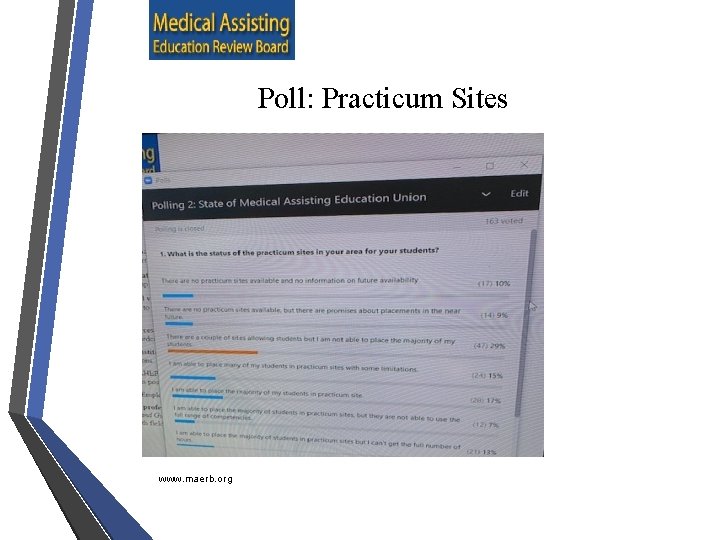
Poll: Practicum Sites www. maerb. org
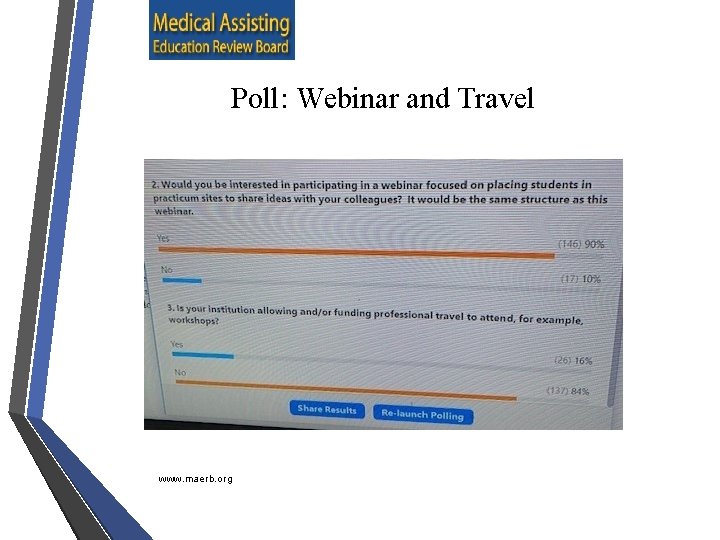
Poll: Webinar and Travel www. maerb. org
Accreditation Protects Quality www. maerb. org
Karon Walton: Virtues of Accreditation • Accreditation assures professional competence: Graduates from a CAAHEP-accredited program have covered the comprehensive MAERB Core Curriculum and achieved the psychomotor and affective competencies to ensure patient safety. • Accreditation offers standardization, uniformity, and consistency: All CAAHEP-accredited programs cover the same MAERB Core Curriculum, so employers can be guaranteed that the students know a given body of entry-level knowledge. • Accreditation requires external verification, review, and validation: In fulfilling the standards, CAAHEP-accredited programs submit their outcomes to MAERB for an annual review and go through a comprehensive site visit review with CAAHEP every ten years. • Accreditation protects Resources: The accreditation Standards and Guidelines specify that the students and faculty have access to specific resources in order to ensure that the program can comply with the national standards. • Accreditation enhances the institution’s reputation: Institutions participating in programmatic accreditation distinguish themselves from other institutions. • Accreditation is public: CAAHEP-accredited programs are listed in a CAAHEP database for student and educator access, and CAAHEP-accredited programs post their status and outcomes. • • Accreditation travels well: Employers across the country recognize the value of accreditation. Accreditation advances the profession: The standardization, uniformity and consistency that accreditation ensures, as well as the review of the Standards and Guidelines and MAERB Core Curriculum, move the profession forward toward greater recognition in the allied health field. www. maerb. org
- Slides: 20