
Physical Disabilities Health Impairments and ADHD Chapter 11
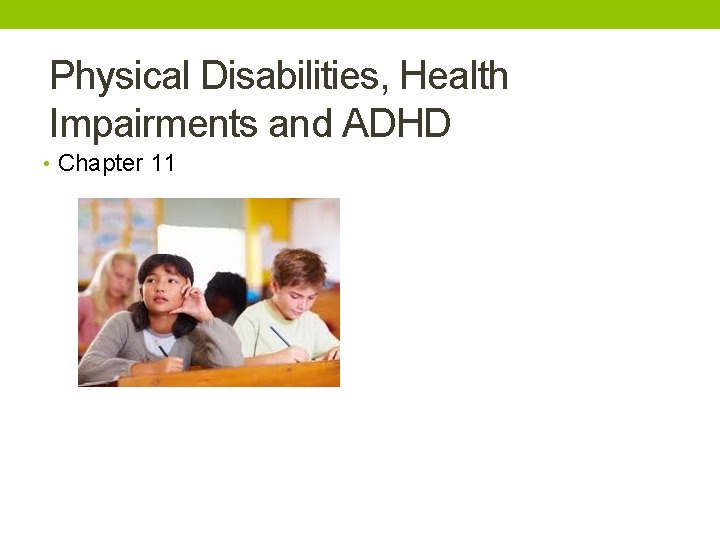
Physical Disabilities, Health Impairments and ADHD • Chapter 11
Ch. 11 Group Activity • IRIS center overview • https: //iris. peabody. vanderbilt. edu/module/nur 01 - personnel/cresource/q 1/p 03/#content • Differences between Section 504 plans and an IEP? Complete attached worksheet and hand in one per group at the end of class. (Group Activity 10 minutes) This will be followed by a group share.
Components of IDEA Definitions Severe Orthopedic Impairment (OI) • Congenital abnormality - club foot, absence of a limb • Impairments caused by disease - poliomyelitis, bone tuberculosis • Impairments by other causes - cerebral palsy, fractures, burns • Adversely affecting educational performance Other Health Impairment (OHI) • Limited strength, vitality, or alertness due to chronic or acute health problems • Adversely affecting educational performance
Cerebral Palsy video • Slide 3 • Cerebral Palsy: Most prevalent __________________ in children. Usually does not get progressively worse. • https: //www. youtube. com/watch? v=svz. Pm 8 l. T 36 o • This is a video of a man with cerebral palsy that creates beautiful artwork using only a typewriter.
Comments on Paul • What type of Cerebral Palsy do you think Paul had? _________________________ • Why is Paul even more inspiring than his art? __________________________________________________ _______________________ • Is there a relationship between motor impairment and the degree of intellectual impairment? _________________________ • How is Cerebral Palsy classified? according to the type of body movement and posture problem
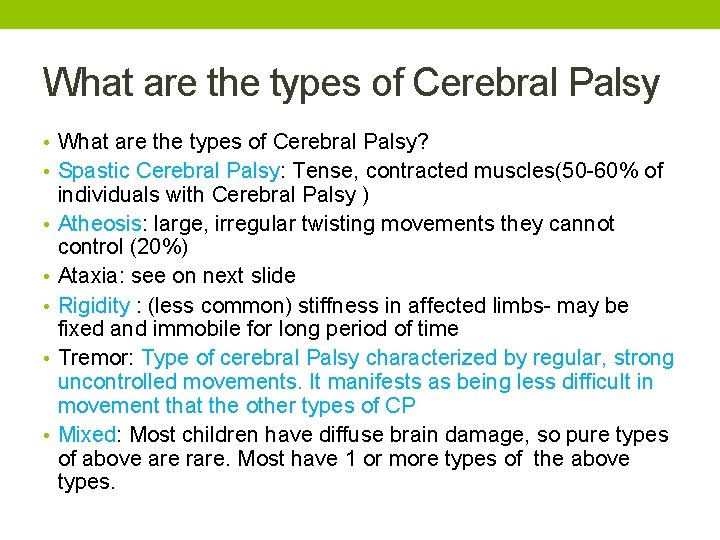
What are the types of Cerebral Palsy • What are the types of Cerebral Palsy? • Spastic Cerebral Palsy: Tense, contracted muscles(50 -60% of • • • individuals with Cerebral Palsy ) Atheosis: large, irregular twisting movements they cannot control (20%) Ataxia: see on next slide Rigidity : (less common) stiffness in affected limbs- may be fixed and immobile for long period of time Tremor: Type of cerebral Palsy characterized by regular, strong uncontrolled movements. It manifests as being less difficult in movement that the other types of CP Mixed: Most children have diffuse brain damage, so pure types of above are rare. Most have 1 or more types of the above types.
Ataxia is now its own category • Ataxia: used to be considered a type of CP- now its own category • Ataxia describes the lack of muscle coordination when a voluntary movement is attempted. It may affect any motion that requires muscles to work together to perform a function, from walking to picking up an object to swallowing.

Orthopedic Impairments • Cerebral Palsy • A disorder of voluntary movement and posture • Most prevalent physical disability in school age children • Classified according to muscle tone and motor movement • Spina Bifida • Congenital malformations of the brain, spinal cord, or vertebrae • Can result in paralysis below affected vertebra • Muscular Dystrophy • Progressive weakening and degeneration of the muscles • No known treatment exists to stop or reverse any form of muscular dystrophy • Spinal Cord Injuries • Caused by penetrating injury, fracture, stretching, or compression of spinal cord • Car accidents, sports injuries, and violence most common causes • Results in paralysis below affected vertebra
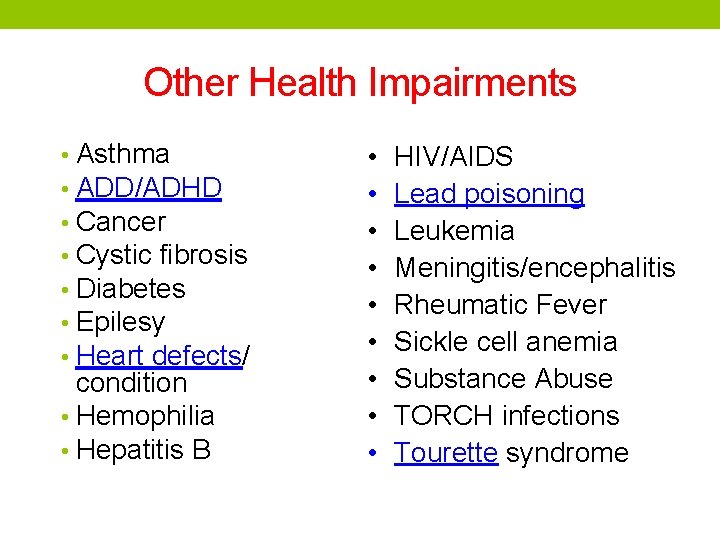
Other Health Impairments • Asthma • ADD/ADHD • Cancer • Cystic fibrosis • Diabetes • Epilesy • Heart defects/ condition • Hemophilia • Hepatitis B • • • HIV/AIDS Lead poisoning Leukemia Meningitis/encephalitis Rheumatic Fever Sickle cell anemia Substance Abuse TORCH infections Tourette syndrome
Characteristics • As a group, students with physical disabilities or health impairments function well below grade level academically q. Daily health care routines and medications have negative side effects on academic achievement q. Educational progress is often hampered by frequent and sometimes prolonged absences from school for medical treatment when flare-ups or relapses require hospitalization q. As a group, students with physical disabilities and health impairments perform below average on measures of social-behavioral skills q. Concerns about physical appearance are frequently identified as reasons for emotional difficulties and feelings of depression
Prevalence • Studies of the number of children with physical disabilities and health impairments have produced hugely diverse findings • 1% of children receiving special education services are orthopedically impaired (OI) • 11. 6 % of children receiving special education services are other health impaired (OHI) • 3% to 7% of all school-age children have ADHD • 40 -50% of students with ADHD qualify for special education services • Many children with OI and OHI receive services under other categories • Some do not require specialized educational services
Variables Affecting Educational Performance • Factors that affect educational needs include • Severity with which the condition affects different areas of functioning • Age of onset - children with congenital or acquired impairments have different needs • Visibility - the visibility of impairment may cause some to underestimate the child’s abilities and limit opportunities
Early Intervention • Critical • Minimize the severity of the disability • Try to prevent secondary conditions or behaviors • Increase motor and self-care skills • Provide foundation for learning
Educational Approaches • Students with physical disabilities or health impairments may need intensive instruction in a “parallel curriculum” to include qusing adaptive methods and assistive technology for mobility, communication, and daily-living tasks; qincreasing independence by self-administering special health care routines; and learning selfdetermination and self-advocacy skills • Teaming often involves the collaboration of a transdisciplinary team including physical and occupational therapists, speech therapists, health care aides, and other specialists who frequently provide services to these students
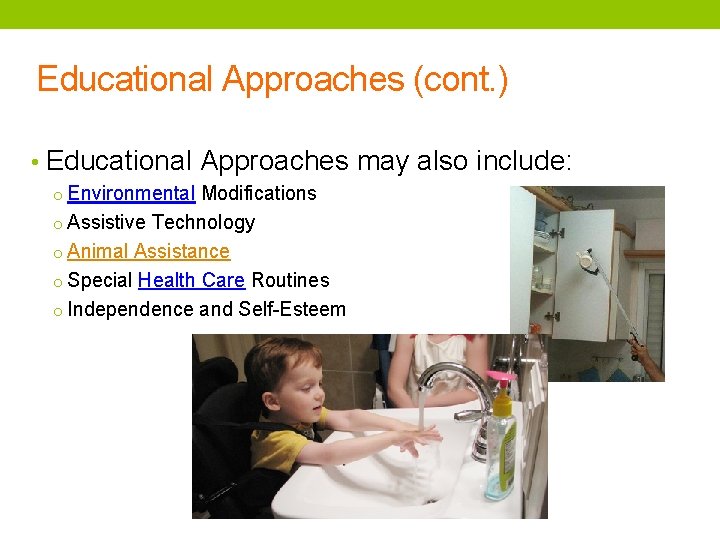
Educational Approaches (cont. ) • Educational Approaches may also include: o Environmental Modifications o Assistive Technology o Animal Assistance o Special Health Care Routines o Independence and Self-Esteem
Service Animals • Watch the video about service animals • https: //monkeyhelpers. org/meet-our-monkeys/monkey • • college/monkey-college https: //monkeyhelpers. org/ With Sophia joining Sean for the first day of Third Grade, local TV station KDKA reported about this monumental day! Hopefully an open door for kids with service animals in schools! https: //www. youtube. com/watch? v=w. Ejcj 9 OC 12 w Michael Hingson is a blind man who survived the attack on the World Trade Center on September 11, 2001 with the help of his guide dog Roselle. They walked down 78 floors. https: //www. youtube. com/watch? v=8 to. QOVLVs. Dk Equestrian Therapy https: //www. youtube. com/watch? v=b 9 g 0 CHSGozs
More about Physical Disabilities • https: //www. youtube. com/watch? v=pp. ILw. Xws. Mng&featur e=related • For a month, Pierpaolo Petruzziello's amputated arm was connected to a robotic limb, allowing him to feel sensations and control the arm with his thoughts. Rossella Lorenzi talks to him about the bionic experiment.
Attention-Deficit/Hyperactivity Disorder • The essential feature is a persistent pattern of inattention and/or hyperactivity-impulsivity that is more frequent and severe than is typically observed • Three ADHD subtypes: combined, predominantly inattention, and hyperactive-impulsive • Most students with ADHD have the combined type • Children with ADHD can be served under the “other health impairments” category or under Section 504 • Most children with ADHD struggle in the classroom • There is comorbidity with other disabilities
Videos Facts about ADHD https: //www. youtube. com/watch? v=Pdc 8_ayq. Dtg Watch the video about Brad is an extremely bright, creative 12 year-old who loves building things, playing in his treehouse and making movies. He is also diagnosed with ADHD. https: //www. youtube. com/watch? v=z 2 h. La 5 k. DRCA&feature=relm fu For strategies, go to Iris Center https: //www. teachingchannel. org/videos/teaching-adhdstudents? fd=1 Heward Exceptional Children, 10 e © 2013 Pearson Education, Inc. All rights reserved. 11 -19
Related Services in the Classroom • Controversial issues concerning including students with physical impairments and special health care needs in general education classrooms • The extent of responsibility properly assumed by teachers and schools • Irving Independent School District v. Tatro • Catheterization is a related service • Cedar Rapids Community School District v. Garret F • Nursing services are related services • Acceptance is the most basic need of children with physical disabilities and health impairments
Glossary of terms for Ch. 11 • Club Foot: Doctors use the term "clubfoot" to describe a range of foot abnormalities usually present at birth (congenital). In most cases, the front of the foot is twisted downward and inward, the arch is increased, and the heel is turned inward. Effects seen in mobility, calf muscles smaller on affected side, size of foot different. • Cystic fibrosis: inherited disorder caused by dysfunction of the pancreas and mucus, salivary and sweat glands. Causes severe, long term respiratory issues- no cure • More to follow
- Slides: 21