
Physical Disabilities Chapter 13 Deviance and Physical Disabilities
Physical Disabilities Chapter 13
Deviance and Physical Disabilities • Individuals with disabilities are often denied access to normal social interaction with others. • Societal members tend to focus on what the person cannot do, rather than on what the person can do. • The disabled are sometimes denied employment and housing based on their disability. • The disabled are regarded as “outsiders. ”
Deviance and Physical Disabilities • Most people do not regard physical disabilities as deviant conditions. • However, disabled people experience many of the same social reactions as deviants, such as stigma and social rejection.
Deviance and Physical Disabilities • Sociology of difference vs. sociology of deviance. • People with physical disabilities often encounter isolation, segregation, and discrimination in their interactions with others (Nagler, 1993).
Deviance and Physical Disabilities • Disabled individuals are forced to overcome obstacles such as: • Forming relationships • Following normative guidelines • Conforming to adult roles
Definitions and Distinctions • Impairment: • The loss of some ability, usually caused by some physical reason. • Sometimes, a physical conditions present at birth inhibit functions in the optic nerve, the portion of the brain that controls: • Talking, a limb, or the inner ear; each constitutes an example of an impairment.
Definitions and Distinctions • Disability • The loss of function that accompanies an impairment. • It describes the effect of that loss on the affected person’s activities.

In Class Question 1. The limitation on normal activities of selfcare and mobility which resulted from some type of impairment is called? a. b. c. d. Handicap Disability Liability All of the above
In Class Question 1. The limitation on normal activities of selfcare and mobility which resulted from some type of impairment is called? a. b. c. d. Handicap Disability Liability All of the above Answer A
Definitions and Distinctions • Handicap • The limitation on normal activities of self-care and mobility that results from some impairment. • Thus, physical conditions determine impairments, whereas disabilities and handicaps represent social and behavioral consequences of those impairments.
In Class Question 2. The central difference between a physical disability and deviance is its identity as a condition rather than a behavior. a. True b. False
In Class Question 2. The central difference between a physical disability and deviance is its identity as a condition rather than a behavior. a. True b. False Answer A
Disabilities and the Idea of Deviance • The central difference between a physical disability and deviance is its identity as a condition rather than a behavior. • Society regards criminal offenders and drug addicts as choosing forms of deviance.
Disabilities and the Idea of Deviance • Society imputes deviant status to people with visible physical handicaps, physiologically obese people, and the intellectually disabled because they are outside normative conception. • Physically disabled persons acquire deviant identities not as a result of their behaviors, rather because of they are different. • Society defines conditions, as well as behavior, as examples of deviance.
Disabilities and the Idea of Deviance • Disability as Deviant Status • Disability becomes the master status. • Disability may reflect personal discredit. • Deviant labels may depend on the individual’s responsibility for the condition.
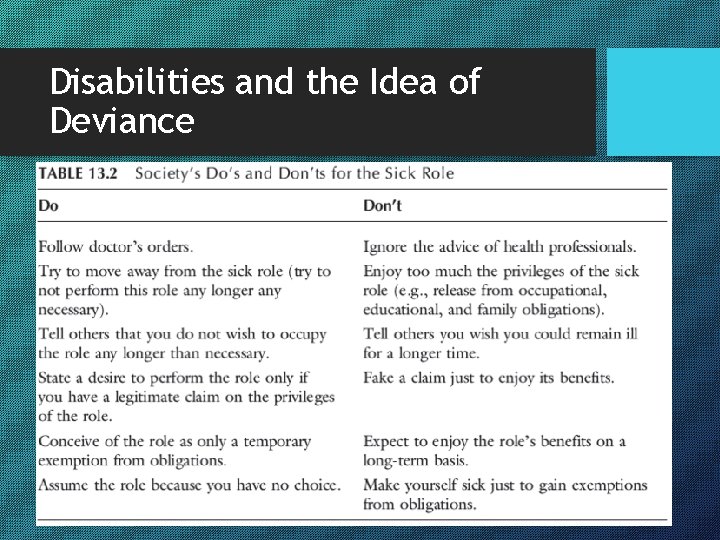
Disabilities and the Idea of Deviance • Disability and the Sick Role • According to Parsons (1951), the sick role emerges from two interrelated sets of exemptions. • Most people exempt individuals defined as ill from certain obligations and responsibilities. • No one blames them for their illnesses, nor does anyone expect their conditions to improve due to their motivation alone.

Disabilities and the Idea of Deviance • Disability and the Sick Role • Some expect individuals exhibiting the sick role to define the state as undesirable and must do everything within their power for recovery.
Disabilities and the Idea of Deviance • Disability and the Sick Role • Four elements make-up the sick role: 1. 2. 3. 4. No attribution of responsibility of individuals for their own conditions. Exemptions from normal role obligations. Recognition of the undesirable character of illness despite the benefits of these role exemptions. An obligation to seek help to heal the sickness.
Disabilities and the Idea of Deviance
Societal Reaction and Ambivalence toward Disability • Blindness • Three categories of blindness (Koestler, 1976): • Totally blind, determined by total absence of any light or image perception. • Legally blind, determined by central visual acuity of 20/200 with corrective lenses in the better eye along with restriction of the central visual field that allows the individual to see objects only within a 20 -degree arc. • Functionally blind, determined by inability to read ordinary newspaper print, even with perfectly fitted glasses.
Societal Reaction and Ambivalence toward Disability • Blindness • To avoid technical confusion, most people apply the blind label to those who are totally or nearing blind. • Historically, societies have relegated blind members to inferior roles as outcasts and beggars.
Societal Reaction and Ambivalence toward Disability • Blindness • The humanitarian movement promoted an attempt to restore the selfconfidence and self-reliance by: • Securing a relief status. • Creating special schools for them. • Common public stereotypes • Helplessness • Dependency • Useless
Societal Reaction and Ambivalence toward Disability • Intellectual Disability • People with intellectual disability are limited as to intelligence and ability to perform cognitive tasks. • The exact of individuals with this type of disability in the United States remains unknown. • The National Organization of Disability (2010), reports that one estimate indicates that perhaps 3 out of every 100 people suffer from intellectual disability.
Societal Reaction and Ambivalence toward Disability • Intellectual Disability • Three elements define this disability (Evans, 1983): • People with intellectual disability do not learn as quickly or as much as non-retarded people do. • People with intellectual disability do not retain as much information as others do; and • People with intellectual disability have weak powers of mental abstraction, which limit their use of the information they do retain.
Societal Reaction and Ambivalence toward Disability • Intellectual Disability • Society set the highest value on the ability to think. It helps them to plan and arrange their lives, to manage all their affairs. • Those who lack these attributes experience the most stigma. • No other stigma implies such unfitness because people regard a person with intellectual disability as lacking in even basic competence.
Societal Reaction and Ambivalence toward Disability • Physical Handicaps • Some handicaps are developed from birth, while others are a result of accidents or illnesses. • Depending on the importance society places on physical health, attractiveness, and competence, individuals with physical handicaps may be labeled deviant.
Societal Reaction and Ambivalence toward Disability • Physical Handicaps • Inability to perform physical tasks for oneself frequently reduces a person’s social status to that of a child. • Societies have commonly separated cripples from “normal” people which may result in varying degrees of isolation, persecution, and ridicule.
Societal Reaction and Ambivalence toward Disability • Physical Handicaps • Crippled people face problems with occupational roles, social relationships, and general social participation. • Severe physical disabilities strain marriages and often cause job changes and social isolation.

In Class Question 3. It sparked both concern and hope when ______ “walked” in a January 2000 Super Bowl commercial. a. Steven Hawking b. Christopher Reeve c. Ian Dury d. Helen Keller

In Class Question 3. It sparked both concern and hope when ______ “walked” in a January 2000 Super Bowl commercial. a. Steven Hawking b. Christopher Reeve c. Ian Dury d. Helen Keller Answer B
Societal Reaction and Ambivalence toward Disability • Obesity • People who are excessively fat, tall, or short, particularly dwarfs and midgets, often face stigma and ridicule. • Appearance norms value thinness for women and slim, muscular builds for males (Schur, 1984).
In Class Question 4. Starting in the 1940 s, the Metropolitan Life Insurance Company began to publish tables that listed the “ideal” weight for a given _____. a. Height b. Age c. Race d. All of the above
In Class Question 4. Starting in the 1940 s, the Metropolitan Life Insurance Company began to publish tables that listed the “ideal” weight for a given _____. a. Height b. Age c. Race d. All of the above Answer A
Societal Reaction and Ambivalence toward Disability • Obesity • Attitudes of rejection toward obese persons are socially constructed through culture, usually at an early age. • Attitudes toward obesity rest upon moral foundations. Some chastise obese people as gluttons unwilling to control their behavior regardless of the consequences.
Societal Reaction and Ambivalence toward Disability • Obesity • Many people feel that sanctions simply give obese people what they deserve, assuming that they could have prevented their problems through basic self-restraint.
Societal Reaction and Ambivalence toward Disability • Obesity • Many people feel that sanctions simply give obese people what they deserve, assuming that they could have prevented their problems through basic self-restraint. • As a result, obese people may withdraw from social interactions to escape negative sanctions.
Disability as a Socialization Process • Socialization and Disability • Most physical abilities are a result of physical trauma or disease. • Individuals who are disabled will have to deal with many questions such as: • Why did this happen to me? • Who will take care of me? • What will my like be like now?
In Class Question 5. Which of the following is NOT a method of learning to adapt to a disability? a. b. c. d. Denial and isolation Anger Acceptance Violence
In Class Question 5. Which of the following is NOT a method of learning to adapt to a disability? a. Denial and isolation b. Anger c. Acceptance d. Violence Answer D
Disability as a Socialization Process • Socialization and Disability • Some individuals assume the sick role, although many have difficulty because it goes against their own values. • Disabled people learn to adapt through developmental stages (Kubler-Ross, 1969): • • • Denial and isolation Anger Bargaining Depression Acceptance
Disability as a “Career” • Career disability that amounts to secondary deviance, results from role adaptation rather than formation of a new role. • Once society validates the disability, role expectations may change to correspond with judgments about the seriousness of impairment.
Disability as a “Career” • Professionals and Agencies • Professional assistance from doctors or counselors are crucial in shaping an individuals’ self-concept and transition to career disability. • Many rehabilitation agencies make contributions to society’s efforts to prevent, treat, and control disabilities and to individual clients.
Disability as a “Career” • Subcultures and Groups • “Communities” within a larger society. • Disability subculture serves numerous functions: • • Social and recreational outlets Education for the public Pressing public officials on policies Assisting with marriage and employment
Managing Disability • The Role of Stigma in the Disability Career • Disabled individuals have to deal with various issues as a result of their conditions such as: • • Mobility Employment Medical Needs Maintaining Relationships
Managing Disability • The Role of Stigma in the Disability Career • Although, deviant labels result from a condition rather than behavior, disabled individuals still have to utilize management techniques to manage stigma. • • Passing Normalizing Coping Dissociation
The Americans With Disabilities Act • The Individuals with Disabilities Education Act (1975) was intended to stop discrimination against children with disabilities. • Before passage of the act, many children had been excluded from public schools, institutionalized, or placed in programs with little or no learning component.
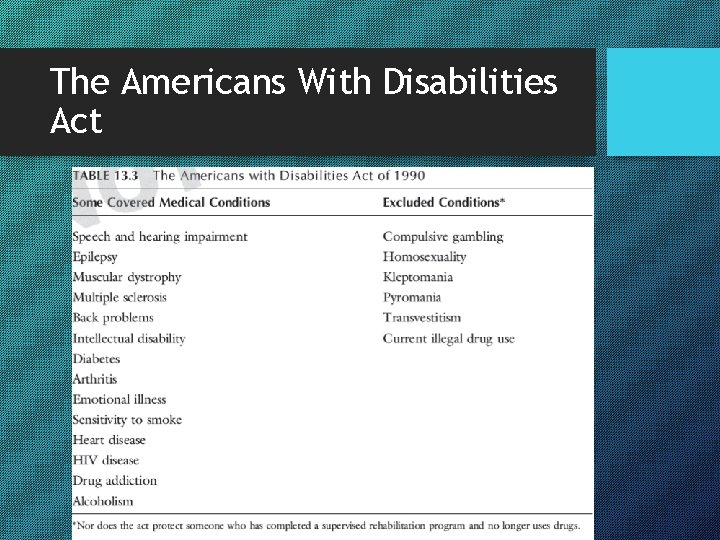
The Americans With Disabilities Act
The Americans With Disabilities Act • The American with Disabilities Act provisions apply to three kinds of people: • Anyone with a physical or mental impairment that substantially limits one or more major life activities. • Any person with a record of such an impairment. • Any person perceived as having a physical or mental impairment.
The Americans With Disabilities Act • The ADA has made huge strides for disabled individuals. • Employment • Monetary discrimination relief • National awareness • The ADA was amended in 2008 and signed into law effective January 1, 2009. • Broadened definitions of “disability” such that more conditions can be included in the act.
- Slides: 49