
PHYSICAL DEVELOPMENT OF TODDLERS TODDLERS A child between
PHYSICAL DEVELOPMENT OF TODDLERS
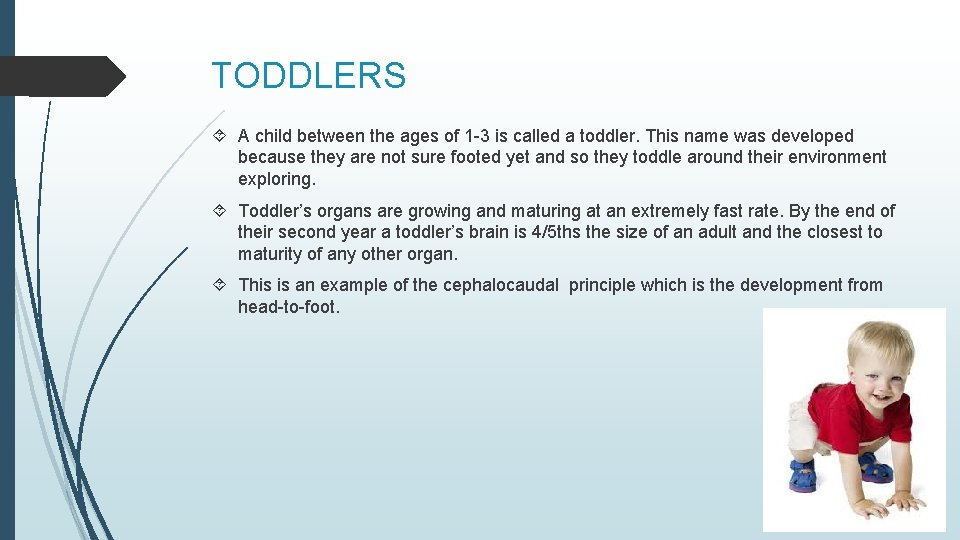
TODDLERS A child between the ages of 1 -3 is called a toddler. This name was developed because they are not sure footed yet and so they toddle around their environment exploring. Toddler’s organs are growing and maturing at an extremely fast rate. By the end of their second year a toddler’s brain is 4/5 ths the size of an adult and the closest to maturity of any other organ. This is an example of the cephalocaudal principle which is the development from head-to-foot.
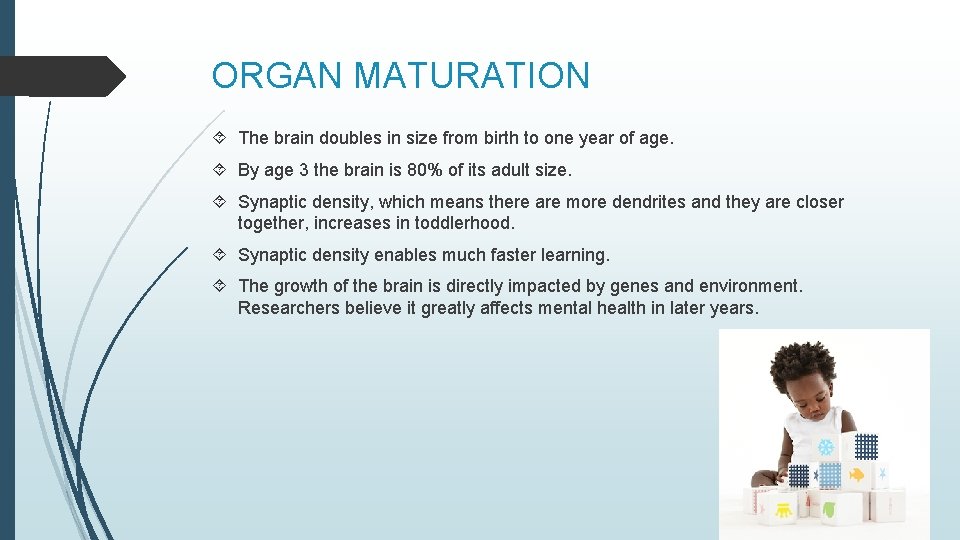
ORGAN MATURATION The brain doubles in size from birth to one year of age. By age 3 the brain is 80% of its adult size. Synaptic density, which means there are more dendrites and they are closer together, increases in toddlerhood. Synaptic density enables much faster learning. The growth of the brain is directly impacted by genes and environment. Researchers believe it greatly affects mental health in later years.
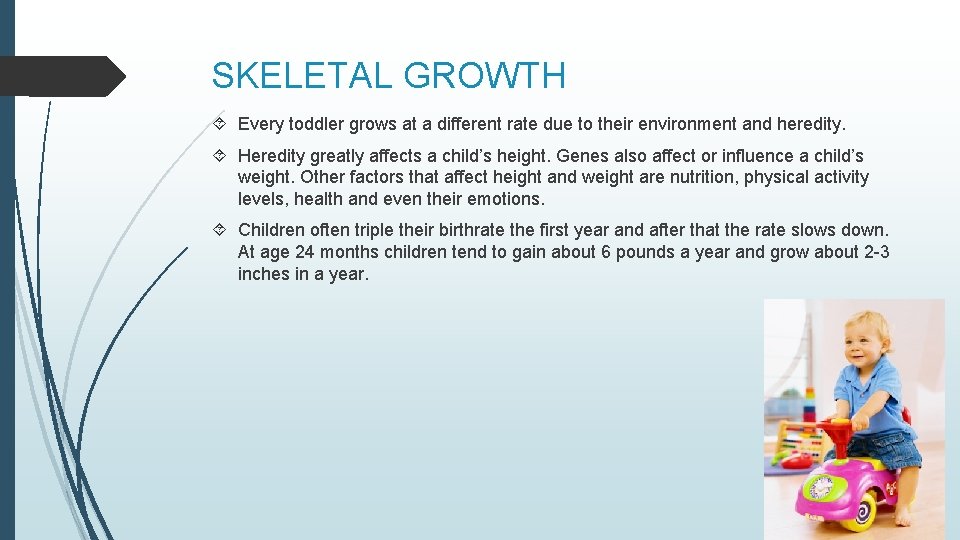
SKELETAL GROWTH Every toddler grows at a different rate due to their environment and heredity. Heredity greatly affects a child’s height. Genes also affect or influence a child’s weight. Other factors that affect height and weight are nutrition, physical activity levels, health and even their emotions. Children often triple their birthrate the first year and after that the rate slows down. At age 24 months children tend to gain about 6 pounds a year and grow about 2 -3 inches in a year.
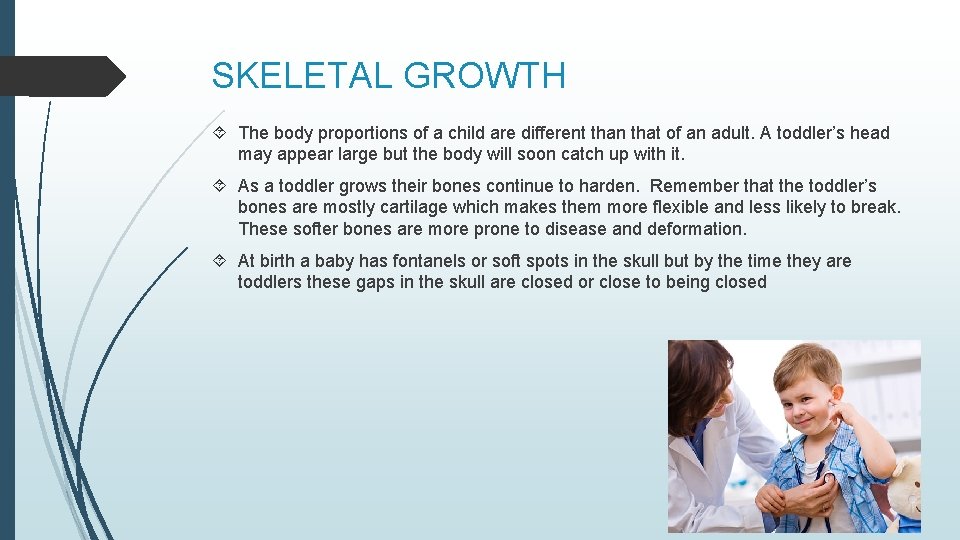
SKELETAL GROWTH The body proportions of a child are different than that of an adult. A toddler’s head may appear large but the body will soon catch up with it. As a toddler grows their bones continue to harden. Remember that the toddler’s bones are mostly cartilage which makes them more flexible and less likely to break. These softer bones are more prone to disease and deformation. At birth a baby has fontanels or soft spots in the skull but by the time they are toddlers these gaps in the skull are closed or close to being closed

SKELETAL GROWTH About 2 years of age a child has a full set of deciduous teeth or baby teeth. It is essential that you teach your child to care for their teeth at this early age because it will affect their dental hygiene when they get older. The fat deposits from infancy begin to decrease and the chubby baby become a more slender child. Forming healthy habits in the toddler years will help later in life so supply nutritious snacks and have some type of physical activity
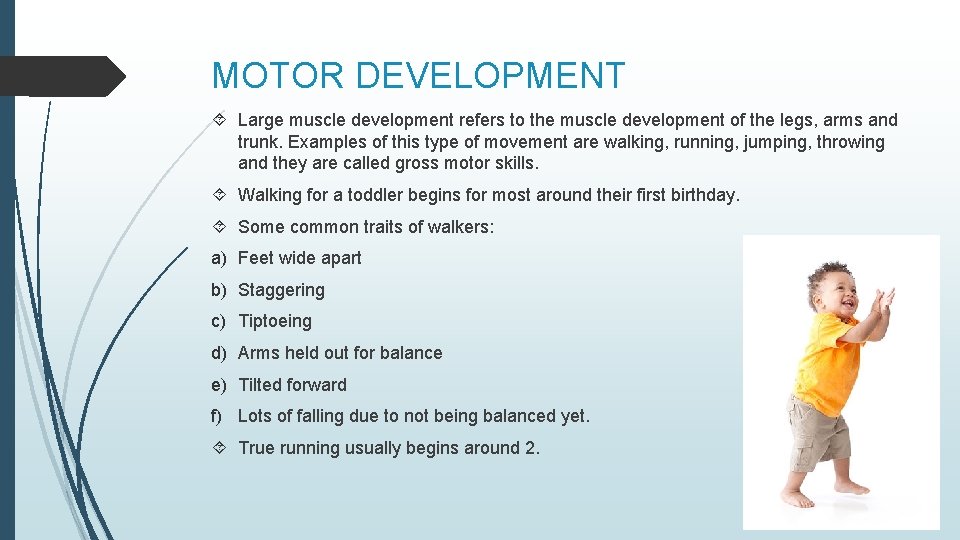
MOTOR DEVELOPMENT Large muscle development refers to the muscle development of the legs, arms and trunk. Examples of this type of movement are walking, running, jumping, throwing and they are called gross motor skills. Walking for a toddler begins for most around their first birthday. Some common traits of walkers: a) Feet wide apart b) Staggering c) Tiptoeing d) Arms held out for balance e) Tilted forward f) Lots of falling due to not being balanced yet. True running usually begins around 2.
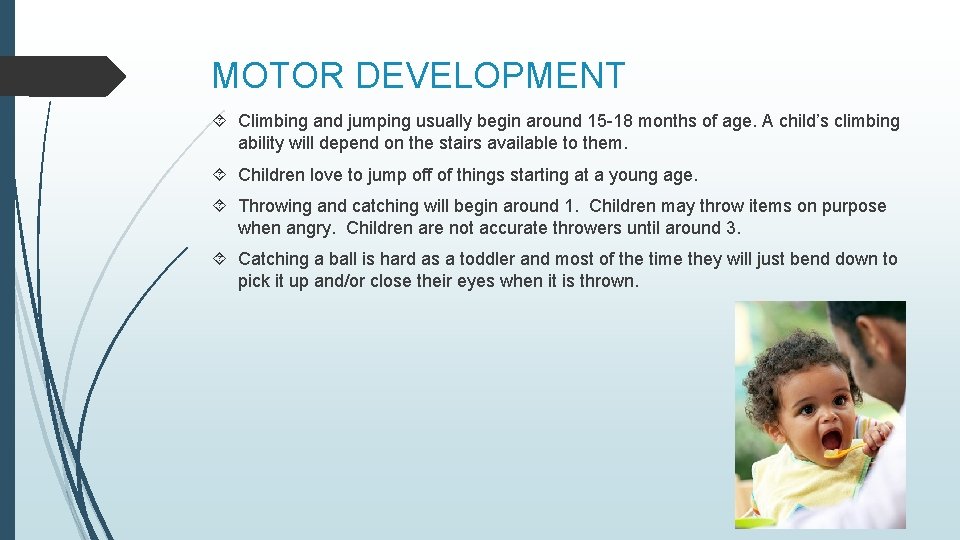
MOTOR DEVELOPMENT Climbing and jumping usually begin around 15 -18 months of age. A child’s climbing ability will depend on the stairs available to them. Children love to jump off of things starting at a young age. Throwing and catching will begin around 1. Children may throw items on purpose when angry. Children are not accurate throwers until around 3. Catching a ball is hard as a toddler and most of the time they will just bend down to pick it up and/or close their eyes when it is thrown.
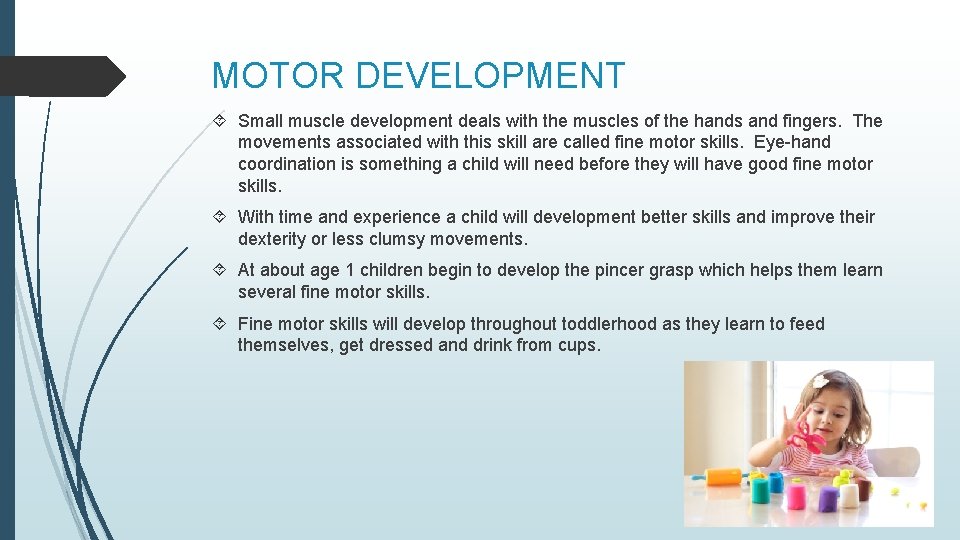
MOTOR DEVELOPMENT Small muscle development deals with the muscles of the hands and fingers. The movements associated with this skill are called fine motor skills. Eye-hand coordination is something a child will need before they will have good fine motor skills. With time and experience a child will development better skills and improve their dexterity or less clumsy movements. At about age 1 children begin to develop the pincer grasp which helps them learn several fine motor skills. Fine motor skills will develop throughout toddlerhood as they learn to feed themselves, get dressed and drink from cups.
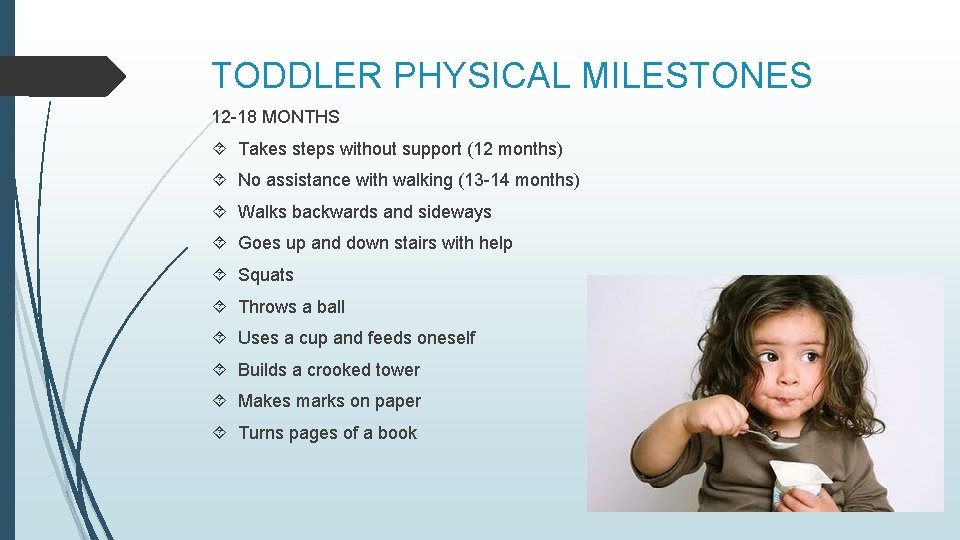
TODDLER PHYSICAL MILESTONES 12 -18 MONTHS Takes steps without support (12 months) No assistance with walking (13 -14 months) Walks backwards and sideways Goes up and down stairs with help Squats Throws a ball Uses a cup and feeds oneself Builds a crooked tower Makes marks on paper Turns pages of a book
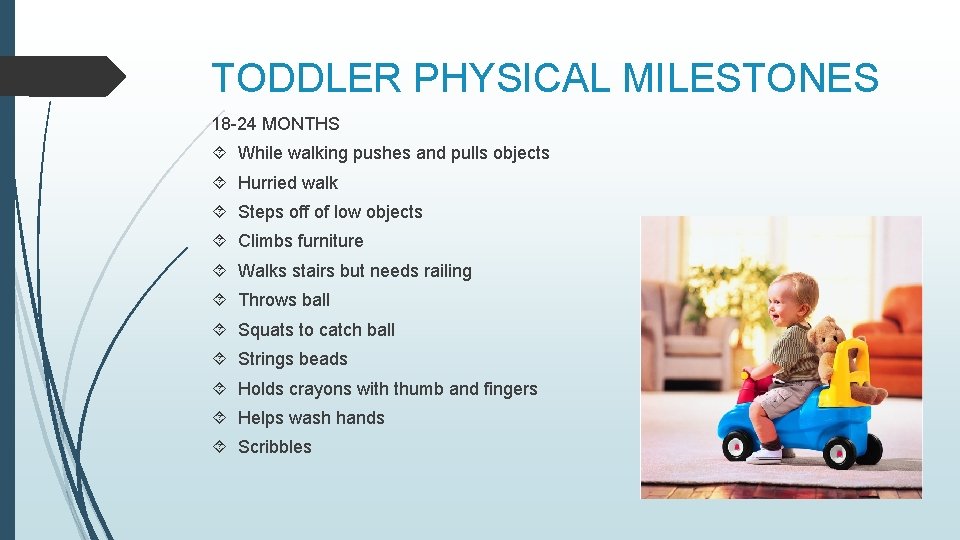
TODDLER PHYSICAL MILESTONES 18 -24 MONTHS While walking pushes and pulls objects Hurried walk Steps off of low objects Climbs furniture Walks stairs but needs railing Throws ball Squats to catch ball Strings beads Holds crayons with thumb and fingers Helps wash hands Scribbles
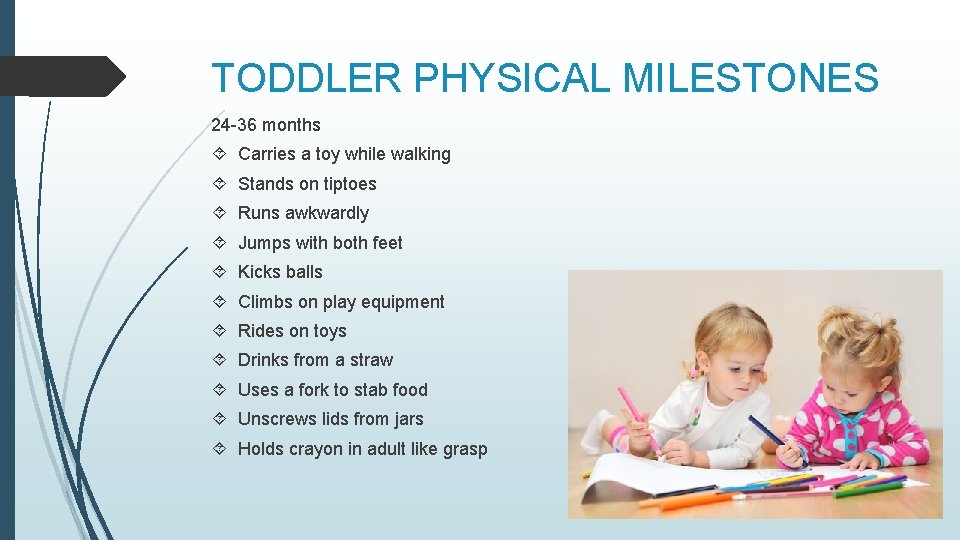
TODDLER PHYSICAL MILESTONES 24 -36 months Carries a toy while walking Stands on tiptoes Runs awkwardly Jumps with both feet Kicks balls Climbs on play equipment Rides on toys Drinks from a straw Uses a fork to stab food Unscrews lids from jars Holds crayon in adult like grasp
PHYSICAL MILESTONES A toddler is better able to do more complex physical activities because of the refinement of the brain, better muscle control and positive environmental settings. This development helps them to reach the milestones we have previously discussed.
- Slides: 13