
PHYSICAL DEVELOPMENT OF PRESCHOOLERS PRESCHOOLERS A preschooler is
- Slides: 14
PHYSICAL DEVELOPMENT OF PRESCHOOLERS
PRESCHOOLERS A preschooler is considered to be a child between the ages of 3 -5. Preschoolers growth rate slow considerably but organs start to stabilize. Preschoolers start to look more like an adult and less like a child. Preschoolers are able to master most basic gross motor skills and are obtaining a new set of fine motor skills.
ORGAN MATURATION The brain is the fastest growing organ during the preschool years. Because it grows so rapidly it requires 30% of the body’s energy which makes good nutrition a must. By age 5 a preschooler’s brain weighs are 90% of adult weight. Boys typically have larger heads than girls.
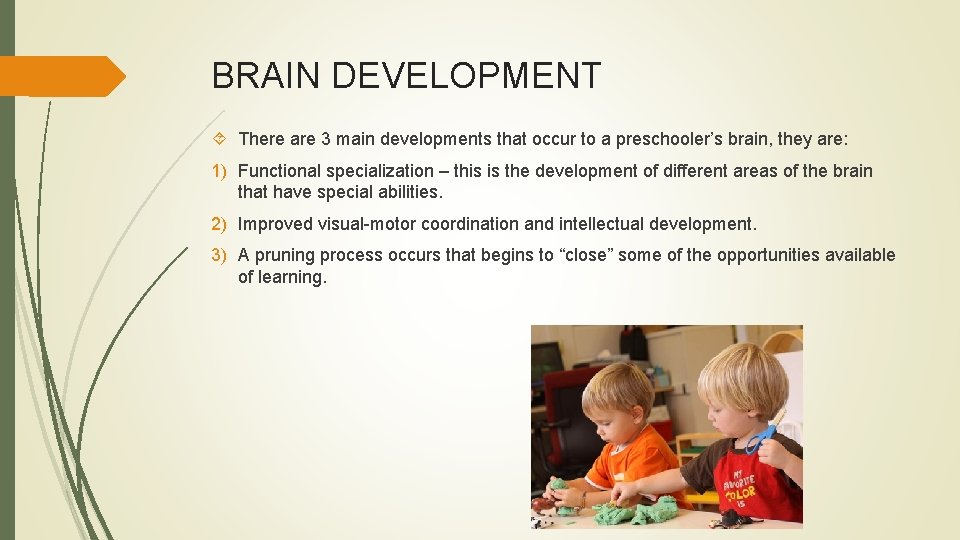
BRAIN DEVELOPMENT There are 3 main developments that occur to a preschooler’s brain, they are: 1) Functional specialization – this is the development of different areas of the brain that have special abilities. 2) Improved visual-motor coordination and intellectual development. 3) A pruning process occurs that begins to “close” some of the opportunities available of learning.
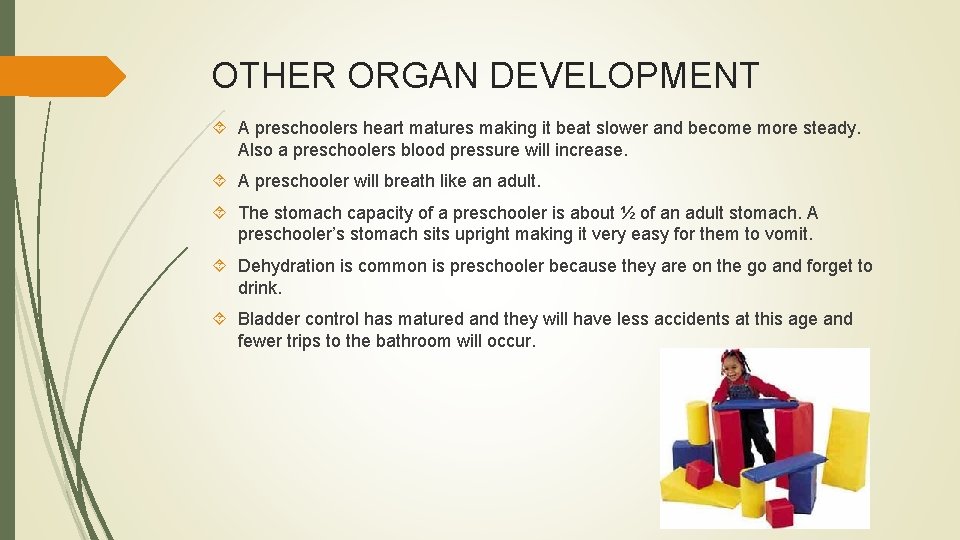
OTHER ORGAN DEVELOPMENT A preschoolers heart matures making it beat slower and become more steady. Also a preschoolers blood pressure will increase. A preschooler will breath like an adult. The stomach capacity of a preschooler is about ½ of an adult stomach. A preschooler’s stomach sits upright making it very easy for them to vomit. Dehydration is common is preschooler because they are on the go and forget to drink. Bladder control has matured and they will have less accidents at this age and fewer trips to the bathroom will occur.
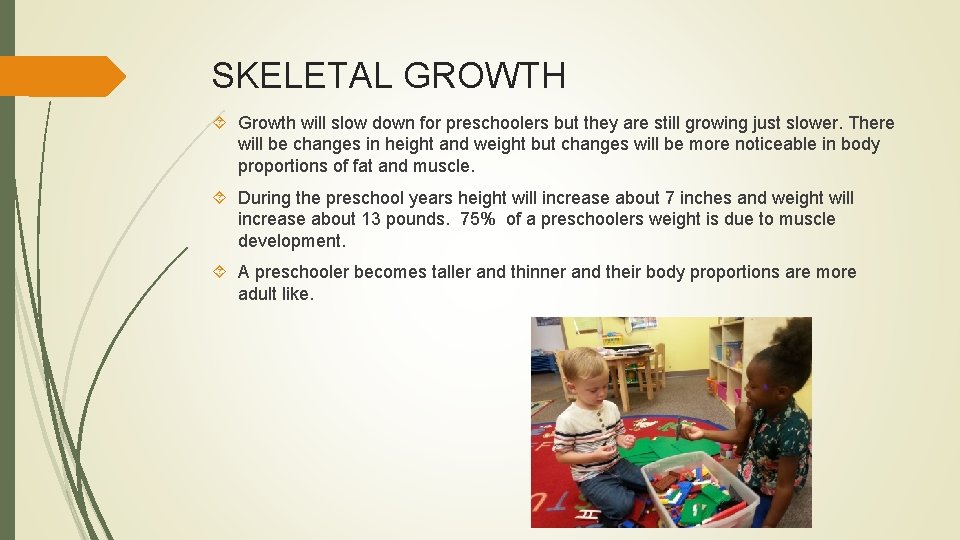
SKELETAL GROWTH Growth will slow down for preschoolers but they are still growing just slower. There will be changes in height and weight but changes will be more noticeable in body proportions of fat and muscle. During the preschool years height will increase about 7 inches and weight will increase about 13 pounds. 75% of a preschoolers weight is due to muscle development. A preschooler becomes taller and thinner and their body proportions are more adult like.
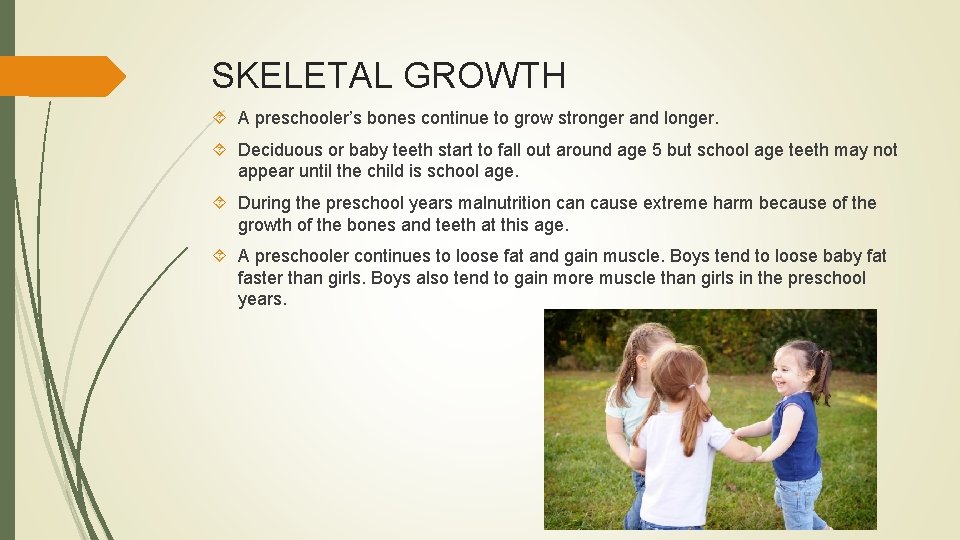
SKELETAL GROWTH A preschooler’s bones continue to grow stronger and longer. Deciduous or baby teeth start to fall out around age 5 but school age teeth may not appear until the child is school age. During the preschool years malnutrition cause extreme harm because of the growth of the bones and teeth at this age. A preschooler continues to loose fat and gain muscle. Boys tend to loose baby fat faster than girls. Boys also tend to gain more muscle than girls in the preschool years.
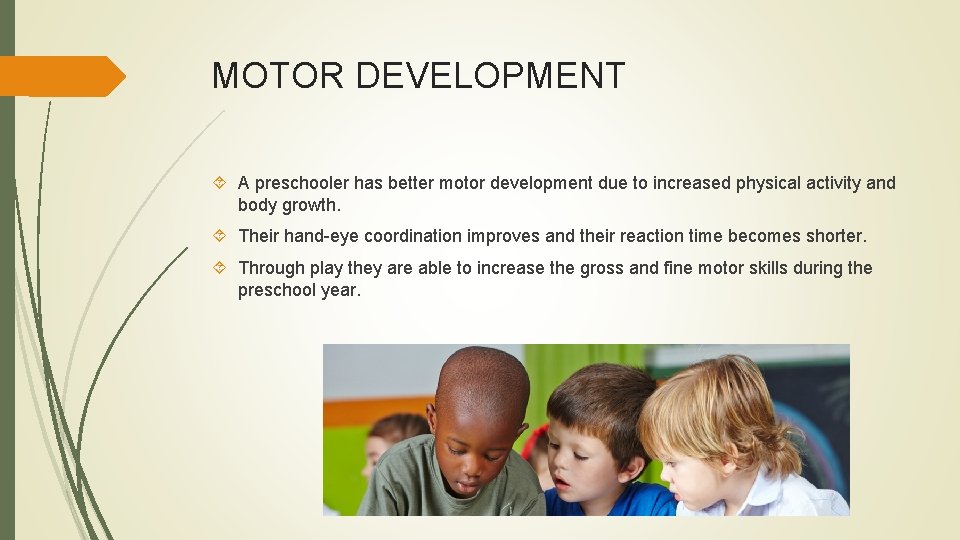
MOTOR DEVELOPMENT A preschooler has better motor development due to increased physical activity and body growth. Their hand-eye coordination improves and their reaction time becomes shorter. Through play they are able to increase the gross and fine motor skills during the preschool year.
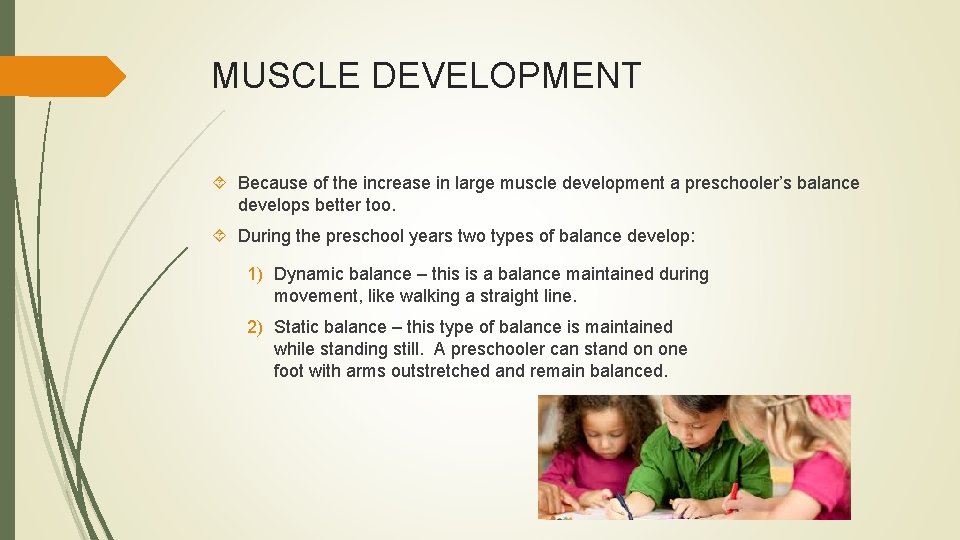
MUSCLE DEVELOPMENT Because of the increase in large muscle development a preschooler’s balance develops better too. During the preschool years two types of balance develop: 1) Dynamic balance – this is a balance maintained during movement, like walking a straight line. 2) Static balance – this type of balance is maintained while standing still. A preschooler can stand on one foot with arms outstretched and remain balanced.
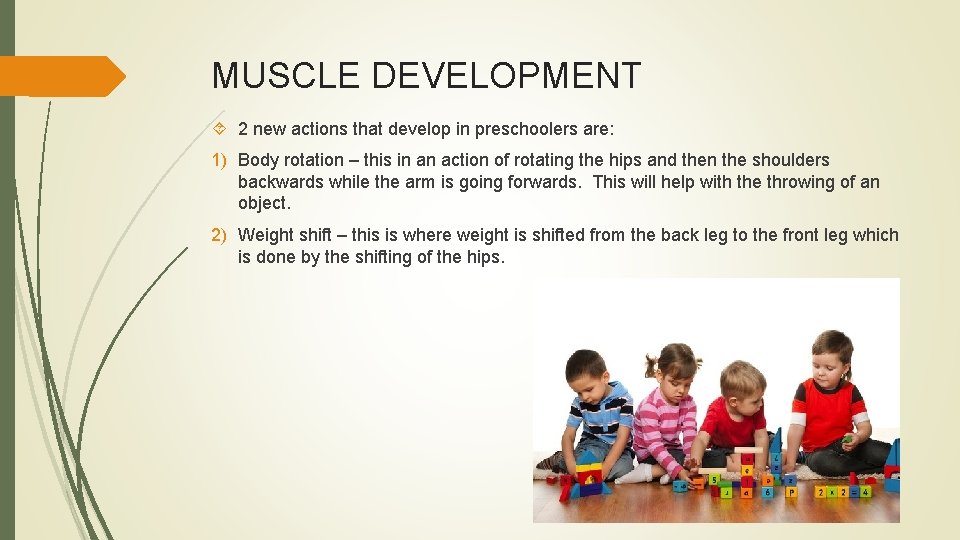
MUSCLE DEVELOPMENT 2 new actions that develop in preschoolers are: 1) Body rotation – this in an action of rotating the hips and then the shoulders backwards while the arm is going forwards. This will help with the throwing of an object. 2) Weight shift – this is where weight is shifted from the back leg to the front leg which is done by the shifting of the hips.
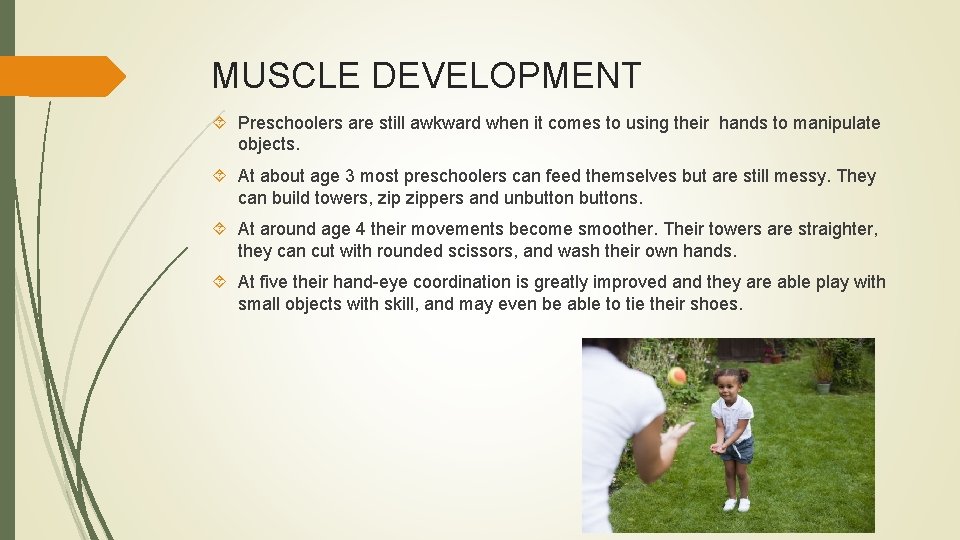
MUSCLE DEVELOPMENT Preschoolers are still awkward when it comes to using their hands to manipulate objects. At about age 3 most preschoolers can feed themselves but are still messy. They can build towers, zippers and unbuttons. At around age 4 their movements become smoother. Their towers are straighter, they can cut with rounded scissors, and wash their own hands. At five their hand-eye coordination is greatly improved and they are able play with small objects with skill, and may even be able to tie their shoes.
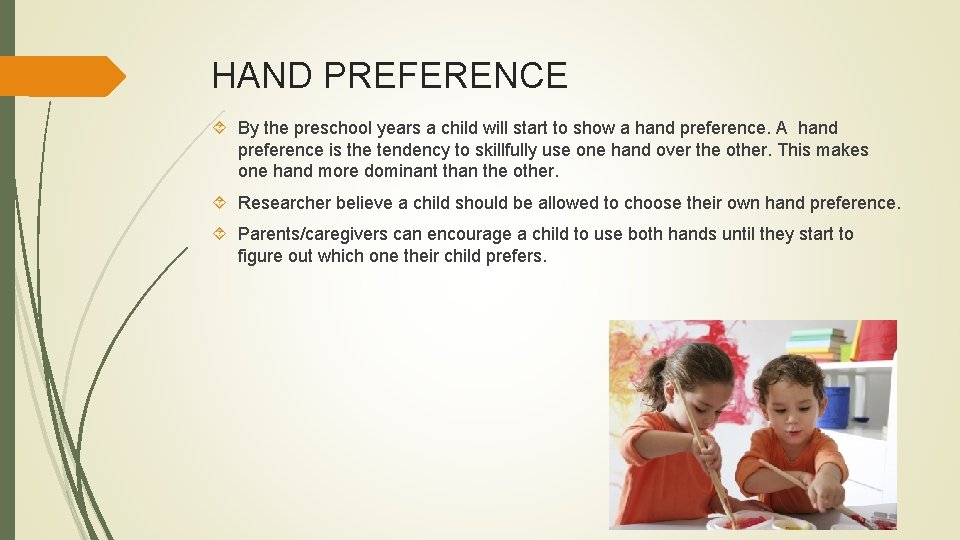
HAND PREFERENCE By the preschool years a child will start to show a hand preference. A hand preference is the tendency to skillfully use one hand over the other. This makes one hand more dominant than the other. Researcher believe a child should be allowed to choose their own hand preference. Parents/caregivers can encourage a child to use both hands until they start to figure out which one their child prefers.
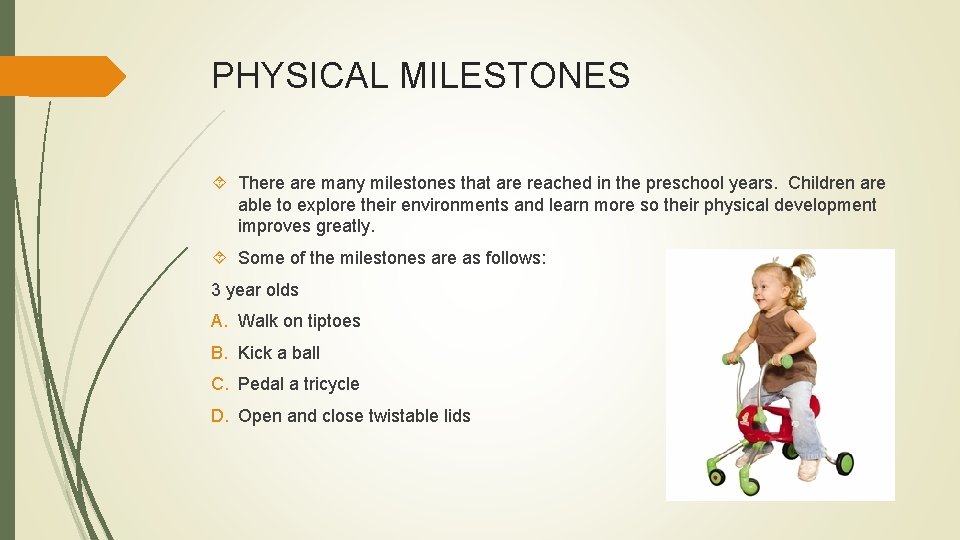
PHYSICAL MILESTONES There are many milestones that are reached in the preschool years. Children are able to explore their environments and learn more so their physical development improves greatly. Some of the milestones are as follows: 3 year olds A. Walk on tiptoes B. Kick a ball C. Pedal a tricycle D. Open and close twistable lids
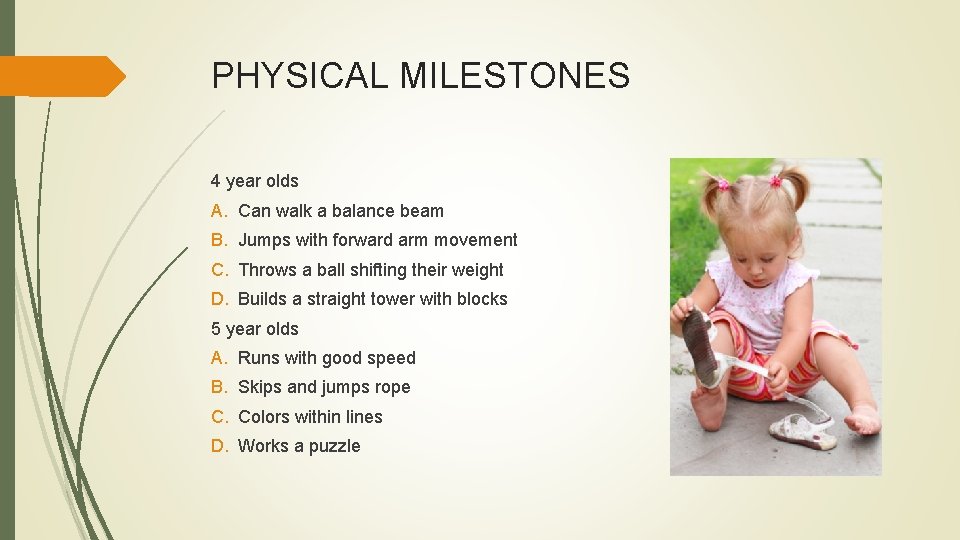
PHYSICAL MILESTONES 4 year olds A. Can walk a balance beam B. Jumps with forward arm movement C. Throws a ball shifting their weight D. Builds a straight tower with blocks 5 year olds A. Runs with good speed B. Skips and jumps rope C. Colors within lines D. Works a puzzle