
Physical Development of a Preschooler Physical Characteristics Physical




- Slides: 14
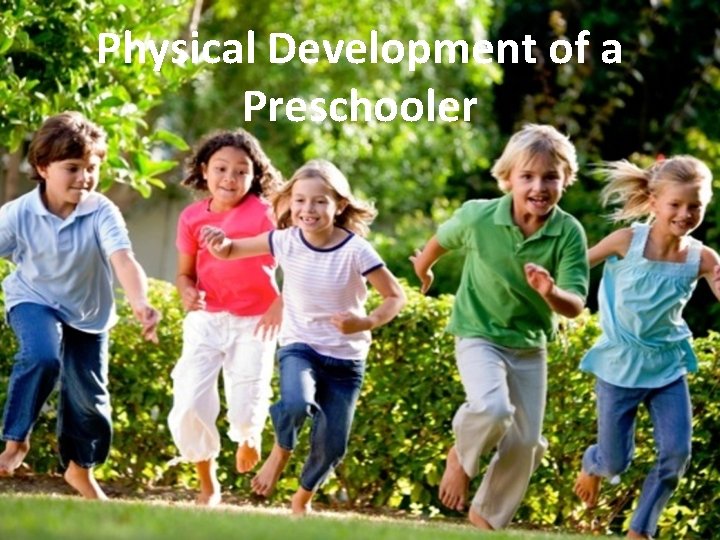
Physical Development of a Preschooler
Physical Characteristics • • • Physical growth slows down greatly. Size varies due to individual growth patterns. Bodies have become straighter and slimmer. Protruding stomach from babyhood flattens. Neck becomes longer. Legs lengthen and grow straighter and firmer.
Physical Skills • Very active and energetic. • Skills are practiced by participating in the action again and again. • There begins to be a refinement and practice of gross and fine motor skills.
Gross Motor Skills • Define: – Larger movements your body makes with their arms, legs, feet, or entire body. • Examples: – Running, jumping and throwing
4 Year Old Gross Motor Skills • • • Stand on tip toes Throwing and catching Hopping on one foot Alternates feet walking up and down the stairs Walking backwards
5 Year Old Gross Motor Skills • • Improved speed and coordination Turning somersaults Skipping Balancing on one foot
Let’s Practice Gross Motor Skills • Bring your chair up to the front • Make a circle • Take one out so there is one less chair than there are students • Let’s play musical chairs!
Fine Motor Skills • Define: – Smaller movements your body makes with fingers, toes, wrists, lips, and tongue. – More refined manual dexterity (ability to use your hands and fingers) – Better eye hand coordination • Examples: – Cutting, pasting, painting
4 Year Old Fine Motor Skills • • Put on and zip up their own coats Cut with scissors Complete puzzles Write letters of the alphabet
5 Year Old Fine Motor Skills • Tie their own shoes • Drawing a person with a head, body, arms and legs • Stay in the line • Using a spoon and fork to eat • Definite hand preference for being right or left -handed
Let’s Practice Fine Motor Skills • You are going to create a Mosaic Flower. • Tear construction paper into about 1” pieces. • Glue them on another piece of construction paper, creating a flower. • You may make any type of flower you’d like. • Be creative and have fun!
Role of Play • Play is a child’s work. • It is how they learn about their world around them and all the areas of development. • Continues with solitary, on-looker and parallel play. • But now because of their ability to share, help, and do things another person’s way, it allows them to engage in cooperative play.
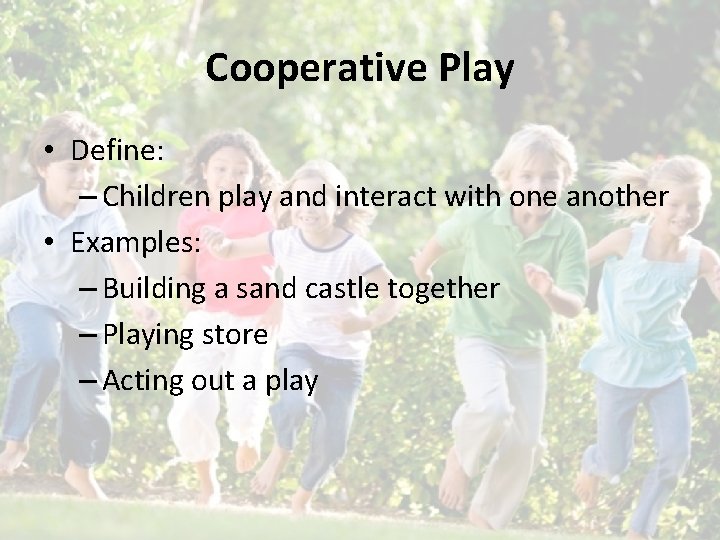
Cooperative Play • Define: – Children play and interact with one another • Examples: – Building a sand castle together – Playing store – Acting out a play
Summary • Preschool children are growing rapidly. • Their heads are more in proportion with their bodies and their coordination is improving. • It is important that adults provide them with toys and equipment to develop both large and small muscles.