
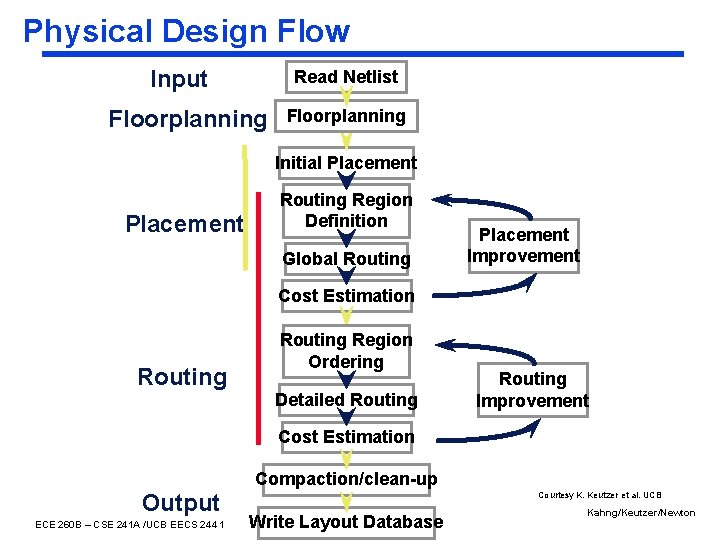
Physical Design Flow Input Read Netlist Floorplanning Initial
- Slides: 12
Physical Design Flow Input Read Netlist Floorplanning Initial Placement Routing Region Definition Global Routing Placement Improvement Cost Estimation Routing Region Ordering Detailed Routing Improvement Cost Estimation Output ECE 260 B – CSE 241 A /UCB EECS 244 1 Compaction/clean-up Courtesy K. Keutzer et al. UCB Write Layout Database Kahng/Keutzer/Newton
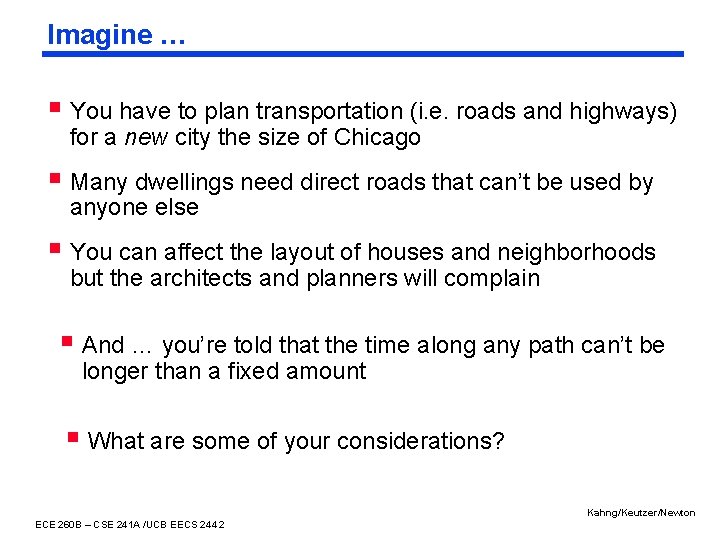
Imagine … § You have to plan transportation (i. e. roads and highways) for a new city the size of Chicago § Many dwellings need direct roads that can’t be used by anyone else § You can affect the layout of houses and neighborhoods but the architects and planners will complain § And … you’re told that the time along any path can’t be longer than a fixed amount § What are some of your considerations? Kahng/Keutzer/Newton ECE 260 B – CSE 241 A /UCB EECS 244 2
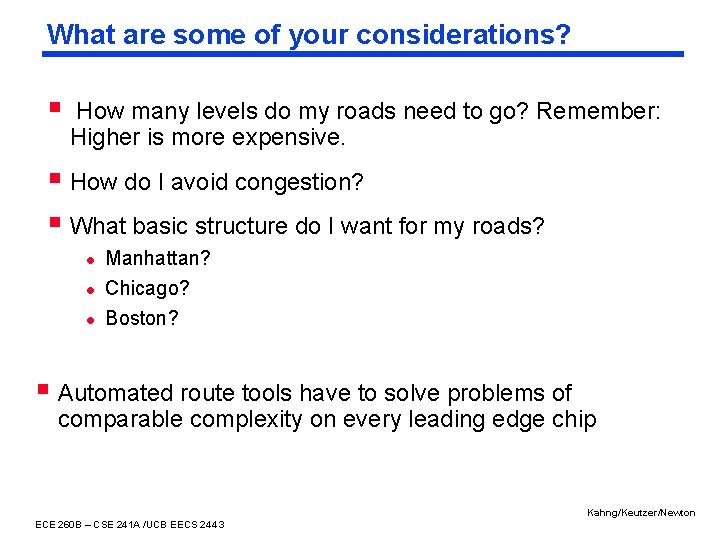
What are some of your considerations? § How many levels do my roads need to go? Remember: Higher is more expensive. § How do I avoid congestion? § What basic structure do I want for my roads? l Manhattan? l Chicago? l Boston? § Automated route tools have to solve problems of comparable complexity on every leading edge chip Kahng/Keutzer/Newton ECE 260 B – CSE 241 A /UCB EECS 244 3
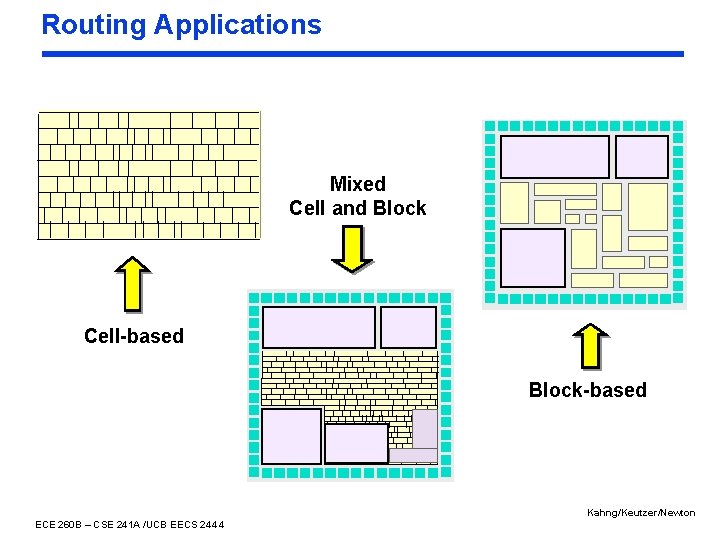
Routing Applications Mixed Cell and Block Cell-based Block-based Kahng/Keutzer/Newton ECE 260 B – CSE 241 A /UCB EECS 244 4
Routing Algorithms Hard to tackle high-level issues like congestion and wire-planning and low level details of pinconnection at the same time § Global routing l l Identify routing resources to be used Identify layers (and tracks) to be used Assign particular nets to these resources Also used in floorplanning and placement § Detail routing Actually define pin-to-pin connections l Must understand most or all design rules l May use a compactor to optimize result l Necessary in all applications ECE 260 B – CSE 241 A /UCB EECS 244 5 l Kahng/Keutzer/Newton
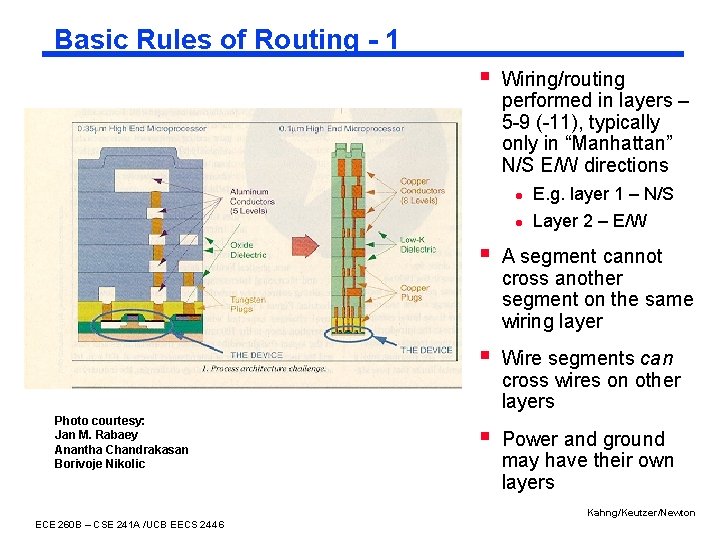
Basic Rules of Routing - 1 § Wiring/routing performed in layers – 5 -9 (-11), typically only in “Manhattan” N/S E/W directions l l Photo courtesy: Jan M. Rabaey Anantha Chandrakasan Borivoje Nikolic E. g. layer 1 – N/S Layer 2 – E/W § A segment cannot cross another segment on the same wiring layer § Wire segments can cross wires on other layers § Power and ground may have their own layers Kahng/Keutzer/Newton ECE 260 B – CSE 241 A /UCB EECS 244 6
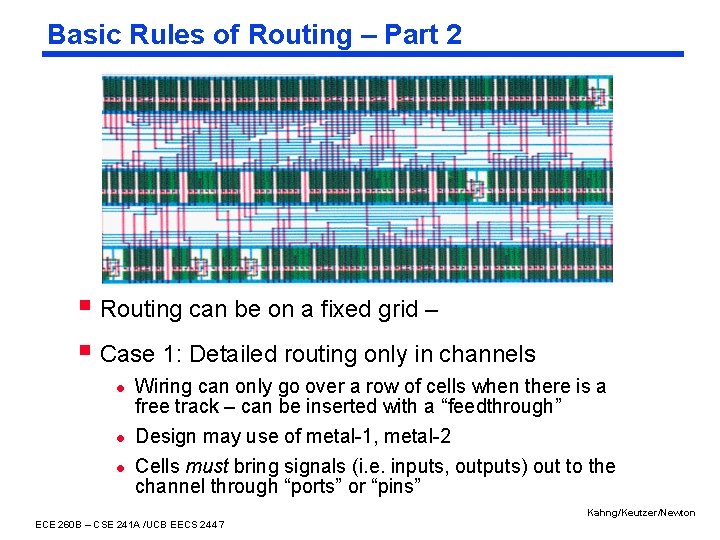
Basic Rules of Routing – Part 2 § Routing can be on a fixed grid – § Case 1: Detailed routing only in channels l l l Wiring can only go over a row of cells when there is a free track – can be inserted with a “feedthrough” Design may use of metal-1, metal-2 Cells must bring signals (i. e. inputs, outputs) out to the channel through “ports” or “pins” Kahng/Keutzer/Newton ECE 260 B – CSE 241 A /UCB EECS 244 7
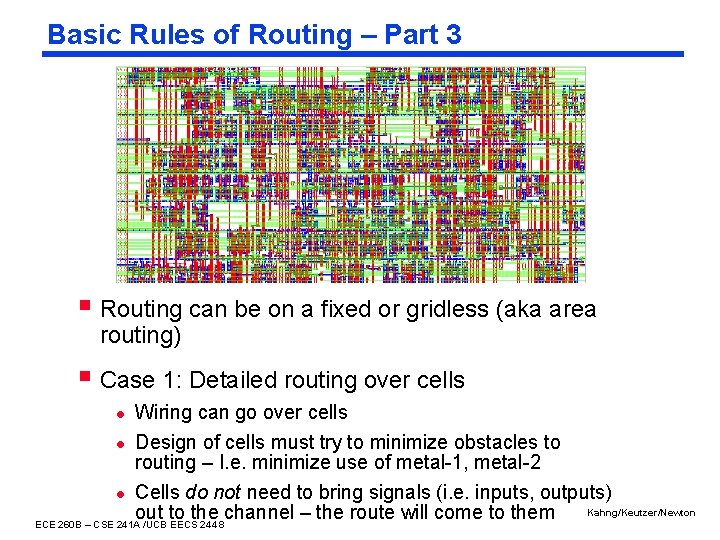
Basic Rules of Routing – Part 3 § Routing can be on a fixed or gridless (aka area routing) § Case 1: Detailed routing over cells l l Wiring can go over cells Design of cells must try to minimize obstacles to routing – I. e. minimize use of metal-1, metal-2 Cells do not need to bring signals (i. e. inputs, outputs) Kahng/Keutzer/Newton out to the channel – the route will come to them ECE 260 B – CSE 241 A /UCB EECS 244 8 l
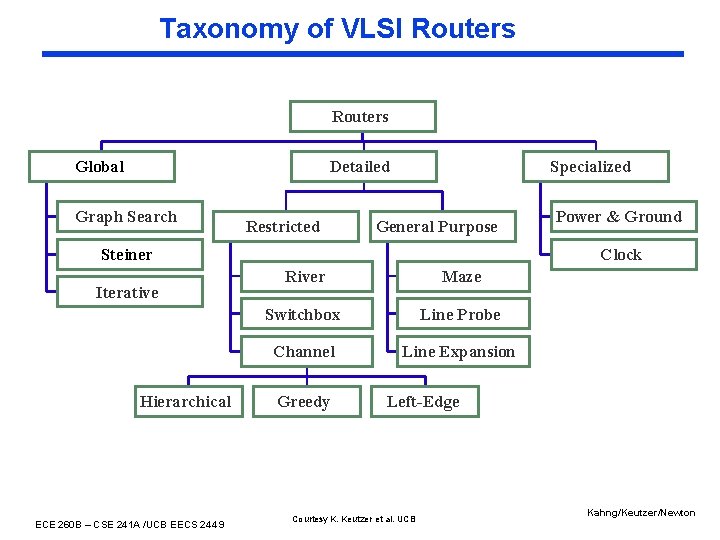
Taxonomy of VLSI Routers Global Detailed Graph Search Restricted Specialized General Purpose Steiner Iterative Hierarchical ECE 260 B – CSE 241 A /UCB EECS 244 9 Power & Ground Clock River Maze Switchbox Line Probe Channel Line Expansion Greedy Left-Edge Courtesy K. Keutzer et al. UCB Kahng/Keutzer/Newton
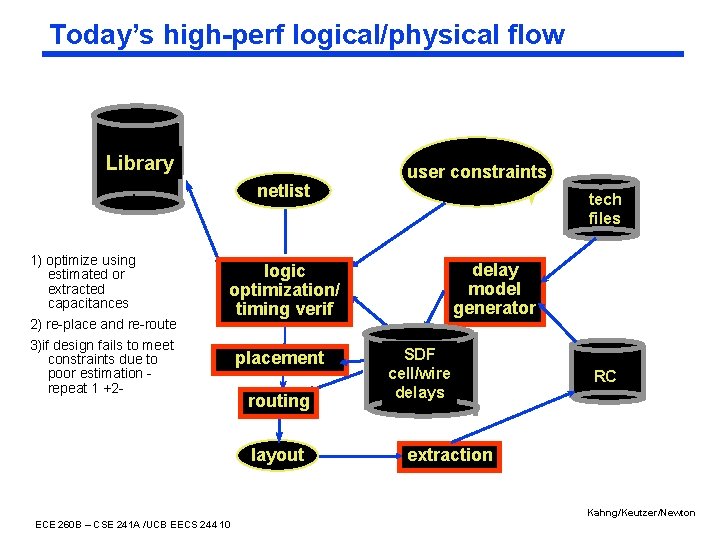
Today’s high-perf logical/physical flow Library netlist 1) optimize using estimated or extracted capacitances 2) re-place and re-route user constraints tech files delay model generator logic optimization/ timing verif 3)if design fails to meet constraints due to poor estimation repeat 1 +2 - placement routing layout SDF cell/wire delays RC extraction Kahng/Keutzer/Newton ECE 260 B – CSE 241 A /UCB EECS 244 10
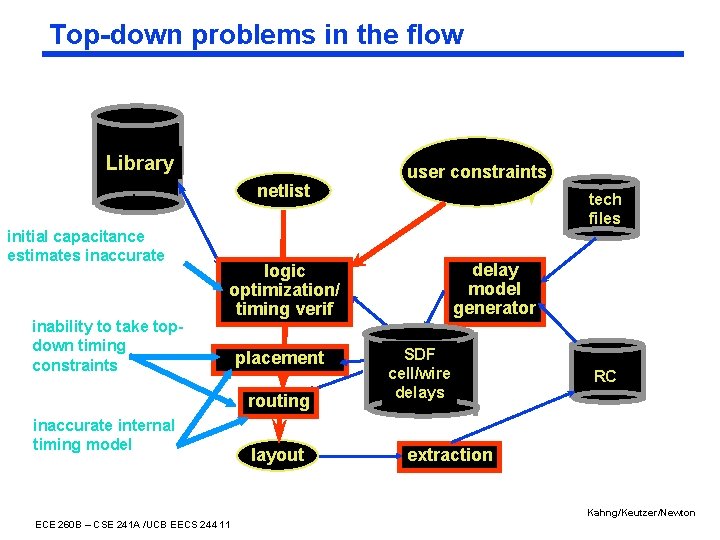
Top-down problems in the flow Library netlist initial capacitance estimates inaccurate inability to take topdown timing constraints user constraints tech files delay model generator logic optimization/ timing verif placement routing inaccurate internal timing model layout SDF cell/wire delays RC extraction Kahng/Keutzer/Newton ECE 260 B – CSE 241 A /UCB EECS 244 11
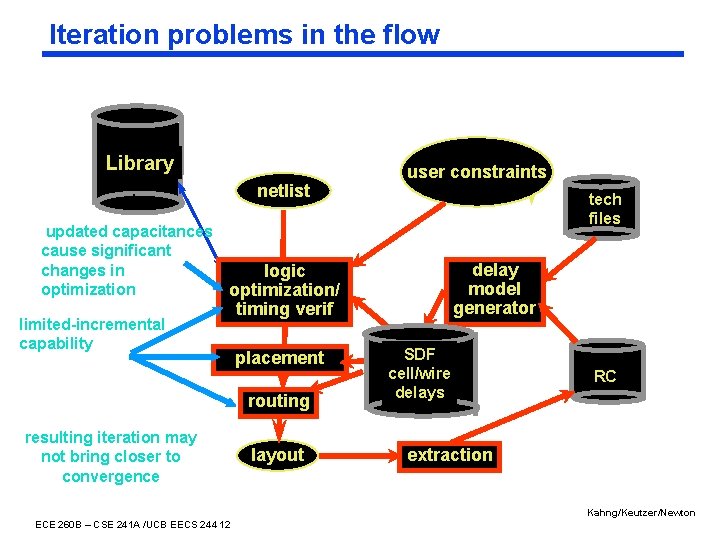
Iteration problems in the flow Library netlist updated capacitances cause significant changes in optimization limited-incremental capability user constraints tech files delay model generator logic optimization/ timing verif placement routing resulting iteration may not bring closer to convergence layout SDF cell/wire delays RC extraction Kahng/Keutzer/Newton ECE 260 B – CSE 241 A /UCB EECS 244 12