
Physical Deposition Processes Outline Introduction Basic Theory Thermal


Physical Deposition Processes
Outline • • • Introduction Basic Theory Thermal and e-gun evaporation Sputtering Laser ablation
Introduction • Physical Vapor Deposition (PVD) basically consist of vaporizing a source (target) in order for the transfer to and deposition on a substrate • The processes are preformed under vacuum to prevent contamination issues • PVD allows for very precise atomic layer film growth in thickness ranging from nanometers to millimeters • Normally there is no chemical reaction throughout the deposition process. However, in some methods (e. g. sputtering) new growth-species can be created chemically in the vapor phase and deposited on the substrate • There are many types of physical deposition methods and systems, three of which will be presented here
Outline • • • Introduction Basic Theory Thermal and e-gun evaporation Sputtering Laser ablation
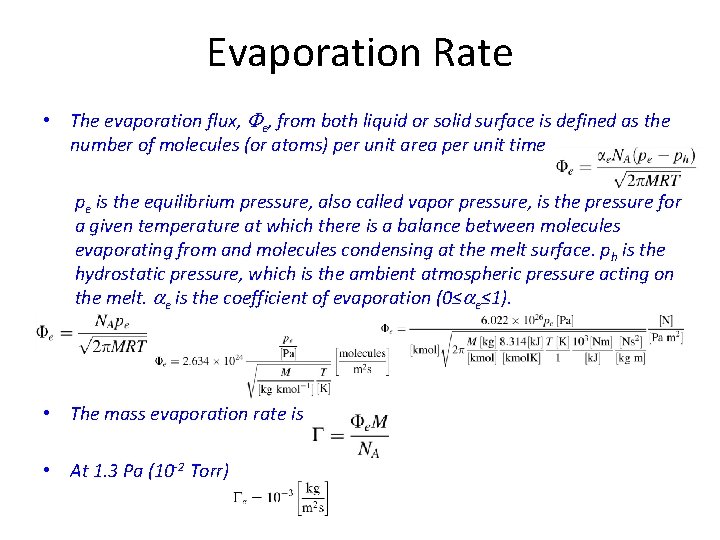
Evaporation Rate • The evaporation flux, Fe, from both liquid or solid surface is defined as the number of molecules (or atoms) per unit area per unit time pe is the equilibrium pressure, also called vapor pressure, is the pressure for a given temperature at which there is a balance between molecules evaporating from and molecules condensing at the melt surface. ph is the hydrostatic pressure, which is the ambient atmospheric pressure acting on the melt. ae is the coefficient of evaporation (0≤ae≤ 1). • The mass evaporation rate is • At 1. 3 Pa (10 -2 Torr)
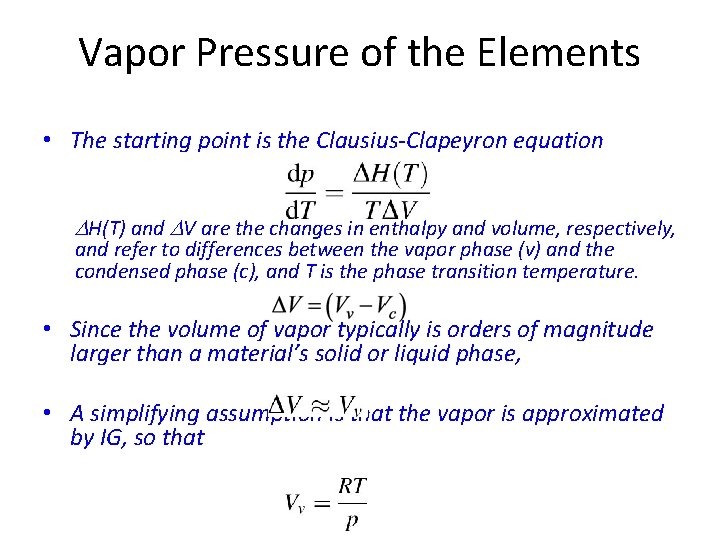
Vapor Pressure of the Elements • The starting point is the Clausius-Clapeyron equation DH(T) and DV are the changes in enthalpy and volume, respectively, and refer to differences between the vapor phase (v) and the condensed phase (c), and T is the phase transition temperature. • Since the volume of vapor typically is orders of magnitude larger than a material’s solid or liquid phase, • A simplifying assumption is that the vapor is approximated by IG, so that

• Therefore, • By approximating • Where DHe is the molar heat of evaporation (heat required to boil or condense one mole of substance at the boiling point), which is constant. Integration yields • Where I is a constant of integration
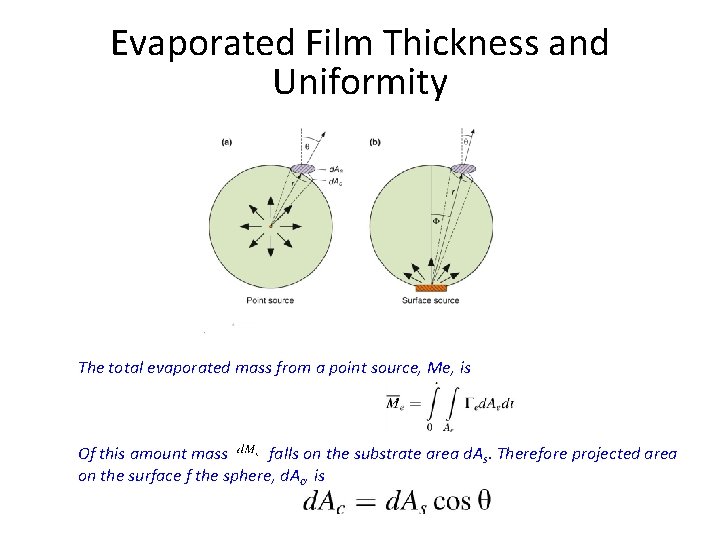
Evaporated Film Thickness and Uniformity The total evaporated mass from a point source, Me, is Of this amount mass falls on the substrate area d. As. Therefore projected area on the surface f the sphere, d. Ac, is
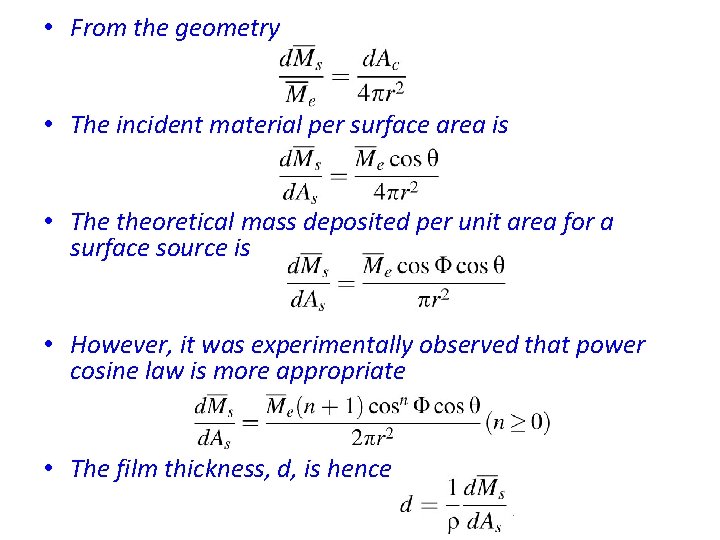
• From the geometry • The incident material per surface area is • The theoretical mass deposited per unit area for a surface source is • However, it was experimentally observed that power cosine law is more appropriate • The film thickness, d, is hence
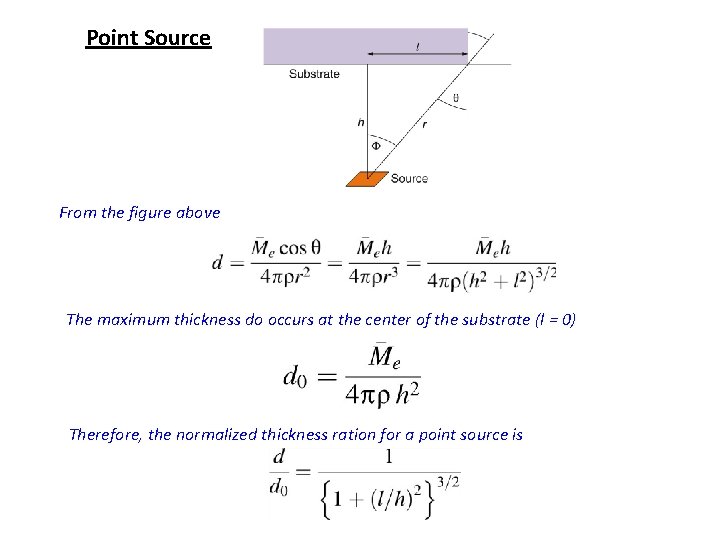
Point Source From the figure above The maximum thickness do occurs at the center of the substrate (l = 0) Therefore, the normalized thickness ration for a point source is
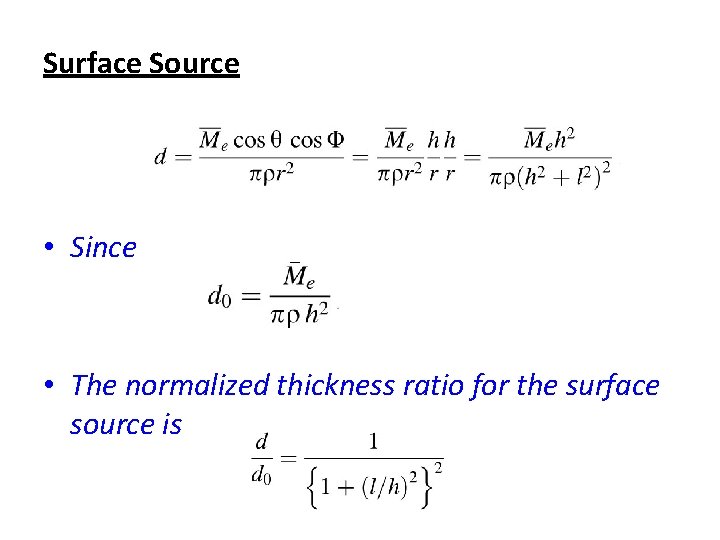
Surface Source • Since • The normalized thickness ratio for the surface source is
Outline • • • Introduction Basic Theory Thermal and e-gun evaporation Sputtering Laser ablation
Thermal Evaporator • Thermal energy is used to atomize elemental metals. Alloys tend to separate due to melting temperature • Metal selection is based on temperature, with a nominal limit of Platinum • Vacuum level is important to minimize contamination. Generally a base vacuum of 10 -5 Torr is desired to prevent water contamination • This originates 'shadowing' phenomena with 3 D objects, especially in those regions not directly accessible from the evaporation source substrate surface is generally low (order of k. T, i. e. tenths of e. V). This affects seriously the morphology of the films, often resulting in a porous and little adherent material
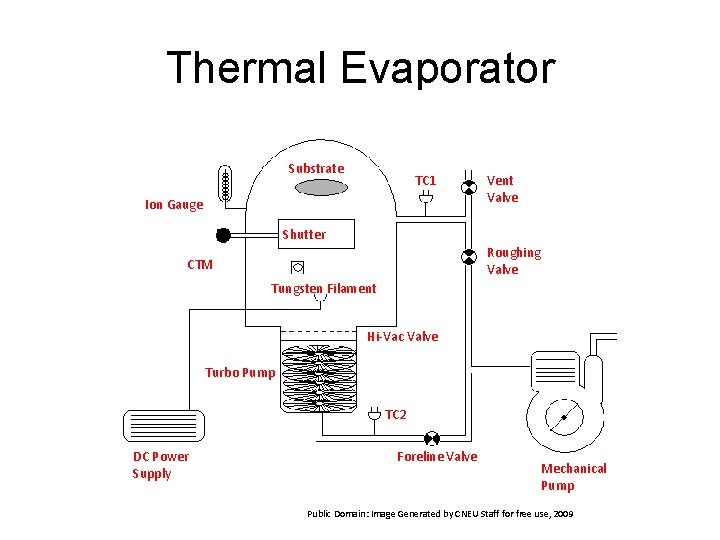
Thermal Evaporator Substrate TC 1 Ion Gauge Vent Valve Shutter Roughing Valve CTM Tungsten Filament Hi-Vac Valve Turbo Pump TC 2 DC Power Supply Foreline Valve Mechanical Pump Public Domain: Image Generated by CNEU Staff for free use, 2009
E-Gun Evaporator • E-beam source permits the use of metals that have a higher melting temperature than the evaporator. • Crucible materials are selected to prevent contamination • Crucible selection chart……………….
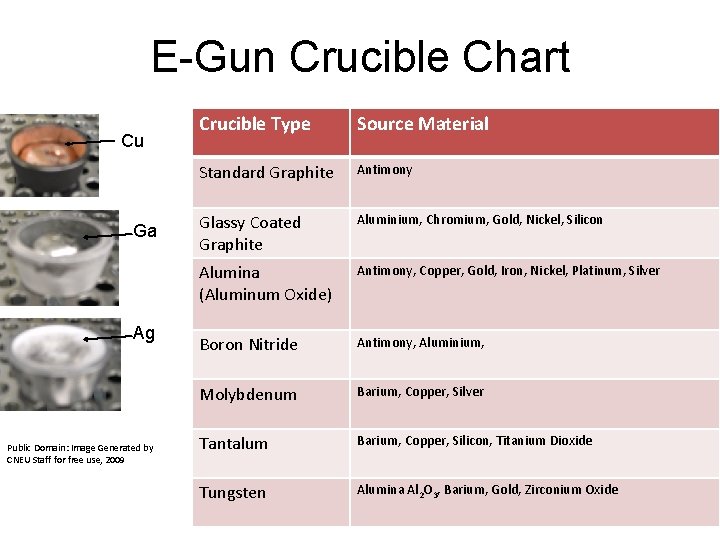
E-Gun Crucible Chart Cu Ga Ag Public Domain: Image Generated by CNEU Staff for free use, 2009 Crucible Type Source Material Standard Graphite Antimony Glassy Coated Graphite Aluminium, Chromium, Gold, Nickel, Silicon Alumina (Aluminum Oxide) Antimony, Copper, Gold, Iron, Nickel, Platinum, Silver Boron Nitride Antimony, Aluminium, Molybdenum Barium, Copper, Silver Tantalum Barium, Copper, Silicon, Titanium Dioxide Tungsten Alumina Al 2 O 3, Barium, Gold, Zirconium Oxide
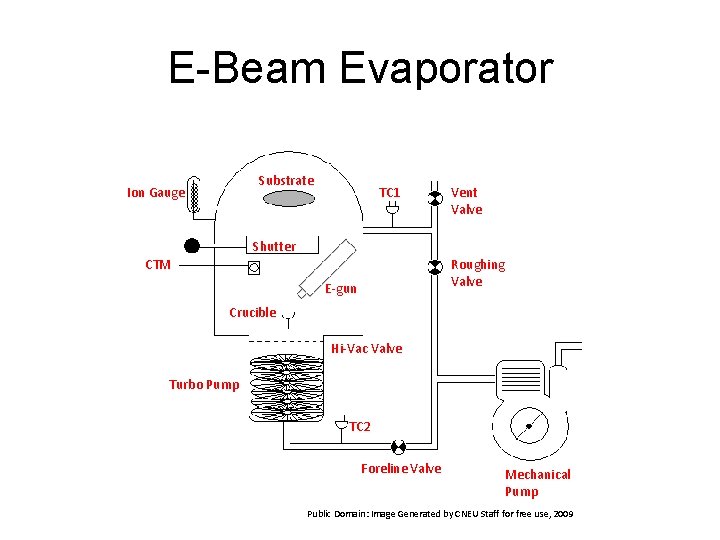
E-Beam Evaporator Substrate Ion Gauge TC 1 Shutter CTM Tungsten Filament. E-gun Vent Valve Roughing Valve Crucible Hi-Vac Valve Turbo Pump TC 2 DC Power Supply Foreline Valve Mechanical Pump Public Domain: Image Generated by CNEU Staff for free use, 2009
E-Beam Evaporation • Target anode is bombarded with an electron beam given off by a charged tungsten filament under high vacuum • Vacuum level is important to minimize contamination. Generally a base vacuum of 10 -5 Torr is desired to prevent water contamination
Outline • • • Introduction Basic Theory Thermal and e-gun evaporation Sputtering Laser ablation
Sputtering • RF power is used to create ions that impinge on the target. • Ion bombardment “grinds down” the target, and the resulting material is deposited on the substrate • The product of ion impingement energy and substrate temperature create a unique morphology of the deposited material • Permits the use of many materials. – Compounds – Pure metals – Mixtures – Alloys
Sputtering Advantages • Reproducibility • Thickness Control • Stronger Adhesion • Deposits More Materials – Compounds – Pure metals – Mixtures – Alloys
Sputtering • Benefits – Ability to deposit complex compounds while maintaining their stoichiometry – Capability to deposit high-temperature and refractory metals – Ability to deposit controlled, uniform films on large substrates and components – Can be part of a multi-chamber cluster tool – Can be used as a pre-process substrate cleaning tool
Sputtering Disadvantage • • Higher quality equipment Higher costs Lower deposition rates Organic material integrity is easily degraded by ion bombardment
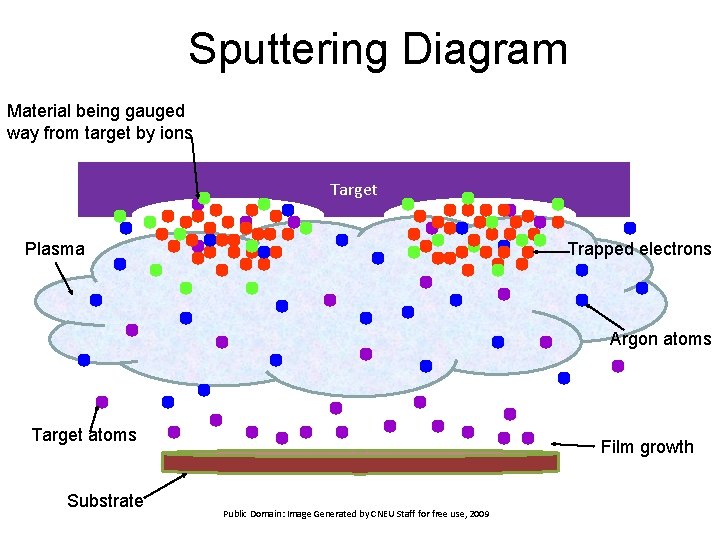
Sputtering Diagram Material being gauged way from target by ions Target Plasma Trapped electrons Argon atoms Target atoms Substrate Film growth Public Domain: Image Generated by CNEU Staff for free use, 2009
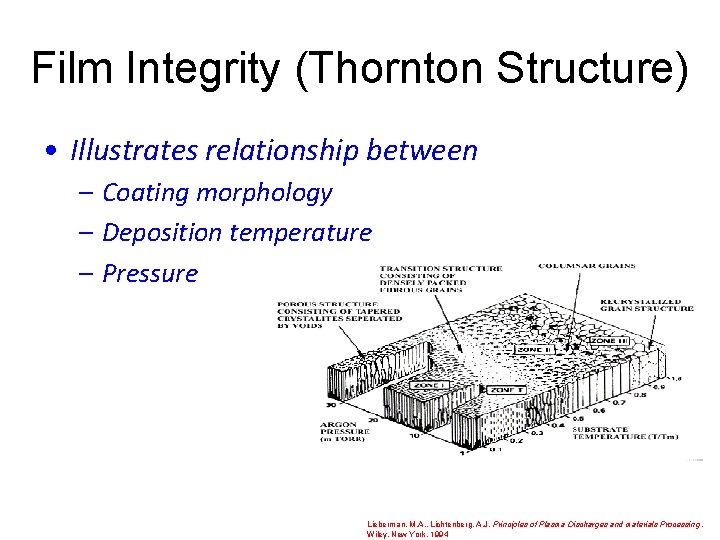
Film Integrity (Thornton Structure) • Illustrates relationship between – Coating morphology – Deposition temperature – Pressure Lieberman, M. A. , Lichtenberg, A. J. Principles of Plasma Discharges and materials Processing. Wiley. New York. 1994
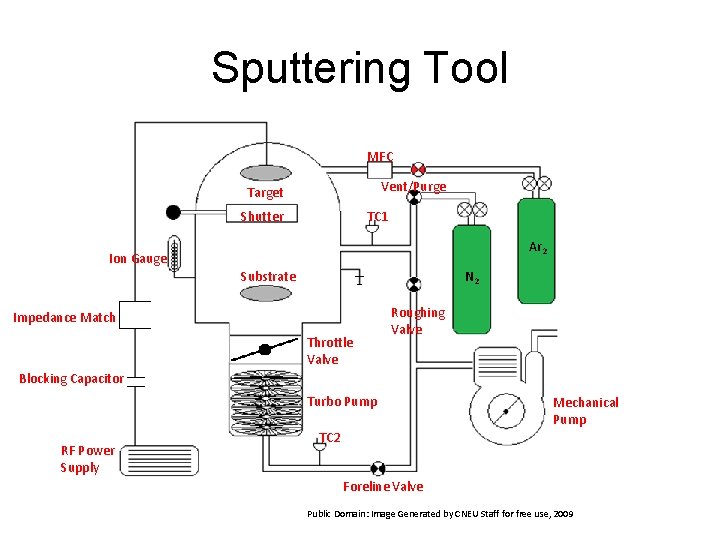
Sputtering Tool MFC Vent/Purge Target Shutter TC 1 Ar 2 Ion Gauge Substrate N 2 Impedance Match Throttle Valve Roughing Valve Blocking Capacitor Turbo Pump RF Power Supply Mechanical Pump TC 2 Foreline Valve Public Domain: Image Generated by CNEU Staff for free use, 2009
Outline • • • Introduction Basic Theory Thermal and e-gun evaporation Sputtering Laser ablation
Laser Ablation • The laser’s wavelength is chosen based on the source material’s absorption characteristics • At low laser flux, the material is heated by the absorbed laser energy and evaporates or sublimates • At high laser flux, the material is typically converted from the source into a plasma the components of a least some of which deposits on the substrate • Pulsed lasers are usually used but it is possible to ablate material with a continuous wave laser beam if the laser intensity is high enough
Laser Ablation Advantages • Laser ablation can effectively deposit complex films • Laser ablation allows the control of the deposition material when solid and the vapor composition when depositing
Laser Ablation Disadvantages • Laser ablation systems have a far more complex design, thus high cost associated with them • Finding the best wavelength for evaporation can be difficult • Laser ablation often has a low conversion efficiency
- Slides: 31