
Physical Cognitive Development in Middle to Late Childhood




- Slides: 42
Physical & Cognitive Development in Middle to Late Childhood
Physical Changes & Health
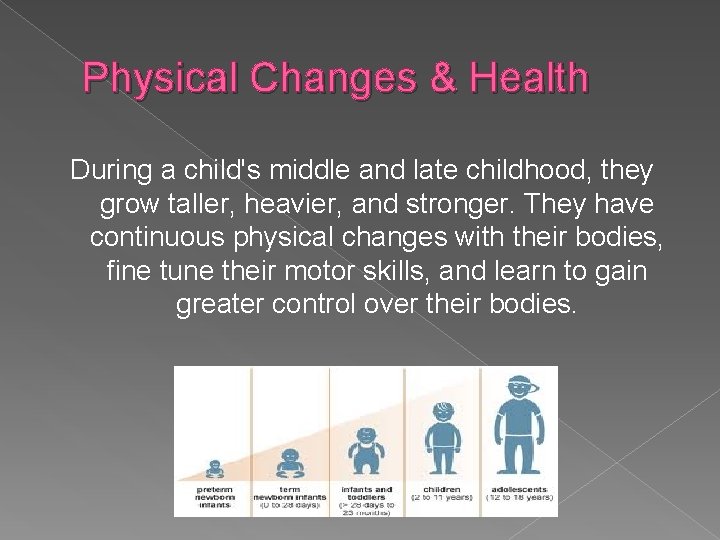
Physical Changes & Health During a child's middle and late childhood, they grow taller, heavier, and stronger. They have continuous physical changes with their bodies, fine tune their motor skills, and learn to gain greater control over their bodies.
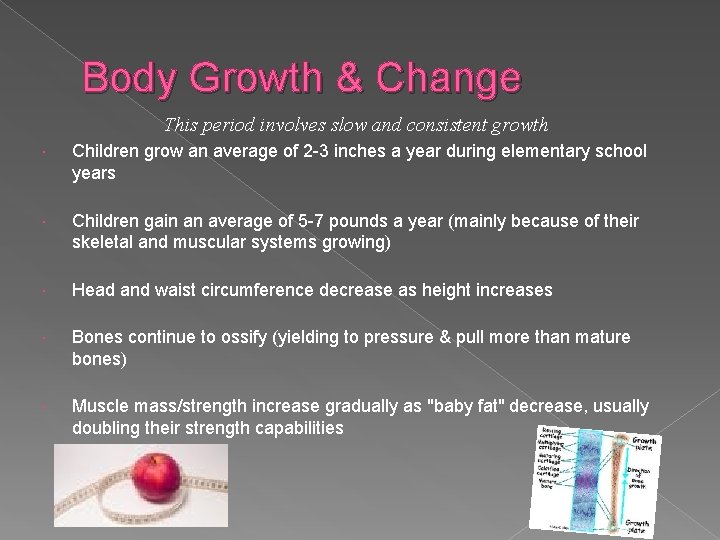
Body Growth & Change This period involves slow and consistent growth Children grow an average of 2 -3 inches a year during elementary school years Children gain an average of 5 -7 pounds a year (mainly because of their skeletal and muscular systems growing) Head and waist circumference decrease as height increases Bones continue to ossify (yielding to pressure & pull more than mature bones) Muscle mass/strength increase gradually as "baby fat" decrease, usually doubling their strength capabilities
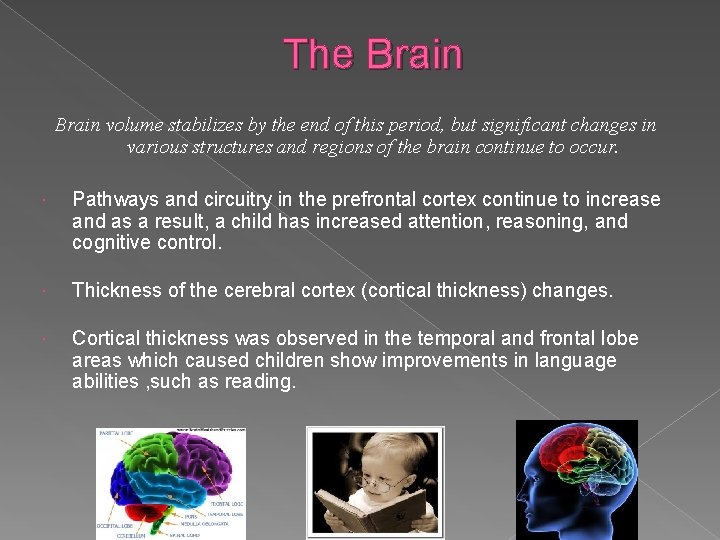
The Brain volume stabilizes by the end of this period, but significant changes in various structures and regions of the brain continue to occur. Pathways and circuitry in the prefrontal cortex continue to increase and as a result, a child has increased attention, reasoning, and cognitive control. Thickness of the cerebral cortex (cortical thickness) changes. Cortical thickness was observed in the temporal and frontal lobe areas which caused children show improvements in language abilities , such as reading.
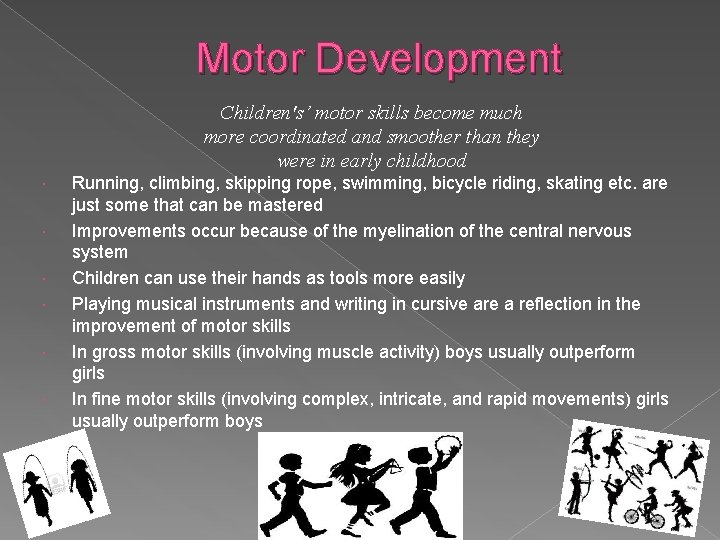
Motor Development Children's’ motor skills become much more coordinated and smoother than they were in early childhood Running, climbing, skipping rope, swimming, bicycle riding, skating etc. are just some that can be mastered Improvements occur because of the myelination of the central nervous system Children can use their hands as tools more easily Playing musical instruments and writing in cursive are a reflection in the improvement of motor skills In gross motor skills (involving muscle activity) boys usually outperform girls In fine motor skills (involving complex, intricate, and rapid movements) girls usually outperform boys
Exercise Children at this age are far from physical maturity, so they need to be active Increased fatigue more in long periods of sitting than running or jumping Exercise plays an important role in children's development because it helps refine their developing skills
Here are some ways to get children to exercise more: • offer more physical fitness programs run by volunteers at school facilities • Improve physical fitness activities in school • Have children plan community and school activities that really interest them
HEALTH, ILLNESS, AND DISEASE Middle to late childhood for the most part is a time of excellent health. Disease and death are less prevalent than in other periods of childhood and adolescence. However, there are some health problems that children have during this time that harm their development.
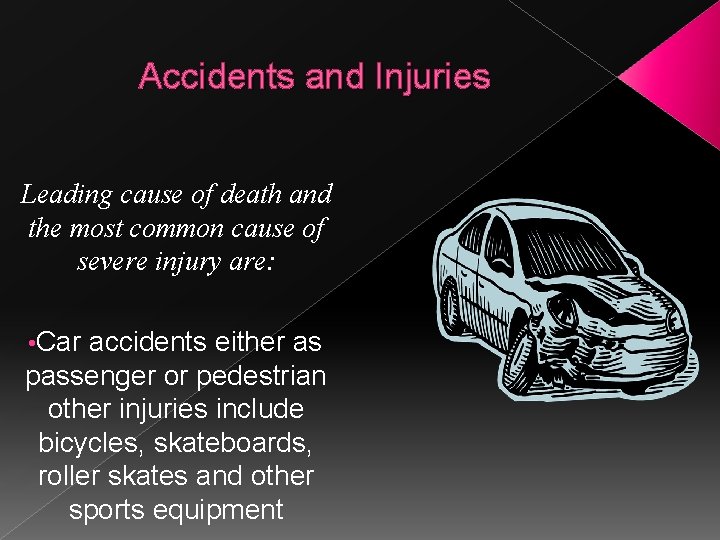
Accidents and Injuries Leading cause of death and the most common cause of severe injury are: • Car accidents either as passenger or pedestrian other injuries include bicycles, skateboards, roller skates and other sports equipment
Overweight Children This is an increasing child health problem. Overweight children have an increased risk for developing: • Pulmonary problems, such as sleep apnea and hip problems • Diabetes, high blood pressure, and high cholesterol levels are very common • Some children also develop low self esteem issues
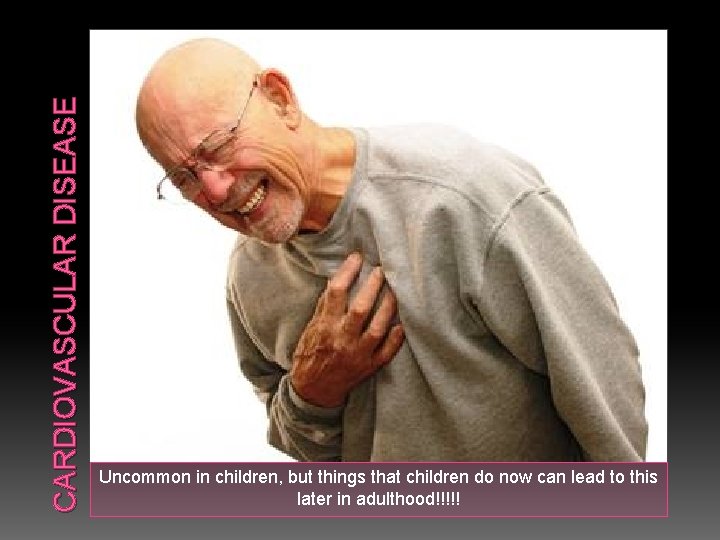
CARDIOVASCULAR DISEASE Uncommon in children, but things that children do now can lead to this later in adulthood!!!!!
Cancer • Second leading cause of death in U. S. • Child cancers (ages 5 to 14) mainly attack the white blood cells (leukemia), brain, bone, lymph system, muscles, kidneys, and nervous system. • Most common is leukemia, a cancer where bone marrow manufactures an abundance of abnormal white blood cells that "crowd out" normal cells, making the child susceptible to bruising and infection. • Advancements in cancer treatment has increased the survival rate in child cancer patients.
Children with Disabilities
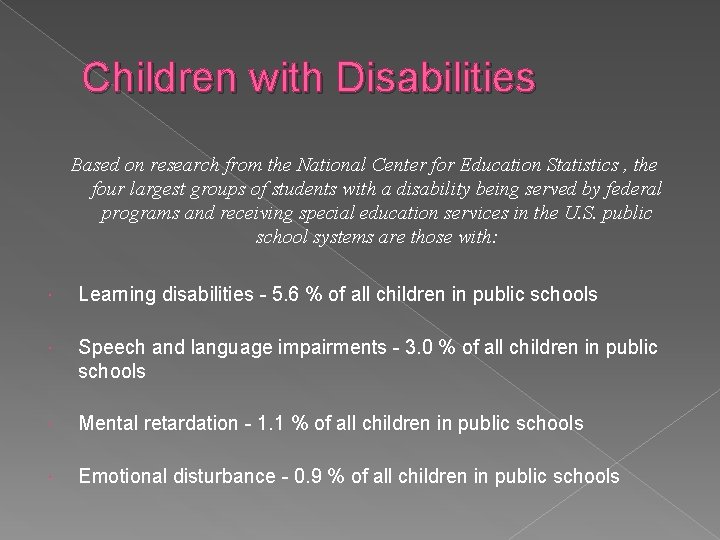
Children with Disabilities Based on research from the National Center for Education Statistics , the four largest groups of students with a disability being served by federal programs and receiving special education services in the U. S. public school systems are those with: Learning disabilities - 5. 6 % of all children in public schools Speech and language impairments - 3. 0 % of all children in public schools Mental retardation - 1. 1 % of all children in public schools Emotional disturbance - 0. 9 % of all children in public schools
Learning Difficulties According to the definition created by the U. S. Government, a child with a learning disability suffers from difficulty in learning that involves understanding or using spoken or written language. This difficulty will appear in : • Listening • Thinking • Reading • Writing • Spelling • Mathematics
To be classified as a learning disability, the learning problem is not primarily the result of any of the following: • visual • hearing • motor disabilities • mental retardation • emotional • environmental • cultural disorders disadvantages • economic disadvantages
Referral Bias: higher likelihood of being referred by a teacher due to troublesome behavior Three times as many boys than girls are classified as having a learning disability. This is due to: a greater biological vulnerability
Reasons for learning disabilities Precise cause of learning disabilities have not yet been determined by scientists and researchers. scientists do know based on evidence from Brain Imagery Techniques (such as Magnetic Resonance Imagery - M. R. I. ) that it is unlikely that learning disabilities reside in one specific brain location. Evidence Suggest that learning disabilities are due to: Problems in integrating information from multiple brain regions and/or difficulties in brain structures & functions
The learning disabilities that affect 5. 6 % of all children in the public school system are: • Dyslexia • Dysgraphia • Dyscalculia • Attention Deficit Hyperactivity Disorder (ADHD)
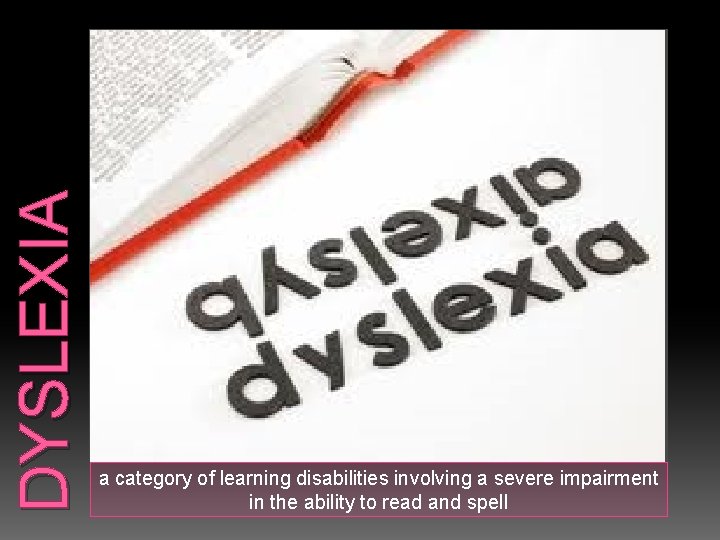
DYSLEXIA a category of learning disabilities involving a severe impairment in the ability to read and spell
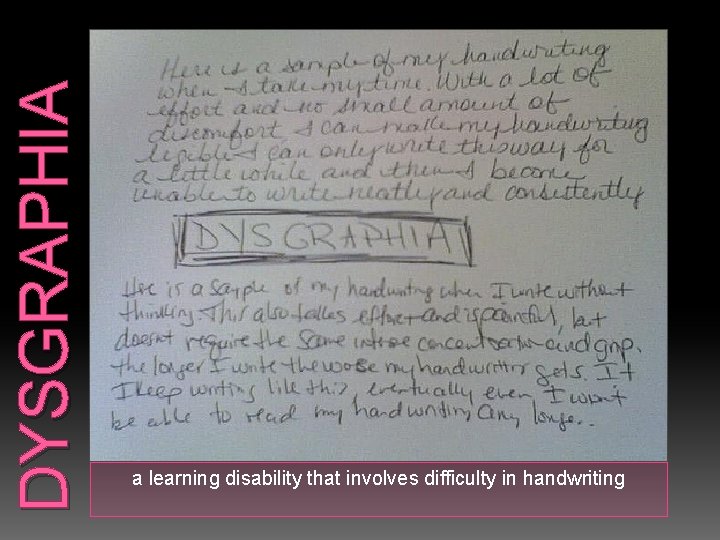
DYSGRAPHIA a learning disability that involves difficulty in handwriting
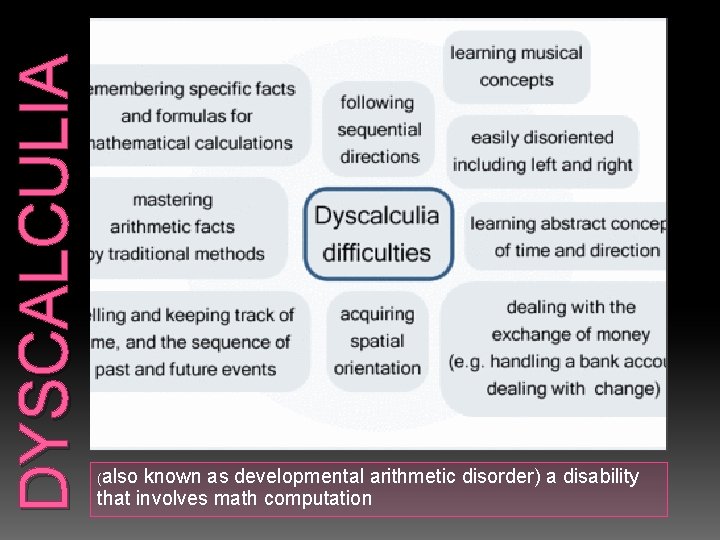
DYSCALCULIA (also known as developmental arithmetic disorder) a disability that involves math computation
ATTENTION DEFICIT HYPERACTIVITY DISORDER a disability that consistently showcases one ore more of the following characteristics over time : inattention, hyperactivity, impulsivity
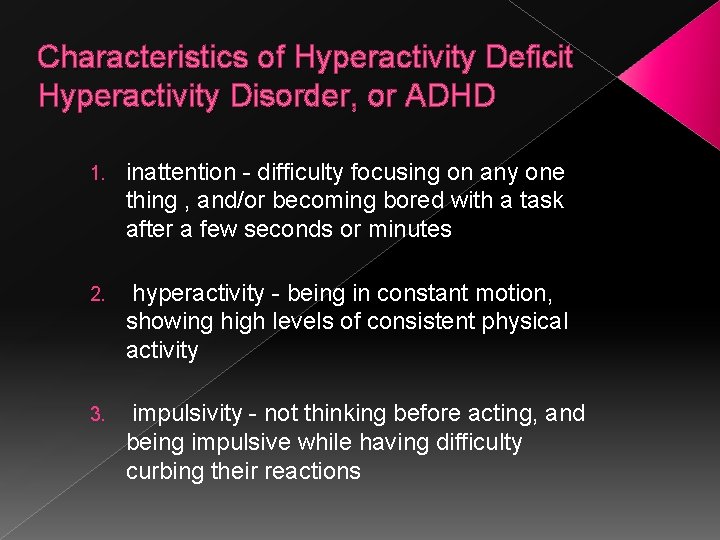
Characteristics of Hyperactivity Deficit Hyperactivity Disorder, or ADHD 1. inattention - difficulty focusing on any one thing , and/or becoming bored with a task after a few seconds or minutes 2. hyperactivity - being in constant motion, showing high levels of consistent physical activity 3. impulsivity - not thinking before acting, and being impulsive while having difficulty curbing their reactions
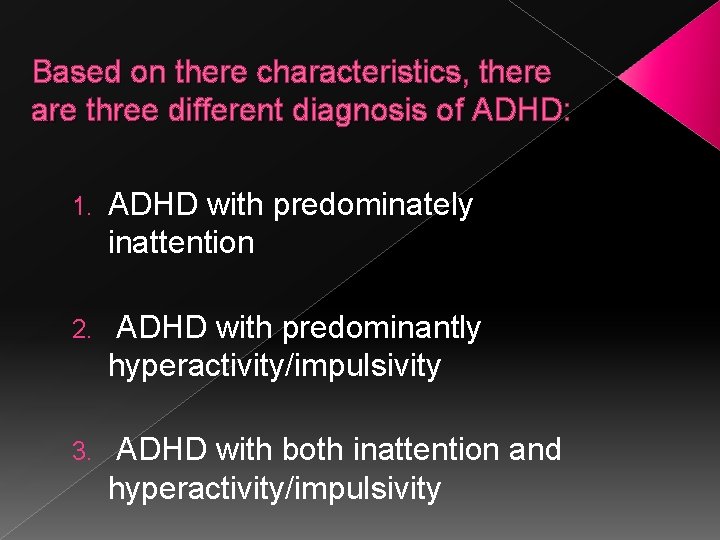
Based on there characteristics, there are three different diagnosis of ADHD: 1. ADHD with predominately inattention 2. ADHD with predominantly hyperactivity/impulsivity 3. ADHD with both inattention and hyperactivity/impulsivity
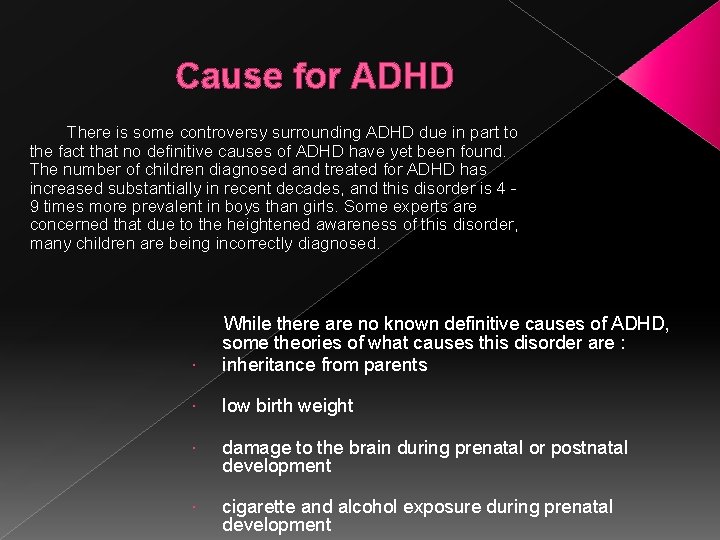
Cause for ADHD There is some controversy surrounding ADHD due in part to the fact that no definitive causes of ADHD have yet been found. The number of children diagnosed and treated for ADHD has increased substantially in recent decades, and this disorder is 4 9 times more prevalent in boys than girls. Some experts are concerned that due to the heightened awareness of this disorder, many children are being incorrectly diagnosed. While there are no known definitive causes of ADHD, some theories of what causes this disorder are : inheritance from parents low birth weight damage to the brain during prenatal or postnatal development cigarette and alcohol exposure during prenatal development
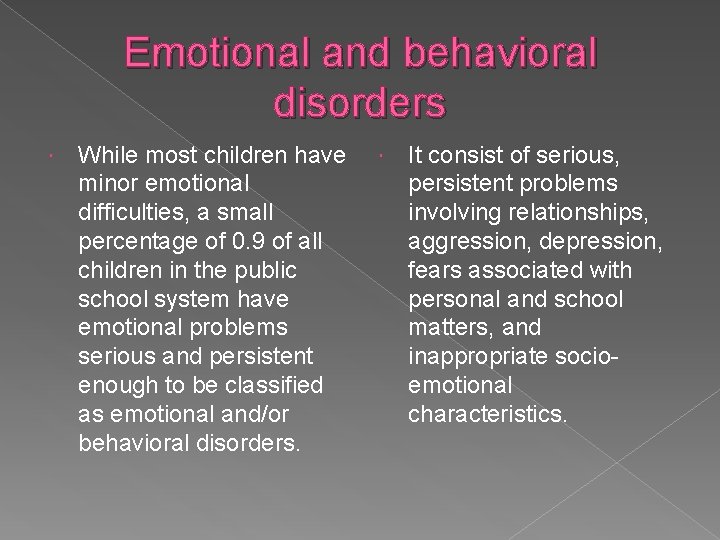
Emotional and behavioral disorders While most children have minor emotional difficulties, a small percentage of 0. 9 of all children in the public school system have emotional problems serious and persistent enough to be classified as emotional and/or behavioral disorders. It consist of serious, persistent problems involving relationships, aggression, depression, fears associated with personal and school matters, and inappropriate socioemotional characteristics.
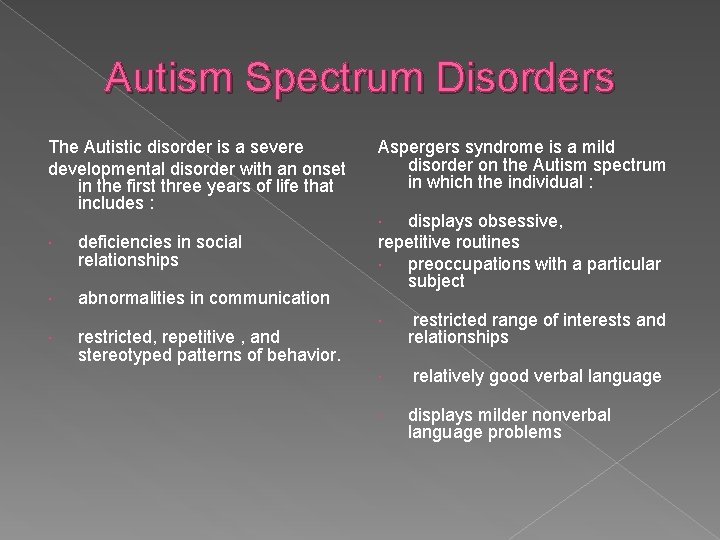
Autism Spectrum Disorders (ASD) Autism Spectrum Disorders are pervasive developmental disorders that are characterized by : • problems in social interaction • problems in verbal and nonverbal communication • repetitive • atypical • mental behaviors responses to sensory experiences retardation in some ( others show average or above average intelligence)
Autism Spectrum Disorders The Autistic disorder is a severe developmental disorder with an onset in the first three years of life that includes : Aspergers syndrome is a mild disorder on the Autism spectrum in which the individual : displays obsessive, repetitive routines preoccupations with a particular subject deficiencies in social relationships abnormalities in communication restricted, repetitive , and stereotyped patterns of behavior. restricted range of interests and relationships relatively good verbal language displays milder nonverbal language problems
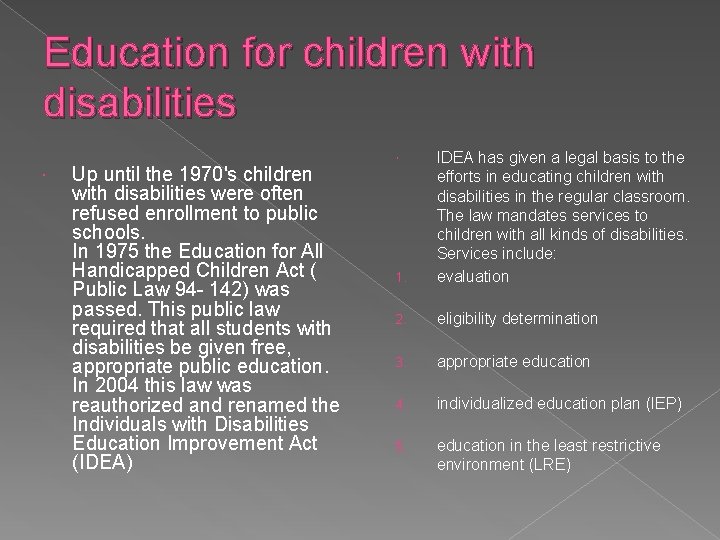
Education for children with disabilities Up until the 1970's children with disabilities were often refused enrollment to public schools. In 1975 the Education for All Handicapped Children Act ( Public Law 94 - 142) was passed. This public law required that all students with disabilities be given free, appropriate public education. In 2004 this law was reauthorized and renamed the Individuals with Disabilities Education Improvement Act (IDEA) 1. IDEA has given a legal basis to the efforts in educating children with disabilities in the regular classroom. The law mandates services to children with all kinds of disabilities. Services include: evaluation 2. eligibility determination 3. appropriate education 4. individualized education plan (IEP) 5. education in the least restrictive environment (LRE)
Inclusion With emphasis on the IEP (individualized education plan) and the LRE (education in the least restrictive environment) , the individual with special needs is educated full time in the regular classroom. For many children inclusion in the regular classroom with modifications or supplemental services is appropriate.
Some leading experts argue that the effort to educate children with disabilities in the regular classroom has become too extreme. Many believe that children with disabilities may benefit more from an individualized approach that does not involve inclusion , but instead allows special education outside of the regulate classroom. James Kauffman, a leading expert on special education argues that children need the services of specially trained professionals , altered curricula , and adaptations to make learning possible. He states, " We sell students with disabilities short when we pretend that they are not different from typical students. We make the same err when we pretend that they must not be expected to put forth extra effort if they are to learn to do some things in a different way… Like general education, special education should challenge students with disabilities to become all they can be. " Experts James Kauffman The Argument
Piaget's Cognitive Developmental Theory & Information Processing Intelligence
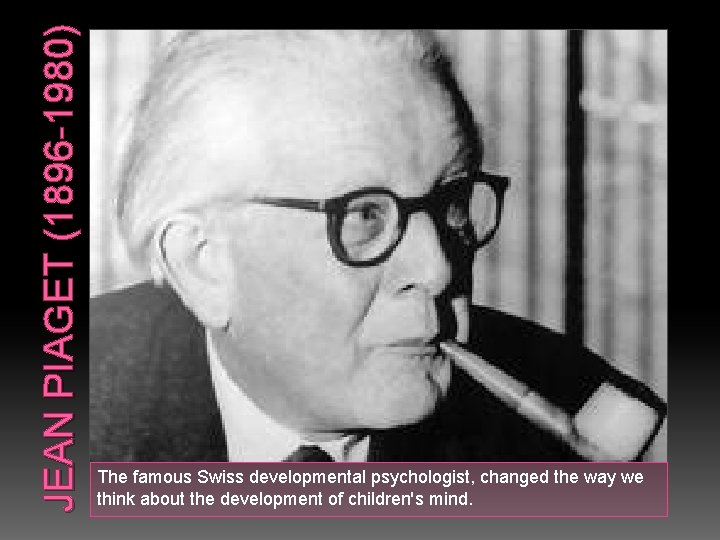
JEAN PIAGET (1896 -1980) The famous Swiss developmental psychologist, changed the way we think about the development of children's mind.
Schemas In Piaget's view, children actively construct their cognitive world, using schemas to make sense of what they experience. A schema is a concept or framework that already exists at given moment in a person's mind and the organizes information and provides a structure for interpreting it. For example, sucking is an early, simple schema. Later on, more complex schemas include licking, blowing, crawling, hiding, and so forth. Piaget's interest in schemas had to do with how they help in organizing and making senses out of current experience.
Two Processes that are responsible for how people use and adapt their schemas : Assimilation: occurs when individuals incorporate new information into existing knowledge For example - the first time a child realizes that she might pick up a set of keys, she is assimilating the category "keys" into the schema of "picking up". Accommodation: occurs when individuals adjust their schemas to new information For example- the schema "picking up" becomes modified into different schemas the accommodate the realities of different types of objects.
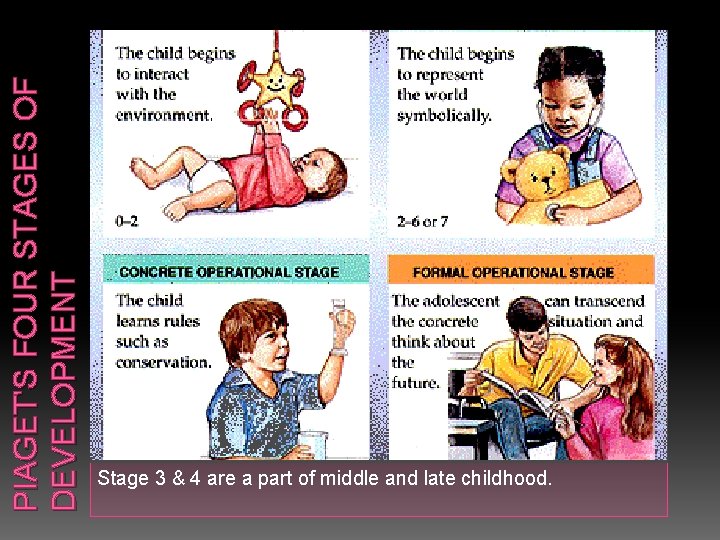
PIAGET'S FOUR STAGES OF DEVELOPMENT Stage 3 & 4 are a part of middle and late childhood.
Stages 3 & 4 Stage 3 - Concrete Operational Stage The child can now reason logically about concrete events and classify objects into different sets. Stage 4 - Formal Operational Stage The adolescent reasons in more abstract, idealistic, and logical ways.
Evaluating Piaget • Piaget opened a new way of looking at how children's minds develop. • We owe him for a long list of masterful concepts that have enduring power and fascination. • We also owe Piaget for the currently accepted vision of children as active, constructive thinkers who manufacture their own development.
Intelligence (Like creativity, the word intelligent can apply to behavior or a person). Intelligence: refers to individual differences in problem solving-skills and in important abilities. Intelligence is understood as something that is relatively stable and on which people can be compared.
MEASURING INTELLIGENCE Intelligence is mainly measured through tests. Certainly, a person's intelligence quotient (IQ) can be a powerful measure. The criteria for a good intelligence test: validity, reliability, and standardization. • Validity, refers to the sourness of conclusions to be drawn from an experiment. • Reliability is the extent to which a test yields a consistent, reproducible measure of performance. Reliability and validity are related. • Standardization involves developing uniform procedures for administering and scoring a test, as well as creating norms.