
Physical Chemical Constraints on Population Dynamics 25 year

- Slides: 44
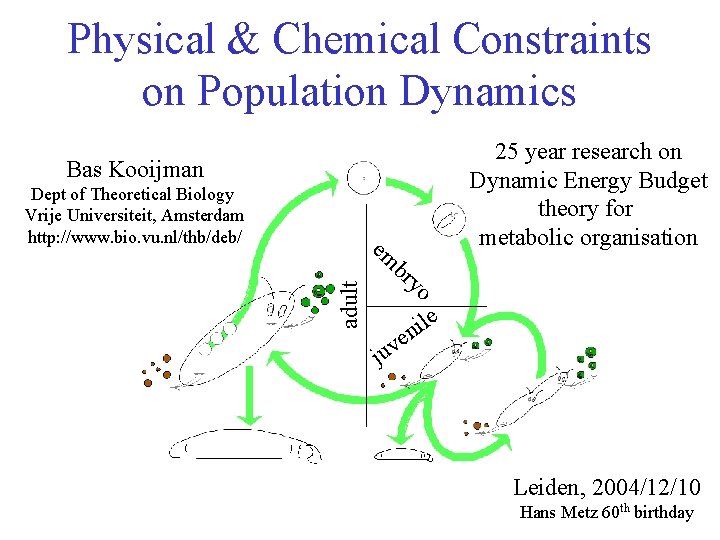
Physical & Chemical Constraints on Population Dynamics 25 year research on Dynamic Energy Budget theory for metabolic organisation Bas Kooijman Dept of Theoretical Biology Vrije Universiteit, Amsterdam http: //www. bio. vu. nl/thb/deb/ adult em br yo e l i n e v ju Leiden, 2004/12/10 Hans Metz 60 th birthday
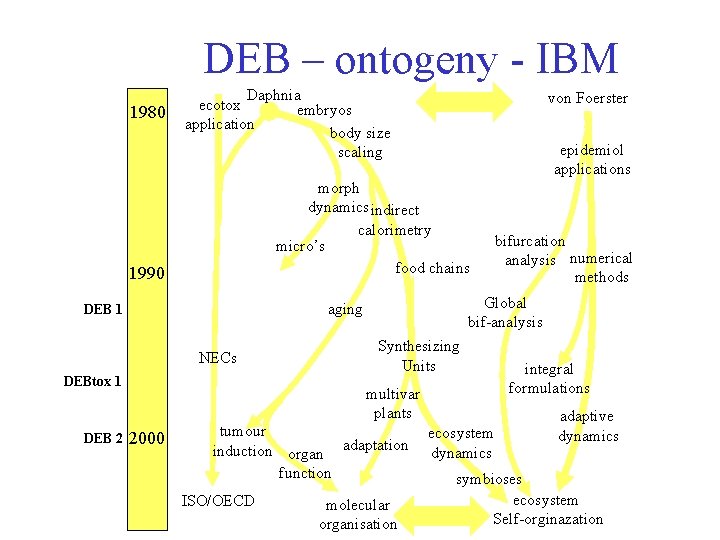
DEB – ontogeny - IBM 1980 Daphnia ecotox embryos application body size scaling epidemiol applications morph dynamics indirect calorimetry micro’s food chains 1990 NECs DEBtox 1 Synthesizing Units multivar plants 2000 tumour induction organ adaptation function ISO/OECD bifurcation analysis numerical methods Global bif-analysis aging DEB 1 DEB 2 von Foerster molecular organisation ecosystem dynamics integral formulations adaptive dynamics symbioses ecosystem Self-orginazation
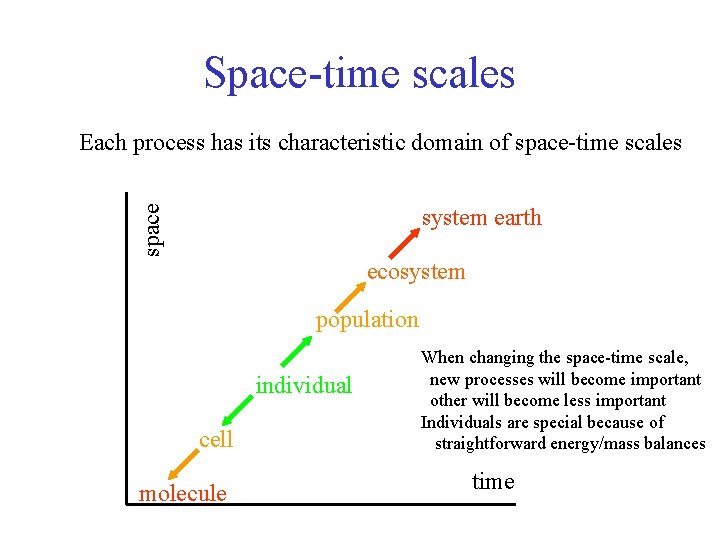
Space-time scales Each process has its characteristic domain of space-time scales space system earth ecosystem population individual cell molecule When changing the space-time scale, new processes will become important other will become less important Individuals are special because of straightforward energy/mass balances time
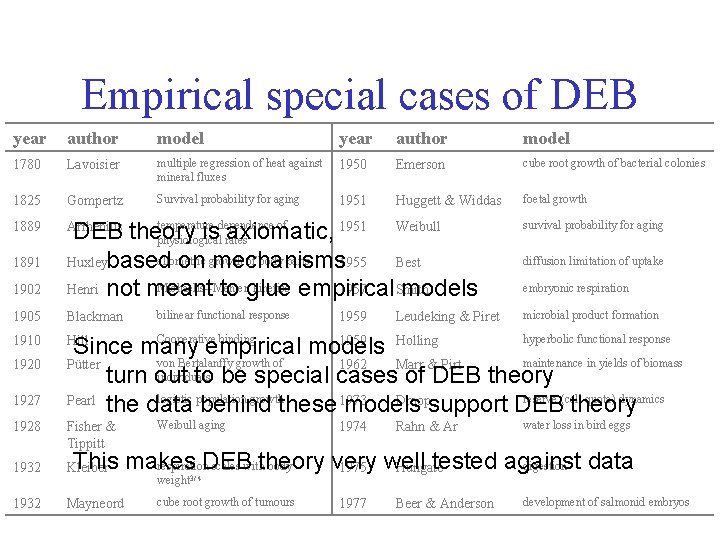
Empirical special cases of DEB year author model 1780 Lavoisier multiple regression of heat against mineral fluxes 1950 Emerson cube root growth of bacterial colonies 1825 Gompertz Survival probability for aging 1951 Huggett & Widdas foetal growth 1889 Arrhenius 1902 temperature dependence of DEB theory is rates axiomatic, 1951 Weibull physiological allometric of body parts Huxleybased 1955 Best on growth mechanisms Michaelis--Menten kinetics empirical Henri not meant 1957 Smith to glue models 1905 Blackman 1910 Hill 1891 1920 1927 bilinear functional response 1959 Leudeking & Piret survival probability for aging diffusion limitation of uptake embryonic respiration microbial product formation Cooperative binding hyperbolic functional response 1959 Holling Since many empirical models von Bertalanffy growth of maintenance in yields of biomass Pütter 1962 Marr & Pirt individuals turn out to be special cases of DEB theory logistic population growth reserve (cell quota) dynamics Pearl Droop the data behind these 1973 models support DEB theory 1928 Fisher & Tippitt 1932 Kleiber 1932 Mayneord Weibull aging 1974 Rahn & Ar water loss in bird eggs This makes DEB theory very tested against data respiration scales with body digestion 1975 well Hungate weight 3/ 4 cube root growth of tumours 1977 Beer & Anderson development of salmonid embryos
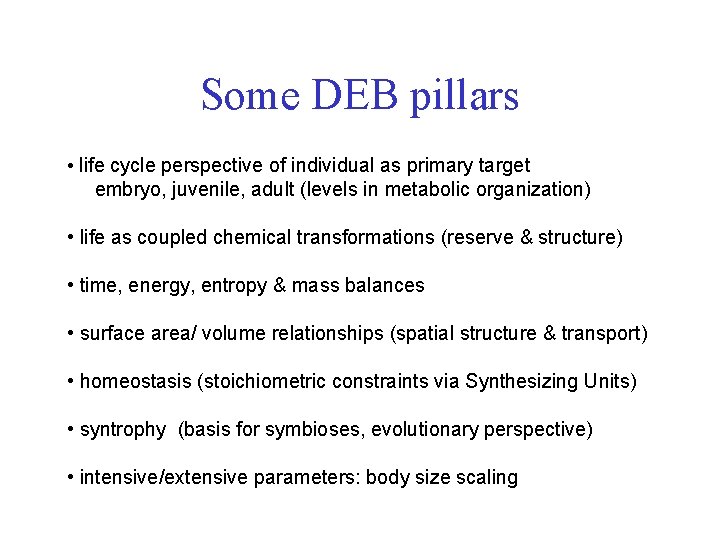
Some DEB pillars • life cycle perspective of individual as primary target embryo, juvenile, adult (levels in metabolic organization) • life as coupled chemical transformations (reserve & structure) • time, energy, entropy & mass balances • surface area/ volume relationships (spatial structure & transport) • homeostasis (stoichiometric constraints via Synthesizing Units) • syntrophy (basis for symbioses, evolutionary perspective) • intensive/extensive parameters: body size scaling
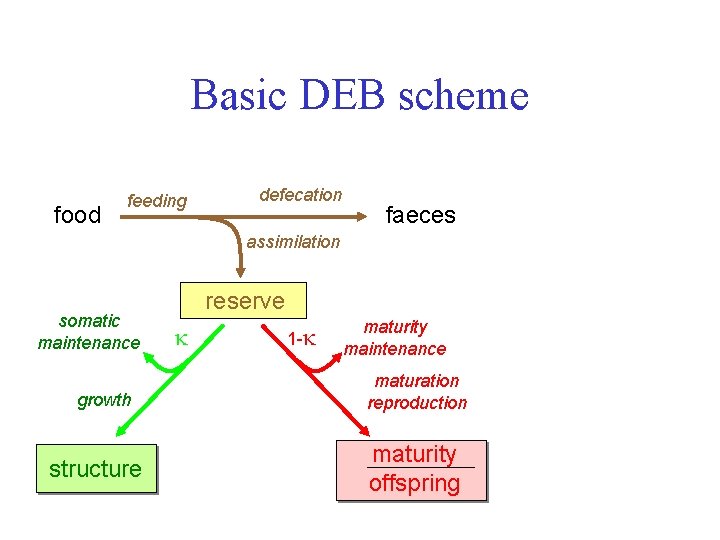
Basic DEB scheme food feeding defecation faeces assimilation somatic maintenance growth structure reserve 1 - maturity maintenance maturation reproduction maturity offspring
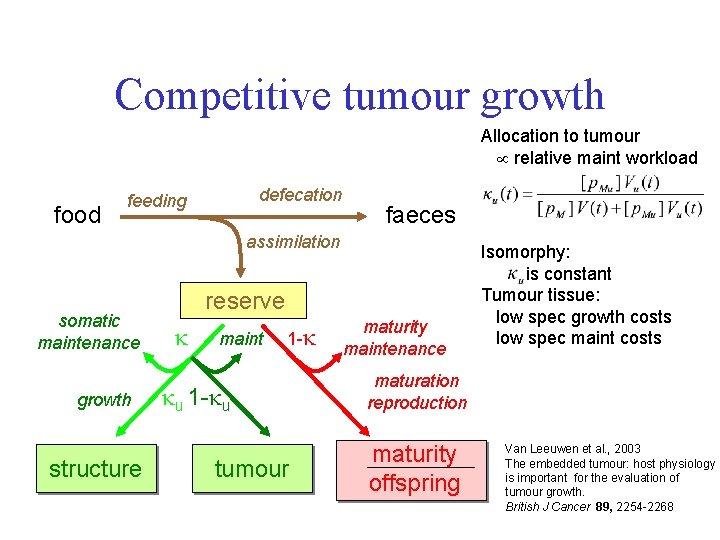
Competitive tumour growth Allocation to tumour relative maint workload food defecation feeding faeces assimilation somatic maintenance growth structure reserve maint 1 - u 1 - u tumour maturity maintenance Isomorphy: is constant Tumour tissue: low spec growth costs low spec maint costs maturation reproduction maturity offspring Van Leeuwen et al. , 2003 The embedded tumour: host physiology is important for the evaluation of tumour growth. British J Cancer 89, 2254 -2268
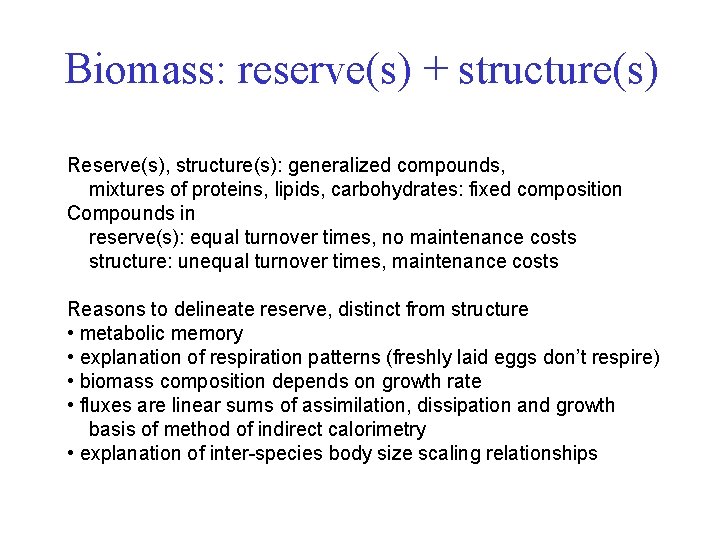
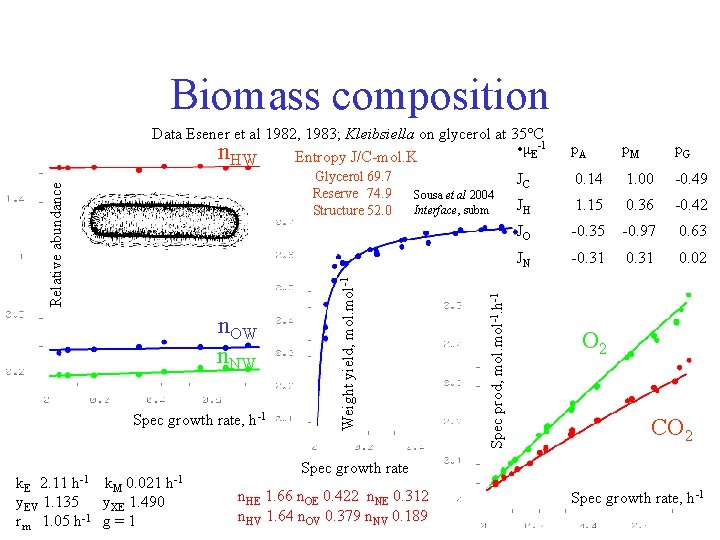
Biomass: reserve(s) + structure(s) Reserve(s), structure(s): generalized compounds, mixtures of proteins, lipids, carbohydrates: fixed composition Compounds in reserve(s): equal turnover times, no maintenance costs structure: unequal turnover times, maintenance costs Reasons to delineate reserve, distinct from structure • metabolic memory • explanation of respiration patterns (freshly laid eggs don’t respire) • biomass composition depends on growth rate • fluxes are linear sums of assimilation, dissipation and growth basis of method of indirect calorimetry • explanation of inter-species body size scaling relationships
Biomass composition n. OW n. NW Spec growth rate, h-1 k. E 2. 11 k. M 0. 021 y. EV 1. 135 y. XE 1. 490 rm 1. 05 h-1 g = 1 h-1 Sousa et al 2004 Interface, subm Weight yield, mol-1 Reserve 74. 9 Structure 52. 0 Spec prod, mol-1. h-1 Relative abundance Data Esener et al 1982, 1983; Kleibsiella on glycerol at 35°C • μE-1 n. HW Entropy J/C-mol. K Glycerol 69. 7 JC p. A p. M p. G 0. 14 1. 00 -0. 49 JH 1. 15 0. 36 -0. 42 JO -0. 35 -0. 97 0. 63 JN -0. 31 0. 02 O 2 CO 2 Spec growth rate n. HE 1. 66 n. OE 0. 422 n. NE 0. 312 n. HV 1. 64 n. OV 0. 379 n. NV 0. 189 Spec growth rate, h-1
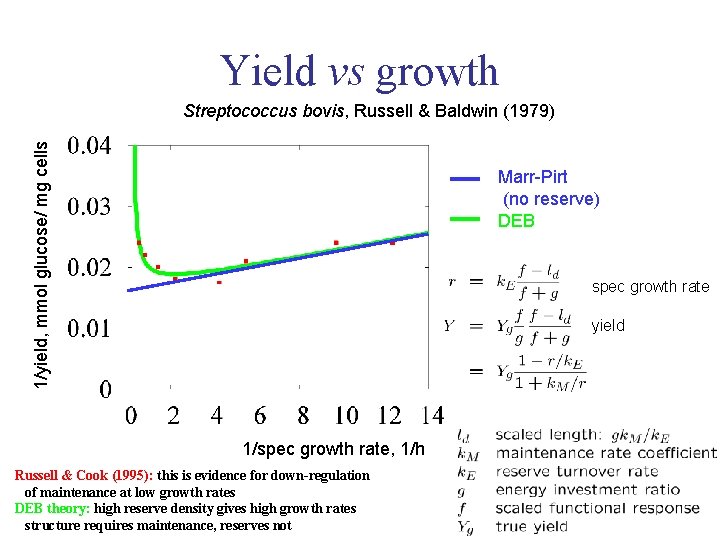
Yield vs growth 1/yield, mmol glucose/ mg cells Streptococcus bovis, Russell & Baldwin (1979) Marr-Pirt (no reserve) DEB spec growth rate yield 1/spec growth rate, 1/h Russell & Cook (1995): this is evidence for down-regulation of maintenance at low growth rates DEB theory: high reserve density gives high growth rates structure requires maintenance, reserves not
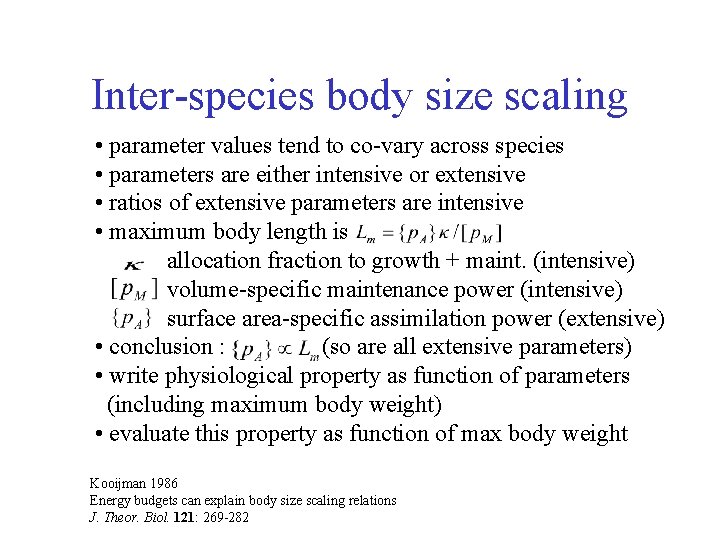
Inter-species body size scaling • parameter values tend to co-vary across species • parameters are either intensive or extensive • ratios of extensive parameters are intensive • maximum body length is allocation fraction to growth + maint. (intensive) volume-specific maintenance power (intensive) surface area-specific assimilation power (extensive) • conclusion : (so are all extensive parameters) • write physiological property as function of parameters (including maximum body weight) • evaluate this property as function of max body weight Kooijman 1986 Energy budgets can explain body size scaling relations J. Theor. Biol. 121: 269 -282
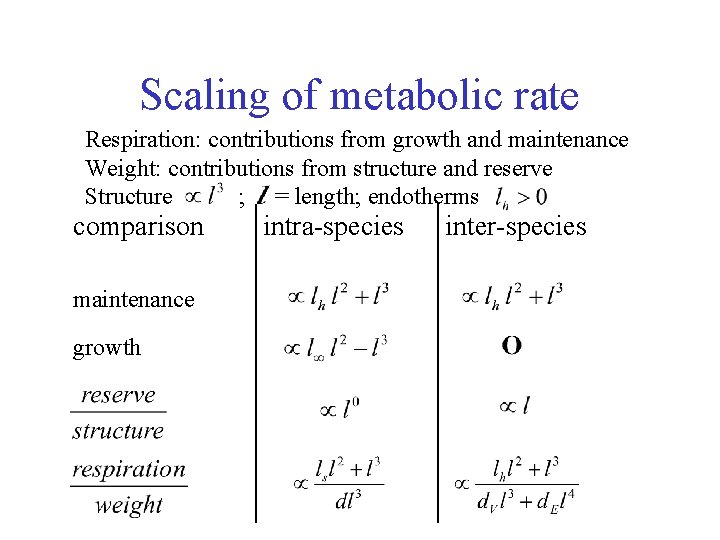
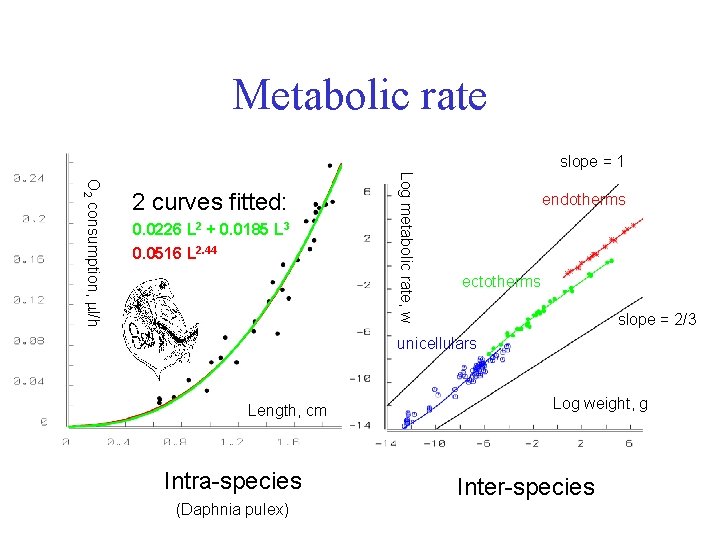
Scaling of metabolic rate Respiration: contributions from growth and maintenance Weight: contributions from structure and reserve Structure ; = length; endotherms comparison maintenance growth intra-species inter-species
Metabolic rate slope = 1 0. 0226 L 2 + 0. 0185 L 3 0. 0516 L 2. 44 Log metabolic rate, w O 2 consumption, l/h 2 curves fitted: endotherms ectotherms slope = 2/3 unicellulars Length, cm Intra-species (Daphnia pulex) Log weight, g Inter-species
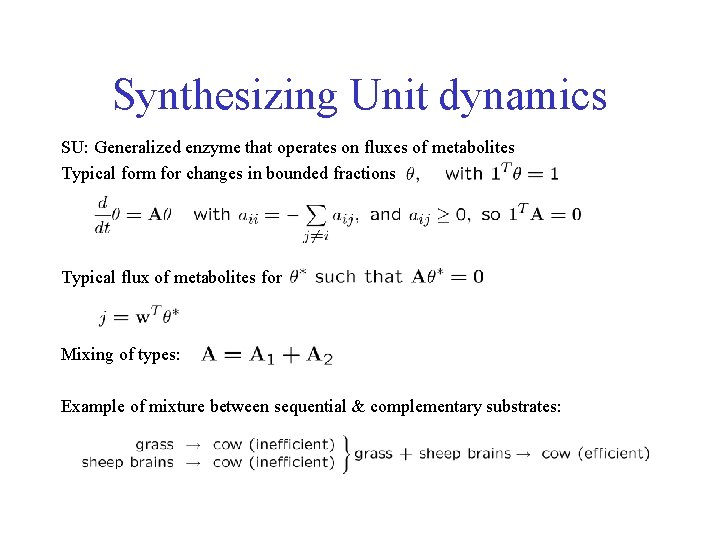
Synthesizing Unit dynamics SU: Generalized enzyme that operates on fluxes of metabolites Typical form for changes in bounded fractions Typical flux of metabolites for Mixing of types: Example of mixture between sequential & complementary substrates:
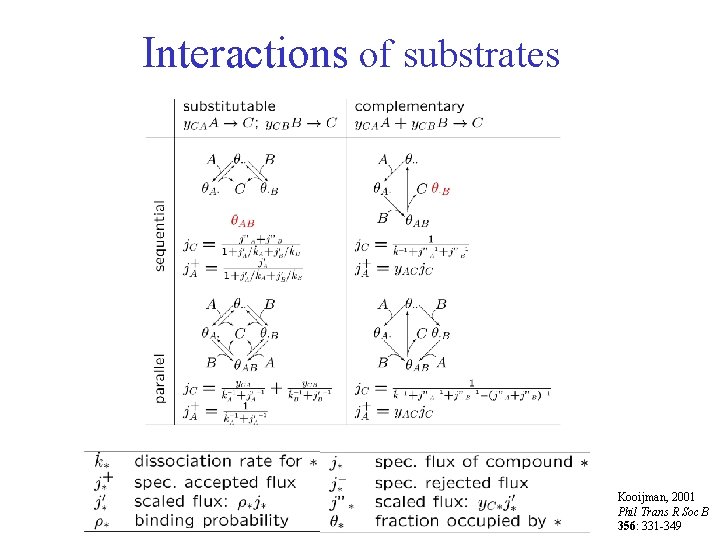
Interactions of substrates Kooijman, 2001 Phil Trans R Soc B 356: 331 -349
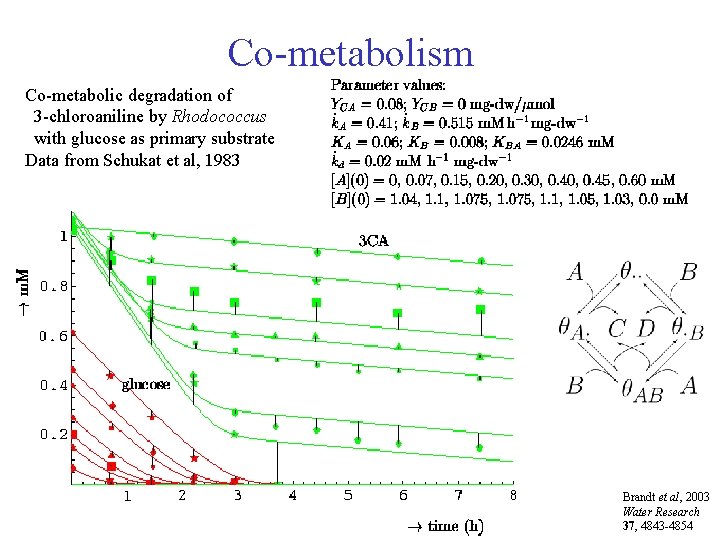
Co-metabolism Co-metabolic degradation of 3 -chloroaniline by Rhodococcus with glucose as primary substrate Data from Schukat et al, 1983 Brandt et al, 2003 Water Research 37, 4843 -4854
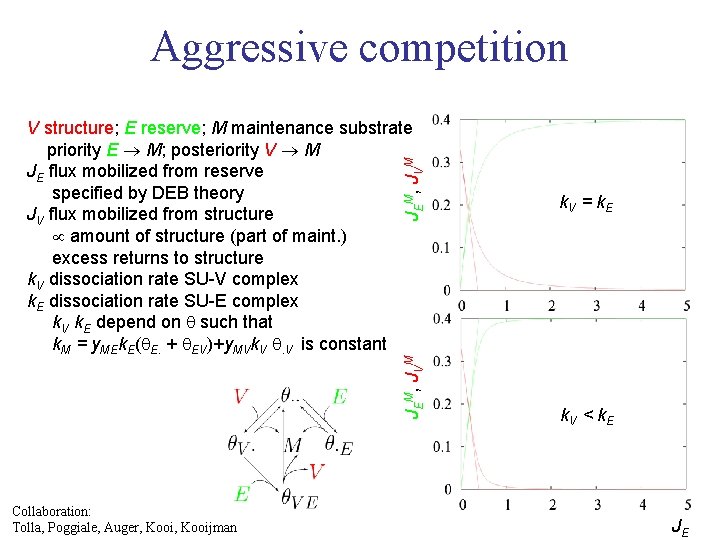
Aggressive competition JEM, JVM V structure; E reserve; M maintenance substrate priority E M; posteriority V M JE flux mobilized from reserve specified by DEB theory JV flux mobilized from structure amount of structure (part of maint. ) excess returns to structure k. V dissociation rate SU-V complex k. E dissociation rate SU-E complex k. V k. E depend on such that k. M = y. MEk. E( E. + EV)+y. MVk. V is constant Collaboration: Tolla, Poggiale, Auger, Kooijman k. V = k. E k. V < k. E JE
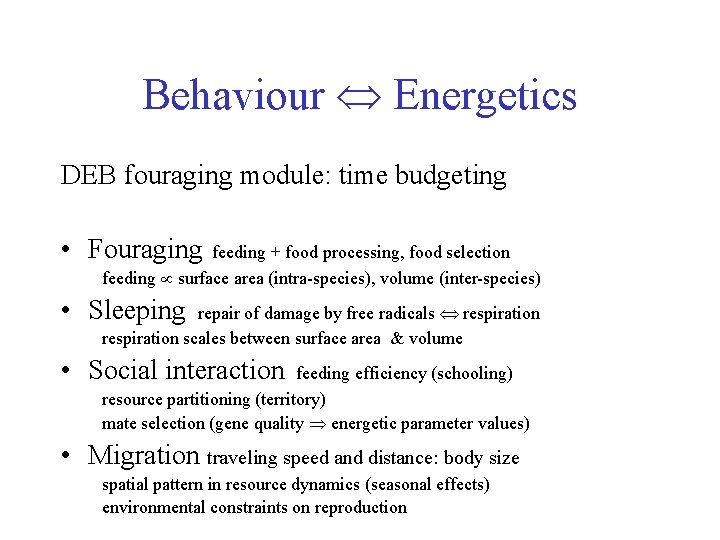
Behaviour Energetics DEB fouraging module: time budgeting • Fouraging feeding + food processing, food selection feeding surface area (intra-species), volume (inter-species) • Sleeping repair of damage by free radicals respiration scales between surface area & volume • Social interaction feeding efficiency (schooling) resource partitioning (territory) mate selection (gene quality energetic parameter values) • Migration traveling speed and distance: body size spatial pattern in resource dynamics (seasonal effects) environmental constraints on reproduction
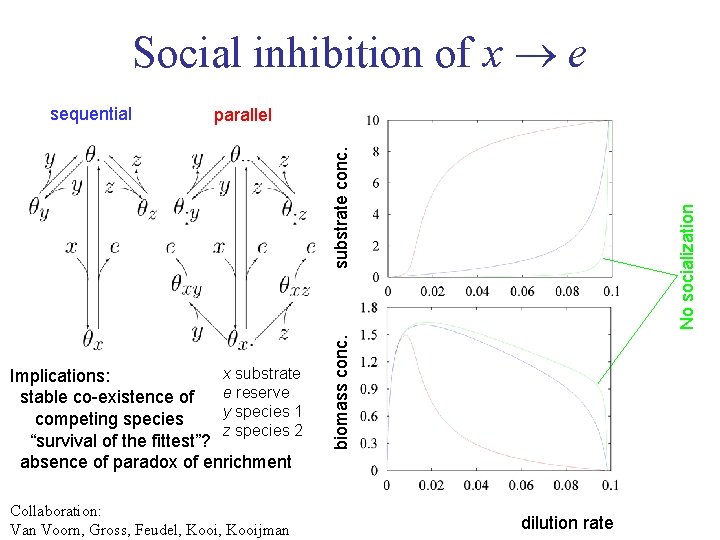
Social inhibition of x e parallel Collaboration: Van Voorn, Gross, Feudel, Kooijman biomass conc. x substrate Implications: e reserve stable co-existence of y species 1 competing species z species 2 “survival of the fittest”? absence of paradox of enrichment No socialization substrate conc. sequential dilution rate
Significance of co-existence Main driving force behind evolution: • Darwin: Survival of the fittest (internal forces) involves out-competition argument • Wallace: Selection by environment (external forces) consistent with observed biodiversity Mean life span of typical species: 5 - 10 Ma Sub-optimal rare species: not going extinct soon (“sleeping pool of potential response”) environmental changes can turn rare into abundant species
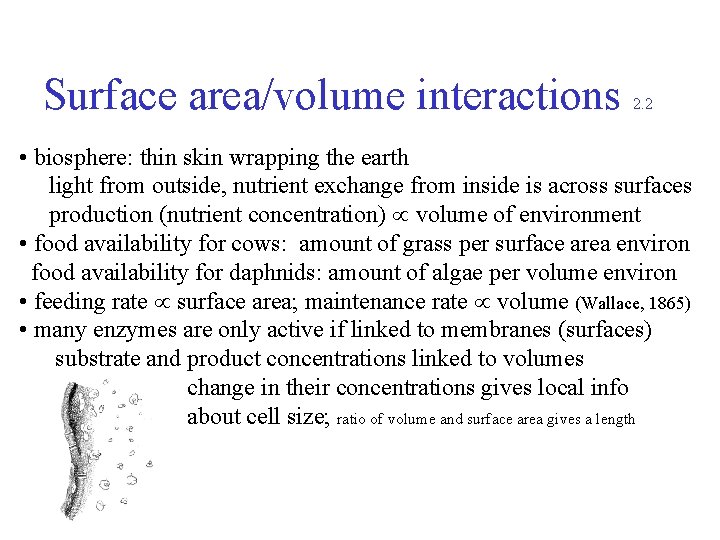
Surface area/volume interactions 2. 2 • biosphere: thin skin wrapping the earth light from outside, nutrient exchange from inside is across surfaces production (nutrient concentration) volume of environment • food availability for cows: amount of grass per surface area environ food availability for daphnids: amount of algae per volume environ • feeding rate surface area; maintenance rate volume (Wallace, 1865) • many enzymes are only active if linked to membranes (surfaces) substrate and product concentrations linked to volumes change in their concentrations gives local info about cell size; ratio of volume and surface area gives a length
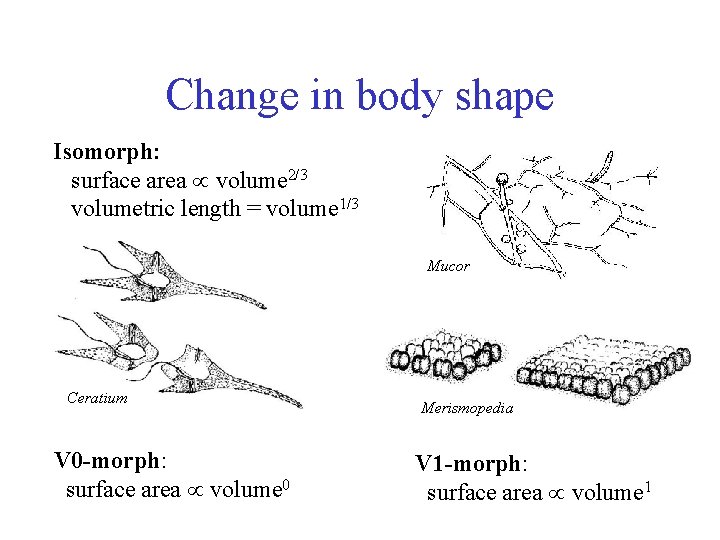
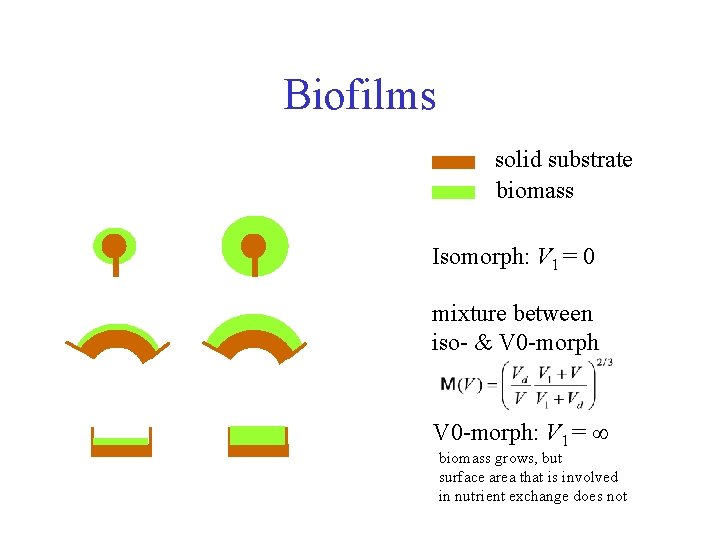
Change in body shape Isomorph: surface area volume 2/3 volumetric length = volume 1/3 Mucor Ceratium V 0 -morph: surface area volume 0 Merismopedia V 1 -morph: surface area volume 1
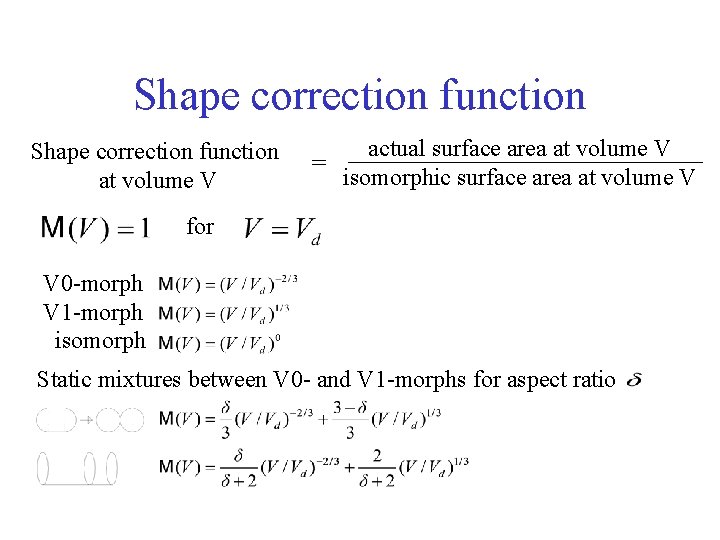
Shape correction function at volume V = actual surface area at volume V isomorphic surface area at volume V for V 0 -morph V 1 -morph isomorph Static mixtures between V 0 - and V 1 -morphs for aspect ratio
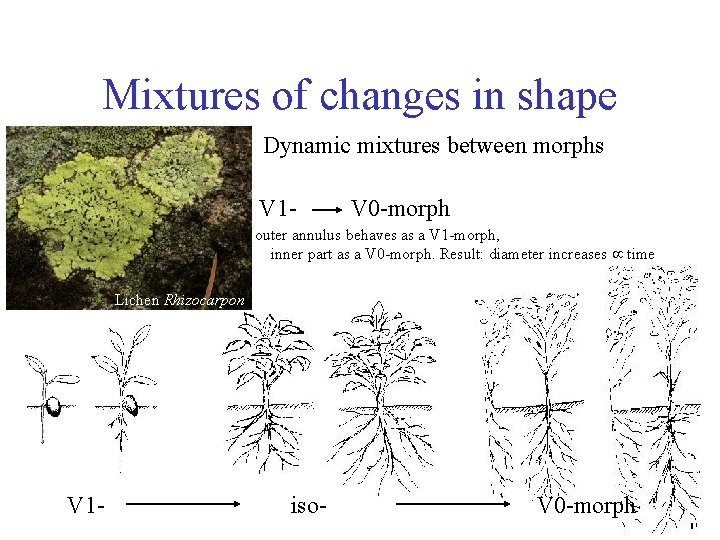
Mixtures of changes in shape Dynamic mixtures between morphs V 1 - V 0 -morph outer annulus behaves as a V 1 -morph, inner part as a V 0 -morph. Result: diameter increases time Lichen Rhizocarpon V 1 - iso- V 0 -morph
Biofilms solid substrate biomass Isomorph: V 1 = 0 mixture between iso- & V 0 -morph: V 1 = biomass grows, but surface area that is involved in nutrient exchange does not
Size-structured Unstructured Population Dynamics Isomorphs: individual-based or pde formulation V 1 -morphs: unstructured (ode) formulation Effect of individuality becomes small if ratio between largest and smallest body size reduces This suggest a perturbation method to approximate a pde with an ode formulation Need for simplification of ecosystem dynamics
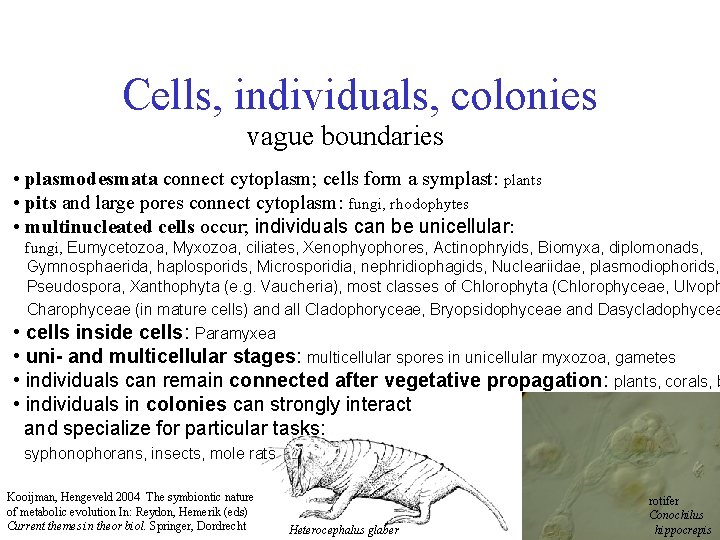
Cells, individuals, colonies vague boundaries • plasmodesmata connect cytoplasm; cells form a symplast: plants • pits and large pores connect cytoplasm: fungi, rhodophytes • multinucleated cells occur; individuals can be unicellular: fungi, Eumycetozoa, Myxozoa, ciliates, Xenophyophores, Actinophryids, Biomyxa, diplomonads, Gymnosphaerida, haplosporids, Microsporidia, nephridiophagids, Nucleariidae, plasmodiophorids, Pseudospora, Xanthophyta (e. g. Vaucheria), most classes of Chlorophyta (Chlorophyceae, Ulvoph Charophyceae (in mature cells) and all Cladophoryceae, Bryopsidophyceae and Dasycladophycea cells inside cells: Paramyxea uni- and multicellular stages: multicellular spores in unicellular myxozoa, gametes individuals can remain connected after vegetative propagation: plants, corals, b • • individuals in colonies can strongly interact and specialize for particular tasks: syphonophorans, insects, mole rats Kooijman, Hengeveld 2004 The symbiontic nature of metabolic evolution In: Reydon, Hemerik (eds) Current themes in theor biol. Springer, Dordrecht Heterocephalus glaber rotifer Conochilus hippocrepis
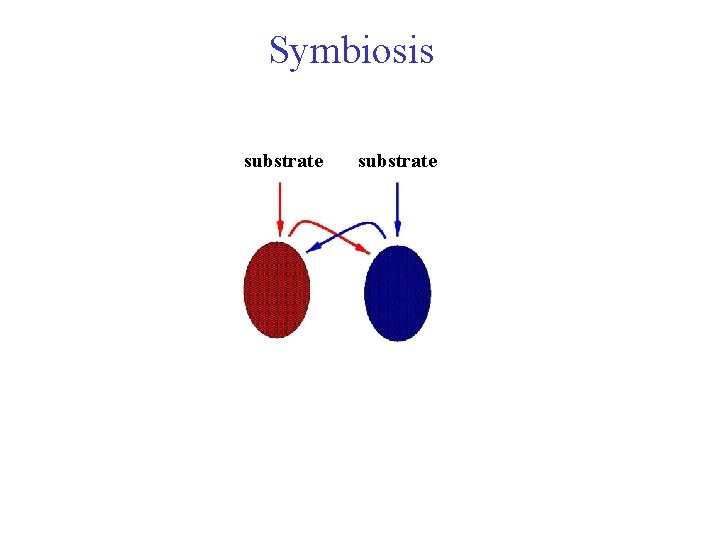
Trophic interactions Transitions between these types frequently occur • Competition for same resources size/age-dependent diet choices • Syntrophy on products faeces, leaves, dead biomass • Parasitism (typically small, relative to host) biotrophy, milking, sometimes lethal (disease) interaction with immune system • Predation (typical large, relative to prey) living individuals, preference for dead/weak specialization on particular life stages (eggs, juveniles) inducible defense systems; cannibalism
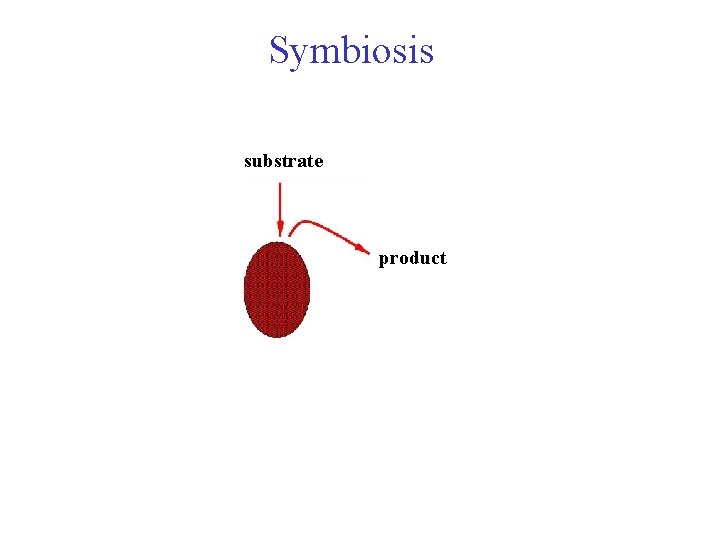
Symbiosis substrate product
Symbiosis substrate
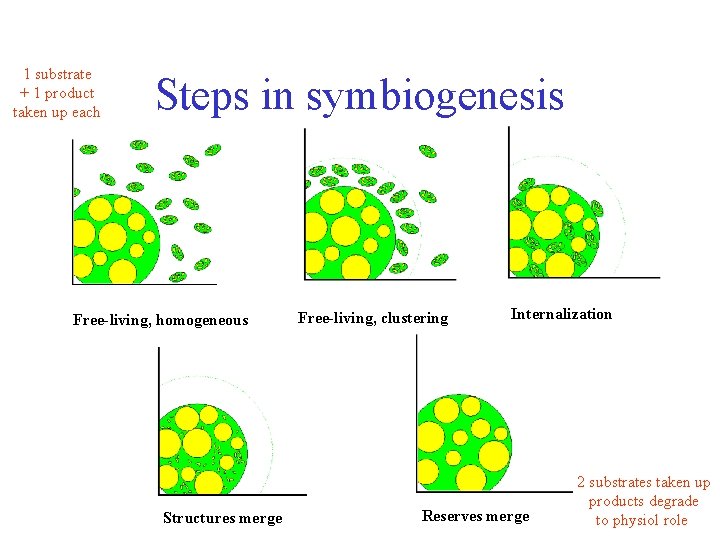
1 substrate + 1 product taken up each Steps in symbiogenesis Free-living, homogeneous Structures merge Free-living, clustering Internalization Reserves merge 2 substrates taken up products degrade to physiol role
Symbiogenesis • symbioses: fundamental organization of life based on syntrophy ranges from weak to strong interactions; basis of biodiversity • symbiogenesis: evolution of eukaryotes (mitochondria, plastids) • DEB model is closed under symbiogenesis: it is possible to model symbiogenesis of two initially independently living populations that follow the DEB rules by incremental changes of parameter values such that a single population emerges that again follows the DEB rules • essential property for models that apply to all organisms Kooijman, Auger, Poggiale, Kooi 2003 Quantitative steps in symbiogenesis and the evolution of homeostasis Biological Reviews 78: 435 - 463
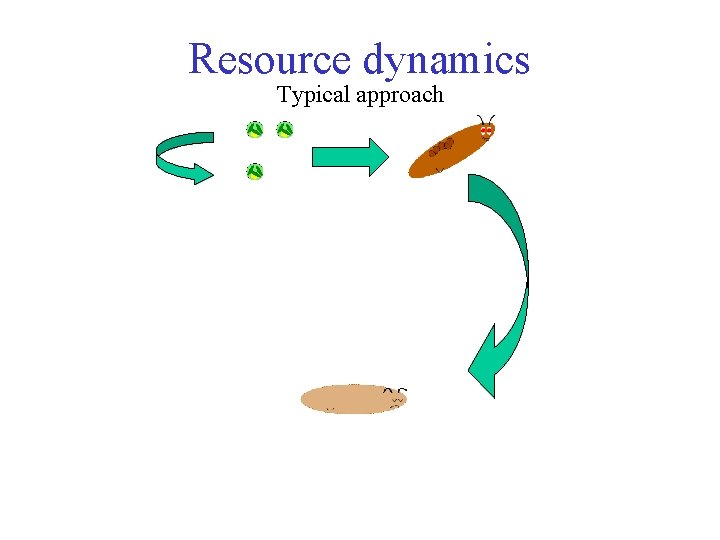
Resource dynamics Typical approach
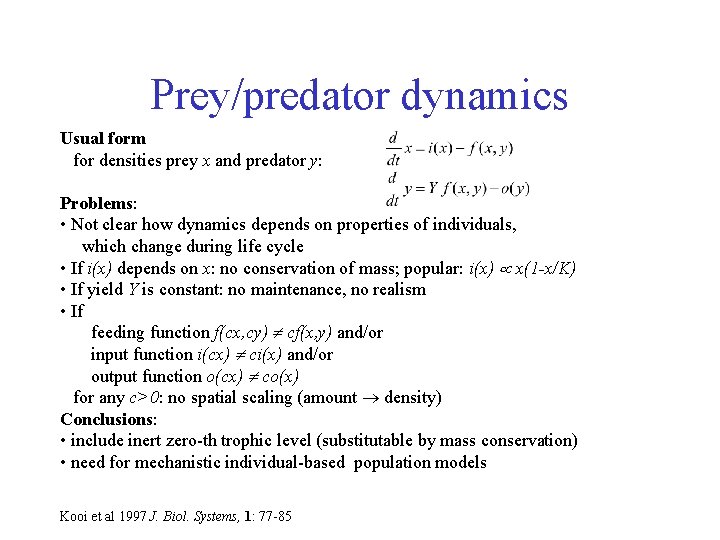
Prey/predator dynamics Usual form for densities prey x and predator y: Problems: • Not clear how dynamics depends on properties of individuals, which change during life cycle • If i(x) depends on x: no conservation of mass; popular: i(x) x(1 -x/K) • If yield Y is constant: no maintenance, no realism • If feeding function f(cx, cy) cf(x, y) and/or input function i(cx) ci(x) and/or output function o(cx) co(x) for any c>0: no spatial scaling (amount density) Conclusions: • include inert zero-th trophic level (substitutable by mass conservation) • need for mechanistic individual-based population models Kooi et al 1997 J. Biol. Systems, 1: 77 -85
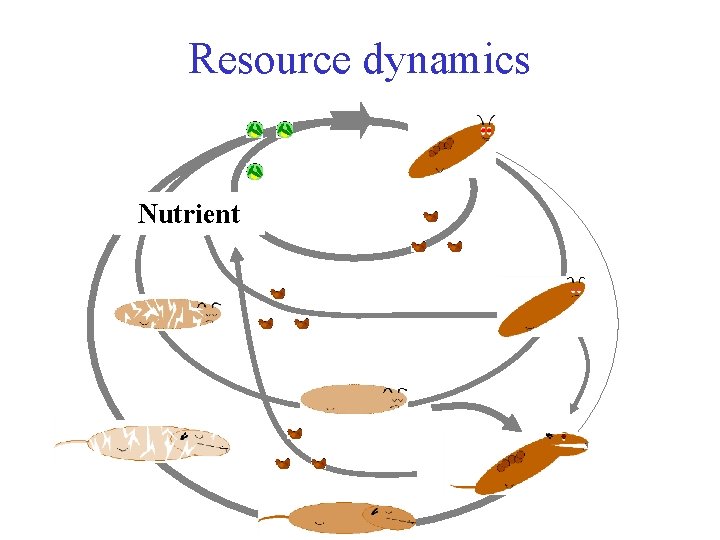
Resource dynamics Nutrient
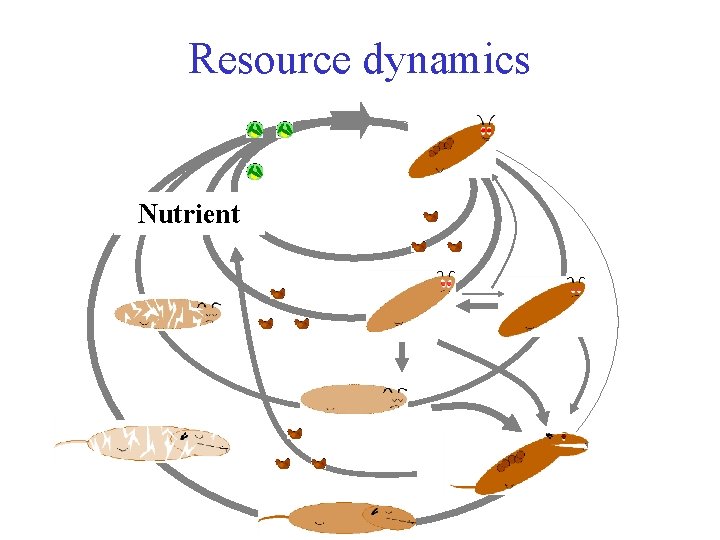
Resource dynamics Nutrient
Resource dynamics Nutrient
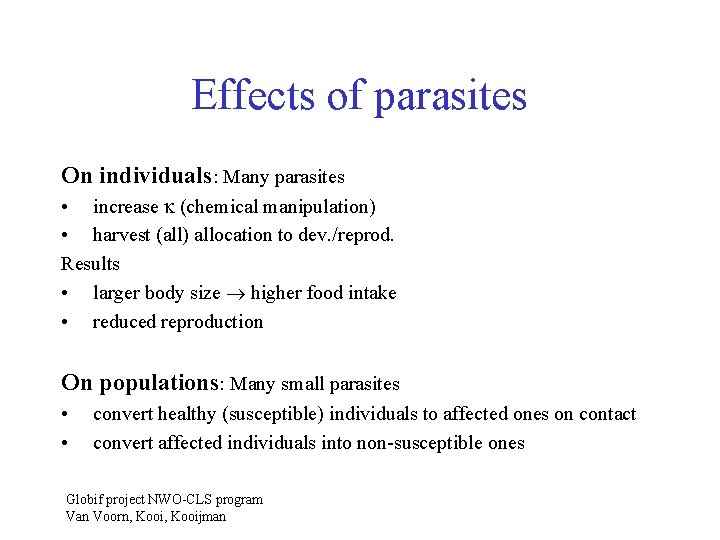
Effects of parasites On individuals: Many parasites • increase (chemical manipulation) • harvest (all) allocation to dev. /reprod. Results • larger body size higher food intake • reduced reproduction On populations: Many small parasites • • convert healthy (susceptible) individuals to affected ones on contact convert affected individuals into non-susceptible ones Globif project NWO-CLS program Van Voorn, Kooijman
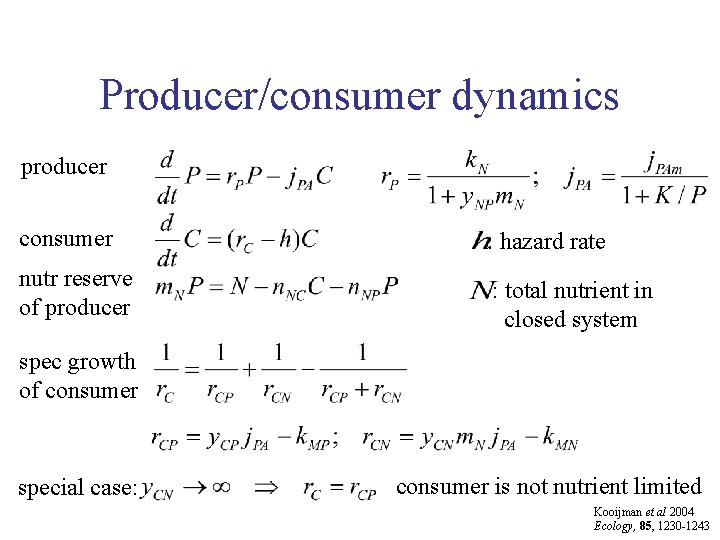
Producer/consumer dynamics producer consumer : hazard rate nutr reserve of producer : total nutrient in closed system spec growth of consumer special case: consumer is not nutrient limited Kooijman et al 2004 Ecology, 85, 1230 -1243
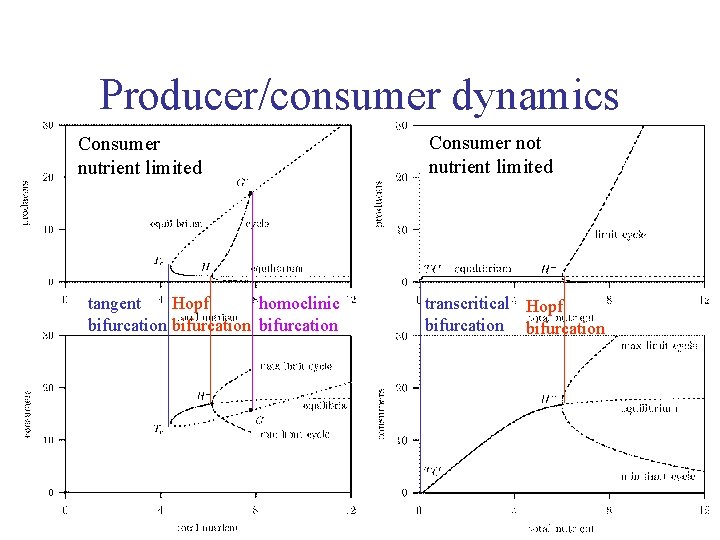
Producer/consumer dynamics Consumer nutrient limited tangent Hopf homoclinic bifurcation Consumer not nutrient limited transcritical Hopf bifurcation
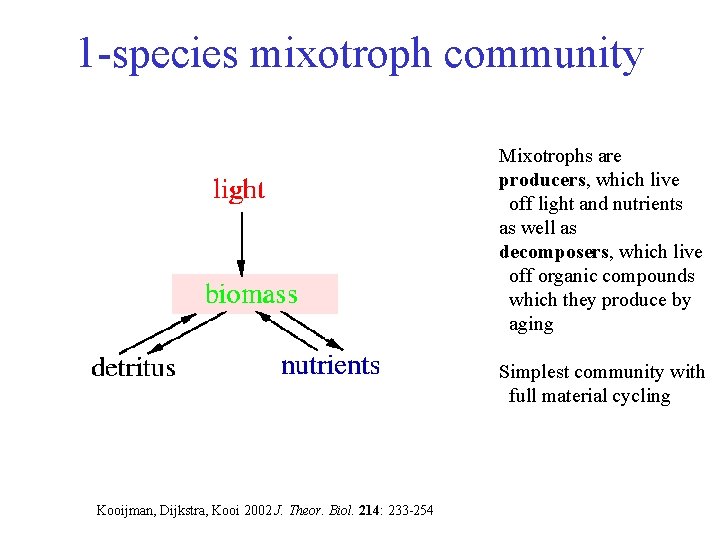
1 -species mixotroph community Mixotrophs are producers, which live off light and nutrients as well as decomposers, which live off organic compounds which they produce by aging Simplest community with full material cycling Kooijman, Dijkstra, Kooi 2002 J. Theor. Biol. 214: 233 -254
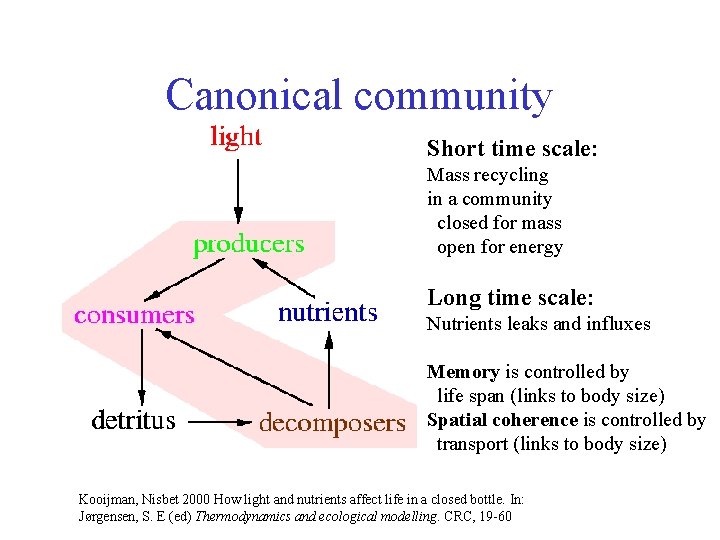
Canonical community Short time scale: Mass recycling in a community closed for mass open for energy Long time scale: Nutrients leaks and influxes Memory is controlled by life span (links to body size) Spatial coherence is controlled by transport (links to body size) Kooijman, Nisbet 2000 How light and nutrients affect life in a closed bottle. In: Jørgensen, S. E (ed) Thermodynamics and ecological modelling. CRC, 19 -60
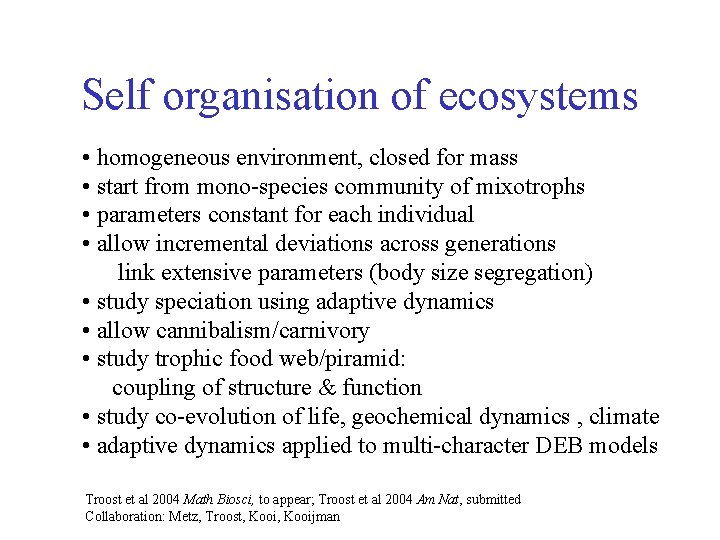
Self organisation of ecosystems • homogeneous environment, closed for mass • start from mono-species community of mixotrophs • parameters constant for each individual • allow incremental deviations across generations link extensive parameters (body size segregation) • study speciation using adaptive dynamics • allow cannibalism/carnivory • study trophic food web/piramid: coupling of structure & function • study co-evolution of life, geochemical dynamics , climate • adaptive dynamics applied to multi-character DEB models Troost et al 2004 Math Biosci, to appear; Troost et al 2004 Am Nat, submitted Collaboration: Metz, Troost, Kooijman
DEB tele-course 2005 Feb – April 2005, 10 weeks, 200 h no financial costs http: //www. bio. vu. nl/thb/deb/course/