
Physical Behavioural and Mechanical Practices in Rice IPM

Physical, Behavioural and Mechanical Practices in Rice IPM Introduction Pest management is known as an ecological approach to tackle pest problems, because here emphasis is on containing pests in such a way that other biotic components of the system such as natural enemies, human beings and wild life are not harmed and environment is preserved in general. Birds- victims of indiscriminate pesticide use

In IPM different methods of pest control such as resistant varieties, cultural methods, physical methods, behavioural methods, mechanical enemies methods, natural and pesticides are to suppress pest integrated population without jeopardizing other components environment. of the IPM Concept
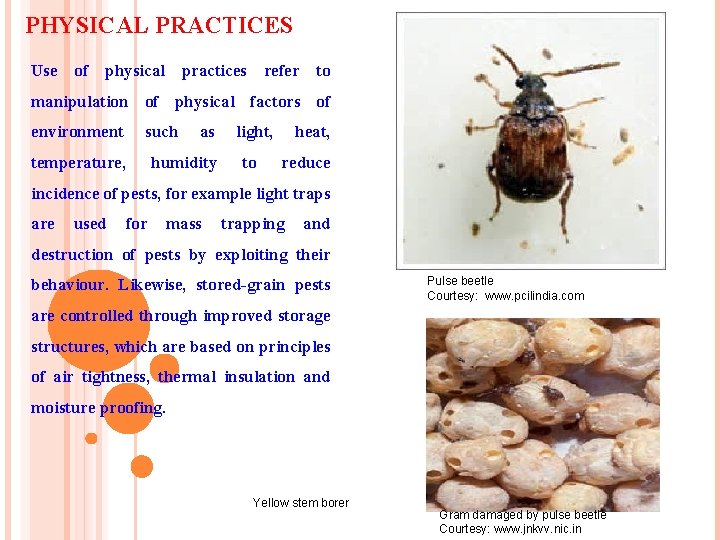
PHYSICAL PRACTICES Use of physical practices refer to manipulation of physical factors of environment such temperature, as humidity light, to heat, reduce incidence of pests, for example light traps are used for mass trapping and destruction of pests by exploiting their behaviour. Likewise, stored-grain pests Pulse beetle Courtesy: www. pcilindia. com are controlled through improved storage structures, which are based on principles of air tightness, thermal insulation and moisture proofing. Yellow stem borer Gram damaged by pulse beetle Courtesy: www. jnkvv. nic. in
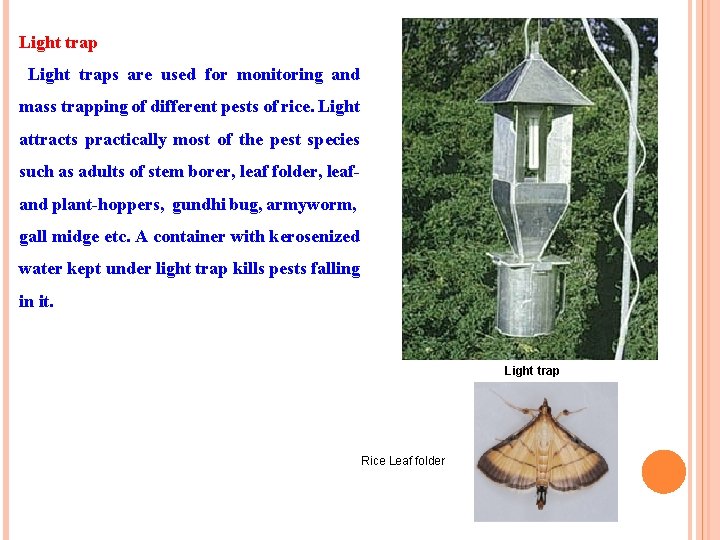
Light traps are used for monitoring and mass trapping of different pests of rice. Light attracts practically most of the pest species such as adults of stem borer, leaf folder, leafand plant-hoppers, gundhi bug, armyworm, gall midge etc. A container with kerosenized water kept under light trap kills pests falling in it. Light trap Rice Leaf folder
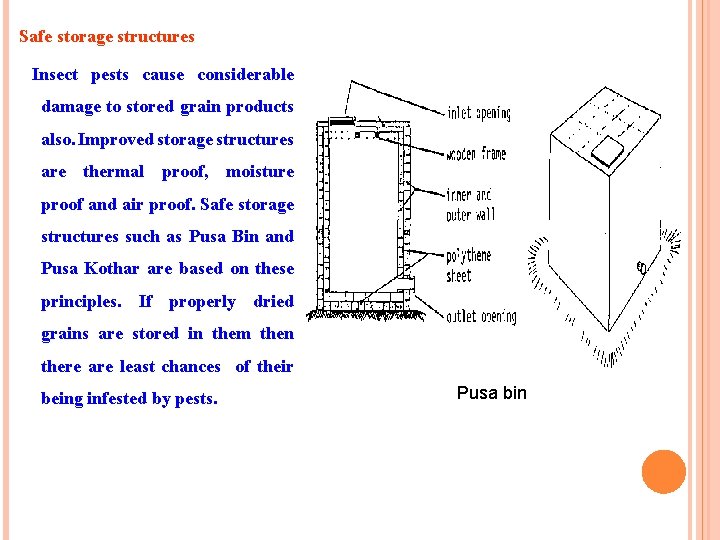
Safe storage structures Insect pests cause considerable damage to stored grain products also. Improved storage structures are thermal proof, moisture proof and air proof. Safe storage structures such as Pusa Bin and Pusa Kothar are based on these principles. If properly dried grains are stored in them then there are least chances of their being infested by pests. Pusa bin
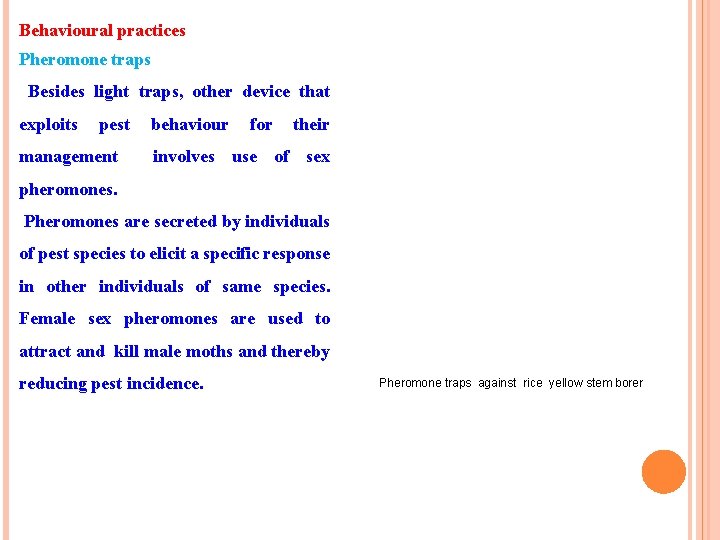
Behavioural practices Pheromone traps Besides light traps, other device that exploits pest management behaviour for their involves use of sex pheromones. Pheromones are secreted by individuals of pest species to elicit a specific response in other individuals of same species. Female sex pheromones are used to attract and kill male moths and thereby reducing pest incidence. Pheromone traps against rice yellow stem borer
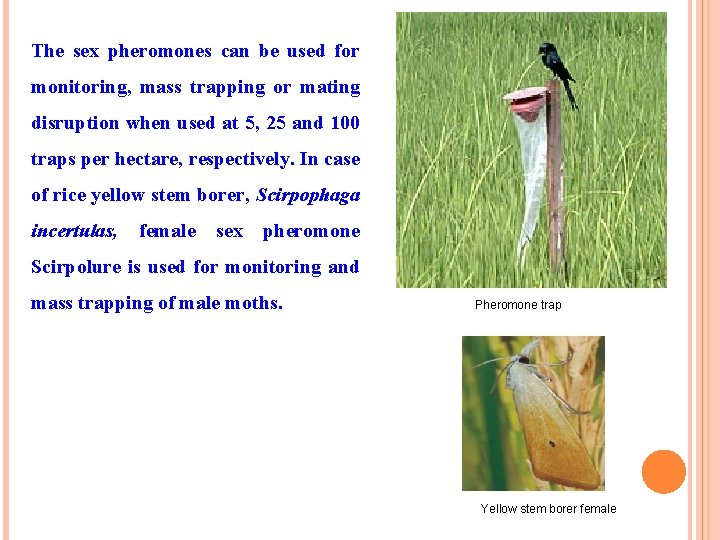
The sex pheromones can be used for monitoring, mass trapping or mating disruption when used at 5, 25 and 100 traps per hectare, respectively. In case of rice yellow stem borer, Scirpophaga incertulas, female sex pheromone Scirpolure is used for monitoring and mass trapping of male moths. Pheromone trap Yellow stem borer female
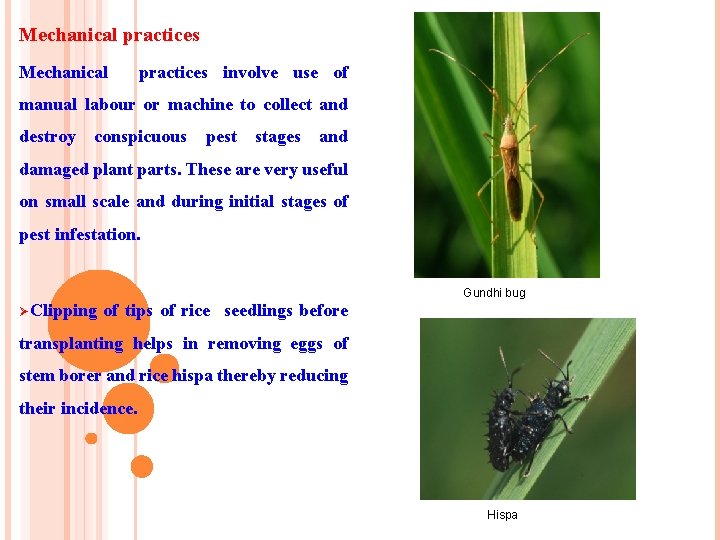
Mechanical practices involve use of manual labour or machine to collect and destroy conspicuous pest stages and damaged plant parts. These are very useful on small scale and during initial stages of pest infestation. Gundhi bug ØClipping of tips of rice seedlings before transplanting helps in removing eggs of stem borer and rice hispa thereby reducing their incidence. Hispa
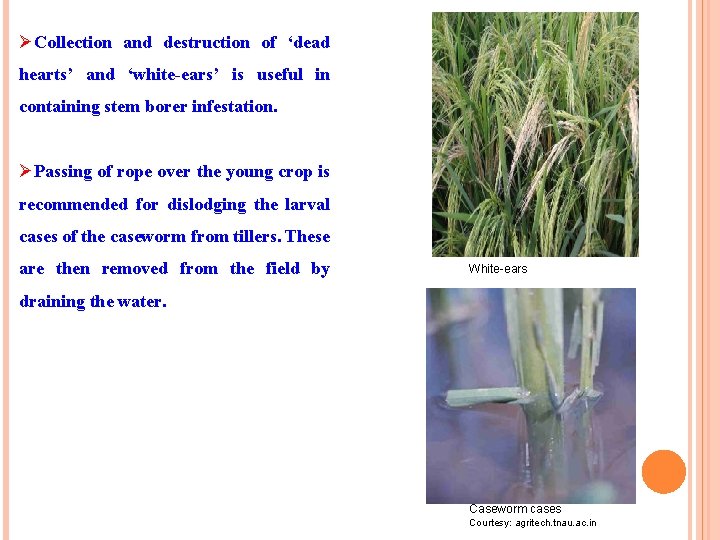
ØCollection and destruction of ‘dead hearts’ and ‘white-ears’ is useful in containing stem borer infestation. ØPassing of rope over the young crop is recommended for dislodging the larval cases of the caseworm from tillers. These are then removed from the field by White-ears draining the water. Caseworm cases Courtesy: agritech. tnau. ac. in
Let’s Sum Up ØUse of physical practices refer to manipulation of physical factors of environment such as light, heat, temperature, humidity to reduce pest incidence. ØLight traps are used for mass trapping and destruction of pests by exploiting their behaviour. ØStored-grain pests are controlled through improved storage structures, which are based on principles of air tightness, thermal insulation and moisture proofing. ØAnother device that exploits pest behaviour for their management involves use of sex pheromones. ØFemale sex pheromones are used to attract and kill male moths and thereby reducing pest incidence. ØMechanical practices involve use of manual labour or machines to collect and destroy conspicuous pest stages and damaged plant parts.
- Slides: 10