
Physical and Mathematical Basics of Stellar Dynamics best
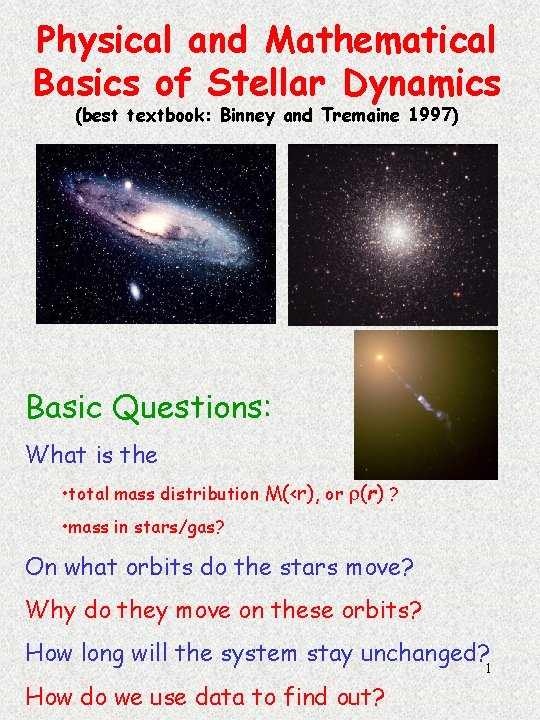
Physical and Mathematical Basics of Stellar Dynamics (best textbook: Binney and Tremaine 1997) Basic Questions: What is the • total mass distribution M(<r), or (r) ? • mass in stars/gas? On what orbits do the stars move? Why do they move on these orbits? How long will the system stay unchanged? 1 How do we use data to find out?
I. Collisionless vs. Collisional Matter How often do stars in a galaxy collide? - ignore binary stars - order of magnitude estimates • RSun 7 x 1010 cm; DSun- Cen 1019 cm! => collisions extremely unlikely! …and in galaxy centers? Mean surface brightness of the Sun is = - 11 mag/sqasec, which is distance independent. The central parts of other galaxies have ~ 12 mag/sqasec. Therefore, (1 - 10 -9) of the projected area is empty. Even near galaxy centers, the path ahead of stars is empty. 2
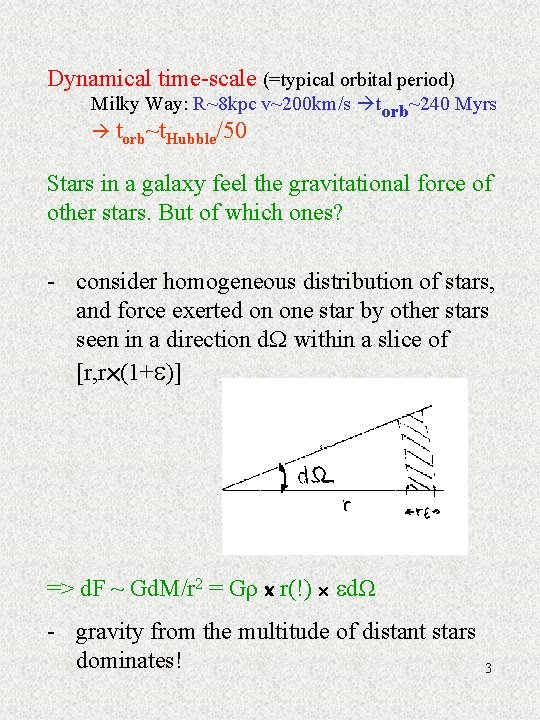
Dynamical time-scale (=typical orbital period) Milky Way: R~8 kpc v~200 km/s torb~240 Myrs torb~t. Hubble/50 Stars in a galaxy feel the gravitational force of other stars. But of which ones? - consider homogeneous distribution of stars, and force exerted on one star by other stars seen in a direction d within a slice of [r, rx(1+ )] => d. F ~ Gd. M/r 2 = Gρ x r(!) x dΩ - gravity from the multitude of distant stars dominates! 3
What about (diffuse) interstellar gas? - continuous mass distribution - gas has the ability to loose (internal) energy through radiation. - Two basic regimes for gas in a potential well of ‚typical orbital velocity‘, v • • k. T/m v 2 hydrostatic equilibrium k. T/m << v 2, as for atomic gas in galaxies - in the second case: • supersonic collisions shocks (mechanical) heating (radiative) cooling energy loss • for a given (total) angular momentum, what‘s the minimum energy orbit? A (set of) concentric (co-planar), circular orbits. => cooling gas makes disks! 4
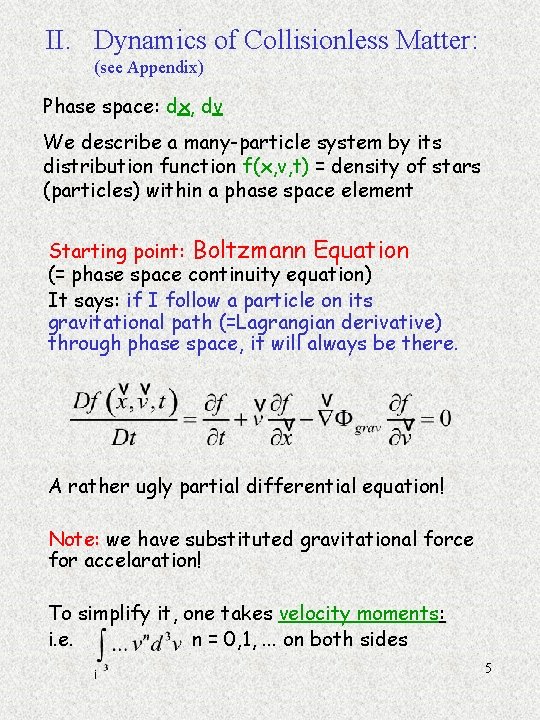
II. Dynamics of Collisionless Matter: (see Appendix) Phase space: dx, dv We describe a many-particle system by its distribution function f(x, v, t) = density of stars (particles) within a phase space element Starting point: Boltzmann Equation (= phase space continuity equation) It says: if I follow a particle on its gravitational path (=Lagrangian derivative) through phase space, it will always be there. A rather ugly partial differential equation! Note: we have substituted gravitational force for accelaration! To simplify it, one takes velocity moments: i. e. n = 0, 1, . . . on both sides 5

Moments of the Boltzmann Equation Oth Moment mass conservation : mass density; v/u: indiv/mean particle velocity 1 st Moment “Jeans Equation” The three terms can be interpreted as: momentum change pressure force grav. force 6
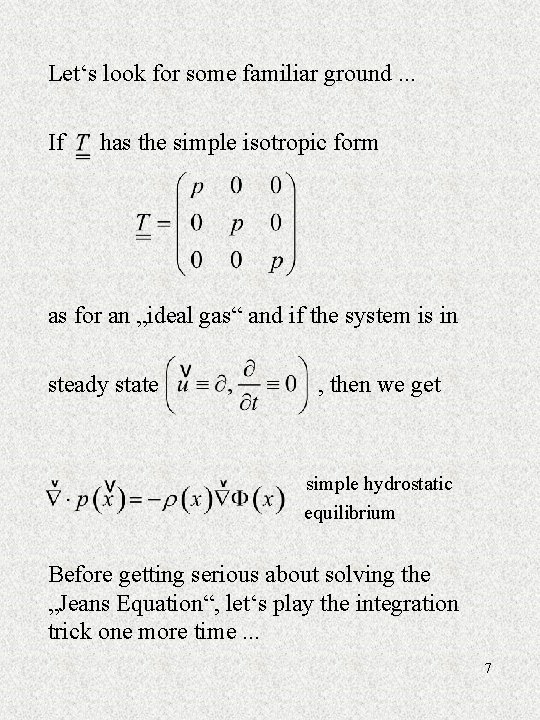
Let‘s look for some familiar ground. . . If has the simple isotropic form as for an „ideal gas“ and if the system is in steady state , then we get simple hydrostatic equilibrium Before getting serious about solving the „Jeans Equation“, let‘s play the integration trick one more time. . . 7

Virial Theorem To keep the math simple, we consider the one -dimensional analog of I. 4 in steady state: I. 5 „velocity dispersion“ After integrating over velocities, let‘s integrate over : [one needs to use Gauss’ theorem etc. . ] 8
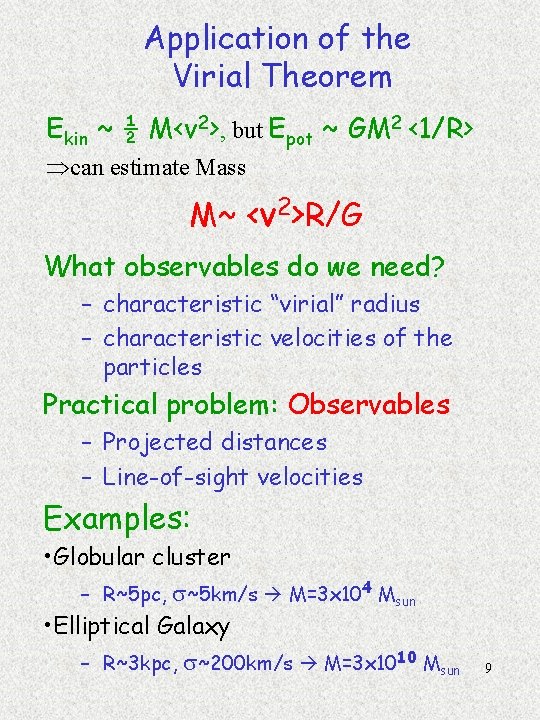
Application of the Virial Theorem Ekin ~ ½ M<v 2>, but Epot ~ GM 2 <1/R> can estimate Mass M~ <v 2>R/G What observables do we need? – characteristic “virial” radius – characteristic velocities of the particles Practical problem: Observables – Projected distances – Line-of-sight velocities Examples: • Globular cluster – R~5 pc, ~5 km/s M=3 x 10⁴ Msun • Elliptical Galaxy – R~3 kpc, ~200 km/s M=3 x 10¹⁰ Msun 9
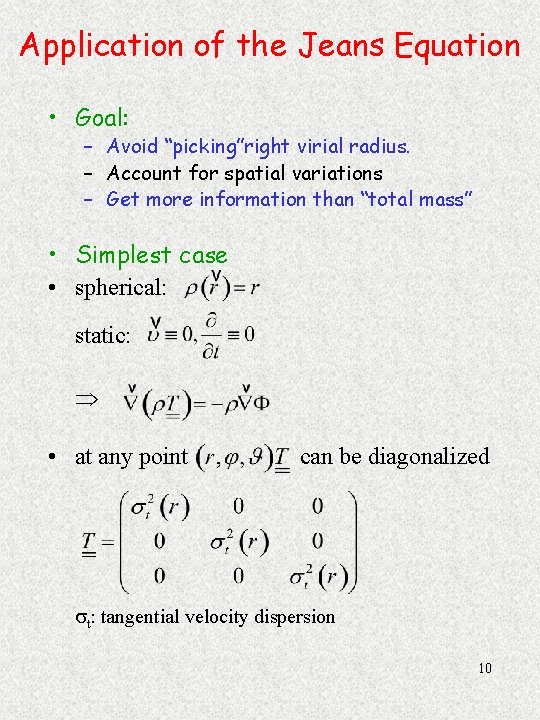
Application of the Jeans Equation • Goal: – Avoid “picking”right virial radius. – Account for spatial variations – Get more information than “total mass” • Simplest case • spherical: static: • at any point can be diagonalized t: tangential velocity dispersion 10
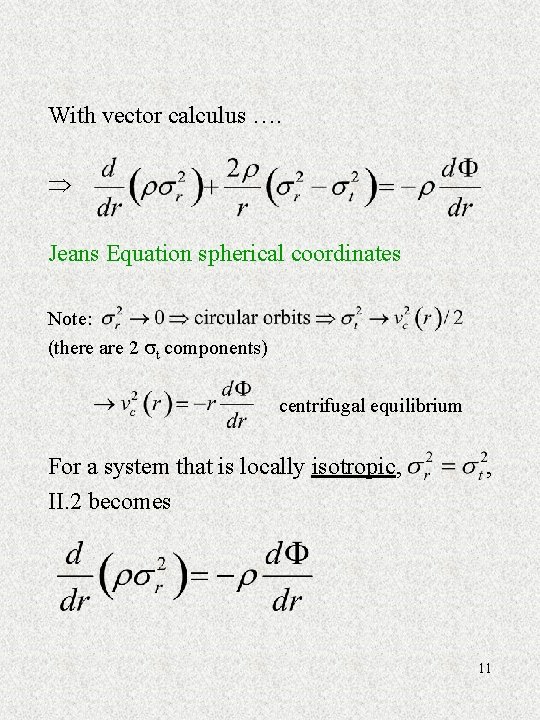
With vector calculus …. Jeans Equation spherical coordinates Note: (there are 2 t components) centrifugal equilibrium For a system that is locally isotropic, II. 2 becomes , 11
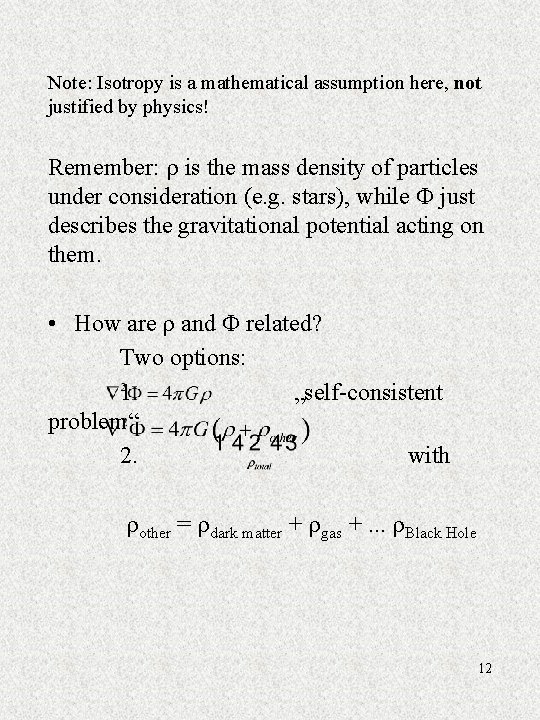
Note: Isotropy is a mathematical assumption here, not justified by physics! Remember: is the mass density of particles under consideration (e. g. stars), while just describes the gravitational potential acting on them. • How are and related? Two options: 1. „self-consistent problem“ 2. with other = dark matter + gas +. . . Black Hole 12
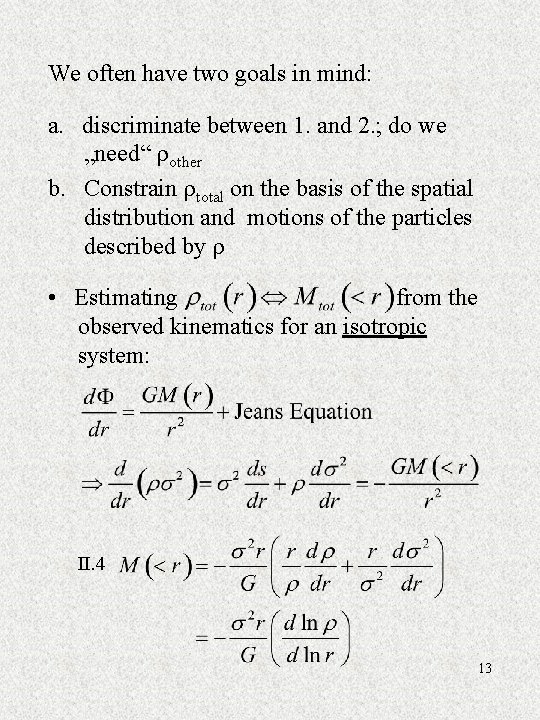
We often have two goals in mind: a. discriminate between 1. and 2. ; do we „need“ other b. Constrain total on the basis of the spatial distribution and motions of the particles described by • Estimating from the observed kinematics for an isotropic system: II. 4 13
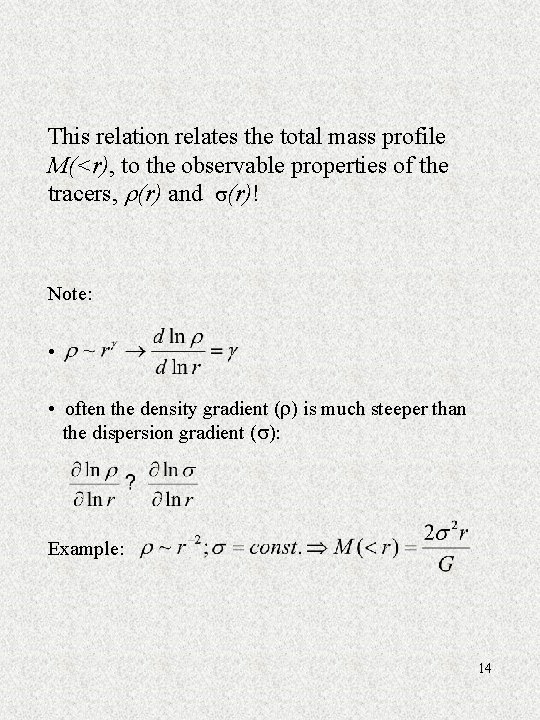
This relation relates the total mass profile M(<r), to the observable properties of the tracers, (r) and (r)! Note: • • often the density gradient ( ) is much steeper than the dispersion gradient ( ): Example: 14
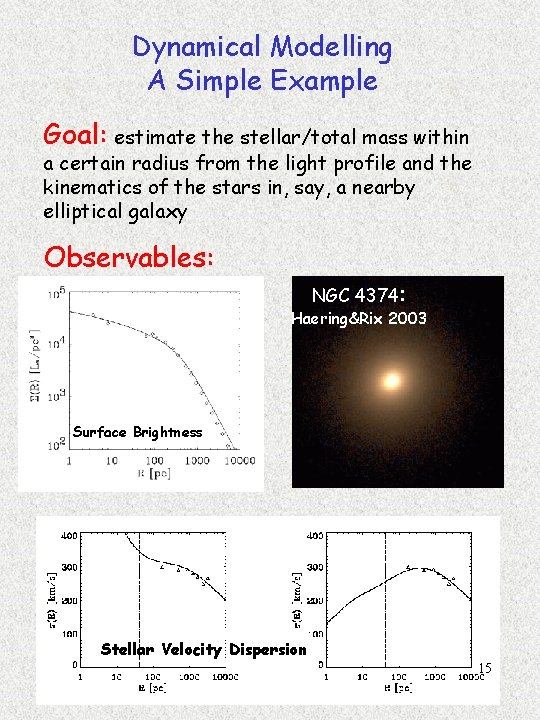
Dynamical Modelling A Simple Example Goal: estimate the stellar/total mass within a certain radius from the light profile and the kinematics of the stars in, say, a nearby elliptical galaxy Observables: NGC 4374: Haering&Rix 2003 Surface Brightness Stellar Velocity Dispersion 15
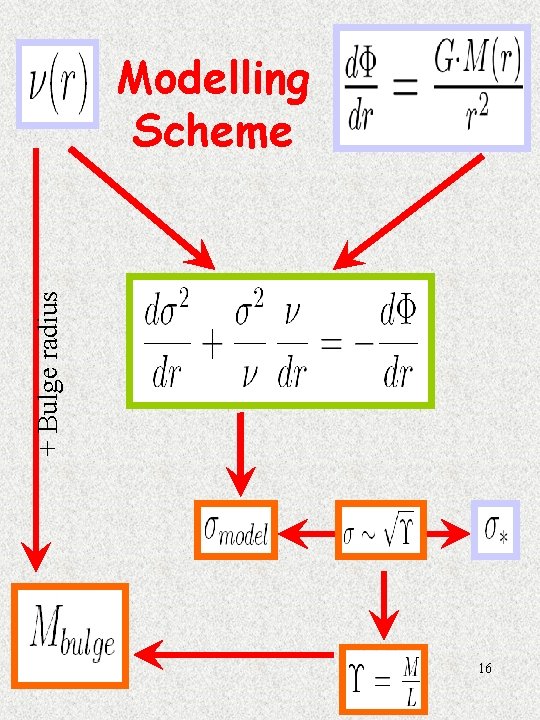
+ Bulge radius Modelling Scheme 16
Galaxies out of Equilibrium I. Mergers and Interaction Brief History: • Zwicky and Arp (1950 s and 1960 s) studied “peculiar galaxies” which exhibit distortions, bridges between pairs, etc. (“Atlas of Peculiar Galaxies”, Arp 1966). • In 1956 Zwicky speculated that “tidal interactions” may cause these features. 17
• In 1972, Alan and Juri Toomre published the first “realistic” simulations of galaxy interactions, matching M 51 and the “Antennae”. This paper contains two predictions: – encounters transfer orbital into internal energy merger spirals “messy” ellipticals First proposed mechanism of galaxy evolution! – at earlier epochs densities were higher more interactions/mergers 18
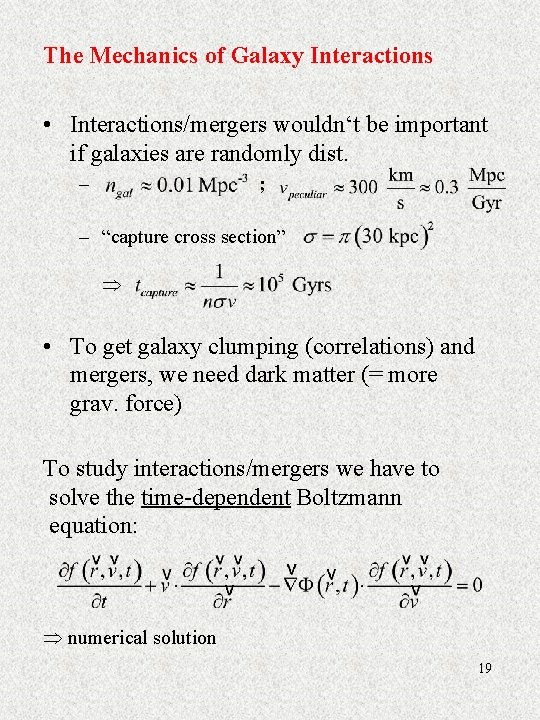
The Mechanics of Galaxy Interactions • Interactions/mergers wouldn‘t be important if galaxies are randomly dist. – ; – “capture cross section” • To get galaxy clumping (correlations) and mergers, we need dark matter (= more grav. force) To study interactions/mergers we have to solve the time-dependent Boltzmann equation: numerical solution 19
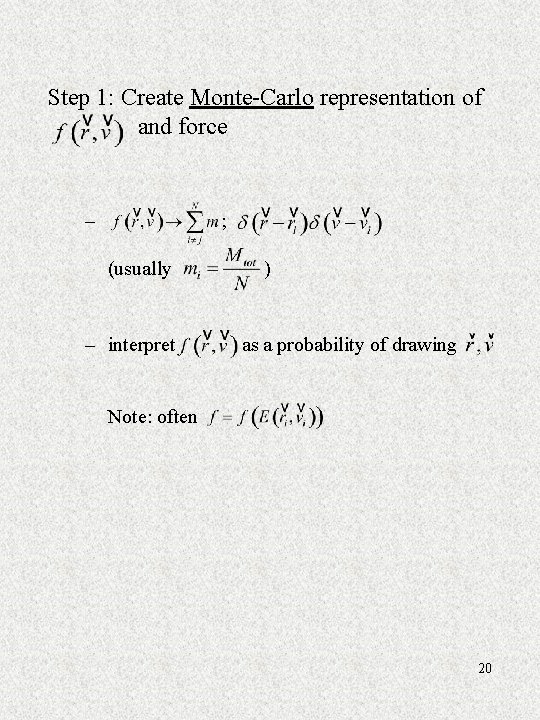
Step 1: Create Monte-Carlo representation of and force – ; (usually – interpret ) as a probability of drawing Note: often 20
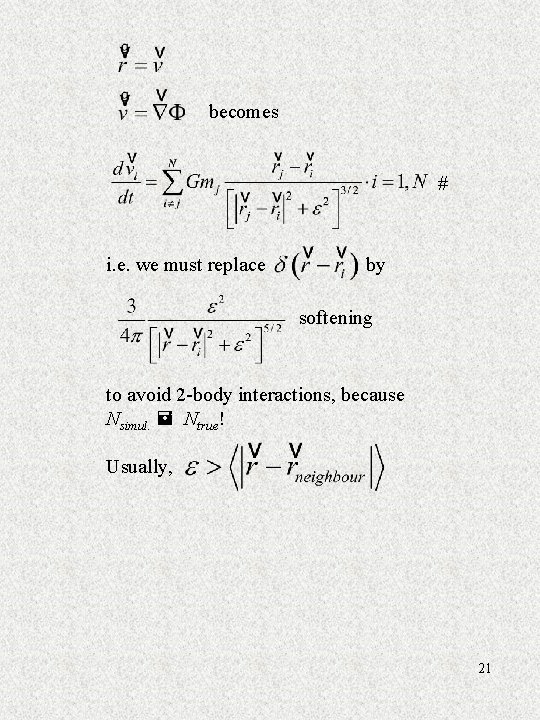
becomes # i. e. we must replace by softening to avoid 2 -body interactions, because Nsimul. Ntrue! Usually, 21
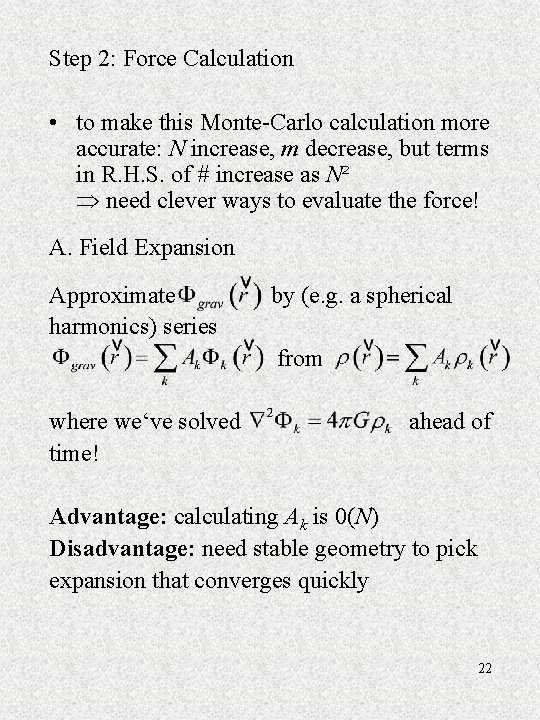
Step 2: Force Calculation • to make this Monte-Carlo calculation more accurate: N increase, m decrease, but terms in R. H. S. of # increase as N² need clever ways to evaluate the force! A. Field Expansion Approximate harmonics) series by (e. g. a spherical from where we‘ve solved time! ahead of Advantage: calculating Ak is 0(N) Disadvantage: need stable geometry to pick expansion that converges quickly 22
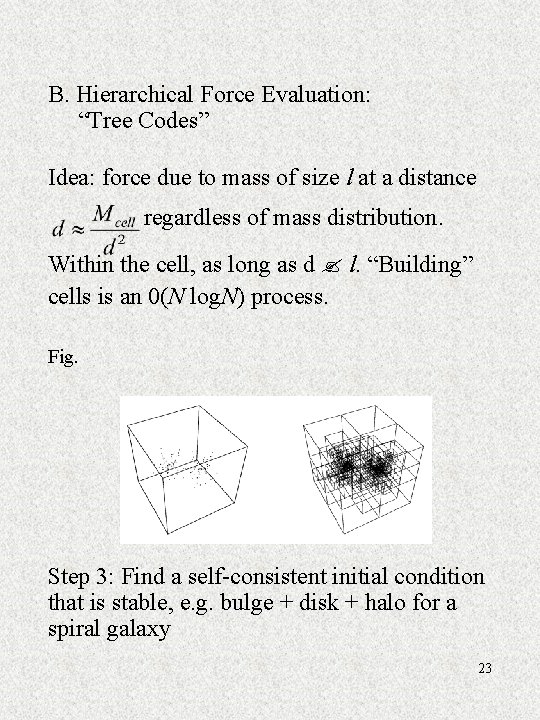
B. Hierarchical Force Evaluation: “Tree Codes” Idea: force due to mass of size l at a distance regardless of mass distribution. Within the cell, as long as d l. “Building” cells is an 0(N log. N) process. Fig. Step 3: Find a self-consistent initial condition that is stable, e. g. bulge + disk + halo for a spiral galaxy 23
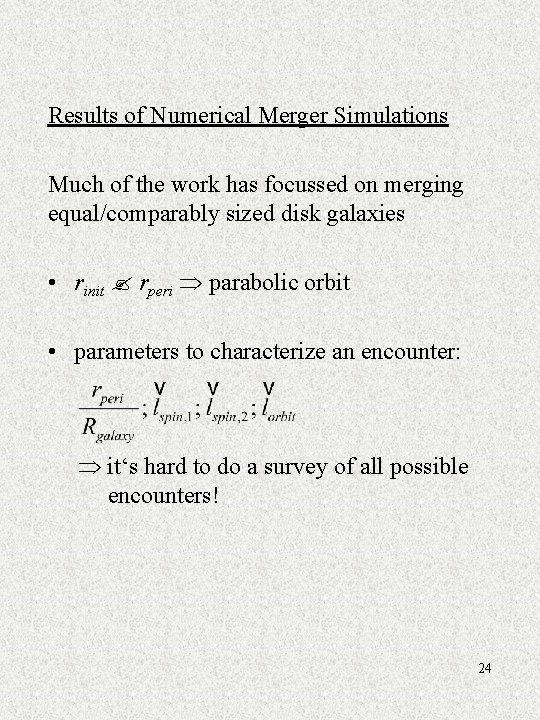
Results of Numerical Merger Simulations Much of the work has focussed on merging equal/comparably sized disk galaxies • rinit rperi parabolic orbit • parameters to characterize an encounter: it‘s hard to do a survey of all possible encounters! 24
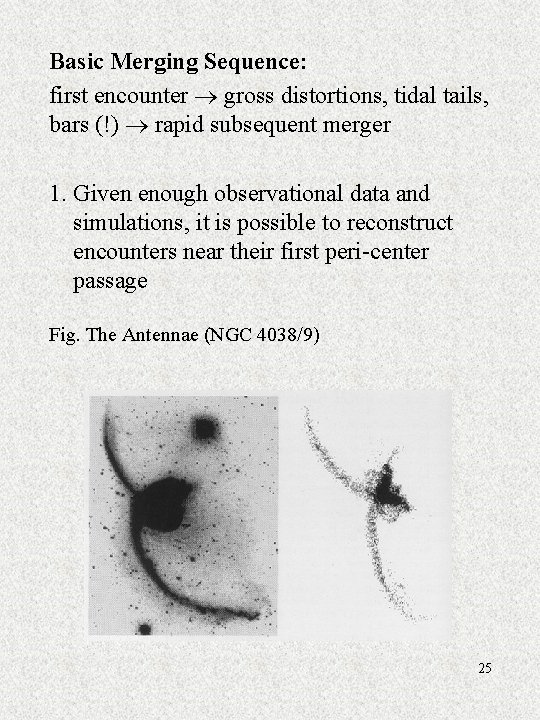
Basic Merging Sequence: first encounter gross distortions, tidal tails, bars (!) rapid subsequent merger 1. Given enough observational data and simulations, it is possible to reconstruct encounters near their first peri-center passage Fig. The Antennae (NGC 4038/9) 25
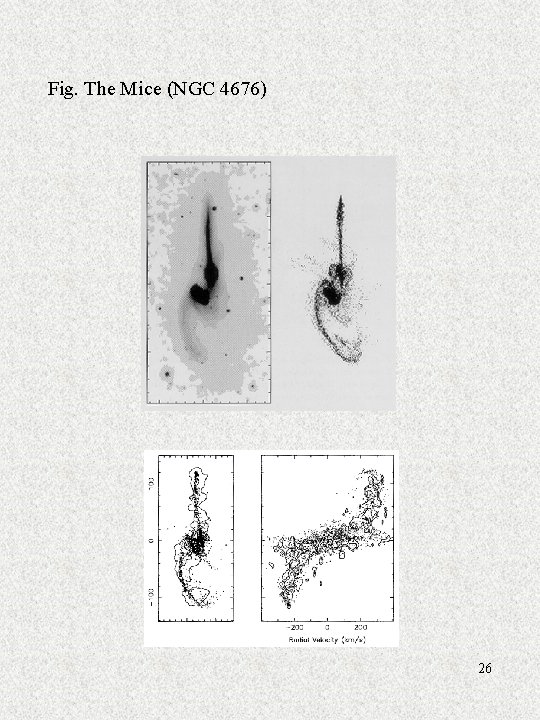
Fig. The Mice (NGC 4676) 26
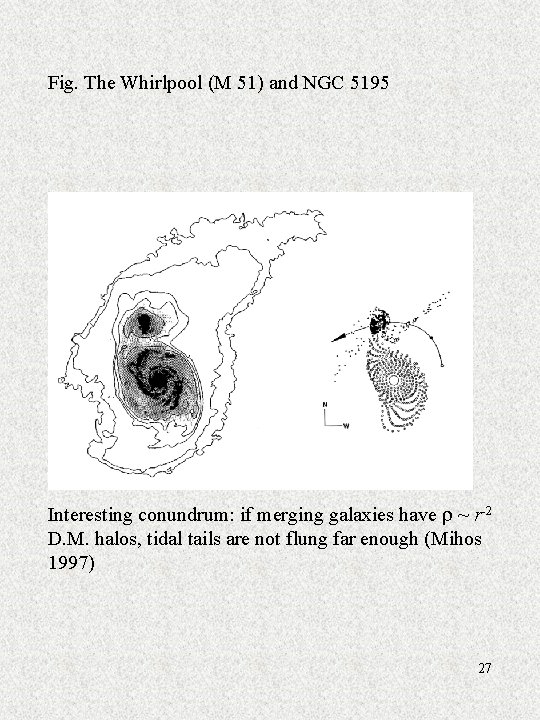
Fig. The Whirlpool (M 51) and NGC 5195 Interesting conundrum: if merging galaxies have ~ r-2 D. M. halos, tidal tails are not flung far enough (Mihos 1997) 27
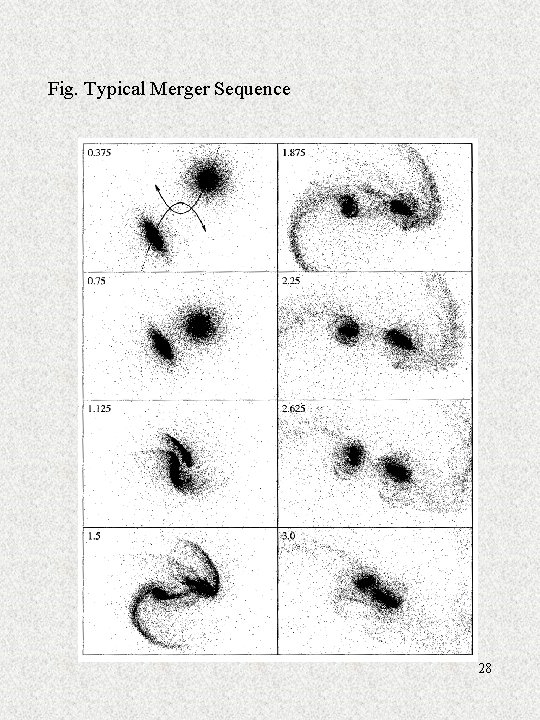
Fig. Typical Merger Sequence 28
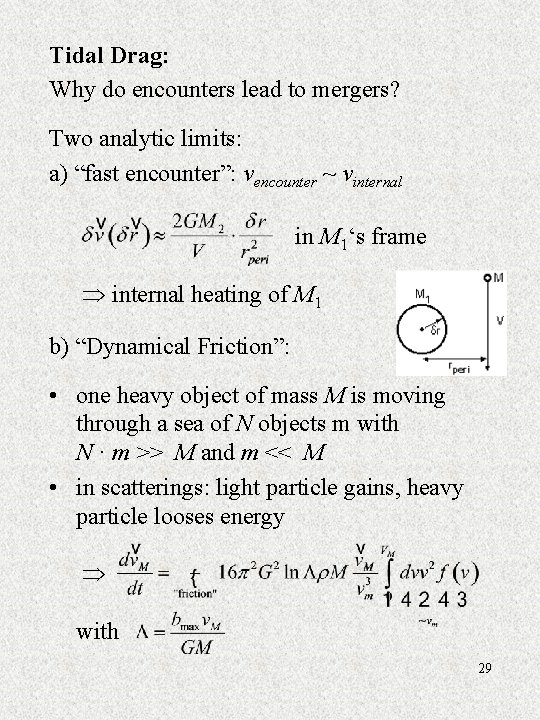
Tidal Drag: Why do encounters lead to mergers? Two analytic limits: a) “fast encounter”: vencounter ~ vinternal in M 1‘s frame internal heating of M 1 b) “Dynamical Friction”: • one heavy object of mass M is moving through a sea of N objects m with N · m >> M and m << M • in scatterings: light particle gains, heavy particle looses energy with 29
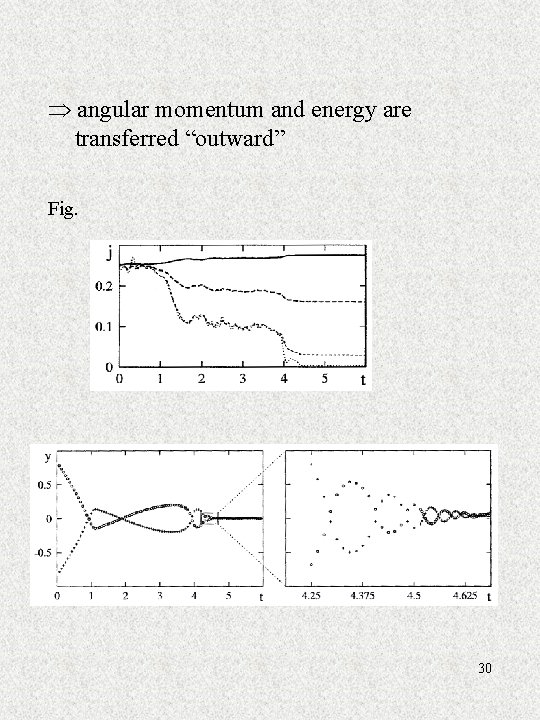
angular momentum and energy are transferred “outward” Fig. 30
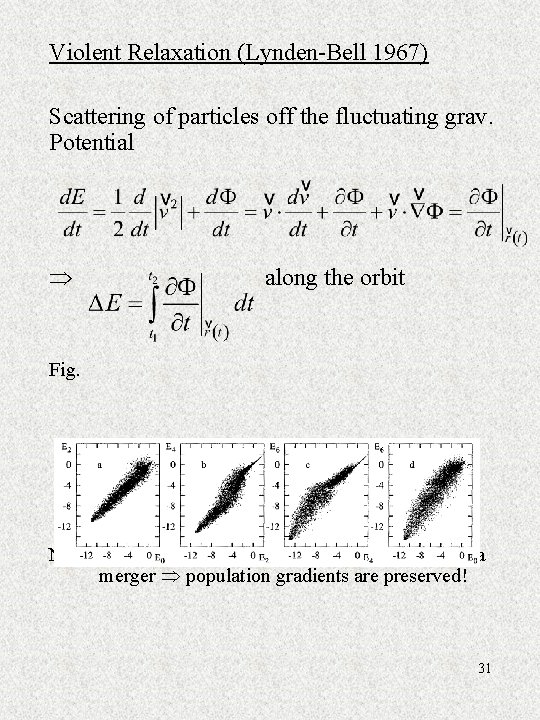
Violent Relaxation (Lynden-Bell 1967) Scattering of particles off the fluctuating grav. Potential along the orbit Fig. Note: the energy ordering of particles is preserved in a merger population gradients are preserved! 31
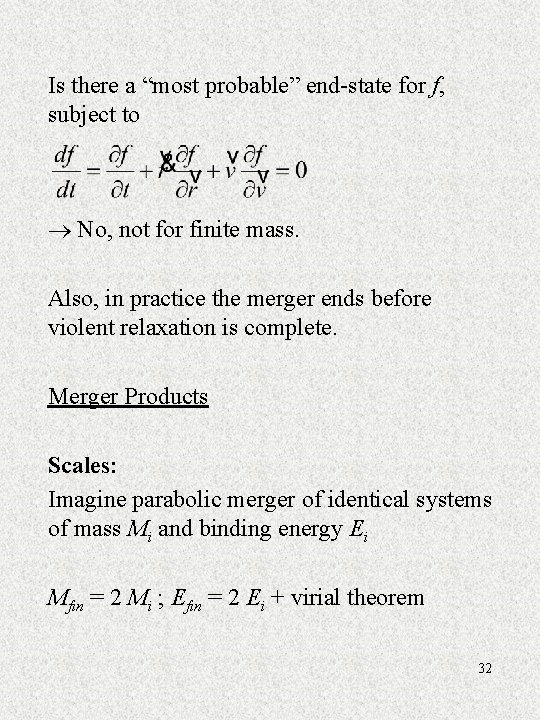
Is there a “most probable” end-state for f, subject to No, not for finite mass. Also, in practice the merger ends before violent relaxation is complete. Merger Products Scales: Imagine parabolic merger of identical systems of mass Mi and binding energy Ei Mfin = 2 Mi ; Efin = 2 Ei + virial theorem 32
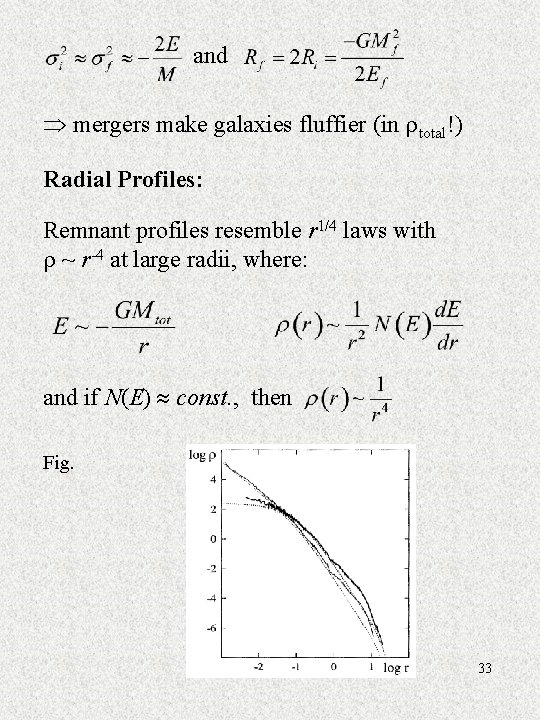
and mergers make galaxies fluffier (in total!) Radial Profiles: Remnant profiles resemble r 1/4 laws with ~ r-4 at large radii, where: and if N(E) const. , then Fig. 33
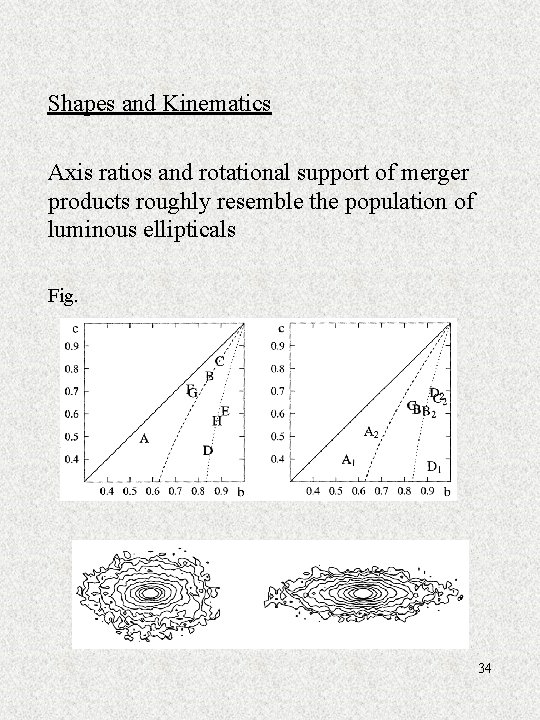
Shapes and Kinematics Axis ratios and rotational support of merger products roughly resemble the population of luminous ellipticals Fig. 34
Merger Summary • Galaxy mergers do happen and will transform galaxies. – Orbital energy internal energy • Stars (and dark matter) can be simulated quite well merger results look much like ellipticals Intense gas inflow can and will happen (hard to quantify through simulations) 35

36
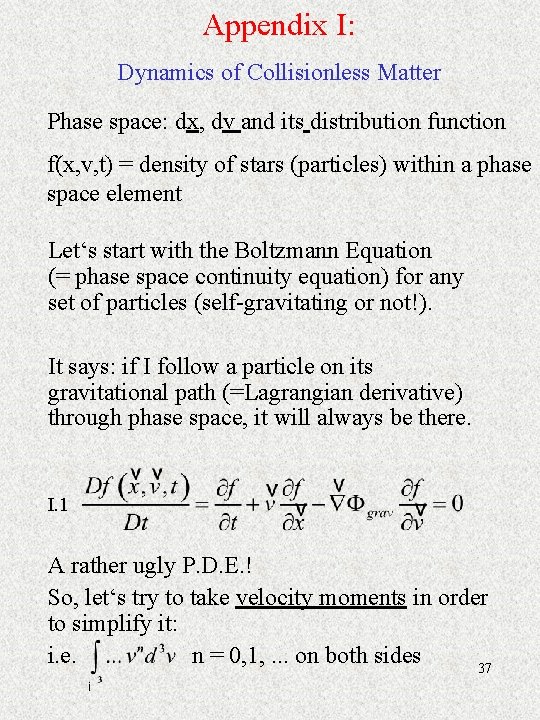
Appendix I: Dynamics of Collisionless Matter Phase space: dx, dv and its distribution function f(x, v, t) = density of stars (particles) within a phase space element Let‘s start with the Boltzmann Equation (= phase space continuity equation) for any set of particles (self-gravitating or not!). It says: if I follow a particle on its gravitational path (=Lagrangian derivative) through phase space, it will always be there. I. 1 A rather ugly P. D. E. ! So, let‘s try to take velocity moments in order to simplify it: i. e. n = 0, 1, . . . on both sides 37
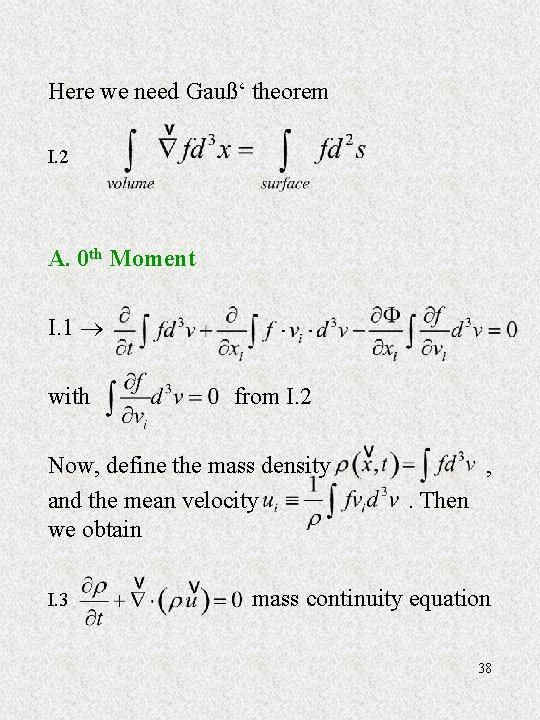
Here we need Gauß‘ theorem I. 2 A. 0 th Moment I. 1 with from I. 2 Now, define the mass density and the mean velocity we obtain I. 3 , . Then mass continuity equation 38
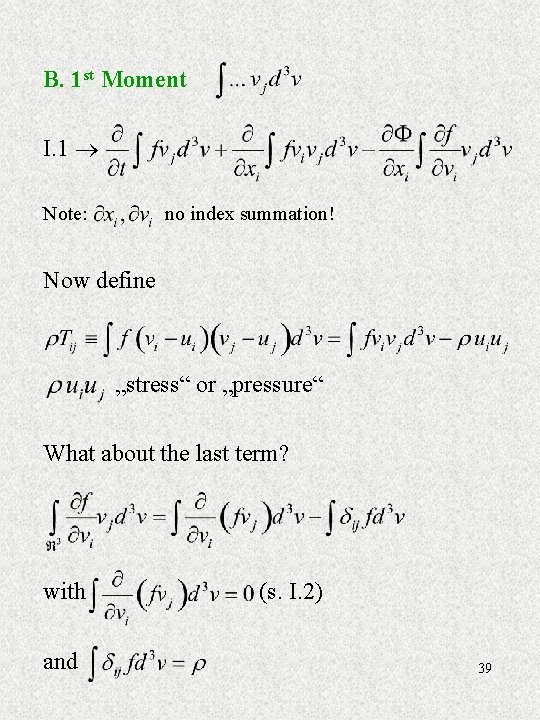
B. 1 st Moment I. 1 Note: no index summation! Now define „stress“ or „pressure“ What about the last term? with and (s. I. 2) 39
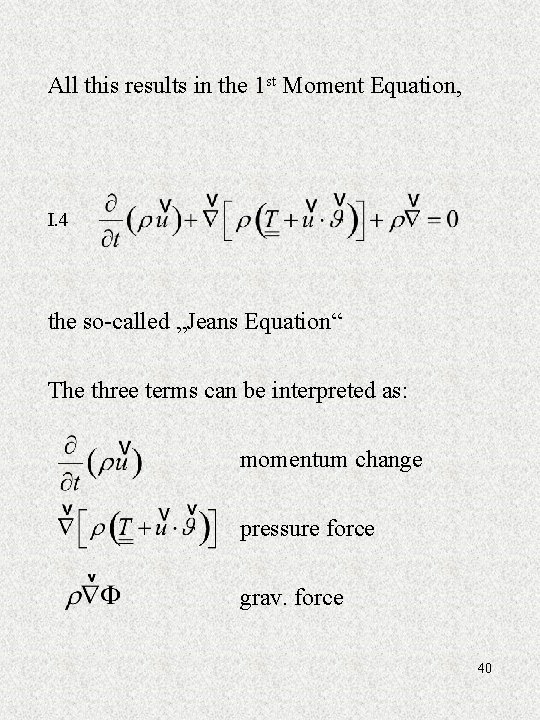
All this results in the 1 st Moment Equation, I. 4 the so-called „Jeans Equation“ The three terms can be interpreted as: momentum change pressure force grav. force 40
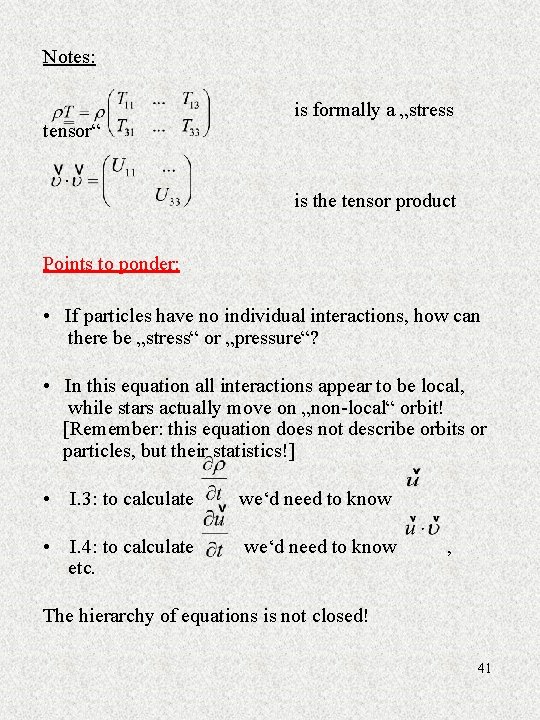
Notes: tensor“ is formally a „stress is the tensor product Points to ponder: • If particles have no individual interactions, how can there be „stress“ or „pressure“? • In this equation all interactions appear to be local, while stars actually move on „non-local“ orbit! [Remember: this equation does not describe orbits or particles, but their statistics!] • I. 3: to calculate we‘d need to know • I. 4: to calculate etc. we‘d need to know , The hierarchy of equations is not closed! 41
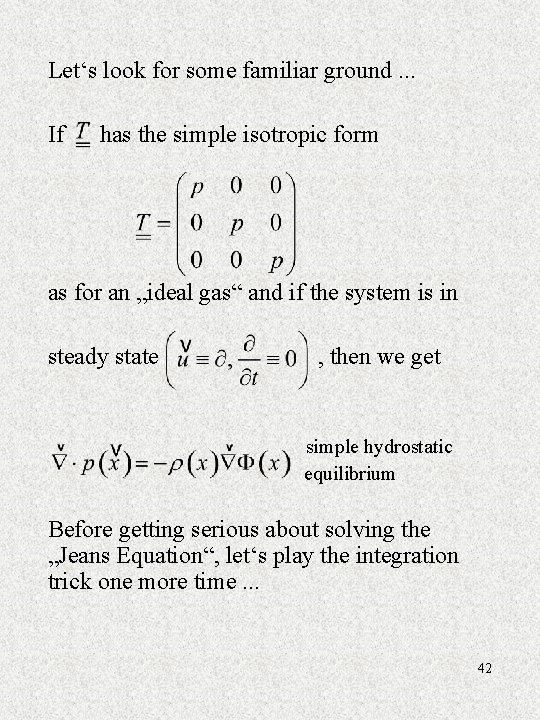
Let‘s look for some familiar ground. . . If has the simple isotropic form as for an „ideal gas“ and if the system is in steady state , then we get simple hydrostatic equilibrium Before getting serious about solving the „Jeans Equation“, let‘s play the integration trick one more time. . . 42
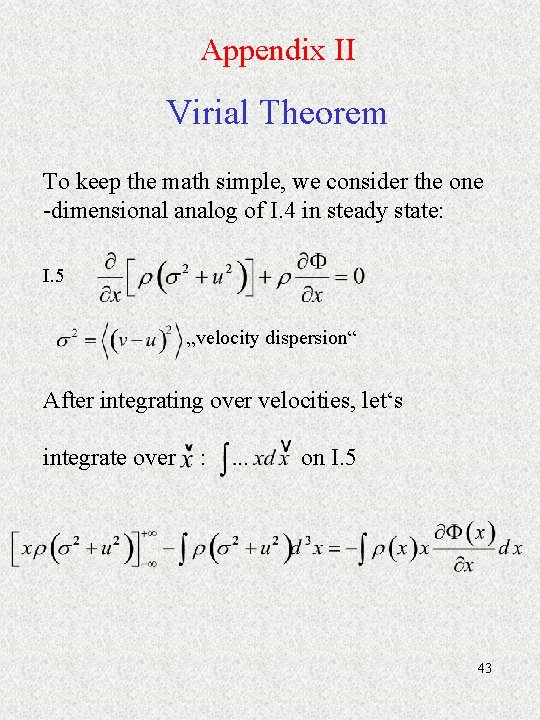
Appendix II Virial Theorem To keep the math simple, we consider the one -dimensional analog of I. 4 in steady state: I. 5 „velocity dispersion“ After integrating over velocities, let‘s integrate over : on I. 5 43
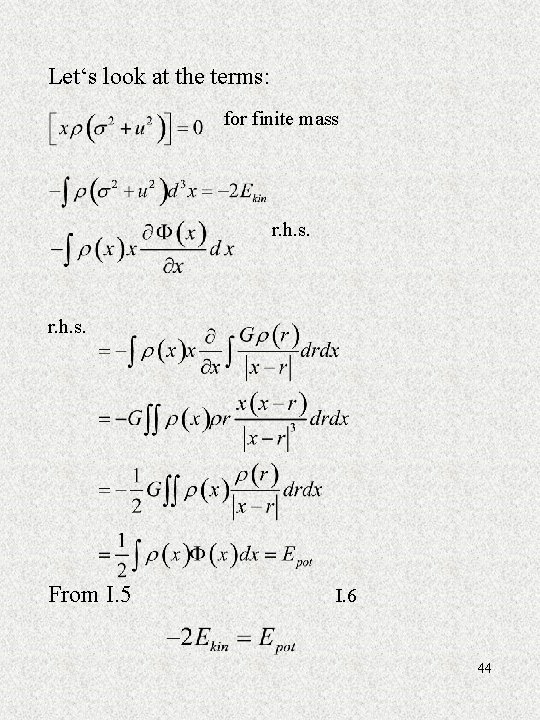
Let‘s look at the terms: for finite mass r. h. s. From I. 5 I. 6 44
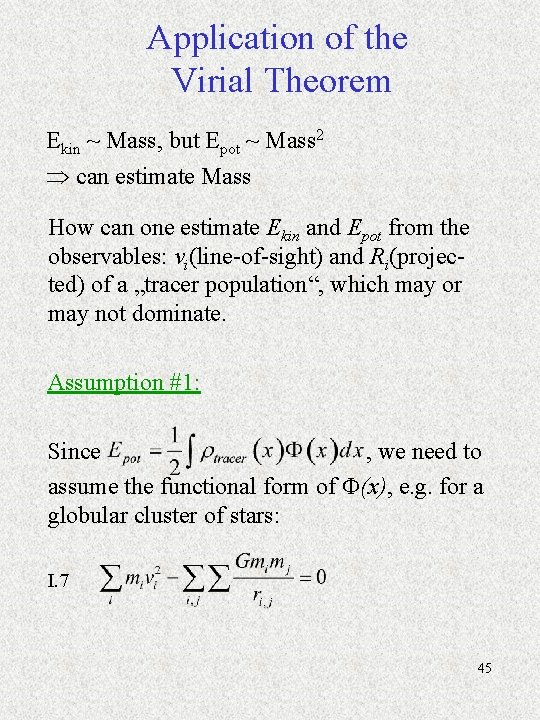
Application of the Virial Theorem Ekin ~ Mass, but Epot ~ Mass 2 can estimate Mass How can one estimate Ekin and Epot from the observables: vi(line-of-sight) and Ri(projected) of a „tracer population“, which may or may not dominate. Assumption #1: Since , we need to assume the functional form of (x), e. g. for a globular cluster of stars: I. 7 45
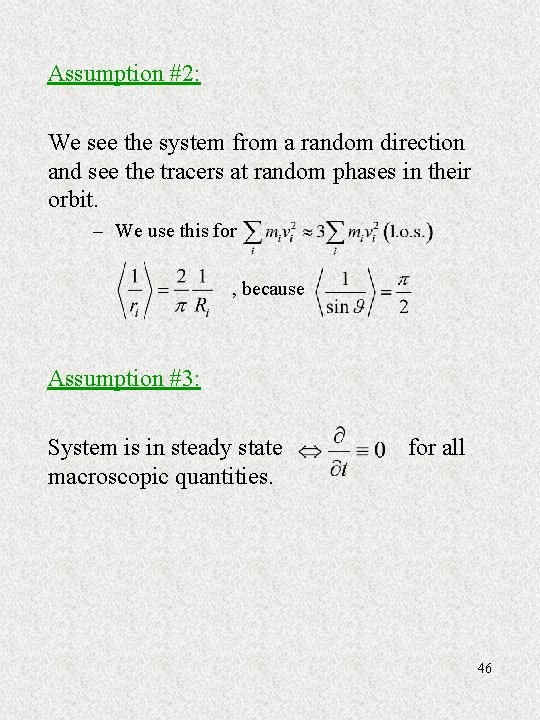
Assumption #2: We see the system from a random direction and see the tracers at random phases in their orbit. – We use this for , because Assumption #3: System is in steady state macroscopic quantities. for all 46
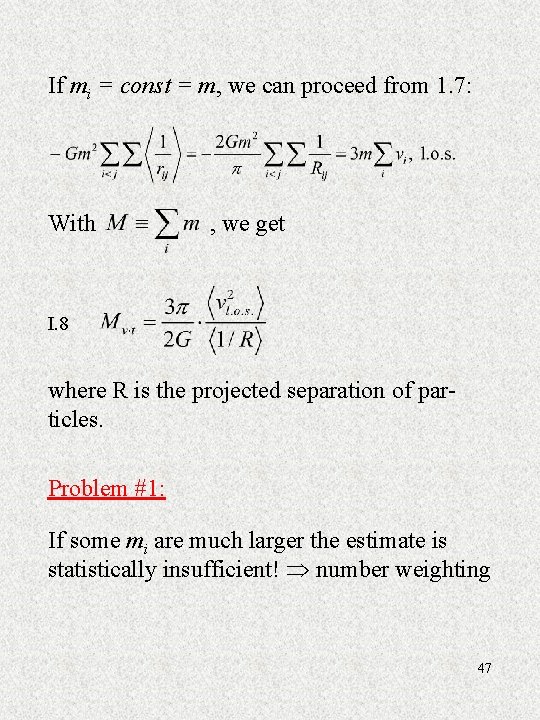
If mi = const = m, we can proceed from 1. 7: With , we get I. 8 where R is the projected separation of particles. Problem #1: If some mi are much larger the estimate is statistically insufficient! number weighting 47
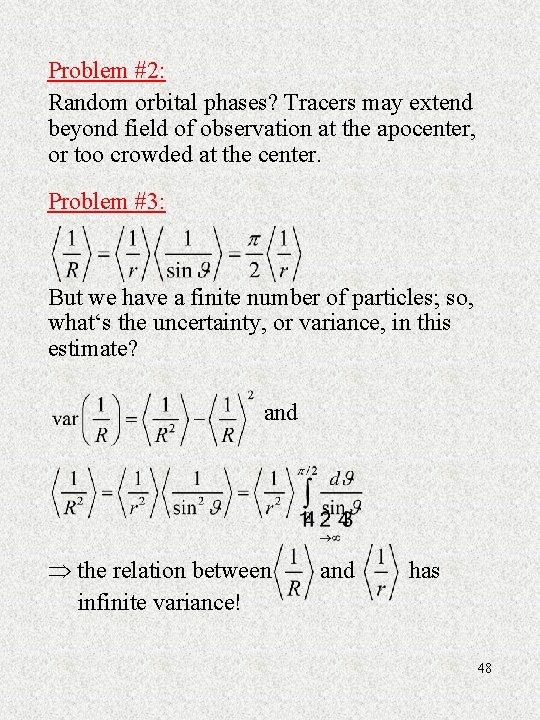
Problem #2: Random orbital phases? Tracers may extend beyond field of observation at the apocenter, or too crowded at the center. Problem #3: But we have a finite number of particles; so, what‘s the uncertainty, or variance, in this estimate? and the relation between infinite variance! and has 48
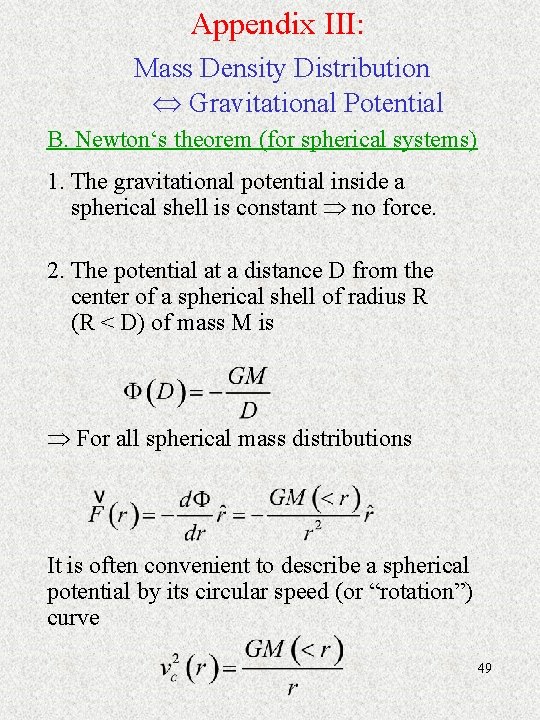
Appendix III: Mass Density Distribution Gravitational Potential B. Newton‘s theorem (for spherical systems) 1. The gravitational potential inside a spherical shell is constant no force. 2. The potential at a distance D from the center of a spherical shell of radius R (R < D) of mass M is For all spherical mass distributions It is often convenient to describe a spherical potential by its circular speed (or “rotation”) curve 49
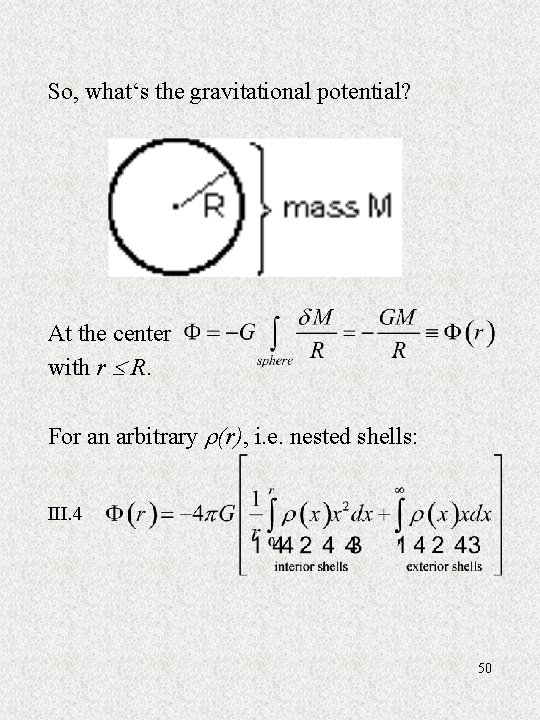
So, what‘s the gravitational potential? At the center with r R. For an arbitrary (r), i. e. nested shells: III. 4 50
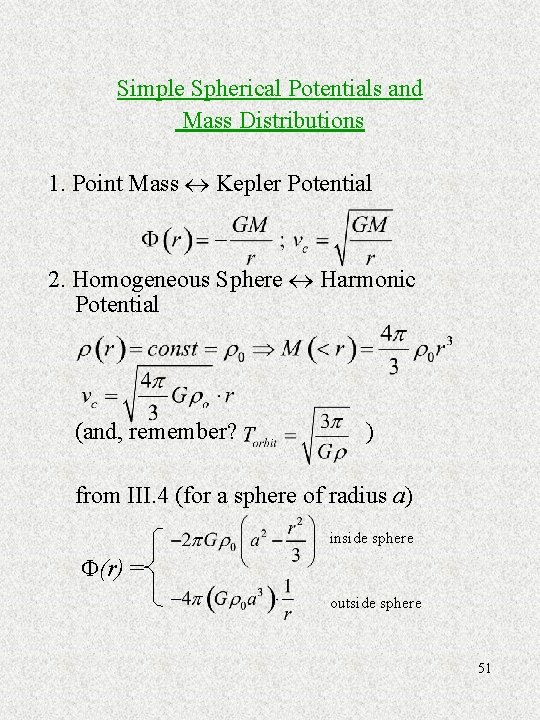
Simple Spherical Potentials and Mass Distributions 1. Point Mass Kepler Potential 2. Homogeneous Sphere Harmonic Potential (and, remember? ) from III. 4 (for a sphere of radius a) inside sphere (r) = outside sphere 51
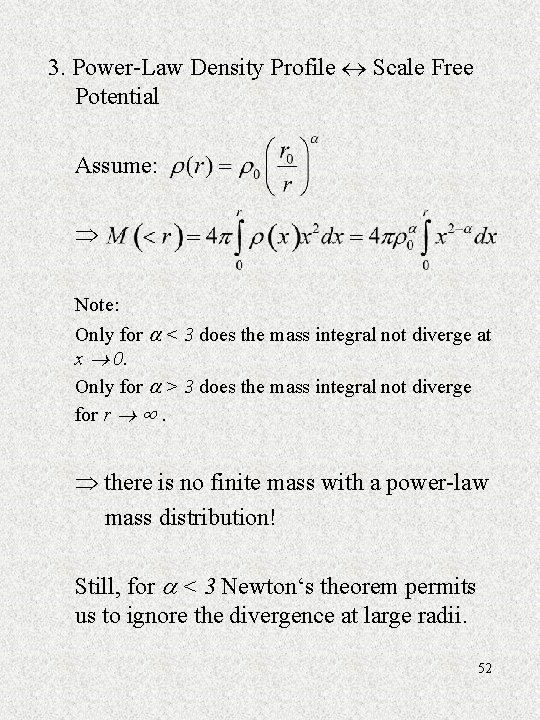
3. Power-Law Density Profile Scale Free Potential Assume: Note: Only for < 3 does the mass integral not diverge at x 0. Only for > 3 does the mass integral not diverge for r . there is no finite mass with a power-law mass distribution! Still, for < 3 Newton‘s theorem permits us to ignore the divergence at large radii. 52
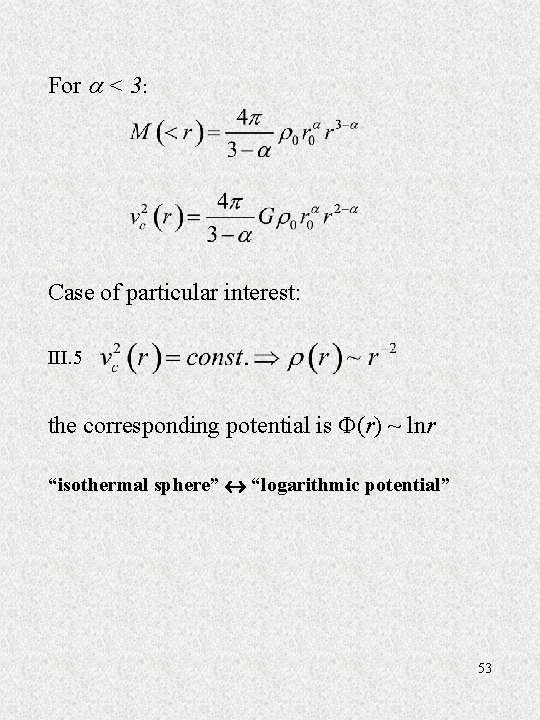
For < 3: Case of particular interest: III. 5 the corresponding potential is (r) ~ lnr “isothermal sphere” “logarithmic potential” 53
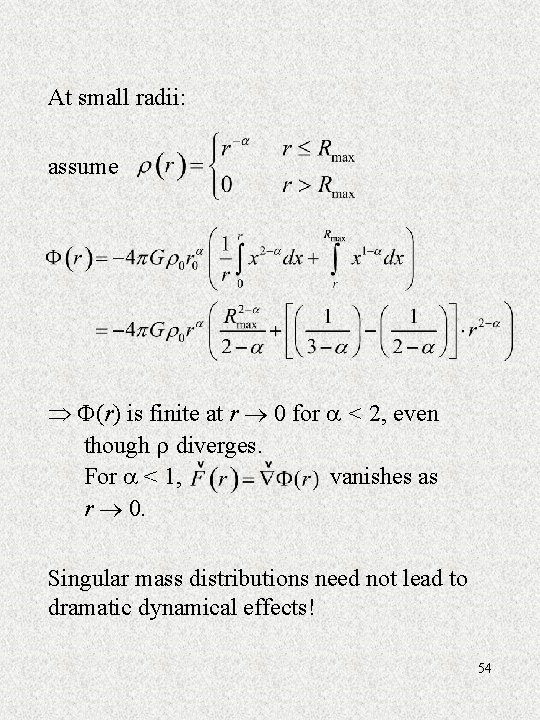
At small radii: assume (r) is finite at r 0 for < 2, even though diverges. For < 1, vanishes as r 0. Singular mass distributions need not lead to dramatic dynamical effects! 54
- Slides: 54